North Korea's unlikely economic revival reshapes life in Pyongyang as Russia and China deepen support
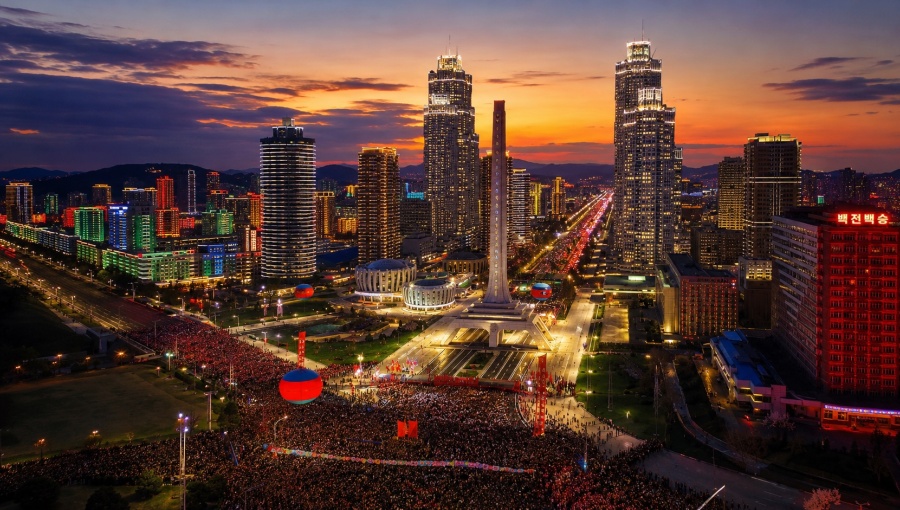
Pariah no longer, since the war in Ukraine started, Russian and Chinese money has poured into Pyongyang, fuelling a rapid economic development and unexpected real estate boom in a country better known for repression and poverty.
Decades of sanctions, international isolation and chronic shortages left the country an economic basket case, but once the world was split into rival Global South and North as part of the ongoing East-West clash, catalysed by the mercurial Trump administration, the Democratic People’s Republic of Korea (DPRK) North Korea has been drawn into the expanding CRINK supremacy – a pragmatic economic-military alliance of China, Russia, Iran and North Korea.
On the face of it, North Korea does not have much to offer, but after decades of isolation, it has built up huge stockpiles of Soviet-designed artillery shells and sold millions of these, albeit low quality, shells to Russia in the first year of the war, significantly changing the balance of power in the war at a time when Kyiv was running out of ammunition.
Pyongyang has also aided Iran. As part of its nuclear missile development programme, it has been investing heavily into long-range missile technology and appears to have shared this with Tehran in what could also be dubbed a “coalition of the sanctioned.”
Iran surprised the world when it attempted to strike the joint US-UK base at Diego Garcia in March using two Kheibar (aka Khorramshahr-4) missiles, based on the DPRK’s technology. What was surprising is the island base is around 4,000km from Iran – twice the distance of what was previously assumed Iran’s longest-range missiles can reach. One failed during flight and the other was intercepted by a US Navy SM-3 missile before reaching the island, but in theory these missiles put parts of Europe into the range of Iranian missiles, including cities such as Berlin, Paris and Rome.
All this help has to be paid for. Russian Foreign Minister Sergei Lavrov was in Pyongyang last summer to reaffirm the Russo-North Korea security pact where Pyongyang provides military equipment and soldiers to Russia in return for grain, energy, technology and money, following Russian President Vladimir Putin's visit to North Korea in 2024. Unusually, Russia signed off on a full security agreement with North Korea during Putin’s visit, that includes Nato Article 5-like collective security clauses – something that was not offered to Iran when Putin signed a similar deal with Tehran in 2025.
Obviously, there is little official information on how much this trade is worth, but experts’ at the South Korean state-linked Institute for National Security Strategy best-guess estimates put the total trade and investment value at about $7bn–$14.4bn from Russia since 2023 through arms supplies, missiles and personnel support for the Ukraine war. That’s a huge sum for an economy whose annual GDP is usually estimated at only about $25bn–$30bn.
Reported components include the sale of roughly 250 KN-23 short-range ballistic missiles, artillery ammunition, multiple-launch rocket systems and troop-related payments. One estimate says Russia may have paid more than $600mn for North Korean military personnel alone deployed from late 2024 and used to retake the Kursk after it was occupied by the Armed Forces of Ukraine (AFU).
China has been less proactive, but trade is flourishing: China-North Korea trade recovered to about $2.3bn in 2023, $2.2bn in 2024 and $2.73bn–$2.74bn in 2025, close to the pre-pandemic 2019 level of $2.79bn. Reuters reported that China trade rose again in early 2026.
Trade with China is now at its highest level in eight years, supplying consumer goods, industrial components and technology that contribute to a growing domestic digital economy.
Pyongyang booming
Recent accounts from Russian travellers and diplomats suggest that life in the capital is booming as a result of the inflowing cash.
"Restaurants there serve up brick-oven pizza and chicken wings. Diners can pay through a mobile QR-code system. Chinese electric vehicles whiz through the streets. Pyongyang has new pet stores, an internet-gaming cafe and car dealerships selling BMWs," Russia analyst Nina Byzantina wrote in a recent blog post. "Kim has initiated a nationwide construction boom. Last year, North Korea built 10,000 new homes in Pyongyang—more than either Los Angeles or Chicago."
The observations, highlighted in a recent Wall Street Journal report, paint a picture of a country whose capital is becoming increasingly modern despite remaining one of the world's most heavily sanctioned economies.
Military cooperation with Russia, expanding trade with China and increasingly sophisticated methods of circumventing international sanctions, as the CRINK members are now actively developing alternative trade and payment systems in concert, have all provided the Kim Jong Un regime with fresh sources of revenue.
For returning visitors, the changes are immediately visible. Australian tour operator Rowan Beard, who has travelled to North Korea more than 100 times, told a local newspaper he was astonished by the speed of change after returning for the first time since before the pandemic.
"My mind was blown," Beard said after using a smartphone application to hail a taxi in Pyongyang — a service that barely existed only a few years earlier.
The digital transformation extends well beyond ride-hailing. QR-code payments have become common in restaurants and department stores, while smartphone-based delivery services, domestic mobile applications and online services have expanded rapidly, supported largely by Chinese-made components and technology.
Kim has made construction one of the defining themes of his economic policy. Entire new districts of apartment towers have appeared across Pyongyang as part of an ambitious programme to build 10,000 new homes annually. Major infrastructure projects completed over the past year reportedly include hospitals, industrial facilities, greenhouses and tourism developments, while Kim's "20×10" regional development initiative aims to build factories and modern public facilities across the country over the next decade.
The capital's roads have also been fixed. Chinese-built electric vehicles have become commonplace, reflecting both Beijing's growing commercial presence and Pyongyang's efforts to modernise transport while reducing dependence on imported fuel. Dealerships now sell imported BMW AG vehicles, alongside a growing range of Chinese brands that have quietly entered the market despite international restrictions.
Most of the progress is reportedly contained to the capital. Outside Pyongyang, conditions remain starkly backward. United Nations agencies continue to estimate that large parts of the population suffer from chronic food shortages, while much of the countryside remains impoverished. The benefits of recent growth appear concentrated overwhelmingly among the political elite and residents of the capital, as in the early days of Russia’s transformation in the 1990s.
Even so, analysts argue that the improvements visible in satellite imagery suggest the changes are not simply state propaganda.
South Korean researchers have documented increased activity at oil-storage facilities, busier parking areas and substantially brighter nighttime satellite imagery. According to one study cited by the Wall Street Journal, North Korea now emits roughly three times more light at night than it did five years ago, suggesting higher electricity consumption and greater economic activity.
Economic growth
The Bank of Korea, South Korea's central bank, estimates the DPRK's economy expanded by 3.7% in 2024, the fastest pace in eight years. While outside estimates remain necessarily imprecise, the figure broadly aligns with reports of expanding industrial production, construction and foreign trade.
For years, Western policymakers assumed economic sanctions would eventually force Pyongyang back to negotiations over its nuclear weapons programme. However, first Iran and now Russia have shown that even extreme sanctions have little effect and are unable to force policy changes on reluctant regimes. Indeed, now they are backfiring by driving the sanctioned regimes into an expanding anti-western alliance.
Growing financial support from Moscow, expanding commercial ties with Beijing and revenues from cybercrime have provided Kim with alternative sources of income that reduce dependence on sanctions relief.
Stephen Haggard, a long-time specialist on the North Korean economy at the University of California, San Diego, described the turnaround as remarkable given the country's isolation and limited resources.
The result is an economy that remains deeply distorted but considerably more resilient than many Western policymakers had hoped for. And one that is actually booming now as an intended consequence of the various wars and military threats plaguing the rest of the world.

No comments:
Post a Comment