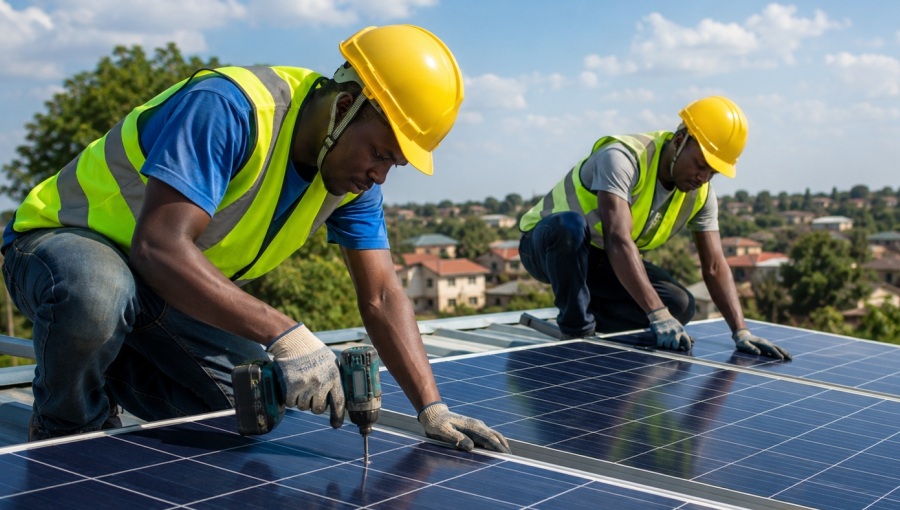
Sub-Saharan Africa's transition to a low-carbon economy could generate between 3.8mn and 7.9mn direct and indirect jobs by 2030, rising to between 65.9mn and 84.5mn by 2050 if governments implement supportive policies and invest in workforce development, according to a report published on June 15 by FSD Africa, the UK-backed financial development agency, in partnership with recruitment consultancy Shortlist and the Shell Foundation.
The report, Unlocking Africa's Green Transition: Opportunities Towards a Green and Inclusive Workforce, argues that the 4.1mn-job gap between its lower and upper employment scenarios for 2030 reflects the additional jobs that could be created through targeted policy reforms, investment in skills and workforce systems, and stronger public-private collaboration.
Rather than following the infrastructure-led model seen in advanced economies, Africa's green transition is expected to be driven by decentralised, service-based industries such as clean cooking, off-grid solar, waste recycling and electric mobility.
"The report shows that Africa's green economy is already taking shape," the authors said, projecting employment of between 3.8mn and 7.9mn jobs by 2030, rising to between 65.9mn and 84.5mn by 2050. They argue that much of this employment will be created through "distribution, installation, maintenance and informal enterprise networks rather than large-scale infrastructure alone."
The study warns, however, that the continent currently lacks the skilled workforce needed to realise that potential. Africa's renewable energy workforce accounts for only 2% of the global total despite possessing around 60% of the world's best solar resources, while less than 1% of global climate finance is directed towards skills development, creating what the report describes as a critical bottleneck. Only 6.5% of African youth have completed formal vocational training.
The report also cautions that the transition could reinforce existing inequalities unless policymakers focus on job quality as well as job creation. It estimates that 86% of green jobs in 2030 will be informal, leaving many workers without labour protections or opportunities for career progression. Women and young people are expected to benefit from much of the employment growth but are also likely to be concentrated in lower-value and commission-based roles unless governments intervene.
"Unlike other regions, the employment dividend of Africa's green transition will be realised through service value chains, not construction sites, and we have to invest accordingly," Kevin Munjal, Director of Development Impact at FSD Africa, said at the report's launch. "Finance directed towards sectors such as clean cooking, distributed solar, waste recycling and e-mobility will generate substantially more employment than utility-scale infrastructure. But we also need the right policy frameworks to make that happen."
Richard Gomes, Chief Programme Officer at the Shell Foundation, said the transition should be viewed as an economic development strategy as much as a climate policy.
"Africa's green transition represents one of the most significant economic opportunities of our generation. However, this vision can only be realised if the green economy is designed to work for the lower-income and informal workers who power our society – and in particular for women. The prize here is not 'more green jobs'. The prize is future-proofed jobs anchored in sectors that will continue to grow as the world navigates compounding climate, energy and economic disruption."
The report concludes that policy choices made over the coming decade will determine whether Africa realises the upper end of its employment potential. Priority measures include directing finance towards labour-intensive green sectors, embedding workforce development into climate investment, modernising vocational training systems and extending social protection to informal workers. Without such reforms, the continent could create fewer than half the green jobs projected under the high-growth scenario by 2030, with the gap widening further by mid-century.
The report estimates that East and Southern Africa will account for 58% of high-scenario green employment by 2050 despite representing only around 40% of Sub-Saharan Africa's population. The region's advantage reflects stronger policy execution, more mature renewable energy markets, widespread mobile money infrastructure, expanding electric mobility ecosystems and greater success in attracting climate finance. West and Central Africa, meanwhile, are expected to generate employment primarily through expanded access to clean cooking, energy and waste-management services, with much of that growth occurring through informal businesses and micro-enterprises.
Clean cooking is projected to become Africa's largest green employer, supporting between 1.4mn and 2.5mn jobs by 2030 and as many as 26.3mn by 2050. Waste recycling could generate up to 14.7mn jobs, while solar home systems and electric two- and three-wheelers also emerge as major sources of employment. The report estimates that indirect jobs will account for around 56% of green employment by 2030, rising to about 62% by 2050 as markets mature and operations, maintenance and service activities become increasingly important.
Country-level analysis highlights sharply different labour-market challenges.
In South Africa, the green economy is expected to create between 0.7mn and 1.3mn jobs by 2030, rising to around 4.3mn by 2050 under the medium-employment scenario. However, the report warns that declining mathematics achievement is narrowing the engineering talent pipeline, increasing the risk that employers will need to import skilled labour. Female participation is projected to remain around 25% through 2050 owing to occupational segregation and workplace barriers, while employment gradually shifts from temporary construction work towards permanent operations and maintenance roles.
Nigeria presents a different picture. The report projects that around 87% of green jobs created by 2030 will remain informal, largely through nano- and micro-enterprises operating in clean cooking, waste management and distributed energy. Rather than pursuing rapid formalisation, policymakers should focus on improving productivity, access to finance, social protection and career pathways for informal workers, the report says.
Kenya, meanwhile, is identified as one of Africa's most advanced green labour markets thanks to its mature renewable electricity sector, extensive mobile money ecosystem and leadership in electric mobility. The report says future employment growth will increasingly depend on county-level skills planning because green jobs are created where infrastructure is deployed rather than concentrated in major urban centres.
The report also highlights persistent inclusion challenges. Around 86% of projected green jobs in 2030 are expected to be informal, while women are forecast to account for only about 31% of employment initially, rising to 44% by 2050. Clean cooking and solar home systems offer the greatest opportunities to improve female participation, approaching gender parity over time, while waste recycling provides some of the strongest opportunities for low-income workers entering the green economy.
The authors argue that investment in infrastructure alone will not unlock Africa's green employment potential. Instead, governments will need to strengthen technical education, improve recognition of informal skills, expand access to finance for micro-enterprises and align labour-market planning with climate investment if the continent is to realise the full employment dividend of the energy transition.

No comments:
Post a Comment