.jpg)
June 26, 2026
EWTN News
By Tyler Arnold
The U.S. Supreme Court on June 25 ruled in favor of President Donald Trump’s restrictive asylum policies that faced strong opposition from the U.S. Conference of Catholic Bishops and some other Catholic advocacy groups.
One ruling allows the Department of Homeland Security to end “temporary protected status” for Haitians and Syrians, who can now be deported. The other allows the government to turn away asylum seekers at the southern border by limiting the number of claims they will process each day.
Both cases were decided 6-3. All of the justices who sided with the majority were appointed by Republican presidents and each dissenting justice was appointed by Democratic presidents.
Anna Gallagher, the executive director of Catholic Legal Immigration Network, said in a statement to EWTN News that both decisions are “devastating for our clients, and for those of us who accompany vulnerable immigrants through the legal system.”
“As Catholics, we believe in a God who weeps for our suffering, who is concerned for the fall of the sparrow, for the least of these,” she said.
“And so we, too, weep for our clients whose asylum rights are restricted or who fear return to immediate life-threatening conditions because of this court decision.”
“We walk with them as legal advocates, seeing the injustice of our laws play out firsthand. We know that today is a dark day for many people we have come to know and care for — including legal residents of this country, beloved members of our community.”
Protections for Haitians, Syrians gone
The Supreme Court decision in Mullin v. Doe and Trump v. Miot, which were consolidated into one case, ensures that the government’s decision to terminate temporary protected status for Haitians and Syrians will be in effect. The ruling strips them of legal protections for work authorization and prevention from deportation.
Justice Samuel Alito, who wrote the opinion, said that the law itself generally gives the government broad discretion in determining whether to approve, extend, or terminate protected status for a given country. The ruling found that all non-constitutional claims are not subject to judicial review.
Haitians protected under the protected status argued that the policy terminations discriminated against people based on race. In its ruling the Supreme Court stated that both the protected designations and the terminations come from a racially diverse collection of countries.
“They claim that TPS has not been terminated for any predominantly white nation, and they therefore infer that the reason for the termination of the TPS designation for Haiti was having a predominantly nonwhite population,” the opinion stated.
The plaintiffs’ “definition of a predominantly non-white nation is broad, apparently encompassing major European countries,” the ruling said.
“It may be that only the termination of a TPS designation for a Nordic or Germanic country would be sufficient in their judgment to show that the Secretary’s unbroken record of TPS terminations was race-neutral,” the decision added.
Justice Elena Kagan, in her dissenting opinion, said she believes the court erred in ruling that all non-constitutional claims are barred from judicial review, arguing that the court should be able to determine whether the secretary followed the proper procedures in deciding to terminate protected status.
She also argued that Trump’s comments show that race played a role in the decision to end the Haitian protected status designation.
“The majority briefly replies that [his] remarks are not ‘overtly racial,’ … but it is hard to know what that means,” Kagan wrote. “Haitians are Black. …The references — of filth, disease, and primitiveness — are shot through with racial stereotypes and tropes.”
Andrew Arthur, a resident fellow in law and policy at the Center for Immigration Studies and a former immigration judge, told “EWTN News Nightly” on June 25 that the ruling essentially solidifies that “no one has the ability to sue when the government decides it’s going to terminate TPS status.”
He said the protected status is meant to provide temporary legal status for someone escaping a danger in their country. He said some protected designations “have been in place … for more than a quarter of a century,” even for “events that occurred decades ago” and are no longer impacting the country.
The U.S. bishops had urged the government to extend protected status, including for Haitians, who are a majority Catholic community.
“We are deeply concerned about the plight of our Haitian brothers and sisters living in the United States,” Bishop Brendan J. Cahill, chair of the bishops’ committee on migration, and Bishop A. Elias Zaidan, chair of the committee on international justice and peace, said in a joint statement in February.
“There is simply no realistic opportunity for the safe and orderly return of people to Haiti at this time,” they said.
Asylum seekers at the border
The decision in Mullin v. Al Otro Lado dealt with the “metering” policy that started under former President Barack Obama and is being enforced by Trump, which the court ruled is a lawful policy.
Under the policy, the government can limit the number of asylum claims it chooses to process in a day and can turn people away from entry into the country when they approach the southern border.
The case centered on an asylum seeker’s right to apply for asylum when he or she “arrives in the United States.” The ruling, also authored by Alito, states that the right only applies when the person has already entered the country and it does not give legal protections for someone who is seeking entry into the country but has not yet been allowed in.
“We begin by considering what the phrase ‘arrives in the United States’ means when used in everyday speech,” the ruling states. “That meaning is clear. A person arrives in a geographic location only when he enters it.”
The ruling states that if Congress wanted to extend that right to anyone who approaches the border or seeks entry into the country, it would have written the law to clearly state that.
Justice Sonia Sotomayor wrote the dissent, arguing that the ruling allows the executive branch to “circumvent … mandatory procedures by having U. S. immigration officers stand at the border and physically block noncitizens from setting a foot onto U. S. soil.”
“Words … must be read in context and with attention to how they fit into the statute as a whole,” Sotomayor wrote.
“The majority ignores the statutory context and history, not to mention the longstanding position of the Executive Branch, all of which show that any noncitizen arriving at our doorstep and seeking admission must be inspected and allowed to apply for asylum, regardless of whether her foot has crossed the threshold,” she said.
Arthur told “EWTN News Nightly” that the decision essentially “narrows the ability of people who havenʼt actually entered the country … to apply for asylum.”
“You’re not subject to United States law … until you’ve actually crossed into this country,” he said.
The U.S. bishops petitioned the Supreme Court to rule against the policy and require the government to process all asylum claims.
“The turnback policy is not just a flawed piece of statutory interpretation but an historical aberration — one that, during the period it was enforced, left vulnerable asylum seekers stranded in encampments on the border while lawfully trying to seek asylum at a port of entry,” the bishops wrote.
The Supreme Court has not yet ruled on the most significant immigration case before it, Trump v. Barbara, which will decide the extent of birthright citizenship in the United States.
About EWTN News
EWTN News is the rebranding of the Catholic News Agency (CNA), following the decision by EWTN — which was launched as a Catholic television network in 1981 by Mother Angelica, PCPA — that brings CNA and its affiliated ACI international outlets under a single, unified identity. Previous CNA articles may be foundby clicking here.
View all posts by EWTN News →
June 25, 2026
RAW STORY
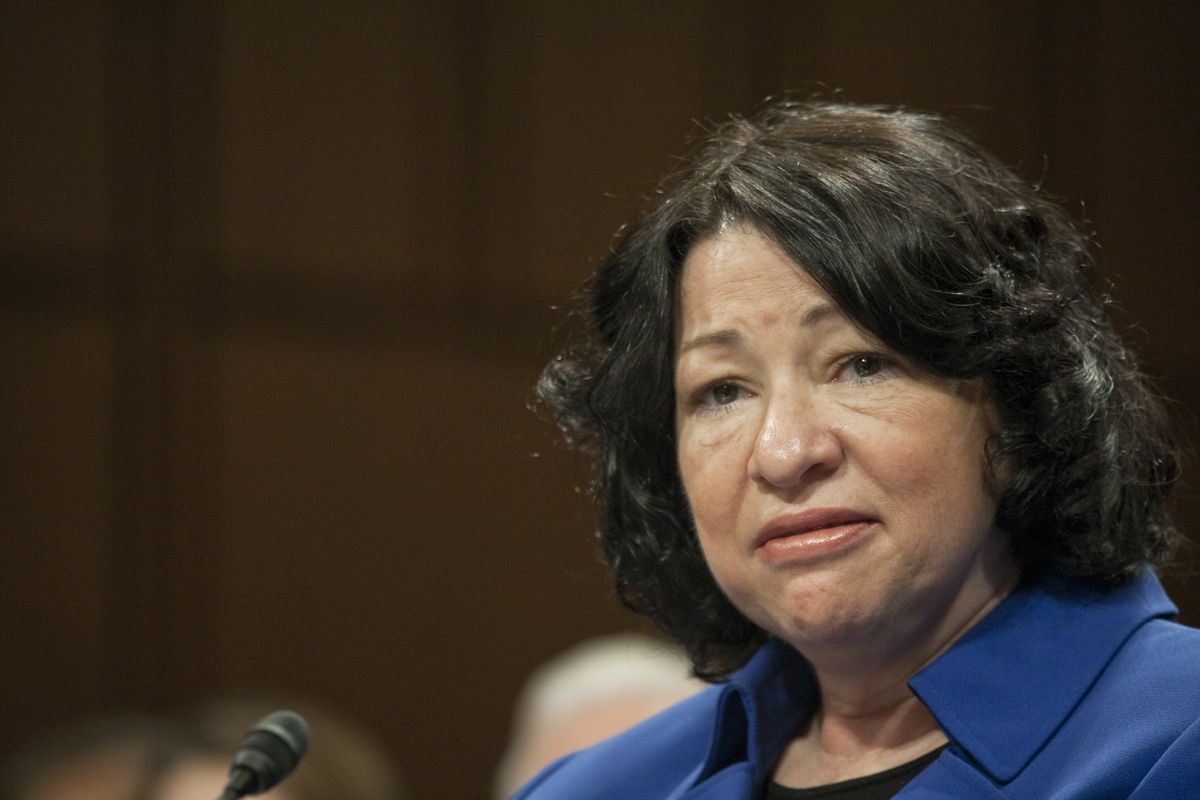
WASHINGTON - JULY 13 : US Supreme Court Nomimee hearing Sonia Sotomayor July 13, 2009 in Washington, DC (Shutterstock)
The Supreme Court's conservative super majority on Thursday sided with the Trump administration in a 6-3 ruling, and in a sharp dissent, Justice Sonia Sotomayor described the consequences of turning away asylum-seekers at the U.S.-Mexico border.
Following the ruling in Markwayne Mullin, Secretary of Homeland Security v. Al Otro Lado, Sotomayor spoke from the bench and reminded the high court of a historical moment in 1939 when more than 900 Jewish refugees who were attempting to flee persecution in Nazi Germany boarded the M.S. St. Louis in Hamburg, Germany, and were turned away from Cuba and the United States during the Holocaust. Justices Elena Kagan and Ketanji Brown Jackson also joined the dissent.
"The ship docked in the Havana harbor for days, but the Cuban Government refused to allow the fleeing passengers offboard," Sotomayor wrote. "The ship then sailed near the Miami coastline, but the U.S. Government also turned them away in part because the immigration laws at the time had strict country quotas and the relevant quota was already filled for that year. The ship sailed to Canada and was again turned away. It eventually returned to Europe. Tragically, over 500 of the refugees that had attempted to flee were trapped in Western Europe under German control, and over 250 of them died during the Holocaust. Most of them were 'murdered in the killing centers of Auschwitz and Sobibór' and 'the rest died in internment camps, in hiding, or attempting to evade the Nazis.'"
Sotomayor argued that the majority's decision would have serious repercussions.
"The majority ignores the statutory context and history, not to mention the longstanding position of the Executive Branch, all of which show that any noncitizen arriving at our doorstep and seeking admission must be inspected and allowed to apply for asylum, regardless of whether her foot has crossed the threshold," Sotomayor wrote. "Because the Court today blesses the Executive Branch’s decision to slam the door shut on all who are fleeing persecution, despite the detailed inspection and asylum system that Congress enacted and commands, I respectfully dissent."
Sotomayor also issued a warning.
"The consequences of today’s decision are predictable," she wrote. "More people will die. More people will attempt to cross the border illegally, and some will make it while others will not. More people will be forced to walk along the U. S.-Mexico border in dangerous conditions, trying to find a port that will inspect them. More people will turn back and be subjected to violence because of something they cannot or should not have to change about themselves, such as their race, religion, nationality, or political opinion. Because this is neither what Congress said nor what its words permit, I respectfully dissent."
US Supreme Court paves way for mass
deportation of Haitians, Syrians

Washington (United States) (AFP) – The US Supreme Court on Thursday backed a Trump administration move to strip deportation protections from some 350,000 Haitians and 6,000 Syrians living in the United States.
Issued on: 25/06/2026 -
The conservative-dominated court, in a 6-3 ruling, said the Department of Homeland Security's decision to end Temporary Protected Status (TPS) for Haitian and Syrian immigrants was not subject to judicial review.
TPS protects its holders from deportation and is granted to people deemed to be in danger if they return home because of war, natural disaster or other extraordinary circumstances.
Lawyers for Haitian and Syrian TPS holders contended during oral arguments before the court in April that conditions in their home countries remained unsafe and the administration's move was motivated at least in part by racial hostility.
Justice Samuel Alito, who wrote the majority opinion in which he was joined by the five other conservative justices on the top court, rejected claims that race was a "motivating factor" in President Donald Trump's decision to strip Haitians of TPS status.
"None of the cited statements by either the President or the (Homeland Security) Secretary was overtly racial, and in substance all expressed policy views that could rest on race-neutral justifications," Alito wrote.
Trump campaigned for the White House on a pledge to expel millions of migrants and has pushed to dismantle the TPS program as part of his broader immigration crackdown. At the height of the 2024 election campaign, Trump stoked fears about Haitian immigrants by falsely claiming they were eating Americans' pets.
The Supreme Court ruling in the TPS case could have implications for more than one million beneficiaries of TPS status from more than a dozen countries.
TPS status has been revoked for nationals of Afghanistan, Cameroon, Ethiopia, Honduras, Myanmar, Nepal, Nicaragua, Somalia, South Sudan, Venezuela, Yemen, and others in addition to Haitians and Syrians since Trump took office.
Haitians became eligible for TPS in 2010 following a devastating earthquake, and the country continues to suffer from severe poverty, rampant violence from heavily armed gangs and chronic political instability.
The State Department advises Americans not to travel to the Caribbean nation "due to kidnapping, crime, civil unrest and limited health care."
TPS was extended to war-torn Syria in 2012.
Justice Sonia Sotomayor, a liberal, questioned during oral arguments whether a "discriminatory purpose may have played a part" in the Trump administration's decision to strip TPS status from Haitians and referred to statements by the Republican president.
"We have a president saying at one point that Haiti is a quote filthy, dirty and disgusting s-hole country -- I'm quoting him -- and where he complained that the United States takes people from such countries instead of people from Norway, Sweden or Denmark," Sotomayor said.
Solicitor General John Sauer replied that the president's comments were being taken out of context and he was referring to "problems of crime, poverty and welfare dependency."
Sauer said court review of TPS decisions was barred to prevent "judicial micromanagement" of foreign policy determinations.
© 2026 AFP
Pope Leo XIV exalts first American saint Cabrini as a model for Christians for her care of migrants
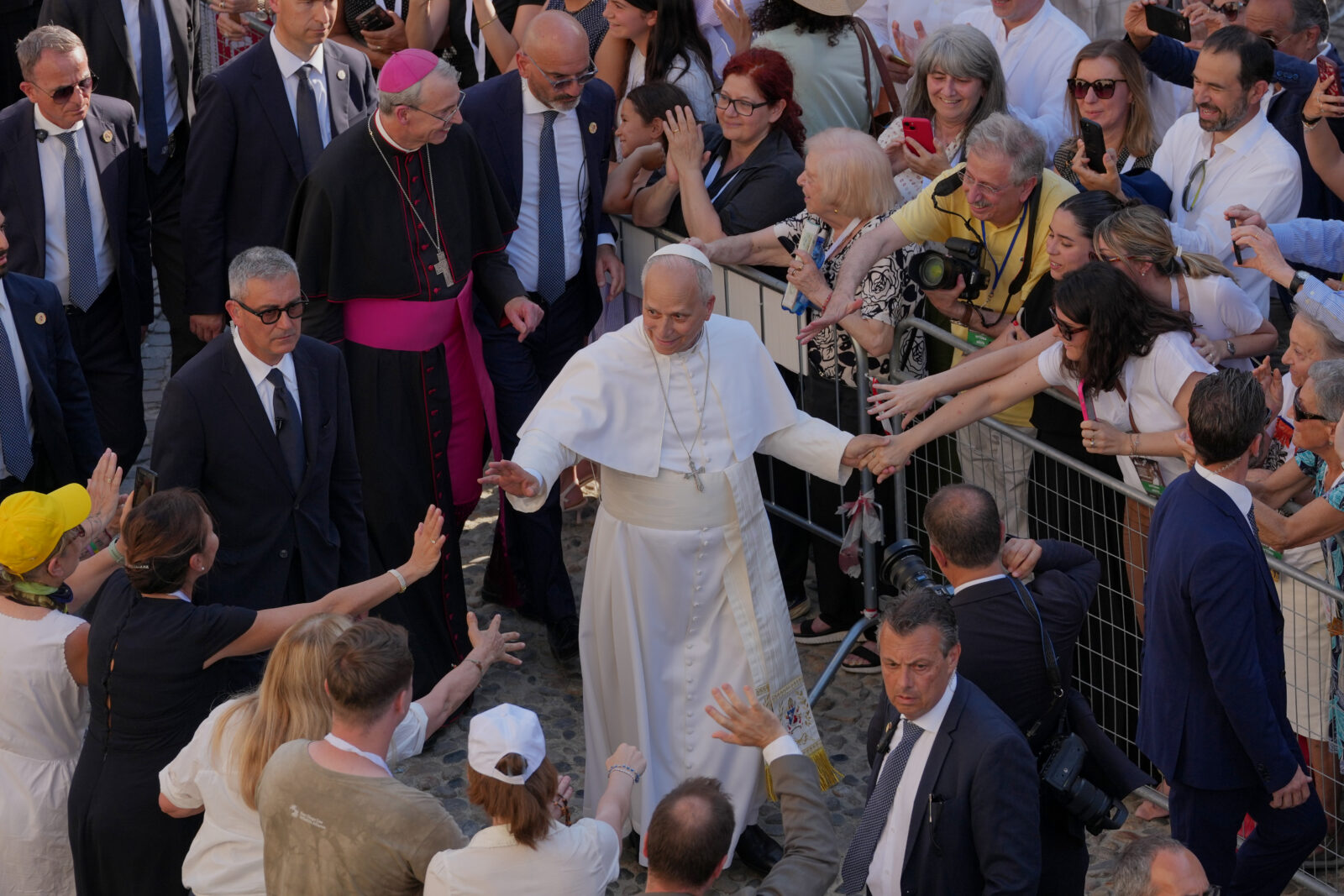
SANT’ANGELO LODIGIANO, Italy (AP) — Pope Leo XIV on Saturday exalted the first American saint, Mother Frances Cabrini, as a model for Christians today to care for migrants in need, as he visited her birthplace during a day trip to northern Italy.
Leo, who has clashed with the Trump administration over its migrant crackdown, urged young people in particular to learn about Cabrini’s life and service, once again confirming history’s first U.S. pope as the heir to Pope Francis in prioritizing the plight of migrants.
Leo prayed before Cabrini’s tomb in a basilica named for her in her birthplace in Sant’Angelo Lodigiano, near Milan, and presided over an evening prayer service. The visit to northern Italy is part of Leo’s summertime grand tour of Italy to visit key cities to get to know his flock.
Cabrini, the patron saint of migrants, is well known to many Americans for her work caring for Italian immigrants in the United States at the turn of the last century. Her work went beyond the U.S., however, as she crisscrossed the globe building schools, hospitals and orphanages for those who had nothing.
After she died in 1917, as a naturalized U.S. citizen in Leo’s native Chicago, Cabrini was beatified and then canonized in 1946 as the first American saint.
Leo asks what Francis would do
In praising Cabrini on Saturday, Leo said she was inspired by her faith to help those migrants who had left everything behind to try to find a better life.
“What could be more relevant today than a missionary charism dedicated to serving migrants?” he said.
“Let us ask ourselves: if Mother Francesca were alive today, what would her missionary spirit tell her?” Leo said. “And what would a pope like Francis — who, as the son of Italian immigrants, made service to migrants one of the key priorities of his pontificate — ask of her?”
“I therefore take this opportunity to make an appeal, especially to young people: get to know St. Frances Cabrini!” Leo said, urging them to read her writings, travel journals and notes from retreats.
A July 4 with migrants
Leo has embraced the Catholic Church’s Gospel-mandated call to “welcome the stranger” in his ministry to migrants. Last week, Leo spent two days in Spain’s Canary Islands, a major destination for migrants leaving West Africa, where he called for welcoming and integrating those fleeing hardship and conflict.
Leo’s next Italy day trip is on July 4, when he heads to Lampedusa, the Sicilian island that is a major destination for migrants fleeing North Africa for Italy.
Leo’s clash with the Trump administration over migration has given added symbolic significance to his decision to spend July 4 — U.S. Independence Day — in Lampedusa, which was where Francis chose to make his first trip outside Rome as pope, in 2013.
A prayer at the tomb of St. Augustine
Leo arrived in Cabrini’s hometown after first stopping in nearby Pavia to pray at the tomb of St. Augustine, the fifth-century inspiration of his religious order. There, he encouraged Italians to rediscover their lagging Catholic faith.
Like many once-Christian strongholds in Europe, Italy has seen its churches empty in recent years amid secularizing trends, with fewer and fewer Italians getting married in the church or going to Mass regularly.
“At a time when many people seem to have lost their spiritual appetite or, for various reasons, no longer find the Christian faith appealing for their lives, we are called first and foremost to proclaim the Gospel,” Leo said.
He pointed to Augustine as a source of inspiration for today’s faithful.
Augustine was born in 354 in what is today Algeria, but he lived for five years in and around Milan, where he converted to Christianity. He later became a bishop, developed a rule for monastic life and wrote some of the most important works of Western thought, including “Confessions” and “The City of God.”
“His thought, the story of his conversion, and his spirituality remind us of the value and primacy of interiority,” of finding meaning inside oneself, Leo said.
Leo proclaimed himself a “son of St. Augustine” on the night of his election and has cited Augustine prolifically in his first year, making clear that the saint is the guiding inspiration of his pontificate.
___
Nicole Winfield reported from Rome.
___
Associated Press religion coverage receives support through the AP’s collaboration with The Conversation US, with funding from Lilly Endowment Inc. The AP is solely responsible for this content.


No comments:
Post a Comment