It’s possible that I shall make an ass of myself. But in that case one can always get out of it with a little dialectic. I have, of course, so worded my proposition as to be right either way (K.Marx, Letter to F.Engels on the Indian Mutiny)
Saturday, July 25, 2026
'Wow': Tearful Iran war widow left speechless by Trump admin response
Mia Gonzalez-Swinton, the widow of Staff Sergeant Michael Swinton, told CNN she was left speechless by the response from the Trump administration. (CNN/Screenshot)
The widow of a service member recently killed amid the Iran war was speechless when asked about the Trump administration's response.
During an interview with CNN anchor Erin Burnett, Mia Gonzalez-Swinton spoke about her husband, late Sgt. Michael Emmanuel Swinton, who was one of four U.S. service members killed last weekend in the ongoing conflict with Iran. Swinton was killed in Iraq, and his name vanished from the Department of Defense casualty list, Burnett noted.
Gonzalez-Swinton gave a tearful interview with Burnett where she described her late husband as "goofy" and a father to a baby girl. Burnett asked her about the Trump administration removing her husband's name, along with three others, from the casualty list.
"Mia, something happened this week that we don't really understand," Burnett said. "The Pentagon, you know, removing Michael and the three soldiers who also died this past weekend from the public casualty count of soldiers and troops who have died during the war."
Burnett said that the Pentagon explained the removal was "a glitch."
She asked Gonzalez-Swinton, "Has anyone spoken to you about this or told you anything about it?"
A silence followed while Gonzalez-Swinton appeared to collect her thoughts and change her expression. After a few seconds, she slowly said, "Nobody has reached out yet."
Gonzalez-Swinton took another brief pause while she seemed to think, and again her expression changed to surprise.
"Wow," she continued. "I kind of don't have words for that."
Burnett seemed to struggle too, as she responded, "I can imagine." Gonzalez-Swinton broke into tears as the interview ended.
'Off the charts': Trump admin slammed for 'despicable' deletion of fallen heroes' names
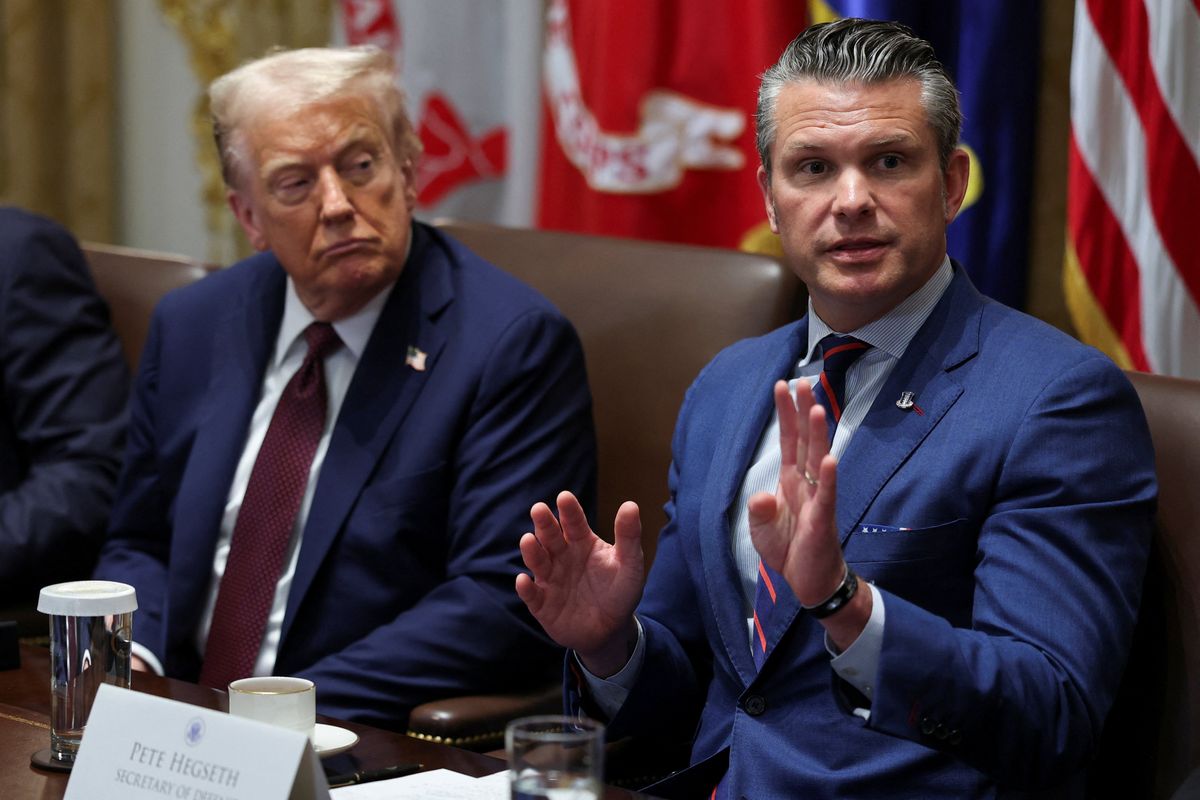
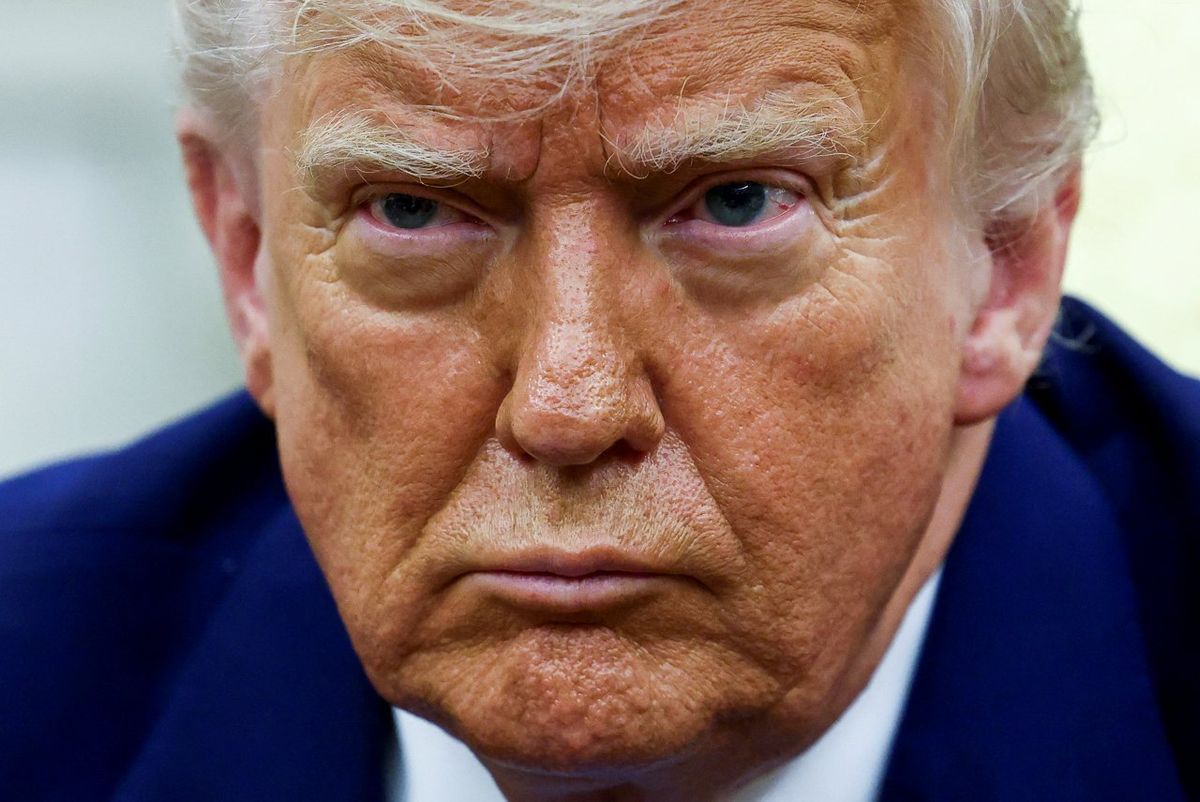
Donald Trump and Defense Secretary Pete Hegseth attend a cabinet meeting. REUTERS/Jonathan Ernst
A decision by President Donald Trump’s administration to delete the names of four US service members from the Iran war dead was slammed Friday on MS NOW as “among the more offensive moves that the administration has made."
The panel was responding to a New York Times report that the number of dead listed by the Pentagon mysteriously dropped from 18 to 14, ostensibly “because their deaths occurred after President Trump declared a cease-fire in the war in April.”
“I mean, this wouldn't be the first time that the government, that the Trump administration has tried to doctor things to make the president look better,” Lemire stated.
"It is a nonsensical argument that these four lives would matter less because they happened after a ceasefire was declared, when obviously the ceasefire is over; there are major strikes happening in the region now for well more than a week. To me, this was particularly outrageous and disgraceful.”
MS NOW contributor Sam Stein offered, “Well, to me too. It's both not shocking that the Trump administration would do this, and it's shocking that it happened. What is the actual goal of doing something like this is to try to limit your political exposure for the war.”
“It's despicable, honestly,” he added. "It's failing to own the consequences of their actions, or at least trying to avoid the consequences of their actions. And honestly, it's insulting to the people who sacrificed to say, ‘Hey, this was not actually a war casualty.’ It was what a casualty of a — what's the word he uses? — skirmish. I found this to be among the more offensive moves that the administration has made politically, but it obviously reflects a larger thinking that they have internally, which is that this is politically problematic.”
“The callousness here is off the charts,” Lemire agreed. “And but perhaps not surprising. I agree with you, Sam. Remember, President Trump and his first term called those who were reportedly killed in combat ‘suckers and losers.’”
WSJ rips into Trump for tearing down the economy over his 'obsession'
President Donald Trumpgot a reaming from the Wall Street Journal on Friday over his ongoing "obsession" with imposing as many tariffs as possible.
The Journal's editorial board, while unflinchingly conservative, has nonetheless been waging a low-grade war against the president over his trade policy ever since he resumed office, opposing to his broad-based schemes to tax as many imports as possible — and particularly warning that tariffs imposed right ahead of a critical midterm election can only spell disaster.
"The Administration late Thursday unveiled new tariffs under Section 301 to replace the President’s Section 122 tariffs that were lapsing. These latest duties will affect some 60 economies, hitting nearly all U.S. imports, with rates from 10% to 12.5%, and they come on top of a slew of other border taxes," wrote the board.
The Supreme Court may have killed his first tariff scheme under emergency powers — but he's now using a number of other laws, including Section 301, which means he is effectively accusing Canada and the European Union of importing goods made with forced labor, Section 232; which is a national security provision Trump is applying to generic medicines, cars, furniture, steel, aluminum, and semiconductors; and Section 338, a never-before-used section of the controversial 1930 Smoot-Hawley Act.
Trump, the board lamented, "doesn’t seem to care about the damage since tariff costs are dispersed across businesses, consumers and workers. Customs duties have raised $163 billion in the current fiscal year through June, which excludes some $70 billion in emergency-tariff refunds. That’s a big tax increase."
And ultimately, the board warned, Trump's party is going to take a hit at the ballot box.
"Americans remain unhappy about the economy, and higher prices are a big reason," the board concluded. Even if they don't know the exact figures, voters "know that tariffs are adding to their pain ... [and] Republicans could pay the price in November."
Trump shrugs as Wolf Blitzer details his assault on the press in WSJ award speech
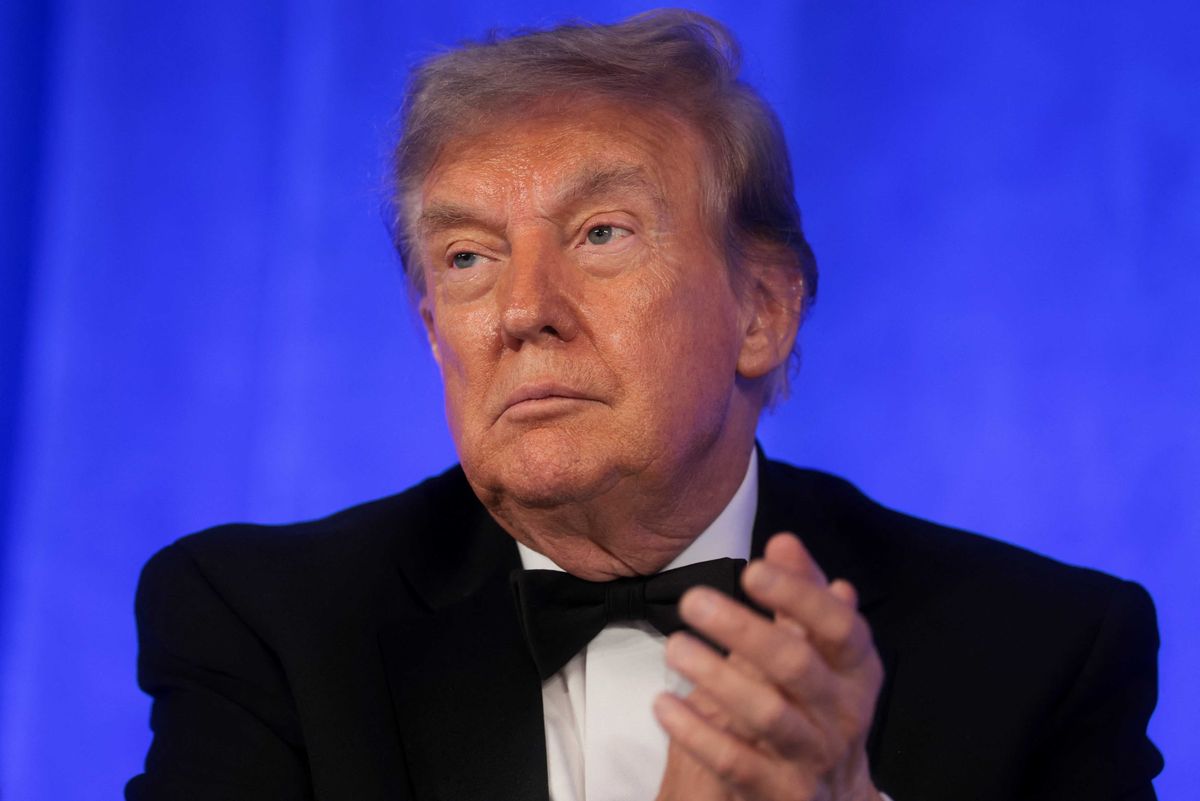
President Donald Trump reacts at the White House Correspondents' Association (WHCA) Dinner, which was rescheduled from April after it was interrupted when a man tried to force his way through security and fired a shotgun, at the Waldorf Astoria hotel in Washington, D.C., on July 24, 2026. REUTERS/Jonathan Ernst
The White House Correspondents' Dinner faced an awkward moment on Friday when CNN anchor Wolf Blitzer confronted President Donald Trump with his attack on journalism.
Blitzer was onstage to present reporters from The Wall Street Journal for bombshell reporting last year, exposing Trump's lewd birthday poem from decades ago to late billionaire financier and child trafficker Jeffrey Epstein, in which he sketched an image of a naked woman and wrote, "may every day be another wonderful secret."
As Trump sat there, listening to all of this, Blitzer added, “Trump filed a lawsuit against The Journal, revealing a reporter's home address.”
At this, Trump's only reaction a shrug.
The president has continued to deny The Journal's reporting, insisting that he doesn't make doodles like those reported in the article — even though a number of other such doodles from Trump exist and are in the public record.
'Scumbags!': Trump's 'expletive'-riddled temper tantrum leaked to WSJ
U.S. President Donald Trump looks on as he meets South African President Cyril Ramaphosa in the Oval Office of the White House in Washington, D.C., U.S., May 21, 2025. REUTERS/Kevin Lamarque TPX IMAGES OF THE DAY
President Donald Trump recently threw a curse-riddled temper tantrum inside the Oval Office over his own failure end the war in Iran, according to an inside source.
Trump called Iranian leaders "scumbags" and lunatics" and was heard "unleashing a series of expletives," the Wall Street Journal reported late Thursday night.
"Trump is increasingly frustrated that a conflict he once thought would be over in a matter of weeks has dragged on with no end in sight," the Wall Street Journal reported.
"Some of Trump’s advisers now worry that the war—which has resulted in higher prices, falling approval ratings and the deaths of more than a dozen U.S. service members—is consuming his presidency."
Trump's frustration stems from his growing fear that he cannot negotiate the lasting peace he promised the American people after launching a war without Congressional permission he promised would last “four to five weeks,” the Journal reported.
The memorandum of understanding with Iran, signed in June, lasted just over a month.
"The president in recent days has grown skeptical that negotiations with Iran can produce a lasting peace, according to people familiar with the matter," the Wall Street Journal reported.
"A senior administration official said Trump believes that the only thing Iran understands is military force, adding that he was in 'revenge mode' against Tehran."
Trump slammed for 'weak and petulant' order to slap right-wing propaganda on Smithsonian
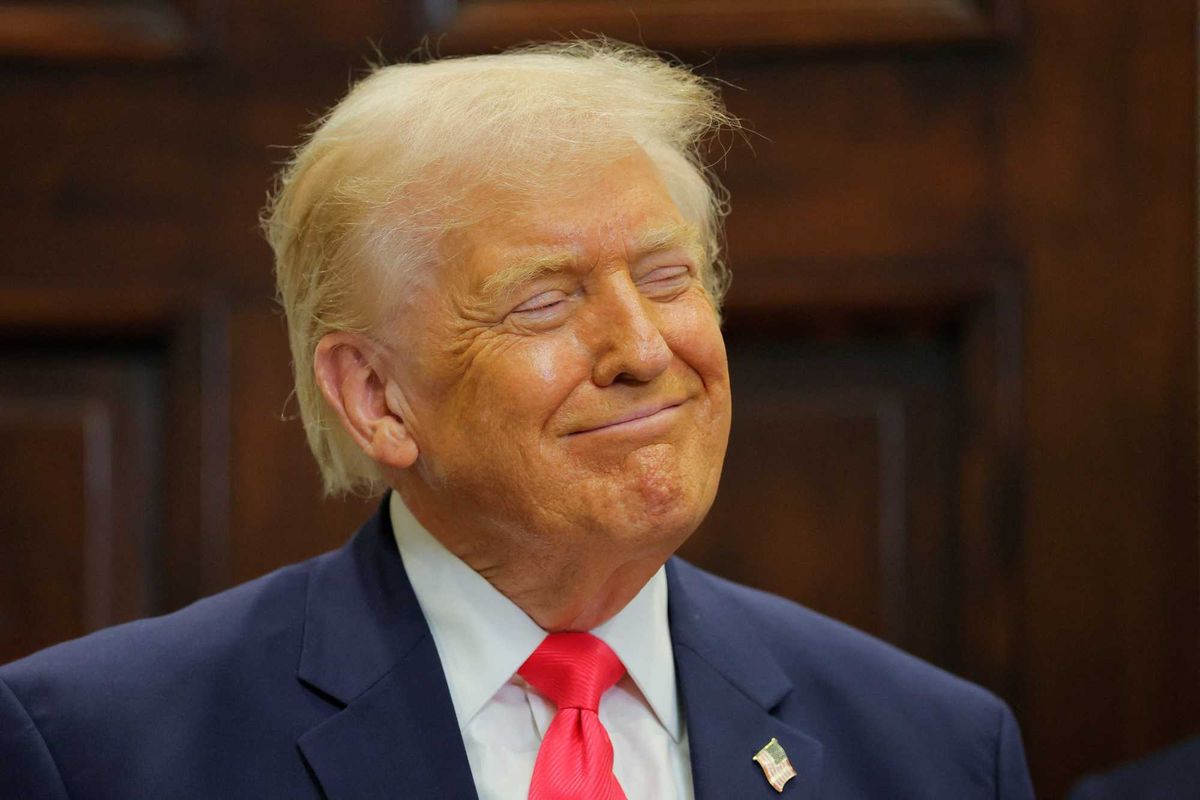
U.S. President Donald Trump smiles during an announcement about "Trump accounts", in the Roosevelt Room at the White House in Washington, D.C., U.S., December 2, 2025. REUTERS/Brian Snyder
President Donald Trump issued a new executive order on Friday demanding warning signs be placed outside the Smithsonian Museum of American History.
The order, which is meant to alert visitors that the institution has been taken over by liberal "ideological capture" and expresses "inaccurate" views of American history that the Trump administration doesn't endorse, earned instant fury from commenters on social media.
"Trump massively escalates against the Smithsonian," wrote New York Times reporter Maggie Haberman.
"Trump just ordered warning signs and exhibits to be installed outside the Smithsonian's National Museum of American History to alert the public that the museum does not, in his view, accurately reflect American history," wrote MS NOW "Weeknight" executive producer Kyle Griffin. "For the record: It does."
"This is one of the dumbest and most bizarre Executive Orders we have ever read," wrote Rep. Melanie Stansbury (D-NM). "Clearly, this Administration knows they are trying to commit Executive overreach over our nation’s independent cultural institutions. This EO is a clear political overreach, driven by an ideological agenda to rewrite American history. Our Smithsonian institutions do not belong to the President, but to the American people and so does our nation’s history."
"This EO should be titled: 'Time to destroy the Smithsonian just like I did the Kennedy Center,'" wrote Sen. Jeff Merkley (D-OR).
"This Smithsonian executive order is amazingly weak and petulant," wrote Mother Jones reporter Dan Friedman. "Trump can't or won't order the Smithsonian American History Museum to change their exhibits to push the propaganda he wants, so he's telling NPS to post signs outside attacking the museum."
"I thought electing Trump meant no more trigger warnings and safe spaces," wrote independent journalist Mike Rothschild.
"Trump’s absurdities are boundless," wrote retired Missouri State University president Mike Nietzel.
'Bizarre': Trump mocked after 'dumbest' order yet installs warnings outside Smithsonian
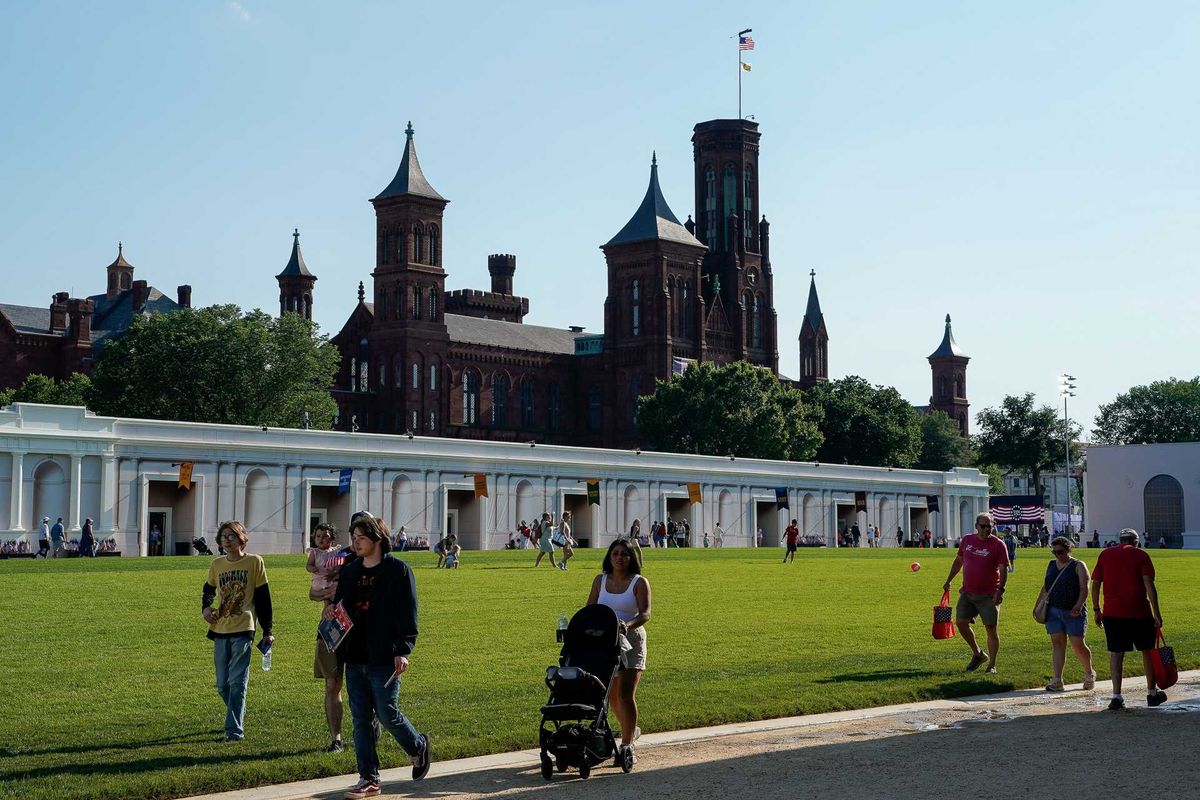
Visitors attend the opening of The Great American State Fair on the National Mall, with the Smithsonian Castle in the background, in Washington D.C., U.S., June 25, 2026. REUTERS/Elizabeth Frantz
Lawmakers and historians ridiculed President Donald Trump's executive order directing warning signs outside the Smithsonian's history museum, calling it the "dumbest" order yet.
Trump signed the order Friday, directing the National Park Service to install warning signs on public sidewalks outside the National Museum of American History, according to the executive order.
The order accuses museum leadership of "ideological capture" and says the signs must direct visitors to "locations and resources for accurate information regarding America's history."
"He's insisting on posting these ignorant signs on sidewalks and walkways because he has no control over what is INSIDE the museum," Yale historian Joanne Freeman wrote on Bluesky.
"Notably, this absurd executive order appears to recognize that Trump cannot directly control the Smithsonian," former Justice Department official Eric Columbus wrote on Bluesky. The signs, Columbus noted, are ordered onto sidewalks maintained by the National Park Service — not on the museum itself.
"This is one of the dumbest and most bizarre Executive Orders we have ever read," Rep. Melanie Stansbury (D-NM) wrote on X.
"This EO is a clear political overreach, driven by an ideological agenda to rewrite American history," Stansbury added.
"Time to destroy the Smithsonian just like I did the Kennedy Center," Sen. Jeff Merkley (D-OR) wrote on X.
In March 2025, Trump signed an executive order titled "Restoring Truth and Sanity to American History" — the opening move in a 16-month campaign against the museum.
By August 2025, his administration had launched a formal review of eight Smithsonian museums. On July 4 of this year — the nation's 250th anniversary — the White House released a 162-page report accusing the museum of using American history as a "prime tool" to advance social justice.
Congressional hearings grilling museum director Anthea Hartig followed this week, according to the New York Times.
"Historians are appalled," University of Massachusetts historian Samuel J. Redman told the Times. "The Smithsonian has been known for trying to present a consensus version of history."
"When historians talk about reframing a traditional narrative, we don't mean erasing it," Hartig said at this week's hearings, according to the Times. "We mean adding the evidence, the voices, the objects that earlier tellings left out so that more Americans can see themselves reflected in the national story."
Stansbury had the last word on social media.
"Our Smithsonian institutions do not belong to the president, but the American people, and so does our national story," she wrote.
MAGA freaks out as Fox News interviews Pete Buttigieg: 'Why aren't you defending Trump?'
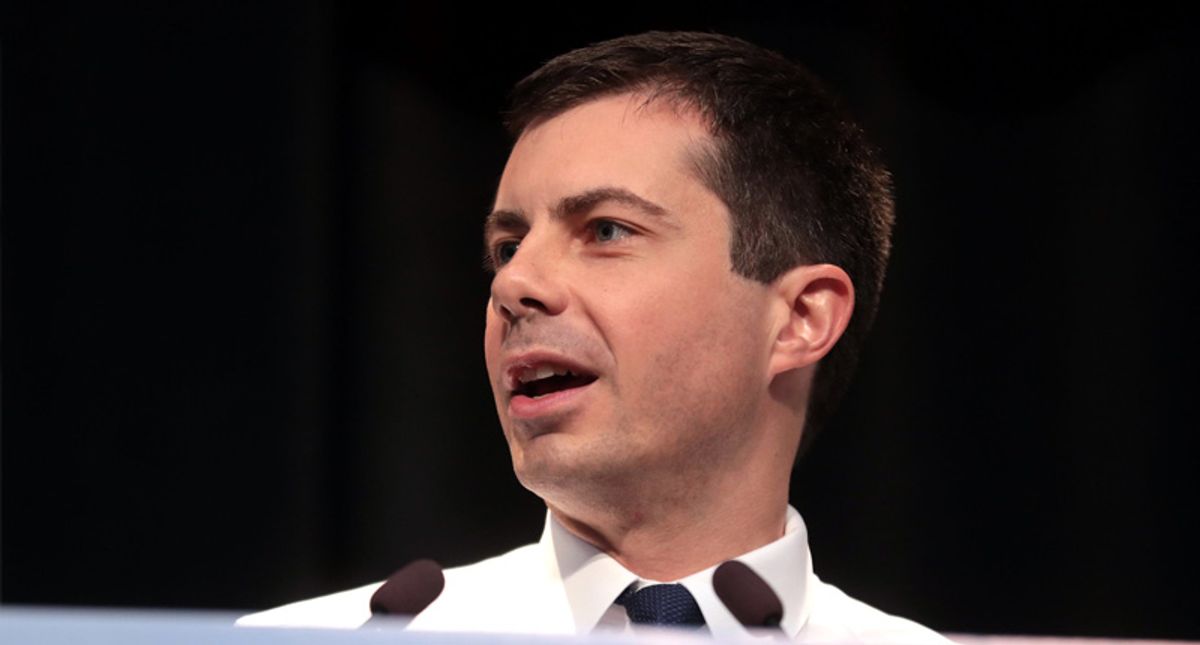
Mayor Pete Buttigieg speaking with attendees at the 2019 Iowa Federation of Labor Convention hosted by the AFL-CIO at the Prairie Meadows Hotel in Altoona, Iowa. (Gage Skidmore/Flickr)
MAGA loyalists were furious Friday as Fox News interviewed Democrat and Former Transportation Secretary Pete Buttigieg.
Buttigieg spoke with anchor Sandra Smith about tariffs, President Donald Trump and his second administration and New York City Mayor Zohran Mamdani.
MAGA social media users were livid over the conversation and made it known — even attacking Smith for the sit-down.
"Sandra Smith is terrible at interviewing. She allowed Pete Buttigieg to spew lies, walk all over her and spin her questions. She was completely outmatched by one of the worst candidates on the left. Between her and Turner, not sure if I’m watching CNN or Fox," X account RepubFrank, who frequently shares MAGA-related content, wrote.
"Why aren't you defending President Trump and his policies with this idiot Pete Buttigieg and allowing him to speak lies !!!! Your not even interrupting him once !!!!" User Maria Tambasco, who often shares pro-Trump posts, wrote on X.
"Why is Sandra Smith not pushing back on Pete Buttigieg?" Pro-MAGA user Sherry Cappello wrote on X.
"Disgusting tongue bath for 20 minutes. Nice objectivity @SandraSmithFox," user SirGern, who self-identifies as "MAGA/MAHA," wrote on X.
Legal expert stupefied as Trump Energy Department admits to massive lie in court
President Donald Trump's Department of Energy made a damning admission in court — and it left one legal observer stunned. According to The New York Times, "federal officials acknowledged this month" in court documents that they rescinded $7.5 billion in clean energy grants "'based solely' on political criteria, targeting projects in states that were represented by Democrats and had voted for Kamala Harris, the party’s presidential nominee, in the 2024 election."
This revelation, noted The Times, indicates that "far from rooting out the sort of misspending that Mr. Trump sees as rife in Washington, the White House has instead sought to leverage the budget as a tool to assist its allies — or as a cudgel to hurt the president’s foes."
The report was immediately pounced on by American Immigration Council senior fellow Aaron Reichlin-Melnick, who noted that the administration has publicly denied any such motive for canceling the grants.
"The Department of Energy admitted in court it cancelled hundreds of grants 'based solely on the political identity of the grant recipient's state,' and NOT 'based on any programmatic, statutory, cost-reduction, or performance-based factor,'" Reichlin-Melnick wrote on X. "This proves the White House lied."
The Energy grants are not the first time the administration has been accused of politically gatekeeping federal funds.
In April, a federal judge in Rhode Island accused the administration of "covertly" denying disaster aid to states that voted against him in the 2024 presidential election.
(RACIST) Trump floats LeBron James is 'racist' because 'he doesn't like Trump'
FILE PHOTO: Apr 18, 2026; Los Angeles, California, USA; Los Angeles Lakers forward LeBron James (23) shoots the ball against Houston Rockets forward Jabari Smith Jr. (10) and guard Amen Thompson (1) in the second half during game one of the first round of the 2026 NBA Playoffs at Crypto.com Arena. Credit: Kirby Lee-Imagn Images/via Reuters
President Donald Trump on Friday proposed that LeBron James is "racist" simply because "he doesn't like Trump."
Fox News senior White House correspondent Peter Doocy asked Trump to settle the LeBron vs. Michael Jordan debate, prompted by James's announcement that he is signing with the Philadelphia 76ers.
Doocy wanted to know Trump where he stood on LeBron versus Jordan as the greatest player of all time.
"Well, Michael Jordan is a guy that's a friend of mine, playing golf with him. He's a really good guy," Trump said. "And I think LeBron is — maybe he's a racist, but maybe he doesn't like Trump. I don't know. But I only like people that like me, so I would say Michael Jordan all the way."
Back in August 2018, after James told CNN's Don Lemon that Trump was using sports to divide the country, Trump fired back on X with a midnight post questioning James's intelligence.
"LeBron James was just interviewed by the dumbest man on television, Don Lemon. He made LeBron look smart, which isn't easy to do. I like Mike!" Trump wrote.
"I support LJ," Jordan said in a statement at the time. "He's doing an amazing job for his community."
James had first gone after Trump a year before that, in September 2017, after Trump rescinded the Golden State Warriors' White House invitation over Stephen Curry's reluctance to attend.
"U bum @StephenCurry30 already said he ain't going! So therefore ain't no invite. Going to White House was a great honor until you showed up!" James wrote on X. According to Twitter, it was the most retweeted post by any athlete that year.
James, who turns 42 in December, signed a two-year, $8 million deal with the 76ers.
IAEA's non-proliferation safeguards and industry's role
Friday, 24 July 2026
This year the International Atomic Energy Agency's Symposium on International Safeguards will have its own dedicated evening to showcase how the nuclear industry works with IAEA Safeguards. There will also be a training day on the application of safeguards to new nuclear reactor designs and technologies, writes Kristine Madden, IAEA Safeguards Evaluator.
(Image: IAEA)
What are nuclear safeguards?
Nuclear safeguards are technical measures applied to verify that nuclear material in peaceful activities is not diverted to nuclear weapons. Implemented in 192 States, International Atomic Energy Agency (IAEA) safeguards are an essential component of the international nuclear non-proliferation regime. Here, the nuclear industry plays an important role. Through building safeguards considerations into nuclear facility designs, industry can support effective and efficient verification by IAEA safeguards inspectors.
Nuclear safeguards must remain at the cutting edge of technological developments, especially amid the rapid expansion of the nuclear industry, the emergence of novel reactor designs and a wave of new applications for nuclear technology. These place fresh demands on nuclear verification. To ensure that IAEA safeguards continue to be effective and efficiently implemented, cooperation with industry and regulators is essential.
'Fostering open exchange'
Against that backdrop, the IAEA Symposium on International Safeguards is making innovation and cooperation with industry a defining theme. Meeting under the title 'Innovation and Resilience in a Changing World - Safeguards as a Shared Responsibility', the Symposium will bring policymakers, regulators, industry and IAEA experts together to address opportunities and challenges in nuclear verification.
Massimo Aparo, IAEA Deputy Director General and Head of the Department of Safeguards, says this year's Safeguards Symposium is taking place at a time when the operating environment is more complex, technologically demanding and financially strained than ever before. "By fostering open exchange, the Symposium provides opportunities for the Department and our stakeholders to identify areas where collaboration can be expanded to ensure that nuclear verification remains robust for years to come."
Held every four years, the Symposium generates ideas for actions, and reviews progress made since its last edition. The Symposium in 2022 welcomed nearly 1,000 participants from 124 countries.
This year's programme includes an Industry Night, the dedicated evening event where industry stakeholders can present technologies, showcase research and engage with the global safeguards community. Industry stakeholders are invited to exhibit their services and products, and can reserve exhibition space until 15 August.
"As nuclear energy expands around the world, trust and cooperation will be fundamental to the success of the global nuclear industry," said Sama Bilbao y León, Director General of World Nuclear Association.
"IAEA Safeguards provide international trust and give governments, investors and communities confidence that nuclear materials are being used only for peaceful purposes. As our industry expands into new countries, new markets and new applications, and develops new technologies, it is essential that professionals across the nuclear sector understand the role of safeguards and work together to implement them effectively to reinforce both non proliferation objectives and deployment realities. The Symposium is a confidence-building and stabilising forum that allows the IAEA, industry, and relevant stakeholders to strengthen their mutual understanding and collaboration to promote effective and efficient safeguards implementation in support of the expected growth of peaceful nuclear activities globally."
The Symposium will also feature a dedicated training day, giving industry professionals and representatives from newcomer countries an opportunity to deepen their understanding of safeguards requirements and meet IAEA experts - and provide engineers, designers and project managers with practical insights into applying safeguards requirements to current and next-generation reactor designs and technologies.
Linked to this will be the central focus on 'Safeguards by Design', which provides guidance to State authorities, designers, equipment providers and prospective purchasers on the importance of taking international safeguards into account when designing a nuclear facility or process. It is applicable to all aspects of the nuclear fuel cycle, from initial planning and design through construction, operation, waste management and decommissioning.
Safeguards by Design has several advantages for both the industry and the IAEA. It enables informed design choices for effective and efficient safeguards implementation and ultimately reduces the operational burden and mitigates the risk of costly retrofitting. For new nuclear facilities, especially novel designs or processes, the earlier safeguards are considered the better: Safeguards by Design allows for safeguards to be built 'into' the system, rather than around it afterwards.
The fifteenth IAEA Symposium on International Safeguards will be held from 9 to 12 November 2026, at the Vienna International Centre in Vienna, Austria. Registration and further information are available on the IAEA event page. This article was also co-authored by the IAEA’s Haley Mead, Adem Mutluer and Wolfgang Picot.
Russia stresses long-term nature of nuclear cooperation with China
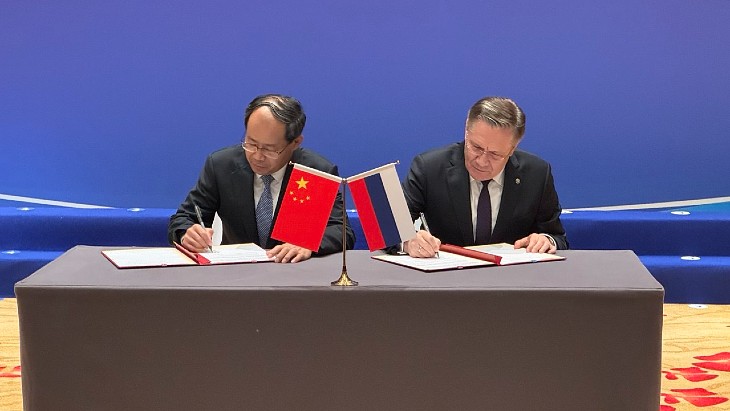
Rosatom Director General Alexei Likhachev told reporters in Beijing that Russia and China both think "a century ahead" in developing nuclear energy, and said the Russian state nuclear corporation plans to "continue localising fuel fabrication technologies".
(Image: Rosatom)
He was speaking during a visit in which the 30th meeting of the Russian-Chinese Subcommittee on Nuclear Issues was held, which he co-chaired with Shan Zhongde, Director of China's Atomic Energy Agency.
Rosatom reported that "the parties discussed the progress of current projects, as well as the future agenda for cooperation in the peaceful uses of nuclear energy. Following the meeting, a protocol was signed".
In comments reported by Russia's official Tass news agency Likhachev referenced the state nuclear corporation's work with China on supplying equipment and software codes for China's CFR-600 fast sodium-cooled reactor and preparations for its operation.
He also said that this year Rosatom would start supplying advanced nuclear fuel for China's VVER-1200 reactors and fast neutron reactors.
He said: "When developing nuclear power, every country, and above all Russia and China, the leaders in this race, thinks a century ahead. A century is not a figure of speech here - it means the need to ensure that a power plant has fuel for more than 100 years of operation, both natural uranium and the most advanced technological solutions for efficient and safe fuel. And it is in China where we are introducing our advanced technologies related to safe fuel, including fuel with an 18-month cycle.
"We will continue localising fuel fabrication technologies here in accordance with the growth in reactor demand."
According to Tass, he said one each of the new VVER-1200 units at Tianwan and Xudapu nuclear power plants would begin commissioning "in the coming weeks" with the second new units at each plant, set to follow next year.
And on nuclear fusion, he said: "China has its own developments and operational facilities that will undoubtedly enrich us as we move forward with joint projects."
The Northern Sea Route - where nuclear-powered icebreakers have been playing an increasingly important role in opening up the new Arctic trade route - is another area of bilateral focus, with cargo transportation from China set to double this year, he said.
Background
Rosatom's TVEL fuel company dispatched in 2022 all shipments to supply the first core loading of the CFR-600 sodium-cooled pool-type fast-neutron reactor under construction at Xiapu in China's Fujian province.
The production of CFR-600 uranium fuel was established at the Elemash Machine-Building Plant in Elektrostal in Russia in 2021. For this purpose, the site for the fabrication of fuel assemblies for fast reactors was modernised at the enterprise, unique equipment was developed and installed.
Construction of unit 1 of the Xiapu fast reactor demonstration project began in 2017. It is part of China's plan to work towards a closed nuclear fuel cycle. In addition to the reactor in China, there are BN-600 and BN-800 sodium-cooled fast reactors at the Beloyarsk nuclear power plant in the Urals region of Russia.
Saudi Arabia, USA sign nuclear agreements
An intergovernmental agreement on the peaceful uses of nuclear energy and an accompanying bilateral safeguards agreement has been signed by Saudi Minister of Energy and Minister of Industry and Mineral Resources Prince Abdulaziz bin Salman bin Abdulaziz and US Secretary of Energy Chris Wright.
(Image: US Department of Energy)
The agreement "aims to enhance cooperation between the two countries in the peaceful uses of nuclear energy and to facilitate the exchange of expertise, knowledge, and technologies, contributing to strengthening bilateral cooperation in accordance with the highest international standards of nuclear safety, nuclear security, and nonproliferation", according to a statement published by Saudi Arabia's official national news agency, SPA. It also "reflects the shared vision of both countries to expand cooperation in energy and future technologies while supporting sustainable development".
Formal cooperation agreements are required between countries that want to trade nuclear power goods and services. Those involving the USA are known as 123 Agreements after the paragraph of the country's 1954 Atomic Energy Act which requires them.
No details have been given about the contents of the agreements, although media reports ahead of the announcement by the two countries suggested that the agreement was expected to include provisions that would allow Saudi Arabia to enrich uranium. However, this is seen as a potential nuclear proliferation risk: the same technology used to increase the content of the fissile uranium-235 isotope to levels needed in nuclear fuel (typically up to 5% for nuclear reactors in operation around the world today) could also be used to produce weapons-usable highly enriched uranium. Previous 123 Agreements concluded by the USA with other countries - including that concluded with the UAE in 2009 - have specifically prohibited those countries from developing domestic uranium enrichment capabilities.
The US Department of Energy (DOE) said the two agreements "lay the legal foundation for a decades-long, multi-billion-dollar partnership that advances several priority economic and strategic objectives, including nuclear non-proliferation", providing "great access for American companies in the Saudi nuclear energy programme" as well as advancing US and regional security by "upholding high standards of nuclear safety, security, and non-proliferation and strengthening the United States' competitive edge in civil nuclear technology".
"These agreements reflect our two nations' shared commitment to strengthening US-Saudi commercial relations, delivering prosperity at home and security to our allies abroad," Wright said. "Rest assured, these agreements uphold the highest standards of nuclear safety and non-proliferation, while relying on the world's best nuclear technology and scientists, designed right here in the United States."
Saudi Arabia's electricity generation is dominated by fossil fuels, but the potential use of nuclear power - including for desalination of water - has featured in the country's plans for many years. It has, over the past decade or so, signed nuclear cooperation agreements with countries including France, Argentina, South Korea, China, Hungary and Jordan, as well as Russian nuclear company Rosatom. According to the World Nuclear Association information paper on Saudi Arabia, the King Abdullah City for Atomic and Renewable Energy (KA-CARE) - set up by the Saudi government to advance its nuclear and renewable energy agenda - has also been in negotiations with the Czech Republic and the UK as well as the USA.
The 123 Agreement is to be reviewed by the US Congress.
EDF extends life of UK's Heysham 1 and Hartlepool
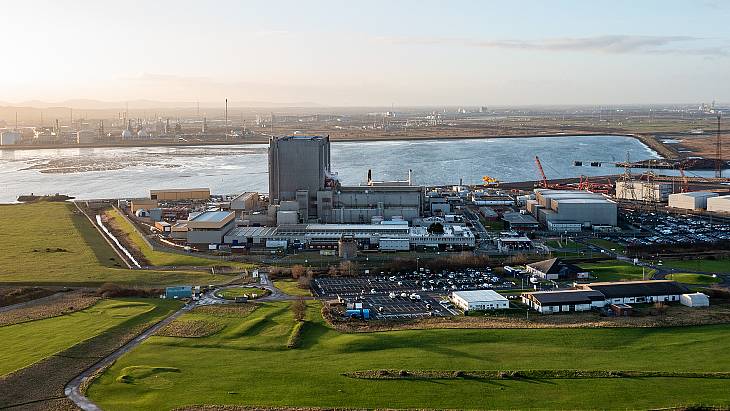
EDF has announced that the Heysham 1 and Hartlepool advanced gas-cooled reactor nuclear power plants will continue generating electricity until March 2030, an extension of two years.
Hartlepool is now due to operate until 2030 (Image: EDF)
The decision comes following a detailed review covering technical aspects like the condition of the boilers and the graphite cores as well as supply chain resilience and workforce planning. Decisions on end of generation dates for EDF's nuclear power plants in the UK are independent of the regulators or government and are taken by EDF's licensee board following recommendations from EDF Nuclear Generation Limited's Executive. Prior to this decision, Heysham 1 and Hartlepool were due to move into defueling in March 2028 based on a review in September 2025.
As well as supporting more than 1,000 jobs across the two sites for longer, extending the generating lives of these plants could boost nuclear output by 28 TWh over the two-year period, enough to power 8.4 million homes, EDF noted.
"We have been clear it is our ambition to generate from these stations for as long as it is safe and commercially viable to do so it is great to be able to confirm a further two-year extension for Heysham 1 and Hartlepool," said EDF's Managing Director of Nuclear Operations, John Munro. "The AGR stations have been the backbone of secure, zero-carbon generation in the UK for five decades. The nuclear fleet also has a key role in maintaining grid stability, which is so important as the overall system becomes led by renewables. Today's decision retains stable baseload, domestic generation, reducing reliance on imports during tighter periods."
When EDF acquired the fleet in 2009, all seven advanced gas-cooled reactor (AGR) stations were scheduled to be offline by 2023, but a series of life extensions mean four of those stations are still generating with three now in various stages of defuelling or decommissioning.
"When nuclear goes offline it is often replaced with gas generation," Munro said. "If we are serious about reducing the UK's reliance on gas and retaining system stability, it makes sense to keep these stations online to support energy security and our carbon targets."
According to EDF, keeping these plants online will retain around 12% of the UK's nuclear generation in the mix in 2028 and the volume of gas they could avoid in each year of the extension is equal to 25 Liquid Natural Gas cargoes or 20% of the LNG imports in 2025.
EDF said it will continue to keep AGR lifetimes under review to establish whether further life extensions can be achieved.
EDF manages the UK's seven nuclear power plant sites, five that are operating (Sizewell B, Torness, Heysham 2, Heysham 1 and Hartlepool) and two that have entered decommissioning (Hinkley Point B and Dungeness B). It took over the sites when it acquired British Energy in 2009. The company is also constructing the new Hinkley Point C plant in Somerset, and there are advanced plans for a replica of Hinkley Point C at Sizewell C in Suffolk.
The lifetimes of the Torness and Heysham 2 AGR plants were not reviewed as part of this process. These plants are expected to close in March 2030, as announced in December 2024.
Earlier this month, it was announced that the Sizewell B plant is set to get a 20-year lifetime extension after terms were agreed by the UK government and operator EDF. The pressurised water reactor, which came online in 1995, had an initial 40-year operating life to 2035.
Chris O'Shea, CEO of Centrica, which has a 20% share in the operating plants, said: "I'm delighted that Heysham 1 and Hartlepool will continue to play a key role in the UK's energy system for longer. These stations provide reliable, low-carbon electricity that supports Britain's energy security, protects skilled jobs and underpins a more resilient economy. Following the recent positive news on the life extension of Sizewell B, this further demonstrates the important role nuclear can continue to play in delivering the secure and dependable power the UK needs as demand for electricity grows."
Approval for VVER fuel production in Germany
The Lower Saxony Ministry for the Environment, Energy and Climate Protection, acting on behalf of the federal government, has approved an application from Framatome subsidiary Advanced Nuclear Fuels to expand its facility in Lingen for the production of fuel for VVER-1000 reactors. The approval is subject to strict conditions.
A Framatomr VVER-100 fuel assembly (Image: Framatome)
Framatome subsidiary Advanced Nuclear Fuels (ANF) applied in March 2022 under the Atomic Energy Act for permission to begin producing hexagonal pressurised water fuel elements under licence with TVEL, the fuel arm of Russian state nuclear corporation Rosatom. The fuel elements are to be manufactured using Russian licences and Russian technology in a joint venture with TVEL for the Eastern European market. The licence application includes some changes to some manufacturing and testing equipment and the installation of some additional equipment in existing buildings to enable the manufacture of VVER fuel elements.
The federal government had already clarified in a supervisory letter to the state that, given the current assessment by federal security authorities regarding the risk of sabotage or espionage, there was no legal basis for denying the permit.
The Lower Saxony Ministry for the Environment, Energy and Climate Protection has now announced that it has approved ANF's application, subject to a number of conditions, as "after intensive review and inquiries, [it] had no legal grounds under the Atomic Energy Act to reject or limit the application". The restrictions it has imposed include a general ban on entry to the facility for employees of TVEL or Rosatom, as well as persons authorised by them. Entry is only permitted in very limited cases and under the supervision of the regulatory authority.
In addition, the ministry said the hardware and software of the TVEL-licensed machines must undergo external security audits, and these machines must be data-integrated with the rest of the fuel element factory's operational technology and information technology infrastructure. Also, the finished gadolinium fuel rods arriving from Russia must be 100% inspected for potential tampering using active and passive scanners according to the 'four-eyes' principle. Furthermore, ANF employees must receive regular training and awareness programmes to protect against espionage and sabotage.
Lower Saxony's environment ministry said the approval could be revisited "if new risks are identified", particularly in "national security", Euractiv reported.
ANF was created in 1975 and currently employs around 400 people in Lingen. ANF fabricates fuel rods and assemblies for pressurised water reactors and boiling water reactors for customers worldwide.
In recent years, especially since the war with Ukraine began, nuclear power operators in European Union countries who had previously relied on Russian-supplied fuel have sought alternative suppliers. Nineteen VVER reactors - developed during the time of the Soviet Union and historically reliant on Russian fuel supplies - are currently in operation in the EU, including four VVER-1000 reactors in Bulgaria and the Czech Republic, and 15 VVER-440 reactors in the Czech Republic, Finland, Hungary and Slovakia.
Framatome has "a dual-track approach" to supplying fuel to VVER reactors in operation in the EU. In the short term, it will fabricate fuel identical to the proven design currently used by the reactors. In parallel, Framatome is developing and qualifying European sovereign fuels of its own design for VVER-440 and VVER-1000 reactors. The qualification of a new design requires several years within the framework of regulatory and usual certification practices, Framatome notes.
Framatome had planned to produce both VVER-1000 and VVER-440 fuel under licence from and as part of a joint venture with Rosatom at its subsidiary Advanced Nuclear Fuels in Lingen. However, it was recently reported that Framatome has now decided to produce the VVER-440 fuel at its Romans-sur-Isere fuel production site in south-east France. The company expects to submit a request to the French nuclear regulator, the Autorite de Surete Nucleaire et de Radioprotection, by the end of 2026 for approval of the changes needed at the French plant for the production of VVER-440 fuel.
Oklo cleared to start up test reactor
The US Department of Energy has granted authorisation to nuclear technology company Oklo to start up its Groves Isotope Test Reactor, located near Lockhart in Caldwell County, Texas.
Groves Isotope Test Reactor facility (Image: Oklo)
This authorisation, granted under department's Reactor Pilot Program, completes the Department of Energy (DOE) authorisation process and clears the way for fuel loading, startup testing, and reactor operations. The authorisation followed a rigorous readiness review, through which DOE confirmed that Oklo has achieved the engineering, organisational, and operational readiness needed to safely receive fuel and begin reactor operations.
The Reactor Pilot Program, announced in June 2025, aims to expedite the testing of advanced reactor designs that will be authorised by the DOE at sites located outside of the national laboratories. Part of the Reforming Nuclear Reactor Testing at the Department of Energy executive order signed by President Donald Trump in May last year, its goal is "to construct, operate, and achieve criticality of at least three test reactors using the DOE authorisation process by July 4, 2026".
Antares Nuclear's Mark-0 reactor became the first reactor under the programme to reach initial criticality in early June, closely followed by Valar Atomics' Ward 250 reactor. Deployable Energy's Unity demonstration reactor achieved criticality on 1 July, while Aalo Atomics' Critical Test Reactor chieved initial criticality in the early hours of 4 July.
Groves is a low-power test reactor designed to demonstrate reactor design, build, and operations, and to establish operating experience needed to support future isotope production facilities. The project advances Oklo's plans to establish domestic production of critical isotopes for potential use in cancer care, manufacturing, scientific research, space exploration, and national security.
A privately financed facility, Groves was built on private land, including full-scale civil excavation and construction, and assembled with all full-scale systems, components, and fuel either sourced commercially or manufactured by Oklo.
"This facility marks the fastest time that we are aware of to go from greenfield to substantial completion for a full-scale, privately funded and sited reactor in history," said Oklo co-founder and CEO Jacob DeWitte. "By building on a greenfield site on private land, performing full-scale civil excavation and construction, and procuring fuel and all major components commercially, we demonstrated that the advanced nuclear industry can move at a pace that many did not believe possible. And this experience is fully translatable to future commercial deployments."
Principal Deputy Assistant Secretary for Nuclear Energy Mike Goff added: "The US Department of Energy is excited to see another Reactor Pilot Program participant receive authorisation. With the right enabling environment, Oklo has been able to accelerate their progress and is now ready to take the next step with their technology."
Landmark module installation at Lufeng 2
The CA01 'super module' has been installed at unit 2 of the Lufeng nuclear power plant in China's Guangdong province, China General Nuclear announced.
(Image: CGN)
With a hoisting weight of more than 950 tonnes and measuring more than 26 metres long, 29 metres wide and 23 metres high, the concrete and steel CA01 module - composed of 47 sub-modules - sits inside the unit's containment module where it will house the plant's reactor pressure vessel, steam generators and other components.
The installation of the CA01 module on 21 July "signifies that the construction of the reactor building for Unit 2 of the Lufeng Nuclear Power Plant has entered a new phase, laying a solid foundation for subsequent nuclear island structure construction and equipment installation", CGN said.
(Image: CGN)
The CAP1000 reactor design - the Chinese version of Westinghouse's AP1000 - uses modular construction techniques, enabling large structural modules to be built at factories and then installed at the site. The CA01 module is referred to as a super module because it is too large to be transported by road and rail, and was constructed on site.
The CA01 module of unit 1 at the Lufeng site was installed in September last year.
"Building on the successful experience of unit 1, the assembly phase of unit 2's CA01 module further expanded the scope of modular construction, enabling the pre-assembly and integration of more items on the ground, and improving the overall integrity of the assembly compared to unit 1," CGN said.
Background
The Lufeng nuclear power plant is the first nuclear power project in eastern Guangdong Province. The proposed construction of four 1250 MWe CAP1000 reactors (units 1-4) at the Lufeng site was approved by China's National Development and Reform Commission in September 2014.
The Lufeng units have not been built in the numerical order their names would appear to suggest.
In April 2022, the State Council approved construction of two Hualong One units at Lufeng as units 5 and 6. First concrete was poured for unit 5 on 8 September 2022 and that for unit 6 on 26 August 2023. The reactor vessel of unit 6 was installed in February this year. Units 5 and 6 are expected to begin operating in 2027 and 2028, respectively.
The construction of units 1 and 2 did not receive State Council approval until August 2024. The first safety-related concrete for the nuclear island of unit 1 was poured in February last year, with that of unit 2 following in December. Both units are scheduled to begin operating in 2030. Approval for units 3 and 4 is still pending.
According to CGN, once all six units are in operation, the Lufeng plant will generate about 52 TWh, which will reduce standard coal consumption by almost 16 million tonnes and reduce carbon dioxide emissions by more than 42 million tonnes.
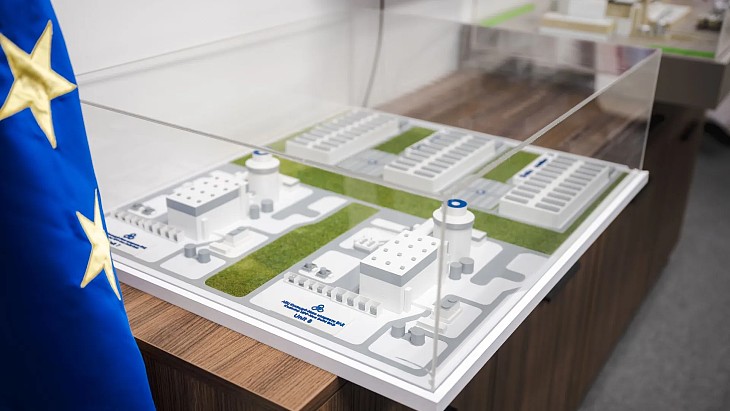
Commitment to the on-going project to build two new units at the Kozloduy Nuclear Power Plant has been stressed in talks between senior Bulgarian and US representatives.
A model of a concept of two new units, with three data centres (Image: Kozloduy NPP-Build)
The new board of directors of Kozloduy Nuclear Power Plant-New Build EAD, which is state-owned via its parent company Kozloduy NPP EAD, which operates the existing nuclear power plant, held talks with the US Chargé d'Affaires in Bulgaria, H Martin McDowell, and Patrick Thilou, Political and Economic Officer, at the embassy.
"The two sides declared their common commitment to the project for new nuclear power capacities in Kozloduy, which remains a strategic priority in the bilateral cooperation between Bulgaria and the United States of America," the project company said.
"The main topic of the discussion was the progress on the construction of units 7 and 8, the next stages of implementation, and the possibilities for financing from US export banks.
"In conclusion, the delegations expressed mutual readiness to continue active dialogue and close cooperation throughout all subsequent stages of the project's implementation."
The meeting came the week after Bulgarian Prime Minister Rumen Radev - a former president who became prime minister with a new government in May - met with representatives of Westinghouse.
According to the government press service: "During the meeting, the implementation of the preliminary engineering activities for the project to build units 7 and 8 of the Kozloduy NPP was discussed. Issues related to the completion of the feasibility study for the time frame for the construction of the new units and the expected final price were also considered."
Background
Kozloduy units 1-4 were VVER-440 models which the European Commission classified as non-upgradeable and Bulgaria agreed to close them during negotiations to join the European Union in 2007. Units 5 and 6 feature VVER-1000 reactors that were connected to the grid in 1987 and 1991, respectively. Both units have been through refurbishment and life-extension programmes to enable extension of operation from 30 to 60 years. The country's two operable reactors generate about one-third of its electricity.
Westinghouse's AP1000 has been selected as the technology for the two proposed new units and in November 2024 Hyundai Engineering & Construction, Westinghouse and Kozloduy NPP-New Build signed an engineering contract for the new capacity, with ministers saying that signing the contract meant that schedule and finance details would be firmed up for the new capacity. The Ministry of Energy and the USA's Citi bank agreed on a partnership in July last year to secure funding for the construction of the new units, and site location applications were submitted.
In December Kozloduy NPP-New Build EAD and a consortium comprising Laurentis Energy Partners, its subsidiary Canadian Nuclear Partners SA (CNPSA) and BWXT Canada, signed an owner’s engineer contract to advance the two new AP1000 units.
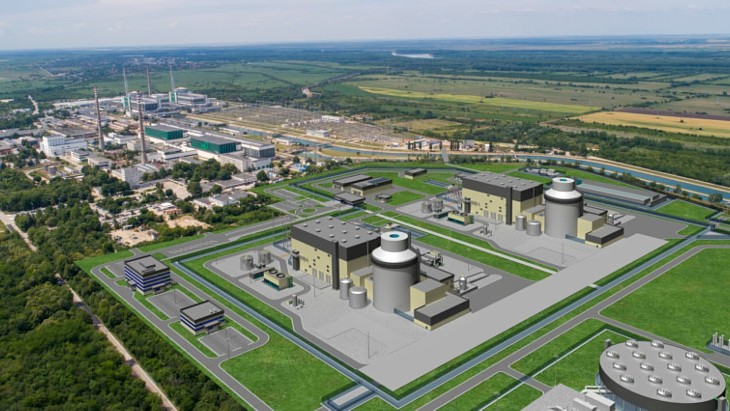
How the two new units could look at Kozloduy (Image: Westinghouse)
The aim is for the first new Westinghouse AP1000 unit - unit 7 at Kozloduy - to be operational in 2035 and the second one - unit 8 - to be operational in 2037. The 2,300 MWe capacity of the two new units would exceed the 1,760 MWe capacity of the closed first four units. The Bulgarian government has also said that further units will be needed to replace units 5 and 6 by 2050. It has also been considering the deployment of small modular reactors in the country.







_14949.jpg)
_64458.jpg)
_11312.jpg)
_22249.jpg)
_dc2f9ec8.jpg)