It’s possible that I shall make an ass of myself. But in that case one can always get out of it with a little dialectic. I have, of course, so worded my proposition as to be right either way (K.Marx, Letter to F.Engels on the Indian Mutiny)
Tuesday, September 20, 2022
VOTE 4 GUN CONTROL AT MIDTERMS
GOP AGs push Visa, Mastercard, AmEx not to track gun sales
By KEN SWEET
yesterday FILE - American Express, Visa and Master card cards are on display in Richmond, Va., Thursday, July 1, 2021. A group of Republican attorneys general are pushing the major payment networks _ Visa, Mastercard and American Express _ to drop their plans to start tracking sales at gun stores, arguing the plans could infringe on consumer privacy and push legal gun sales out of the mainstream financial network. The letter comes more than a week after the payment networks said they would adopt the International Organization for Standardization’s new merchant code for sales at gun stores.
\(AP Photo/Steve Helber)
NEW YORK (AP) — A group of Republican attorneys general are pushing the major payment networks — Visa, Mastercard and American Express — to drop their plans to start tracking sales at gun stores, arguing the plans could infringe on consumer privacy and push legal gun sales out of the mainstream financial network.
The letter comes more than a week after the payment networks said they would adopt the International Organization for Standardization’s new merchant code for sales at gun stores. The merchant code would categorize sales at gun stores not unlike how payment networks categorize sales at airlines, restaurants, and department stores.
In their letter, the AGs threaten to use all legal tools at their disposal to stop the payment networks from tracking gun sales.
“Categorizing the constitutionally protected right to purchase firearms unfairly singles out law-abiding merchants and consumers alike,” the letter said.
In recent weeks gun control advocates argued that separately categorizing gun store sales could potentially flag a surge of suspicious sales activity to public safety officials. They have used the example from the 2016 Pulse Nightclub shooting in Orlando, where the shooter purchased $26,000 worth of ammunition ahead of the massacre.
But the Second Amendment lobby and its advocates have argued that the merchant code would do a poor job of tracking potential red flags and could unfairly flag legal gun purchases. A sale of a gun safe worth thousands of dollars would be categorized as a gun store sale just as much as someone buying thousands of dollars worth of ammunition, for example.
The payment networks said when they adopted the policy that they are just following the guidance from ISO. It will be largely up to the banks who issue the credit and debit cards to decide whether they want to stop sales under certain merchant codes.
The CEOs of the major banks will appear in front of Congress on Wednesday and Thursday this week, and they are almost certainly to be asked questions on the gun store sales tracking controversy.
UPDATED
Putin's Russia triggers plan to formally annex occupied Ukrainian regions
Zee News - 9h ago
LONDON: Two Russian-controlled regions in eastern Ukraine announced plans to hold referendums on joining Russia later this week and an ally of President Vladimir Putin said the votes would alter the geopolitical landscape in Moscow's favour forever.
The move, which seriously escalates Moscow's standoff with the West, comes after Russia suffered a battlefield reversal in northeast Ukraine and as Putin ponders his next steps in a nearly seven-month-old conflict that has caused the most serious East-West rift since the 1962 Cuban Missile Crisis.
The Russian-backed, self-proclaimed Luhansk People's Republic (LPR) and the neighbouring Donetsk People's Republic (DPR) said the planned referendums would be held from Sept. 23-27.
In a post on social media addressed to Putin, DPR head Denis Pushilin wrote: "I ask you, as soon as possible, in the event of a positive decision in the referendum - which we have no doubt about - to consider the DPR becoming a part of Russia."
Earlier on Tuesday, Russian-installed officials in the southern Kherson region, where Moscow's forces control around 95% of the territory, said they had also decided to hold a referendum. Pro-Russian authorities in part of Ukraine's Zaporizhia region were expected to follow suit.
Ukraine and the United States have said such referendums would be an illegal sham and have made clear that they and many other countries would not recognise the results.
Dmitry Medvedev, a former president who is currently deputy chairman of the Security Council, suggested before the announcements that the outcome of such votes would be irreversible and give Moscow - which has the largest stockpile of nuclear weapons in the world - carte blanche to defend what it would regard as legally its own territory.
"Encroachment onto Russian territory is a crime which allows you to use all the forces of self-defence," Medvedev said in a post on Telegram. "This is why these referendums are so feared in Kyiv and the West."
No future Russian leader would be able to constitutionally reverse their outcome, he added.
Vyacheslav Volodin, the head of Russia's State Duma, the lower house of parliament, said that his chamber would support the two regions joining Russia if they voted to do so.
Washington and the West have so far been careful not to supply Ukraine with weapons that could be used to shell Russian territory, and Medvedev's interpretation of what de facto annexation would legally mean from Moscow's point of view looked like a future warning to the West.
"They (the referendums) would completely change the vector of Russia's development for decades. And not just of our country. The geopolitical transformation of the world would be irreversible once the new territories were incorporated into Russia," he wrote.
It is unclear how the referendums would be held given that Russian and Russian-backed forces control only around 60% of the Donetsk region, while Ukrainian forces are trying to retake Luhansk.
Pro-Russian officials have previously said the referendums could be held electronically.
The move would come eight years after Russia annexed the Crimean peninsula from Ukraine.
Explainer-Russia unfolds annexation plan for Ukraine
Tue, September 20, 2022 By Guy Faulconbridge and Felix Light
LONDON (Reuters) - Russia on Tuesday announced plans by separatists in Ukraine to hold referendums paving the way for the formal annexation of swathes of territory after nearly seven months of war with its neighbour, a former Soviet republic. WHO WANTS A REFERENDUM?
The self-styled Donetsk (DPR) and the Luhansk People's Republics (LPR), which President Vladimir Putin recognised as independent states just before the invasion on Feb. 24, have said they want referendums on joining Russia on Sept. 23-27 - that is this Friday to Tuesday.
The Kherson and Zaporizhzhia regions, which have yet to be recognised as independent states by Russia, have also said they will hold votes of their own. Russia does not fully control any of the four regions, with only around 60% of Donetsk region in Russian hands. HOW MUCH TERRITORY COULD UKRAINE LOSE?
The territory that Russia does control amounts to more than 90,000 square km, or about 15% of Ukraine's total area - equal to the size of Hungary or Portugal.
Russia annexed Crimea in 2014. With Crimea and the territory in the four other regions, Russia would gain an area about the same size as the U.S. state of Pennsylvania.
WHAT'S THE SIGNIFICANCE?
If Russia goes ahead with the referendums and joins all four regions to Russia then Ukraine - and potentially its Western backers too - would, from a Russian perspective, be fighting against Russia itself.
That would raise the risk of a direct military confrontation between Russia and the NATO military alliance, a scenario that President Joe Biden has said could lead to World War Three, because NATO-members are supplying arms and giving intelligence to Ukraine.
As such, a rushed Russian move to formally annex another big chunk of Ukrainian territory would be a major escalation just days after potentially the most significant Russian battlefield defeat of the war in northeastern Ukraine.
Russia's nuclear doctrine allows the use of such weapons if it is attacked with nuclear or other weapons of mass destruction, or if the Russian state faces an existential threat from conventional weapons.
While escalating the stakes of the confrontation, Putin could also announce additional steps. Russian stocks plunged to their lowest in a month on Tuesday as Moscow reignited martial law fears with new legislation that tightened penalties for military personnel.
Unless Ukraine agreed to stop fighting for its lost territory, then Russia would have to commit significant military forces to defend the newly annexed regions - which are still not fully under Russian control.
"Putin has made a bet on escalation," said Tatiana Stanovaya, founder of the political analysis firm R.Politik.
"All this talk about immediate referendums is an absolutely unequivocal ultimatum from Russia to Ukraine and the West."
WHAT DOES UKRAINE SAY?
Ukraine said the threat of referendums was "naive blackmail" and a sign Russia was running scared.
"This is what the fear of defeat looks like. The enemy is afraid, and obfuscates primitively," said Andriy Yermak, chief of staff to Ukrainian President Volodymyr Zelenskiy.
Ukraine says it will not rest until every Russian soldier is ejected from its territory. Kyiv says it will never accept Russian control over its territory and has called on the West to supply more and better arms to fight Russian forces.
WHAT HAPPENED IN CRIMEA?
The conflict in eastern Ukraine began in 2014 after a pro-Russian president was toppled in Ukraine's Maidan Revolution and Russia annexed Crimea.
After Russian forces on Feb. 27, 2014 took control of Crimea, which has an ethnic Russian majority and was transferred to Ukraine in Soviet times, a referendum on joining Russia was held on March 16.
Crimea’s leaders declared a 97% vote to secede from Ukraine and join Russia. Russia formally added Crimea on March 21, less than a month after invasion. Kyiv and the West said the referendum violated Ukraine’s constitution and international law.
(Reporting by Guy Faulconbridge, Editing by Angus MacSwan)
4 Ukrainian regions schedule votes this week to join Russia
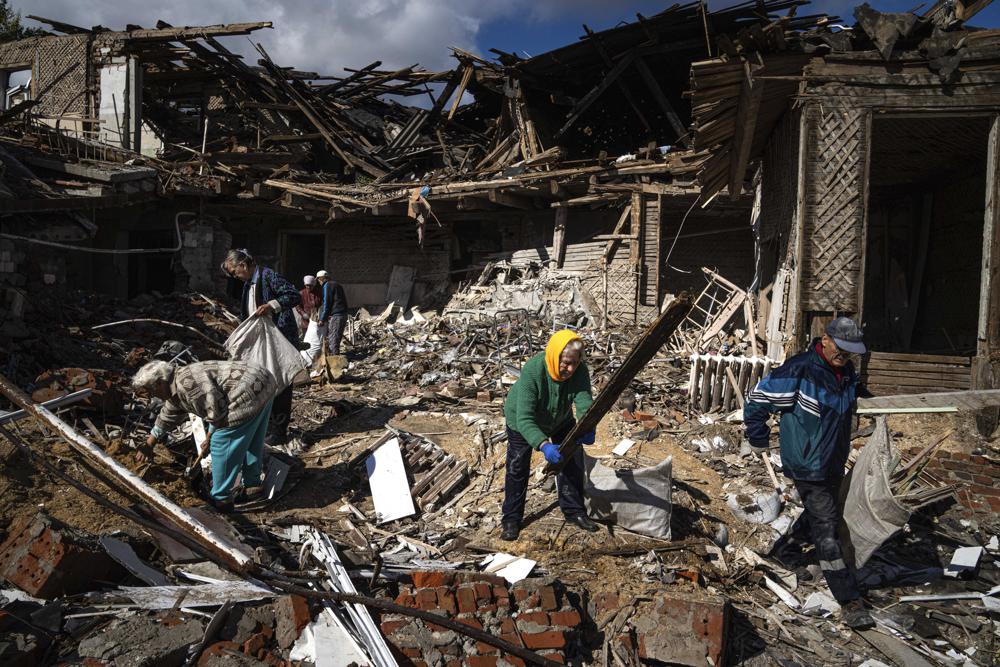
Local residents collect wood for heating from a destroyed school where Russian forces were based, in the recently retaken area of Izium, Ukraine, Monday, Sept. 19, 2022. Residents of Izium, a city recaptured in a recent Ukrainian counteroffensive that swept through the Kharkiv region, are emerging from the confusion and trauma of six months of Russian occupation, the brutality of which gained worldwide attention last week after the discovery of one of the world's largest mass grave sites. (AP Photo/Evgeniy Maloletka)
KYIV, Ukraine (AP) — Russian-controlled regions of eastern and southern Ukraine announced plans Tuesday to start voting this week to become integral parts of Russia. The concerted and quickening Kremlin-backed efforts to swallow up four regions could set the stage for Moscow to escalate the war following Ukrainian successes on the battlefield.
The scheduling of referendums starting Friday in the Luhansk, Kherson and partly Russian-controlled Zaporizhzhia and Donetsk regions came after a close ally of Russian President Vladimir Putin said the votes are needed and as Moscow is losing ground in the invasion it began nearly seven months ago, increasing pressure on the Kremlin for a stiff response.
Former President Dmitry Medvedev, the deputy head of Russia’s Security Council chaired by Putin, said referendums that fold regions into Russia itself would make redrawn frontiers “irreversible” and enable Moscow to use “any means” to defend them.
The votes, in territory Russia already controls, are all but certain to go Moscow’s way but are unlikely to be recognized by Western governments who are backing Ukraine with military and other support that has helped its forces seize momentum on battlefields in the east and south.
Ukrainian Foreign Minister Dmytro Kuleba denounced them as a sham and tweeted that “Ukraine has every right to liberate its territories and will keep liberating them whatever Russia has to say.”
There was also swift international condemnation. Speaking in New York, where he is attending the U.N. General Assembly, German Chancellor Olaf Scholz said: “It is very, very clear that these sham referendums cannot be accepted.”
Latvian Foreign Minister Edgars Rinkevics called for more sanctions against Russia and more weapons for Ukraine, tweeting: “We must say no to Russian blackmail.”
In Donetsk, part of Ukraine’s wider Donbas region that has been gripped by rebel fighting since 2014 and which Putin has set as a primary objective of the invasion, separatist leader Denis Pushilin said the vote will “restore historic justice” to the territory’s “long-suffering people.”
They “have earned the right to be part of the great country that they always considered their motherland,” he said.
In partly Russian-occupied Zaporizhzhia, pro-Russia activist Vladimir Rogov said: “The faster we become part of Russia, the sooner peace will come.”
Pressure inside Russia for votes and from Moscow-backed leaders in Ukrainian regions that Moscow controls increased after a Ukrainian counteroffensive — bolstered by Western-supplied weaponry — that has recaptured large areas.
Former Kremlin speechwriter and Russian political analyst Abbas Gallyamov said on Facebook that Moscow-backed separatists appeared “scared that the Russians will abandon them” amid the Ukrainian offensive and forged ahead with referendum plans to force the Kremlin’s hand.
In another signal that Russia is digging in for a protracted and possibly ramped-up conflict, the Kremlin-controlled lower of house of parliament voted Tuesday to toughen laws against desertion, surrender and looting by Russian troops. Lawmakers also voted to introduce possible 10-year prison terms for soldiers refusing to fight. If approved, as expected, by the upper house and then signed by Putin, the legislation would strengthen commanders’ hands against failing morale reported among soldiers.
Kremlin spokesman Dmitry Peskov said there are no prospects for a diplomatic settlement. Medvedev, who served as Russia’s president from 2008-2012, said on his messaging app channel that separatist region votes are important to protect their residents and would “completely change” Russia’s future trajectory.
“After they are held and the new territories are taken into Russia’s fold, a geopolitical transformation of the world will become irreversible,” Medvedev said.
“An encroachment on the territory of Russia is a crime that would warrant any means of self-defense,” he said, adding that Russia would enshrine the new territories in its constitution so no future Russian leader could hand them back.
“That is why they fear those referendums so much in Kyiv and in the West,” Medvedev said. “That is why they must be held.”
Ukrainian analyst Volodymyr Fesenko, head of the independent Penta Center think-tank based in Kyiv, said the Kremlin hopes the votes and the possibility of military escalation will raise the pressure from Western governments for Ukrainian President Volodymyr Zelenskyy to start talks with Moscow.
The move “reflects the weakness, not the strength of the Kremlin, which is struggling to find levers to influence the situation that has increasingly spun out of its control,” he said.
The recapturing of territory, most notably in the northeastern Kharkiv region, has strengthened Ukraine’s arguments that its troops could deliver more stinging defeats to Russia with additional armament deliveries.
More heavy weaponry is on its way, with Slovenia promising 28 tanks and Germany pledging four additional self-propelled howitzers. More aid also is expected from Britain, already one of Ukraine’s biggest military backers after the U.S. British Prime Minister Liz Truss is expected to promise that in 2023, her government will “match or exceed” the 2.3 billion pounds ($2.7 billion) in military aid given to Ukraine this year.
The swiftness of the Ukrainian counteroffensive also saw Russian forces abandon armored vehicles and other weapons as they beat hasty retreats. Ukrainian forces are recycling the captured weaponry back into battle. A Washington-based think tank, The Institute for the Study of War, said abandoned Russian T-72 tanks are being used by Ukrainian forces seeking to push into Russian-occupied Luhansk.
In the counteroffensive’s wake, Ukrainian officials found hundreds of graves near the once-occupied city of Izium. Yevhenii Yenin, a deputy minister in Ukraine’s Internal Affairs Ministry, told a national telecast that officials found many bodies “with signs of violent death.”
“These are broken ribs and broken heads, men with bound hands, broken jaws and severed genitalia,” he said.
Meanwhile, Ukraine’s southern military command said its troops sank a Russian barge carrying troops and weapons across the Dnieper River near the Russian-occupied city of Nova Kakhovka. It offered no other details on the attack in the Russian-occupied Kherson region, which has been a major target in the Ukrainian counteroffensive.
In other developments:
— Ukraine’s presidential office said fresh shelling killed three civilians and injured 19 more in a 24-hour span.
— Moscow has likely moved its Kilo-class submarines from their station on the Crimean Peninsula to southern Russia over fears about them being struck by long-range Ukrainian fire, the British military said.
— McDonald’s restaurants in Kyiv began serving again for the first time since the invasion, offering only delivery service initially but marking a step of sorts back toward the life Ukrainians knew before the war.
Sept. 19 (UPI) -- Students in Virginia will now have to file legal documents if they wish to be called by their preferred pronouns, and will no longer be allowed to use facilities based on the gender they identify with.
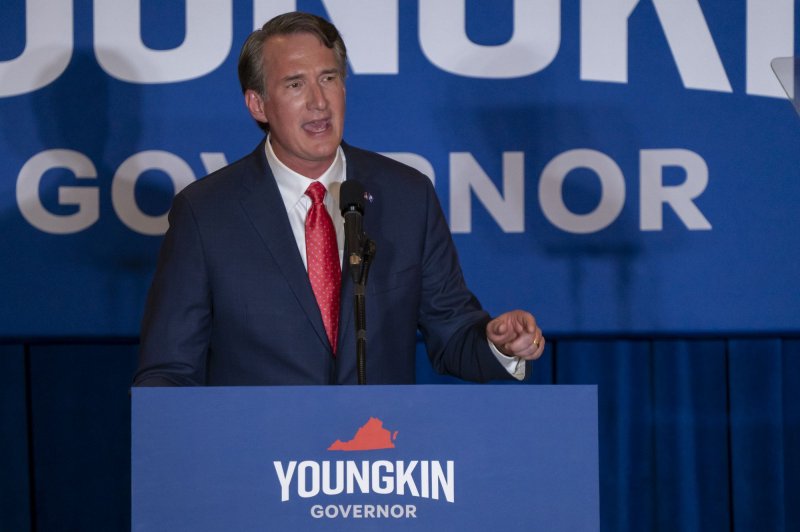
The Virginia Department of Education announced the guidelines, fulfilling a pledge by Republican Gov. Glenn Youngkin to get tougher on transgender issues in schools. The new rules will affect the more than 1 million children in the state's public school system.
"The 2022 model policy posted delivers on the governor's commitment to preserving parental rights and upholding the dignity and respect of all public school students," Macaulay Porter, a spokesman for Youngkin, said according to the New York Times.
Yet some students will now be losing the right to use bathrooms and locker rooms of their choice. They also will only be allowed to participate on sports teams that correspond with their sex assigned at birth.
If a student wishes to change their name and gender, they will now need an official legal document or court order. The harsher rules apply to teachers and other school officials too. They will only be allowed to refer to students by the pronouns associated with their sex at birth.
The ACLU of Virginia said that the new policies would only make it more difficult for transgender students to function and it would worsen the high rates of suicide.
"We are appalled by the Youngkin administration's overhaul of key protections for transgender students in public schools," the group wrote on Twitter.
Virginia joins a growing chorus of conservative states who are seeking to restrict the rights of transgender students.
There have been more than 200 anti-LGBTQ bills introduced at the state level this year alone, according to the LGBTQ rights group, Freedom for All Americans.
"Trans kids deserve to learn and thrive in an environment free of bullying, intimidation, and fear," Mike Mullin, a Democratic member of the state House of Delegates, said on Twitter on Friday. "That means being addressed as who they are and supported for who they will be. Especially from their teachers and their administrators."
Disaster Capitalism in the Wake of COVID -19 February 2021 Authors: Malini Balamayuran
Abstract The COVID-19 pandemic has disrupted and impacted people's lives profoundly all around the world. The United Nations has urged all governments to embrace a cooperative and human rights-based approach, when adapting measures to cure and curb the worldwide pandemic. A plethora of subsisting commentary presents the view that moments of crisis generally elongate a state of exception for capitalist corporations and businesses to grow and evolve widely. Particularly, the in-depth analysis of 'disaster capitalism' by Naomi Klein presents the view that any crisis situation is manipulated by the largest corporations and businesses to put in place a series of desired free-market policies that may otherwise have taken decades to take effect. This article primarily examines the ways in which the responses to the COVID-19 of the neo-liberal governments favor the capitalist corporations' agenda that were deferred or deprioritized in pre-pandemic times. Based on the primary and secondary sources, it has been found that neo-liberal governments have attempted to manipulate this current global health crisis to serve the way that automatically boosts higher profits for corporations and businesses. Therefore, this study concludes that the current global health pandemic has extended the agents of capitalism another perfect chance albeit at an immense human and environmental cost.
THE EFFECTS OF NATURAL DISASTER CAPITALISM ON INDUSTRY PROFIT 1
How Could Home Improvement Corporations That Benefit From Natural Disasters Contribute More Sustainable Aid to Coastal Communities Most at Risk From Climate Change?
Word Count: 4000
Allende Miglietta
THE EFFECTS OF NATURAL DISASTER CAPITALISM ON INDUSTRY PROFIT 2 May 2019
Abstract With a newer theory of disaster capitalism on the rise, this research examines how home improvement corporations along the United States coast are taking advantage of major natural disasters with increased revenue from sales while raising prices on their goods in people's' greatest time of need. Communities along the coast would be less likely to accept the corporate intrusions under normal circumstances. Instead, this paper argues for home improvement corporations to contribute towards more sustainable aid to coastal communities most at risk from climate change. As greenhouse gases continue to be emitted into the atmosphere, more powerful natural disasters will continue to strike-especially with an increase in global warming. This raises the question: How could home improvement corporations that benefit from natural disasters contribute more sustainable aid to coastal communities most at risk from climate change? There is a gap in analyzing how to push home improvement corporations to contribute more sustainable aid, along with analyzing which communities might not survive rising ocean flooding. Within the topic of natural disaster capitalism, the most common methodology varies depending on the factors of the environment, the economy, and aid. The best approaches would be (1) for beneficiary corporations to minimize their carbon footprint; (2) for beneficiary corporations to come together and agree on ways to provide more sustainable aid to coastal communities most at risk after natural disasters; and (3) for local governments to pass legislation requiring benefiting corporations from disaster capitalism, or those contribute most to global warming, to increase sustainable aid. The aim of this research is to bring equitable and sustainable aid to coastal communities along the United States coast while examining how corporations must play a greater role in slowing or resolving global warming and climate change.
GOP Seizes on Biden's 'Pandemic Is Over' Remark to Demand Medicaid Cuts
On top of pushing for an end to pandemic-related Medicaid funding, Republican Sen. Richard Burr also asked the president whether he plans to "rescind" his student debt forgiveness plan.
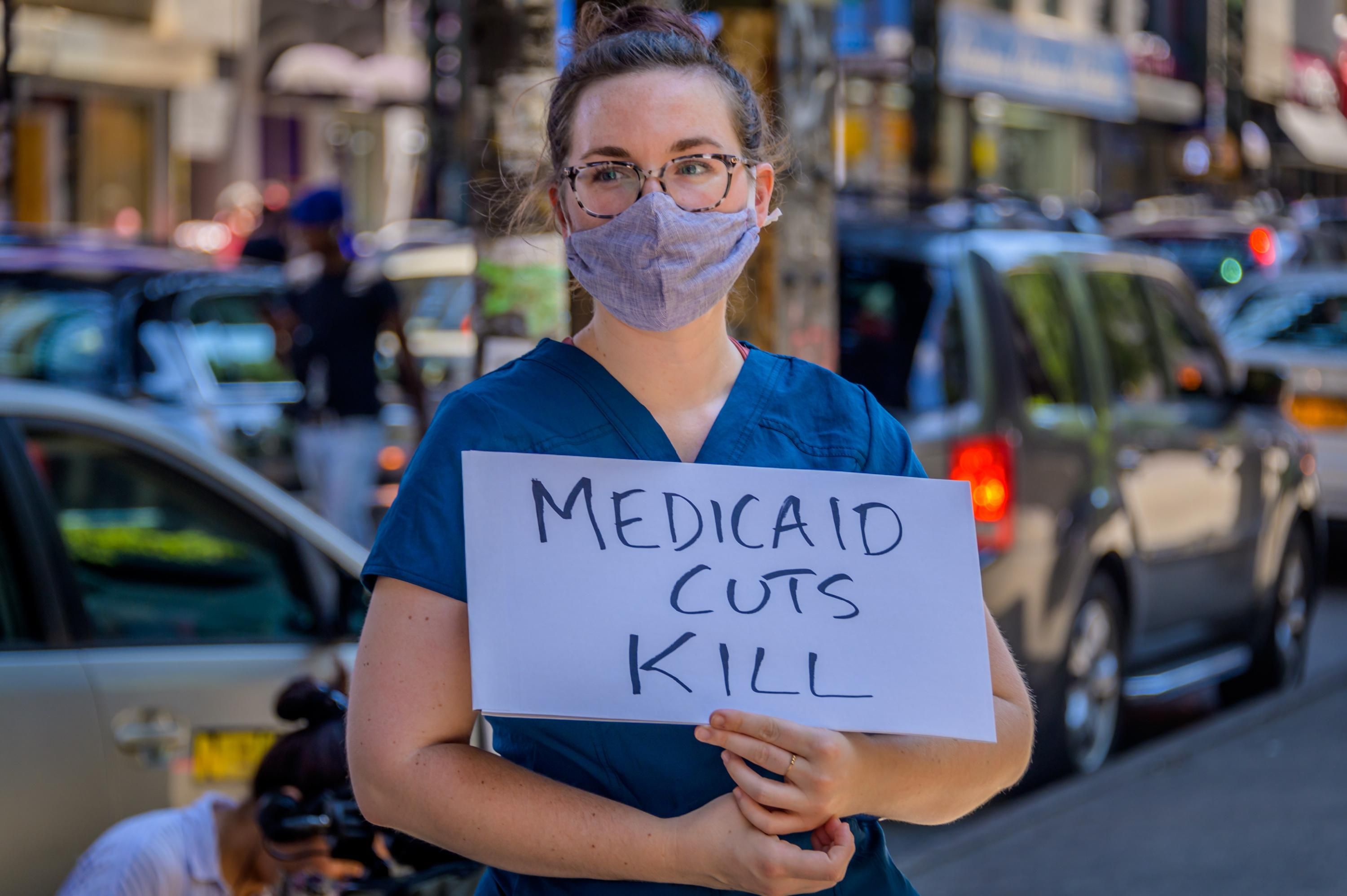
A demonstrator holds a "Medicaid Cuts Kill" sign at a rally in New York
on July 9, 2020. (Photo: Erik McGregor/LightRocket via Getty Images)
Congressional Republicans on Monday wasted no time seizing on President Joe Biden's widely criticized claim that the "pandemic is over" to demand a slew of policy changes with potentially disastrous public health implications, including Medicaid funding cuts that could result in millions losing coverage.
Sen. Richard Burr (R-N.C.), the top Republican on the Senate Health, Education, Labor, and Pensions Committee, wrote in a letter to Biden that he "watched with great interest" the "60 Minutes" interview in which the president said that while the United States still has "a problem with Covid," the pandemic has come to an end.
"Saying the pandemic is 'over' is likely to eliminate the possibility of any additional Covid response funding from Congress."
If that's the case, the North Carolina Republican asked Biden, "how do you justify spending tens of billions to keep people on Medicaid who would otherwise make too much money to qualify for the program and already have employer-sponsored insurance?"
Burr was referring to a provision of the 2020 CARES Act that gives states a 6.2-percentage-point boost in Medicaid funding for the duration of the federally declared public health emergency, which is currently set to end on October 13.
In exchange for the funding increase, states are barred from dropping people from Medicaid without their consent—a rule that has allowed millions of people across the U.S. to maintain continuous health coverage amid mass layoffs and other pandemic-induced turmoil.
Recent increases in Medicaid coverage helped drive an overall decline in the number of Americans without any health insurance last year.
If the Biden administration were to formally declare an end to the public health emergency—as Burr and other Republicans have made clear they want—the funding boost would end, the continuous coverage requirement would lapse, and around 15 million people could be kicked off Medicaid, including millions of children.
Biden's Health and Human Services Department (HHS) has estimated that nearly half of the 15 million set to lose coverage could be stripped of Medicaid benefits by states despite still being eligible for the program. According to HHS, that's because of "administrative churning... which can occur if enrollees have difficulty navigating the renewal process, states are unable to contact enrollees due to a change of address, or other administrative hurdles."
In addition to the pandemic-related Medicaid provisions, Burr also targeted a slew of other measures, including masking and vaccination guidance as well as "policies that prevent manufacturers of Covid-19 countermeasures from selling their products within the commercial market."
Burr also asked whether the Biden administration plans to "rescind [his] student loan forgiveness decision" given that the legal justification for the move rests on emergency powers.
The president's comments, which aired Sunday, reportedly caught top members of his administration off guard, particularly given that they came as the White House is pushing Congress to approve billions of dollars in additional funding for Covid-19 vaccines and treatments.
Republicans who have long opposed the Biden administration's push for more coronavirus funding signaled after the president's remarks aired Sunday that they intend to block new pandemic money.
"Saying the pandemic is 'over' is likely to eliminate the possibility of any additional Covid response funding from Congress (granted, chances were already low)," tweeted Josh Michaud, associate director of global health at the Kaiser Family Foundation.
Our work is licensed under Creative Commons (CC BY-NC-ND 3.0). Feel free to republish and share widely.
Near Miss at Second Ukraine Plant Intensifies Fears of Nuclear Disaster
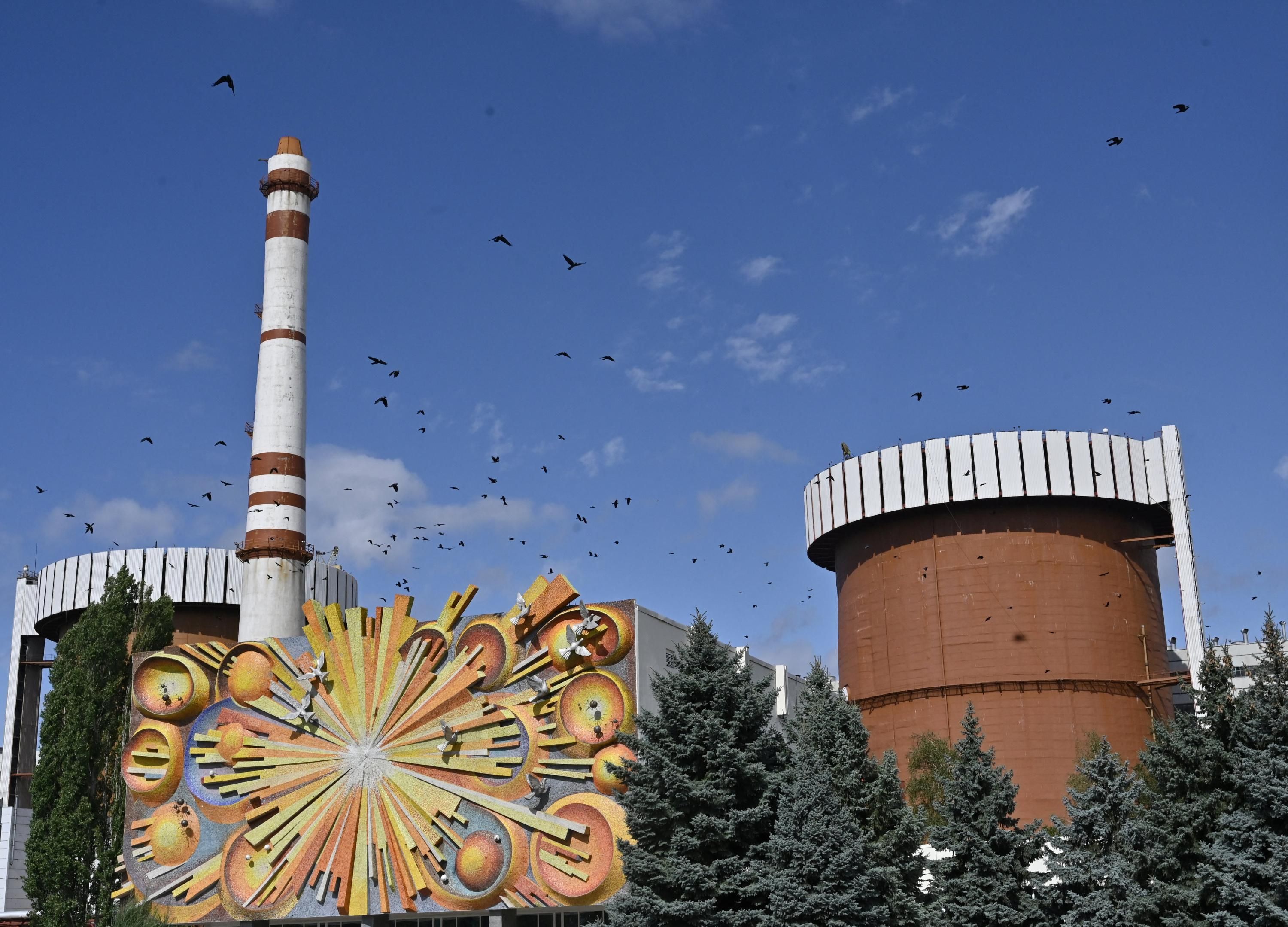
The IAEA director general said the "explosion near the South Ukraine Nuclear Power Plant all too clearly demonstrates the potential dangers also at other nuclear facilities in the country." A picture taken in Yuzhnoukrainsk on September 20, 2022 shows the South Ukraine Nuclear Power Plant the day after the nation's nuclear energy operator, Energoatom, accused Russia of attacking the facility. (Photo: Genya Savilov/AFP via Getty Images)
Concerns about Russia's war on Ukraine sparking a nuclear disaster are growing after a missile on Monday hit within 1,000 feet of a Ukrainian power plant amid alarm over the security of another Russian-held energy facility.
"There is no other way to characterize this except for nuclear terrorism."
The missile struck near the South Ukraine Nuclear Power Plant (SUNPP), which is about 160 miles west of the six-reactor Zaporizhzhia Nuclear Power Plant (ZNPP), Europe's largest such station. Shelling of that Russian-controlled facility—which Russia and Ukraine have blamed on each other—has fueled fears of a disaster in the nation home to Chernobyl.
Rafael Mariano Grossi, director general of the International Atomic Energy Agency (IAEA), addressed both the missile strike close to the SUNPP and a disconnected power line that had provided the ZNPP with electricity from the Ukrainian grid in a statement Monday.
"The situation at the Zaporizhzhya Nuclear Power Plant remains fragile and precarious. Last week, we saw some improvements regarding its power supplies, but today we were informed about a new setback in this regard," he said. "The plant is located in the middle of a war zone, and its power status is far from safe and secure. Therefore, a nuclear safety and security protection zone must urgently be established there."
"While we have recently focused on the urgent need for action to prevent a nuclear accident at Ukraine's Zaporizhzhya Nuclear Power Plant—establishing an IAEA presence there earlier this month—today's explosion near the South Ukraine Nuclear Power Plant all too clearly demonstrates the potential dangers also at other nuclear facilities in the country," Grossi added. "Any military action that threatens nuclear safety and security is unacceptable and must stop immediately."
Energoatom, the state-run operator of Ukraine's four nuclear stations, said that Russian forces "carried out a missile attack on the industrial site" of the SUNPP. No staff was harmed and all three reactors "are operating in a normal mode," but the "powerful explosion" damaged buildings, broke over 100 windows, and shut down a hydropower unit as well as three high-voltage power lines.
"Acts of nuclear terrorism committed by the Russian military threaten the whole world," Energoatom added. "They should be stopped immediately to prevent a new disaster!"
The head of the nuclear operator and a Ukrainian official issued similar warnings, according to The New York Times:
"There is no other way to characterize this except for nuclear terrorism," Petro Kotin, the head of Energoatom, told Ukrainian national television on Monday. He said that although the heavily fortified concrete buildings that house nuclear reactors are built to withstand a plane crash, the blast from the overnight strike would have been powerful enough to have damaged the containment structures, had the missile struck closer.
"A few hundred meters and we would have woken up in a completely different reality," Kyrylo Tymoshenko, the deputy head of the Ukrainian president's office, said in a statement.
The Associated Press reported that while the Russian Defense Ministry did not immediately comment on the missile strike, Patricia Lewis, the international security research director at the Chatham House think tank in London, said that attacks on the plants suggest Russia is trying to shut down both power stations before winter.
"It's a very, very dangerous and illegal act to be targeting a nuclear station," she told the AP. "Only the generals will know the intent, but there's clearly a pattern."
"What they seem to be doing each time is to try to cut off the power to the reactor," Lewis continued. "It's a very clumsy way to do it, because how accurate are these missiles?"
Responding to the strike near SUNPP, Beyond Nuclear said Monday that "until now, all eyes have been focused on the six-reactor Zaporizhzhia nuclear plant, far closer to the most intense of the military action. But there are four operational nuclear sites in Ukraine with 15 reactors total, all of which present a grave danger should the fighting embroil them."
The U.S.-based advocacy group also noted that "at Beyond Nuclear, we have been warning about these risks since before Russia invaded Ukraine on February 24."
Our work is licensed under Creative Commons (CC BY-NC-ND 3.0). Feel free to republish and share widely.
Ukraine warns of ‘nuclear terrorism’ after strike near plant
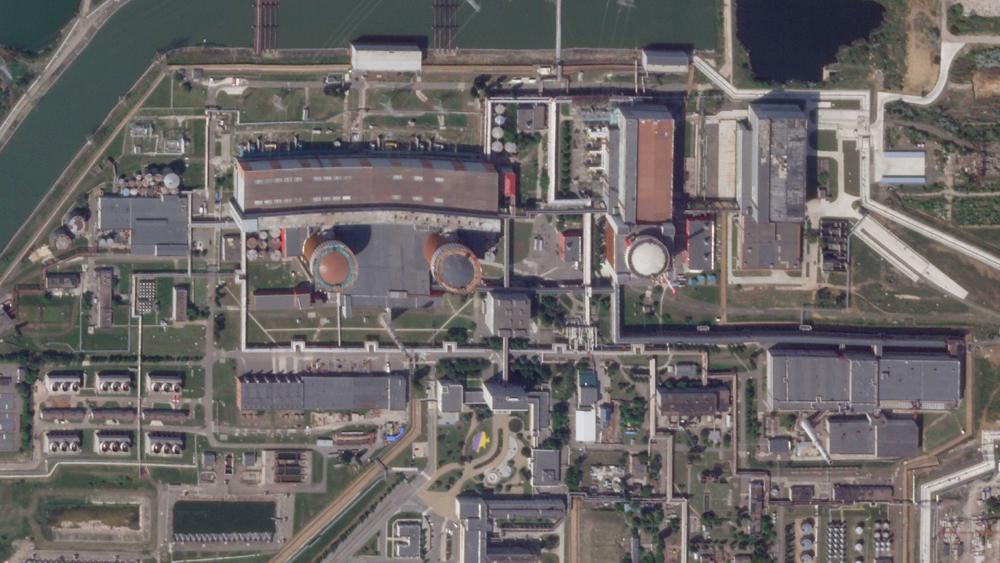
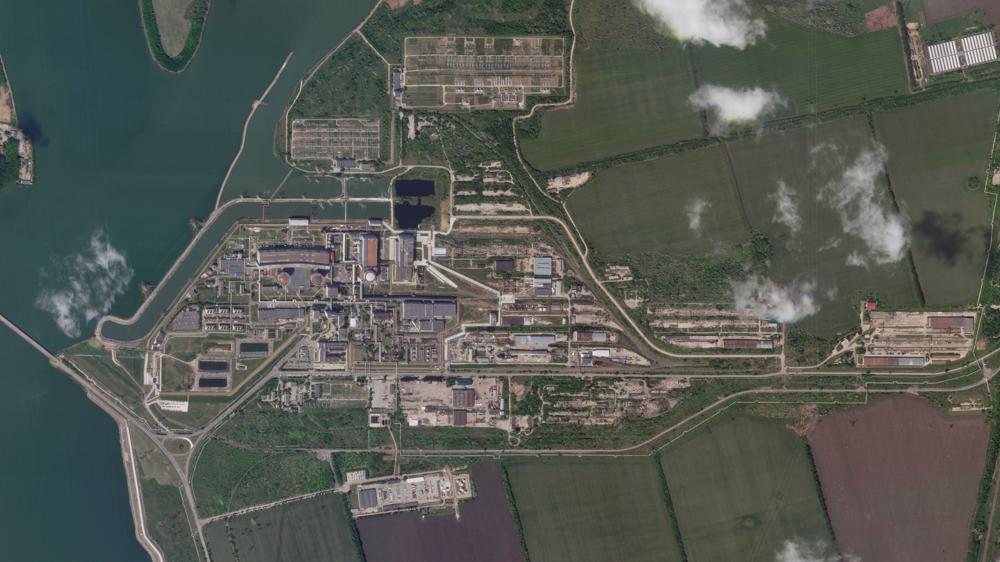
This satellite image from Planet Labs PBC shows the Pivdennoukrainsk Nuclear Power Plant, also known as the South Ukraine Nuclear Power Plant, in the southern Mykolaiv region of Ukraine, May 31, 2022. A Russian missile strike hit a facility close to the nuclear power plant in southern Ukraine Monday, Sept. 19, 2022, causing no damage to its reactors but damaging other industrial equipment in what the country's atomic energy operator denounced as an act of "nuclear terrorism."
(Planet Labs PBC via AP)
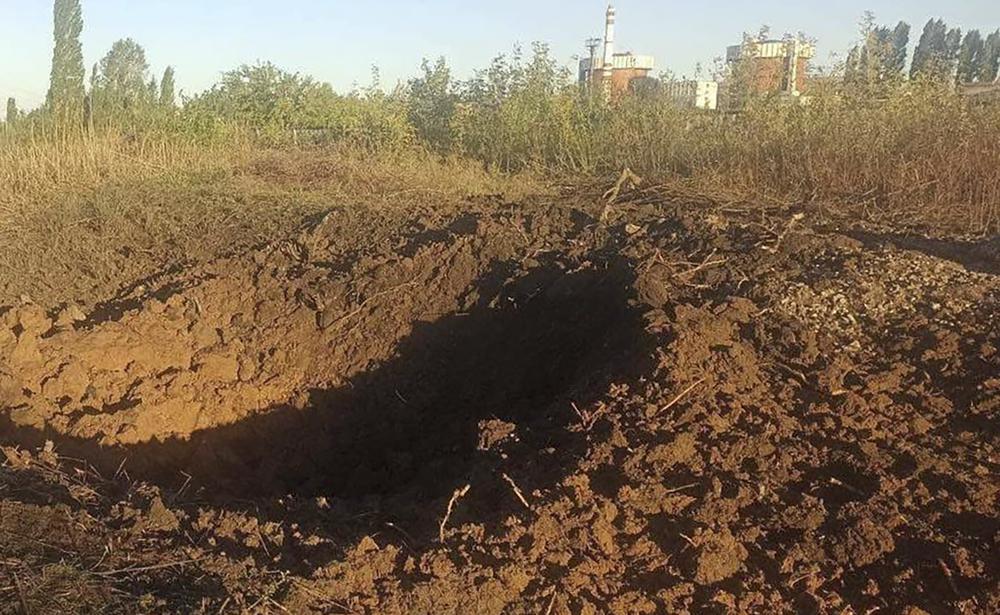
In this photo provided by the South Ukraine nuclear power plant, a crater left by a Russian rocket is seen 300 meter from the South Ukraine nuclear power plant, in the background, close to Yuzhnoukrainsk, Mykolayiv region, Ukraine, Monday, Sept. 19, 2022.
(South Ukraine Nuclear Power Plant Press Office via AP)
KYIV, Ukraine (AP) — A Russian missile blasted a crater close to a nuclear power plant in southern Ukraine on Monday, damaging nearby industrial equipment but not hitting its three reactors. Ukrainian authorities denounced the move as an act of “nuclear terrorism.”
The missile struck within 300 meters (328 yards) of the reactors at the South Ukraine Nuclear Power Plant near the city of Yuzhnoukrainsk in Mykolaiv province, leaving a hole 2 meters (6 1/2 feet) deep and 4 meters (13 feet) wide, according to Ukrainian nuclear operator Energoatom.
The reactors were operating normally and no employees were injured, it said. But the proximity of the strike renewed fears that Russia’s nearly 7-month-long war in Ukraine might produce a radiation disaster.
This nuclear power station is Ukraine’s second-largest after the Zaporizhzhia Nuclear Power Plant, which has repeatedly come under fire.
Following recent battlefield setbacks, Russian President Vladimir Putin threatened last week to step up Russian attacks on Ukrainian infrastructure. Throughout the war, Russia has targeted Ukraine’s electricity generation and transmission equipment, causing blackouts and endangering the safety systems of the country’s nuclear power plants.
The industrial complex that includes the South Ukraine plant sits along the Southern Bug River about 300 kilometers (190 miles) south of the capital, Kyiv. The attack caused the temporary shutdown of a nearby hydroelectric power plant and shattered more than 100 windows at the complex, Ukrainian authorities said. The U.N.’s International Atomic Energy Agency said three power lines were knocked offline but later reconnected.
Ukraine’s Defense Ministry released a black-and-white video showing two large fireballs erupting one after the other in the dark, followed by incandescent showers of sparks, at 19 minutes after midnight. The ministry and Energoatom called the strike “nuclear terrorism.”
The Russian Defense Ministry did not immediately comment on the attack.
Russian forces have occupied the Zaporizhzhia nuclear plant, Europe’s largest, since early after the invasion. Shelling has cut off the plant’s transmission lines, forcing operators to shut down its six reactors to avoid a radiation disaster. Russia and Ukraine have traded blame for the strikes.
The IAEA, which has stationed monitors at the Zaporizhzhia plant, said a main transmission line was reconnected Friday, providing the electricity it needs to cool its reactors.
But the mayor of Enerhodar, where the Zaporizhzhia plant is located, reported more Russian shelling Monday in the city’s industrial zone.
While warning Friday of a possible ramp-up of strikes, Putin claimed his forces had so far acted with restraint but warned “if the situation develops this way, our response will be more serious.”
“Just recently, the Russian armed forces have delivered a couple of impactful strikes,” he said. ”Let’s consider those as warning strikes.”
The latest Russian shelling killed at least eight civilians and wounded 22, Ukraine’s presidential office said Monday. The governor of the northeastern Kharkiv region, now largely back in Ukrainian hands, said Russian shelling killed four medical workers trying to evacuate patients from a psychiatric hospital and wounded two patients.
The mayor of the Russian-occupied eastern city of Donetsk, meanwhile, said Ukrainian shelling had killed 13 civilians and wounded eight there.
Patricia Lewis, the international security research director at the Chatham House think-tank in London, said attacks at the Zaporizhzhia plant and Monday’s strike on the South Ukraine plant indicated that the Russian military was attempting to knock Ukrainian nuclear plants offline before winter.
“It’s a very, very dangerous and illegal act to be targeting a nuclear station,” Lewis told The Associated Press. “Only the generals will know the intent, but there’s clearly a pattern.”
“What they seem to be doing each time is to try to cut off the power to the reactor,” she said. “It’s a very clumsy way to do it, because how accurate are these missiles?”
Power is needed to run pumps that circulate cooling water to the reactors, preventing overheating and — in a worst-case scenario — a radiation-spewing nuclear fuel meltdown.
Other recent Russian strikes on Ukrainian infrastructure have targeted power plants in the north and a dam in the south. They came in response to a sweeping Ukrainian counterattack in the country’s east that reclaimed Russia-occupied territory in the Kharkiv region.
Analysts have noted that beyond recapturing territory, challenges remain in holding it. In a video address Monday, Ukrainian President Volodymr Zelenskyy said cryptically of that effort, “I cannot reveal all the details, but thanks to the Security Service of Ukraine, we are now confident that the occupiers will not have any foothold on Ukrainian soil.”
The Ukrainian successes in Kharkiv — Russia’s biggest defeat since its forces were repelled from around Kyiv in the invasion’s opening stage — have fueled rare public criticism in Russia and added to the military and diplomatic pressure on Putin. The Kremlin’s nationalist critics have questioned why Moscow has failed to plunge Ukraine into darkness yet by hitting all of its major nuclear power plants.
In other developments:
— A governor said Ukraine had recaptured the village of Bilogorivka in the Russian-occupied eastern region of Luhansk. Russia didn’t acknowledge the claim.
— The Russian-installed leaders of Ukraine’s Luhansk, Donetsk and Kherson regions reiterated calls Monday for referendums to be held to tie their areas formally to Russia. These officials have discussed such plans before but the referendums have been repeatedly delayed, possibly because of insufficient popular support.
— The Supreme Court in the Russian-occupied region of Luhansk convicted a former interpreter for the Organization for Security and Cooperation in Europe and another person whose duties were not specified of high treason Monday. Both were sentenced to 13 years in prison.
—The Baltic nations of Estonia, Latvia and Lithuania closed their borders Monday to most Russian citizens in response to domestic support in Russia for the war in Ukraine. Poland will join the ban on Sept. 26.
— Mega-pop star Alla Pugacheva became the most prominent Russian celebrity to criticize the war, describing Russia in an Instagram post Sunday as “a pariah” and saying its soldiers were dying for “illusory goals.” Valery Fadeyev, the head of the Russian president’s Human Rights Council, accused Pugacheva of insincerely citing humanitarian concerns to justify her criticism and predicted that popular artists like her would enjoy less public influence after the war.
___
AP journalist John Leicester in Le Pecq, France, contributed.
Lula Up 16 Points Over Bolsonaro as Lead Grows Ahead of Brazilian Election
With less than two weeks to go, former leftist president ahead of far-right incumbent by double digits.
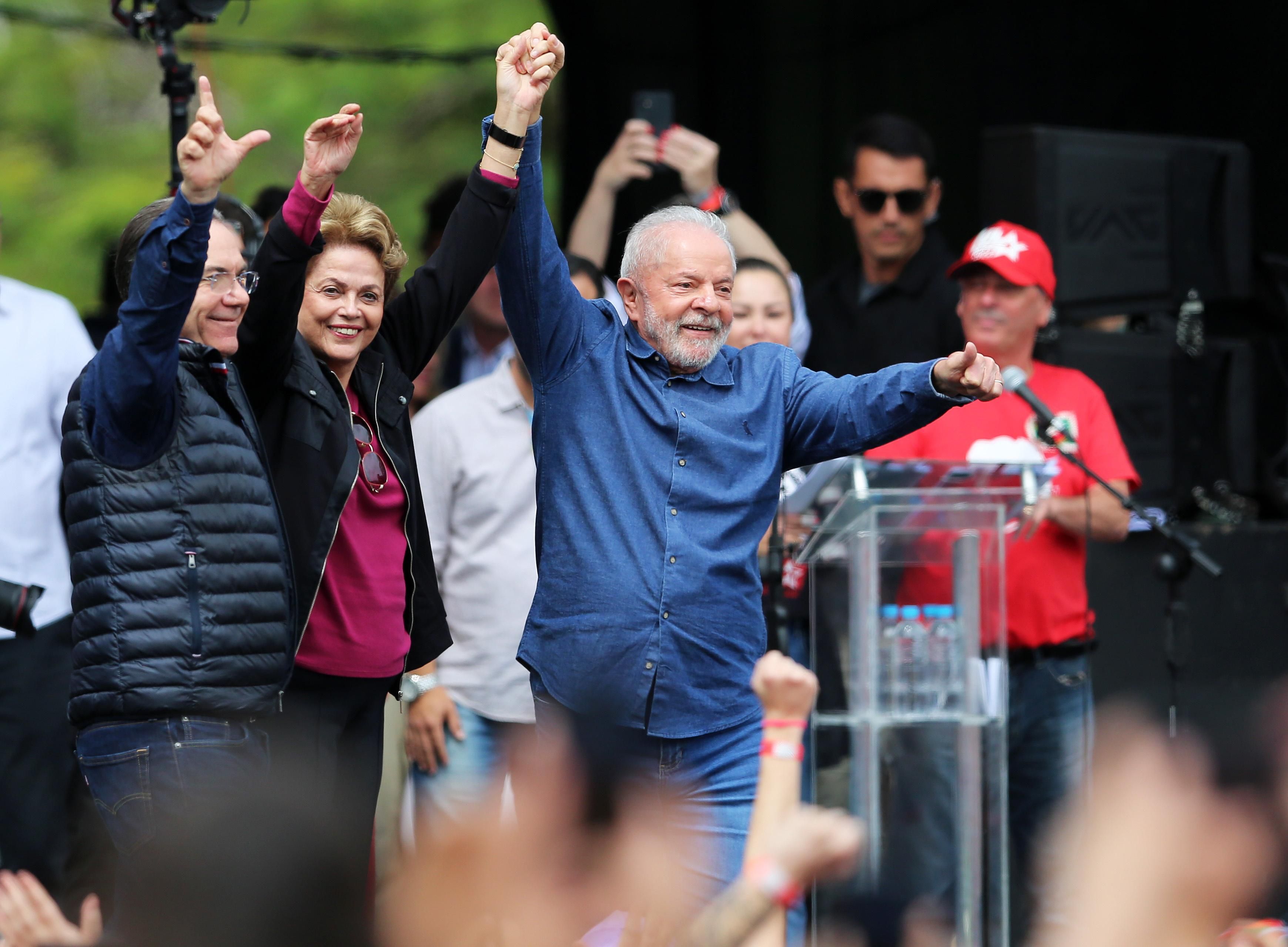
Brazilian presidential hopeful Luiz Inácio Lula da Silva holds up the hand of Dilma Rousseff, who is also a former president representing the leftist Workers' Party, at a campaign rally in Florianópolis, Santa Catarina on September 18, 2022. (Photo: Heuler Andrey/Getty Images)
With less than two weeks remaining until the first round of Brazil's presidential election, new polling figures show democratic socialist frontrunner Luiz Inácio Lula da Silva has slightly widened his double-digit lead over far-right incumbent President Jair Bolsonaro.
Brazilian pollster IPEC's latest survey shows da Silva leading Bolsonaro 47% to 31% in the first-round contest, which will take place on October 2. That's a one-point boost from the previous week's polling.
The IPEC poll also gives da Silva—the Workers' Party candidate who previously served as Brazil's 35th president from 2003 to 2010—a 19-point lead in a potential second-round runoff, which is scheduled for October 30 if no candidate wins over 50% of the vote in the first round.
Other pollsters also show da Silva enjoying a double-digit lead. Datafolha's most recent figures give da Silva a 45% to 33% edge over Bolsonaro in the first round, with 90% of surveyed voters having decided for whom they will vote.
Bolsonaro—an open admirer of the former U.S.-backed 1964-85 military dictatorship in whose army he served as an officer—has said he might not accept the results of the election if he loses. There are widespread fears in Brazil and beyond that a beaten Bolsonaro may attempt to foment a coup or an insurrection along the lines of the January 6, 2021 attack on the U.S. Capitol by supporters of defeated former President Donald Trump.
Da Silva has been drawing massive crowds of supporters at recent campaign events, including a Sunday rally in the southern city of Florianópolis where he said that when "every woman and every child is eating three times a day, I will have completed my life's mission."
Hunger and food insecurity—which was dramatically reduced through social programs like Fome Zero (Zero Hunger) and Bolsa Família (Family Allowance) during da Silva's first presidential term—have returned under Bolsonaro's right-wing economic and social policies.
Seven former Brazilian presidential candidates from various political parties on Monday called on voters to return da Silva to the Palácio da Alvorada.
"All Brazilian democrats must unite and avoid the tragedy that would be the re-election of the current president," said Cristovam Buarque, a former federal senator and member of the socialist party Cidadania who served as da Silva's education minister.
Also on Monday, Brazilian election authorities denounced a fake narrated video making the rounds on pro-Bolsonaro social media accounts showing the president leading da Silva 46% to 31%. Our work is licensed under Creative Commons (CC BY-NC-ND 3.0). Feel free to republish and share widely.
World-Renowned Economists Call for 'Emergency' Corporate Profit Taxes to Avert Global Recession
Governments have a choice, argues a new report: Impose austerity programs that harm the poor, or tax "the multinationals and the super-rich, many of whom have also benefited from the crisis."
People wait in a queue for hours hours to buy food and fuel on May 18, 2022
With warnings of a global economic meltdown on the rise as central banks jack up interest rates in their efforts to combat runaway inflation, a new report authored by world-renowned economists and advocates calls on governments to enact windfall profit taxes and other "emergency" measures to prevent an entirely avoidable disaster.
Published Tuesday, the report notes that "the battle against the global pandemic has left many governments vulnerable, saddling them with massive debts they took on as tax revenues fell, health needs soared, and as they strived to soften the economic blow." According to data from the Institute of International Finance, 32 emerging-market governments have a combined $83 billion in U.S.-dollar debt due in 2023.
"This is a case where the profits cannot be justified, and the uses of the funds are really imperative."
"Now developing countries confront spiraling energy and food prices, higher interest rates, and more volatile capital flows: the world is standing on the threshold of an economic slowdown, and the effects are once again disproportionately falling on most vulnerable households, exacerbating poverty and inequality," warns the new report launched by the Independent Commission for the Reform of International Corporate Taxation (ICRICT), an organization whose commissioners include Nobel laureate Joseph Stiglitz, University of Massachusetts at Amherst professor Jayati Ghosh, and Paris School of Economics professor Thomas Piketty.
The 27-page paper argues that governments have a fundamental choice in how to respond to the intertwined emergencies of an ongoing pandemic, war in Eastern Europe, supply chain disruptions, energy market chaos, high inflation, and worsening costs-of-living crises, which are fueling mass uprisings around the world as they threaten to push tens of millions more into poverty.
The new report says governments, in response, "can opt for austerity programs, cutting funding to public services and increasing the contribution of the poorest through inflation-enhanced consumption taxes, at the expense, once again, of the most vulnerable."
"Or they can decide to increase taxation on those who have so far failed to pay their fair share: the multinationals and the super-rich, many of whom have also benefited from the crisis," the report adds.
ICRICT lands strongly on the side of the latter solution, contending it would bring in crucial revenue from energy companies and other corporate giants exploiting the war and the pandemic and enable governments to "lessen the severity of this economic storm and counter the unacceptable levels of hunger, extreme poverty, and inequality."
"Bold taxation actions by governments in the short term could avoid the worst to come," the paper states. "It would also pave the way for more transformative tax systems in the medium term, while the international community overcomes the political impasse on how to better tax large multinational corporations in a digitalized world."
The paper was published in the wake of urgent warnings from major global institutions, including the World Bank and the International Monetary Fund, that central bank rate hikes have pushed the world to the brink of a massive recession.
During an ICRICT press conference last week, Stiglitz—who has been highly critical of central banks' approach to fighting inflation—argued that the case for a windfall profits tax is "very, very clear," pointing specifically to Europe's mounting economic woes.
"The revenues from that are necessary both to protect those who are being hurt very badly by the shock and by Europe's mistakes in structuring the electricity market—but also to make the investments to make the European economy more resilient," said Stiglitz. "So this is a case where the profits cannot be justified, and the uses of the funds are really imperative."
Windfall profits taxes have been pushed by some governments in recent months. India first imposed a surplus profits tax on oil companies in July, while the European Union has proposed a tax targeting the excess profits of fossil fuel giants and other energy firms that have been making a killing amid Russia's war on Ukraine.
The United Kingdom, meanwhile, approved a 25% windfall tax on oil and gas firms in May—but new right-wing Prime Minister Liz Truss has made clear she opposes windfall taxes and won't support any new ones.
Critics have lamented the limited nature of the windfall taxes pursued thus far. Chiara Putaturo, a tax expert at Oxfam E.U., said earlier this month that the European bloc's proposal is "a step forward but only addresses a part of the problem."
"We need a windfall tax that applies to all companies profiteering from the crisis," said Putaturo. "In the last two and a half years, big multinationals from a variety of sectors such as pharma, Big Tech, energy, and food have raked in enormous profits. Meanwhile, inflation is up and pushing more and more people into poverty. Revenues from a broad windfall tax will make sure that it is not the poorest who are paying the highest price."
Ghosh, ICRICT's co-chair, echoed that sentiment during last week's press conference, noting that pharmaceutical companies profited hugely from the pandemic and that "food multinationals have never had it so good."
"We are not regulating them. We are not taxing them. We are not preventing them from doing really terrible things, not just to people in developing countries but to the world and to the planet," said Ghosh. "It's extraordinary how government support of a few large companies is enabling a wide-scale increase in inequality, a massive destruction of our ecological foundations, and driving a very significant proportion of humanity into absolute starvation."
Our work is licensed under Creative Commons (CC BY-NC-ND 3.0). Feel free to republish and share widely.
"Those with the power and money to change this must come together to better respond to current crises and prevent and prepare for future ones," a coalition of charities asserted.
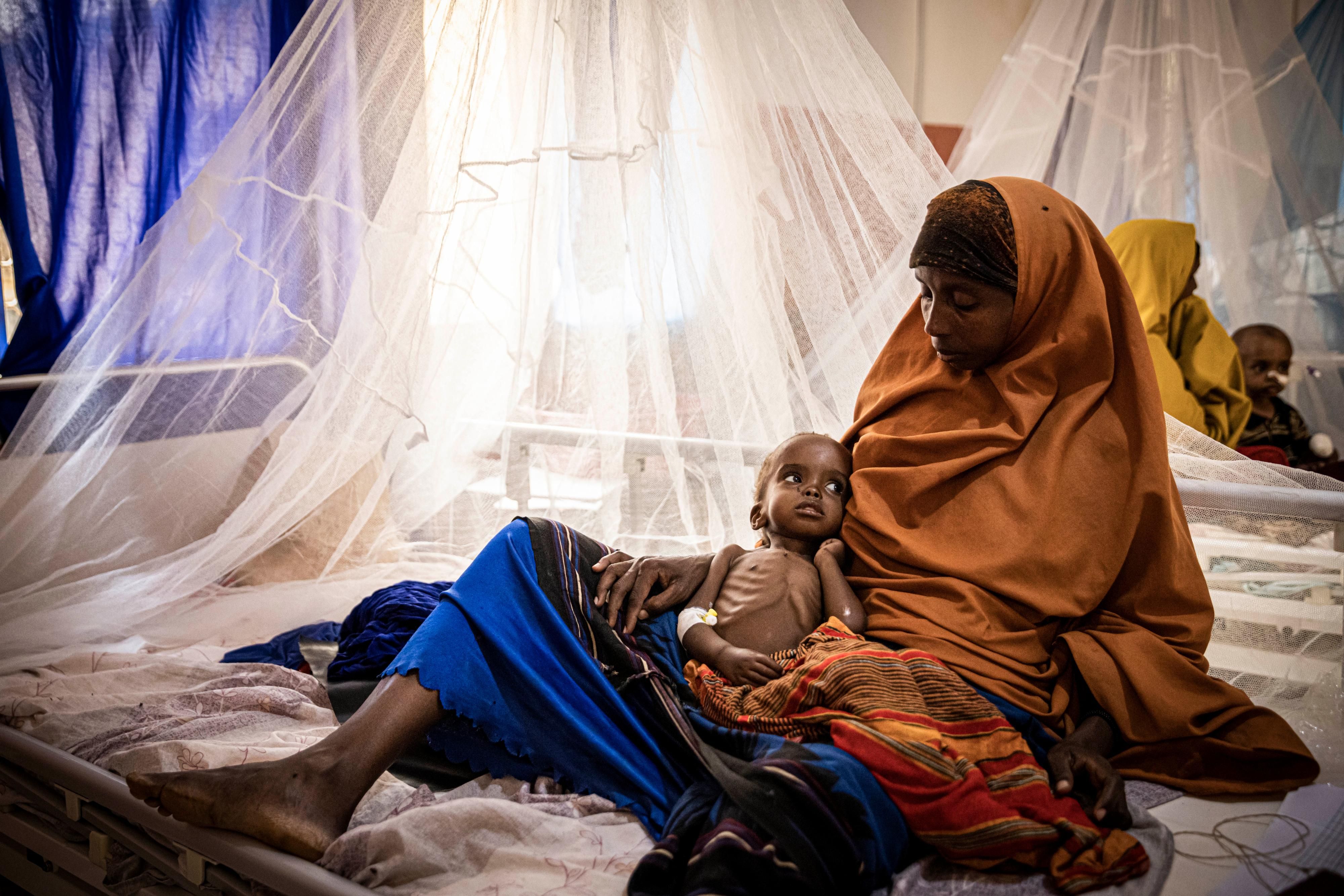
A mother holds her malnourished baby at a hospital in Baidoa,
Somalia on September 3, 2022. (Photo: Ed Ram/Getty Images)
As a new analysis revealed that the global ranks of the superrich soared to a record number, a coalition of charity groups said Tuesday that hundreds of millions of people around the world are hungry—and that someone starves to death every four seconds.
"This is about the injustice of the whole of humanity."
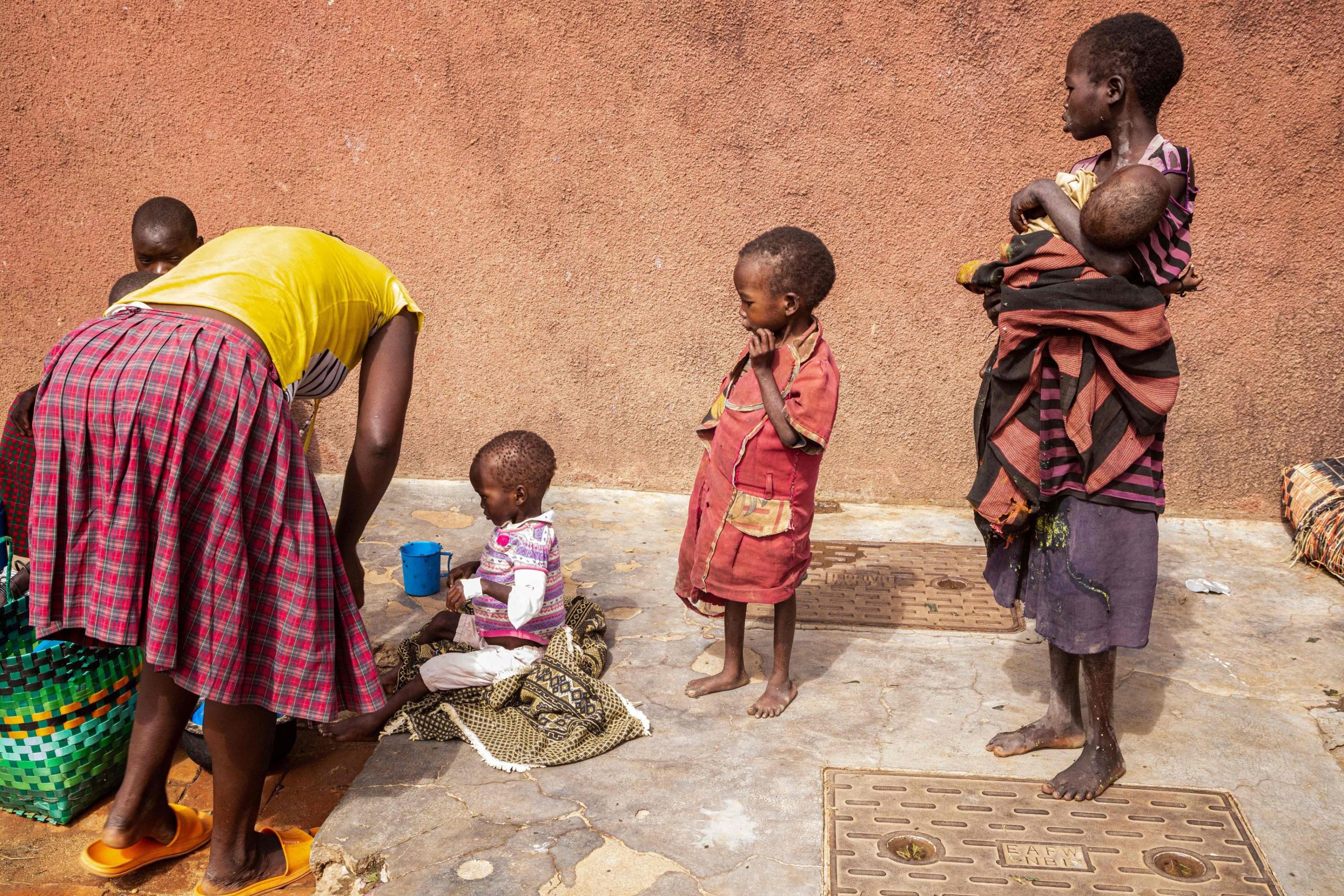
At least 238 international and local charities from 75 countries signed an open letter noting that "a staggering 345 million people are now experiencing acute hunger, a number that has more than doubled since 2019."
"Despite promises from world leaders to never allow famine again in the 21st century, famine is once more imminent in Somalia," the signers stated. "Around the world, 50 million people are on the brink of starvation in 45 countries."
The letter—which was timed to coincide with the annual meeting of the United Nations General Assembly in New York—asserts that "the global hunger crisis has been fueled by a deadly mix of poverty, social injustice, gender inequality, conflict, climate change, and economic shocks, with the lingering impacts of the Covid-19 pandemic and the crisis in Ukraine further driving up food prices and the cost of living."
"Those with the power and money to change this must come together to better respond to current crises and prevent and prepare for future ones," the signatories argued.
The number of those with the most money grew to a record number last year.
According to an analysis published Tuesday by Credit Suisse, there were 218,200 ultra-high net worth (UHNW) people in the world in 2021, an increase of 46,000 from the previous year. The share of the world's wealth held by the richest 1% of people also increased from 44% to 46% last year.
Credit Suisse said there were 62.5 million U.S. dollar millionaires on Earth, and that all the wealth in the world added up to $463.6 trillion, while attributing what one of the report's authors called the "explosion of wealth" to soaring home and stock values.
A separate report published in July by letter signatory Oxfam revealed that profits from soaring food prices have enriched billionaires around the world by a collective $382 billion.
Meanwhile, Sumaya, a 32-year-old mother of four living in a camp for internally displaced people in Ethiopia's Somali region, lamented her family's dire situation in the charity groups' letter: "No water, no food, a hopeless life."
"Above all, my children are starving," she said. "They are on the verge of death. Unless they get some food, I'm afraid they will die."
Last week, Oxfam published a report underscoring how the climate emergency is exacerbating extreme hunger. The report examined 10 of the world's worst climate hot spots, where 18 million people are on the brink of starvation.
Mohanna Ahmed Ali Eljabaly of the Yemen Family Care Association, which also signed the charities' letter, said that "it is abysmal that with all the technology in agriculture and harvesting techniques today we are still talking about famine in the 21st century."
"This is not about one country or one continent and hunger never only has one cause. This is about the injustice of the whole of humanity," she continued. "It is extremely difficult to see people suffering while others sharing the same planet have plenty of food."
"We must not wait a moment longer to focus both on providing immediate lifesaving food and longer-term support," Elhjabaly added, "so people can take charge of their futures and provide for themselves and their families."
Our work is licensed under Creative Commons (CC BY-NC-ND 3.0). Feel free to republish and share widely.
Polluters must pay, says UN chief, urges taxes to help climate victims
World leaders address the 77th Session of the United Nations General Assembly at U.N. Headquarters in New York City
Tue, September 20, 2022 By Michelle Nichols
UNITED NATIONS (Reuters) -U.N. chief Antonio Guterres on Tuesday urged rich countries to tax windfall profits of fossil fuel companies and use that money to help countries harmed by the climate crisis and people who are struggling with rising food and energy prices.
Addressing world leaders at the 193-member U.N. General Assembly, the climate activist secretary-general stepped up his attacks on oil and gas companies, which have seen their profits explode by tens of billions of dollars this year.
"The fossil fuel industry is feasting on hundreds of billions of dollars in subsidies and windfall profits while household budgets shrink and our planet burns," he said.
"Polluters must pay," he added.
While Guterres again pushed developed countries to tax the fossil fuel windfall profits, this time he also used his platform to spell out where the money should be spent.
"Those funds should be redirected in two ways: to countries suffering loss and damage caused by the climate crisis; and to people struggling with rising food and energy prices," he told the annual gathering of world leaders in New York.
Britain has passed a 25% windfall tax on oil and gas producers in the North Sea, while the European Union plans to raise more than 140 billion euros to shield consumers from soaring energy prices by taxing windfall profits from oil companies and electric generators. U.S. Democratic lawmakers have discussed a similar idea, though it faces long odds in a divided Congress.
While these plans focus on redirecting windfall profits to domestic consumers, the secretary general advocated for a tax that would be directed to the world's most climate vulnerable countries, which have been embracing the idea.
He also said multilateral development banks "must step up and deliver" and that helping poor countries adapt to worsening climate shocks "must make up half of all climate finance."
Guterres added: "Major economies are their shareholders and must make it happen."
The secretary general also broadened his criticism of oil and gas companies to enabling industries that he said helps keep carbon pollution growing, such as banks and other financial institutions that invest in those companies and the public relations and advertising industries.
"Just as they did for the tobacco industry decades before, lobbyists and spin doctors have spewed harmful misinformation," Guterres said. "Fossil fuel interests need to spend less time averting a PR disaster – and more time averting a planetary one."
(Reporting by Michelle Nichols; Additional reporting by Valerie Volcovici in Washington; Editing by Jonathan Oatis and Aurora Ellis)