Wednesday, September 21, 2022

EU health regulator says COVID pandemic not over, contradicting U.S. President 


Exterior of European Medicines Agency is seen in Amsterdam

Tue, September 20, 2022 

FRANKFURT (Reuters) -An official at the European Union's drugs regulator said on Tuesday the COVID-19 pandemic was not over, contradicting U.S. President Joe Biden, and that a planned vaccination campaign in the region during the cold season was key to fighting it.

"We in Europe still consider the pandemic as ongoing and it's important that member states prepare for rollout of the vaccines and especially the adaptive vaccines to prevent further spread of this disease in Europe," the European Medicines Agency's (EMA) Chief Medical Officer Steffen Thirstrup told a media briefing, referring to vaccines targeting specific strains of the virus.

He was asked to comment on Biden's remark in an interview broadcast on Sunday that "the pandemic is over".

"I cannot obviously answer why President Biden came to that conclusion," Thirstrup said.

The World Health Organization has said the pandemic remains a global emergency but the end could be in sight if countries use the tools at their disposal.

During the media briefing, EMA officials reaffirmed a call by the agency's Executive Director Emer Cooke made last week in a Reuters Next Newsmaker interview that people in Europe should take whatever COVID-19 booster is available and recommended to them in the coming months.

Apart from the original COVID vaccines, the EMA has in recent weeks endorsed a number of vaccines adapted to the Omicron variant of the virus for use as booster shots to ease the burden from a feared surge in infections during autumn and winter in Europe.

The EMA's head of vaccines strategy, Marco Cavaleri, said the agency was also looking into the use of the adapted shots as a primary course of vaccination and that there were discussions on the types of data that could support such an approval

(Reporting by Ludwig Burger Editing by Madeline Chambers and Mark Potter)

Fauci tempers Biden’s declaration that pandemic is ‘over’


Anna Moneymaker/Getty Images North America/TNS

Theresa Braine, New York Daily News
Tue, September 20, 2022 

Not so fast, Mr. President. Outgoing presidential COVID adviser Dr. Anthony Fauci on Monday walked back President Joe Biden’s assertion that the coronavirus pandemic was “over.”

A lot depends on how we respond to current variables and future virus variants, the nation’s top infectious disease expert said during a fireside chat with the Center for Strategic and International Studies. And much of that is up to the American people.

“How we respond and how we’re prepared for the evolution of these variants is going to depend on us,” Fauci said. “And that gets to the other conflicting aspect of this — is the lack of a uniform acceptance of the interventions that are available to us in this country where even now, more than two years, close to three years, into the outbreak, we have only 67% of our population vaccinated and only one-half of those have received a single boost.”

Biden cited the dropping infection, death and hospitalization rate, as well as the fact that people were relaxing protective protocols when he spoke to “60 Minutes” anchor Scott Pelley.

“The pandemic is over,” Biden declared in answer to Pelley’s question during an interview that aired Sunday night.

Fauci had a slightly more tempered take.

“We are not where we need to be if we are going to quote ‘live with the virus’ because we know we are not going to eradicate it,” Fauci said. “The next question we ask: ‘Are we going to be able to eliminate it from our country or from most of the world?’ and the answer is unlikely, because it is highly transmissible and the immunity that’s induced by vaccine or infection is also transient.”

COVID-19 is still killing nearly 400 people daily, and though the pandemic is “heading in the right direction,” that did not preclude a resurgence caused by yet another variant, Fauci said.

The pandemic phase of the coronavirus outbreak certainly does seem to be ebbing, as even World Health Organization Director-General Tedros Adhanom Ghebreyesus said last week.

“We are not there yet, but the end is in sight,” he said at a press conference in Geneva, with worldwide deaths from the novel coronavirus dropping to levels matching those at the beginning of the pandemic in March 2020.

It’s not clear how much of that drop is due to cases simply not being detected, given that countries worldwide have been relaxing protocols in recent weeks and months, even as the omicron BA.5 variant has taken over.

Fauci says ‘we are not where we need to be’ after Biden declares ‘pandemic is over’


Olafimihan Oshin
Mon, September 19, 2022 

Anthony Fauci, the nation’s top infectious disease expert, said Monday that the U.S. is not where it needs to be regarding the coronavirus pandemic, the day after an interview with President Biden was broadcast in which Biden said that the “pandemic is over.”

In a talk with the Center for Strategic and International Studies, Fauci, Biden’s top COVID-19 adviser who last month announced his pending retirement from the government, said that much depends on how the country handles future virus variants.

“How we respond and how we’re prepared for the evolution of these variants is going to depend on us. And that gets to the other conflicting aspect of this — is the lack of a uniform acceptance of the interventions that are available to us in this country where even now, more than two years, close to three years, into the outbreak, we have only 67 percent of our population vaccinated and only one-half of those have received a single boost,” Fauci said.

He noted that the country is still experiencing more than 400 daily deaths due to COVID-19, though that number is down from a year earlier.

“But we are not where we need to be if we’re going to be able to, quote, ‘live with the virus,’ because we know we’re not going to eradicate it. We only did that with one virus, which is smallpox, and that was very different because smallpox doesn’t change from year to year, or decade to decade, or even from century to century,” Fauci added.

“And we have vaccines and infection that imparts immunity that lasts for decades and possibly lifetime.”

The Hill has reached out to the White House for further comment.

In a “60 Minutes” interview that ran Sunday, Biden, who recently recovered from a COVID-19 breakthrough case, told CBS News correspondent Scott Pelley that the country seems to be in “good shape” to move past the pandemic phase.

“The pandemic is over,” Biden said. “We still have a problem with COVID. We’re still doing a lotta work on it. It’s — but the pandemic is over. if you notice, no one’s wearing masks. Everybody seems to be in pretty good shape. And so I think it’s changing. And I think this is a perfect example of it.”
CRIMINAL CAPITALI$M
Feds: Minnesota food scheme stole $250M; 47 people charged

AMY FORLITI
Tue, September 20, 2022 

MINNEAPOLIS (AP) — Federal authorities charged 47 people in Minnesota with conspiracy and other counts in what they said Tuesday was the largest fraud scheme yet to take advantage of the COVID-19 pandemic by stealing $250 million from a federal program that provides meals to low-income children.

Prosecutors say the defendants created companies that claimed to be offering food to tens of thousands of children across Minnesota, then sought reimbursement for those meals through the U.S. Department of Agriculture's food nutrition programs. Prosecutors say few meals were actually served, and the defendants used the money to buy luxury cars, property and jewelry.

“This $250 million is the floor," Andy Luger, the U.S. attorney for Minnesota, said at a news conference. “Our investigation continues.”

Many of the companies that claimed to be serving food were sponsored by a nonprofit called Feeding Our Future, which submitted the companies' claims for reimbursement. Feeding Our Future’s founder and executive director, Aimee Bock, was among those indicted, and authorities say she and others in her organization submitted the fraudulent claims for reimbursement and received kickbacks.

Bock’s attorney, Kenneth Udoibok, said the indictment “doesn’t indicate guilt or innocence.” He said he wouldn't comment further until seeing the indictment.

In interviews after law enforcement searched multiple sites in January, including Bock's home and offices, Bock denied stealing money and said she never saw evidence of fraud.

Earlier this year, the U.S. Department of Justice made prosecuting pandemic-related fraud a priority. The department has already taken enforcement actions related to more than $8 billion in suspected pandemic fraud, including bringing charges in more than 1,000 criminal cases involving losses in excess of $1.1 billion.

Federal officials repeatedly described the alleged fraud as “brazen,” and decried that it involved a program intended to feed children who needed help during the pandemic. Michael Paul, special agent in charge of the Minneapolis FBI office, called it “an astonishing display of deceit."

Luger said the government was billed for more than 125 million fake meals, with some defendants making up names for children by using an online random name generator. He displayed one form for reimbursement that claimed a site served exactly 2,500 meals each day Monday through Friday — with no children ever getting sick or otherwise missing from the program.

“These children were simply invented,” Luger said.

He said the government has so far recovered $50 million in money and property and expects to recover more.

The defendants in Minnesota face multiple counts, including conspiracy, wire fraud, money laundering and bribery. Luger said some of them were arrested Tuesday morning.

According to court documents, the alleged scheme targeted the USDA's federal child nutrition programs, which provide food to low-income children and adults. In Minnesota, the funds are administered by the state Department of Education, and meals have historically been provided to kids through educational programs, such as schools or day care centers.

The sites that serve the food are sponsored by public or nonprofit groups, such as Feeding Our Future. The sponsoring agency keeps 10% to 15% of the reimbursement funds as an administrative fee in exchange for submitting claims, sponsoring the sites and disbursing the funds.

But during the pandemic, some of the standard requirements for sites to participate in the federal food nutrition programs were waived. The USDA allowed for-profit restaurants to participate, and allowed food to be distributed outside educational programs. The charging documents say the defendants exploited such changes “to enrich themselves."

The documents say Bock oversaw the scheme and that she and Feeding Our Future sponsored the opening of nearly 200 federal child nutrition program sites throughout the state, knowing that the sites intended to submit fraudulent claims.

“The sites fraudulently claimed to be serving meals to thousands of children a day within just days or weeks of being formed and despite having few, if any staff and little to no experience serving this volume of meals,” according to the indictments.

One example described a small storefront restaurant in Willmar, in west-central Minnesota, that typically served only a few dozen people a day. Two defendants offered the owner $40,000 a month to use his restaurant, then billed the government for some 1.6 million meals through 11 months of 2021, according to one indictment. They listed the names of around 2,000 children — nearly half of the local school district's total enrollment — and only 33 names matched actual students, the indictment said.

Feeding Our Future received nearly $18 million in federal child nutrition program funds as administrative fees in 2021 alone, and Bock and other employees received additional kickbacks, which were often disguised as “consulting fees” paid to shell companies, the charging documents said.

According to an FBI affidavit unsealed earlier this year, Feeding Our Future received $307,000 in reimbursements from the USDA in 2018, $3.45 million in 2019 and $42.7 million in 2020. The amount of reimbursements jumped to $197.9 million in 2021.

Court documents say the Minnesota Department of Education was growing concerned about the rapid increase in the number of sites sponsored by Feeding Our Future, as well as the increase in reimbursements.

The department began scrutinizing Feeding Our Future’s site applications more carefully, and denied dozens of them. In response, Bock sued the department in November 2020, alleging discrimination, saying the majority of her sites were based in immigrant communities. That case has since been dismissed.
CRIMINAL CAPITALI$M
AMP handed $9.7 million penalty for charging pensioners 'fees for no service'


 The logo of AMP Ltd, Australia's biggest retail wealth manager, adorns their head office located in central Sydney, Australia

Mon, September 19, 2022 

(Reuters) - Wealth manager AMP Ltd was handed a penalty of A$14.5 million ($9.74 million) on Tuesday by Australia's Federal court for charging customers with 'fees for no service' on their corporate pension accounts.

The Australian Securities and Investment Commission (ASIC) had alleged in 2018 that companies related to the wealth manager charged fees from customers despite being notified that they were no longer able to access the advice.

Between July 2015 and September 2018, AMP entities deducted A$356,188 in fees even though they were aware that the members had ceased their employment and could no longer receive advice services, the court found.

AMP had acknowledged the claims and said it self-reported the issue to the regulator in 2018 and provided remediation to affected customers in November 2019.

"Although AMP has remediated A$691,032 to affected customers, the court found AMP failed to investigate whether or not there was a systemic issue, despite many complaints over a lengthy period of time," ASIC said.

The penalty received on Tuesday has already been provisioned in the 2022 half-yearly financial statement, AMP said.

"Superannuation trustees should treat the penalty imposed today as an important reminder to maintain robust internal governance and assurance arrangements," ASIC Deputy Chair Sarah Court said.

AMP has been embroiled in scandals surrounding its practices and corporate culture, including allegations that five related companies charged life insurance premiums and advice fees to more than 2,000 customers after their deaths.

A Royal Commission inquiry in 2018 found that the 172-year-old firm engaged in "unconscionable" conduct and Australia's biggest banks broke laws when providing financial advice.

(This story refiles to correct currency in third and fifth paragraphs to A$)

($1 = 1.4890 Australian dollars)

(Reporting by Harish Sridharan in Bengaluru; Editing by Dhanya Ann Thoppil and Subhranshu Sahu)
Major U.S. banks threaten to leave Mark Carney's climate alliance - FT


Wed, September 21, 2022 

COP26 in Glasgow


(Reuters) - Major Wall Street banks have threatened to leave United Nations climate envoy Mark Carney's financial alliance over legal risks, the Financial Times reported on Wednesday, citing several people involved in internal talks.

Morgan Stanley, JPMorgan and Bank of America are among the banks that are weighing an exit as they fear being sued over the alliance's stringent decarbonisation commitments, the report said.   
https://on.ft.com/3RZv9Cl

The Glasgow Financial Alliance for Net Zero (GFANZ), set up in 2021 by former Bank of England governor Carney, is a coalition of assets managers, banks and insurance firms representing $130 trillion in assets directed toward tackling climate change.


Some members of the alliance have recently said that they "feel blindsided by tougher UN climate criteria and are worried about the legal risks of participation", the report said.

Morgan Stanley, JPMorgan, Bank of America and GFANZ did not immediately respond to Reuters requests for comment outside business hours.

The banks' legal departments are particularly anxious about U.S. Securities and Exchange Commission (SEC) rules around climate-risk disclosures, the report said. The SEC will soon require formal disclosures in annual reports about governance, risk-management and strategy with respect to climate change.

The bankers have also complained that the demands placed on them are not supported by enough government action on climate change and that there are fewer members in GFANZ from the world's top carbon-emitting countries such as China, Russia and India.

GFANZ earlier said it planned to release a series of frameworks, white papers and other guidance to help its members reach their climate goals as it prepares for the next UN climate summit in Egypt in November.

Carney became the chair of Brookfield's asset management division in August. (This story corrects to remove reference to Santander in paragraph 2 and 5)

(Reporting by Akanksha Khushi in Bengaluru; Editing by Devika Syamnath)
FT: Private equity may become ‘pyramid scheme’, says Danish pension fund

Surin Murugiah/theedgemarkets.com
September 21, 2022 

-

KUALA LUMPUR (Sept 21): A top executive at Denmark’s largest pension fund has warned that the private equity industry is akin to a pyramid scheme, highlighting that buyout groups are increasingly selling companies to themselves and to peers on a scale that “is not good business”.

In a report on Tuesday (Sept 20), the Financial Times (FT) cited ATP chief investment officer Mikkel Svenstrup as saying that he was concerned because last year, more than 80% of sales of portfolio companies by the private equity funds that ATP has invested in were either to another buyout group or were “continuation fund” deals — where a private equity group passes it between two different funds that it controls.

“We’re a big fund investor. We have hundreds of funds and thousands of portfolio companies,” he said. “This is not good business, right? This is the start of, potentially, I’m saying ‘potentially’, a pyramid scheme. Everybody’s selling to each other? Banks are lending against it. These are the concerns I’ve been sharing.”

The FT said ATP is a major investor in private equity funds. It has US$119 billion (RM543.45 billion) under management, and has committed money to 147 buyout funds, according to PitchBook data.

The financial newspaper said Svenstrup’s comments, made at the IPEM private equity conference in Cannes, are similar to those made by Amundi Asset Management CIO Vincent Mortier in June. Mortier said some parts of the private equity industry “look like a pyramid scheme in a way”.


Svenstrup said the “exponential growth” of the private equity industry in recent years, as investors have poured cash into its funds, would stop “at some point”, adding that this is “just a question of time”.

“It’s not that I think the private equity market is going to drop off a cliff,” Svenstrup said. “We’re just going to be looking [at] potentially low returns and high costs.”

He added that the industry plays an important role as “a key driver of taking some companies from one step to the next and eventually, hopefully, getting IPO’d (an initial public offering) or owned by some long-term owners”.

ATP is cutting down on the number of private equity groups it commits money to, he told the conference.

“Obviously, we’ve been looking very carefully at...who’s been tweaking [returns figures by] using bridge financing, leveraged funds...all those tricks they do to kind of manipulate the IRR,” he said. The IRR, or internal rate of return, is a key measure by which private equity groups report returns to their investors.
THE NEED FOR MEAT
Beyond Meat suspends COO after alleged nose biting incident

Alexandra Canal
·Senior Reporter
Tue, September 20, 2022 

Beyond Meat (BYND) has suspended its Chief Operating Officer (COO) Doug Ramsey after he was arrested this past weekend for allegedly biting a man’s nose.

The alleged incident took place inside an Arkansas parking garage following a University of Arkansas football game, according to a preliminary police report obtained by local television station KNWA/Fox 24. The report noted that Ramsey allegedly "punched through the back windshield" of another vehicle during a road rage altercation after the vehicle hit the front tire of the food executive's car.

Ramsey, who had just joined the company in December, was charged with terroristic threatening and third-degree battery, according to court records.


Beyond Meat COO Doug Ramsey arrested after alleged road rage altercation (Source: Washington County, Arkansas)

In a statement released on Tuesday afternoon, the company said that Jonathan Nelson, senior vice president of manufacturing operations, will oversee operations activities on an interim basis in the meantime.

Ramsey's arrest is just the latest PR headache for Beyond Meat, which has also dealt with a sinking stock price amid various operational headwinds.

The plant-based meat maker slashed its global workforce by 4% and cut its full-year guidance after reporting a wider-than-expected loss in its latest quarter. The company also missed on revenue, blaming the impact of sales to liquidation channels in addition to foreign exchange headwinds and increased discounts.

"We recognize progress is taking longer than we expected," CEO Ethan Brown said in a statement at the time.

Beyond's leadership team noted that its operating environment continues to be affected by near-term uncertainty related to macroeconomic issues, including inflation and rising interest rates, in addition to COVID-19 and supply chain disruptions.

On the earnings call, the company revealed that it sees a delay in post-COVID resumption of growth, and that shopping patterns have shifted away from plant-based meat with consumers largely trading down.

Analysts expect Beyond Meat's sales and profits to remain volatile until the company makes greater strides in containing operating expenses.

"The pursuit of growth opportunities such as jerky is creating operational inefficiencies and higher costs, burning through cash," Bloomberg Intelligence analyst Jennifer Bartashus said in a note, adding that "elevated supply-chain costs and production challenges may weigh on margins."
1,000-year-old stalagmites from a cave in India show the monsoon isn’t so reliable – their rings reveal a history of long, deadly droughts


Ashish Sinha, Professor of Earth and Climate Sciences, California State University, 
Dominguez Hills and Gayatri Kathayat,
 Associate Professors of Global Environmental Change,
Xi'an Jiaotong University
THE CONVERSATION
Mon, September 19, 2022 

Stalagmites grow from the cave floor up as water drips down. Gayatri Kathayat

In a remote cave in northeast India, rainwater has slowly dripped from the ceiling in the same spots for over 1,000 years. With each drop, minerals in the water accumulate on the floor below, slowly growing into calcium carbonate towers known as stalagmites.

These stalagmites are more than geological wonders – like tree rings, their layers record the region’s rainfall history. They also carry a warning about the potential for catastrophic multiyear droughts in the future.

By analyzing the geochemistry of these stalagmites in a new study published Sept. 19, 2022, in the Proceedings of the National Academy of Sciences, we were able to create the most precise chronology yet of the summer Indian monsoon over the past millennium. It documents how the Indian subcontinent frequently experienced long, severe droughts unlike any observed in the last 150 years of reliable monsoon rainfall measurements.

The drought periods we detected are in striking synchrony with historical accounts of droughts, famines, mass mortality events and geopolitical changes in the region.

They show how the decline of the Mughal Empire and India’s textile industries in the 1780s and 1790s coincided with the most severe 30-year period of drought over the millennium. The depth and duration of the drought would have caused widespread crop failures and the level of famine discussed in written documents at the time.

Another long drought encompasses the 1630-1632 Deccan famine, one of the most devastating droughts in India’s history. Millions of people died as crops failed. Around the same time, the elaborate Mughal capital of Fatehpur Sikri was abandoned and the Guge Kingdom collapsed in western Tibet.

Our findings have important implications today for water planning in a warming world, particularly for India, which, with its vast monsoon-reliant agriculture industry, is on pace to soon be the most populous country on the planet.

Why the monsoon’s history matters

Scientists began systematically measuring India’s monsoon rainfall with instruments around the 1870s. Since then, India has experienced about 27 regionally widespread droughts. Among them, only one – 1985 to 1987 – was a three-year consecutive drought or worse.

The apparent stability of the Indian monsoon in that data might lead one to surmise that neither protracted droughts lasting multiple years nor frequent droughts are intrinsic aspects of its variability. This seemingly reassuring view currently informs the region’s present-day water resource infrastructure.

However, the stalagmite evidence of prolonged, severe droughts over the past 1,000 years paints a different picture.

It indicates that the short instrumental period does not capture the full range of Indian monsoon variability. It also raises questions about the region’s current water resources, sustainability and mitigation policies that discount the possibility of protracted droughts in the future.

Timeline of major societal and geopolitical changes in India and the oxygen isotope record from Mawmluh cave. Gayatri Kathayat


How do stalagmites capture a region’s monsoon history?

To reconstruct past variations in rainfall, we analyzed stalagmites from Mawmluh cave, near the town of Cherrapunji in the state of Meghalaya – one of the wettest locations in the world.

Stalagmites are conelike structures that grow slowly from the ground up, typically at a rate of about one millimeter every 10 years. Trapped within their growth layers are minute amounts of uranium and other elements that were acquired as rainwater infiltrated the rocks and soil above the cave. Over time, uranium trapped in stalagmites decays into thorium at a predictable pace, so we can figure out the age of each stalagmite growth layer by measuring the ratio of uranium to thorium.

The oxygen in rainwater molecules comes in two primary types of isotopes – heavy and light. As stalagmites grow, they lock into their structure the oxygen isotope ratios of the percolating rainwater that seeps into the cave. Subtle variations in this ratio can arise from a range of climatic conditions at the time the rainwater originally fell.

Stalagmite formation are marked inside Mawmluh Cave, where the new study was based. 
Gayatri Kathayat

A cross-section of a stalagmite shows differences in its ring formation as climate conditions changed. 
Gayatri Kathayat

Our previous research in this area showed that variations in oxygen isotope ratios in rainwater, and consequently, in stalagmites, track changes in the relative abundance of different moisture sources that contribute to summer monsoon rainfall.

During years when monsoon circulation is weak, rainfall here is primarily derived from the moisture that evaporated from the nearby Arabian Sea. During strong monsoon years, however, atmospheric circulation brings copious amounts of moisture to this area all the way from the southern Indian Ocean.

The two moisture sources have quite different oxygen isotope signatures, and this ratio is faithfully preserved in the stalagmites. We can use this clue to learn about the overall strength of the monsoon intensity at the time the stalagmite formed. We pieced together the monsoon rainfall history by extracting minute amounts of calcium carbonate from its growth rings and then measuring the oxygen isotope ratios. To anchor our climate record to precise calendar years, we measured the uranium and thorium ratio.


Stalagmites grow from the ground, and stalactites grow from above. These are in Mawmluh Cave, where the authors conducted their research.
 Gayatri Kathayat


Next steps


The paleoclimate records can usually tell what, where and when something happened. But often, they alone cannot answer why or how something happened.

Our new study shows that protracted droughts frequently occurred during the past millennia, but we do not have a good understanding of why the monsoon failed in those years. Similar studies using Himalayan ice cores, tree rings and other caves have also detected protracted droughts but face the same challenge.

In the next phase of our study, we are teaming up with climate modelers to conduct coordinated proxy-modeling studies that we hope will offer more insight into the climate dynamics that triggered and sustained such extended periods of drought during the past millennium.

This article is republished from The Conversation, an independent nonprofit news site dedicated to sharing ideas from academic experts. It was written by: Gayatri Kathayat, Xi'an Jiaotong University and Ashish Sinha, California State University, Dominguez Hills

Read more:

Climate change fueled the rise and demise of the Neo-Assyrian Empire, superpower of the ancient world


Sharks that hunted near Antarctica millions of years ago recorded Earth’s climate history in their teeth

Gayatri Kathayat receives funding from the National Natural Science Foundation of China

Ashish Sinha receives funding from the US National Science Foundation and the Chinese Academy of Sciences President's International Fellowship Initiative.
Philippines leader: Rich countries have put poorest at risk


President of the Philippines Ferdinand Marcos Jr. addresses the 77th session of the United Nations General Assembly, at U.N. headquarters, Tuesday, Sept. 20, 2022. (AP Photo/Jason DeCrow)

MATT SEDENSKY
Tue, September 20, 2022 

UNITED NATIONS (AP) — The world’s richest people have put its poorest at risk, Philippine President Ferdinand Marcos Jr. charged Tuesday at the United Nations, pushing for action on inequality, nuclear weapons and climate change.

Addressing the U.N. General Assembly for the first time since taking office in June, Marcos said “the time for talk about ‘if’ and ‘when’ has long since passed” on climate change, and he called on industrialized countries to fulfill obligations to cut greenhouse gases and aid developing countries.

“The effects of climate change are uneven and reflect a historical injustice: Those who are least responsible suffer the most,” Marcos said. “This injustice must be corrected and those who need to do more must act now.”

Marcos returned to the theme of the rich-poor divide at multiple points throughout his speech, noting ballooning debt burdens, lack of Internet access and lopsided impacts of the COVID-19 pandemic.


“Richer nations immediately received vaccines at the expense of the have-nots,” he said. “Filipino health workers were at the front lines in many countries ... risking and oftentimes sacrificing their own lives to save those of others.”

Marcos hinted at inequality in the very complex he stood in, pressing for a seat on the Security Council. He said very foundations of the U.N. were being ignored, but offered no elaboration.

“Our very charter is being violated around the world as we speak,” he said.

Among other issues, Marcos called for a reduction in nuclear arms and the creation of regulations governing cyberspace and the weaponization of artificial intelligence.

Marcos was swept into office in a stunning election victory, 36 years after an army-backed “People Power” revolt booted his father, Ferdinand Marcos Sr., from office and into global infamy. The elder Marcos was known for tyrannical rule, though his son has rejected labeling him a dictator.

___

AP National Writer Matt Sedensky can be reached at msedensky@ap.org and https://twitter.com/sedensky. For more AP coverage of the U.N. General Assembly, visit https://apnews.com/hub/united-nations-general-assembly
 DECRIMINALIZE DRUGS
Millions of Americans Will Die If Drug War Continues, Colombia President Warns


Gustavo Petro, President of Colombia

Oscar Medina
Tue, September 20, 2022

(Bloomberg) -- Colombia’s President Gustavo Petro warned that millions of young Americans will die if the “failed” war on drugs continues for another four decades, in an impassioned plea to change the policy toward narcotics.

In his first address to the United Nations General Assembly, Petro said that nearly three million U.S. citizens will overdose on fentanyl if there’s no change of approach.

“We’ll see millions of Afro-North Americans locked up in private jails,” Petro told the world’s leaders on his speech. “And we’ll see another million Latin Americans murdered.”

Still, Colombia’s first leftist president, who took office last month, stopped short of laying out the details of his alternative to decades of repressive drug policies, beyond saying that creating a “better society” would cut demand.

World’s Biggest Cocaine Producer Rethinks the War on Drugs: Q&A


In his speech, Petro also warned that US-led war on drugs has contributed to the destruction of the Amazon. Colombia is the world’s biggest producer of cocaine.

Colombia's Petro calls on Latin America to unite against war on drugs


Colombian President Gustavo Petro 

Tue, September 20, 2022 

(Reuters) - Colombian President Gustavo Petro called on Latin American countries to join forces to end the war on drugs during a speech to the United Nations General Assembly in New York on Tuesday.

Petro, Colombia's first leftist president, has long derided the global war on drugs as a failure, even using his inauguration speech in August to call for a new international strategy to fight drug trafficking.

"From my wounded Latin America, I demand you end the irrational war on drugs," Petro said, while calling on the wider Latin American community to unite to defeat that "which torments our body."

Drug trafficking and the war on drugs are major contributors to Colombia's armed conflict, according to a report from the country's truth commission, which was established as part of a 2016 peace deal with the now demobilized FARC guerrillas.

The South American country, considered the world's top producer of cocaine, comes under frequent pressure from prime ally the United States to reduce cocaine output.

In July, the U.S. White House Office of National Drug Control Policy (ONDCP) reported that Colombia's potential cocaine output fell to 972 tonnes in 2021 from 994 tonnes the previous year.

Colombia's area taken up by crops of coca, the chief ingredient in cocaine, also declined last year to 234,000 hectares (578,227 acres), down from 245,000 hectares in 2020, the ONDCP said.

Petro, who has also promised to ease Colombia away from its dependence on hydrocarbon exports, also criticized a global addiction to oil and coal, adding that efforts to stop global warming were not working.

"The fight against the climate crisis has failed," he said.


(Reporting by Oliver Griffin; Editing by Marguerita Choy)

Tuesday, September 20, 2022

UPDATED
Mexico’s earthquake coincidence drives anxiety for many

By FABIOLA SÁNCHEZ
yesterday

1 of 8
A resident walks through a street cordoned off amid debris from the previous day's earthquake in Coalcoman, Michoacan state, Mexico, Tuesday, Sept. 20, 2022. The magnitude 7.6 earthquake shook Mexico’s central Pacific coast on Monday, killing at least one person. (AP Photo/Armando Solis)

MEXICO CITY (AP) — As the parents of children killed when a school collapsed during Mexico’s 2017 earthquake celebrated a Mass in their memory, the ground began to shake again.

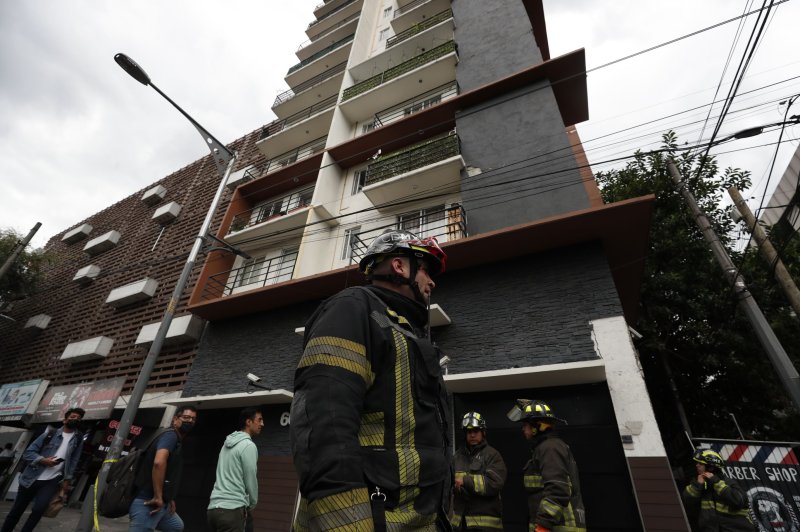
“No, not again! My God, not again!” they shouted when a magnitude 7.6 earthquake rattled the capital Monday, killing two people in the Pacific coast state of Colima.

Three powerful earthquakes have struck Mexico on Sept. 19 — in 1985, 2017 and now 2022. The unlucky coincidence has driven anxiety high for many. The last two quakes also came very shortly after the annual earthquake drill conducted every Sept. 19 to commemorate the devastating 1985 temblor.

Mexico’s national Civil Defense Coordinator Laura Velázquez said Tuesday that the two deaths in Colima were due to parts of buildings collapsing. Ten people were injured -- nine in Colima and one in neighboring Michoacan.

More than 200 buildings were damaged, including dozens of schools and health centers, she said. Most of the damage was in those Pacific states, close to the Michoacan epicenter. Some 20 Mexico City buildings were damaged, but it was minor, she said.

On the morning of Sept. 19, 1985, an 8.0 magnitude earthquake devastated the center, south and west of the country, leaving some 9,500 dead.

“It’s really strange, but a lot of people already don’t like that day,” said Jorge Ornelas, a call center coordinator. He said a lot of his acquaintances begin to worry about an earthquake come September.

“If we keep thinking that every Sept. 19 it’s going to shake, it’s going to continue happening every year, because what you think is always what happens,” the 35-year-old Ornelas said.

Xyoli Pérez-Campos, a researcher in the seismology department at the National Autonomous University of Mexico’s Geophysical Institute, said there was no physical reason for the coincidence of major earthquakes on a single day. Monday’s earthquake was the result of the “interaction of the Cocos plate with the North America plate,” which also generated the 1985 earthquake.

Five plates -- the North America, the Pacific, the Rivera, the Caribbean and the Cocos -- all run under Mexican territory.

“The plates break when it’s their time to break,” Pérez-Campos said. “What are they going to know about the calendar?”

At least one dead after magnitude 7.6 earthquake hits Mexico's pacific coast

At least one person died and residents reported damage to buildings after a major earthquake struck Mexico on Monday. Photo by Jose Mendez/EPA-EFE

Sept. 19 (UPI) -- At least one person is dead after a strong earthquake shook Mexico's central Pacific coast Monday, as the nation observed the anniversaries of two previous quakes.

A magnitude 7.6 earthquake hit at 1:05 p.m. local time, according to the U.S. Geologic Survey. The quake was centered 23 miles southeast of Aquila.

Mexican President Andres Manuel Lopez Obrador said on Twitter that Admiral Jose Rafael Ojeda Duran, Secretary of the Navy, had informed him that a person died after a wall collapsed at a mall in the city of Manzanillo.

A mandatory evacuation order was issued in Mexico City and the U.S. Tsunami Warning System said there was risk of a tsunami near the coast of Michoacan.

Local residents said that buildings -- including a hospital -- were damaged near the epicenter in Coalcoman, Michoacan, but no injuries were immediately reported, according to The New York Times.

Mexico City Mayor Claudia Sheinbaum tweeted that there were no reports of damage in the capital but said some parts of the city lost power following the quake.

Monday's earthquake occurred on the five year anniversary of a 7.1 earthquake that killed more than 200 people in Central Mexico and just an hour after an earthquake drill in Mexico City was held at 12:19 p.m. on Monday to honor the anniversary of the 2017 disaster.

That quake took place 32 years to the day after a 8.1 massive quake devastated the country, claiming thousands of lives.

Tsunami warning issued after 7.6 magnitude earthquake rocks central Mexico

Graig Graziosi - Yesterday 

A strong earthquake has hit central Mexico. The extent of the damage caused by the quake is still being determined. The earthquake is reported to be a 7.6 magnitude quake according to the US Geological Survey. The USGS initially reported the quake was a 7.5.


Screen Shot 2022-09-19 at 2.36.21 PM.png© US Geological Surve

At least one person has been confirmed dead, according to Mexican President Andrés Manuel López Obrador. That individual was killed in the coastal city of Manzanilo, approximately 130km south of the epicentre.

According to the president, the individual died when a shopping centre collapsed in the port city.

According to the USGS, the earthquake’s centre was in the Pacific Ocean near La Placita de Morelos, about 300 miles northwest of Acapulco.

The US Tsunami Warning System has issued an alert warning that a tsunami is possible along the coast of Michoacan, Mexico.

A Twitter user in Puerto Vallarta captured the effects of the earthquake on video. In the clip, the room rumbles and a ceiling fan swings wildly as the earthquake rocks the area. Puerto Vallarta is approximately 400km north of the earthquake’s epicentre.


According to the Pacific Tsunami Warning Centre, possible tsunami waves could occur within 300km of the earthquake’s epicentre. It noted that waves between 1 and 3 meters above the tide level are possible along the Mexican coast. On Monday afternoon the agency said it had observed tsunami waves.

Waves of up to 0.3 meters above the tide level are possible for a number of nations, including Hawaii, American Samoa, Guam, Australia, Japan, Chile, Columbia, Costa Rica, El Salvador, Guatemala and Honduras.

The Pacific Tsunami Warning Centre said there was no tsunami threat to Hawaii following the earthquake.
The effects of the earthquake were felt hundreds of miles away. Video from Mexico City showed street signs swaying during the quake and locals crowded in the streets as a warning siren blared in the background.

In Manzanillo, videos showed that the wall of a gym collapsed, leaving it and the roof in a pile of rubble. The sky could be seen through a gaping hole in the building’s exterior.

The quake occurred on the same day Mexico holds its national earthquake drill, which also commemorates the massive quake in 1985 that left thousands dead in Mexico City.

Another earthquake hit Mexico on the same day in Puebla in 2017, leaving 370 dead.

Monday’s quake occurred only a half an hour after the annual drill concluded.

On Sunday, a 6.6 magniture earthquake hit Taiwan, killing one and injuring 146.

From news to politics, travel to sport, culture to climate – The Independent has a host of free newsletters to suit your interests. To find the stories you want to read, and more, in your inbox, click here.

Strong earthquake shakes Mexico on 'cursed' anniversary of tremblors

NEWS WIRES -

A magnitude 7.6 earthquake shook Mexico's central Pacific coast on Monday, killing at least one person and setting off a seismic alarm in the rattled capital on the anniversary of two earlier devastating quakes.


Strong earthquake shakes Mexico on 'cursed' anniversary of temblors
© Fernando Carranza, Reuters

There were at least some early reports of damage to buildings from the quake, which hit at 1:05 pm local time, according to the US Geologic Survey, which had initially put the magnitude at 7.5.

It said the quake was centered 37 kilometres (23 miles) southeast of Aquila near the boundary of Colima and Michoacan states and at a depth of 15.1 kilometres (9.4 miles).

President Andrés Manuel López Obrador said via Twitter that the secretary of the navy told him one person was killed in the port city of Manzanillo, Colima when a wall at a mall collapsed.

In Coalcoman, Michoacan, near the quake's epicentre, buildings were damaged, but there were not immediate reports of injuries.

“It started slowly and then was really strong and continued and continued until it started to relent,” said 16-year-old Carla Cárdenas, a resident of Coalcoman. Cárdenas ran out of her family’s hotel and waited with neighbours.

She said the hotel and some homes along the street displayed cracks in walls and segments of facades and roofs had broken off.

“In the hotel, the roof of the parking area boomed and fell to the ground, and there are cracks in the walls on the second floor,” Cárdenas said.

She said the town’s hospital was seriously damaged, but she had so far not heard of anyone injured.

Related video: Major quake strikes Mexico on 'cursed' anniversary
Duration 2:19


Mexico's National Civil Defense agency said that based on historic data of tsunamis in Mexico, variations of as much as 32 inches (82 cm) were possible in coastal water levels near the epicentre.

The US Tsunami Warning Center said that hazardous tsunami waves were possible for coasts within 186 miles (300 kilometres) of the epicenter.

Irlanda Villa, of coastal Coahuayana, Michoacan near the border with Colima, said some walls had fallen, but the big fear was that a tsunami would follow. “We were afraid the sea would go out, but in the end everything is fine.”

Mexico City Mayor Claudia Sheinbaum tweeted that there were no reports of damage in the capital

Alarms for the new quake came less than an hour after a quake alarms warbled in a nationwide earthquake simulation marking major quakes that struck on the same date in 1985 and 2017. The magnitude 8.0 quake centered near the coast of Guerrero state in 1985 killed at least 9,500 people. More than 360 people died in the magnitude 7.1 quake that struck in 2017.

“This is a coincidence,” that this is the third Sept. 19 earthquake, said US Geological Survey seismologist Paul Earle. “There’s no physical reason or statistical bias toward earthquakes in any given month in Mexico.”

Nor is there a season or month for big earthquakes anywhere on the globe, Earle said. But there is a predictable thing: People seek and sometimes find coincidences that look like patterns.

“We knew we’d get this question as soon as it happened,” Earle said. “Sometimes there are just coincidences.”

The quake was not related to or caused by the drill an hour or so earlier, nor was it connected to a damaging temblor in Taiwan the day before, Earle said.

Humberto Garza stood outside a restaurant in Mexico City's Roma neighborhood holding his 3-year son. Like many milling about outside after the earthquake, Garza said the earthquake alarm sounded so soon after the annual simulation that he was not sure it was real.

“I heard the alarm, but it sounded really far away,” he said.

Outside the city's environmental ombudsman's office, dozens of employees waited. Some appeared visibly shaken.

Power was out in parts of the city, including stoplights, snarling the capital's already notorious traffic.

(AP)