Monday, July 28, 2025

‘We’ll see where things land,’ Carney says amid ‘intense phase’ of ongoing U.S. negotiations and looming tariff deadline
Published: July 28, 2025 


The American administration reached a trade deal with the European Union, but negotiations with Canada continue. CTV National's Colton Praill has the latest.

Prime Minister Mark Carney says negotiations with the U.S. are at an “intense phase,” as U.S. President Donald Trump’s deadline to increase tariffs on Canadian goods to 35 per cent fast approaches.

“It’s a complex negotiation,” Carney told reporters on Monday, when asked what message he’s sending to the industries that are anxious about the U.S. threatening higher levies. “You see with the various trade deals that have been agreed by other jurisdictions — European Union yesterday, Japan before, Indonesia, etc., the United Kingdom — that there are many aspects to these negotiations.”

“We’re engaged in them, but the assurance for Canadian business, for Canadians, is we will only sign a deal that’s the right deal, that’s a good deal for Canada,” Carney also said, echoing statements he made last week that his government is prioritizing “the best deal” over a timely one.

Carney made the comments on P.E.I. Monday following an announcement the federal government is cutting the toll to use the Confederation Bridge.

Still looming, meanwhile, is Trump’s threat to increase tariffs to 35 per cent on Friday, the date by which Carney has said the Canadian government is aiming to hash out a new economic deal with the United States.

The new levies will not apply to goods that are covered by the Canada-U.S.-Mexico Agreement (CUSMA), the White House has confirmed. Still in place, however, are steep tariffs on steel and aluminum, and autos, with Trump also signalling he plans to impose higher duties on copper as of Friday.

While the protracted trade war and the status of negotiations have dominated discussions among Canadian lawmakers — namely during last week’s meetings between Carney and the premiers, and as Canada-U.S. Trade Minister Dominic LeBlanc met with several U.S. senators both in Ottawa and Washington last week — Trump on Friday said his administration hasn’t “been focused” on Canada.

“Aug. 1 is going to come, and we will have most of our deals finished, if not all,” Trump told reporters at the White House. “We haven’t really had a lot of luck with Canada. I think Canada could be one where they’ll just pay tariffs. It’s not really a negotiation.”

Today, the prime minister dismissed the president’s comments as a negotiating tactic.

Still, LeBlanc has said Canada is still working toward an Aug. 1 target date to reach a deal, and to that end he is set to return to Washington this week.

Asked Monday whether he should have kept the controversial digital services tax (DST) to earn the revenue from it, Carney said that’s “a hypothetical on a hypothetical.”

Carney dropped the tax late last month after Trump said he’d end negotiations with Canada “effective immediately” over the issue, with the president calling it “a direct and blatant attack” on the U.S. and its technology companies.

“We’ll see where things land in terms of negotiation,” Carney said Monday. “There are pros and cons of that tax, as there are with any tax.”

“It may seem like it’s a long way from a trade discussion at the end of this week,” Carney also said, pointing to other efforts his government has made to reduce the impact of the trade war on Canadians. “What we’re really spending the vast, vast part of our time on is what we can control, and building the country together, bringing the country together, and then building out the country.”


Spencer Van Dyk

Writer & Producer, Ottawa News Bureau, CTV News

Harper says Carney team sought his trade advice, advises looking outside U.S.

By The Canadian Press
Updated: July 28, 2025 

Former prime minister Stephen Harper speaks ahead of the King delivering speech from the throne in the Senate in Ottawa on Tuesday, May 27, 2025. THE CANADIAN PRESS/Blair Gable-Pool

Former prime minister Stephen Harper said Monday he’s urging Ottawa to find new trading partners outside the United States.

“I think it’s fair to say I’m probably the most pro-American prime minister in Canadian history,” Harper told Canadian and American legislators gathered for the annual Midwestern Legislative Conference meeting in Saskatoon.

“We’ve got to get something short-term worked out with the Trump administration. But this really is a wake-up call for this country to truly diversify its trade export markets.

“Just because we have that geographic proximity does not justify the degree of dependence that we have on a single market.”

Harper said he was approached by the government two weeks ago for advice on dealing with U.S. trade policy.

The Canadian Press has asked Prime Minister Mark Carney’s office whether it approached the former Conservative prime minister for advice but has not yet received a response.

Harper told the conference that Canada should no longer rely on Washington for its security.

“While the border is a shared responsibility, let’s make sure we spend a lot more on defence so that we can be independently responsible for our own land, seas and skies, independent of the United States,” he said.

Harper said that anyone who had asked for his trade advice a year ago would have been urged to deepen economic and security ties with Canada’s southern neighbour.

“However, when the government did actually ask me a few weeks ago, my advice was the opposite,” he said.

Harper said that while Washington is using a failed economic policy of pursuing economic growth through tariffs, the U.S. still needs trading partners.

“We just cannot be in a position in the future where we can be threatened in this way and not have that leverage,” he said.

“The current government does, you know, get it better than their predecessors.”

He said he hopes Americans recognize that they can’t take their international allies and trading partners for granted.

“I really do hope that a realization seeps into the United States,” he told the crowd of American lawmakers.

“Canadians are a combination of just angry and bewildered by what is happening here. And that is very real. And it is very deep and it is across the country, and it is across the political spectrum.”

Harper also said China is undermining global trade through its use of World Trade Organization mechanisms. He said the Pacific Rim trading bloc created through the Comprehensive and Progressive Agreement for Trans-Pacific Partnership allows Canada to undertake trade with other countries that respect global rules.

He also revealed that he told American officials during his time as prime minister that a military response would be needed to prevent Iran from getting a nuclear bomb.

“I have been saying for 15 years at least that the single biggest threat of nuclear war was Iran ever getting a nuclear weapon,” he said. “And I had told American administrations confidentially for years it was my conclusion (that) the only way to ever stop that would be military action.”

By Dylan Robertson.

With files from Jeremy Simes in Saskatoon.

Trump says ‘we don’t have a deal with Canada’


By Luca Caruso-
Updated: July 25, 2025 


Just days before the presumed Aug. 1 agreement deadline, U.S. President Donald Trump said “we haven’t been focused” on reaching a trade deal with Canada.

“We don’t have a deal with Canada,” he told reporters Friday morning during a windy outdoor scrum.

“Aug. 1 is going to come, and we will have most of our deals finished, if not all. We haven’t really had a lot of luck with Canada. I think Canada could be one where they’ll just pay tariffs. It’s not really a negotiation.”

In contrast, Trump said the administration is likely to reach a deal with the EU and that he had solidified the confines of an accord with China. He also celebrated a breakthrough with Australia, which recently relaxed import restrictions that will allow the U.S. to sell it “so much” beef.

His comment comes a day after Dominic LeBlanc, Canada’s minister for trade with the U.S., said he was encouraged following a meeting with U.S. Commerce Secretary Howard Lutnick and a bipartisan group of senators. LeBlanc said the closed-door negotiations with the Americans are “complex” and suggested they may not resolve by Aug. 1.

On that day, Trump promised, the U.S. will impose a 35 per cent tariff on Canadian goods crossing the border. Those fees could go even higher if Canada further retaliates. However, they’re limited to the minority of goods not covered under the two countries’ existing free trade deal, which Trump signed in his first term and vowed to renegotiate next year.

Canada is also bearing the weight of Trump’s tariffs on steel, aluminum and automobiles, and will be affected by copper duties that are also expected to kick in on Aug. 1.

Trump’s deals

Trump has published several letters addressed to world leaders revealing the tariffs he intends to impose on their imports.

“When those letters go out – they’re a page and a half – that means they have a deal,” he said. “That is a contract, essentially.”

One reporter had asked Trump if he thought the letters would bring some market certainty, but the president suggested negotiations have continued even after the documents were sent.

Japan and the EU got letters, “and they came back and negotiated a deal.”

Canada got one that revealed Trump’s 35 per cent levy planned for Aug. 1, but Ottawa’s negotiators haven’t yet found common ground with their U.S. counterparts.

Following Thursday’s visit, LeBlanc said Ottawa is still working towards the Aug. 1 deadline, but that negotiators are willing to miss it if it means inking a better deal later on.

CTV News reached out to the Office of the Prime Minister, which said it would not be commenting on Trump’s statement at this time. LeBlanc is expected to return to Washington next week.


With files from CTVNews.ca’s Spencer Van Dyk
Luca Caruso-

CTVNews.ca Breaking Digital Assignment Editor
Eric Ham: China’s record purchases of Canadian crude could be a harbinger of more deals to come

By Eric HamOpens 
Published: July 27, 2025

Eric Ham is based in Washington, D.C. and is a political analyst for CTV News. He’s a bestselling author and former congressional staffer in the U.S. Congress and writes for CTVNews.ca.

China is now importing record amounts of Canadian oil after slashing U.S. oil purchases by roughly 90 per cent.

As a result, imports of Canadian crude have surged, reaching a record 7.3 million barrels in March. This massive boon comes as Canadian negotiators are racing against the clock to make a trade deal with the White House.

The expanded Trans Mountain Pipeline has enabled China and other East Asian importers to access Canada’s vast crude reserves, which are relatively cheap and suitable for China’s advanced refineries that process dense, high-sulfur crude.

The shift reflects Beijing’s strategic move to diversify its oil sources away from the U.S., Russia, and the Middle East, with Canadian oil becoming an increasingly attractive option.

Crude oil tankers SFL Sabine, back left, and Tarbet Spirit are seen docked at the Trans Mountain Westridge Marine Terminal, where crude oil from the expanded Trans Mountain Pipeline is loaded onto tankers, in Burnaby, B.C. on June 10, 2024. THE CANADIAN PRESS/Darryl Dyck

It’s a serendipitous endeavour, considering U.S. President Donald Trump’s unrelenting attacks on America’s northern neighbour, which are increasing as the deadline on a trade deal rapidly approaches.

Still, record purchases of Canadian crude by China could be a harbinger of more deals involving Beijing and Ottawa as Canadian leaders seek viable alternatives. A move that could see Canada exit America’s sphere of influence, as the relationship appears to be no longer mutually beneficial and grows more turbulent and confrontational with each passing day.

Instead of looking south, Ottawa is now looking (Far) East. During a recent summit in Bellevue, Washington, U.S. envoy to Canada Pete Hoekstra told the audience that Trump thinks the country is “nasty” to deal with. As a result of the rapid deterioration the brewing cold war between once-great friends and allies now has Beijing exploring a possible opening.

As the uncertainty of difficult trade demands and erratic import duties stifle global markets, Ottawa and Beijing are looking increasingly more enchanting to each other, given the increasing volatility emanating from Washington.

China is Canada’s second-largest trading partner, trailing behind the United States. Canada exports $47 billion worth of goods to the world’s second-largest economy in 2024, according to Chinese customs data.

Chinese Premier Li Qiang speaks as he chairs the "1+10" Dialogue on Building Consensus on Development to Promote Global Common Prosperity, at the Diaoyutai State Guesthouse in Beijing on Dec. 9, 2024. (AP Photo/Andy Wong)

After years of fraught relations and simmering tensions, the two nations agreed on a diplomatic reset after a phone call between Prime Minister Mark Carney and Premier Li Qiang back in June. The thawing comes as both nations find themselves under siege by a White House hell-bent on exacting maximum punishment on both countries as trade negotiations reach a fevered pitch.

Still, as Ottawa eyes new pathways, in a geopolitical landscape marked by turmoil and ambiguity, Beijing has signalled a willingness to readily engage and establish closer ties with the Great White North. Chinese envoy to Ottawa, Wang Di, has even gone so far as to state on the record that China would be willing to consider negotiating a free-trade deal.More opinion on CTVNews.ca

The remarks underscore the Asian powerhouse’s readiness to advance opportunities beyond the incessant economic warfare being waged by Washington. Yet, while China’s premier and Carney have both signaled a willingness and desire to move towards a more advantageous relationship, Carney still appears to be moving at a tepid pace. Despite this, China continues to show an outward motivation to deepen ties in the face of growing alienation and separation with the U.S. Canada’s premiers, meanwhile, are hoping to speed up the diplomatic thawing.


Saskatchewan Premier Scott Moe, whose province is Canada’s top canola producer, said the country must “reset our relationship with China if we are going to have any hope of diversifying.”

“China is one of the largest markets in the world. It’s our second-largest trading partner as the province of Saskatchewan,” said Moe in Huntsville, Ont., where he attended meetings with other provincial leaders and the prime minister. “They’ll need to be a part of that process.”

Prime Minister Mark Carney, right, speaks with Premier of Saskatchewan Scott Moe following the First Minister’s Meeting in Saskatoon, Sask., on June 2, 2025. THE CANADIAN PRESS/Liam Richards

Further highlighting this desire to look east rather than south, in a joint statement, Canada’s premiers urged Carney to “improve the overall trade relationship” with Beijing and remove the tariffs.

Ontario Premier Doug Ford said he’s against removing tariffs against Chinese electric vehicles, but he would have no problem doing more business with China, “as long as China plays fair and doesn’t undercut our markets.”

“I don’t consider Americans the enemy, but right now President Trump himself is acting like the enemy,” Ford said. In a classic ‘the enemy of my enemy is my friend’ moment, many Canadians see the U.S. as increasingly and openly hostile to the nation’s interests.

As the enmity and bellicosity from the White House continues to grow, the premiers are increasingly open to seeking pathways to growth, which includes less reliance and dependence on the United States.

Saskatchewan Premier Scott Moe, left to right, Ontario Premier Doug Ford and Alberta Premier Danielle Smith sign a memorandum of understanding during the meeting of Canada's premiers in Huntsville, Ont., on July 22, 2025. THE CANADIAN PRESS/Nathan Denette

China, despite years of antagonism, and growing suspicions, seems ready to move past the intense divisions and leverage Washington’s insolence and insularity to both its and Canada’s benefit.

If the oil sector is any indication of the possibilities on the horizon, Ottawa and Beijing might find a welcome resolve — at least short-term — from the instability and erratic oscillation that is plaguing Washington. Recently, a bipartisan group of U.S. senators travelled to Ottawa to meet with Carney.

The lawmakers were seeking common ground on many of the recalcitrant issues facing negotiators. Touting themselves as “bridge-builders” and dismissing Trump’s rhetoric of Canada as the 51st state as merely “bluster,” the members of the U.S. Senate Finance Committee are hoping to maintain strong ties with Ottawa and see the relationship bolstered and fortified.

Unfortunately, their wishes and hopes count for very little as it is the opinion of one, the occupant of the White House, that will ultimately determine the tone and trajectory of relations between Washington and Ottawa. Which is why Beijing is hoping and betting big that given Trump’s history, it can be the stand-in when, not if, the ties that once bound two nations are eventually severed.
In China, repair demand for banned Nvidia AI chipsets booms

By Reuters
Published: July 25, 2025

Nvidia's headquarters in Santa Clara, Calif. (Philip Pacheco/Photographer: Philip Pacheco/Blo)

BEIJING/SHANGHAI — Demand in China has begun surging for a business that, in theory, shouldn’t exist: the repair of advanced Nvidia artificial intelligence chipsets that the U.S. has banned the export of to its trade and tech rival.

Around a dozen boutique companies now offer repair services, according to two such firms in the tech hub of Shenzhen which say they predominantly fix Nvidia’s H100 graphics processing units (GPUs) that have somehow made their way to the country, as well as A100 GPUs and a range of other chips.

Even before it was launched, the H100 was banned from sale in China in September 2022 by U.S. authorities keen to rein in Chinese technological development, particularly advances that its military could use. Its predecessor, the A100, was also banned at the same time after being on the market for over two years.

“There is really significant repair demand,” said a co-owner of a firm that has been fixing Nvidia’s gaming GPUs for 15 years and began working on AI chips in late 2024.

Business has been so good that the owners created a new company to handle those orders, which now repairs up to 500 Nvidia AI chips per month. Its facilities, as shown in social media advertising, include a room which can accommodate 256 servers, simulating customers’ data center environments to conduct testing and validate repairs.

The rapid growth of the repair industry from late last year supports the view that there has been a significant amount of smuggling of Nvidia chipsets into China. Tenders have shown that the government and the military have made purchases of the U.S. firm’s banned AI chips.

Concern about large-scale smuggling of high-end Nvidia products into China has prompted both Republican and Democratic lawmakers to introduce bills that would require the tracking of chipsets so that their location can be verified after they are sold. U.S. President Donald Trump’s administration also backed the idea this week.

The thriving repair industry also highlights how Nvidia’s advanced GPUs remain in high demand despite new, albeit less powerful, products from Chinese tech giant Huawei.

Though the buying, selling and repair of Nvidia GPUs is not illegal in China, sources for this article were reluctant to draw scrutiny from U.S. or Chinese authorities and declined to be identified.

Nvidia cannot legally provide repair or replacement items for restricted products in China. In contrast, sources said if an Nvidia GPU in another nation has a defect and is under warranty, which is normally three years, the company usually replaces it.

An Nvidia spokesperson said only the company and authorized partners “are able to provide the service and support that customers need. Using restricted products without approved hardware, software, and technical support is a nonstarter, both technically and economically.”

Repair demand may not fade

Nvidia has only just been allowed to recommence sales of its H20 AI chipset, which has been specifically developed for China to comply with U.S. restrictions. Switching over to H20 chipsets is, however, not necessarily a simple or good option for Chinese entities.

Price is an issue as one H20 server with eight GPUs inside will likely cost more than 1 million yuan (US$139,400), industry sources say. H20 chipsets, which have increased memory bandwidth, have been specifically designed for AI inference work, but firms involved in the training of large language models would likely prefer H100 chipsets which are better suited to that task.

Industry sources said some of the H100 and A100 GPUs in China have been crunching data around the clock for years now, leading to an increase in failure rates. Depending on how frequently a GPU is used and how often it is maintained, an Nvidia GPU generally lasts two to five years before needing to be repaired, they said.

According to the first source, his company charges between 10,000 yuan and 20,000 yuan ($1,400 to $2,800) to fix a GPU depending on the complexity of the problem.


The second Shenzhen-based repair service provider - which shifted from GPU rentals to repairs this year - says it can repair up to 200 Nvidia AI chips each month, charging about 10 per cent of the GPUs’ original selling price per repair.

Services generally include software testing, fan repair, printed circuit board and GPU memory fault diagnostics and repair, as well as the replacement of broken parts.

In the meantime, smuggling of high-end Nvidia chips continues. Traders of chips in China say customer demand is pivoting to top-of-the-line B200 chips which Nvidia began shipping to other countries in larger quantities this year.

A server with eight B200 GPUs costs more than 3 million yuan in China, they said.

(Reporting by Che Pan in Beijing and Casey Hall in Shanghai; Additional reporting by Stephen Nellis in San Francisco; Editing by Anne Marie Roantree and Edwina Gibbs)


China Lashes Out As U.S. Reports Tracking Chinese Research Vessel in Arctic

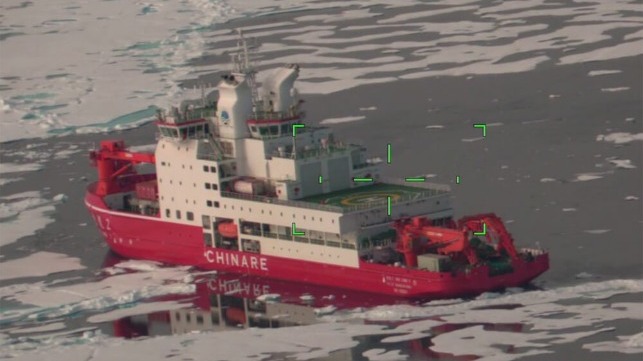
Chinese research shin in Arctic
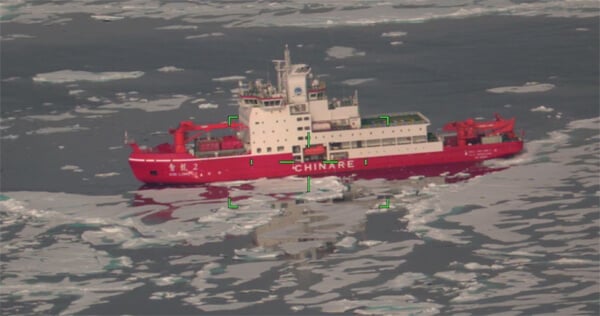
USCG released pictures of Xue Long 2 in the Arctic

Published Jul 28, 2025 5:33 PM by The Maritime Executive


The U.S. Coast Guard reported on July 26 that it has been tracking a Chinese-flagged research vessel that it contends entered U.S. waters in the Arctic, and this came after a similar report from the Canadians. China was quick to respond, through its Global Times newspaper, launching a broad range of accusations at the U.S., which it called a “rule-breaker” and “global troublemaker.”

The vessel Xue Long 2 (12,769 gross tons) was “detected,” the U.S. Coast Guard said in its statement, and that it had responded to the vessel. They reported dispatching a C-130J aircraft to locate and document the Chinese vessel. USCG released photos of the vessel.

The U.S. contends the vessel was on the U.S. Extended Continental Shelf, approximately 290 nautical miles north of Utqiagvik, Alaska. The U.S. said the vessel was 130 nautical miles inside the ECS boundary.

“The U.S. has exclusive rights to conserve and manage the living and non-living resources of its ESC,” wrote the USCG.


China lashed out at the U.S. reporting of its research vessel in the Arctic (USCG)


The U.S. sighting came days after Canada’s CBC revealed that Canadian forces had also been tracking the vessel as it moved in the Arctic. On July 22, the Canadian military, however, asserted the vessel was not currently in Canadian territorial waters.

According to CBC, the vessel, which was built in 2019, had left Shanghai on July 6, making its way along the western Pacific coastline. The ship, which is operated by the Polar Research Institute of China, is 122.5 meters (approximately 402 feet) in length. China reports it has a 20,000 nautical mile endurance and a capacity of 101 people. It can continuously break through ice of up to 1.5 meters (nearly 5 feet) at a speed of 2 to 3 knots.

In a highly ironic statement, China asserts the vessel is in international waters and accuses the U.S. of making the ECS “a self-drawn area, a unilateral claim of territory.” They claim the U.S. redrew the boundaries in December 2023 and said China opposes any country’s unilateral self-interpretation. They assert the U.S. has a “blatant disregard for international law.”

"China's position on Arctic maritime rights and interests has been made clear that they must be handled in accordance with the United Nations Convention on the Law of the Sea (UNCLOS),” writes the Global Times. 

The Chinese statement says that in addition to the U.S., nations including Canada, Denmark, Norway, and Russia have all made sovereign claims over sections of the Arctic seabed. They say it is motivated by the region’s vast resources.

The research vessel Xue Long 2 is on a repeat visit to the Arctic after having conducted a similar visit in 2024. In 2023, the Polar Research Institute highlighted that it was launching its 13th research expedition to the Arctic. They said the 2022 mission had lasted 79 days and covered 14,000 nautical miles. They predicted the 2023 mission would be more comprehensive, covering 15,500 nautical miles.

The Global Times said last weekend’s release by the USCG “is essentially about stoking anti-China sentiment at home and peddling the China threat narrative abroad to create confrontation.” They said it was more rhetoric from the United States.


Chinese Carrier May Invest up to $2.5B in Russia's Port of Arkhangelsk

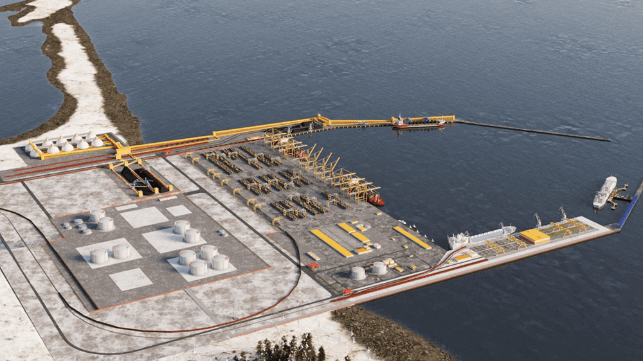
Eurosib port
Courtesy Eurosib

Published Jul 28, 2025 1:45 PM by The Maritime Executive


China's NewNew Shipping Line has agreed to pay billions of dollars to support the construction of new port facilities at Arkhangelsk, a key seaport at the western end of the Northern Sea Route, the Russian-administered waterway off Siberia's Arctic coast.  

Located near the mouth of the Dvina River on the White Sea, Arkhangelsk is just south of the Arctic Circle and is icebound in winter. In the navigation season, it is a gateway to consumers and industries in western Russia: though the city is itself remote, it is still the NSR's closest deep-sea port to Moscow and St. Petersburg, and the Severnaya Railway connects it with the rest of Russia's rail network. 

Last month, regional governor Alexander Tsybulsky told Russian outlet PortNews that planning is under way for a major expansion of Arkhangelsk's seaport. The new terminal will be able to welcome merchant ships with a draft of up to about 48 feet and capacity of 75,000 dwt. The objective is to triple the port's modest throughput by 2040. "Here we work closely with our partners - the state corporation Rosatom, the company Eurosib," he said. "The main investors have been identified, there is interest from foreign companies. In particular, we are actively working with the Chinese NewNew Shipping Line."

Last weekend, in a readout of a meeting with Russian President Vladimir Putin, Tsybulsky elaborated that NewNew is ready to take a 30 percent stake in the port with an investment of up to $2.5 billion - far more than the value of NewNew's fleet.

"We are currently working on technical issues with them, but if you agree, we are ready to continue this work and sign a memorandum with them on the main directions that we would be ready to use in this port," Tsybulsky told Putin. 

NewNew Shipping Line started a container route along the NSR in 2023, and it added a round trip service from Shanghai/Ningbo to Arkhangelsk in 2024. Last year's 13 voyages were profitable, and the firm plans to use larger ships in this year's rotation. 

In the long term, NewNew is planning a series of Arc7 ice class container ships in cooperation with Russian state nuclear agency Rosatom, operator of Russia's nuclear icebreakers and the managing agency for Northern Sea Route development. The Panamax-sized vessels would be capable of an extended navigation season in the ice-choked eastern stretch of the NSR - just like the Arc7-class icebreaking LNG carriers that serve Novatek's Yamal LNG plant. An expanded deepwater container terminal at Arkhangelsk would reduce these ships' transit times to western Russia by a week (when compared to a voyage to St. Petersburg). 

Year-round NSR navigation between Russia and China is a top priority for Putin's administration, in part for supply chain security and in part for the economic benefits of an active trade lane for other projects along Russia's remote northern shore. 


China Ditches U.S. LNG as Russian Pipelines and Domestic Output Surge

  • China’s LNG imports have declined for eight consecutive months, down 12% y/y in June 2025, due to increased domestic gas production.

  • Trade tensions with the U.S. and a 125% tariff have halted American LNG imports, pushing China toward other suppliers like Qatar and Indonesia and threatening long-term U.S. LNG contracts.

  • Falling Chinese demand is reshaping global energy flows, easing pressure on other Asian and European markets.

Over the past couple of years, China has become the world’s largest importer of Liquefied Natural Gas (LNG), surpassing Japan as the top buyer of super-chilled gas since 2021. China’s surging LNG imports have been shaping Asian energy flows, with the country accounting for more than 40% of the continent's total LNG import growth. However, China’s dominance in LNG markets now appears in jeopardy, and we are seeing a prolonged decline in imports.

According to ship-tracking data by Kpler via Bloomberg, China’s LNG imports are estimated to have clocked in at 5 million metric tons in June 2025, good for a hefty 12% year-on-year decline, marking the eighth straight month of declines. In the first four months of the year, China’s LNG imports slumped to 20 million tons, a sharp fall from 29 million tons from last year’s comparable period. Full-year imports for the current year are now expected to fall 6–11% to 76.65 million metric tons.

This trend appears to defy earlier projections for China’s LNG demand to continue growing through 2035. This, coupled with ongoing shifts in the country’s oil import dynamics, signals major changes in global energy flows. In 2023, China averaged 9.5 billion cubic feet per day in LNG imports, with Australia supplying 34% of total imports; Qatar 23%, Russia 11% and Malaysia 10%.

There are several factors driving this unexpected trend. First off, China has seen a significant increase in pipeline imports from Russia and Central Asia, as well as a 6% increase in domestic gas production, both lowering LNG demand. Pipeline gas accounted for 41% of China’s 16.0 Bcf/d natural gas imports in 2023, with Russia (via the Power of Siberia 1 pipeline), Turkmenistan and Myanmar supplying the majority.

Russia is actively increasing its pipeline gas exports to China as part of its strategy to reorient its energy exports away from Europe and towards Asia, with China as the leading target. Specifically, the Power of Siberia 1 pipeline is expected to reach its full capacity of 38 billion cubic meters (bcm) by 2025, and a new pipeline, Power of Siberia 2, is planned to further increase exports to China by an additional 50 bcm per year. Russia is also exploring other potential pipeline routes to China, including one that would transit through Kazakhstan. This could further expand export capacity and provide alternative routes to diversify supply.

Second, trade tensions between Washington and Beijing have forced China to halt U.S. LNG imports since March 2025 after Trump slapped a punitive 125% tariff on its key trading partner. Consequently, China redirected purchases to Asian suppliers like Qatar and Indonesia. 

Third, weak industrial demand due to slowing growth by China’s industrial and chemical sectors has taken a toll on gas demand. These pivotal sectors are experiencing a slowdown due to a combination of factors including a broader economic slowdown, a struggling real estate market, weaker global demand for exports, and reduced foreign investments. To exacerbate matters, China's GDP growth is projected to slow down in the coming years despite showing resilience against U.S. tariffs, with forecasts suggesting growth below the official target and a further easing in 2026. The Organisation for Economic Co-operation and Development (OECD) has projected that China’s economic growth will moderate from 5.0% in 2024 to 4.7% in 2025 and 4.3% in 2026. Finally, a milder winter has lowered demand for residential heating particularly in northern China.

China’s falling LNG imports are having ripple effects across global energy markets. Weakening demand is freeing up LNG volumes, easing supply pressure to other Asian countries including Japan and India as well as Europe. Falling Chinese demand is also depressing Asian spot LNG prices, with prices dropping to $11/MMbtu in May 2025 from a February peak of $16.50/MMBtu. Chinese buyers tend to turn to pipeline gas and domestic production whenever Asian gas prices exceed $10/MMBtu.

Finally, the halt of U.S. LNG exports to China threatens long-term contracts worth 20 million tons per year with U.S. suppliers. Chinese LNG buyers are now reselling U.S. cargoes to Europe and also seeking new deals with  Asia-Pacific and Middle Eastern suppliers, undermining U.S. export growth.

Meanwhile, China’s pivotal crude oil sector is facing serious headwinds, too.

Last year, China experienced a decline in transportation fuel demand, marking a significant shift away from the historical trend of increasing demand. China’s consumption of gasoline, jet fuel and diesel in 2024 was ~8.1 million barrels per day, 2.5% below 2021 levels and just above 2019 levels. This decline was primarily driven by a combination of factors including a shift towards electric vehicles, a slowdown in the construction sector, and a weakening in consumer spending. Indeed, the International Energy Agency (IEA) has predicted that combustion uses of petroleum fuel in China has already plateaued.

By Alex Kimani for Oilprice.com

China’s Coal Capital Is Transforming Into a Clean Energy Hub


  • Shanxi produced 1.27 billion tonnes of coal in 2024 but is rapidly expanding its clean energy capacity.


  • Major investments in solar, wind, and hydrogen projects are helping the province shift its energy profile.


  • While the transition promises environmental benefits, over 1.7 million coal-related jobs could be lost by 2030.


China’s coal hubs are some of the biggest in the world, with the Asian country having long relied on the fossil fuel for power and industry. However, some of these regions are now being transformed into green energy hubs, as China gradually reduces its reliance on coal in favour of renewable alternatives. One such region is Shanxi in the North of China. 

In 2023, China produced around 4.71 billion tonnes of coal from over 3,000 mines. Coal is China’s biggest source of carbon emissions. However, with China pledging to achieve peak carbon dioxide emissions by 2030, and to net-zero carbon emissions by 2060, the government is gradually closing its coal mines as the country expands its renewable energy capacity. Following years of heavy investment in green energy, many energy experts expect that China might even achieve peak emissions ahead of schedule

In 2024, China’s primary coal mining region, Shanxi, produced around 1.27 billion tonnes of coal, which is more than that of India. If Shanxi were a country, it would be the second-biggest coal producer in the world, after China. However, thanks to the government’s rapid renewable energy rollout, the country is growing to rely less on coal and is developing its green energy sector. China is developing more wind and solar power than the rest of the world combined, and its wind and solar power generation soared to almost 1,500 GW in April, exceeding its fossil fuel output.

In Shanxi, around one in ten people work in the coal and related industries. There are fears that as China shuts down its coal mines, many people in the province will be left unemployed. More than 1.7 million coal-related jobs are expected to be cut by 2030. In anticipation of the dramatic hit to the job market, Shanxi is developing other economic sectors, such as tourism and clean energy. 

By the end of 2024, Shanxi had a total installed clean energy capacity of 61.89 GW, which is around the same as that of the United Kingdom. Over half of it came from solar power, which reached 34.8 GW last year. In Shanxi's 14th Five-Year Plan (2021-25) for renewable energy development, the province set a target of a cumulative 30 GW wind capacity and 50 GW solar PV capacity in operation by the end of 2025, which is aimed at diversifying the province’s energy mix. 

LONGi, one of China’s largest solar power companies, launched a solar panel factory in Datong in 2022, which employs over 160 people, with over half of its employees coming from the coal industry. 

Several other companies have also established operations in Shanxi to support the transition from a coal region to a renewable energy hub. Meijin Energy, in Shanxi’s capital Taiyuan, is one of China’s largest private coke companies, with the capacity to process over 6 million tonnes of coal each year, and 11 million tonnes of coke. In recent years, Meijin has expanded its portfolio to include hydrogen, which is a byproduct of the coking process and can be used to fuel vehicles. Meijin now produces around 1,500 tonnes of hydrogen a year, much of which is used to power its transport. Previously, the excess hydrogen was burnt or discarded, which contaminated he air. However, the company has seen the potential of supporting the energy revolution in the region.

In 2024, the Chinese firm Shanxi International Energy Group signed a deal with a local government in northern China to produce 350,000 tonnes a year of green aviation fuel produced from wind-powered hydrogen, according to local reports. The $1.48 billion project is expected to include 1 GW of new off-grid wind power, which will be used to produce green hydrogen to be combined with sequestered carbon dioxide to produce e-kerosene, which is chemically identical to conventional jet fuel. 

The project is expected to be developed over two phases. The first phase includes the development of 300 MW of wind power to produce 100,000 tonnes of green kerosene a year, and the second includes a further 700 MW of wind energy capacity, for a fuel output of 250,000 tonnes. 

There is also international interest in diversifying China’s energy mix and helping the Asian country reduce its reliance on coal to support a global green transition. In 2019, the World Bank Group launched a $350 million project aimed at accelerating “Shanxi’s transition to a lower coal consumption and more diversified economy, and provide alternative employment opportunities, thereby mitigating global climate change and improving air quality.” 

There is significant potential for China’s Shanxi province to transition away from a reliance on coal to renewable alternatives in the coming years. However, the closure of many coal mines will likely lead to significant job losses across the region. China could mitigate the risk of widespread unemployment in Shanxi by investing heavily in a just transition, training workers in the coal industry to take up roles in other energy sectors as the province expands its renewable energy capacity. 

By Felicity Bradstock for Oilprice.com


Drew Marine Launches Comprehensive Newbuild Program

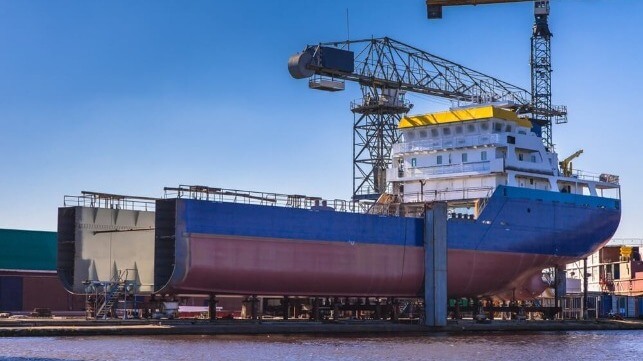
Block construction
File image courtesy iStock / CreativeNature NL

Published Jul 28, 2025 5:23 PM by Drew Marine


Drew Marine is proud to introduce its newly launched New Build Program, a purpose-built initiative backed by a specialized team dedicated to supporting vessel construction from concept through commissioning. This program is designed to provide shipowners, operators, and shipyards with seamless, end-to-end technical support and advanced chemical solutions that are integrated early and effectively into the new build process.

“As maritime operations grow increasingly complex and global environmental standards continue to evolve, Drew Marine’s New Build Program offers a smarter, future-ready approach”, said New Build Director, Sam Manzolillo. The program bridges the gap between innovation and implementation, ensuring vessels are not only compliant and safe from day one, but also optimized for performance and long-term asset protection.

From vessel design to delivery, Drew Marine’s expert team works alongside project stakeholders to reduce risks, eliminate costly late-stage modifications, and accelerate crew preparedness. The program is engineered to deliver value through customized recommendations, pre-commissioning support, onboard training, and scalable chemical treatment programs tailored to each vessel’s design and mission.

Whether you’re preparing for vessel design or final sea trials, Drew Marine ensures your vessel is equipped to meet today’s challenges and tomorrow’s opportunities. The Drew Marine New Build Program is available now. Contact Drew Marine’s expert team for a complimentary consultation and learn how to streamline your new build process, protect your investment, and start your voyage on the right course.

This article is sponsored by Drew Marine. Discover more at: www.drew-marine.com/new-builds
 

The opinions expressed herein are the author's and not necessarily those of The Maritime Executive.


First Hybrid Electric, Hydrogen Capable, CSOV Nears Delivery

hydrogen-fueled CSOV
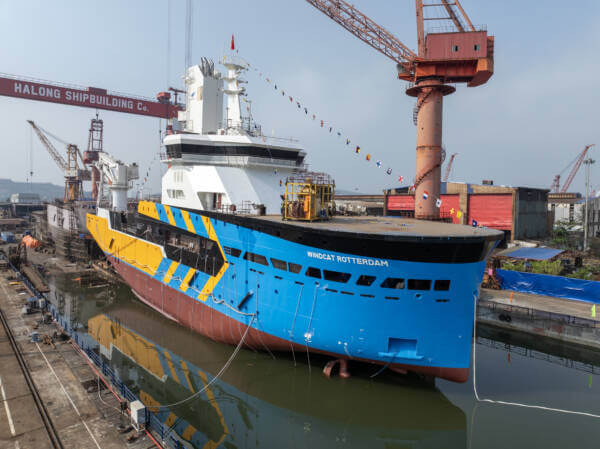
Windcat Rotterdam represents an advanced design with hydrogen fuel capabilities (Damen)

Published Jul 28, 2025 7:00 PM by The Maritime Executive


The first of a series of unique vessels, the commissioning service operation vessel Windcat Rotterdam, recently completed sea trials and is nearing delivery. According to CMB.TECH, its Windcat division, and Damen, which is building the six ships, they represent advances in efficiency, performance, and comfort and will be the first capable of being powered by hydrogen.

CMB.TECH reported the order for two vessels in 2022 and later expanded it to a class of six ships as it looks to continue to drive the deployment of alternative fuels. Windcat, the group’s offshore service company, was the first to deploy a hydrogen-powered crew transfer vessel and is now set to take delivery of Windcat Rotterdam.

At approximately 6,700 gross tons, the vessels are billed as an advancement in the CSOV sector when compared to the earlier designs for offshore wind farm support vessels. Each ship is 87 meters (285 feet) in length, with 90 cabins and accommodations for up to 120 people and a capability to remain onsite for up to 30 days.

The vessel is fitted with a diesel-battery hybrid power generation system, and a secondary dual-fuel (diesel and hydrogen) genset with hydrogen storage located at the rear of the open main deck. An additional 2MW electrical connection is provided for green shore power, green offshore recharging, or additional sources of green power installed on the deck (e.g., battery or H2).

The vessels are being built at Ha Long Shipyard in Vietnam. Windcat Rotterdam was launched on October 12, 2024.

“The hybrid-electric propulsion system coupled with an efficient power distribution system means that there will be no need to run a backup diesel generator and the vessel will never use more power than necessary,” said Joost van der Weiden, Damen Sales Manager Benelux. “We have optimized the thruster configuration, enhancing dynamic positioning during transfer operations. These innovations are expected to substantially reduce fuel consumption and emissions.”


The vessel floated in October 2024 (Windcat)


The ships incorporate CMB.TECH’s dual fuel hydrogen technology. They will be capable of using hydrogen as a fuel and CMB.TECH reports the potential to increase hydrogen use as the energy market evolves. Called the Elevation Series, Windcat says they are designed with future-proof technology.

Windcat and Damen report that Windcat Rotterdam underwent more than a week of rigorous testing at sea and validated every element of the advanced ecosystem design. Final outfitting is being completed, and the vessel will be delivered shortly.


Amid Global Uncertainty, Cyprus Rises as a Shipping Industry Favorite

File image of a ship

Published Jul 28, 2025 5:12 PM by Leandros Papaphilippou


In a world where shipping lanes are increasingly shaped by politics as much as trade, the question of where a vessel is registered is no longer just administrative — it’s strategic. From sanctions to supply chain disruption, global shipping is navigating choppier waters than at any point in recent memory. And in this landscape, Cyprus is fast emerging as the jurisdiction of choice for owners, investors, and financiers seeking not just tax efficiency, but legal resilience.

For decades, traditional “flags of convenience” — Panama, Liberia, and especially the Marshall Islands — offered shipowners low friction and low cost. But the recent Seanergy vs. Sphinx decision in the Marshall Islands, which saw the local court undermine investor rights, was a wake-up call for the industry. Legal certainty can no longer be taken for granted. And in a multi-trillion-dollar sector where contracts span continents and enforcement is key, credibility matters.

Shipping is no longer insulated from geopolitics. Red Sea attacks, Black Sea blockades, Western sanctions, and climate-linked regulation have all raised the stakes. Weak or opaque registries can expose shipowners to reputational, legal, and financial risk. In this climate, alignment with robust legal norms and transparent governance isn’t just prudent — it’s essential.

Cyprus stands apart. With a shipping registry dating back to 1963 and a legal system grounded in English common law, it combines maritime tradition with institutional credibility. As a member of the European Union, it offers access to EU courts, adherence to rigorous AML and transparency standards, and full regulatory alignment with international norms.

Its EU-approved tonnage tax regime, efficient ship registration process, and professional flag administration make it attractive on a practical level. But beyond that, Cyprus offers political stability, judicial independence, and a proven commitment to investor protection. It has become a hub not only for vessel registration, but for maritime legal services, arbitration, and financing — a full-service jurisdiction for a full-spectrum industry.

The calculus for shipowners is shifting. Where once tax savings alone might have justified a flag decision, today’s operators are looking for something more enduring: legal protection, geopolitical alignment, and institutional depth. Cyprus checks those boxes.

This isn’t theoretical. More owners are actively reflagging to Cyprus, not as a vanity project, but as a long-term hedge against uncertainty. In the same way that vessel operators diversify bunker suppliers and routing options, they are now diversifying legal exposure — and Cyprus is rising to the top of that list.

In a global economy increasingly defined by systemic shocks and regulatory scrutiny, shipping needs legal homes that can weather the storm. Cyprus offers more than convenience; it offers confidence. And in a sector where credibility is currency, that may be the most valuable asset of all.

Leandros Papaphilippou is Managing Partner of L. Papaphilippou & Co. LLC, a leading law firm based in Nicosia, Cyprus, with a longstanding focus on maritime law and international commercial arbitration.

This article is sponsored by L. Papaphilippou & Co. LLC.

The opinions expressed herein are the author's and not necessarily those of The Maritime Executive.


Russia Now Has a Working Suicide Drone Boat of its Own

Drone boat explosion
Courtesy Russian Ministry of Defense

Published Jul 28, 2025 2:48 PM by The Maritime Executive


Russia's defense ministry has released new footage of what appears to be a previously-unseen drone attack boat, similar in concept to Ukraine's successful Magura V5. 

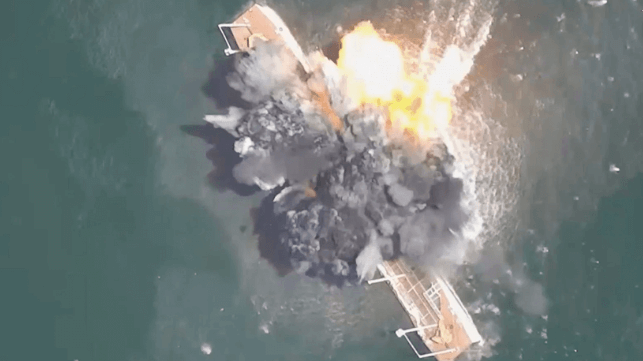
The test was performed during the large-scale "July Storm" exercise in the Baltic. The test footage's resolution is low, and it is difficult to determine the boat's dimensions, but it is clearly a small unmanned speedboat operated by remote control. The video shows it make contact with a stationary test barge, and a massive explosion follows. Russian reviewers suggested that the size of the explosive payload was significantly improved over other versions. 

There is no after-action footage to show the extent of the damage (or whether the barge stayed afloat), but it's clear that Russia is developing a bomb boat with comparable destructive power to Ukraine's Magura - assuming that Russian forces have similar command and control capabilities. 

Ukraine's forces have had so much success with sea drones because of access to secure, high-bandwidth communications links for command and control over the horizon (Starlink). The drones are remote-controlled by human operators during their final approach to target, and without satellite connectivity, they would not be possible to guide from hundreds of nautical miles away. Russia does not have (authorized) access to Starlink, but it is working hard to implement something like it - the Bureau 1440 project - by 2027. 

Russia's navy has been putting resources into the hardware side of the problem. In 2024, it stood up dedicated drone units to operate unmanned systems for a range of purposes, from reconnaissance to combat. It also set up an indoor, year-round test facility in St. Petersburg to support capability development. The Russian military has begun using these drone systems quietly, according to analyst H.I. Sutton, who warns that more activity may be to come. 

"We're not seeing large numbers of the same [Russian] drones used systematically, but I think that's coming. Expect them to be used more and more in the Black Sea, especially against the Odesa area," Sutton said in a video update. "This has actually been happening and has been reported in media a little bit, but it's probably more common than is reported.