Wednesday, April 22, 2026

Oil’s Last Stand and the End of the American Empire?

 April 20, 2026

Photograph by Nathaniel St. Clair

Before Ronald Reagan became the 40th US president, he sold anything and everything from toasters to refrigerators as the TV host and travelling spokesperson for General Electric. Today, Donald Trump’s salesmanship reveals more about his unvarnished support for Big Oil and a staggering ignorance about the world, even compared to the Gipper. But with the closing of the Strait of Hormuz and resultant loss of millions of barrels of shipped oil per day from the Persian Gulf in the ongoing US-led war against Iran, change is coming. Beleaguered citizens everywhere are looking for alternatives to oil and gas, sick of the endless war games, violence, cost, and loss of control in their lives.

With each hike in gas prices, lost fertilizer sales, and million-dollar spent missiles – all the result of failed Trump policy – the world is waking up to the charade. American leadership, influence, and empirical reach are failing with ever-declining returns as the United States extends itself further in another losing Middle East conflict over oil. Citing Winston Churchill in 1942 at a turning point in World War Two after the Allies repelled the Germans in North Africa, “It is not the end, it is not even the beginning of the end, but it is perhaps the end of the beginning.”

Is the American attack on Iran another turning point in the transition from brown to green as governments across the globe attempt to deal with the fallout from lost oil supplies? Subsidizing energy costs to counter the growing impact will force the world to change its dependence on oil as lost public revenues pile up and domestic well-being suffers.

In his 1962 book The Structure of Scientific Revolutions, Thomas Kuhn noted that “Paradigms gain their status because they are more successful than their competitors in solving a few problems that the group of practitioners has come to recognize as acute.” Today, renewable energy is cleaner, safer, and cheaper than petroleum as wind, water, and sun continue to replace a century of dirt, danger, and greed. Over a century ago, horses lost out to the internal combustion engine, now losing ground to a green electric grid and chemical storage batteries. Renewables and the Revolution Revolution are driving the future.

Alas, the dominoes of change don’t fall cleanly or easily. Benjamin Franklin (1752) was lucky he didn’t electrocute himself when he stuck a key on the end of a kite string in an electric storm, showing that lightning was static electricity. Alessandro Volta (1799) understood that the legs of a frog twitched when touched by two different metals (copper and iron) because of their different electronegativities, sparking his idea for the first-ever electrochemical battery, while at the same time disproving his rival Luigi Galvani’s “animal electricity.” Edwin Drake (1859) almost gave up bashing for oil in Titusville, Pennsylvania, before raising enough crude to finance the first American commercial oil well, which set the United States on its path to riches and eventual collision course with a changing climate.

Change is slow until it isn’t, from Aristotle (geocentric universe) to Copernicus (heliocentric universe), from Newton (gravity) to Einstein (relativity). Thomas Edison (1882) in Lower Manhattan and Nikola Tesla (1900) at Niagara Falls developed the electric grid that lit the world, Russell Ohl (1939) and Walter Brattain (1954) developed the differentially doped p-n junction at Bell Labs that lead to the transistor and photovoltaic (PV) solar cell, and James Hansen’s report to Congress (1988) helped show how industrial carbon dioxide changes the atmosphere and climate for the worse.

Each change remakes the economy and our everyday lives. Before coal ceded to oil, Great Britain ruled the waves (more than half the world’s wealth). Today, the US produces a quarter of global GDP ($30 trillion). But as economist Giovanni Arrighi noted, wealth-accumulating empires fail when finance dominates manufacturing, citing Spain, the Netherlands, Great Britain, and the United States. In the US today, a few super-rich control most of the country’s wealth, while $1 billion a day is spent on war and the public debt passes $39 trillion (up $3 trillion since the start of Trump 2.0!). Socialism for the rich. Poverty for the rest.

China is the main beneficiary, a next empire in waiting. As in the past, Spanish sails gave way to bigger Dutch rigging that fell to British coal that in turn lost to American oil, China is now reaping the spoils of a new paradigm – the sun. While oil and gas imports decline from a clogged Middle East transit route, China continues to sell more solar panels, wind turbines, and electric vehicles than any other country. Chinese renewable energy is winning today’s shift from old to new. Exponential growth rules as costs decrease and uptake increases.

With an untenable surcharge on imported petroleum since the start of the American attack on Iran, EU citizens are spending €500 million more per day in fuel. The worst is in Germany, where consumers aren’t as sheltered as in other European countries. Ireland saw a week-long protest when farmers, fishermen, and truck drivers blockaded cities to protest higher fuel costs. The impact is felt everywhere with reduced social spending, anger toward oil companies, and customers queuing to buy off-the-shelf, plug-in solar panels.

In Pakistan, rooftop solar panels and EV sales are rising. In the Philippines, gas rationing has begun. Canada removed federal taxes on gasoline, diesel, and aviation fuel. But while citizens around the world suffer, American oil companies profit even more from US military action in Iran. Is Trump rewarding his Big Oil friends who so generously donated to his election?

According to an analysis by The Guardian, “The world’s top 100 oil and gas companies banked more than $30 million every hour in unearned profit in the first month of the US-Israeli war in Iran.” Top of the list are the main global warming deniers, Saudi Aramco, Gazprom, and ExxonMobil. In response, an energy policy expert at the E3G think tank called for “taxes on windfall profits to accelerate the transition to green energy, rather than deepen dependence on fossil fuels.” Indeed, why should Big Oil prosper as governments respond by making fossil fuels cheaper, instead of working to build new green infrastructure?

Clearly “the system” doesn’t work, be it unregulated capitalism or unchecked presidential firepower. But change is coming. We have no choice, because of the earth’s limited petroleum supply (44 years?) and our worsening climate (430 ppm atmospheric carbon dioxide). Fortunately, solar power scales via manufacturing not geology (technology > extraction) – no moving parts. Unfortunately, Big Oil is the friction in the system – it’s all about the money. But we are the answer. In the words of Artemis II astronaut Christina Koch after returning home from the moon, “Planet Earth, you are a crew.”

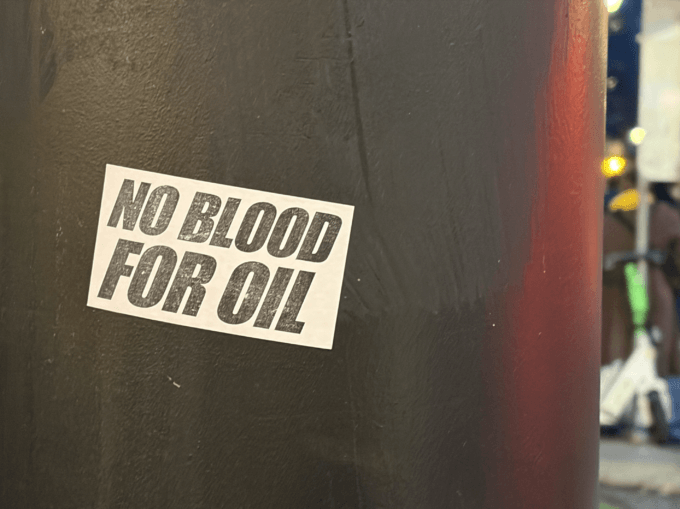
Financial wealth doesn’t define a nation. In fact, excess money management signals the end, when nurses, teachers, firefighters, and everyday workers can’t pay the monthly bills, can’t save for a rainy day, can’t keep the wolves from the door because transactional players are gaming the system, aided and abetted by a beholden government and war-mongering president who wants to sell even more blood-soaked oil.

Why do we continue to pay for yesterday’s dirty world when the future is clean, green, and safe? It’s time to bet on a future we all support.

John K. Whitea former lecturer in physics and education at University College Dublin and the University of Oviedo. He is the editor of the energy news service E21NS and author of The Truth About Energy: Our Fossil-Fuel Addiction and the Transition to Renewables (Cambridge University Press, 2024) and Do The Math!: On Growth, Greed, and Strategic Thinking (Sage, 2013). He can be reached at: johnkingstonwhite@gmail.com

To Stop Endless War in Iran and Beyond, Congress Should Rescind the Money to Fight

Faced with the threat of more war in Iran and elsewhere, Congress must do everything in its power to stop Trump. One tool Congress hasn’t used is its power to immediately cut off money for wars


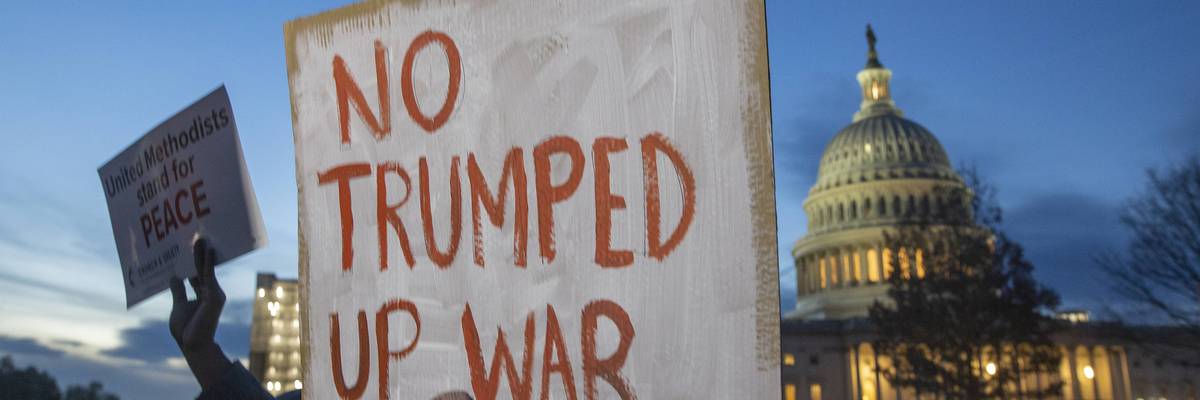
Protesters hold signs at the US Capitol to for the Anti-Iran War Rally
 Washington DC, United States.
(Photo by Tasos Katopodis/Getty Images)


David Vine
Apr 21, 2026
Common Dream

As a candidate for president, Donald Trump infamously promised to end endless wars and be the president of peace. In office, President Trump has launched illegal regime change wars in Iran and Venezuela; bombed at least five other countries; threatened war against Cuba, Greenland, Mexico, Panama, and Colombia; and supported Israel’s genocide in Gaza and war in Lebanon.

Despite a two-week ceasefire and diplomatic negotiations with Iran, Trump has deployed thousands of additional troops to the Middle East, while “Secretary of War” Pete Hegseth has made renewed threats to attack Iran’s civilian infrastructure, widely considered a war crime. For the next fiscal year, Trump has requested the largest military budget in US history, $1.5 trillion. He has also indicated he will ask for up to $200 billion more to fund the war in Iran. By all indications, Trump looks likely to return to war, if not in Iran, somewhere else.

Trump’s embrace of endless wars already has killed and injured tens of thousands, displaced millions, squandered tens of billions of taxpayer dollars, driven up prices on gas and other necessities, created a global economic crisis, and risked wider catastrophe and World War III. And don’t forget Trump’s genocidal threats to “wipe out” Iranian civilization, implying a potential nuclear attack.

Faced with the threat of more endless war in Iran and beyond, Congress must do everything in its power to stop Trump. One tool Congress hasn’t used is its power to immediately cut off money for wars in Iran and beyond. With constitutional authority over government spending, Congress can use its rescission power—that is, the power to rescind, or take back, money previously appropriated to government agencies. Specifically, Congress should rescind around one-third of this year’s discretionary budgets for the “Department of War” and Department of Energy, where nuclear weapons spending is hidden, while avoiding cuts that would harm military personnel and their families.

While a rescissions bill of this sort may break with congressional precedent, the future of the country and the world is at stake. Extraordinary threats demand extraordinary measures.

Cutting $350 billion in discretionary spending from the over $1 trillion war budgets would actually help protect the troops by making it harder, if not impossible, for Trump to deploy them into harm’s way to fight his wars. While a $350 billion cut may sound daunting, it would leave the country with a total military budget far larger than that of China and Russia combined and allow the military to focus on defending the country rather than squandering billions on endless wars.

While only two Republican Congress members have voted to stop Trump’s war in Iran, Democrats should advance a rescissions bill to continue to apply pressure to end the war in Iran and show they won’t fund another day of endless war. While a rescissions bill is unlikely to pass now, we may soon see more Republicans defecting from Trump’s sinking presidency and increasingly unhinged behavior. While a rescissions bill of this sort may break with congressional precedent, the future of the country and the world is at stake. Extraordinary threats demand extraordinary measures.
Cutting the War Budget Now

Given what we’ve seen from Trump, how can he be trusted to continue to control a military budget that already exceeds $1 trillion? Doing so is to almost literally leave loaded guns in the hands of an increasingly erratic and dangerous man.

The danger Trump poses underlines the desperate need to get Trump out of office as quickly as possible through impeachment or the 25th Amendment. Amid these efforts and continued attempts to pass Iran War Powers Resolutions to prevent Trump from waging war without congressional approval, Congress should help protect the country and the world by removing the funds available to Trump to make more war.

Allowing Donald Trump to continue to control the entirety of this year’s Pentagon budget—let alone a larger one next year—risks his not only continuing his immoral, illegal war in Iran but also his likely launching new wars, including, for example, in Cuba and most frightening of all with China.

Congress has the power to take back money it’s previously appropriated to the Pentagon just as it has passed thousands of rescissions bills to take back all kinds of funding it previously approved.

There are at least three forms a rescissions bill could take. Under each, the bill won’t take pay or services from military personnel or their family members. It will instead take money from weapons makers and others profiting off war and budgets that make the military an offensive, endless war fighting force. A rescissions bill could rescind money for war and:Return the money to citizens in the form of $600 to $1,200 stimulus checks (or a “peace dividend”) and some lowering of the national debt, as military budget expert Stephen Semler has proposed. As Semler says, this proposal could appeal to people across the political spectrum given the longstanding affordability crisis, which has been worsened by the rising price of gas and other necessities thanks to Trump’s new war.Reappropriate—that is, redirect—the funds as a peace dividend to defend people’s daily lives by improving and expanding access to things like Medicare and Medicaid, free school lunches and other food assistance, childcare, affordable housing, and other critical infrastructure.Return the money to the US Treasury to reduce the near $40 trillion national debt.

Importantly, a rescissions bill could reclaim both money not yet obligated—that is, not yet committed to spending—and money that has been obligated. Both offer an opportunity to take money back from some of the hugely expensive, unnecessary, and often world-endangering weapons systems and the war profiteers who make them. This includes funding for new nuclear weapons, the F-35 fighter jet (the world’s most expensive weapons system that has a terrible record of actually being able to fly), its planned sequel F-47, and Trump’s technologically infeasible fantasy “golden dome” missile defense system. A rescissions bill could mandate specific budget cuts or could cut a percentage from all Pentagon and nuclear weapons accounts except those supporting military personnel and their families.
Is It Realistic?

A rescissions bill is unlikely to pass in today’s Congress. To now, only two Republicans have voted for War Powers Resolutions to stop the war in Iran. However, the resolutions failed by just a few votes given the tiny Republican majority in Congress. And we don’t know what Congress will look like in one month or three, when more Republicans may abandon Trump.

Democrats and others shouldn’t be afraid of the tired shibboleth that military spending is about “supporting the troops”—it is increasingly obvious that increasingly large military budgets have made it easier to wage offensive, catastrophic wars of choice that have put troops in harm’s way, causing tens of thousands of troop deaths and hundreds of thousands of injuries, in addition to millions more dead in Afghanistan, Iraq, and far beyond.

A rescissions bill also gives politicians an opportunity to vote “yes” to cut the Pentagon budget; “yes” to a peace dividend; “yes” to using taxpayer money to actually defend the country and improve national security.

Even if a rescissions bill can’t pass now, it can be another way to pressure the administration to end the US-Israeli war in Iran and Lebanon. Along with war powers resolutions, a rescissions bill is another way to demonstrate continuing opposition to this and other endless wars. It’s a way to keep the media focused on a war that’s been all too distant from many people’s lives in the US. It’s a way to do everything humanly possible to stop wars that have already killed and injured tens of thousands and that could exceed the catastrophe of the wars in Afghanistan and Iraq if they continue.

A rescissions bill will also allow constituents and journalists to ask Congress members and midterm candidates, “Do you want to fund more endless war or do you think Congress should take money back from the Pentagon to prevent more war and fund things we need? Do you think we can trust Trump with the current Pentagon budget or not? Do you think we can trust that Trump won’t use the out-of-control military budget to restart the war with Iran and start new wars, most terrifyingly a potential nuclear war with China?”

A rescissions bill also gives politicians an opportunity to vote “yes” to cut the Pentagon budget; “yes” to a peace dividend; “yes” to using taxpayer money to actually defend the country and improve national security; “yes” to a rational, realistic, defense-focused military budget rather than a military budget designed for offensive wars.

While Trump has trashed his promise to “stop wars” not start them, Congress has the power to pass a rescissions bill that would protect the country and the world from more endless war while transforming the US military into the defensive force it should be.


Our work is licensed under Creative Commons (CC BY-NC-ND 3.0). Feel free to republish and share widely.


David Vine
David Vine is a collaborative writer, political anthropologist, and author of a trilogy of books about war and peace including "The United States of War: A Global History of America’s Endless Conflicts, from Columbus to the Islamic State," which was a finalist for the 2021 Los Angeles Times Book Prize in History. The other books are "Base Nation: How U.S. Military Bases Abroad Harm America and the World" and "Island of Shame: The Secret History of the U.S. Military Base on Diego Garcia." David’s other writing has appeared in The New York Times, The Washington Post, The Guardian, Politico, and Mother Jones, among others. David was a professor of anthropology at American University in Washington, D.C. for 18 years (2006-2024), achieving the rank of full professor in 2018.
Full Bio >
Trump's China strategy torn apart by GOP tax gurus following evidence of failure

April 21, 2026
ALTERNET


President Donald Trump’s image is indelibly linked to that of American business, from branding a real estate empire with his name and giving business advice in his ghostwritten-book “The Art of the Deal” to starring in the business-themed reality TV show, “The Apprentice.” Yet a nonprofit that exists to promote free markets and low taxes, two policy staples of the American business community, accused Trump on Tuesday of failing American business against its main foreign competitor, China.

“Government reviews have repeatedly documented the ongoing failure of Section 301 tariffs to change China’s behavior,” wrote Bryan Riley, director of the Free Trade Initiative for a 501(c)(4) called the National Taxpayers Union. “Ways and Means and Finance Committee Members may want to ask Amb. Greer why we should expect new Section 301 actions launched by USTR to fare any better.”

The “Amb. Greer” in question is U.S. Trade Representative (USTR) Jamieson Greer, who is scheduled to speak before both the Senate Finance Committee and the House Ways and Means Committee about Trump’s trade policies.

“In light of USTR’s recent announcement of new Section 301 trade investigations, those committees may want to follow up on his statement to the House Appropriations Committee last week,” Riley wrote. “‘In President Trump’s first term, the Section 301 tool was used to great effect.’ His comment referred to tariffs imposed following a 2017 Section 301 investigation into China’s Acts, Policies, and Practices Related to Technology Transfer, Intellectual Property, and Innovation. The goal of the investigation was to reduce or eliminate China’s unfair practices in these areas.”

Yet Riley insisted that “subsequent reviews cast substantial doubt on the effectiveness of this action,” ticking off as evidence data from a 2018 USTR update on Section 301, a 2019 Economic Report of the President on Chinese retaliatory tariffs, a 2021 Report of the U.S.-China Economic and Security Review Commission and President Biden’s 2024 four-year review of the Section 301 tariffs.

“China has not eliminated many of its technology transfer-related acts, policies, and practices. Instead of pursuing fundamental reform, the Chinese government largely took superficial measures aimed at addressing negative perceptions of its technology transfer-related acts, policies, and practices,” Biden’s report started per Riley. “At the same time, China has persisted and even become more aggressive, particularly through cyber intrusions and cybertheft, in its attempts to acquire and absorb foreign technology, which further burden or restrict U.S. commerce.”

Although Trump imposed tariffs on a wide range of products at the start of his second term, the Supreme Court famously ruled Trump had abused his power by incorrectly claiming he could levy tariffs unilaterally. The tariffs are also exacerbating inflationary pressures at a time when Trump’s ongoing war against Iran, which prompted Iran to raise gas prices by closing the Strait of Hormuz, has made his tariffs increasingly unpopular."These ‘economists’ are idiots,” White House spokesman Kush Desai
told AlterNet earlier this month. He was referring to a pair of economists, Richard Wolff and Ed Gresser, who had criticized Trump’s senior counselor for trade and manufacturing Peter Navarro for arguing the Iran war will lower gas prices. “Peter Navarro is an American Patriot whose loyalty to the President and the American people is unimpeachable.”

Capitalism Without Beneficial Socialized Restraints Is Unbearably Toxic

April 22, 2026

Photograph by Nathaniel St. Clair

Imagine a neighborhood that resulted from a Commune-ity of efforts and, is now, filled with distrust, accusations, monetary hoarding, spying, and boarded-up windows with numerous weapons at every opening, while the inhabitants support themselves by selling off the foundations so that they can escape from their own delusion-filled creation.

A reading of Erskine Caldwell’s “God’s Little Acre” would seem possibly beneficial but also would probably be too much to ask.

The zealous Capitalists have always relied (definite pun) upon Socialized restraints in order to maintain and expand their dependence upon inequality, injustice, and vanity. They are highly dependent upon ignorance and misrepresentation in order to feed their unquenchable insecurities and arrogance. Global militarized violence is an inescapable component of the lie that they worship – the worshipped lie that they are not using vast amounts of resources, human and otherwise, in order to feed their love of indifference to suffering and environmental degradation for private monetary gain. They also lie when they portray these chronic perversities as being aspects of integrity.

Every form of taxation is socialism.

Where has the great majority of taxes been going?

War and punishing economics in support of elitist arrogance, avarice, and impunity. Socialized cruelty, inequality, and degradation of the environment have always been the main characteristics of Capitalism’s domination over Socialism’s possible benefits. Instead of being egalitarianly beneficial Socialism has been chronically reduced to a position whereby its restraints are used to guarantee Capital is the willfully abusive lord of the manner/manor. The basement foundations – where the majority of those relegated to servitude are told they must live – is continually being stripped for the lust of those who reside above them. The manor house is a whorehouse.

Capitalism has always depended on taxations. Most of the taxations – be they monetary or degrees of privileged power or reliance upon vicious violence – are implemented through predatory Socialized restraints. Capitalists believe the lie that their religiosity is disconnected from Socialism. The truth is that their devotions are inherently dependent upon a toxic form of Socialist restraints and the deliberate elimination of Socialist restraints which are beneficially egalitarian and are conducive to improving environmental quality.

Capitalism can never exist and has never existed on its own. Anyone who promotes the lie that Capitalism is a free-standing economic system is a liar and a member of a cult of degradation. They are pathetic ignoramuses who are severely lacking the very characteristics they proudly and delusionally claim that they epitomize.

These ignoramuses overwhelmingly belong to and support both major teams in thrall to the political whorehouse known falsely as the United States of America. They deserve repudiation and shunning.

We are currently seeing a small rise in the numbers of people aligning with or claiming to be Democratic Socialists. They want the Capitalist focus to evolve into a healthier set of priorities and to implement a shift away from the current, long-standing predatory Socialist Restraints and toward the necessary egalitarian Socialist Restraints. The great problem is that the majority of these Democratic Socialists are also promoting the belief that membership in one of the dominant teams in the whorehouse of the Fake USA is a form of pragmatism. This thinking seems to be a cherished perversity which guarantees continued debaucheries and the belief that, if beneficial Socialist priorities remain in a reduced status in order to buffer the prioritized private Capitalist impunities, this postponing will incrementally transform debauchery into salvation.

As with all the other major religions and their superstitions and love of promoting feelings of insecurity, Capitalism–without Socialized egalitarian and environmental restraints, is a (would-be lordly) devil’s paradise.

The real motto of the pathetic and ignorant Capitalist-dominated state of mind is “God Is Being In Two Places At Once” or “Money Is God’s Essence and Whatever Is Done For Money Is Righteousness” or All of the above.