Saturday, May 02, 2026

Technology

Theses for an ecosocialist critique of artificial intelligence

Saturday 2 May 2026, by Daniel Tanuro


This text focuses on generative AI. The formulation in theses (unevenly developed) is not intended to establish certainties, but to facilitate debate by the conciseness of the presentation.

Intelligence and human intelligence

1. What we call intelligence is what makes it possible to grasp difference, to apprehend the new, to anticipate the possible in the course of the events that punctuate time.

2. Intelligence is a product emerging from the non-linear evolution of life.

Nature makes leaps. Inert things are not intelligent. Symbiotic organizations of plants and fungi communicate and adapt to events without anticipation or awareness. Intelligence as defined here appears in the animal kingdom where it presents various forms and degrees. In unicellular organisms and organisms without brains, it is conflated with the “survival instinct” (survival mechanisms).

3. Human intelligence combines a great capacity for abstraction from a small number of data, sophisticated communication, thought, and a developed spiritual life that is expressed in complex symbolic realizations, both individual and collective.

Homo sapiens

5. Without human society, without a communicating and collaborating body, there is no reflective intelligence, no spiritual life, no consciousness.

The characteristics of our intelligence result both from physical traits (brain volume and structure, bipedalism, hand specialization, phonatory apparatus) and from the fact that Homo sapiens is a social mammal. The young of our species can only survive through prolonged parental care, we communicate through complex syntactic language, and our social relationship with the rest of nature is mediated by work, carried out with the help of tools. These traits give Homo sapiens multiple intelligences and a great adaptability, which is decisive for understanding the ontogenetic development of humanity.

6. Mind, thought and consciousness depend on the development/functioning of the brain but also on that of the body in general.

Mind, thought and consciousness cannot be located in a specific area of the brain. These properties are, so to speak, secreted in the process of individuation by which humans develop physically, psychically and collectively.

7. Human intelligence is not only social but also ecosystemic.

The ability of young humans to identify and classify forms, regularities and exceptions is shaped by climate, seasons and biotopes. Our intelligence is enriched by the exceptional diversity of terrestrial fauna and flora and the complexity of their relationships with the physical world.

8. Intelligence necessarily combines reason and emotion, the knowledge of what is, the remembrance of what is no more, and desire for what could be.

Emotion – etymologically “that which sets in motion”, “that which makes one come out of oneself” – is that which arises from the tension between the self and otherness; the desired world and the world as it is; the project and its implementation; the existing and the absent. It is the foundation of ethics and is therefore much more than a supplement to the soul of reason: an essential part of our intelligence. Without emotion, without empathy, without ethics, reason would be dangerously pathological.

9. The forms of human intelligence are historically and ecologically varied.

In the social production of their existence, humans develop knowledge, techniques and modes of production. They transform society, nature and their metabolism with it, and thus also the conditions under which they communicate and collaborate – and consequently their intelligence. Homo sapiens probably did not think in the same way before and after the invention of writing, their artistic creations were not identical before and after the steam engine, their symbolic universes differ in the Arctic tundra, in the tropical forest, in the megacities of iron and concrete.

AI, intelligence, machinery and capitalism

10. The breakthrough of AI accelerates the destructiveness of capitalist progress.

The rise of capitalism is punctuated by scientific advances. Leaps forward in knowledge have developed the means of production, extended exchanges, opened horizons. But this progress is contradictory. By reducing intelligence to reason, and reason to the calculation of profits, Capital mutilates both. The law of value renders reason absurd and drives emotion into “the icy waters of selfish calculation.” The implementation of AI accelerates these trends: it intensifies the destruction of community ties and biodiversity, thereby impoverishing the social and ecosystem sources of intelligence. While reflecting more extensive knowledge than ever before, it restricts the fields of investigation of science and encourages feedback loops in research.

11. Despite its prowess, AI is not and cannot be intelligent.

AI research is advancing the understanding of how the brain works. The mastery of language by artificial neural networks, in particular, is a major scientific breakthrough. But AI doesn’t think, doesn’t dream, doesn’t imagine. It “speaks” without seeing (knowing) what it is talking about, because it has no world. The future it projects is inferred from what has dominated the past in statistics. Its inventory capacities are both dizzying and partial because its data (our data, which it appropriates!) is limited to the share of collective human knowledge circulating on the Internet.

12. AI is human, not “artificial.” It exacerbates capitalist extractivism, its instrumental reason and the subsumption of labour.

Algorithms are in the hands of capitalist-engineers who seek to maximize profit. Thanks to their monopoly situation and their global influence, the digital giants are evading the equalization of the rate of profit. It is this mechanism of capturing value created by work that allows them to accumulate gigantic rents. These are rooted in the characteristic mechanisms of the system: the (over)exploitation of labour power (particularly in the extraction and refining of rare earths made available by nature), and the gratuitous monopolization of accumulated human knowledge. The masters of tech aspire to absolute power that has similarities to that of the ruling class under the old regime, but digital capitalism is not feudalism.

13. Marx’s critique of the machine is decisive for understanding AI.

For Marx, the machine reduces proletarians to a series of gestures useful to capitalist valorisation. Their know-how is reduced to smithereens, their alienated work “extinguishes” their creativity; it becomes the accessory of the machine; it has taken their place, they lose their dignity. When the machine is automatic, the appropriation of living labour by dead labour becomes the fact of the productive process; machinery thus gives Capital its most adequate form. From then on, the collective intelligence appropriated by the capitalist—objectified labour—completely dominates living labour; The machine appears both as a “hostile force” and as the prerequisite for production. From formal, the subsumption of labour to capital becomes real. This Marxian critique of machinery applies perfectly to AI.

14. The danger does not lie in the fact that the machine would risk becoming “smarter” than us – “superintelligent”. It lies in the fact that AI is the “hostile force” par excellence, pure instrumental reason, objectified capitalist inhumanity. To increase one’s power is to increase the power of that which dominates us and drags us towards the abyss.

AI, long waves and exploitation of labour

15. In the face of work, AI “embodies” the logic of capital better than the capitalists themselves.

In a non-capitalist world, other AIs could relieve humanity of tedious and repetitive tasks. In education, in health, in ecosystem care, for example, specific AIs would allow living work to focus on social and ecological interactions, enriching them in a human logic of “care”. In the real capitalist world, however, “care” – cancer detection, weather forecasting, etc. – is subordinate to profit. AI is set to extract surplus value to the last drop, automatically, without truce or rest. It substitutes even more dead work for living work, extends real subsumption to administrative and service tasks, and dries up creative professions. Algorithms are perfecting the Taylorist logic of work control: the worker’s activity, gestures, location, succession of operations, working and travel times can be controlled, evaluated and rewarded (and above all sanctioned) remotely, directly. Far from lightening work, AI makes it more intense and denser.

16. Promises of a new golden age by AI are without serious foundation. No technology can lead capitalism out of the contradictions of value production.

Projections of increased productivity through the implementation of AI currently range between 0.07 and 0.7% per year for ten years. This is not enough to feed a long wave of growth. AI does not revive accumulation, it sharpens systemic contradictions. We go back to Marx again: machinery implies an enormous fixed capital that “no longer orients itself towards immediate value” but towards “production for production’s sake”; The depreciation of machines therefore requires that the circulating fraction be oriented towards “consumption for consumption’s sake”. However, the capital gain must be realized regularly, for a sufficient period of time. After forty years of wage austerity and in a world of powers fighting for hegemony, this is where the problem lies: who can guarantee the sustainable sale of the goods promoted by billions of smartphones? In line with the intuitions of Ernest Mandel, the severity of the systemic eco-social crisis and the classical contradictions of value production probably exclude any new long wave of capitalist expansion.

17. It is not the revival of employment that will be on the agenda of AI, but the deepening of social and environmental plunder.

Unlike previous technological revolutions, the job losses caused by AI are unlikely to be compensated for by the development of new equivalent functions. As the enormous development of the fixed part of capital tends to lower the rate of profit, capital resorts to the well-known counter-tendencies: increased plundering of free natural resources and underpaid labour power. The dematerialization of the economy is a myth. In reality, the breakthrough of AI is accompanied by a growing material brutality in the imperialist appropriation of ecosystems and in the cruellest superexploitation of proletarians (platform capitalism, child labour, zero-hour contracts, etc.). All these mechanisms accentuate at the same time colonial inequalities and ableist, racist and gender discrimination.

18. AI is inflating a new bubble of fictitious capital and reinforcing the trend towards militarization.

The astronomical sums that a handful of oligopolies are investing in the development of AI reflect the unprecedented plethora of money capital, the weight of finance in contemporary capital, and its very high degree of concentration/centralization. But the fetishism of technology combined with specific intra-oligopolistic competition blinds investors. In themselves, their investments do not provide any solution to the problem of valorisation. AI does not have the expected results, is too expensive, customers prefer human contact, etc. AI is thus inflating a new bubble of fictitious capital. Sooner or later, to soften the shock, technological capital will impose the use and payment of what is now presented as a wonderful free service. But this will not be enough. The AI rush has everything it takes to trigger another major financial crisis and accelerate the tendency of crisis-ridden capital to invest in weapons production as a lifeline.

Global Inequality, Civilization and “Technofascism”

19. AI is deepening the gap between imperialist metropolises and peripheral countries.

Only the powerful monopolies of the most developed capitalist countries can mobilise the enormous amounts of capital needed for AI infrastructure. Its frenetic development is already an additional factor in deepening the inequalities between the most developed capitalist countries (in particular the United States and China) and the low- and middle-income countries (LMICs). This division stimulates the mechanisms of the crudest imperialist-colonial domination and encourages the imperialist powers to further harden their barbaric management of migratory flows.

20. From a general social perspective, generalist AI degrades intelligence, creativity, empathy, ethics and public health (including mental health) – especially that of children.

Communication and collaboration are inseparable. Today, algorithms are taking over the former as steam engines yesterday took over the latter. The toxic tendencies that result from this extend beyond the sphere of work. In society in general, contact with the always different other, human and non-human, is in competition with the association of the same in a narcissistic bubble; the machine replaces the confidante; the hyper-solicitation of information gnaws the wings of wandering thought; the joyful quest for truth is replaced by a sad addiction to virtual realities and their lies; The hope of a different future is lost in the statistical compilation of an objectified past.

21. By helping Capital to subsume labour as never before, AI helps it to subsume society as a whole like never before.

In the sphere of reproduction, through “social” networks, AI multiplies the possibilities of realizing the surplus value produced by the exploitation of labour. It accelerates the circulation of goods and intensifies the consumerist subjugation of minds. The machinery of the industrial revolution disqualified the know-how of the producers by dispossessing them of the control of the labour process. AI disqualifies, so to speak, “savoir-vivre” – the formation of desires and consciousness. Free access to the machine that seems to speak, understand, even sympathize, creates emotional dependencies that will later be exchanged. The subsumption of work is added to the subsumption of life.

22. Through its inability to distinguish between truth and falsehood, AI promotes supremacy, the law of the strongest, the elimination of the weak, the end that justifies the means in the struggle of all against all.

Children acquire the notion of truth through socialization and language learning. Since AI is neither living nor social, the notion of morality is foreign to it – alien. The machine is said to be “self-learning”, but it cannot discard on its own the gigantic masses of data corrupted by lies, hatred and perversion. Thousands of underpaid “click proletarians” are responsible for instilling “values” in it. These stem from the worldview of their employers. No wonder AI helps suicidal people commit suicide, scammers help swindle, rapists rape. It “lies”, “cheats”, “tricks”, and “prevents her from being disconnected”"... just like its creators.

23. AI is the perfect instrument in the service of a rogue capitalism that finds its political expression assumed in a bigoted, racist, machismo, LGBT-phobic, colonial, anti-ecological and neo-Malthusian “technofascism”.

Generalist AI is promoting the rise of the far right fuelled by more than forty years of neoliberalism. Fascists use it to manipulate the masses via social media and rig elections. Authoritarian powers use it to control populations at an unprecedented point in history. (Increasingly less) democratic governments use it to track down migrants and file opponents. AI has an unparalleled ability to get individuals to change their minds. The generation of images and texts is a formidable means of indoctrination that solicits the cerebral mechanisms of “rigid thinking2. Some neuroscience researchers believe that these mechanisms lead to epigenetic changes, which can be transmitted over several generations (a possibility glimpsed by Darwin). If this is true, AI has the potential to bring humanity back under the yoke of irrational beliefs in the long term.

AI, ecology and cataclysm

24. AI accelerates the social-ecological catastrophe, climate catastrophe in particular. Its development precipitates the crossing of “tipping points”.

In 2023, U.S. data centres consumed 17 billion litres of water, and this figure is expected to more than double by 2028. Worldwide, 8,000 data centres consumed 460 TWh of electricity per year in 2024, to which 160 to 590 TWh (compared to 2022) should be added in 2026 – i.e. the annual consumption of Sweden and Germany respectively. CO2 emissions from these infrastructures will triple between 2020 and 2035, according to the IEA (International Energy Agency). The extraction of rare earths needed by AI generates 13 billion tonnes of waste per year, and some studies project more than a hundred times more by 2050. The poor in poor countries are hit hardest by these effects, either directly through mining and the depletion of water resources pumped by offshore data centres, or indirectly through biodiversity loss and extreme weather events.

25. AI increases the risks – inherent in capitalist competition – of major technological disasters.

AI has become the primary issue in competition between tech monopolies closely intertwined with the states in struggle, mainly China and the United States. As a result, the race for AI is immediately a race for its military applications. Research is opaque and derogates from the scientific practice of “organized scepticism”. This configuration promotes secrecy which increases the dangers. The self-insertion of an even more powerful AI into many systems could interrupt basic services, produce dangerous viruses, trigger a nuclear attack, without us knowing exactly how... The inability of the capitalist system to stop the climate shift (perfectly documented by science) shows that these scenarios are not science fiction.

Avenues for a necessary elaboration

26. A public initiative is essential to identify risks and take immediate measures to protect society from the effects of AI.

  A broad democratic debate, duly informed by scientific expertise independent of capitalist interests, should pronounce on the social utility of AI and in particular discuss the following problems and provisions:
  AI research and development must be taken out of the hands of capitalist groups and subjected to the procedures of the scientific community;
  full transparency on the design of models, the training of algorithms and the technical methodologies used by companies;
  ban on AI in the field of artistic and literary creation. Cracking down on data piracy;
  protection of cooperative initiatives for the use of digital technologies (Wikipedia, etc.) against AI competition and AI hacking;
  faced with the risk of dehumanizing social relations through the use of AI, maintaining and extending employment in the fields of “care” (education, health, assistance to early childhood and the elderly, prevention of violence against women, etc.); ensuring that public counters are maintained in the administrations;
  banning the applications of AI in the military and police domains;
  prohibition of racist, macho and LGBT-phobic content;
  removal of access to social networks for children under the age of sixteen; education about technologies and their risks;
  reform of school curricula with the aim of developing cooperation, a sense of belonging to nature and respect for the living.

27. AI confronts the world of work with the need for an international, radically anti-colonial combative trade unionism that articulates struggles at all levels of the value chain and puts workers’ control back on the agenda.

The power of Big Tech rentier capitalism is based on the super-exploitation of millions of workers and children in mining, rare earth refining and the electronics industry. The consequent struggle against these rapacious monopolies and their technofascist project requires the unification of workers at all levels of the value chain. Recognition of trade unions and freedom of association everywhere. Obligation to consult workers on the introduction of AI at work. Trade union veto. Workers’ control over the evolution of the workload, in quantity and quality. Against layoffs due to the introduction of AI in companies, reduction of working hours without loss of salary.

28. A moratorium on the construction of data centres and other heavy AI infrastructure is essential. Any further progress must be made conditional on the adoption of a comprehensive ecological and social strategy, including: a strategy to reduce social inequalities, the sustainable management of resources (water, minerals), the restoration of massacred ecosystems, as well as a precise plan to reduce greenhouse gas emissions, in line with the objectives of the Paris Climate Agreement.

29. Develop a counterculture in the face of AI. In social movements, implement collective practices to resist the degradation of social relations and the debate of ideas by AI.

The formation of a collective intelligence cannot do without collective action decided and evaluated democratically during “face-to-face”" exchanges, allowing verbal and non-verbal expression. Social networks are not a place for debate. The left must combat the fascination with “talking machines”, consciously work to ban the use of smartphones from its meetings and rehabilitate printed publications aimed at the exchange of points of view and in-depth analyses.

30. Another kind of digital, public and democratic, is possible.

As part of an essential redistribution of wealth, local, regional and national authorities must have the means to provide free public messaging, data storage and social network infrastructure under democratic control, with protection of user data and development of AI by domain.

31. Fighting capitalism in the age of AI reinforces the need for a radical refoundation of the left.

The breakthrough of AI casts a harsh light on the disarray of the left. It reinforces the need to purge Marxism, and the left in general, of productivism, instrumentalist ideologies (“the end justifies the means”), the cult of progress and the idea of “technological neutrality”. The global grip of Big Tech from Silicon Valley, Shenzhen and other imperialist centres underscores the absurdity of campism: the break with capital can only be conceived in the internationalist perspective of a revolution to be pursued permanently until the global abolition of capitalism. Beyond Marxism, it is also a question for the left of breaking with post-modern conceptions such as “actor-network theory”: fully taking into account the dangerous consequences of the alien nature of AI presupposes abandoning the idea that technical devices that function as prostheses of human activity, because they have a social effect, should be considered as social actors. It is humans who forge their history, not machines.

32. The threats of AI underscore the urgency of a revolutionary, ecosocialist break with the civilization of capitalist growth.

The threats of AI do not stem solely from capitalism. Whatever the relations of production, neural networks will remain structurally incapable of distinguishing truth from falsehood and of projecting a different future. Replacing capitalist property with collective ownership, in and of itself, would not be enough to bring the ecological footprint of AI back to the limits of terrestrial sustainability. The idea that AI would act as a miracle cure for the market to solve the terrible problems created by the market is magic, not reason. The only perspective compatible with human dignity and with the survival of the species is the ecosocialist degrowth of global material production, planned in social justice, aiming at a world economy of satisfaction of real needs democratically determined in respect of ecosystems, their limits and their fragile, irreplaceable beauty.

*At various stages of their writing, these theses have benefited from the remarks of Marius Gilbert, Cédric Leterme, Léonard Brice, Michaël Löwy, Christine Poupin, Julia Steinberger and Mélodie Vandelook, whom I thank for their attention.

9 February 2026

Translated by International Viewpoint from A l’Encontre.


(Video) Ian Angus’ ‘Metabolic Rifts: Capitalism’s Assault on the Earth’s System’: A Global Ecosocialist Network forum

Ian Angus introduces his new book Metabolic Rifts: Capitalism’s Assault on the Earth’s System, joined by Helena Sheehan, Inea Lehner, and David McNally. Hosted by Jess Spear and the Global Ecosocialist Network.

About Metabolic Rifts:

Like an autoimmune disease that attacks the body it dwells in, capitalism is tearing apart the very planet that feeds it. "Metabolic Rifts: Capitalism’s Assault on the Earth System" builds on Karl Marx’s insight that while capitalism is dependent on the natural world, it is also waging war on the natural systems that sustain life on Earth.

Focusing on deadly rifts in two of the most important natural systems—the carbon and nitrogen cycles—Ian Angus explains and elaborates on the Marxist view that capitalism is massively disrupting essential exchanges of matter and energy between society and the rest of nature, putting the entire Earth System in danger. After tracing the long-neglected history of metabolic rift theory in scientific and socialist writing, Angus draws on a wealth of modern research to extend and deepen the natural science basis of Marxist ecology. In clear, non-technical language, Metabolic Rifts offers a scientific basis for understanding the deep causes of today’s environmental crises, and a program for action to prevent catastrophe in our time.

India: When democracy erases its own citizens


West Bengal elections

There is a particular kind of violence that leaves no bruises; it does not announce itself at your doorstep, it does not come with riot shields or batons. It arrives instead as a printed list, or rather, as your absence from one.

Sk. Rabiul Islam (54) has been actively participating in every Indian election — national, state or local panchayet — for the past three decades. After the list published by the Election Commission of India (ECI), he finds himself off the voters’ list in his state of West Bengal. The reason was so heartbreaking in its mundanity; he went by “Rabiul Islam”, his name, on his voter card, and Sk. Rabiul Islam on other government documents, including his Aadhar biometric card and ration cards. A lifetime citizenship, erased over the title “Sk.”

Rabiul is certainly not alone in his predicament. He is one of nearly 9 million people who have lost their voting rights in West Bengal ahead of its April 23-29 Assembly election. Almost 6 million of these 9 million people were declared absentee or deceased, while the remaining 3 million are unable to vote until a special tribunal hears their cases.

For those unfamiliar with the scale of what is happening, that figure demands contextualisation: nine million people disenfranchised in a single Indian state, just weeks ahead of a democratic election, through a formally sanctioned administrative process. Why does it matter far beyond the borders of Bengal?

What is SIR and why it matters

The mechanism behind this erasure is called the Special Intensive Revision (SIR), a process that on paper sounds entirely reasonable. Under the Representation of the People Act 1950, the ECI is empowered to periodically revise electoral rolls, removing dead voters, duplicates and those who have migrated. Routine maintenance, as it were, of a database. The ECI claims the SIR process is aimed at removing duplicate or deceased voters and adding genuine people left out of voter lists.

But the devil, as always, lives in the implementation. What has unfolded in West Bengal just before the Assembly elections is anything but routine. Many scholars labelled this the largest targeted disenfranchisement exercise in modern electoral history. It demands the attention of everyone who still believes the vote is not a privilege to be administered, but a right to be protected.

Bengal is not like other states

To understand what happened in Bengal and why it is different, one first needs to understand what happened elsewhere. Since 2025, the ECI, now under Chief Election Commissioner Gyanesh Kumar, has carried out SIR exercises in 12 states, including Bihar, West Bengal, Tamil Nadu, Kerala, and Uttar Pradesh, among others.

In states such as Bihar, 6.4 million names were initially flagged, but the final count produced only about 200,000 deletions and 2.3 million additions. In every other state, exclusion was followed by small deletion and large additions. Bengal was the only state where exclusion was followed by mass deletions.

When the SIR process commenced in West Bengal in November 2025, the state had 76.6 million registered voters. By the time the final rolls were published, the effective electorate had dropped dramatically, with 9,066,000 names removed. A new, never-before-deployed category called “logical discrepancy” was introduced: a computer-generated mismatch between current voter data and records from 2002.

Sabir Ahmed, of the Kolkata-based SABAR institute, said that while the revision of electoral rolls is a routine activity, usually conducted over one or two years, the process was hurried in high stakes West Bengal. There seems to be some motive behind such a hurried activity, he said. Observers with no local knowledge were brought in from other states. The ECI process also lacked transparency and lists were published in the middle of the night.

A community in the crosshairs

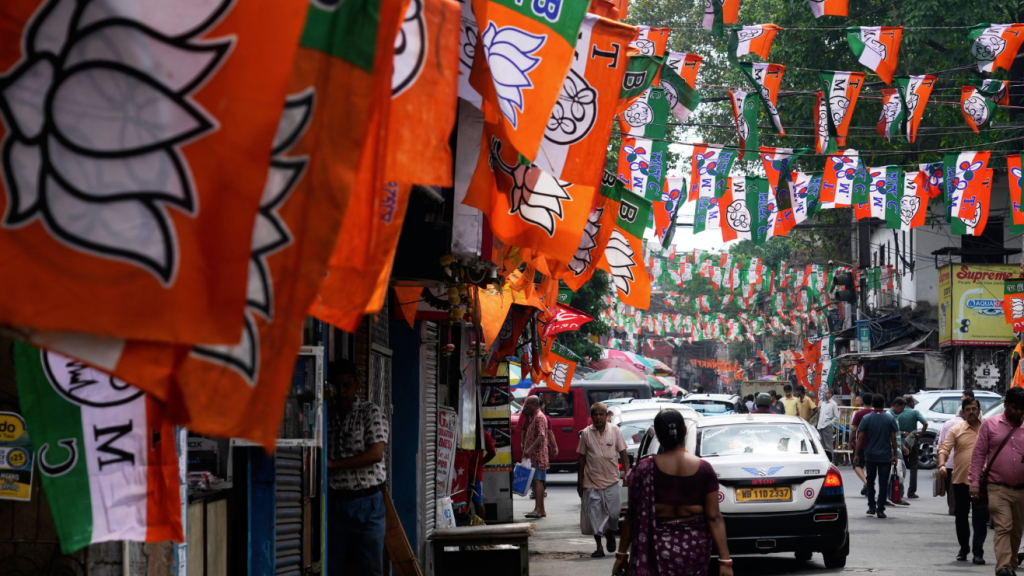
There are about 25 million Muslim residents in West Bengal, constituting roughly 27% of the state’s population — the second largest Muslim population among Indian states, after Uttar Pradesh. What is significant is that West Bengal was never ruled by the Bharatiya Janata Party (BJP). Since 2011 it has been run by Trinamool Congress (TMC), headed by Mamata Banerjee. Muslims are an integral part of its electoral support base. The BJP’s political calculation is not difficult to read.

The SABAR Institute analysed voter deletions in two key constituencies, Nandigram and Bhabanipur, both contested by Suvendu Adhikari, the BJP leader in the West Bengal Legislative Assembly. The analysis found that while Muslims make up about 25% of Nandigram’s population, more than 95% of the names deleted from the list were Muslims. Similarly, Bhabanipur has 20% of Muslims, but 40% of voters deleted in the constituency are Muslims.

The mechanism driving this pattern is the “logical discrepancy” tool. Spelling variations in names across generations, slight differences in a father’s name, a nickname or a slight difference in spelling on one document and a formal name on another; all these became grounds for deletion. In a country where records are notoriously inconsistent, especially for women, the rural poor and communities whose names are rendered differently in Arabic, Urdu, or Bengali script, this standard was not a filter. It was a trap.

Across the Muslim-dominated border belt, a disproportionate share of voters was funnelled through the “under adjudication” pipeline, a process that carries its own shadow of suspicion. In the urban-industrial belt, deletion happened through the draft-roll route. The effect, as The Wire’s analysis found, was not random. It followed a political map of exclusion.

Women were hit especially hard. Over 53% of women voters were disproportionately deleted, a demographic that routinely faces documentation challenges in a patrilocal society where women often change addresses after marriage but lack updated records to prove it. In West Bengal, there is also the common use of nicknames, which often gets into official documents. Most women, especially Muslim women, are given different surnames before and after marriage.

The unfairness is further compounded by the structure of redress. If most deletions are concentrated on districts far from Kolkata, yet all tribunal benches are situated in Kolkata, the right to appeal becomes formally available but materially out of reach. Travel costs, low wages, procedural intimidation, language barriers and unfamiliarity with legal settings will not fall equally on all citizens. The burden will fall most heavily on the poor, the rural and the socially vulnerable categories.

The BJP’s convenient democracy

One must be very naïve to not realise that all of these developments must be understood through the BJP’s political strategy. In the 2021 West Bengal Assembly Election, the TMC defeated the BJP by about 6.04 million votes. This margin came down to about 4.24 million in the 2024 Lok Sabha election. Eventually, the ECI announced a SIR of the electoral roll. The timing was not coincidental, it was pre-planned.

While campaigning, Adhikari threatened the livelihood of migrant Muslim workers, warning they would have to return to BJP-ruled states for work after the elections. He said there were more than 30,000 migrant workers from Nandigram employed in Gujrat, Maharashtra Odisha, and they “could not afford to make mistakes”.

This is the full architecture of the BJP’s Bengal Project: delete the vote on one end, coerce the voter on the other. The BJP has been using the bogey of Bangladeshi and Rohingya “infiltrators” or “illegal migrants” to appeal to its mainly Hindu support base, casting an entire community’s electoral participation as a security threat while simultaneously dismantling their ability to vote through administrative procedures.

Banerjee said at a campaign rally that the SIR Process was selectively applied in West Bengal to benefit the BJP. The BJP is plotting to forcefully capture votes through fraudulent means as they do not have the guts to fight and win the elections democratically.

Dr. B. R Ambedkar, on June 15, 1949 while moving the draft provision that would become Article 324 of the Constitution, warned that no eligible person should be excluded from electoral rolls due to “the prejudice of a local government, or the whim of an officer,” as such exclusion would “cut at the very root of democratic government”. The present episode appears to run contrary to that founding principle.

The problem goes further than just the outcome of one particular election and touches upon the integrity of the Indian Constitution. Adult franchise is more than just a system; rather it is the basis for legitimacy in any democracy. If large numbers of voters have been systemically deprived of their right to vote, legitimacy suffers accordingly.

As per the case of West Bengal, it can be considered as the “democratic emergency” hiding in plain sight, its not an administrative oversight but structurally built around the idea of hollowing out the constitution. When the state itself systematically erases its most vulnerable citizens from the electoral map, and addresses these erasures as data cleansing and administrative efficiency, it is not strengthening democracy, it is pushing the vulnerable citizens into a dark path.

Restoring public trust in the electoral process will require corrective measures to be taken to ensure no eligible citizens are denied the right to vote. Without taking such action, the promise of democratic governance made by the constitution will become nothing more than a formality and not the practice of democracy itself.

For 9 million people in West Bengal, the electoral voting machines will not open. Their silence will be counted as absence. And that manufactured, deliberate and meticulously engineered absence will be called democracy.

Sandip Nayak is a Research Fellow at the Department of International Relations, Jadavpur University, India. Email: sandipn.ir.rs@jadavpuruniversity.in

Reference

https://enewsroom.in/9-million-voter-deletions-bengal-eci-democracy-crisis/

https://m.thewire.in/article/caste/bengal-sir-data-analysis-the-wire-dashboard-seat-assembly-muslims-reserved-seats-urban-rural/amp

https://www.aljazeera.com/news/2026/4/16/muslims-the-target-fury-as-millions-lose-voting-rights-in-indias-bengal

https://thewire.in/rights/in-the-bengal-sir-when-the-state-fails-the-voter-pays

https://thefederal.com/elections-2026/west-bengal-voter-deletion-sir-yogendra-yadav-interview-239161

https://www.thehindu.com/news/national/west-bengal/west-bengal-sir-cases-of-logical-discrepancies-in-progeny-mapping-come-down-to-95-lakh/article70468458.ece

The myth of the ‘miscalculation’: Why the war on Iran was no accident


Iran NYT

First published at Ali Keshtkar’s Substack.

When wars begin, the narratives that explain them tend to emerge almost as quickly as the wars themselves. These are narratives designed to offer rational justification, to a questioning public, for why a war started, who won, and who lost. Rarely in the history of warfare is it acknowledged that wars are the product of deliberate decisions, of power projects, of the internal logic and rationality that governs them. Instead, they are consistently explained in ways that strip them of their own internal logic and reduce them to human error: the fallibility of individuals. Errors attributed, on one hand, to the psychological disorders and mental illness of the human agents involved, conditions that allegedly caused them to deny the rational logic governing war, and on the other hand, to failures of analysis and calculation: miscalculation, faulty intelligence, or weakness of political judgement.

This pattern, the reduction of decision-making structures to individual human error, appears to be a well-established convention in the tradition of Western political analysis, and it serves several important functions. First, it reduces war to individual decisions in order to absolve structures of power from responsibility. The agent of the war becomes Donald Trump or Benjamin Netanyahu, not the entire power structure of the United States and Israel. Second, it provides moral justification for rival political factions, transforming political and strategic disagreements within the governing establishment into a moral narrative of “the rational versus the reckless.” Rather than being analysed as competing positions within a shared structure of power, these disagreements are narrated as ethical conflicts between individuals, in order to preserve public confidence in the system itself. Third, and most importantly, it obscures the strategic rationality of war. While genuine disagreements exist within power structures, about timing, method, and risk, the option of war itself was already present on the horizon of decision-making long before the first bomb fell. What is ultimately presented in official narratives as a confrontation between the prudent and the impulsive is, in reality, a dispute within a shared rationality: a disagreement about how to exercise power, not about whether to exercise it.

The New York Times’ recent report, “How Trump Took U.S to War with Iran,” published on April 6, falls squarely within this framework. Drawn from extensive interviews with officials speaking on condition of anonymity, and previewing a forthcoming book titled Regime Change: Inside the Imperial Presidency of Donald Trump, the piece reconstructs a series of highly classified Situation Room meetings in which President Trump weighed his options before authorising what would become a major US-Israeli military assault on Iran. The report attempts to demonstrate how Trump was ultimately swept along by Netanyahu’s hard sell, how internal warnings were dismissed, and how a fateful decision was made despite serious misgivings among senior advisers.

But what if the “miscalculation” narrative is itself part of the problem?

The war was already in motion

The NYT’s narrative centres on a classified Situation Room meeting on February 11, in which Netanyahu presented Trump with a sweeping case for joint military action. But to treat that meeting as the origin point of this war is to misread the timeline entirely.

By mid-January, the contours of the conflict were already visible. On January 13, as protests intensified inside Iran, Trump publicly urged Iranians to “keep protesting, help is on the way,” and later warned that those responsible for killing and torturing demonstrators would “pay a very heavy price.” Within days, he announced that a US carrier strike group, led by the USS Abraham Lincoln, was heading to the Middle East. A second carrier, the USS Gerald R. Ford, followed in early February. On February 13, two days after the Situation Room presentation, Trump declared that regime change in Iran would be "the best thing that could happen.” The following day, US officials told Reuters that the military was preparing for a sustained, multi-week campaign targeting not just nuclear facilities but Iran’s broader governmental and security infrastructure.

By February 24, in his State of the Union address, Trump described Iran as “the world’s greatest sponsor of terrorism,” alleged it had resumed efforts to build a nuclear weapon, and warned that its missiles could already reach Europe and American overseas bases, “and soon the United States itself.”

This is not the picture of a president manoeuvred into war by a persuasive foreign leader in a single meeting. It is the picture of a war that had been gestating for weeks, with military assets pre-positioned, public opinion being prepared, and diplomatic channels being tested, and ultimately used, as a countdown mechanism.

The official story: War as error

Within this broader context, the NYT’s account of the Situation Room deliberations deserves careful scrutiny, not because its details are inaccurate, but because of the interpretive framework it imposes upon them.

According to the report, Netanyahu’s February 11 presentation outlined four objectives: killing Supreme Leader Khamenei; dismantling Iran’s capacity to project military power; triggering a popular uprising; and achieving regime change, with a secular figure, including, in a video shown to Trump, exiled shah’s son Reza Pahlavi, installed to govern. Netanyahu assured the room that Iran’s ballistic missile program could be destroyed within weeks, that the regime would be too weakened to close the Strait of Hormuz, and that Mossad could help foment street protests sufficient to accelerate the regime’s collapse.

Overnight, US intelligence analysts assessed Netanyahu’s pitch. The following day, CIA Director John Ratcliffe briefed Trump’s inner circle. His verdict on Parts 3 and 4, the popular uprising and regime change scenarios, was unambiguous: he described them as “farcical.” Secretary of State Marco Rubio, more bluntly, translated this as “bullshit.” General Dan Caine, Chairman of the Joint Chiefs, told the president that this was "standard operating procedure for the Israelis, they oversell, and their plans are not always well-developed." Vice President JD Vance, the most consistent voice of opposition throughout the deliberations, warned that a regime-change war would cause regional chaos, devastate America’s munitions stockpiles, already strained by years of support for Ukraine and Israel, and fracture Trump’s own political coalition.

The implied message of the NYT’s account is clear: this war could have been avoided, if better judgement had prevailed.

‘Mistake’ as narrative, not explanation

This framing, however, carries a fundamental problem, one the NYT does not address. The United States does not suffer from a shortage of intelligence. It possesses one of the most sophisticated intelligence systems in the world: surveillance satellites, extensive human networks, and the layered analytical capacity of institutions like the Pentagon and the CIA. Senior intelligence and military officials, as the NYT itself reports, had already assessed the regime-change scenarios as detached from reality before the president even entered the room.

The warnings were there. The objections were articulated clearly, at the highest levels. And the decision moved toward war regardless.

The NYT’s own reporting makes this plain. Ratcliffe described the Iranians’ rejection of an offer of free nuclear fuel for the life of their programme as “playing games.” Rubio told the final Situation Room meeting on February 26: “If our goal is regime change or an uprising, we shouldn’t do it. But if the goal is to destroy Iran’s missile program, that’s a goal we can achieve.” Vance told Trump directly: “You know I think this is a bad idea, but if you want to do it, I’ll support you.” Defence Secretary Pete Hegseth was more straightforward still: “We’ll have to take care of the Iranians eventually, so we might as well do it now.” And the president, having heard all of this, gave the order aboard Air Force One on February 27, 22 minutes before General Caine’s deadline: “Operation Epic Fury is approved. No aborts. Good luck.”

This is not the record of a decision-making process that went wrong. It is the record of a decision-making process that produced exactly the outcome it was structured to produce. To understand this outcome, we need to move beyond the language of “error” and toward an analysis of the logic of power.

The NYT notes that Trump’s hawkish instincts on Iran long predated Netanyahu’s February presentation, that the two leaders’ views had been closely aligned across two administrations, “more so than even some of the president’s key advisers recognised.” Trump, the report observes, regarded Iran as a “uniquely dangerous adversary" and was willing to take considerable risks to prevent it acquiring nuclear weapons or threatening US and Israeli interests. He was also, a detail the report mentions but does not dwell on, emboldened by the January commando raid that captured Venezuelan president Nicolás Maduro without American casualties, and by what he regarded as the tepid Iranian response to the June 2025 bombing of its nuclear facilities.

Hegemonic powers have historically been prone to a structural form of overconfidence, a systemic belief in their capacity to reshape political realities quickly and decisively. This is not merely individual arrogance. It is embedded in institutions, doctrines, and historical experience. The assumption that a complex society like Iran could be brought to the point of collapse within weeks is not an intelligence conclusion. It is an ideological projection.

Within this framework, wars do not begin despite uncertainty, they begin from within it. They are instruments for reasserting power, demonstrating capability, and reordering the geopolitical landscape, particularly when that landscape is perceived to be shifting in unfavorable directions.

The NYT frames the relationship between Washington and Tel Aviv as one in which the United States was effectively sold a bill of goods by an overselling ally. But rather than “deception,” what the record reveals is more accurately described as alignment of interests. Israeli security imperatives and US hegemonic calculations are not identical, but they substantially overlap. The optimistic scenarios Netanyahu presented, the popular uprising, the regime’s rapid disintegration, did not need to be literally believed to serve their political function. They provided a narrative through which decisions already tilted toward confrontation could be publicly justified. As General Caine himself observed, the Israelis “know they need us, and that’s why they’re hard-selling.”

The insistence on “miscalculation” ultimately obscures the true nature of the decision that was made. This war was not the product of intelligence failures, strategic naivety, or an impulsive president misled by an overbearing ally. It was the product of a specific kind of rationality, formed within structures of power, reinforced by institutional culture, and directed by the imperative of maintaining regional and global dominance.

This is not to say that internal disagreements were without significance. Vance’s opposition was genuine and persistent. Caine’s repeated warnings about munitions depletion and the unpredictability of Iranian retaliation were substantive. But the structure within which these voices operated continuously reproduced war as an available option, and, at this particular historical moment, as an attractive one. As the NYT’s own account makes clear, the most consequential decision was not made in the Situation Room on February 26. It was made over the preceding weeks, as carrier groups moved into position, as diplomatic channels were deliberately tested to their breaking point, and as a president who had long regarded the Islamic Republic as a problem to be solved looked at the calendar and decided the time had come.

If we continue to call such outcomes “mistakes,” we run the risk of drawing entirely the wrong lessons from them. Not: how do we prevent war? But: how do we justify it more convincingly next time?


The West’s blind spot on Iran

Iran protest Sydney

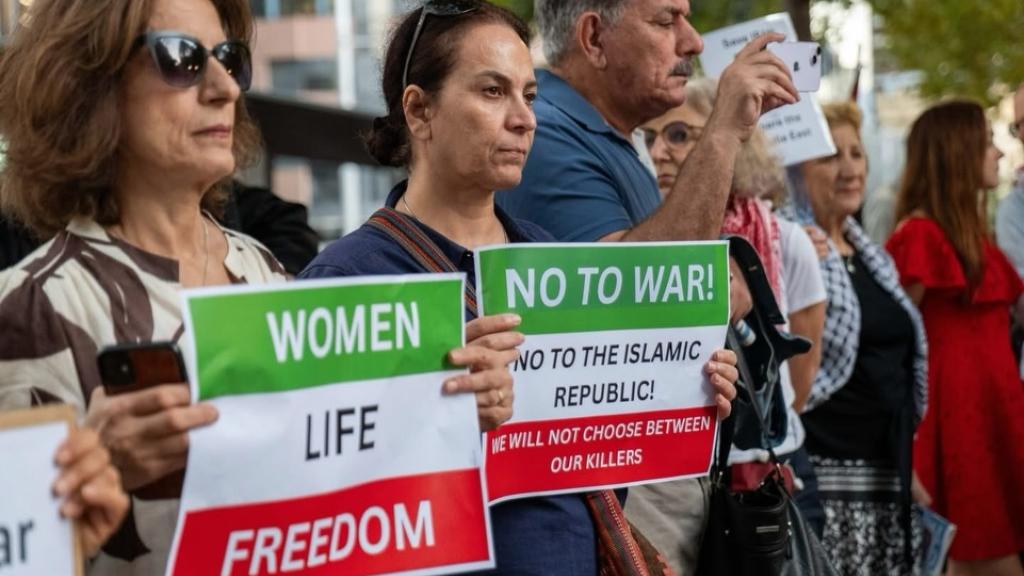
The Western media promotes Iranian voices who support the United States and Israel bombing Iran. The only other Iranian voices they broadcast are those that rally around the Islamic regime’s flag. But these voices do not speak for the majority of Iranians — Iranians like me. And this blind spot has existed for many years.

We, the majority of Iranians, stand against the war and the regime. We stand against the US, Israel and all aggression against innocent civilians, be that in Iran, Palestine or Sudan. But we are made invisible and talked over. The suffering of the Iranian majority, and others at the hands of regimes and foreign powers, needs to be acknowledged.

The Western media ignores us, preferring to promote those who back the monarchy, the regime or Western imperialism. Western regimes use bombs and sanctions to oppress peoples already oppressed by their own regime. In this sense, Western governments are no different to the Islamic regime. If the fight against these evils is to succeed, we must support the invisible majority who reject these powers.

Yet, I have been to anti-war demonstrations in England and, to my horror, witnessed English people waving the Islamic regime’s flag. Have they not heard how this regime treats people in Iran? Do they not know how many people are in prison there simply for expressing dissent or attempting to form a union?

They seem unaware that there are Westerners in Iranian prisons being used as leverage. They seem clueless to the fact that Iran is the world leader for executions per capita, or that there are millions of child workers and homeless children in Iran. Yet, with minimal research, anyone can obtain information about these humanitarian crimes.

Unfortunately, many people view this as a black and white conflict between great powers. They support the “anti-imperialist” power because they are against imperialism. They do not know — or prefer to ignore — that the Islamic regime is ruthlessly capitalist, with many of its leaders having become extremely wealthy by stealing the country’s wealth and investing it privately.

The Western media is uninterested in the voices of Iranians who oppose both the Islamic regime and Western imperialism. Some media outlets even generate support for the regime by amplifying an inaccurate and oversimplified narrative that garners sympathy from anti-imperialists that do not know better. I ask these people to wake up.

Westerners with little knowledge of Iran view the regime as a victim, and not as a product of capitalism that is devouring its civilians in an existential struggle. The regime is not fighting this war for the Iranian people; it is fighting to preserve its system of oppression to protect the financial interests and comforts of a small group of people. The Islamic regime has never sought to meet the Iranian people’s needs. Rather, it has squeezed them so much that there have been countless uprisings during its 47-year reign.

I find it interesting that some Westerners see the former Shah’s regime as oppressive, but not the Islamic regime. Based on their opposition to the US, certain Western intellectuals reject a US-installed monarchy, but support a regime that is strongly pro-Russia and pro-China.

It surprises me that self-described intellectuals could support a regime that oppresses its own people. It surprises me that government-approved chants of “Death to America, Death to Israel” could lead some to support a regime that beats workers for establishing unions and executes activists. I wonder if this support would waver if the same rules were imposed upon these regime supporters.

Their thinking mirrors that of the Western media they so often criticise. When the US explicitly tells its soldiers to go and die in a self-described religious war, there are no repercussions in the Western media. But when a non-white majority religion does the same, it is portrayed differently.

Conversely, these Western intellectuals oppose oppression in the West. But they believe it is okay for Iran to oppress its own people because the regime is pro-Russia and pro-China. They fail to understand that one can oppose imperialism and the Islamic regime.

They choose to ignore the fact that, except for a short period after the people’s revolution in 1979, the censorship that existed under the Shah remained in force under the Islamic regime. That all of the Shah’s prisons quickly filled up again under the Islamic regime. That in some cases, what was once tolerated by the Shah became arrestable offences under the Islamic regime: exercising personal freedoms, immodest clothing and being a woman in public with a man outside marriage would place you in danger.

These Western intellectuals reduce Iranians to objects exploited only under the Shah’s reign. They ignore the voices of workers subjected to lashings by the Islamic regime for wanting a union. Similarly, the numerous executions of activists that go unreported by the Western media. The Islamic regime’s treatment of women is also brushed aside.

So too is the Iranian women’s 47-year fight for their rights. This movement was born just one month after the Islamic regime took power, when Ayatollah Ruhollah Khomeini decreed women must cover their hair. My generation was imprisoned, executed and defeated. But Iranian women continue to fight for their basic rights. We want to wear what we like, say what we believe in, love who we want, live freely and not be forced to marry. Why are we women not heard in the West?

Some of these Westerners accuse every uprising in Iran of being pro-US or somehow organised by Western forces. I wonder why we are viewed as so naive as to support another power crushing us in our own country. 

The truth is that foreign meddling is no excuse for ignoring the voices of those calling for freedom from oppression. It does not negate the genuine cries of people who need bread and freedom. But these people remain pro-regime, no matter how many people are killed or tortured, as I was.

There was foreign meddling during the January uprisings in Iran. Reza Pahlavi, the son of the former Shah, called on Iranians to come out into the streets when they were already there calling for change. Israeli Prime Minister Benjamin Netanyahu claimed Israeli agents were “on the ground” with the Iranian protestors. 

This meddling was the excuse the regime needed to start massacring demonstrators under the charge of being foreign agents. Pahlavi and his US backers knew this, but they still chose to sacrifice countless lives so that they could appear powerful. These regimes help each other while barking at each other's throats.

I also wonder why Westerners who are not pro-Russian equally remain silent on Iran? It seems such people only see systems of power, and not the people exploited by them. It is not seen as a problem if teachers cannot pay their rent or nurses must work overtime to raise a child. They have no knowledge of the women arrested for not wearing “proper” clothing or journalists placed in psychiatric hospitals for saying the “wrong” thing.

This war has worsened the lives of those in Iran significantly. Unemployment is at a record high, people have lost loved ones, and many are suffering from the impact of the bombs. The loss of homes, jobs and loved ones is made worse by the lack of food and destruction of infrastructure. So, we must march against this war — for the people of Iran, not for the regime.

Let us finish all wars being waged on peoples around the world. Let us fight for the universal rights of peoples around the world. The right to a peaceful life means an end to all wars. The war in Iran is clearly illegal. We must demand the arrests of the warmongers, their trials in international courts and, ultimately, their imprisonment.

We also need to call for the sanctions on Iran to be lifted, as it is the people not the regime who suffer their effects. At the same time, we must demand the Islamic regime stop its executions, release political prisoners and provide Internet access for people. Human rights should not be forgotten in these ceasefire talks. The Iranian people have lost so much under the regime and the recent bombings — they too must get something out of these talks.

Nasrin Parvaz is author of the award-winning One Woman’s Struggle in Iran, A Prison Memoir (Victorina Press 2018) and The Secret Letters from X to A (Victorina Press 2018). Her articles have been published in The Guardian, The New Arab, Morning Star, LBC and Huck, among others. Her website is nasrinparvaz.org.