It’s possible that I shall make an ass of myself. But in that case one can always get out of it with a little dialectic. I have, of course, so worded my proposition as to be right either way (K.Marx, Letter to F.Engels on the Indian Mutiny)
Tuesday, May 19, 2026
ARACHNOLOGY
New “happy-face” spider species discovered in the Indian Himalayas
Vibrant, tiny, and sporting a bright red grin on its back, the Happy-Face spider is one of the most famous and recognisable arachnids in the world. For over a century, this cheerful-looking creature was thought to be a unique resident of the Hawaiian Islands, a biological curiosity found nowhere else on Earth.
“The discovery was accidental because our survey was [originally] on ants”, said Devi Priyadarshini, a scientist at the Regional Museum of Natural History who co-authored the study. “But my co-author [Ashirwad Tripathy] kept sending me spiders from high altitude regions for identification. So, one fine day, when he shared this image from the underside of a Daphniphyllum leaf, I froze in shock because I had seen the Hawaiian spider during my master's programme itself, and I knew instantly we had a jackpot because of its striking resemblance. I asked him to send all morphs that he found, and that led to the discovery in the next few months, from October 2023 onwards.”
Priyadarshini added that she was always interested in exploring high-altitude spiders because the landscape and vegetation are so different there than in the plains. “This almost came across as a gateway to look at other polymorphic species from this region.” Ashirwad also said that we could find more variations in the species if the surveys could be done extensively.
The species name, himalayana, serves as a tribute to the mountain range where the spider was found at elevations of over 2,000 meters above sea level. “The name Himalayana was decided as the species name because we both wanted to pay our respects to the mighty Himalaya mountain ranges, which have been standing tall not just guarding our country but also holding a plethora of biodiversity within them”, Ashirwad said. “Since this spider was the first polymorphic from this region, we decided to make it an ode to the amazing mountain ranges.”
The research, published in the open-access journal Evolutionary Systematics, identified 32 different colour variations, or “morphs”, of the species collected from three locations in Uttarakhand: Makku, Tala, and Mandal. DNA analysis revealed a genetic variation of approximately 8.5% from the Hawaiian happy-face spider, confirming it as a separate lineage that evolved independently in Asia.
While the smiling patterns are striking, their exact purpose remains a mystery. “The reason behind the expression of polymorphism is also very complex and unique”, Priyadarshini explained. “These patterns definitely help them survive better in the wild, which is understood prima facie, but why do they resort to such patterns on their back, and what functional role in their life cycle does it exactly serve is yet to be deciphered. This is definitely indicative of a deeper genetic mystery.” Ashirwad also mentioned that the spider species was surrounded by critters which had similar colour patterns on their body.
The study also noted that these spiders are frequently found on ginger plants (Hedychium species), mirroring the behaviour of their Hawaiian cousins. Since ginger is not native to Hawaii, the researchers are intrigued by the evolutionary connection. “How did the spiders choose an invasive species and ginger exactly?” Priyadarshini noted. “If T. himalayana is an elder cousin of T. grallator, although discovered 125 years later! Although this sounds like a tall claim now, it will be our further scope of work to establish any missing links, if at all, through Hedychium sps.”
Brussels, 19 May 2026 – Scientists at VIB and Vrije Universiteit Brussel have uncovered a previously unknown mechanism that helps a widely used biological pesticide become more effective. The study, published in Nature Communications, reveals how bacteria produce ultra-strong protein fibers that form a molecular net, trapping infectious spores and toxins into a sticky film that enhances their ability to kill insect pests.
A new piece of the biopesticide puzzle
Bacillus thuringiensis (Bt) is a bacterium widely used in eco-friendly pest control. It works by attacking insect larvae in two stages. First, it releases toxins that damage the insect's digestive system, creating an opening for spores to enter. The spores then germinate and multiply, consuming the insect from the inside. When the food source is depleted, the bacterium produces new spores and toxins that are released into the environment, ready to infect another insect. Because Bt targets only certain insects, it's considered safe for humans, other wildlife, and helpful insects like bees.
In this way, spores and toxin crystals form an intricate pair in the life cycle of the bacterium. However, one long-standing question has puzzled researchers: how do these spores and toxins stay together in the environment long enough to infect insects effectively?
Researchers at the VIB-VUB Center for Structural Biology have now identified the answer: a previously unknown fibrous network they call ‘sporesilk’, a natural nanofiber net with remarkable properties.
Using advanced imaging techniques, the team discovered that Bt spores and toxin crystals are embedded in a dense mesh of protein fibers just eight nanometers wide. These fibers form a highly organized, double-helical structure and are chemically crosslinked into an exceptionally stable material. The fibers assemble themselves and remain intact under extreme conditions, including heat, drought, harsh chemicals, and mechanical stress.
“This is one of the most robust protein materials we’ve seen in nature,” says Prof. Han Remaut, senior author of the study.
Keeping toxins and spores together
“The sporesilk acts as a molecular net that clusters the spores and toxin crystals into compact ‘infection units’,” says Dr. Mike Sleutel (VIB-VUB). “So, when insect larvae ingest the bacteria, they receive both the infectious spores and the toxic payload at the same time.”
When the researchers removed the gene responsible for these fibers, the clusters fell apart. As a result, the bacteria became less effective at killing insect larvae, with delayed mortality observed in experimental models.
Conversely, adding the fibers, either through genetic engineering or by simply mixing in purified fibers, restored spore – toxin clustering and significantly increased insect-killing efficiency.
“This could offer a practical way to develop more potent and reliable biopesticides while maintaining regulatory and environmental safety standards,” says Remaut.
The study also hints at broader applications. Because of their extreme durability and self-assembling nature, these protein fibers may inspire new biomaterials for use in biotechnology and engineering.
As agriculture seeks more sustainable solutions, understanding and harnessing natural systems like these could play a key role in reducing reliance on chemical pesticides.
Researchers have uncovered a previously unknown mechanism by which plants detect hydrogen peroxide (H₂O₂), a key signaling molecule involved in stress responses and immunity.
Researchers at the Institute of Transformative Bio-Molecules (WPI-ITbM), Nagoya University, together with collaborators from RIKEN Center for Sustainable Resource Science (RIKEN CSRS) and The University of Osaka, have uncovered a previously unknown mechanism by which plants detect hydrogen peroxide (H₂O₂), a key signaling molecule involved in stress responses and immunity. Published in Nature Communications, the study reveals that plants rely on a copper-dependent sensing system, rather than the previously assumed cysteine-based mechanism, to perceive reactive oxygen species (ROS).
This work reshapes our understanding of how plants respond to environmental stress and pathogens, and may pave the way for improving crop resilience. Quinones and hydrogen peroxide play a central role in plant responses to pathogens and environmental stress, and understanding how plants perceive these molecules could inform strategies to enhance crop protection and stress tolerance.
How plants detect redox-related molecules in their environment
As sessile organisms, plants constantly monitor their environment using specialized receptors on the surface of their cells. Among these, a class known as leucine-rich repeat receptor-like kinases can sense a wide range of stimuli. One such receptor, CARD1 (also called HPCA1), was previously shown to detect both quinones and ROS such as H₂O₂. However, how a single receptor distinguishes between these chemically distinct signals remained unclear.
The research team discovered that CARD1 contains a copper ion bound to a cluster of histidine residues on its surface. This copper site plays a critical role in detecting H₂O₂.
Surprisingly, cysteine residues — previously thought to be essential for H2O2 sensing — are not required for signal perception. Instead, the CARD1 receptor uses copper to detect H₂O₂ through redox chemistry.
“The results showed that when the copper-binding site is disrupted, plants lose their ability to respond to H₂O₂ signals,” said Anuphon Laohavisit, lead author and designated associate professor at the WPI-ITbM. “In contrast, mutations in cysteine residues had little effect on signaling, indicating that their primary role is structural rather than signaling.”
Through computational approaches, the team suggests that ROS sensing by CARD1 could occur through oxidation of copper (Cu⁺ to Cu²⁺) at the receptor surface. Such a redox change may either directly trigger signaling or generate secondary molecules that activate downstream responses. It is likely that a separate pathway exists for quinone perception and remains to be identified.
Conclusion and future perspective
The researchers provide the first structural evidence of a metal ion–based sensing mechanism in plant plasma membrane receptors, reshaping our understanding of ROS perception in plants and paving the way for exploring metal-based ROS signaling mechanisms across biology.
The natural environment provides human society with essential non-material values, such as cultural symbolism and local attachment, known as "cultural ecosystem services." But can these abstract cultural values actually influence how communities behave? According to a new study focusing on public schools in Hachioji City, Tokyo, the answer is yes.
In a study published in the journal Nature Conservation, researchers Kazuki Miyauchi and Associate Professor Takeshi Osawa from the Graduate School of Urban Environmental Sciences at Tokyo Metropolitan University investigated the relationship between nature-related vocabulary in school anthems and actual environmental education practices.
Why school songs?
Lyrics serve as a vital medium for expressing nature within a cultural context. However, because popular or general songs are sung in many different places, their references to nature tend to be abstract and often lack a strong connection to a specific region. In contrast, school anthems are deeply rooted in specific schools and communities and are characterized by being sung regularly and repeatedly. Consequently, how local nature is depicted in school anthems can provide insightful clues into the relationship between the school, the community, and the environment
What the data showed
Researchers analyzed the official anthems of all 104 public schools in Hachioji City, Tokyo - where the surrounding mountains and iconic Mt. Takao serve as powerful natural symbols - surveying them simultaneously about nature-based programs and use of local green spaces. Of the 63 schools that provided valid responses, a clear pattern emerged.
Surprisingly, anthems referencing “高尾” (Mt. Takao) by name showed no significant correlation with nature-related programs, nor did lyrics correlate with broader outdoor school programs involving overnight trips to distant locations. But schools whose anthems included general mountain terms - such as “山” (mountain) or “峰” (peak) - showed a statistically significant tendency to utilize nearby green spaces for educational activities.
"This finding suggests a potential link between symbolic cultural representations embedded in school traditions and the actual practice of nature-related education."
- the researchers note in the study.
Research Significance and Potential Impact
This research is highly significant because it demonstrates that natural expressions embedded in school culture - specifically through school anthems - may be linked to concrete actions in actual educational activities.
“It is well-established that childhood experiences in nature exert a strong influence on a person's future environmental awareness. The fact that local nature "lives" within school culture via anthems and correlates with outdoor curriculum suggests that embedding local ecology into cultural traditions can be a catalyst for children to learn to value their immediate surroundings.”
- the researchers explain.
While the study establishes a strong correlation, its scope was limited to mountain-related terms. The researchers point out that future studies should explore other natural elements, such as rivers, forests, and wildlife. The researchers also note that further investigation is needed to determine causality - whether the expressions in the anthems directly influence educational activities, or whether a region's overall pro-nature orientation is simply reflected in both the community's lyrics and its curriculum.
By expanding on these findings, we expect to provide new insights into how environmental education and regional development can leverage the powerful connection between culture and nature.
Original source:
Miyauchi K, Osawa T (2026) Are cultural ecosystem services expressed in school songs associated with nature-related educational activities? Nature Conservation 63: 237-245. https://doi.org/10.3897/natureconservation.63.180492
Swedish lead-cooled small modular reactor technology developer Blykalla has submitted an application to the government to construct a power plant in Norrsundet, Gävle, in east central Sweden, comprising six SEALER reactors.
Submission of the application (Image: Blykalla)
Blykalla said it chose Norrsundet in the municipality of Gävle as the location for its nuclear facility due to its strategic location between two key bidding zones, an existing port, key infrastructure, and industrial heritage – reducing construction complexity while addressing regional power shortages with predictable baseload power. The proposed plant will have a total generating capacity of 330 MWe.
"This application is a historic first for Sweden," said Blykalla CEO Jacob Stedman. "We're not just planning an advanced reactor park - we're building Sweden’s energy future and putting the country at the forefront of the global nuclear power renaissance. Building new energy infrastructure is critical, and the energy systems of the future need to be predictable, reliable and fossil-free. As AI and electrification grow worldwide, we need to accelerate the deployment of predictable, clean baseload power. That's exactly what Blykalla's technology does, and we are uniquely positioned to meet this moment."
The Ministry of Climate and Enterprise said the government will now assess whether the application meets the requirements, whether the proposed activity is justified and whether there are conditions for preparedness and for handling the nuclear material being handled and the nuclear waste that is generated. The government review of the application launches a comprehensive approval process involving multiple agencies, including the Land and Environmental Court and Swedish Radiation Safety Authority. The government will then produce a facility plan to guide decisions on how land and water areas will be used.
The ministry noted the municipality of Gävle needs to approve both the plan and the application before the government can make a decision to approve a nuclear facility. "The approval does not replace the permit review according to the Environmental Code and the Nuclear Activities Act," it said. "However, the government's approval replaces the permissibility review that the government must otherwise carry out according to Chapter 17 of the Environmental Code."
Rendering of the SEALER building in Norrsundet (Image: Blykalla)
Blykalla - formerly called LeadCold - is a spin-off from the KTH Royal Institute of Technology in Stockholm, where lead-cooled reactor systems have been under development since 1996. The company - founded in 2013 as a joint stock company - is developing the SEALER (Swedish Advanced Lead Reactor). A demonstration SEALER (SEALER-D) is planned to have a thermal output of 80 MW.
Subject to the necessary permits and final investment decisions, the commercial-scale Norrsundet facility could become operational in the first half of the 2030s.
In February, the Swedish government announced several proposed measures to make it easier to establish new nuclear power in the country. The new legislation introduces an early-stage government approval process designed to improve predictability and accelerate the deployment of new nuclear capacity. The following month, Kärnfull Next submitted an application to build a power plant based on small modular reactors (SMRs) in the municipality of Valdemarsvik in Östergötland county in southeastern Sweden, becoming the first application under the country's new Act on Government Approval of Nuclear Facilities. It marked the first application for the establishment of new nuclear power in Sweden 50 years.
"New nuclear power is an important piece of the puzzle for Sweden's energy independence," said Acting Minister of Climate and Environment Johan Britz. "The concern we are now seeing in the world clearly shows how vulnerable we are becoming from our dependence on fossil fuels – and how crucial it is to expand fossil-free electricity production. Thanks to our new permit review, more actors now dare to invest in nuclear power."
In October 2022, Sweden's incoming centre-right coalition government adopted a positive stance towards nuclear energy. In November 2023, it unveiled a roadmap which envisages the construction of new nuclear generating capacity equivalent to at least two large-scale reactors by 2035, with the equivalent capacity of up to 10 new large-scale reactors (which may include small modular reactors) coming online by 2045. A new act on state aid entered into force on 1 August 2025, since when interested companies have been able to apply for the aid.
The Swedish government received the first such application in December to support proposals for either five GE Vernova Hitachi BWRX-300 reactors or three Rolls-Royce SMRs to provide about 1500 MW capacity at Ringhals on the Värö Peninsula. The application came from Videberg Kraft AB, a project company owned by Vattenfall AB and backed by a series of industrial firms via the Industrikraft i Sverige AB consortium.
Permit issued for second phase of Grohnde dismantling work
PreussenElektra has received the second and final permit needed for the dismantling of the Grohnde nuclear power plant in Germany.
(Image: PreussenElektra)
PreussenElektra - a subsidiary of EOn Group - applied in October 2017 for approval to decommission and dismantle the 1,360 MWe pressurised water reactor which entered commercial operation in February 1985, and was shut down in December 2021.
The Lower Saxony Ministry for the Environment, Energy and Climate Protection issued the first decommissioning and dismantling permit to the company for the Grohnde plant in December 2023, with dismantling work beginning in the following month.
The dismantling process to date has included the removal of components from the primary cooling circuit. Simultaneously, the newly constructed waste treatment centre has commenced operations. There, all dismantled materials are broken down, radiologically measured, cleaned, and, after official approval, either disposed of or recycled. On 7 April this year, PreussenElektra announced that all the used nuclear fuel assemblies in the storage pool at Grohnde had been transferred to an on-site interim storage facility. To achieve fuel-free status, a total of 694 fuel assemblies were transferred from the plant's storage pool into CASTOR used fuel storage casks.
PreussenElektra submitted the application for the second decommissioning permit in January 2024. This permit allows further key decommissioning work to proceed, including the removal of the reactor pressure vessel and the surrounding biological shield.
During a visit to the plant on 15 May, Lower Saxony's Minister for the Environment, Energy and Climate Protection, Christian Meyer, officially presented PreussenElektra with the second and final permit for the plant's decommissioning. With this, all necessary permits for the complete dismantling of the plant are now in place.
Starting later this year, one of the most technically demanding phases of the decommissioning process will begin: the dismantling of the reactor pressure vessel's internal components. Planning for this is already under way. The first cut is currently scheduled for early 2027. The project is expected to be completed by mid-2028.
"I thank everyone involved for their excellent work on the decommissioning application," said Environment Minister Christian Meyer. "With the final decommissioning permit now granted and the reactor building being free of nuclear fuel, we are creating clarity and the conditions for the safe and sustainable decommissioning of the Grohnde nuclear power plant and its interim storage on site. The decommissioning of nuclear facilities must be safe, transparent, and under strict nuclear regulatory oversight. Our shared goal is a swift, competent, and responsible decommissioning process."
Guido Knott, Chairman of the Management Board of PreussenElektra, said: "With the second permit, we now have all the legal prerequisites to carry out the dismantling of the KWG consistently and according to plan. Our aim is to implement the dismantling safely, efficiently and quickly - with the clear goal of completing the nuclear dismantling by the mid-2030s and being able to use the site for future projects as soon as possible."
In a third, conventional phase, the dismantling will take place after clearance from nuclear regulatory oversight. The dismantling of Grohnde is scheduled for completion by 2039. Afterwards, the power plant site will be available for redevelopment.
PreussenElektra is responsible for the decommissioning of eight nuclear power plants in Germany. Isar 2 was the last of the PreussenElektra plants to cease operations on 15 April 2023. The Brokdorf and Grohnde plants were shut down on 31 December 2021. With the already decommissioned Isar 1, Stade, Unterweser and Würgassen plants, all of PreussenElektra's nuclear facilities are now in various phases of decommissioning and dismantling. The company's goal is to dismantle its power plant fleet by 2040.
Concrete pouring completed for first part of Cernavoda refurb project
Romania's Nuclearelectrica has announced the completion of concrete pouring for the foundation of the Intermediate Radioactive Waste Storage Facility, which is part of the Cernavoda unit 1 refurbishment project.
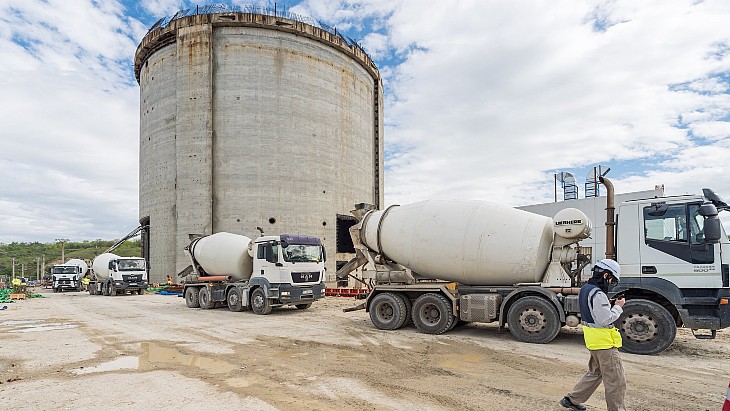
(Image: Nuclearlectrica)
About 3470 cubic metres of concrete was used for the foundation, which the company says was the equivalent of about 380 concrete mixer truck-fulls, and was the most complex such operation since unit 2 was built.
The new waste facility is designed for the handling, processing and interim storage of waste, both from the refurbishment of unit 1 and the long-term commercial operation of both the plant’s units.
Cosmin Ghita, General Manager of Nuclearelectrica, said: "The pouring of the first concrete for the construction of the infrastructure required for the refurbishment of unit 1 holds a significance similar to that of the pouring of the first concrete during the construction of unit 1. After 30 years of operation at high nuclear safety standards and with world-class performance in terms of capacity factor, unit 1, through the refurbishment programme, will continue to operate for another 30 years starting in 2030. Another 30 years of energy security, 5 million MW produced annually, and 5 million tons of CO2 avoided annually - a strategic project for Romania's energy security."
Cernavoda is the only nuclear power plant in Romania and consists of two 650 MWe Candu reactors. Unit 1 went into commercial operation in 1996 and unit 2 in 2007.
The unit 1 refurbishment project began in 2017 and is currently in the second of three phases, in preparation for implementation. The project is scheduled to enter its third and final phase of development in 2027 with the shutdown of unit 1 for refurbishment.
Background
Candu units are pressurised heavy water reactors designed to operate for 30 years, with a further 30 years available subject to refurbishment. This includes the replacement of key reactor components such as steam generators, pressure tubes, calandria tubes and feeder tubes. It involves removing all the reactor's fuel and heavy water and isolating it from the rest of the power station before it is dismantled. Thousands of components, including those that are not accessible when the reactor is assembled, are inspected, and all 480 fuel channels and 960 feeder tubes are replaced during the high-precision rebuild.
In December 2024 Nuclearelectrica signed the engineering, procurement and construction contract for the estimated EUR1.9 billion (USD1.97 billion) refurbishment with a consortium of Korea Hydro & Nuclear Power, AtkinsRealis's Candu Energy, Canadian Commercial Corporation and Ansaldo Nucleare.
The civil construction works began in September 2025 after the company received approval from Romania's nuclear regulator (CNCAN) for the construction of the Intermediate Radioactive Waste Repository. The company said the expansion of the intermediate storage capacity of low and medium radioactive waste was a key part of sustaining long-term operation of the plant.


_64217.jpg)
_c2dd3e92.jpg)
_15918.jpg)