Small is Still Beautiful: The True Political
Realignment
Photograph by Nathaniel St. Clair
We’ve heard a lot about political realignment since the Donald Trump era began, but even more now that we’re confronted with the brutality and chaos of his second term. Some have tied political realignments to social and economic class, or to degree of formal education, or to some other demographic factor, like whether you live in an urban or rural area. There is also, apparently, a growing political divide between men and women.
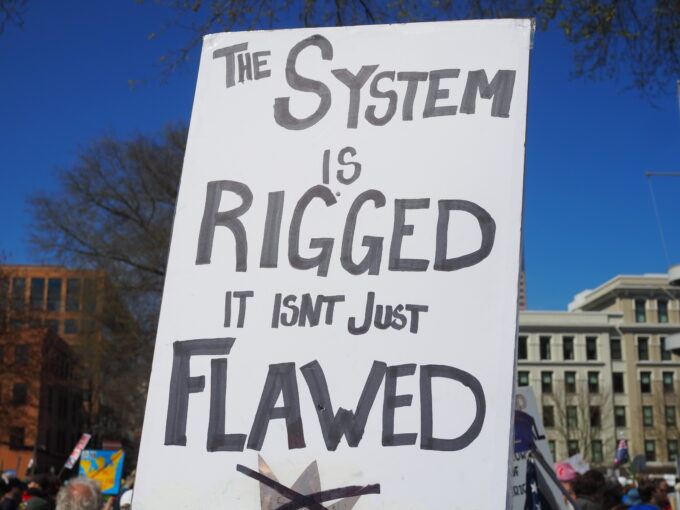
But for all the headlines and hand-wringing, we’ve yet to hit upon the political realignment we need. If we must have a one-dimensional political spectrum, then it ought to be organized around and addressed to the degree of centralization, not to a constantly shifting collection of niche cultural issues and made-up reality TV-style fights between Washington politicians. Batting around meaningless identity categories is not a viable politics or a substitute for one, and hopefully Americans are tired of it.
Real political culture and discourse cannot revolve around whether a system or a given policy conceives of itself as left or right, which are quite literally empty indexical terms. At the risk of stating the obvious, “left” and “right” have not retained stable definitions or referents across time and place within the context of the political. Because of this, the sides are much more like pro sports teams than they are proxies for competing philosophies. Americans are frustrated with the identitarian theater precisely because it has no interest in apprehending power as it actually manifests in our political and economic system.
The question should be whether decision-making power is concentrated in institutions so large, remote, and opaque that the masses of ordinary people have no way to change their functioning or behavior. This is the substantive core of an alternative politics that incorporates a size or scale thesis: that once institutions exceed the human scale, opportunities for either participation or true exit are functionally foreclosed, becoming merely formal or hypothetical. The question of scale and centralized power is today the skeleton key capable of unlocking a new political paradigm and finally loosening the grip of a tiny and shrinking ruling class.
In 1973, E.F. Schumacher published a book that became an international sensation and bestseller, Small is Beautiful, advancing the radical idea that economic systems should serve human beings. Years earlier, one of Schumacher’s major influences, the economist Leopold Kohr, wrote in his 1957 book The Breakdown of Nations, “Wherever something is wrong, something is too big.” Kohr argued that despite their superficial differences, the two halves of the contemporary political class are “both hopelessly leading in the same direction: the abyss of unmanageable proportions.”
Once you have the skeleton key of Kohr’s scale thesis, you can see what is actually there; you can see that extremes of concentrated wealth and political power are dominant in American society, that this is almost never discussed openly, and that this reality has nothing at all to do with the meaningless slop spectacle palmed off as “politics” by a handful of global entertainment companies. Kohr and Schumacher understood that our entire political conversation is predicated on deep and pervasive misunderstandings about the role of massive, coercive institutions in society, whether misleadingly called “public” or “private.” There is no way for an ordinary citizen (read: subject) to meaningfully contend with such organizations, much less to hold them accountable via elections in which one’s vote counts for nothing to the extent it contradicts elite preferences.
Trends of extreme corporate consolidation and industry concentration have gripped every major sector for decades. The Big Three asset managers (BlackRock, Vanguard, and State Street) are now the largest shareholders in almost 90 percent of the S&P 500; they “have almost quadrupled their collective ownership stake in S&P 500 companies over the past two decades.” Today, with these shares, they cast about 25 percent of the votes in S&P 500 companies, and that could be as high as 40 percent within the next two decades, scholars say.
Since the 1980s, the United States has lost more than 70 percent of its banks, as a handful of “too big to fail” giants has consolidated its power and position through successive crises. New laws and reams of new rules from unelected bureaucrats who stay from administration to administration have been powerless to stop these trends. Indeed, many have argued compellingly that the most colossal companies use these legislative and rulemaking mechanisms to create deep moats around their operations.
The healthcare system is famously plagued by its diseconomies of scale. A report from KFF earlier this year found that “[m]ost hospital markets in metropolitan areas (80%) became less competitive from 2015 to 2024 or were controlled by one health system over that entire period.” The Bipartisan Policy Center observes that while 90 percent of hospitals were independent in 1970, that share was less than one-third of hospitals by 2019, adding that today “about 90% of U.S. hospital markets are currently classified as ‘highly concentrated.’”
Big agribusiness is also globally concentrated: four corporations control more than half of the worldwide seed market, with two companies controlling about 90 percent of the genetic traits of major crops planted on American soil. A few companies have claimed monopoly ownership over the genetic traits of the planet’s food supply. One could spend days rattling off similar facts and figures. We have a crisis of concentration and centralization in every major industry, and the charade we’ve been referring to as politics is impotent to address it.
That we never confront politicians or the billionaire ruling class with any of this points to the depth of our conceptual confusion and helplessness. They are the adults, and we are the children. We don’t have any delusion that the political and economic system should take stock of our worries, much less our hopes and dreams.
The idea that we could get a hold of such a system of concentrated power by voting for the Washington corporate uniparty is beyond naive and ridiculous. No less ridiculous is the notion that the U.S. government would step in to help the popular masses by reining in corporate power. That power is quite literally created by the state in the first place. We beat this state-capital complex only by withdrawing and investing in something else, something small and local.
If the country’s massive, top-heavy corporations present themselves as models of business discipline and efficiency, the factual record tells a different story. America’s corporate giants are balanced only precariously; they are viable due to massive state support and periodical bailouts, both valued in the many trillions of dollars in recent years alone. An analogy to the principles of geometry may help clarify the problem of today’s massive scales. According to the square-cube law, the weight of an object increases much faster than its strength. The structural integrity of the unit is increasingly compromised as it grows larger, the scaffolding bearing more weight and pressure. The structure must be reinforced with increasing frequency and vigor. And indeed we witness this all the time, all around us: strikes must be broken, dissent crushed, votes suppressed, voices silenced.
Other physical principles likewise offer useful analogies and insights. Smaller structures tend to have higher frequencies, with lower masses and more rigidity. This makes them more durable against lower (i.e., larger in scale) resonances. A tall skyscraper must sway enough to absorb the forces of the wind, but not so much that structural integrity or occupant comfort are affected. Thus, in physical terms, we can see the dedication to smallness as a mechanism for allowing perturbations in the system without growing out of control in a way that would threaten the viability of the system at large. The higher you go, the more difficult this is, and at a certain point, to go further is folly. This is no less true for our social structure and its institutions, and we long ago reached the summit of folly. Or as Kohr put it, social problems “have the unfortunate tendency to grow at a geometric ratio with the growth of the organism of which they are part, while the ability of man to cope with them, if it can be extended at all, grows only at an arithmetic ratio.”
Ignoring the state’s central role in producing these outcomes, the American ruling class pretends that the kinds of centralized power we are discussing are simply the natural results of technological change. But it has never been a question of being for or against technology itself. New technological tools might have made society more free and decentralized, and they still could. Countless social theorists from a range of academic and philosophical traditions (e.g., Leopold Kohr, E.F. Schumacher, Pierre-Joseph Proudhon, Benjamin Tucker, Ralph Borsodi, Peter Kropotkin, and many others) predicted that new technologies would empower smaller-scale groups and social systems against the power of the authoritarian state and global capitalist monopolies. If that vision is not still within reach, if our own tools cannot be called upon to empower the small and local rather than enriching the few, then perhaps they are not tools worth having. We can decide how to use technology and (what is no less important) who owns it.
The popular political discourse should reincorporate basic worries about institutional size and its consequences for incentives and modes of behavior. It is no longer enough to say that our corporations are driven by greed or that politicians are venal and corrupt. Our country desperately needs a revival of small-scale community life and local pride and attachment. We need technologies that foster independence and autonomy, at the level of both the individual and the local community, against the counterproductive giant institutions of our age, what Ivan Illich called “tools for conviviality.”
Our politics misses the mark on purpose. It is a shell game, a divide-and-rule strategy, a way to prevent ordinary people from joining together in community in ways that have no ideology, -ism, or political party. If we remain confused about the true divide – which pits a highly organized, microscopic ruling class against, practically speaking, everyone in society – we will never have a social and economic system that works for all of us. Americans and people around the world want an alternative to massive-scale authoritarianism, whether it is left-coded or right-coded. The only way to take a country back from criminal governments and parasitic corporations is one community at a time.

No comments:
Post a Comment