Thursday, June 18, 2026

AFTER JOINING NATO

Finland's parliament passes bill in support of lifting total ban on nuclear weapons


By Gavin Blackburn
Published on

Finland dropped decades of military non-alliance to join NATO in April 2023 in response to Russia's full-scale invasion of Ukraine.

Finland's parliament voted to lift a total ban on nuclear weapons on Wednesday, to bring the country in line with NATO's deterrence policy after joining the alliance in 2023.

The bill will permit nuclear weapons to be brought, transported, supplied, or possessed in Finland where the country's military defence requires it.

While 125 deputies backed the government proposal, 61 voted against it, with another 13 absent from the chamber. Now that it has been approved by parliament it only requires the approval of the president.

The decision repeals the national ban on the import, production, possession and detonation of nuclear explosives from the country's Nuclear Energy Act dating back to the 1980s.

It amends the criminal code to include the exceptions to a prohibition on nuclear weapons.

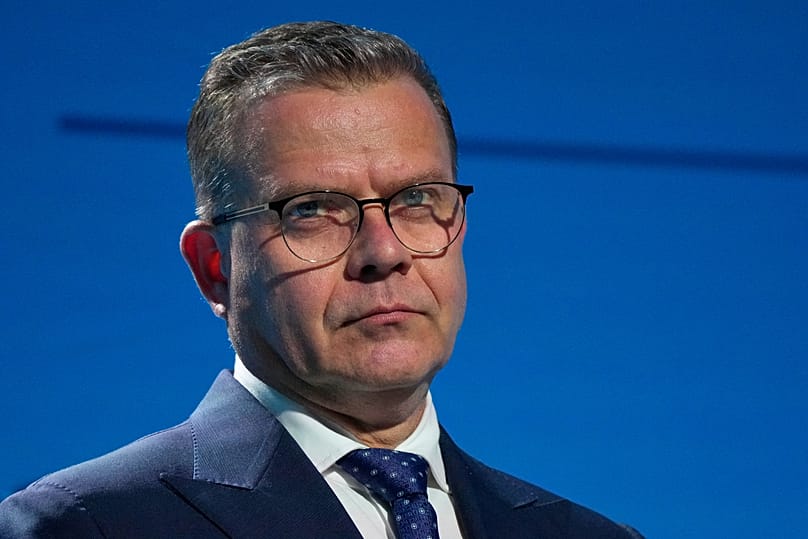
Finnish Prime Minister Petteri Orpo attends a news conference after the Nordic and Baltic countries meeting in Tallinn, 9 June, 2026 AP Photo

"With this proposal, we strengthen Finland's defence and enable the full use of NATO's nuclear deterrent as protection for Finland," Defence Minister Antti Hakkanen posted on X on Tuesday, a day before the vote.

Finland dropped decades of military non-alliance to join NATO in April 2023 in response to Russia's full-scale invasion of Ukraine.

The proposal has sparked debate in Finland in recent months, as opposition parties have criticised Finland's pivot away from its long-standing position of prohibiting nuclear weapons.

Prime Minister Petteri Orpo said earlier in June that Finland was interested in a French-led nuclear deterrence scheme to bolster security on the continent but no decision has been made on it.

In March, French President Emmanuel Macron unveiled a programme under which France, the European Union's only nuclear-armed country, would use its atomic stockpile to boost security on the continent.

DADDYS BOY

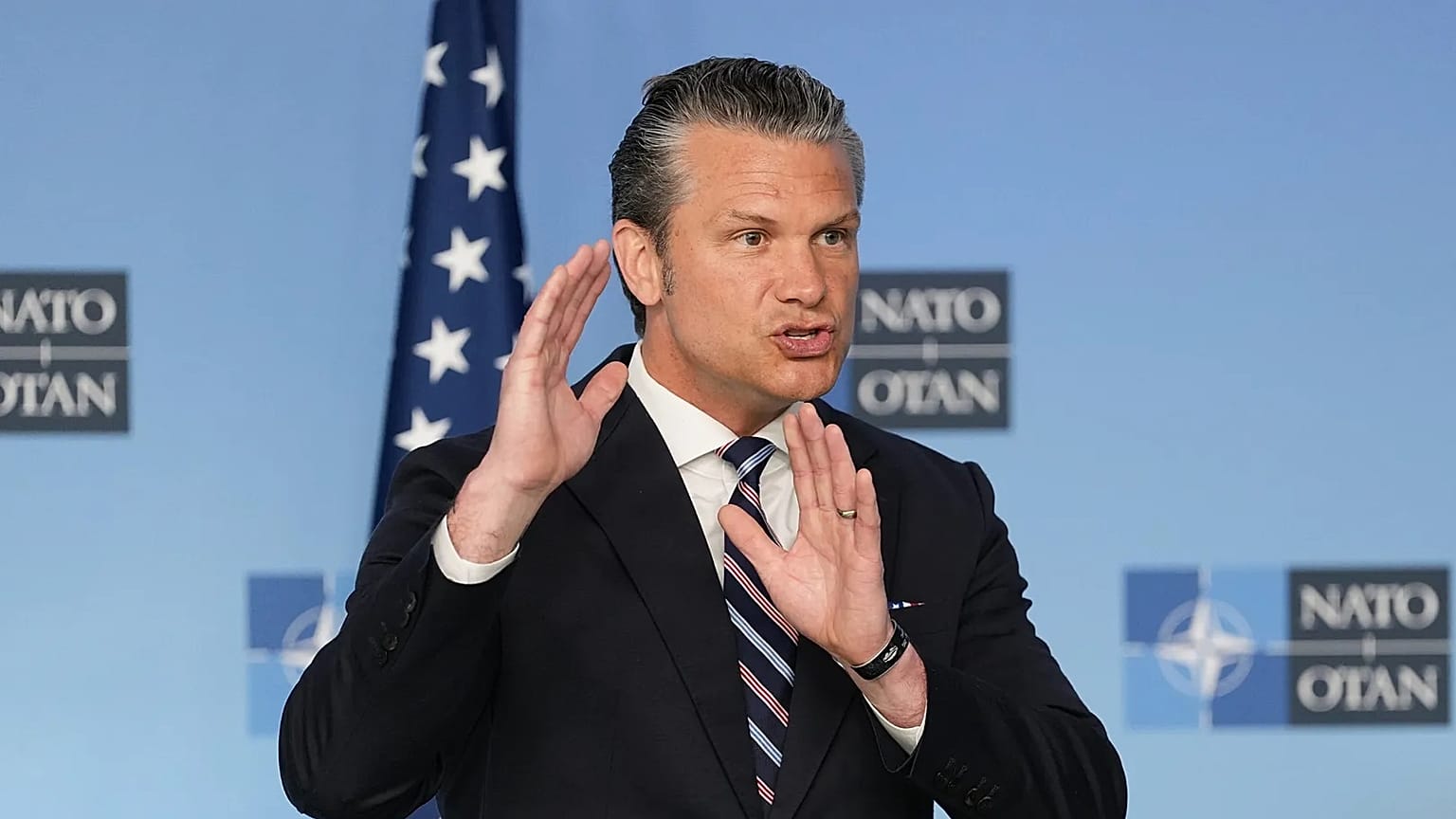
Rutte tries to downplay Pete Hegseth's blistering attack on NATO

US Secretary of War Pete Hegseth.
Copyright Copyright 2026 The Associated Press. All rights reserved.
By Shona Murray
Published on

As the Trump admininstration plans to pull a number troops out of Europe in the next six months, Secretary of War Pete Hegseth lambasted NATO defence ministers in Brussels, describing them as "shameful" and preoccupied with gender equality and climate change.

NATO Secretary General Mark Rutte has downplayed a blistering attack by US Secretary of War Pete Hegseth who described European allies as “shameful" for not helping the US in the war in Iran.

Hegseth was in Brussels for a meeting of NATO defence ministers, where he informed allies the Pentagon will review the number of US forces in Europe within the next six months.

Announcing the details of what he described as "NATO 3.0", Hegseth also told allies the US would reduce its contributions to overall NATO budget if countries weren’t on track to spend 5 percent of GDP on defence by 2035. The alliance agreed to the new spending commitment at last year's summit at the behest of US President Donald Trump.

“Our annual NATO dues will be contingent on other countries meeting their defence spending targets," Hegseth said on Thursday. "Where other allies do not spend with urgency our due contributions will go down.”

He also warned the US will be keeping a “close eye” on allies who are not on the right course.

Ahead of the meeting, NATO countries had hoped the Trump administration's mood might improve after the White House signed off on a memorandum of understanding aimed at ending hostilities in Iran, But any hopes of a reconciliation were dashed when Hegseth denounced the alliance as a “paper tiger”.

The Pentagon chief used his appearance to declare it “shameful” that countries such as Spain, Italy and France refused the US military to bases and skies as part of the Iran war.

Germany gave full access to the US military to its base at Ramstein, but Trump took serious umbrage when German Chancellor Frederic Merz criticised the strategy behind the war as “ill-conceived”.

Trump responded by posting on his social media platform that he was pulling 5,000 US troops from Germany.

In the spirit of US Vice President JD Vance’s similarly harsh criticisms of European society, Hegseth also said Europe had been too focused on climate change and gender equality and blamed immigration for a supposed civilisational collapse.

“Instead of tanks and fighters and air defences, the focus has been on gender equity and climate change and defence austerity," he said. "Europe’s borders flew wide open, welfare states expanded, defence budgets cratered. Along with Europe’s belief in itself and its civilisation.”

'We need to speak the truth'

In a press conference following Hegseth's remarks, Rutte insisted to journalists that Hegseth had also acknowledged allies had upped their game and had spent a historic €90 billion-plus in extra spending in 2025 alone.

“But you’ll still find some allies holding back a bit, and what [Hegseth] tried to do today was keep the pressure on, and that’s good,” said Rutte. “I’m happy he does this, Because we need to speak the truth to each other.”

There is a strong consensus among NATO officials and member states that the US's latest moves are designed to punish Europe for its lack of support over Iran.

In recent weeks, the US told allies it would cut access to a range of capabilities for use by the alliance during wartime through NATO’s so-called Force Model.

Everything linked to deep strike capabilities will be cut, Euronews has learned, including US long-range bombers such as the B2 and B-52. Naval assets, including missile-launching submarine and aircraft carriers, will also be withdrawn and redirected to other theatres.

Rutte said any force reduction plan would be part of structured process and in full consultation with allies and NATO military planners, including the Supreme Allied Commander Europe.

Six takeaways from the G7 summit in Évian

The G7 in Evian.
Copyright AP Photo/Julia Demaree Nikhinson

By Luca Bertuzzi & Jorge Liboreiro & Oleksandra Vakulina
Published on

G7 leaders gathered in France for a high-stakes meeting over the last three days to discuss Ukraine, the Middle East and world challenges. Here is what you need to know.

Leaders of the world's richest economies, plus several partner countries, flocked to Évian-les-Bains, France, to discuss the most pressing global issues, from the war in Ukraine to a fragile truce in the Middle East.

The most repeated word on the lips of diplomats has been "convergence," as they expressed relief that the high-level conference unfolded far more smoothly than the previous summit, and that U.S. President Donald Trump proved cooperative.

Euronews breaks down the most significant takeaways from the G7 summit, cutting through the noise surrounding the latest international developments.

United for Ukraine

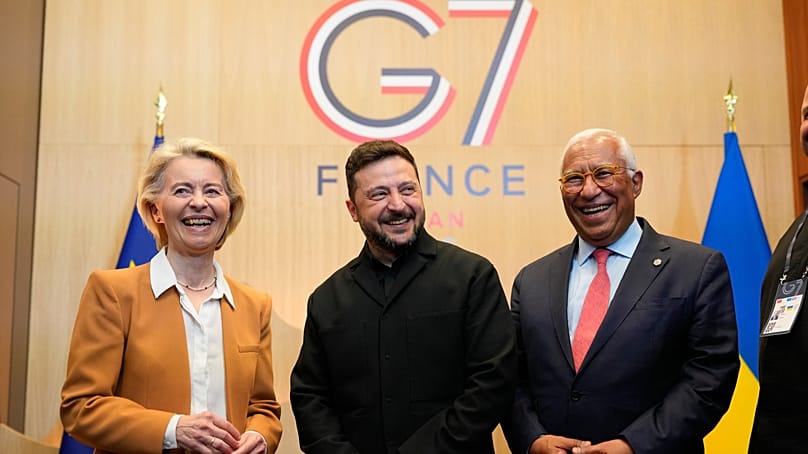
Ukraine was a central topic at the G7 summit. Associated Press.

Ukraine may be the G7's biggest winner, emerging with a strong statement of support from Western leaders despite President Volodymyr Zelenskyy failing to secure a full bilateral meeting with Trump.

G7 leaders pledged to accelerate deliveries of air defence systems, provide further support for Ukraine's energy infrastructure and strengthen sanctions against Russia.

They also said they were "ready to consider" granting Ukraine licences for military production, a critical point since Kyiv badly needs the US-made anti-ballistic Patriot systems to fend off Russia's relentless bombardment.

While the US president merely said he would "take a look" at the idea, that still marks progress on his earlier outright dismissal of the possibility.

Trump also said Washington might "soon" reinstate sanctions on Russian oil and gas, which were temporarily waived in recent weeks to ease the global energy crunch triggered by the war in Iran.

For the first time, the US president stated that it is Russia, not Ukraine, that "should make a deal."

Middle East in focus

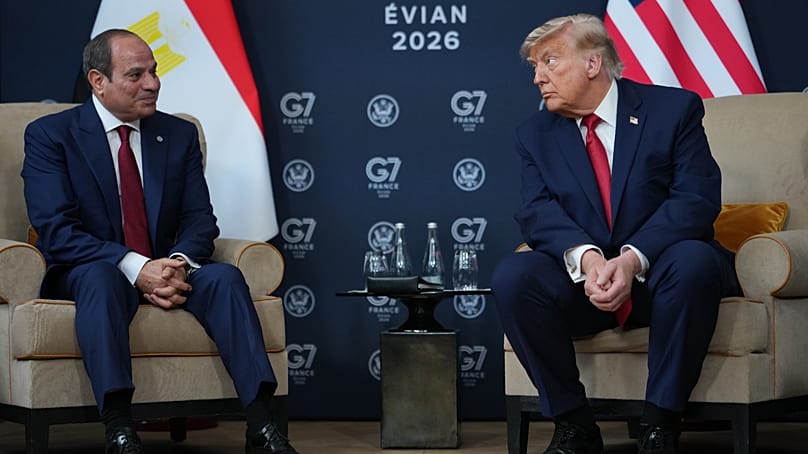
The Egyptian president and Donald Trump. Copyright 2026 The Associated Press. All rights reserved.

The Middle East dominated discussions, as leaders gathered shortly after the US and Iran announced a framework agreement to finalise a peace deal, the details of which leaked on the margins of the G7.

For Trump, the deal's key provision is that Tehran will never acquire nuclear weapons and will reopen the Strait of Hormuz toll-free; in exchange, Iran would secure the lifting of all sanctions and the unfreezing of its assets.

Western leaders welcomed the memorandum of understanding far more enthusiastically than Trump's allies did at home, hoping it would lead to a swift reopening of the Strait of Hormuz, the closure of which has driven up energy prices and strained their economies.

In unprecedented remarks, Trump said Israel "could do better" against Hezbollah and called for moderation in southern Lebanon, even suggesting that Syria might do a better job of dismantling Iran's proxy while causing fewer civilian casualties.

China, the elephant in the room

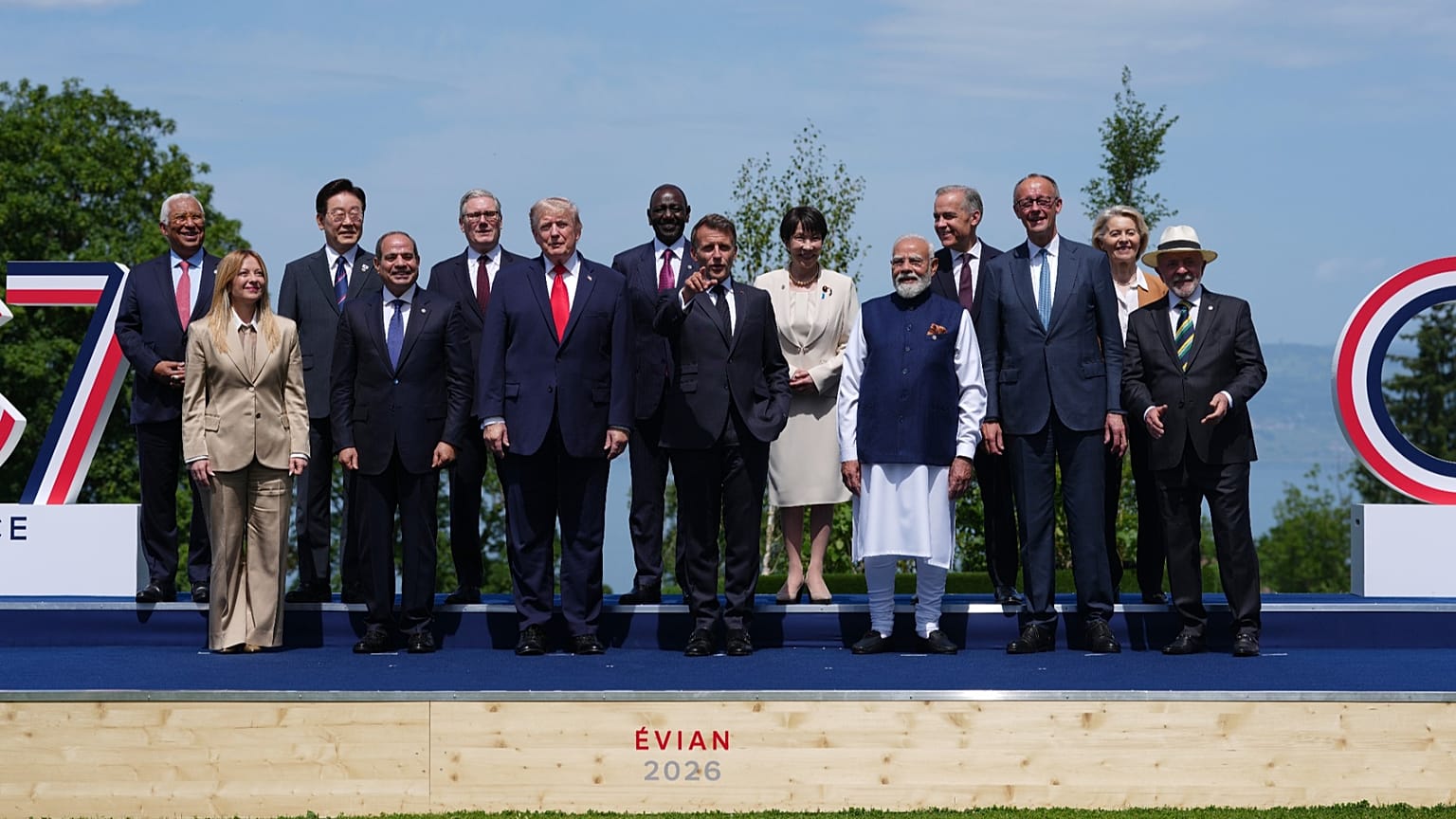
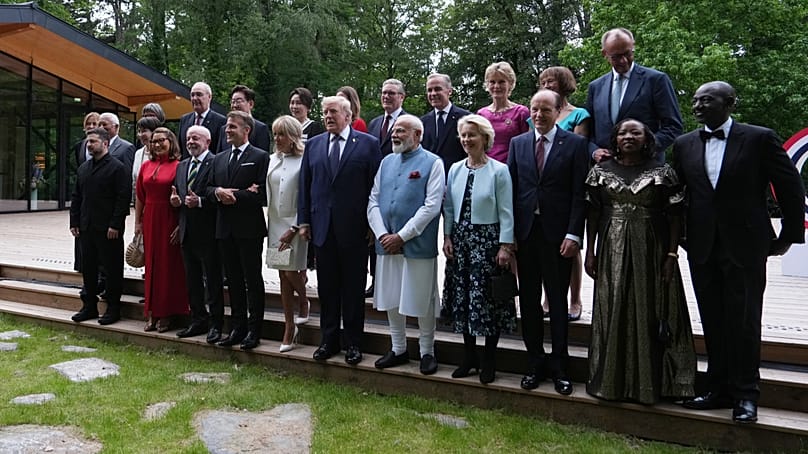
The family picture at the G7 summit. AP Photo

China was arguably the elephant in the room at this G7.

Wednesday's discussion on "promoting balanced, shared and sustainable economic growth" was little more than diplomatic shorthand for a collective effort to address the shockwaves that Beijing's state-led, subsidy-intensive economic model has unleashed.

"Global imbalances can have adverse economic impacts, especially on the poorest countries, although most of them do not contribute to imbalances," reads the joint statement released at the end of the talks, with unmissable references to China.

"We further acknowledge the importance of coordinated action to reduce growing and persistent global imbalances. Reducing global imbalances could facilitate achieving more durable and balanced growth."

The text also urges "countries with large and persistent external surpluses" (meaning China) to strengthen "domestic sources of growth" and avoid "distortive policies with negative spill overs". It also calls for "coordinated action" and "specific policies" to tackle these imbalances, but does not spell them out.

It seems that, for the time being, G7 allies will go their own way.

AI takes centre stage

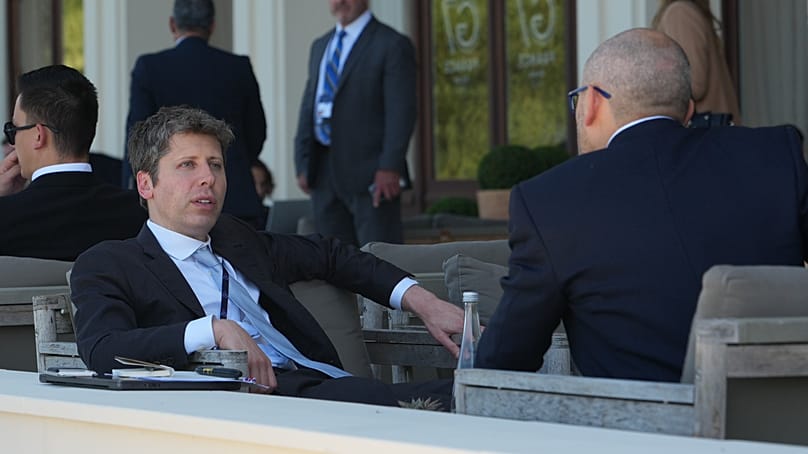
Sam Altman at the G7 summit. Copyright 2026 The Associated Press. All rights reserved.

Artificial intelligence was a major topic at the G7, as the CEOs of Anthropic, OpenAI and other leading tech companies joined leaders for a working lunch on Wednesday to discuss how to ensure AI uptake while limiting the risks.

Washington's recent decision to block foreign nationals from accessing Anthropic's most powerful models loomed large in the discussion, as Western allies realised they too could be cut off from the US's most advanced technology at a moment's notice, just like everyone else.

AI was also at the centre of a joint declaration on online safety for children, which specifically flagged risks linked to conversational chatbots and synthetic child sexual abuse material.

G7 members and partners broadly converged on calling for tech companies to prioritise child safety in the design of digital services, though divisions remain over whether a social media ban is the most effective approach.

Macron's victory lap

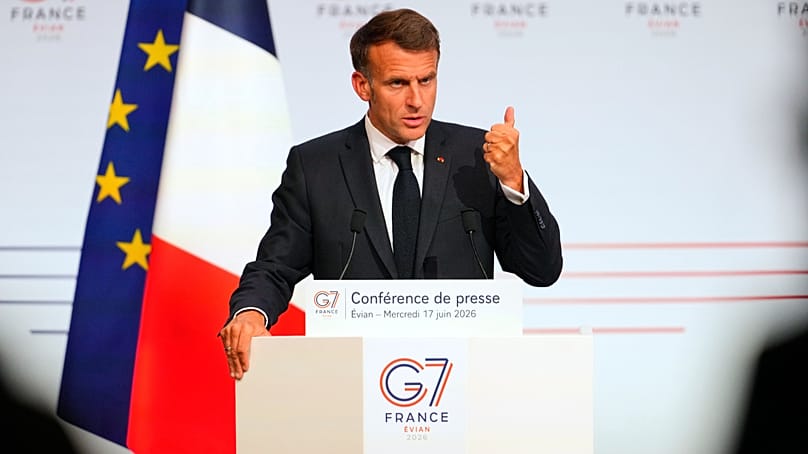
Emmanuel Macron. AP Photo

The summit was especially favourable for the host, French President Emmanuel Macron, who did not spare praise for his own diplomatic achievements.

Ahead of the summit, European officials sounded markedly pessimistic about the possibility of having joint statements on the most contentious issues. Last year in Canada, the host opted for a "chair's summary" as an alternative after Trump left the meeting halfway and left a family picture incomplete.

This time, the G7 delivered a total of nine joint statements, including one touching upon Ukraine, the Middle East and the Indo-Pacific.

"This G7 was held in an extremely difficult context of global fragmentation, multiple crises, and conflicts, and that much can hinge on our discussions," Macron said at the closing press conference, looking visibly satisfied.

"That's why I can say that this G7 is objectively a success: it was a moment of unity, of quality discussion, and of genuine cooperation among the leaders who met here."

Macron hailed an "Évian moment" that brought all leaders together for Ukraine.

Hot mics, a lot of hot mics

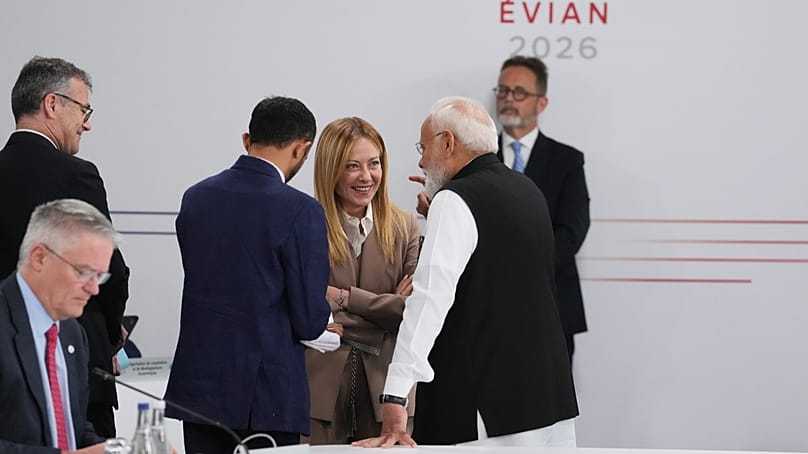
Giorgia Meloni. Copyright 2026 The Associated Press. All rights reserved.

While the G7 summit shone for its meticulous organisation against the dreamlike landscapes of Évian-les-Bains, there was a remarkable amount of protocol faux pas.

Microphones were left generously open to let journalists hear the intimate conversation between leaders. We were given access to Macron and Zelenskyy's walk through the garden, when the French president asked the Ukrainian: "Tonight, you are free?"

Then, it was Italy's Giorgia Meloni, a notorious smoker, who was caught telling her fellow leaders that she had quit the habit "one month ago".

"You stopped? Bravo!" Ursula von der Leyen replied.

The candid moment went viral online and earned personal congratulations from the World Health Organization's director-general.

Another hot-mic moment saw Germany's Friedrich Merz and Canada's Mark Carney joke that Macron had left his watch on the table.

"Give me the watch, okay?" Trump jumped in.

EU Parliament approves 'strictest-ever' migration law


By Vincenzo Genovese
Published on 17/06/2026 
EURONEWS


The European Parliament gave the final green light to a new EU law allowing controversial return hubs outside the bloc and home searches, as conservatives voted with far-right groups to pass the legislation.

The European Parliament on Wednesday approved a law aimed at speeding up the return of migrants with no legal right to remain in the EU, thanks to backing from centre-right and far-right political groups.

The “return regulation” is the bloc's toughest shift in migration policy in decades. It is considered controversial as it would allow EU countries to set up deportation centres outside the bloc, known as return hubs, through agreements with non-EU countries.

These hubs could serve either as transit facilities, where people await return to their country of origin, or as locations where migrants remain for an extended period, potentially without a time limit or guarantee of onward return. Only unaccompanied minors would be exempt from the measure, while families with children could be transferred to the hubs.

The law was approved by 418 votes to 218, with 30 abstentions. After the result was announced, supporters of the bill applauded, while some MEPs on the right of the chamber chanted "send them back", in reference to irregular migrants.

Lawmakers on the opposite side responded with chants of "shame on you".

The vote confirmed the emergence of a right-leaning majority in Parliament on migration issues. The centre-right European People's Party (EPP) once again aligned with the right-wing European Conservatives and Reformists (ECR) and the far-right Patriots for Europe (PfE) and Europe of Sovereign Nations (ESN).Several MEPs from the liberal Renew Europe group also back the bill.

The EPP continues to rule out formal cooperation with parties it considers too extreme, including the far-right Alternative for Germany (AfD) and France's National Rally. EPP leader Manfred Weber has repeatedly rejected the prospect of formal alliances with such forces.

But the EPP sees their votes as crucial for tougher migration legislation, creating an alternative majority to the traditional centrist coalition of the EPP, Socialists and Democrats (S&D) and Renew Europe.


Socialists and left-wing MEPs largely opposed the legislation, arguing that it could undermine migrants' fundamental rights.

“This regulation risks normalising legally questionable practices that would have been unthinkable in the EU only a few years ago,” Ana Catarina Mendes, vice-president of Socialists and Democrats group (S&D), said in a statement.

Beyond the return hubs, the new law also features a provision to search a “place of residence or other relevant premises” of irregular migrants, which NGOs and civil society compare to the notorious raids conducted by the US Immigration and Customs Enforcement (ICE).

Other provisions include longer detention periods, tougher entry bans and new powers to locate irregular migrants.

It raises the maximum legal detention period for irregular migrants waiting to be returned from six months to two years, with a possible six-month extension and an unlimited duration for persons considered as posing a security risk.

Entry bans would also become significantly stricter, rising from five to ten years in most cases, with the possibility of lifetime bans for those considered a security risk.

The legislation would also change the appeals process. Under current rules, deportations are automatically suspended while legal challenges are pending. The new law would end that automatic safeguard, leaving courts to decide on a case-by-case basis whether a return order should be suspended.


Why Europe's labour needs clash with its migration policy

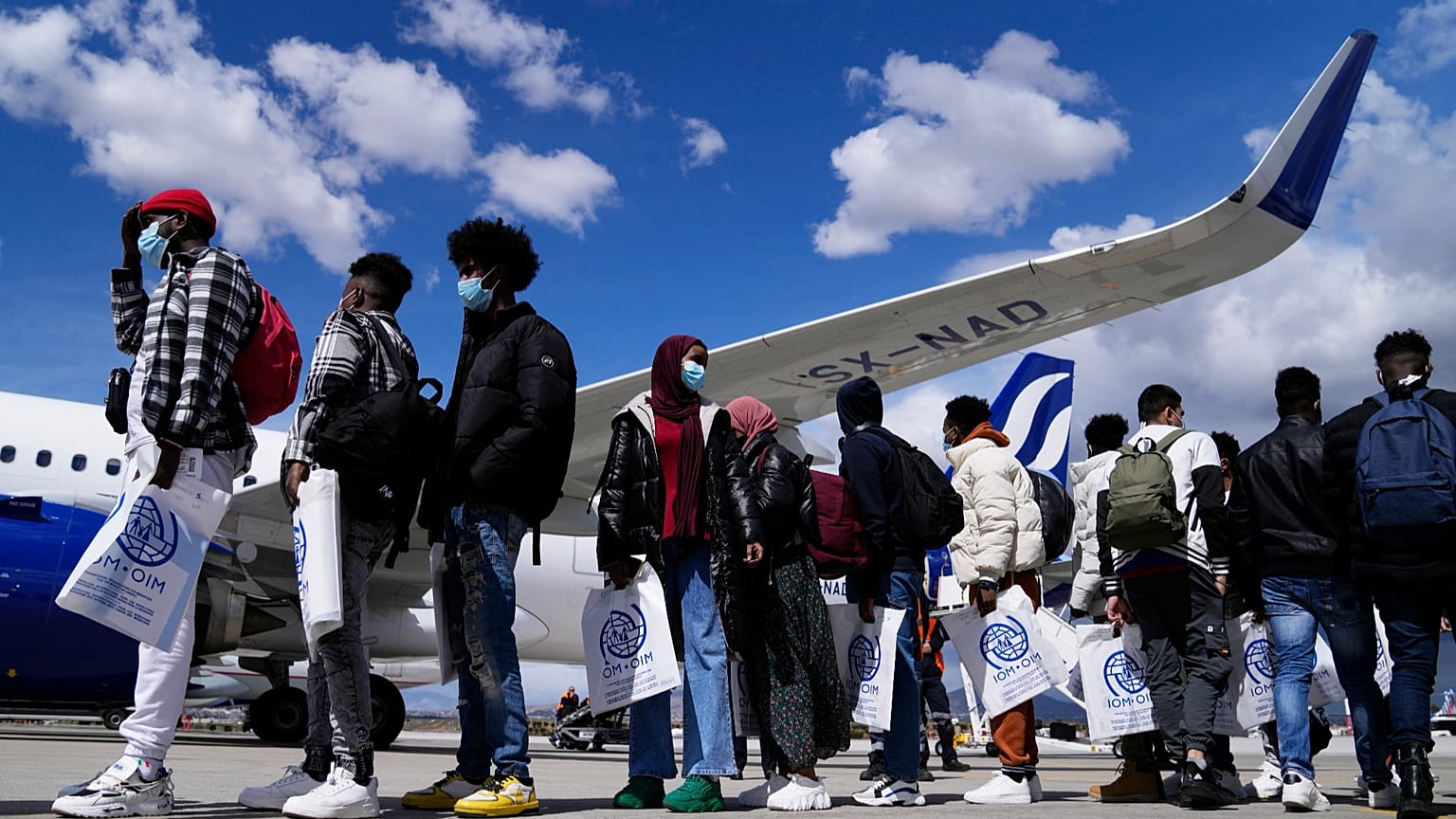
Migration Greece
Copyright AP Photo

By Evi Kiorri
Published on

Europe faces a paradox: economies need workers while governments tighten migration rules. This tension grows as the EU’s Migration and Asylum Pact takes effect on 12 June, marking the bloc’s strictest migration policy in decades.

Europe is simultaneously in desperate need of workers and determined to keep more people out, with its Migration and Asylum Pact taking full effect on June 12. That contradiction sits at the heart of one of the continent's most politically charged debates, and it is becoming harder to ignore.

With unemployment at historic lows and employment rates at record highs, EU labour markets are running on empty. Structural shortages plague healthcare, construction, agriculture, transport and tech sectors. And the cause is no mystery: Europe is ageing rapidly. In 2022, roughly 22 per cent of the EU's population was aged 65 or older. The working-age population is shrinking, particularly in Germany, Italy and Central and Eastern Europe.

On 1 June, EU co-legislators agreed on new "return hubs" outside EU borders to detain migrants without the right to remain. Days later, on 12 June, the full Migration and Asylum Pact enters into force. It is the most extensive overhaul of European migration law in decades, built around tougher screenings, faster deportations, and stricter border controls.

The numbers don't add up

Since 2019, non-EU nationals have filled over half of the net job growth in the EU. In Italy, migrants support an estimated 600,000 pensions through social security contributions, paying approximately €8 billion annually into the welfare system while receiving about €3 billion in benefits. In Germany, each employed migrant contributes to current retirees at the same statutory rate as nationals.

The European Commission, the ECB, and multiple research institutions agree that immigration is one of the few viable options to maintain economic growth and support welfare systems.

Nicolas Schmit, former European Commissioner for Jobs and Social Rights and president of FEPS, warns, "those who tell you the contrary don't tell you the truth." "If Europe goes for zero migration, we will end up in a dead continent," he says.

Yet public debate rarely reflects these numbers. Instead, it is dominated by scenes of overcrowded reception centres like those in Lampedusa and Moria and by rising political pressure from far-right and centre-right parties demanding visible action at the borders.

A tale of two tracks

What has emerged is a "dual track" approach, as researchers call it. Governments tighten asylum rules and border enforcement for public consumption, while quietly expanding targeted labour migration schemes for sectors they cannot afford to leave understaffed.

Italy's government, for instance, has promoted an anti-immigration agenda while approving "flows decrees" that admit tens of thousands of non-EU workers annually. Germany has reformed its Skilled Immigration Act to create new pathways for workers without university degrees.

Schmit, who co-launched the EU's Talent Partnership and Talent Pool initiatives with then-Migration Commissioner Ylva Johansson, says this gap between rhetoric and reality is not sustainable. "We have to transform this toxic discussion on migration into a real one, a debate which is based on facts," he argues. "But I know, in our time, facts are not always at the centre."

Tesseltje de Lange, Professor and Director of the Centre for Migration Law at Radboud University Nijmegen, agrees that the political framing is misleading. "The rhetoric of less migration is a false narrative," she says. "European businesses and households cannot do without migrant labour."

When the system blocks itself

Even where legal pathways exist, the system is broken. De Lange's research maps everyday obstacles preventing employers from filling vacancies with foreign workers: qualification recognition that can take up to a year and remains unharmonised across member states, visa appointment slots monopolised by brokers, and labour market tests that slow applications to a crawl.

"It sometimes takes some nine months just to get an appointment at an embassy," de Lange notes, "because brokers have booked all available timeslots."

The EU's flagship tool for attracting skilled workers, the Blue Card, has been reformed through a 2023–2025 recast with lower salary thresholds, broader qualification criteria and improved intra-EU mobility. But uptake remains patchy, fragmented by competing national schemes and undermined by slow processing times and limited employer awareness.

At the same time, some governments are tightening family reunification rules while recruiting workers from abroad, a move de Lange describes as self-defeating. "To attract and retain talent, literature shows that family commitment is key to a successful placement. Tightening family reunification rules would seem counter-productive if the aim is to attract and retain migrant workers."

What Europe actually needs

Schmit argues that the care sector alone shows how existential the stakes are. "Without immigration, in these ageing societies, we cannot really cover the services in the care sector," he says. It is not only low-skilled roles. Europe also faces shortfalls in engineering, IT and the green and digital transition sectors, areas critical to the continent's long-term competitiveness.

De Lange's prescription for the next decade is procedural and rights-based: harmonised, expedited visa and qualification recognition processes, shortage occupation lists to fast-track applications, and better protection for workers already in the system. "Migrant workers should have an app giving access to all they need to know about their rights and to avoid abuse," she says.

Schmit also calls for a comprehensive and transparent overhaul, including cooperation with countries of origin on skills development, remittances, and circular migration. "This is what Europe needs, this is what we have to do better," he says. "It has to be a win-win. It cannot be just at the advantage of one side."

The political trap

The Migration and Asylum Pact's implementation is already running into trouble. A Commission report from 8 May found that while political willingness is high, practical execution is lagging. IT systems for migrant tracking and border detention facilities are behind schedule in Germany, Italy, Greece, Spain and Cyprus.

The bigger problem is not logistical. It is that European politics has locked itself into a debate about irregular migration, which “represents less than 10 percent of arrivals,” says Schmit. The far larger and more consequential question of organised labour migration gets drowned out.

As Schmit sees it, that is a choice Europe cannot afford to keep making: "We have to stress the absolutely positive sides of migration and not just stress the ones which might not always be positive."


archivehttps://archive.org  › details  › multitudewardemo0000hard

Multitude : war and democracy in the age of empire : Hardt,...

Ask the publishers to restore access to 500,000+ books · Search the history of more than 1 trillion web pages


monoskophttps://monoskop.org  › images  › 9  › 95  › Hardt_Michael_Negri_Antonio_Empire.pdf

EMPIRE

Empire / Michael Hardt and Antonio Negri.
 

Voters head to the polls in key UK by-election that could determine Britain's next PM


By Nathan Rennolds
Published on

Andy Burnham is regarded by many Labour MPs as the party's best chance of recovery following the disastrous May local elections.

Residents are heading to the polls in the Greater Manchester constituency of Makerfield in the UK today in a key by-election to determine their next MP - and quite possibly Britain's next prime minister.

Polls in Makerfield are open from 7 am to 10 pm on Thursday, with the count set to take place after voting closes.

The by-election was triggered after the former Makerfield MP Josh Simons stepped down to pave the way for Andy Burnham, the mayor of Manchester, to be able to mount a challenge to British Prime Minister Keir Starmer.

Simons made the decision following Labour's disastrous local election results in May, which heaped pressure on Starmer and led to calls for him to stand down.

Speaking to the BBC at the time, Simons said it had been the "most difficult decision" of his life but "too big an opportunity to miss".

"We were heading for a leadership election with the Labour Party split into different factions, and there was no hope, no energy that anything would change," he said.

Burnham is regarded by many Labour MPs as the party's best chance of recovery following the May local elections, but he will face stiff competition from the right in Thursday's election.

Nigel Farage's Reform UK and Rupert Lowe's Restore Britain parties will be hoping their focus on tackling immigration will be enough to persuade locals for their votes.

Shortly after polls opened, Farage posted a video to social media in which he presented the election as a choice between Reform candidate Robert Kenyon or "open borders Andy Burnham".

Burnham's stance on the EU and Brexit has attracted particular attention in the runup to the Makerfield election.

Burnham had previously called for the UK to rejoin the bloc, an idea which has been fiercely debated again in recent months, but he has since distanced himself from those comments.

"My view is that Brexit has been damaging," he said in May. "But I also believe the last thing we should do right now is rerun those arguments".

Building A Unified European Cyber Shield – OpEd


June 17, 2026 
By Simon Hutagalung


The European countries’ digital security architecture has turned into a strategic issue of the same importance to traditional military power as is the case with conventional means. However, the architecture remains fragmented and thus exposed to a large number of cyber-vulnerabilities in cross-border situations. This is also reflected in several recent attacks: In the autumn of 2021, for example, the health service of Ireland was the victim of a serious ransomware attack which paralysed a number of vital departments for several weeks and, above all, uncovered serious weaknesses in the resilience of public infrastructure. The health service of Germany, for example, has recently been the target of repeated probing by foreign actors, also targeting energy suppliers. In view of cross-border cyber threats, the current cyber defence of Europe therefore is not yet sufficient and is lacking an integrated framework of defence.

But also new, in terms of their nature and impact, are the challenges to European security and stability from Russia and China. Russia is increasingly integrating cyber operations into its hybrid warfare against European countries by using disinformation, propaganda and even more intrusive cyber measures to undermine their stability and weaken their cohesion. By further expanding its digital presence, for example by rolling out 5G networks, building out cloud capabilities and creating new data ecosystems, China is creating new risks for European countries in terms of their dependence on these new technologies.

While NATO has recognised in its own strategy that cyberspace is now an operational domain, differences in member states’ perceptions of cyber threats and their level of preparedness for dealing with them mean that it is not yet possible to speak of a united stance or of a credible deterrence by the Alliance as a whole. The same is true of the European Union: while there is agreement on a number of measures, such as the Cybersecurity Act and the work of the European Union Agency for Cybersecurity (ENISA), the implementation of these measures is far from consistent. And while European countries are working at the national level to develop their own strategies for dealing with cyber threats, there are considerable differences in terms of the objectives that these strategies are intended to achieve and the measures that are deemed necessary to meet them.

Beyond the traditional threats of cyber-attacks conducted by states or other malicious actors, a large and diverse array of risks are emerging that will affect Europe’s security in the years to come. AI-based cyber-attacks that use deepfakes or other automated methods to compromise IT systems and disrupt operations increasingly pose a threat to democratic stability by challenging information integrity and eroding public trust. Moreover, as global cybercrime continues to evolve, it is increasingly conducted by transnational networks that exploit jurisdictional weaknesses and complicate enforcement across borders. Supply-chain risks, for example, can allow hardware, software or services to be used for espionage or other malicious purposes, especially as companies increasingly rely on external providers for critical IT functions. Achieving strategic autonomy in key technologies, such as semiconductors, cloud computing and AI, is therefore only partially realised, as Europe’s companies remain heavily dependent on non-European providers for these critical functions.


In summary, Europe is not yet a safe and secure area for living and for doing business. To overcome these risks, a European Cyber Security Structure of defence has to be developed to counter cyber threats on an equal footing with other domains of military operation. The national Cyber Security Structures must be able to act in real time and based on a clear mandate from the European Union. Their operational conditions and the way in which they are deployed on the national scene must be on the same footing.

 Harmonised regulations for all member states of the European Union have to be introduced to ensure a uniform level of security. Furthermore, a binding agreement on joint actions to be taken in case of an attack has to be agreed upon by all member states. This in turn requires a massive investment by member states in their own information and communication technologies in order to reduce the current dependence on suppliers outside of Europe. To this end, an adequate innovation system has to be developed, and existing structures have to be optimised for this purpose. To achieve these goals, a close cooperation with the USA has to be maintained but must not be allowed to become an end in itself. In addition, NATO’s cyber doctrine has to be developed further and, in the context of joint military operations, it must be possible to respond within minutes to a cyber-attack. For this purpose, joint exercises must be conducted, and rapid incident response and the exchange of intelligence with all partners involved in the operation must be possible. In addition, a structure for preventive action has to be developed in order to be able to deal with new threats in good time, for example from the area of artificial intelligence.

In summary, it is increasingly important for Europe to ensure its security and stability in the digital age. An integrated approach to cyber security is necessary to ensure security of and in digital networks and to develop defences in order to ward off potential threats. In the context of cross-border threats, Europe’s current cyber defence is not sufficient. This is why a unified and sustainable approach to cyber security is needed. Such an approach would need to be based on integration, self-reliance in terms of technology, and international cooperation. With such an approach, it is possible to create the necessary measures to secure digital networks against new threats. This requires a long-term strategy and corresponding investments. However, without such a strategy and corresponding measures, there is a real risk that the same mistakes will be repeated over and over again and that Europe’s position in the global competition for influence in the digital age will be further eroded.


But Europe needs to step up the effort and move with needed speed. Europe needs to coordinate actions of its member states and their many institutions as threats in the cyber domain are continuously changing – in scale and in type. This requires European leaders to have the determination to pursue unity of action at a time when the global environment is becoming more unstable. And as was the case in the past, democratic values and critical infrastructure of all European countries are under permanent assault from many different actors employing a variety of tools.

The opinions expressed in this article are his own.

References

Villani, S. (2025). The Cyber Solidarity Act: Framework and perspectives for the new EU-wide cybersecurity solidarity mechanism under the EU legal system. European Journal of Risk Regulation, Cambridge University Press.

European Union Agency for Cybersecurity (ENISA). (2026). ENISA international strategy 2026–2028. European Union Agency for Cybersecurity


About Simon Hutagalung
Simon Hutagalung is  retired diplomat from the Indonesian Foreign Ministry and received his master's degree in political science and comparative politics from the City University of New York. The opinions expressed in his articles are his own.
View all posts by Simon Hutagalung →


Companies are rushing into AI, but adoption is still lagging, a KPMG executive says

Copyright Euronews
By Roselyne Min
Published on

Companies may have AI strategies, but few can prove they are paying off, according to KPMG’s recent report. Euronews Next spoke with Mathieu Wallich-Petit, Head of Clients & Markets at KPMG France about how businesses can move from AI pilots to real impact.

Companies are moving quickly to adopt artificial intelligence (AI), but many still struggle to prove its worth, Mathieu Wallich-Petit, Head of Clients & Markets at KPMG France, told Euronews Next at VivaTech in Paris.

According to the company’s report published in March, 95% of its clients have a strong AI strategy, while 64% have already seen tangible results from the technology.

But only 8% can measure a clear return on investment.

“Our clients do embed a real strategy in AI, but in reality, on the ground, there is still a big lag,” Wallich-Petit said.

Wallich-Petit said KPMG’s role is to help companies bridge that gap, as the technology develops faster than many organisations can adapt.

“What is amazing is that the pace of acceleration of the technology is really exponential,” he said. “And we see the adoption within each company to be pretty much linear.”

According to the survey, only around 10% of KPMG clients are already embedding AI at scale.

In the insurance sector, he said, companies are starting to use AI beyond claims handling.

“Before it was very much about automation of claims, and now it’s very much end-to-end, from scoring new clients, pricing and to customer service,” he said.

KPMG says companies are continuing to increase AI budgets because boards see the technology as a competitive advantage and a way to attract talent. At the same time, businesses are now paying closer attention to whether those investments can deliver clear and rapid returns, according to Wallich-Petit.

Tips for companies

The French executive also said the priority that leaders should focus on when transitioning into AI should be workers.

“My view is that it’s really about people, it’s not a question of technology,” he said. “Upskilling people, training people, is probably the most important strategic angle to make an AI strategy a success.”

For companies still stuck between pilots and wider deployment, Wallich-Petit said the priority is to embed AI into everyday business processes.

“The magic recipe is very much to move from proof of concept, from piloting, to really embed into the process,” he said.

That also means stronger governance, better data management and more training for workers, according to Wallich-Petit.

“We always say it’s having people in the loop. I think it’s more than that. We need to have people driving with AI,” he said.

He also stressed that AI sovereignty is becoming a bigger issue for companies, especially as businesses depend on a small number of powerful model providers.

“The main theme is not to rely on only one model, but to have a diversity of models,” he said.

That question has become more concrete as access to some advanced AI models becomes caught up in geopolitics.

In May, KPMG and US AI company Anthropic announced a global alliance to embed Claude into KPMG’s client delivery platform and give its global workforce access to the AI assistant.

Weeks later, Anthropic said it had been ordered by the US government to suspend access to its Fable 5 and Mythos 5 models for any foreign national.