Sunday, June 21, 2026

Khanna Becomes First in Congress to Sign ‘Peace Pledge’ Promising to Reject AIPAC Funds

The co-founder of AIPAC Tracker said the pledge is meant to give lawmakers who once backed Israel “a bridge to get on the right side of history.”
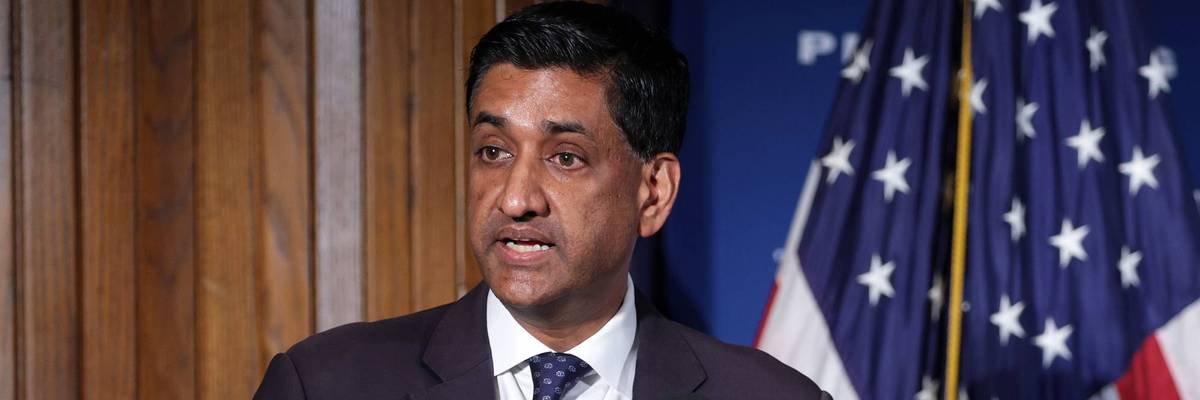


US Rep. Ro Khanna (D-Calif.) delivers remarks during a National Press Club Headliners Newsmaker event on April 14, 2026 in Washington, DC.
(Photo by Alex Wong/Getty Images)

Stephen Prager
Jun 17, 2026
COMMON DREAMS

Rep. Ro Khanna has become the first member of the US Congress to sign a “peace pledge” promising to swear off funds from the Israel lobby and block US support for countries that violate human rights.

The pledge was created by the political action committee Citizens Against AIPAC Corruption, which runs the widely shared “AIPAC Tracker” social media campaign that names and shames politicians who receive support from the American Israel Public Affairs Committee and other pro-Israel groups that have spent tens of millions in recent election cycles to influence members of Congress.

Lawmakers who sign the pledge agree not to take money from AIPAC or pro-Israel lobbying groups and promise to make campaign finance reform a key priority.

Acknowledging the consensus among human rights organizations that Israel is committing a genocide in Gaza, signatories also commit to taking actions in Congress to oppose US military and diplomatic support for Israel or any other nation whose military commits gross human rights violations.

They also agree to oppose efforts by the US government to sanction members of the International Criminal Court who seek the arrest of accused war criminals, including Israeli Prime Minister Benjamin Netanyahu.

Signatories also agree to support First Amendment protections for speech critical of Israel as well as efforts to use financial pressure against the country, like the Boycott, Divestment, and Sanctions (BDS) movement, which members of Congress have sought to criminalize.


In a video in which he signed the pledge on Wednesday, Khanna (D-Calif.) described its commitments as “pretty common sense.”

“It means that we shouldn’t be sending our tax [money] for foreign wars overseas, we should be spending it here at home,” he said. “And it says we shouldn’t be taking money from AIPAC or all of its affiliate PACs or bundled money from those organizations, and that we have to recognize the genocide that took place in Gaza.”

He said, “I’m going to be signing this pledge, and I hope others will follow.”


The push for lawmakers to sign the pledge comes as support for Israel has plummeted to historic lows, especially among Democratic voters in the wake of the Gaza genocide, its accelerating ethnic cleansing campaigns in the illegally occupied West Bank and southern Lebanon, and its role in pressuring the Trump administration to launch and continue a devastating war against Iran.

Voters increasingly view AIPAC as having undue influence over American lawmakers, and many Democrats—including longtime supporters of Israel—have seen the writing on the wall and become vocal critics of the lobby.

Khanna is one of them, having previously accepted money from the liberal Zionist group J Street and voted to fund Israel’s Iron Dome in 2021 and in favor of a resolution conflating anti-Zionism with antisemitism in the wake of October 7, 2023.

Cory Archibald, the co-founder of Track AIPAC, said the goal of the pledge is to give these politicians an opportunity to transform themselves on the issue while also forcing them to put their votes where their mouths are.

“While we have created a very successful pressure campaign to highlight and expose the extent of the influence of AIPAC and their allies on our lawmakers,” she said Wednesday on the Breaking Points podcast, “we also have a responsibility as an organization to give people a bridge to get on the right side of history and to reflect that their policy positions have changed and to chart a new course.”
Thanks to Trump’s Iran War Disaster, Fossil Fuel Industry to Enjoy $700 Billion Windfall in 2026

“We witness not only a massive fossil fuel crisis but a vast upward transfer of wealth built on instability of fossil fuel markets and pain,” said an expert at 350.org


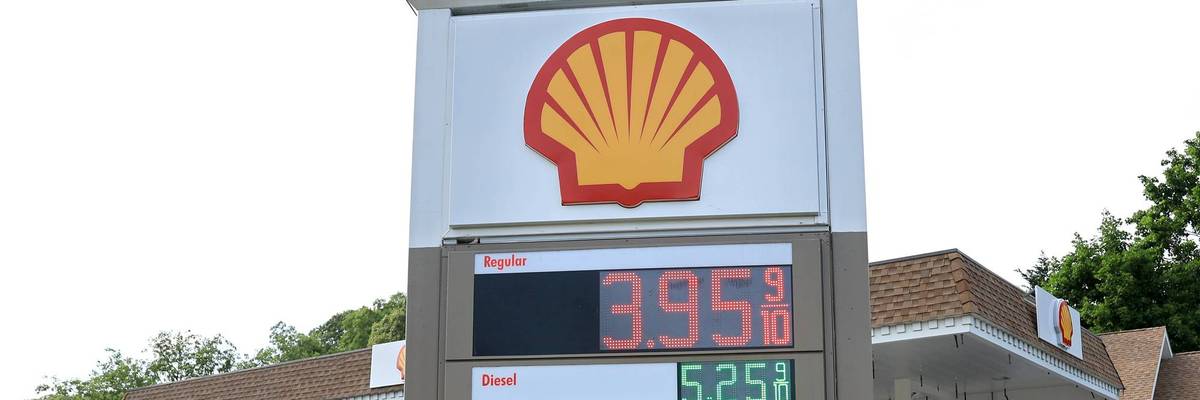
Gasoline prices hover near $4 for Regular at a Shell Station on Middle Country Rd. in Lake Grove, New York, on June 10, 2026.
(Photo by Thomas A. Ferrara/Newsday RM via Getty Images)


Stephen Prager
Jun 18, 2026
COMMON DREAM


US President Donald Trump’s war with Iran may finally be reaching a close. But consumers and businesses around the world will continue to pay the price in the months ahead as still-elevated energy costs funnel hundreds of billions of dollars to fossil fuel giants.

That’s according to a report from the environmental group 350.org released Thursday, following Trump’s signing of a memorandum of understanding with Iran this week to begin the process of formally ending a war that has sent global oil prices skyrocketing and saddled ordinary people with record fuel prices.

The group estimated that just 110 days of war resulted in the transfer of an additional $374 billion from consumers and businesses into the coffers of oil and gas companies beyond what would have been expected had the war never been launched.

And while Trump claims his agreement to end the war this week will avert an “economic catastrophe,” there will likely still be tremendous pain even if the Strait of Hormuz reopens promptly.

Using oil and gas pricing scenarios from the International Monetary Fund’s April 2026 World Economic Outlook and data on global consumption, 350.org predicted that by the end of the year, consumers and businesses will spend an additional $199.8 billion on oil and $128.1 billion on gas above a non-war scenario, making for a grand total of more than $700 billion as a result of the war.

This, the group said, is a conservative estimate, as it does not even take into account knock-on effects. The war will ultimately end up costing much more when factoring in inflation across the rest of the economy, resulting from higher fuel costs or fertilizer shortages caused by the strait’s closure, which has affected food prices.

It also does not take into account the resulting effects on economic output or employment as rising costs and lower consumer spending force companies to tighten their belts.

“The oil and gas industry is draining billions from people and businesses on the back of a war that has killed thousands and pushed millions toward poverty and hunger,” said Andreas Sieber, head of political Strategy at 350.org.

“Even if the Strait of Hormuz reopens tomorrow, we should expect prices to remain above pre-crisis levels,” he said. “We witness not only a massive fossil fuel crisis but a vast upward transfer of wealth built on instability of fossil fuel markets and pain.”

While the war has brought it into starker relief, previous reports from 350.org have shown that even if the US had never attacked Iran, the continued global dependence on fossil fuels was resulting in trillions of dollars of avoidable costs each year, including $9.3 trillion to mitigate climate-related damages and air pollution-related deaths each year, costs that disproportionately fall on the world’s poorest.

In order to alleviate economic strain from the war, Sieber said, “governments should tax these excess profits now and use the revenues to protect people, cut bills, and rapidly deploy renewables that make households and small businesses less vulnerable to the next fossil fuel shock.”

Estimates of inflation also do not account for how the war has heightened global instability and poverty, which will require additional resources for humanitarian relief efforts. In late April, the United Nations Development Program estimated that even if the conflict had ended then, more than 32 million people worldwide would be pushed into economic precarity.

This is not to mention the resources that will need to be expended to address the harms caused by the war itself.

In exchange for negotiations on Iran’s nuclear program, a portion of the memorandum of understanding requires the US to work with “regional partners,” presumably other Persian Gulf allies, to scrounge up at least $300 billion to help Iran pay for reconstruction and economic development after the country was devastated by American and Israeli attacks on civilian infrastructure and millions were displaced.

As a report from the International Rescue Committee detailed last week, the Iran war has also had cascading effects on other conflicts and catastrophes.

“Six months ago, the IRC warned that a New World Disorder was emerging,” said David Miliband, the humanitarian group’s president and CEO. “Since then, disorder has not only grown but accelerated. A war with Iran. A million people have been forced to flee their homes in Lebanon. A brewing global food security catastrophe that risks plunging millions more people into acute hunger. An expanding Ebola outbreak. Defanged diplomacy and collapsing aid budgets.”

“The Iran war couldn’t have happened at a worse time,” Miliband said in a New Yorker article published Thursday. “It set off a chain of events that’s very damaging.”


110 Days of Trump’s Iran War Cost US Consumers $53 Billion Extra in Raised Gas Prices

“Even if the Strait of Hormuz reopens tomorrow, we should expect prices to remain above pre-crisis levels,” said an expert at 350.org


A man pumps gas at the Chevron gas station on Sawtelle Blvd and Culver Blvd. on June 15, 2026, in Los Angeles.
(Photo by Kayla Bartkowski/Los Angeles Times via Getty Images)


Stephen Prager
Jun 18, 2026
COMMON DREAMS

President Donald Trump said on Wednesday that if his war in Iran continued much longer, the US could have faced “economic catastrophe” with gas prices expected to soar as emergency oil reserves were exhausted.

But new reports suggest that although the war appears to be coming to an end and the Strait of Hormuz is reopening, extraordinary irreversible damage has been done, and the economic consequences will be felt well into the future.

The Institute on Taxation and Economic Policy (ITEP) estimates that as a result of the war, Americans have paid nearly $54 billion extra for gas and fuel, amounting to more than $400 per household, than if the war had never started.

In the wake of the memorandum of understanding signed between the US and Iran, Trump has tried to claim credit as average gas prices have fallen below $4 for the first time since the early days of the war in March. However, gas still costs 25% more than it did last year.

This state of affairs can be expected to continue into the future. As The Associated Press reported Thursday morning:


Even as gas prices start to decline, it is anticipated to take weeks or months for oil to start flowing through the Strait of Hormuz again...

And Gulf oil producers that throttled back production will need time to get the oil moving again. Analysts also say ship captains may take their time to decide if passage is safe and that the threat of attack from Iran has truly receded.

In addition, refineries typically pay for crude oil a month or more in advance, so even after oil prices drop, they won’t immediately be processing cheaper products.

Fighting over the Strait of Hormuz disrupted not only supplies of crude and refined fuel but also the supply chains for fertilizer, food, and even footwear. Businesses expect higher costs to linger, which means their customers might need to prepare for that too.

Patrick De Haan, a petroleum analyst at GasBuddy, told CBS News it will be “a very long, multi-month to multi-year process for things to fully normalize,” and that it could take “until potentially mid-to-late 2027” for gas prices to return to pre-war levels.

Even as Americans, and indeed consumers around the world, continue to see their pocketbooks drained in the coming months, there is one big winner here: the fossil fuel industry.

An analysis released on Thursday by the environmental group 350.org shows that over the course of the war, households and businesses have paid the oil and gas industry an additional $374 billion in profits due to higher prices driven by the war.

Based on pricing scenarios from the International Monetary Fund, the group projected that even with the Strait of Hormuz open, the amount siphoned off could balloon to over $700 billion by the end of the year.

“Even if the Strait of Hormuz reopens tomorrow, we should expect prices to remain above pre-crisis levels,” said Andreas Sieber, 350.org’s head of political strategy. “We witness not only a massive fossil fuel crisis but a vast upward transfer of wealth built on instability of fossil fuel markets and pain.”


White House correspondent calls out Trump ICE 'lie': 'They're criminals'

David McAfee
June 21, 202
RAW STORY


Aliya Rahman is carried by federal agents after being pulled from her vehicle following an immigration raid that led to the detainment of two Hispanic youths and multiple observers, days after an ICE agent fatally shot Renee Nicole Good, in Minneapolis, Minnesota, U.S., January 13, 2026. REUTERS/Tim Evans

Donald Trump asked the public to celebrate ICE as misunderstood heroes Saturday, and veteran White House correspondent Brian Karem answered with a single word: "LIE."

The president had posted what he framed as a poll, declaring that "ICE has been abused by the Fake News Media at levels never seen before." He called the agents "Great Patriots who work hard, and do a fantastic job in a very hostile environment," and blamed the criticism on "the Dumocrats and the Fake News." Karem, a longtime reporter who has sparred with multiple administrations from inside the briefing room, was not interested in the patriotic framing.

"ICE ignores due process and hides behind masks as if they're the KKK riding through the south during the 1920s," Karem wrote, before invoking two names that have become central to the case against Trump's immigration crackdown. "Renee Good and Alex Pretti were fatally shot in Minneapolis during the Trump administration's 'Operation Metro Surge'." His conclusion was blunt: "ICE are not patriots. They're criminals."

The history behind those names is not in dispute. Renée Good, a 37-year-old US citizen and mother, was shot and killed by an ICE agent on January 7 while in her car. Alex Pretti, a 37-year-old US citizen and intensive care nurse at a Minneapolis VA hospital, was shot multiple times and killed by Customs and Border Protection officers on January 24 while filming agents with his phone. Both deaths occurred during Operation Metro Surge, the aggressive enforcement campaign that drew more than 3,000 arrests, mass protests, a Minnesota general strike, and a homicide ruling from the county medical examiner in Pretti's case.

What followed deepened the controversy Karem was pointing to. Minnesota officials sued the administration for withholding evidence in the shootings, accusing federal authorities of shielding the agents involved. Local police chiefs and the Hennepin County sheriff condemned the operation, with one calling the agents' conduct "not just only wrong, but illegal." The administration has defended the shootings as self-defense and declined to release the agents' names.

That record is what makes Trump's "Great Patriots" framing so combustible. The president is asking Americans to rally behind an agency whose officers killed two of their fellow citizens months ago, in killings still tangled in lawsuits and stalled investigations. Karem, who has spent a career being told by presidents that the press is the enemy, simply refused to let the rebranding pass unchallenged.


Report Details ‘Human Rights Crisis’ Wrought by Trump ICE Surge in Minnesota


“The federal government sent hordes of masked, armed agents to grab people off the street, whisk them away in shackles, and abuse those who sought to bear witness,” Human Rights Watch said of the deadly blitz.


Protesters and US Immigration and Customs Enforcement agents face off in Minneapolis following the January 13, 2026 fatal shooting of Renee Good.
(Photo by Elizabeth Flores/The Minnesota Star Tribune)


Brett Wilkins
Jun 18, 2026
COMMON DREAMS

Human Rights Watch on Thursday published a scathing report detailing how President Donald Trump “caused a human rights crisis” in Minnesota by ordering the deadly federal invasion of the Twin Cities in service of the administration’s mass deportation agenda.

HRW called Operation Metro Surge, launched by Trump last December, “an unprecedented deployment of thousands of federal immigration agents and officers to the state of Minnesota,” including members of Immigration and Customs Enforcement (ICE) and Customs and Border Protection (CBP).

“The Trump administration claimed that Operation Metro Surge was designed to keep Americans safe and often stated that it was targeting noncitizens with violent criminal histories,” the report states. “But the operation itself caused significant harm, and nearly two out of three immigrants arrested by ICE during Operation Metro Surge had no prior US criminal history whatsoever.”

At least three people have been killed in connection with the operation. ICE agent Jonathan Ross fatally shot Renée Good, a 37-year-old US citizen, in Minneapolis on January 7. A week later, 36-year-old Nicaraguan detainee Victor Manuel Díaz, who was arrested during the operation, became the third person to die at the notorious East Montana concentration camp in Texas. On January 24, CBP officer Raymundo Gutierrez and Border Patrol agent Jesus Ochoa shot and killed nurse Alex Pretti, 37, also in Minneapolis.

“Federal agents shot a third Minneapolis resident and pulled guns on dozens more,” the report continues. “Agents also violently smashed car windows without justification, physically threw people to the ground who were not resisting arrest, and deployed chemical irritants and flash-bang grenades on dozens of occasions, sometimes at close range and without warning, resulting in injuries, including to journalists.”

Furthermore, federal agents “unlawfully arrested and detained hundreds; engaged in racial profiling, harassment, and surveillance; and terrorized Minnesotans, chilling their rights to freedom of expression and assembly, and impacting their rights to education and health, among others,” HRW said, adding that “residents faced further abuses when they collectively acted to protest, prevent, and stop these violations of their rights.”

The HRW report calls for an immediate end to abusive federal enforcement operations in Minnesota; independent investigations into alleged unlawful killings, racial profiling, arbitrary arrests, excessive force, and other rights violations; and full accountability for officials responsible.

“The federal government sent hordes of masked, armed agents to grab people off the street, whisk them away in shackles, and abuse those who sought to bear witness,” Reagan Williams, HRW’s crisis and conflict researcher, said in a statement. “Minnesotans mobilized to protest, to document abuse, and to provide critical aid to one another. National-level action is needed to ensure accountability, end ongoing abuses, remedy the harm, and prevent another crisis of this scale.”

“Operation Metro Surge put the violent and abusive practices of these agencies on full display,” Williams added. “We have clear proof of how they operate when impunity prevails, and we need to urgently chart a new way forward through accountability and structural reforms that put an end to these abuses.”


‘Major Escalation’: Trump Prosecutor Invokes NSPM-7 While Unveiling Charges Against 15 ICE Protesters

National Security Presidential Memorandum-7, which President Donald Trump issued last year, explicitly targets left-wing protesters and beliefs.


A huge crowd of American expats gathers for the No Kings Movement protest on March 28, 2026 in Place de la Bastille, in Paris, France, displaying signs that label federal agents rather than protesters as “domestic terrorists.”
(Photo by Owen Franken Corbis//Getty Images)

Julia Conley
Jun 17, 2026
COMMON DREAMS

Federal prosecutors in Minnesota have struggled to come up with charges that stick as they’ve indicted dozens of people this year for protesting President Donald Trump’s immigration crackdown, and observers suggested Tuesday’s indictments of 15 organizers would likely fail to convince any court. But with a US attorney explicitly citing Trump’s memo threatening to crack down on left-wing protesters, advocates warned the charges were a “major escalation” against First Amendment rights.

US Attorney Daniel Rosen, who was appointed by Trump for the District of Minnesota last year, noted in his announcement of the indictments that Trump issued National Security Presidential Memorandum 7 (NSPM-7) last September and that “Joint Task Force Vanguard,” an investigative group set up “to investigate, prosecute, and disrupt those who engage in political violence and intimidation,” had worked on the case.

NSPM-7, as Common Dreams reported last year, was issued weeks after the assassination of right-wing activist Charlie Kirk and focuses exclusively on left-wing and “anti-fascist” activities, mandating a “national strategy to investigate and disrupt networks, entities, and organizations that foment political violence so that law enforcement can intervene in criminal conspiracies before they result in violent political acts.”

Around the same time, Trump issued an executive order asserting that “antifa,” or the anti-fascist movement, had been designated as a “domestic terrorist organization,” despite the fact that there is no centralized antifa group and that the president does not have the authority to make such a designation.

The president’s directives underpinned the indictment of 15 organizers, including at least one professor and several union leaders and members, who had led direct actions and protests against federal agents during Operation Metro Surge, a crackdown by US Immigration and Customs Enforcement (ICE) and other federal agencies in Minnesota earlier this year.


Rosen said the defendants were members of two Minneapolis-based groups—Direct Action Minnesota and Black Cat Workers Collective—that were associated with “antifa” and were “violently opposed to the enforcement of federal law in our state.”


Twelve of the defendants were arrested on Tuesday, while one had already been in custody on other charges and two had not yet been detained.


The charges include conspiracy to impede or injure a federal officer, solicitation to commit a crime of violence, interstate stalking, assault on a federal officer, and destruction of government property.

But after examining the indictment, David Bier, director of immigration studies at the libertarian Cato Institute, found just one “documented, charged violence by any defendant in the actual indictment against any ICE agent’s person”: A defendant, William Morgan, “approached one of the agents and knocked the agent’s notes out of his hand.”

Bier listed the rest of the overt acts included in the 94-page indictment, which he described as a “cobbled together series of basically unrelated incidents or comments, nearly all of it not criminal with a few minor crimes, effectively all nonviolent acts of civil disobedience.”

The other acts include “attending meetings,” “posting on Facebook and social media about resistance to ICE,” “posting flyers advertising direct actions,” “conducting after-action reviews,” “forming human blockades” at a building used for ICE operations in Minneapolis, and impeding ICE vehicles with sandbags, debris, and vehicles to block roads.


At the press conference Tuesday, evidence presented by Rosen included a Facebook post in which one defendant, Cameron Kennedy, said, “We need to become ungovernable.”

Organizers expressed that they were “highly critical of nonviolent peaceful protest,” said Rosen.

“Oh,” said Bier in response on social media.


Journalist Ryan Grim of Drop Site News also pointed to a section of the indictment that accuses Isaac Auman Sant of engaging in conduct that “caused, attempted to cause, or would be reasonably expected to cause substantial emotional distress to a person.”

“Actual federal charges in Minnesota for hurting ICE agents’ feelings,” Grim said.

The defendants appeared in the US District Court for the District of Minnesota on Tuesday, where Judge John Docherty said the defendants were being released for the time being and that the conditions for a detention hearing had not been met.

A defendant named Erik Davis, a religious studies professor at Macalester College, told Docherty that according to the indictment, he was being “indicted for holding meetings.”

While the charges were denounced as outrageous by a number of observers, an attorney for one of the defendants, Bruce Nestor, told Democracy Now! that the conspiracy charge “is really an attempt to broaden the net of federal law enforcement and to expand the ability of the federal government to target our movement and to foster repression.”


Adam Federman of Type Investigations said the administration’s strategy for cracking down on those who oppose its political agenda appears to be: “Define a loose coalition of activists opposed to the government’s immigration policies as Antifa, make the case that Antifa is a terrorist organization, and then prosecute them on conspiracy charges. We’re going to see a lot more of this.”

The indictment was announced weeks after federal prosecutors dropped all charges against four protesters who had been accused of interfering with ICE agents at a detention center in the Chicago area.

In March, the Trump administration won its first legal victory in its effort to criminalize groups that organize against its agenda when a federal jury convicted eight people of domestic terrorism because they wore all black to a protest outside ICE’s Prairieland Detention Facility in Alvarado, Texas, where one of the protesters shot and wounded a police officer.

“Prairieland was exhibit A,” said Federman on Tuesday. “My guess is that we will get to the end of the alphabet before this administration runs its course.”

US Rep. Ilhan Omar (D-Minn.) noted that the federal officers who fatally shot two Minneapolis protesters, Renée Good and Alex Pretti, in January have not been criminally charged.

“While the killers of Renée Good and Alex Pretti walk free, the DOJ is busy bringing bogus charges against protesters,” said Omar. “The administration thinks intimidation will make us back down. They keep learning the same lesson: Minnesotans don’t scare easily. We organize for our rights.”


SPEAKING MISOGYNY OUT LOUD
New red state elections official says women in office ‘do not have what it takes’


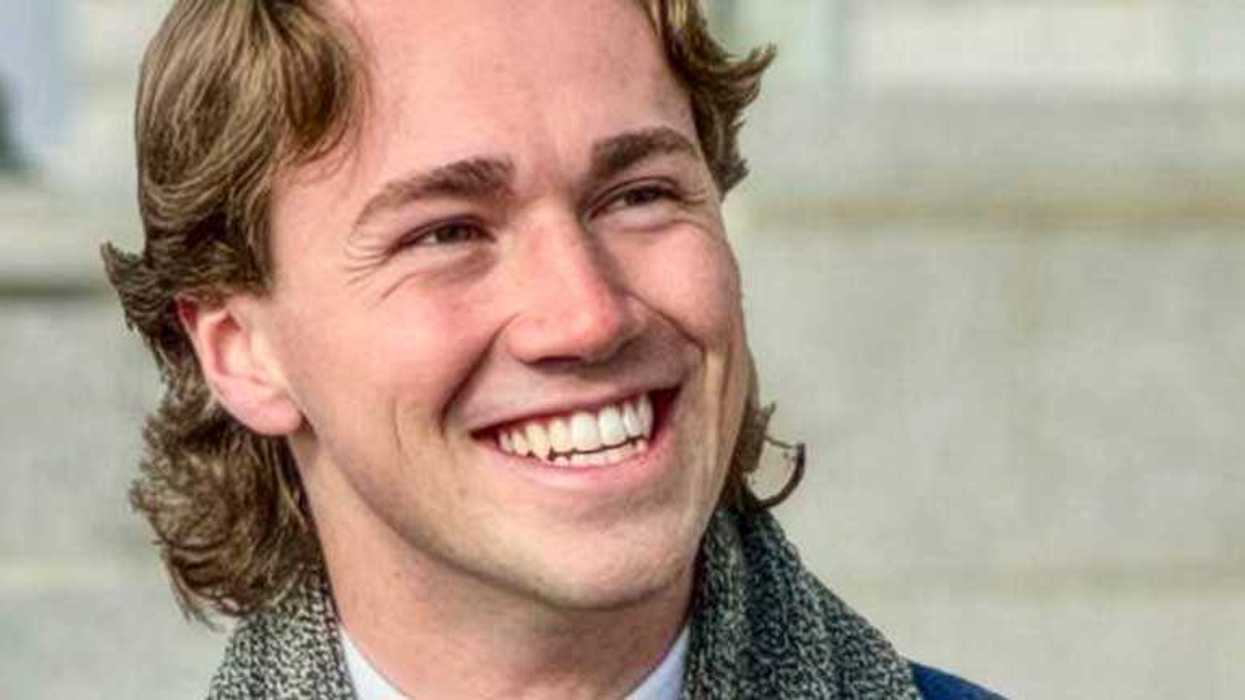
Kai Schwemmer, who has been given the title of confidential administrative associate to the Utah County clerk. (Photo courtesy of Kai Schwemmer)

June 19, 2026 | 

A longtime fixture in local government, Lorene Kamalu’s seen controversy come and go. But she was shocked last week to learn that the newest elections officer in the state was a young conservative influencer who’s described himself as “anti-universal suffrage” and declared “women generally do not have what it takes to endure the pressures of a public office.”

Kamalu, a Republican running for a third term as Davis County commissioner, recalled thinking, “How could this be happening in this day and age? How could this be happening, you know, in the U.S., in very important elected offices? And then, how in the world is this happening in Utah?”

Kamalu is among dozens of women in elected office who signed an open letter calling for “trust, professionalism and equal respect in Utah County elections” after 23-year-old Kai Schwemmer was named deputy county clerk, despite his remarks about women and lack of experience running elections. Other critics vented their frustration at a public meeting last week.

In response to the outcry, Utah County Clerk Aaron Davidson gave Schwemmer a new title this week of confidential administrative associate. In a job description posted Tuesday on the county’s website, Davidson listed the role’s functions as those of “a project manager, external liaison, and key representative,” as well as a personal assistant to the clerk. He has said the position would be temporary but did not give a timeline in the document.

Schwemmer, a student at Brigham Young University and officer in the College Republicans of America, said he’s happy about the change in job description. He told Utah News Dispatch the new role “probably more accurately reflects where I should be, than the chief deputy position.”

Schwemmer streamed for years on a platform founded by white nationalist Nick Fuentes and made remarks in that time criticized as racist and antisemitic, but distanced himself Thursday from those comments and his statement on women in office.

“I do believe fundamentally that every single one of us was made in the image of a loving Heavenly Father,” Schwemmer said. He went on to add that “any idea of, you know, hating a person or believing that they are less than, because of some immutable characteristic, is fundamentally — it fundamentally is incongruent with what is most important to my worldview.”

Schwemmer told Utah News Dispatch he’s not a “groyper” — the term for followers of Fuentes, who’s called for the U.S. to be a white, Christian nation. Schwemmer said that’s not a vision he has for the country. Asked to spell out how his views align or diverge with Fuentes, he said, “I don’t think that’s a productive way of discussing political alignment.”

The duties of his revised role include working on long-term planning and managing the budget, the description says. But unlike the previous title of chief deputy, the new job does not make Schwemmer the default to take over as top elections official in the event the clerk has to step away for one of many reasons, said Utah County Commissioner Amelia Powers Gardner, an author of the letter and the county’s former elections clerk.

Powers Gardner called the revised role “much more appropriate,” saying in an interview that “I’m going to take the win that at least he’s not in an authoritative position now.”

When it comes to women in leadership, Powers Gardner noted “the community that he enjoys today is being run by dozens of us.”

In response to a comment in November from former Georgia Rep. Marjorie Taylor Greene, a Republican who resigned from office after breaking with President Donald Trump, Schwemmer said on the social media site X that “women generally do not have what it takes to endure the pressures of a public office and this is a perfect example.Hey Marg, literally everyone on the internet with any clout gets death threats, you’re not a special case.”

Schwemmer said Thursday he was frustrated with Greene for stepping down when he wrote the post and “it kind of sucks whenever I see somebody taking it to mean that there are no women who can lead effectively or anything like that.”

He told Utah News Dispatch that he’s “had the opportunity in the last year and a half here in Utah, being more active locally, to get to know some truly incredible and very strong and fierce women who are fighting for issues that I think are really important, and I would happily trade dozens of men for a single one of them, so that would be my big thing.”

Statewide, more Utah women are serving in government, with an increase in the state Legislature driven by a growing number of Republican women, according to the Utah Women & Leadership Project.


Davidson, the Utah County clerk, has said he hired Schwemmer to better reach first-time voters whose ballots are sometimes rejected because their signatures look different than on their driver’s licenses.

“You’re making this a bigger issue than it should be,” Davidson told Utah News Dispatch on Wednesday. He said criticism of Schwemmer’s past statements has not considered enough of the context around those comments.

“This is an issue about reaching first-time voters. And you, the media, and these 80 women are politicizing it, and mainly because I’m running for office right now, and I’m trying not to delve into that,” Davidson continued. “I don’t want to address their letter, because I don’t want to sound like I’m using my position to advocate for me running for office.”

He said Schwemmer, in his work for the county, is getting in touch with schools and other institutions in hopes of trying to reach young voters of all stripes and educate them so their ballots get counted.


“He is committed that he is not going to politicize it at all and make it a female-male issue,” Davidson said. “This is a first-time voter issue, and that is it.”

Davidson faces a challenge in the race for Utah County clerk from fellow Republican Corey Astill.

Schwemmer, for his part, said in a statement laying out his commitment to residents of the county that he has two priorities: “ensuring that voter outreach remains nonpartisan in principle and practice, as well as improving ballot validation rates among young voters.”

Provo Mayor Marsha Judkins, also a former state lawmaker and signer of the open letter, noted social media algorithms reward high engagement, creating extra incentive to make inflammatory posts.


“Kai is young,” Judkins said. “His brain has not fully developed. His frontal lobe still has time, right? I’m hoping in 10 years, 20 years, he’s going to look back on this and think, ‘what was I doing?’”

Still, she said, Schwemmer espouses views “that are hurtful and harmful, that denigrate and degrade over half the population. I just don’t see that there should be a role for that person in government.”
'Like we’re under occupation': Tourists aghast at Trump’s ugliest obsession

U.S. President Donald Trump looks on during a press briefing at the White House, on the one-year mark into his second term in office, in Washington, D.C., U.S., January 20, 2026. REUTERS Nathan Howard
June 20, 2026
ALTERNET

Visitors touring Washington D.C. cannot seem to shake off the feeling that President Donald Trump is stamping his presence on every nook and crevice — and they’re furious.

Speaking with city visitors Julie and husband Robert on the edge of Lafayette Square, the Guardian noted a scuffed sign proclaiming: “We are making DC safe and beautiful.”

But Julie didn’t see it that way while visiting the city in celebration of her recent marriage, said the Guardian.

“The irony,” she said, spying the chain-link fence surrounded the square, closing the site off from the public for renovation under the Trump’s orders. “It’s neither safe, nor beautiful.”\

Local preservationists say Julie’s “withering verdict is widely shared.”

“It is a different city right now,” said Rebecca Miller, executive director of the DC Preservation League, a city heritage group. “There are visitors from out of town who are disappointed that they’re only here for a few days, and there’s so much construction going on at the moment. … This is a once-in-a-lifetime trip for some people, and to have it marred down with not being able to access certain sites can be really disappointing.”

Trump ordered the East Wing of the White House demolished to make way for a massive ballroom, leaving a $600 million bill and a colossal gash in the dirt where once sat a pristine wing occupied by First Ladies advocating for women’s and minority rights, as well as national preservation projects, among other noble ventures.

The administration also commissioned a laughable “restoration” of the Lincoln Memorial reflecting pool on the National Mall. By Saturday the “waterproof” American Flag Blue-tinted sealant was peeling up in huge blue mats of floating plastic and being collected by tourists as souvenirs of Trump-style efficiency.

Trump’s no-bid renovation for the project cost taxpayers more than $14 million—about seven times the cost of a competitor’s estimate.

Impenetrable construction barriers and cranes scratch the rest of the local tourist scenery with dozens of Trump-related projects underway, complete with dust, steel beams and overturned lumps of deep gray dirt.

“Scenes of visitors like Robert and Julie squinting for a better view have become commonplace,” as Trump micromanages city construction in connection to his personal birthday and the birthday of the nation, said the Guardian.

“Everything that I’ve seen is to honor Donald Trump, not America’s 250th anniversary,” said Robert, a retired US history professor at a private college in Brooklyn. “ … “We have the irony of a man who has the instincts of an absolute monarch presiding over the celebration of our separation from a constitutional monarch. It’s quite something.”

“I’ve been here many times before, and I have never imagined that I would be so completely locked out of everything,” said Angie Clark, a molecular biologist from Salt Lake City. “It feels exclusive, and not in a good way. Maybe once the party starts up, it will be better.”

“It’s so symbolic of what he’s doing to the country. It’s like he’s s—— all over our nation’s capital,” said Tampa author Norma Roth, spying a line of nearby ugly Porta Potties connected to Trump’s June 14 Ultimate Fighting Championship (UFC) game. “… It’s like we are under occupation.”
‘Trillion-Dollar Scam’: Lawmakers Demand Halt to Trump’s Golden Dome Boondoggle

“Trump’s dangerous... boondoggle will not protect Americans. It’s just a giveaway to defense contractor buddies like Elon Musk,” said US Sen. Ed Markey.


President Donald Trump speaks in front of a map of the proposed “Golden Dome” missile defense system in the Oval Office at the White House on May 20, 2025 in Washington, DC.
(Photo by Chip Somodevilla/Getty Images)


Brad Reed
Jun 18, 2026
COMMON DREAMS

Democratic lawmakers are taking aim at President Donald Trump’s proposed “Golden Dome” missile defense system, which the Congressional Budget Office projected last month would cost $1.2 trillion to create, deploy, and operate over the first 20 years of its existence.

Ten members of Congress, led by Sens. Ed Markey (D-Mass.) and Jeff Merkley (D-Ore.) and Reps. John Garamendi (D-Calif.) and Don Beyer (D-Va.), sent a letter to US Defense Secretary Pete Hegseth on Wednesday demanding information on the proposed project’s cost to taxpayers and its projected effectiveness.

The letter begins by noting that officials working on the Golden Dome still have not shared key details about the project with the CBO, which the independent agency said has made it “impossible to estimate the long-term cost” of the system.

“It is one thing to withhold design details or performance specifications of certain systems,” the letter says, “but it is quite another to withhold the entire system architecture that you expect Congress to approve and fund. Congress and the American public have a right to know what they are paying for.”

The letter says that transparency about the system’s architecture is particularly important given the questions that have been raised about how successful it would be at halting missile attacks. This is especially true, the letter emphasized, given the administration’s insistence that the true cost of the system will be less than one-fifth of the CBO’s projections.

“Simply put, there is no way that a Golden Dome system that costs $185 billion could possibly live up to the promise of ‘forever ending the missile threat to the American homeland,’” the letter states. “According to CBO’s calculations, even a system that would cost $3 trillion would not meet that ambitious goal, which would need to be able to engage hundreds of missiles. If the administration has not scaled back its goals for the system, the current official price tag is woefully unrealistic.”

The letter concludes by asking several questions about the project, including the administration’s estimated 20-year cost, the type of system architecture being planned, and the anticipated responses to the missile shield from rival nations including China and Russia.

“We urge you to halt this dangerous plan,” the letter says, “and return to the more limited missile defense policies that have earned bipartisan support in the past.”

In a separate social media post, Markey pointed out that the project is being used to funnel money to administration allies such as SpaceX CEO Elon Musk, who last week became the world’s first trillionaire and is promoting racist far-right political parties throughout the world.

“Trump’s dangerous $1.2 trillion ‘Golden Dome’ boondoggle will not protect Americans,” Markey wrote. “It’s just a giveaway to defense contractor buddies like Elon Musk. We’re demanding answers from Hegseth on Trump’s trillion-dollar scam.”


‘They Get Rich. Maine Pays the Price’: Platner Campaign Takes Swing at Collins and Corporate Lobbyist Husband

The campaign highlighted findings that the lobbying firm run by Collins’ husband brought in $76 million in federal contracts while she pushed K Street-friendly legislation in the Senate.


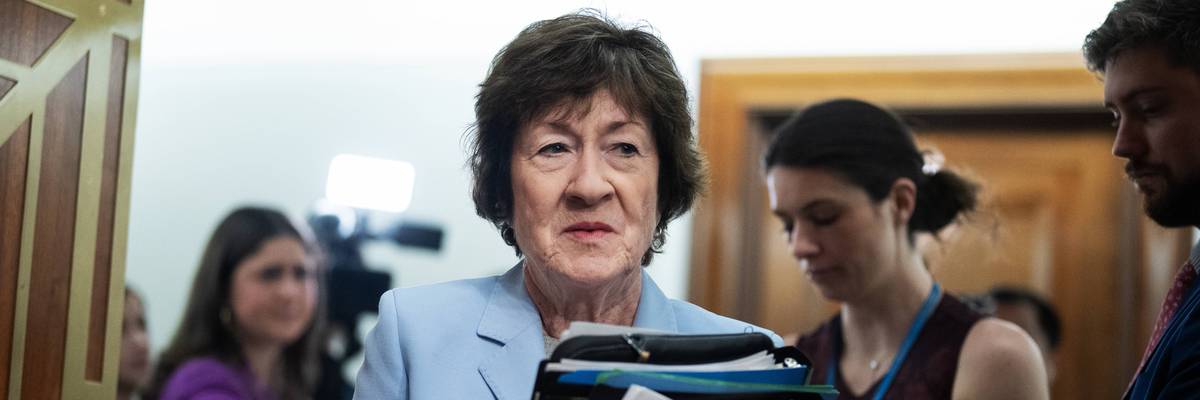
Sen. Susan Collins (R-Maine) arrives for a markup session in Washington, DC on June 17, 2026.
(Photo by Tom Williams/CQ-Roll Call, Inc. via Getty Images)

Stephen Prager
Jun 17, 2026
COMMON DREAMS

Democratic Senate nominee Graham Platner’s campaign is taking aim at Sen. Susan Collins and her lobbyist husband, calling her long history of supporting policies that helped his firm “the biggest political scandal in Maine” in an ad released Wednesday.

It follows a report out the previous day from Zeteo revealing that Collins’ husband, Tom Daffron, worked as recently as last year for a firm owned by Scott Reed, the lobbyist who leads Pine Tree Results, a billionaire-funded super political action committee (PAC) that is spending millions to support Collins’ (R-Maine) campaign for reelection.

While not necessarily a violation of the law, which prohibits super PACs from coordinating with the campaigns they support, the Platner campaign described Daffron’s lobbying work as “only the latest example of the blurred lines between Collins, her husband, and the Washington insider network that has surrounded her political career for decades.”

Daffron’s activity as a Washington lobbyist stretches back more than two decades, before his marriage to Collins in 2012. In 2006, Daffron became the chief operating officer of the lobbying and consulting firm Jefferson Consulting Group.


A veteran of national Republican campaigns, he also served as a consultant on Collins’ 1996, 2002, and 2008 Senate bids, and ran her leadership PAC from 2003 until 2012. As far back as 2001, the Portland Press Herald described Daffron as “a close friend [of Collins] and one of the top advisers in her ‘kitchen cabinet.’

Platner’s ad accuses Collins of having overseen “over $76 million in taxpayer dollars to his company,” which the campaign has argued was due in part to contracting reform legislation she wrote, and which passed in 2008. That law was said to “improve the federal acquisition workforce,” an area in which Jefferson Consulting specialized.

The Platner campaign cited a 2020 article by Salon, which found that:
Between 2006 and 2016, Daffron’s firm landed more than $76 million spread across dozens of federal contracts related to acquisition and procurement, according to searches on USAspending.gov.

In 2010, Jefferson Consulting reported providing acquisitions services and support to nearly two dozen federal agencies. Certain specific provisions included with Collins’ 2007 contract reforms appear to have benefited Daffron’s firm directly, by adding new requirements for acquisition services that Jefferson specialized in.

The ad also highlights Collins’ role in voting against several ethics and transparency efforts that could have impacted firms like the one run by Daffron.

One amendment she voted against in 2006 would have required members of Congress to disclose when they or their staff were discussing a possible future private-sector role while serving in government. It would also have restricted lobbyists from giving gifts to lawmakers, such as free lunch or paying for travel or tickets to events.

In 2012, Collins helped to defeat another amendment that would have targeted the so-called “political intelligence” industry that profits from acquiring insider information and passing it on to investors, corporations, and other clients.


Platner has attacked Collins over her husband’s work in recent days, thundering before a crowd on the night of his primary victory last week that “Susan Collins has used her privilege to funnel... federal contracts to her lobbyist husband. If that’s not corruption, I don’t know what is.”

Collins has denied the accusation, saying “It’s just not true, and it’s obvious that Mr. Platner has a problem with the truth.”

Platner has also highlighted Collins’ own personal net worth, which had grown from just over $205,000 in 2011 to at least $4.3 million today, when including the estimated value of her stock holdings.

“Has anybody else gotten 21 times wealthier since Susan Collins was elected to office?” Platner asked last week. “Does Maine have 21 times the schools and hospitals? No, we have less.”

The ad continues to hammer on this theme of self-dealing, calling out that “Collins voted for new forever wars that gave billions to companies they invested in.“

“They made millions,” the ad states. “They get rich. Maine pays the price.”
Putting ‘Americans at Risk,’ 1-in-4 Trump Commerce Department Officials Have Glaring Conflicts of Interest: Analysis

“These seeming conflicts raise serious questions about whether these federal employees are beholden to the American people or to the interests of private for-profit corporations,” said one of the authors.


US Commerce Secretary Howard Lutnick talks on the phone as he walks across the White House grounds on April 8, 2026 in Washington, DC.
(Photo by Heather Diehl/Getty Images)

Stephen Prager
Jun 17, 2026
COMMON DREAMS

More than 1-in-4 senior appointees in President Donald Trump’s Department of Commerce have significant “conflicts of interest,” according to a report published on Wednesday, pointing to the same sort of corporate capture that is rampant across the administration.

The watchdog group Public Citizen reviewed financial disclosure forms for 112 senior officials in the department, which is dedicated to overseeing industry and economic growth. It found that at least 30 of them have substantial ties to the very industries that the department is tasked with regulating.

It’s a pattern seen across the Trump administration, where fossil fuel lobbyists and insiders dominate the Energy and Interior departments, as well as the Environmental Protection Agency.

But as the new report, written by journalist Zach Everson and researcher Douglas S. Pasternak, explains, the Commerce Department is “unique in its active engagement in the economy to benefit particular companies, including those for whom its current officials once worked.”

“The conflicts of interest identified in this report put Americans at risk,” said Pasternak, the research director for Public Citizen’s Trump Accountability Project.

The entanglements start at the top, with the billionaire Commerce Secretary Howard Lutnick, who has ties to more than 800 different businesses from his decades as the CEO of the Wall Street financial services firm Cantor Fitzgerald, with interests spanning finance, real estate, crypto, AI, tech, satellites, energy, and gaming—many of which could be affected by Commerce policy.

While Lutnick promised to sell his business interests within 90 days of being confirmed at the department, he missed that deadline by more than four months. And instead of putting his financial stake into a blind trust, he sold his interest in the fund to trusts benefiting his four children.

As Commerce Secretary, Lutnick has engaged in actions that the report says “have a clear conflict with his family’s financial interests and appear to violate ethical norms for government employees.”

In particular, it highlights his role in pushing for the dramatic expansion of artificial intelligence data centers across the US, and pressured other governments, including that of the United Arab Emirates, to invest in them.

At the same time, his former company, Newmark, where his son now sits on the board of directors, has facilitated more than $25 billion in AI-data center deals.

Similarly, Commerce invested over $1.6 billion in the mineral company USA Rare Earth Inc. while Cantor was leading the company’s private fundraising.

Lutnick has also been at the center of the Trump administration’s efforts to promote cryptocurrency and develop regulatory policy around it. This could impact the blockchain platform Tether, which hosts the world’s largest stablecoin, for which Cantor acts as the primary custodian for more than $180 billion worth of reserves.

Beyond Lutnick, the department is crawling with ex-industry employees, lobbyists, and corporate lawyers now embedded in the regulation of their former clients.

Joyce Meyer, formerly a top lobbyist for the life insurance industry, now serves as undersecretary for economic affairs, where she oversees the Bureau of Economic Analysis and the US Census Bureau, which produce economic reports that shape federal tax, interest, and spending policy.

The current undersecretary for industry and security, Jeffrey Kessler—who oversees export controls on technology, software, commodities, and other equipment—previously worked as an attorney for the law firm WilmerHale, where he represented dozens of clients across industries he now regulates, including Boeing, Meta, and Eli Lilly.

One of the people in charge of regulating the sale of defense technology abroad, Joe Bartlett, who serves as deputy undersecretary at the Bureau of Industry and Security, came from one of the US military’s biggest drone makers, Skydio, which is subject to BIS export controls.

The report also identifies multiple other employees who have worked for weather data companies that have pushed to privatize forecasts now provided for free by the National Oceanic and Atmospheric Administration.

“It is unclear if these officials are serving the American public as their positions require or attempting to enrich their former employers or potential future employers, and ultimately themselves,” Pasternak said. “These seeming conflicts raise serious questions about whether these federal employees are beholden to the American people or to the interests of private for-profit corporations.”

Everson added that the department “is meant to work in the interest of the people, not in the interest of a few select billionaires.”

He said, “Political appointees within the Trump administration need to be subject to standards of ethical and financial conduct which prevent them from using their positions of power to skim off the top.”
Real Fight With Oligarchy Begins as Billionaires Tax Qualifies for Ballot in California

“David won the second round against Goliath, but healthcare workers and our allies won’t quit until we protect patients from the looming California healthcare collapse manufactured by Trump and Congress.”


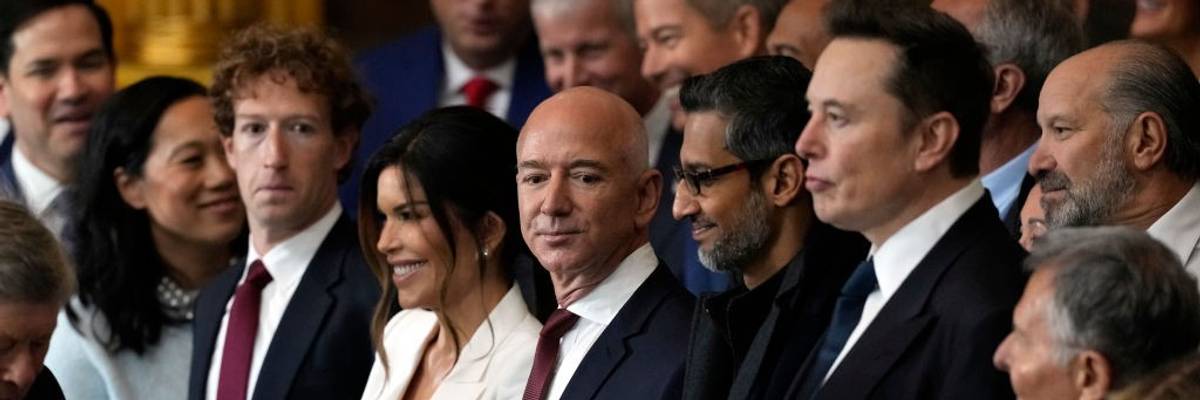
Guests including Mark Zuckerberg, Lauren Sanchez, Jeff Bezos, Sundar Pichai, and Elon Musk attend the Inauguration of Donald J. Trump in the U.S. Capitol Rotunda on January 20, 2025 in Washington DC
(Photo by Julia Demaree Nikhinson - Pool/Getty Images)


Brad Reed
Jun 18, 2026
COMMON DREAMS

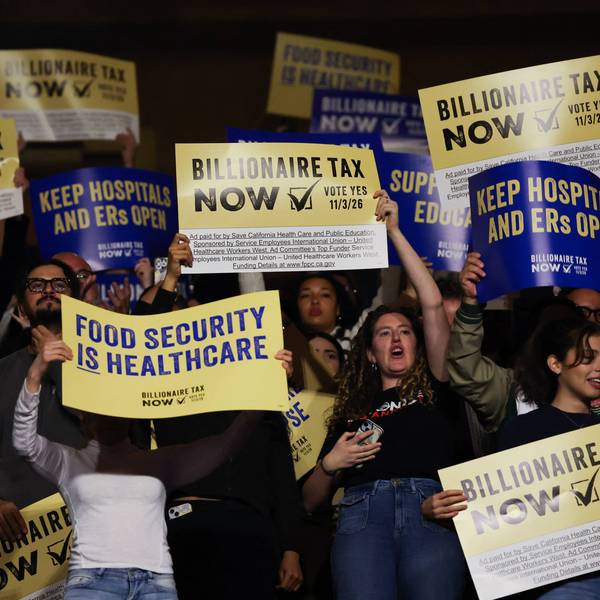
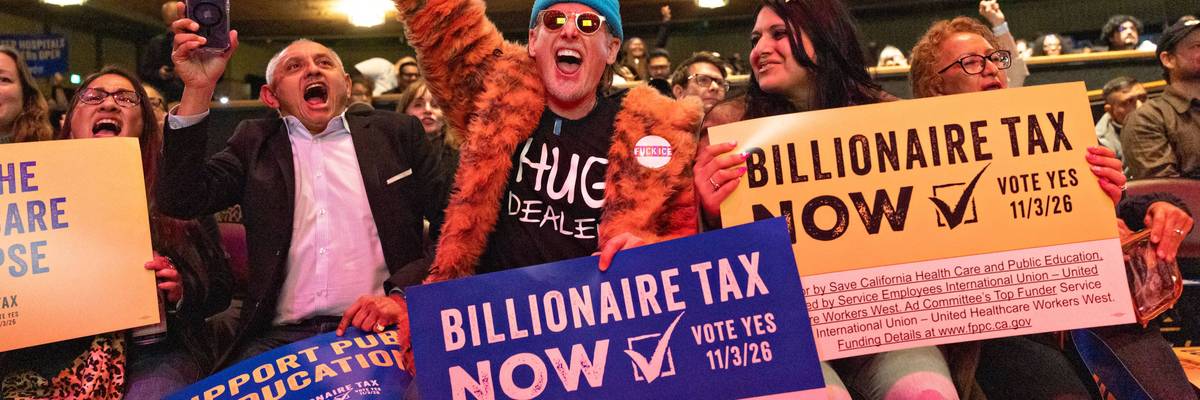
Advocates of a plan to tax California billionaires were celebrating Thursday following confirmation from California Secretary of State Shirley Weber that the proposal had gathered enough signatures to appear as a ballot initiative this November.

Weber revealed late Wednesday that proponents of the California Billionaire Tax Act had gathered more than the 875,000 signatures needed, reaching the benchmark ahead of June 25 deadline.


The proposed tax, which has drawn opposition from Democratic California Gov. Gavin Newsom and support from Sen. Bernie Sanders (I-Vt.), will hit the state’s billionaires with a one-time 5% wealth tax that proponents say will be used to fund local hospitals, food aid, and public education.

Proponents of the tax have called it necessary to make up for budget shortfalls created by the One Big Beautiful Bill Act, the 2025 Republican budget law that slashed spending on Medicaid and the Supplemental Nutrition Assistance Program (SNAP).

Debru Carthan, a spokeswoman for the Billionaire Tax Now Coalition, said on Thursday that getting the proposed tax on the ballot puts the state “one step closer to saving the hospitals and emergency rooms that we all rely on” and that are being endangered by cuts imposed by the GOP law.

“With today’s news, David won the second round against Goliath,” added Carthan, “but healthcare workers and our allies won’t quit until we protect patients from the looming California healthcare collapse manufactured by Trump and Congress.”

A poll of California voters conducted in March by the University of California, Berkeley found that the proposed billionaire tax is broadly popular, with support outweighing opposition by a roughly two-to-one ratio.

An analysis by the Institute on Taxation and Economic Policy estimates that the tax will raise $100 billion in revenue over the next five years, which would be enough to fill the hole in California’s state budget caused by the GOP cuts.


‘Unlikely Bedfellows’: Left-Leaning Groups Join Newsom-Backed Effort to Sink California Billionaire Tax

“This is not going to be, ‘Billionaires killed this wealth tax’ if it appears on the November ballot,” said Newsom’s chief of staff. “It’s going to be Planned Parenthood, doctors, teachers, and labor killed it.”


Supporters rally for the California Billionaire Tax in Los Angeles on February 18, 2026 in Los Angeles, CA.
(Photo by Jason Armond/Los Angeles Times via Getty Images)

Brett Wilkins
Jun 17, 2026

It comes as no shock that Silicon Valley oligarchs and other plutocrats are trying to keep a proposed billionaire tax backed by California governor and presumptive Democratic presidential aspirant Gavin Newsom off November’s ballot. But the participation of progressive groups as “unlikely bedfellows” in the effort to kill the wealth tax has surprised many observers.

Introduced by the Service Employees International Union-United Healthcare Workers West (SEIU-UHW), the California Billionaire Tax would impose a one-time 5% levy on people worth $1 billion or more, to be paid in annual installments of 1% over five years. Proponents say the tax would raise roughly $100 billion in revenue.

The proposal requires the state to spend 90% of revenue from the tax on healthcare and the rest on food assistance and public education. Opponents counter it could drive wealthy residents and investment from California.

Supporters of the billionaire tax have submitted more than 1.5 million signatures, far more than the roughly 875,000 valid signatures required to qualify for November’s ballot. The signatures are still being verified, and the office of California Secretary of State Shirley Weber has until June 25, 2026 to determine whether the initiative qualifies.

The measure is backed by numerous progressive groups including the Teamsters union, California Democratic Socialists of America (DSA), and Our Revolution, as well as individual progressives like Sen. Bernie Sanders (I-Vt.), Rep. Ro Khanna (D-Calif.), and Democratic congressional candidate Connie Chan, who is running to replace retiring longtime San Francisco congresswoman Nancy Pelosi.

However, opponents are trying to stop the proposal from qualifying for the ballot, while preparing for a fight in the likely event that it does.

Newsom, the California Democratic Party, and a growing list of groups—including the California Teachers Association (CTA), Planned Parenthood Affiliates of California (PPAC), and the State Building and Construction Trades Council of California—are publicly opposing the tax and are urging SEIU-UHW to pull the proposal before June 25.

Republicans, the California Chamber of Commerce, and other capitalist interests oppose the billionaire tax, as do both candidates for California governor, Democrat Xavier Becerra and Republican Steve Hilton, and Chan’s opponent in the San Francisco congressional race, state Sen. Scott Wiener (D-11).

Newsom said that the proposed tax “makes no sense” and would be “really damaging to the state.”

CTA argues that the tax is a one-time revenue source, while California schools and healthcare programs need permanent, recurring funding. To that end, the union is backing a separate ballot measure—the Children’s Education and Health Care Protection Act—which would permanently extend Proposition 55, California’s existing high-income-earner tax, set to expire in 2030.

Jodi Hicks, PPAC’s president, recently said that the California Billionaire Tax’s “uncertain impacts on the state budget and lack of specificity on healthcare allocations will do more harm than good in the long term.”

PPAC and aligned groups including California Medical Association and California Primary Care Association also support extending Prop 55.

Meanwhile, tech billionaires and Silicon Valley executives—including Google co-founder Sergey Brin, former Google CEO Eric Schmidt, PayPal and Palantir co-founder Peter Thiel, and Ripple co-founder Chris Larsen—have raised tens of millions of dollars for Building a Better California, a political action committee dedicated to defeating the proposed tax at the ballot box.

Building a Better California is also backing separate initiatives designed to weaken or nullify the billionaire tax, including a ban on retroactive wealth taxation, restrictions on how any new tax revenue can be allocated, and the imposition of new auditing requirements.

Newsom and his allies have a useful weapon to deflect claims that he’s helping billionaires who are trying to defeat the proposed tax.

“This is not going to be, ‘Billionaires killed this wealth tax’ if it appears on the November ballot,” Nathan Barankin, Newsom’s chief of staff, told The New York Times Wednesday. “It’s going to be Planned Parenthood, doctors, teachers, and labor killed it.”

SEIU-UHW accused opponents of the proposed tax of “carrying water for a few of the world’s most controversial billionaires.”

“Their complicity with billionaires at the expense of patient interests is no surprise,” SEIU-UHW chief of staff Suzanne Jimenez told the Times.