Thursday, June 25, 2026


40 years on, Maradona’s ‘Hand of God’ goal is still celebrated. But should it be?
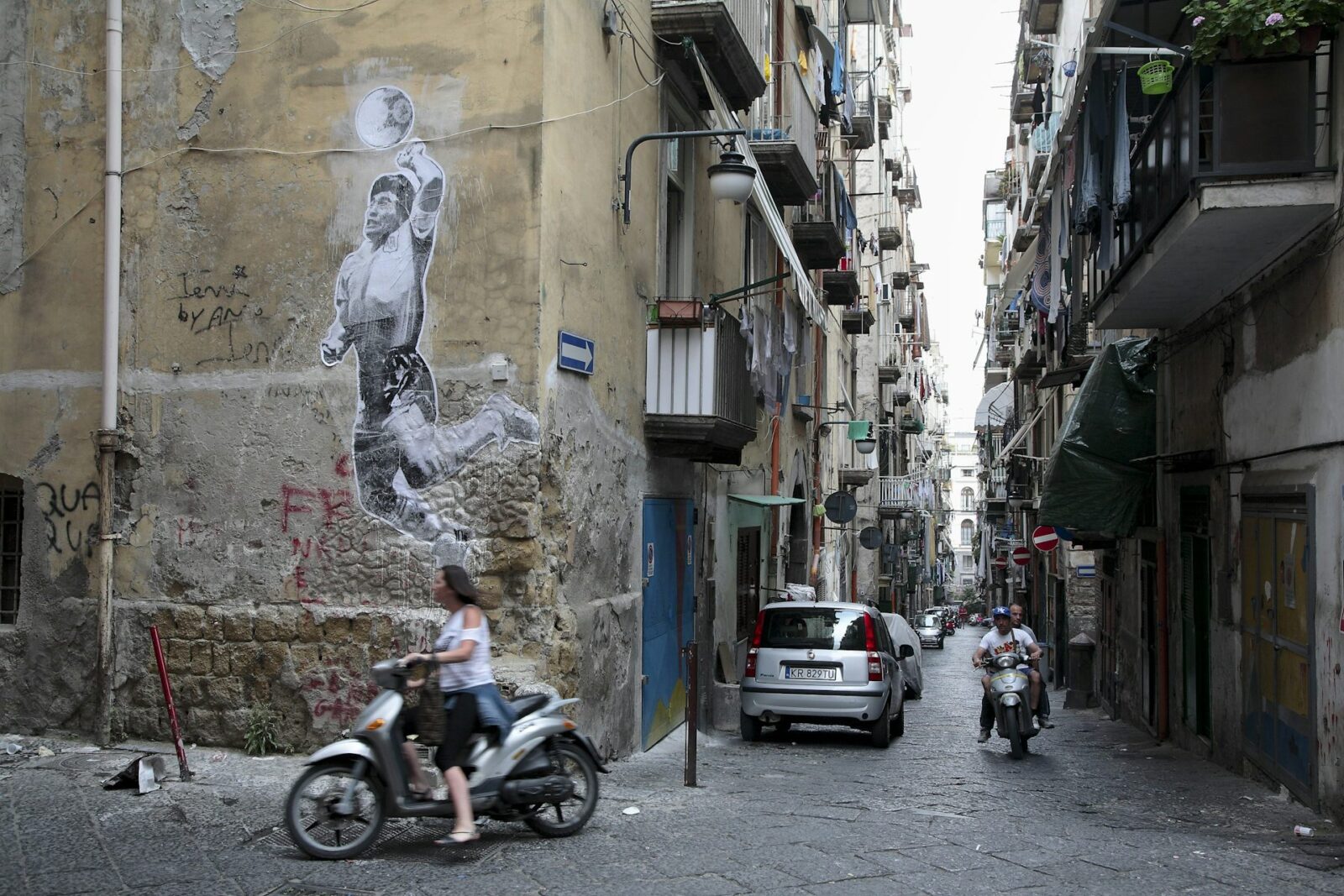
(The Conversation) — A philosopher of sport guides readers through the ethics of Diego Maradona’s most celebrated goal – and his most controversial.
A mural by Argentine artist Spiga depicts Maradona's "Hand of God" goal in Naples. (Alessio Paduano/Anadolu Agency/Getty Images)

(The Conversation) — In soccer, memorable goals are generally linked to the players who scored them. Few can be recalled without mention of the individual – or even the team – involved.

Yet, two goals in one game 40 years ago have attained that status. One is known universally as the “Hand of God,” and the other is widely acknowledged as the “Goal of the Century.” Both were scored by Argentine star Diego Maradona against England in the quarterfinal of the FIFA World Cup at Mexico City’s Azteca Stadium on June 22, 1986.
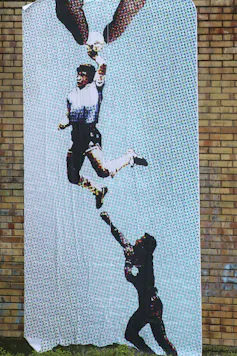
A large poster shows a man punching a ball being lifted.

A poster depicting the ‘Hand of God’ goal outside the Stadio Diego Armando Maradona in Naples. (
Antonio Balasco/Kontrolab/LightRocket via Getty Images

The goals, scored just minutes apart, are among a handful that are immediately recognized decades later – and they hold special resonance in Argentina. Their perceived importance was such that when in 2012 Argentine President Cristina Fernández de Kirchner inaugurated a “Gallery of Popular Idols” at Casa Rosada, the country’s presidential palace, the exhibit included photos of both goals.

But it was the “Hand of God” that stood out, with the iconic capture of Maradona’s outstretched arm punching the ball over England goalkeeper Peter Shilton placed front and center, jumping out at visitors.

A year after the Gallery of Popular Idols was installed, I toured it with a group of international college students from a study-abroad program led by my wife. Knowing that I was a philosopher of sport, members of the group asked me an ethical question: Why was a goal scored illegally – it should have been disallowed as an obvious handball – given such prominence in the presidential palace? The same could be asked of the place it holds in the Argentine consciousness now, with the image common in murals, T-shirts and in songs.
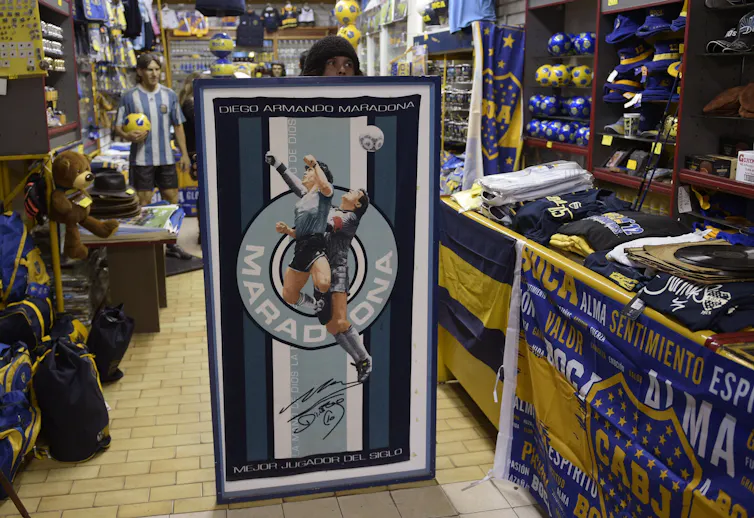
A shop worker holds a large towel.

A vendor holds a collectable towel featuring Diego Maradona’s ‘Hand of God’ goal at a sport shop in Buenos Aires.
Juan Mabromata/AFP via Getty Images

As I explained to the students, to understand why that game and those goals by Maradona – of the 34 he scored for the national team – have become so entrenched in the Argentine imagination, it is necessary to reflect on the complex history of Anglo-Argentine relations.

Anglo-Argentine relations

From the late 16th century onward, Britain sought to expand its empire into South America, mainly to expand the markets for its products elsewhere.

After failed attempts to invade Buenos Aires in 1806 and 1807, Britain played a key role in Argentina’s independence from Spain a few years later. Throughout the rest of the 19th century and the early 20th century, Britain had a major presence in the Argentine economy. So large was the investment and so numerous the British expatriate community that Argentina was described as Britain’s “Sixth Dominion.” Soccer, by way of this community, became a consuming passion of Argentines, too.

Still, the relationship was at times antagonistic. A long-running point of contention was over a group of islands 300 miles off the South American coast, known as the Falkland Islands in the United Kingdom and Islas Malvinas in Argentina.

Britain has occupied the islands since 1833, and Argentina has claimed them as its own ever since. Building tension gave way to war in 1982, when Argentina, then under a brutal dictatorship, sent a military expedition to the islands.
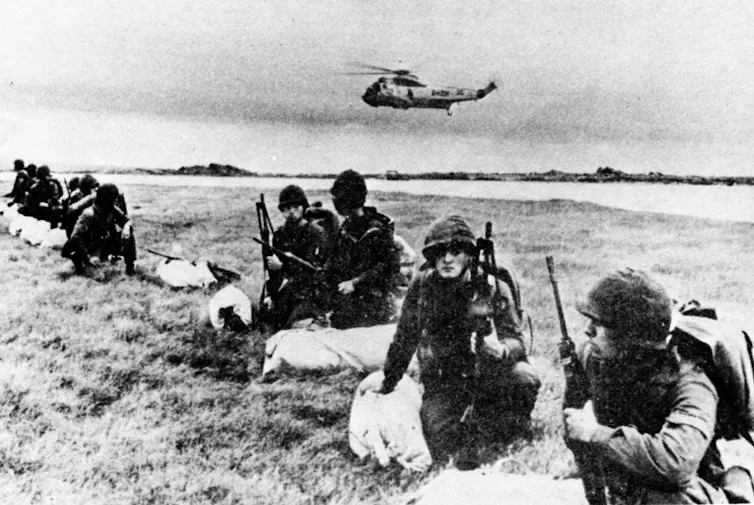
Soldiers in uniform are on a beach with a helicopter in the background.

Argentine soldiers land from a Sea King helicopter not far from Puerto Argentino/Port Stanley in the Malvinas/Falkland Islands.
Fireshot Studio/Fototeca/Universal Images Group via Getty Images

Britain’s decisive response shattered the Argentine foray. Losing the war was a traumatic experience for Argentina, but one that proved an important step in the country’s eventual return to democratic rule the following year.

Maradona’s World Cup

Relations between the two countries were still tense when Argentina and England faced off during the 1986 World Cup. Diplomatic ties had not yet resumed, and many in Argentina perceived the game as an opportunity to honor the conscripts who died in the war and remind the world of the country’s claim to the Malvinas/Falkland Islands.

It was a game charged with intricate political and historical connotations. And Argentina entered it with the greatest player of the age in Diego Maradona.

As Eduardo Galeano, known as soccer’s global poet laureate, wrote in 1995: Mexico ’86 “was Maradona’s World Cup.”

“With two lefty goals against England, Maradona avenged the wound to his country’s pride inflicted in the [Malvinas/]Falklands war: the first he converted with his left hand … and the other with his left foot, after having sent the English defenders to the ground,” Galeano noted.

In the space of just five minutes, Maradona lifted his nation and was elevated to the status of an idol among idols. After the game, as controversy over the first goal swirled, Maradona, following the cue of a journalist, agreed that it must have been scored by the “Hand of God.”

While the second goal was the incarnation of soccer beauty, the imagery surrounding the first made it equally if not more iconic.

That Argentina went on to win the championship only added to Maradona’s imperishable repute, no matter what he did. His death on Nov. 25, 2020, triggered a wave of mourning in Argentina and around the world.

All that is good in the game

Back at the presidential palace, the students pressed me about how I and others should feel about the “Hand of God.” My answer, echoing philosophical arguments I made in a chapter I wrote for a book co-edited with philosopher Daniel G. Campos, went as follows.

Context matters for understanding the meaning that many in Argentina ascribed to that goal. Nonetheless, context cannot justify it.

Soccer is a social practice regulated by rules and what philosophers call “internal goods” – intrinsic rewards that come from participating in an activity. Soccer’s internal goods not only define the game but also represent the foundation for its standards of excellence. They comprise what are known as “constitutive” and “restorative” skills that the sport is meant to test.

Constitutive skills are those implemented during open play and include dribbling, passing and shooting the ball, and opening up spaces. Restorative skills are employed when a game is interrupted and include the ability to take penalty and corner kicks, among others.

Because of its structure, in soccer these sets of skills are clearly related to different ways to control and strike the ball with one’s feet.

A soccer genius … and a case of cheating

Scoring goals with one’s hand is neither a constitutive nor a restorative skill of soccer. Instead, it is an “extra-lusory skill” – that is, one not meant to be tested and thus does not legitimately belong in the game.

In fact, scoring a goal with one’s hands contradicts and dishonors the internal goods that define soccer and its standards of excellence. In this sense, the “Hand of God” downgrades the competency by which players distinguish themselves.

Additionally, it is an unambiguous case of cheating. Maradona intentionally and surreptitiously violated a rule of the sport to obtain an advantage that he would not have obtained otherwise – it distorts the sport, spoils the result and disrespects the opposing team.

It should not, as such, be encouraged or celebrated. Rather, it should be condemned.

Worse, it draws attention away from the kind of play that Maradona, who was subjected to repeated fouling by the English players throughout the game, embodied in the second goal. Indeed, soccer is honored and flourishes with that kind of play.

Over the course of a 60-yard run, Maradona danced past opponents, escaped challenges and left English defenders helpless before beating the goalkeeper with a clinical finish. Journalist Brian Glanville described it in 1993 as “astounding, a goal so unusual, almost romantic.” He added: “It hardly belonged to so apparently rational and rationalized an era as ours.”

That goal is arguably the most celebrated goal in World Cup history.

Forty years after that epochal game between Argentina and England, I suggest that Argentina and the world of soccer should in one breath condemn the scandalous “Hand of God” and rejoice in the sublime “Goal of the Century” – while never forgetting the context in which the two goals occurred.

(Cesar R. Torres, Associate Professor of Kinesiology and Philosophy, Penn State. The views expressed in this commentary do not necessarily reflect those of Religion News Service.)

The Conversation


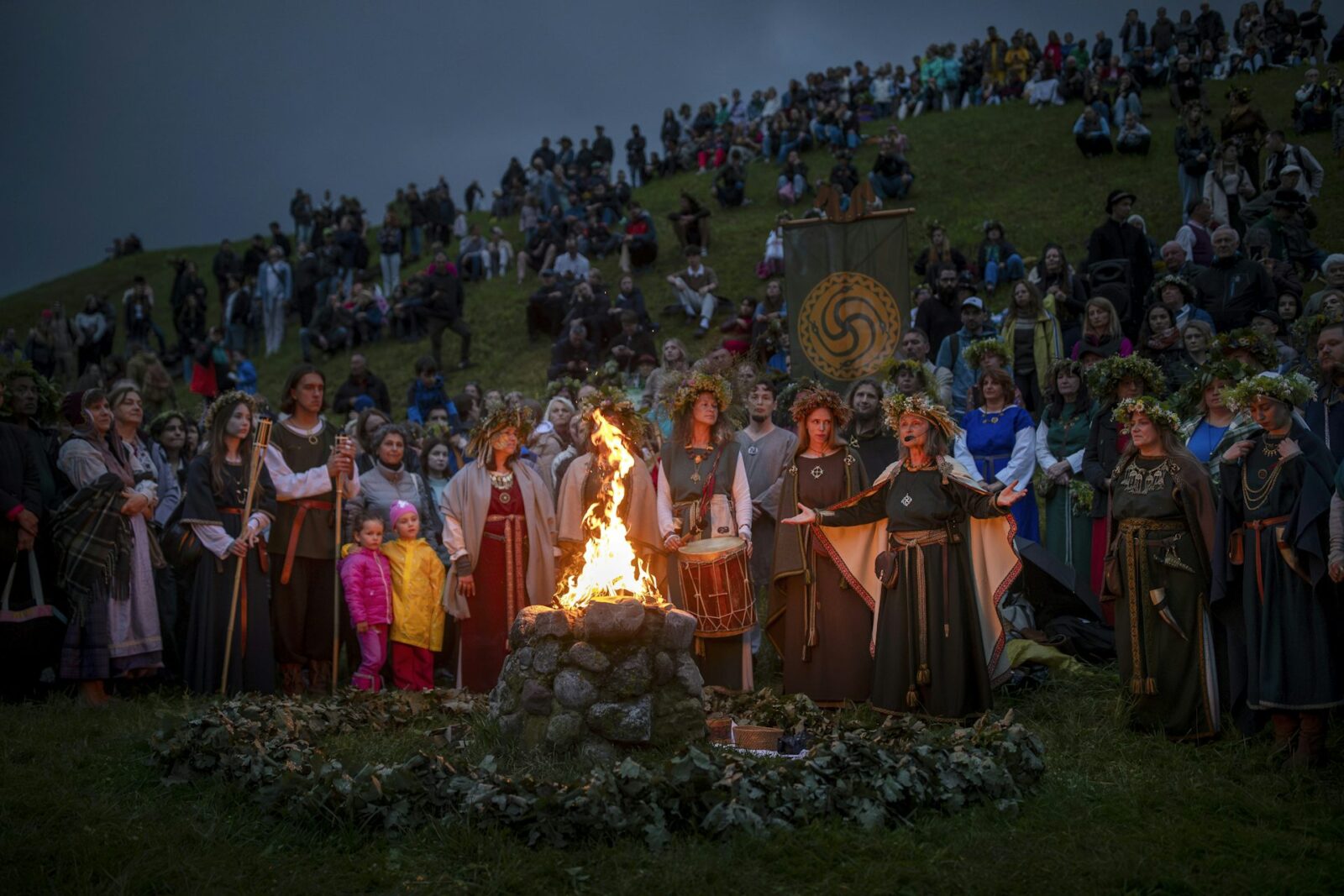
Bonfires, Maypoles and a saint’s day: How Europe celebrates the longest day of the year


(The Conversation) — Midsummer celebrations throughout Europe coincide with the solstice. Many blend pre-Christian and Christian traditions.
People wear traditional clothes as they celebrate St. John's Day and the summer solstice in Kernave, Lithuania, on June 23, 2024. (AP Photo/Mindaugas Kulbis)

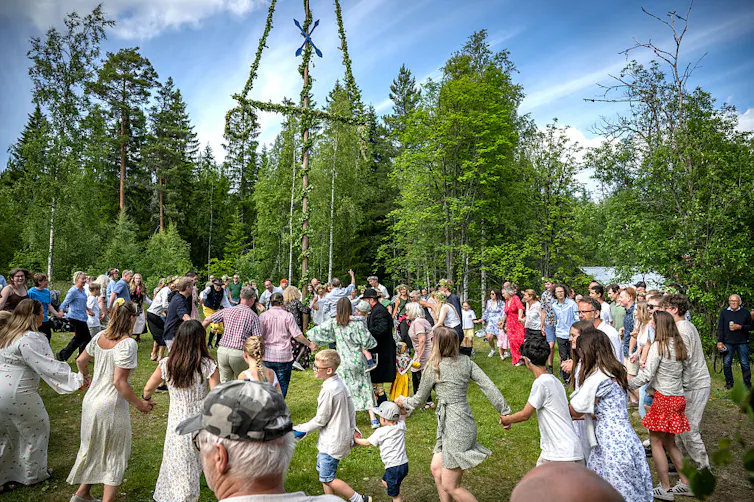
(The Conversation) — Whether cities or villages, many communities across Europe spend the day and night of June 24 celebrating Midsummer. Congregating around bonfires, or sometimes maypoles, sporting handwoven wreaths of wildflowers or oak leaves, they’ll sing, jump, dance, eat, drink, catch up and celebrate the arrival of the longest day of the year. As a scholar of folklore, I have been to Midsummer celebrations in Finland, Sweden, Norway, Denmark, Estonia and Lithuania, and I am endlessly in awe of people’s fervent commitment to the holiday and evident enjoyment of it.

From the Mediterranean to Scandinavia and from France to Poland and beyond, Midsummer goes by many names, including the Italian “Festa di San Giovanni Battista” and the Swedish “Midsommar.” It’s “Leedopäev” in Estonia, “Juhannus” in Finland, and “Mihcamárat” for the Sami, the Indigenous people of Scandinavia. Celebrations mark the summer solstice, which takes place in the Northern Hemisphere around June 21.

A large group of people holding hands dances in a circle outside around a large pole wound with greenery.

People gather for the traditional Midsummer celebrations in Gagnef, Sweden, on June 20, 2025.
Ulf Palm/TT News Agency/AFP via Getty Images

Each morning from the time of the winter solstice to the summer solstice, the sun rises a little farther to the north. As the sun climbs higher in the sky, shadows grow shorter and days grow longer. At the summer solstice, the Sun “stands still” – the meaning of the Latin solstice – and begins its progression back toward the south. Days shorten, shadows lengthen, and the cold and dreariness of winter return.

Europeans across the entire continent have noted this simple and inexorable cycle for millennia. Neolithic monuments such as Ireland’s Newgrange and England’s Stonehenge, both of which date from around 5,000 years ago, were built to mark solstices.

Lighting the bonfire

From the Mediterranean to the northern peripheries of Europe, the summer solstice has long been greeted as a time for rituals to gather luck, tell the future and ward off evil.

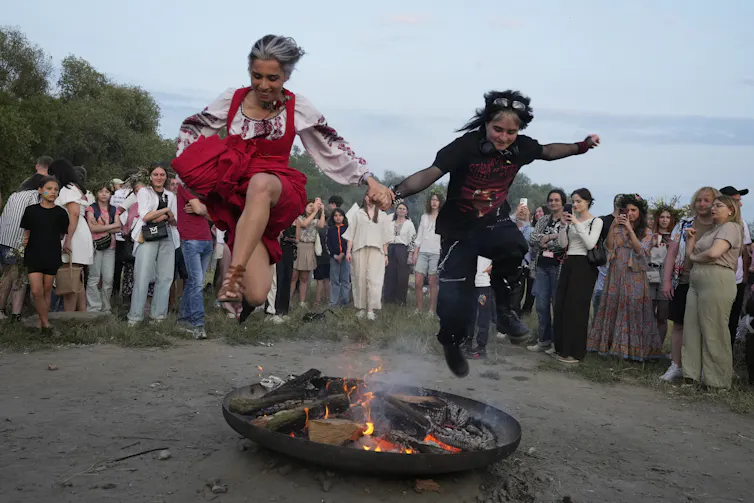
In Germany, northeastern France and many parts of Scandinavia and the Baltic, people still build elaborate bonfire pyres to light in the evening and tend long into the night. According to folk belief, stepping or leaping over the flames brings love and fertility, while the height of the flames predicts the coming year’s harvest.

Two women, one of whom is wearing a traditional red dress, hold hands as they leap over a small flame outside.

Ukrainians jump over fire during a celebration of Kupala Night, a Slavic midsummer festival, in Warsaw, Poland, on June 21, 2025.
AP Photo/Czarek Sokolowski

Traditionally, many Europeans gathered dew, herbs or leaves on Midsummer eve, which was reputed to ensure health, beauty and good fortune. Some brought their cattle close to bonfires to breathe in the smoke, or scattered fields with ashes the next day. Although people today generally regard these beliefs as quaint reminders of the past, often they avidly participate, just in case – tying them to forebears centuries or even millennia ago.

Pagan, Christian and secular

Many of the names for the holiday, such as the Danish “Sankt Hans Aften” or Icelandic “Jónsmessunótt,” are connected with John the Baptist, the Christian saint whose birthday is celebrated June 24. Where Jesus’ birth is commemorated around the time of the winter solstice, the Bible describes his cousin St. John being born precisely six months earlier, at the height of summer. The interest in this connection between Jesus and John explains why the holiday takes place on June 24 – or in some countries, on the nearest Saturday – rather than on the actual solstice.

Medieval Christian authorities did not always relish the “pagan” celebrations of the day and occasionally decried peasants’ dancing, singing and other customs. During the 16th century’s Protestant Reformation, celebrations of Catholic saints’ feast days were suppressed, but Midsummer lived on as a secular holiday.

In places where Protestants and Catholics overlapped, such as the Netherlands, celebrating St. John’s eve became an emblem of Catholic identity. The Feast of St. John is celebrated as the “fête nationale” of the Canadian province of Québec in part to differentiate the province from the culture of its English Protestant neighbors.

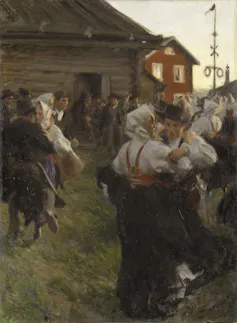
A scene of pairs of men and women dancing in a grassy area outside a wooden cabin.

Swedish painter Anders Zorn completed ‘Midsommardans’ in 1897.
National Museum of Sweden via Wikimedia Commons

One of the most iconic images of Swedish celebrations of the day, Anders Zorn’s 1897 painting “Midsommardans,” or “Midsummer Dance,” reflects 19th-century anxiety that beloved traditions would disappear. Zorn himself paid for the erection of the maypole depicted in his painting, seeking to preserve the picturesque custom in the region of rural Sweden where he lived.

Yet Zorn’s fears were unfounded. Much has changed, but Europeans remain appreciative of the simple and unchanging rhythms of the natural world, including the coming and passing of the season’s longest day.

(Thomas A. DuBois, Professor of Scandinavian Studies, Folklore, and Religious Studies, University of Wisconsin-Madison. The views expressed in this commentary do not necessarily reflect those of Religion News Service.)
Thousands Feared Dead After Back-to-Back Earthquakes Devastate Venezuela

One resident of Venezuela’s capital described the scene in her area as “like a horror movie” as rescue teams searched the rubble of collapsed buildings for survivors.


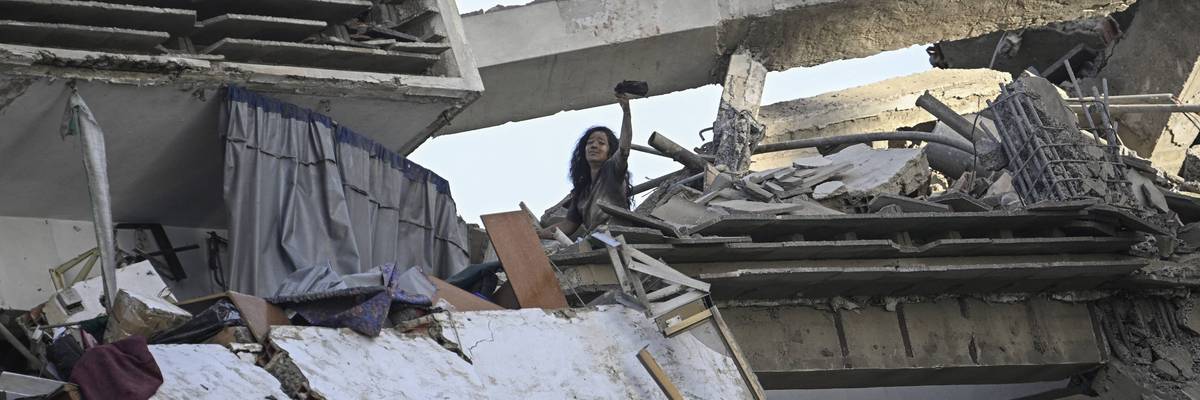
A woman gestures for help atop a destroyed apartment building following an earthquake in La Guaira, Venezuela on June 25, 2026.
(Photo by Federico Parra/AFP via Getty Images)

Jake Johnson
Jun 25, 2026
COMMON DREAMS

Emergency workers rushed to search the rubble of collapsed buildings in and near the Venezuelan capital of Caracas on Thursday after back-to-back powerful earthquakes rocked the country, killing at least 164 people—a toll that’s expected to reach the thousands as victims’ bodies are recovered from the wreckage.

The disaster began on Wednesday afternoon local time as a 7.2-magnitude earthquake hit around 100 miles west of Caracas. Just 39 seconds later, a 7.5-magnitude quake struck, compounding the damage. One Caracas resident told Reuters that the aftermath of the quakes “was like a horror movie.”

The Associated Press reported that rescue teams were seen “using power tools to work their way into piles of rubble where buildings once stood.”

“Panicked residents of the capital were sent pouring into the streets, and after the quakes many people walked among the debris searching for the missing among collapsed buildings and toppled electric poles,” the outlet added. “Footage on state TV showed three children, covered in dust but alive, pulled from the rubble in La Guaira state... one of the areas hardest hit by the quakes because of the large number of collapsed buildings.”


Acting Venezuelan President Delcy Rodríguez, who took charge following the US abduction of President Nicolás Maduro in January, said that “dozens of buildings have collapsed” in La Guaira.

“We are currently carrying out intensive rescue operations to save lives,” Rodríguez added.


US President Donald Trump, who authorized the illegal assault on Venezuela and kidnapping of Maduro earlier this year, wrote on social media that his administration “stands ready, willing, and able to help.”

“I have instructed all agencies of our government to get ready to move quickly,” Trump wrote. “We will be there for our new and great friends. Early reports are not good!!!”

Tom Fletcher, the United Nations’ emergency relief coordinator, said in a statement Thursday that “we are fully mobilized to support the people of Venezuela following the deadly and devastating earthquakes that hit the country.”

“The coming days will require a massive collective effort to support the government-led response and help communities,” Fletcher added. “Even before these earthquakes, nearly 8 million people in Venezuela were in need of humanitarian support. This disaster risks deepening existing vulnerabilities. Sustained international support for humanitarian organizations responding on the ground is essential and urgent.”


Exposed! The deadly effect of US sanctions on Venezuela


“Sanctions kill – the purpose of the continuation of these inhumane sanctions is to punish the population.”

By Siân Errington

As Venezuela’s “national pilgrimage” of mobilisations against the US sanctions continues into its third month, recent research published in Venezuela has confirmed an astonishing level of over 1000 such sanctions against the country remain in place.

The purpose of these inhumane sanctions has been to punish the population, including through the purposeful undermining of social programmes, aiming to cause the Venezuelan economy to crumble. Sanctions have been a core part of the 25-year US war on Venezuela which reached its peak on January 3rd 2026 with the extraordinary development of Trump’s deadly bombing, killing over 100 people, and the kidnapping of President Nicolas Maduro.

In the words of Diosdado Cabello, Venezuela’s Minister for Interior Relations, Justice and Peace, “Venezuela [has been] the target of a transnational hate campaign that uses dehumanization as a tool to justify the economic siege against the country.”

The new research and figures released by Venezuela show the impact of the sanctions with Venezuela having 1,088 sanctions against it, of which 1,040 are active. The total economic damage is estimated as the country losing more than $642 billion in seven years.

The economy is recovering, with recent data confirming that despite widespread US economic sanctions still being in place there had now been 20 quarters of consecutive economic growth. However, the depth of the economic crisis and its consequent contraction mean that the economy is currently 36% of what it was in 2012, showing the severe effect of these measures. GDP had fallen to a quarter of its value between 2015 and 2020; that is, the country lost three-quarters of the economy.

The sanctions produced a 98% drop in the country’s income between 2015 and 2020; that is, of every $100 that used to enter the country, $98 was lost. Oil, which remains the country’s main economic resource, has been targeted – with 16% of the unilateral coercive measures, that is, 171 sanctions, are applied against PDVSA, the Venezuelan state oil company. This contributed to a dramatic drop off in oil production, which was 2.3 million barrels per day in January 2015. Yet in July 2020, it fell to 500,000, meaning it had fallen by more than 87%.

Sanctions kill, and as it has ever been, the purpose of the current continuation of these inhumane sanctions is to punish the population. Even by 2019, a report from experts Mark Weisbrot and Jeffrey Sachs concluded that US sanctions “would fit the definition of collective punishment,” estimating that sanctions were responsible for 40,000 deaths in 2017-2018 alone. They have been much extended since then and remain on a vast level.

The UK Government has played a disgraceful role in backing and implementing the US’ illegal sanctions agenda. This is shown in particular by the Bank of England’s continued refusal to return to Venezuela the billions of dollars of its gold deposited there, which has a value of at least £3.5bn (or US $4.74 bn). As a petition signed by over 13,500 people demanding the return of the gold puts it, “The Venezuelan gold deposited in the Bank of England is the property of the Venezuelan people, not British banks. Preventing its return, only hurts the poorest in Venezuelan society.”

Here, the Venezuela Solidarity Campaign will continue to support Venezuela’s right to determine its own future by backing calls for the full ending of the US economic blockade and campaigning that Britain calls for such an end; supporting international campaigns against Donald Trump’s show trial of Nicolas Maduro; and demanding Britain give backs the gold.


  • EVENT: The 25 Year US War on Venezuela – end all sanctions, give back the gold! Marx Memorial Library London, Thursday, June 25, 6:30 pm, EC1R 0DU. With Venezuelan speakers, Francisco Dominguez (Venezuela Solidarity Campaign) and Kate Hudson (CND.) Register here.
  • PETITION: Keir Starmer – give Venezuela Back It’s Gold! Sign here. Join the Venezuela Solidarity Campaign here.
  • If you support Labour Outlook’s work amplifying the voices of left movements and struggles here and internationally, please consider becoming a supporter on Patreon.