How I Busted the Ruby Ridge Coverup
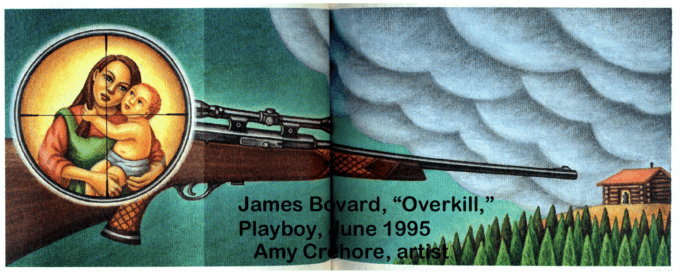
Illustration for James Bovard’s Playboy story “Overkill”, on the Ruby Ridge shooting, by Amy Crehore. (June 1995)
On June 30 1995, I helped shatter the coverup of federal killings at Ruby Ridge, Idaho. For millions of Americans, those brazen killings epitomized how the U.S. government had become a deadly peril to their rights and liberties.
In 1991, an ATF informant entrapped Randy Weaver into selling him two sawed-off shotguns. After ATF officials lied to a federal prosecutor, Weaver was indicted and sent the wrong court date. On August 21, 1992, after numerous illegal intrusions onto Weaver’s Ruby Ridge mountaintop property near the Canadian border, three U.S. marshals dressed in Ninja outfits and carrying submachine guns ambushed Weaver’s 14-year old son and family friend Kevin Harris. One marshal shot the boy’s dog and a firefight erupted in which another marshal was killed. As Sammy Weaver ran from the scene towards the family’s ramshackle cabin, a marshal shot him in the back and killed him.
The next day, the FBI’s Hostage Rescue Team arrived. Within an hour of its snipers taking position, every adult in the cabin was either dead or severely wounded – even though they had not fired a shot at the FBI. FBI sniper Lon Horiuchi shot Randy Weaver in the back as he stood outside his home, and then killed Vicki Weaver as she stood by the cabin doorway holding their 10-month-old baby. The bullet that passed through Vicki Weaver’s skull then badly wounded Kevin Harris.
The FBI proclaimed its Ruby Ridge operation a great success, but a federal jury found Randy Weaver and Kevin Harris not guilty on almost all charges. Federal Judge Edward Lodge condemned the FBI’s misconduct and fabrication of evidence.
I wrote about Ruby Ridge in my 1994 book, Lost Rights: The Destruction of American Liberty. But I knew I was missing so much key dirt on the case.
The debacle in federal court in Idaho spurred an investigation by a Justice Department task force investigation. On December 9, 1994, Deval Patrick, the assistant attorney general for civil rights, announced that he was rejecting the task force’s recommendations to punish federal agents. Patrick announced that the FBI had not used excessive force, whitewashing the entire operation. But Patrick kept secret the hefty report by the task force.
The following month, FBI chief Louis Freeh announced that the FBI had completed its self-investigation and confirmed that its agents performed wonderfully at Ruby Ridge, aside from a few minor technical infractions.
Freeh’s exoneration was the hook for my Wall Street Journal op-ed headlined, “No Accountability at the FBI.” I mocked Freeh’s assertion that the Ruby Ridge “crisis was one of the most dangerous and potentially violent situations to which FBI agents have ever been assigned.” The FBI’s camouflaged snipers were hiding in the woods hundreds of yards away when Randy and Vicki Weaver were gunned down. One FBI sniper that day had summarized the Rules of Engagement: “If you see ’em, shoot ’em.” Though Freeh insisted that the killing of Vicki Weaver was an accident, the FBI initially claimed that killing her was justified. Bo Gritz, the Vietnam War hero who helped negotiate Randy Weaver’s surrender, summarized a government profile on the Weavers: “If you get a chance, take Vicki Weaver out.” It sounded like homicide, not a misfire.
On January 26, 1995, the Wall Street Journal published a response from Freeh that derided “Bovard’s allegations that the FBI has sought to cover up any wrongdoing by the FBI or its employees” and asserted that I “compounded the tragedy by mischaracterizing the circumstances” of the killings. Freeh concluded: “I support the public’s right to know about the workings of its government…. I do not believe, however, that articles such as Mr. Bovard’s, which ignore or twist the truth, further the important objective of public accountability.”
A few days later, the Washington Times published a Freeh letter denouncing my “inflammatory and unfounded allegations” in a Ruby Ridge op-ed I wrote for that paper. The FBI chief harumphed: “Mr. Bovard insults the courageous men and women agents of the FBI when he suggests that they would ‘wantonly shoot private citizens based on mere suspicion.” Freeh could prop up the official storyline on the federal killings at Ruby Ridge because nobody outside the Justice Department was permitted to view that 542-page confidential report.
A few old acquaintances called to say their last good-byes after they saw Freeh’s letters since they expected me to have an accident at any moment.
Republicans took over Congress in early 1995, and outrage over unjustified federal killings at Waco, Ruby Ridge, and elsewhere spurred calls for reform. But the April 19, 1995, explosion at the Oklahoma City federal office building spurred a backlash against government critics. When a top Wall Street Journal editor heard of the bombing, he told editorial team: “These are Jim Bovard’s friends!” Hey – I had never even been to Oklahoma.
I kept dogging Ruby Ridge. Late in June, I got hold of that confidential 542-page Justice Department report. In a long Wall Street Journal piece, I declared that report “reveals that federal officials may have acted worse than even some of their harshest critics imagined.” The report concluded that the FBI Rules of Engagement at Ruby Ridge flagrantly violated the U.S. Constitution and were practically a license to kill – regardless of whether the snipers’ targets posed any threat. Every adult in the cabin was gunned down even though they never fired a shot at any FBI agent. The Justice Department task force was appalled that the adults were gunned down before receiving any warning or a chance to surrender, thereby spurring charges that the feds were “setting Weaver up for attack.” The report blew Freeh’s claims to smithereens.
In the same week, the new issue of Playboy hit the streets with my Ruby Ridge article titled “OverKill” (with the iconic illustration from Amy Crehore atop this article). My piece concluded: “If Congress is not willing to look into such misconduct, who will protect the Constitution? Will Congress let the Justice Department and the FBI get away with murder?”
Two weeks later, on July 13, a Washington Post front-page headline signaled the coverup was collapsing: “Justice Dept. Reopens Ruby Ridge Investigation.” A top FBI official was suspended after admitting destroying documents on the killing of Vicki Weaver. On the same day, the Idaho Statesman reported that Chuck Peterson, Randy Weaver’s attorney, said that “he suspects the [Justice Department’s decision to re-open the investigation] is in response to an article to be published in the August edition of the American Spectator magazine that compares Freeh to J. Edgar Hoover.” The cover of that Spectator issue showed Freeh with a Nixon-like five o’clock shadow nuzzling a Beretta pistol against his cheek. My 6000-word article placed Ruby Ridge in the broader context of a lawless federal agency with vast power to ruin Americans’ lives. At that point, the Spectator had 300,000 subscribers and was the nation’s most popular political magazine.
A month later, Freeh suspended four top FBI officials for suspected perjury or destruction of Ruby Ridge-related evidence. On August 16, the U.S. government paid the Weaver family $3.1 million to settle their wrongful death lawsuit against the U.S. for killing Sammy and Vicki Weaver. The Justice Department announced, “By entering into a settlement, the United States hopes to take a substantial step toward healing the wounds the incident inflicted…. The United States does not admit wrongdoing or liability of the plaintiffs.” But the denial of federal wrongdoing was dicey to reconcile with the multimillion payout to government victims.
The following month, Sen. Arlen Specter’s Senate Subcommittee on Terrorism, Technology, and Government Information commenced a series of hard-hitting hearings on Ruby Ridge. In his testimony, U.S. marshal Dave Hunt stressed that Randy Weaver had repeatedly publicly complained about “lawless government.” I wondered if federal agents felt obliged to snuff any citizen who doubted the government’s legitimacy. Five FBI agents, imitating 1950s-era accused communists, invoked the Fifth Amendment to avoid self-incrimination at the hearings. “Lying seems to have become part of the job description for federal lawmen,” I observed in a American Spectator piece on the congressional hearings.
Idaho prosecutors sought to nail FBI sniper Lon Horiuchi, but the Justice Department torpedoed their case to safeguard boundless federal supremacy. Clinton administration Solicitor General Seth Waxman absolved the sniper because “federal law-enforcement officials are privileged to do what would otherwise be unlawful if done by a private citizen.” But what’s the point of the Bill of Rights if G-men are permitted to shoot private citizens on any pretext?
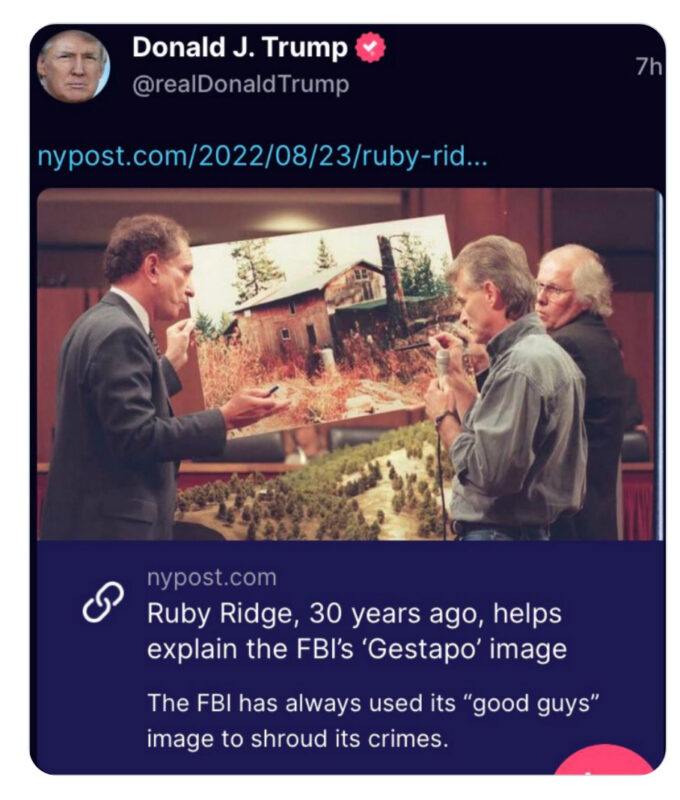
FBI abuses at Ruby Ridge permanently tainted the agency in the minds of many Americans. In 2022, a poll found that 53% of Americans viewed the FBI as “Joe Biden‘s personal Gestapo.” I wrote a New York Post piece citing that poll and former president Donald Trump re-tweeted my article – after the FBI raided his Florida home at Mar-a-Lago.
But now that Donald Trump and Kash Patel are in charge of the FBI, Americans have nothing to fear from G-men off the leash. And if you say otherwise, you might get hit by a billion-dollar defamation lawsuit.
An earlier version of this piece was published by the Libertarian Institute.