Saturday, July 04, 2026

Trump Dismisses Key Housing, Disaster Recovery Reform as ‘Unimportant’


 July 3, 2026

American house, 29 Palms, California. Photo: Jeffrey St. Clair.

Something unusual happened last week in Washington, DC. In a rare showing of bipartisan support during the Trump era, both chambers of Congress passed the 21st Century ROAD to Housing Act, a package incorporating provisions from more than 60 pieces of legislation to help address housing affordability in the US. But then, in a moment that better reflects what Americans expect from the federal government, Trump canceled the bill signing, saying he would hold up the bill until Congress passed his controversial voter ID bill, the SAVE America Act. On Monday, Speaker Mike Johnson sent the housing bill to Trump for signing, but the president called it “a big yawn” and “so unimportant.”

There’s not enough space here to go through all the important sections of the 21st Century ROAD to Housing Act — including a provision that would limit the number of single-family homes that private equity firms can purchase. But with hurricane season upon us and extreme storms and heat waves blanketing the country, one section that stands out is the three-year reauthorization of the Community Development Block Grant Disaster Recovery (CDBG-DR), which would maintain assistance for lower-income families in the wake of disasters.

So what is CDBG-DR?  When people think of disaster recovery and mitigation, they tend to think of programs associated with the Federal Emergency Management Agency (FEMA). But a variety of other government agencies and departments also participate. The Small Business Administration, for instance, grants low-interest financing to help survivors rebuild. And the Department of Housing and Urban Development (HUD) administers programs such as CDBG-DR. When a disaster is declared, HUD opens CDBG-DR grants to state, local, and tribal governments to assist with disaster relief, recovery, rebuilding infrastructure, housing assistance, and economic revitalization. Right now, you’re probably thinking, “How is that different from FEMA assistance?” While FEMA grant programs address immediate post-disaster needs, CDBG-DR addresses long-term needs that are either unmet by FEMA funding or by insurance.

Like many other vital government programs, CDBG-DR has historically been reauthorized and funded sporadically through supplemental packages, leading to inconsistent support. Many groups, including the Appalachian Flood Resilience Coalition, have called on Congress to permanently reauthorize the program to create stability. While the 21st Century ROAD to Housing Act does not do that, the three-year reauthorization is at least a step in the right direction. And as previously noted, the legislation retains the strict threshold that at least 70 percent of a CDBG-DR grant must be used to directly support low- to moderate-income communities, unless HUD provides a formal justification to the contrary. In the past, Congress and HUD have simply asked communities to “make a good faith effort” to meet the requirements or set the threshold to 50 percent.

That Trump has called provisions of the housing bill like this “unimportant” shows how little he thinks of the needs of communities struggling to rebuild. Congress’ rare bipartisan effort to solve an affordability issue stands in stark contrast to the administration’s current priorities, which seem to value spectacle over substantive relief. The president has been focusing on vanity projects like his ballroom, an arch that will block the sightline between Arlington Cemetery and the Lincoln Memorial, and his Great American State Fair, which brings a Ferris wheel to a region that already has a larger observation wheel 14 minutes away. There’s also the war that’s not a war despite the fact that the US and Iran are still firing missiles at each other.

Ultimately, disaster survivors waiting for money to rebuild don’t care about ballroom renovations or “American flag blue” reflecting pools. The 21st Century ROAD to Housing Act is a unique political moment in the Trump era, with Congress finally stepping up to represent the people. This is an opportunity for Trump to show real leadership and do the same. But like all those vanity projects and his war, he’s mishandling it.

This first appeared on CEPR.

NATO 3.0: Alliance or Military-Industrial Investment Fund?


July 3, 2026

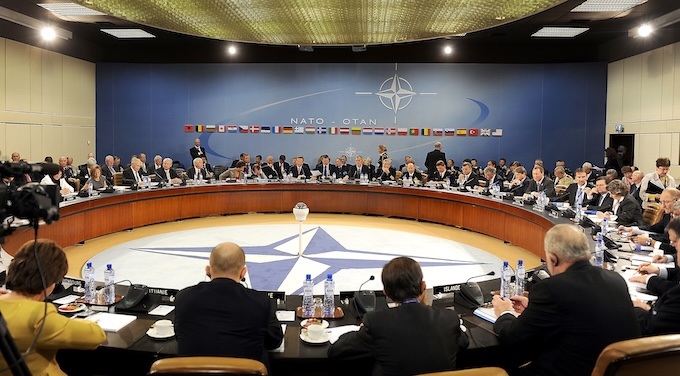
NATO defense ministers conference at NATO HQ in Brussels. Photo: U.S. Air Force Master Sgt. Jerry Morrison, Dept. of Defense.

These are difficult times for anyone who has consistently criticised NATO. From the era of ‘defending the Free World’ against communism, through the age of ‘humanitarian intervention’ and the ‘Global War on Terror,’ to today’s supposedly existential struggle against almost the entire non-Western world, the Alliance has repeatedly reinvented the narratives that justify its existence. The language changes; the underlying logic does not. NATO remains indispensable, and every new enemy (whether discovered, exaggerated, or actively produced) becomes further proof of its necessity.

For decades, critics coming from anti-militarist, anti-hegemonic or left perspectives had to work hard to deconstruct this mythology against the combined efforts of political elites, mainstream media, academic institutions and security experts. The intellectual task itself was never particularly difficult. The contradictions, hypocrisies and devastating consequences of NATO’s interventions have remained visible long after the bombs stopped falling. What required courage was speaking against the prevailing consensus.

Ironically, today the Alliance’s own leaders have become its most effective truth-tellers. Donald Trump has repeatedly stripped away the moral language that traditionally surrounded NATO. Mark Rutte, the Alliance’s Secretary General, has become equally candid, while Germany’s Chancellor and France’s President increasingly speak with remarkable openness about Europe’s military future. Yet the privilege of telling the truth about what NATO has become belongs only to those in power. As the repression of protest movements ahead of the Ankara summit demonstrates, citizens may know the truth about this military giant—but they are not expected to organise against it.

The Ankara Summit has not even begun, yet its conclusions are already known. The phrase ‘historic summit’ has become so overused that it has almost lost its meaning. Some observers expect the ‘Europeanisation’ of NATO, with European allies assuming greater responsibility for financing and leading the Alliance. But this remains largely rhetorical. Europe cannot replace the United States as the Alliance’s military backbone. It can, however, willingly tighten the noose around its own neck—and perhaps around the world’s. While Atlanticists remain preoccupied with the Washington-Brusselsrelationship and whether Trump truly intends to reduce America’s commitment, a more significant transformation is taking place within Europe itself. New military coalitions are emerging inside NATO. The Baltic states and Poland increasingly pursue their own security agenda, driven by historical grievances and profound Russophobia. Sweden and Finland, once symbols of neutrality, have rapidly embraced militarisation, with Helsinki now evenpermitting the deployment of nuclear weapons on its territory (American weapons, naturally, making these states ever more deeply integrated into Washington’s strategic architecture). Similar regional military configurationsare quietly taking shape in the Balkans, where Croatia, Albania, Bulgaria and Kosovo increasingly speak of strengthening their own defence cooperation: NATO within NATO.

What truly distinguishes NATO 3.0, however, is not merely its willingness to name Russia and China explicitly as strategic adversaries or to proclaim its global ambitions. Rutte himself has explained that NATO is indispensable because it enables the United States to project power globally through Europe. Europe, in other words, functions as both a platform and force multiplier for American global strategy (as shown by the Epic Fury operation).

More revealing still is the language in which NATO now describes itself.Rutte proudly speaks of a ‘defence industrial revolution.’ The expression is revealing. Just as the First Industrial Revolution transformed production through factories and mechanisation, NATO 3.0 seeks to reorganise military production on an entirely new scale, not primarily for defence, but for permanent profitability. Behind the rhetoric of ‘collective security,’ ‘strategic autonomy,’ and ‘deterrence’ lies a far simpler reality: NATO increasingly functions as a mechanism for transferring unprecedented amounts of public money into private corporate hands.

Hence NATO 3.0 represents yet another mutation: an alliance whose principal historical mission increasingly appears to be the permanent militarisation of Western economies, and most probably, a new war with Russia.

The timing is remarkable. For decades, governments insisted that public finances required austerity. Hospitals, universities, pensions and social welfare supposedly had to accept painful budget discipline. Suddenly, none of these fiscal constraints apply to military expenditure. Deficits that were politically impossible for healthcare or education have become entirely acceptable for weapons procurement. Defence spending is no longer presented as a burden but as an investment strategy and an excellent possibility for job openings (they don’t mention the expanded graveyards that usually go along with warfare).

This raises further profound questions. If cloud computing, artificial intelligence, satellite communications and autonomous weapons are increasingly developed by private technology corporations, who ultimately controls national security? If governments become structurally dependent upon commercial providers, where does democratic accountability remain? When military procurement begins to resemble venture-capital investment, who actually benefits from permanent insecurity? These questions receive surprisingly little attention.

Instead, we hear only the language of emergency. Europe must rearm immediately. Industrial production must accelerate. Procurement rules must be simplified. Military investment cannot wait. Yet history teaches us that emergencies rarely remain temporary. Exceptional measures gradually become permanent forms of governance. Under conditions of continuous perceived threat, extraordinary military spending begins to appear normal, while demands for investment in education, healthcare or social justice suddenly become fiscally irresponsible.

Security colonises politics. What emerges before our eyes is a model in which war itself becomes increasingly privatised. Private defence contractors, technology firms, logistics companies and AI developers become indispensable actors within the military ecosystem. Even warfare itself becomes increasingly remote. Artificial intelligence, autonomous systems and digital infrastructures allow military operations to be outsourced, automated and commercialised in unprecedented ways. War does not necessarily require mass mobilisation; it requires investment portfolios.

For small member states that expected welfare instead of warfare, the implications are particularly sobering. Increasing defence budgets is presented as solidarity with the Alliance, but in reality, it often resembles compulsory participation in a vast military-industrial investment scheme. Citizens finance weapons they neither produce nor control, purchasing protection against threats that are frequently amplified by the very geopolitical logic that sustains the system.

NATO has never been merely a military alliance within the UN-based international order. It has always been an expression of the Western strategic worldview. Today it is becoming something even more complex: a system where security policy, industrial policy, technological power, and capital accumulation increasingly merge. The Ankara summit will not only discuss defence and deterrence; it will reveal how deeply the future of capitalism, technology and organised violence has become intertwined. It will be yet another chapter in the political economy of permanent mobilization for warfare.

Biljana Vankovska is a professor of peace studies and head of Global Change Center, Skopje, Macedonia.

French Presidential Election 2027

An anti-fascist front, for the victory of the radical left – united and revolutionary!

A statement from the NPA-A


Monday 29 June 2026, by NPA-l’Anticapitaliste (NPA-A)


In order to detrermine its position for the 2027 presidential elections, the NPA-l’Anticapitaliste held a national conference on 27 and 28 June 2026. This conference brought together delegates representing the activists of the NPA-l’Anticapitaliste, who had debated and voted in the general assemblies held throughout June.

In view of the threat posed by the far right, the NPA-l’Anticapitaliste will not field a candidate in the presidential election, but will work towards building a broad anti-fascist front and supporting a unifying candidate from the radical left. Following discussions with LFI and the organisations and currents of the radical left, the NPA-l’Anticapitaliste will decide on the nature of its involvement in the campaign and the terms of its support for this candidate, whilst running its own campaign through rallies, public meetings and campaign materials to highlight the need for a united anti-fascist front.

The NPA-l’Anticapitaliste calls on all activists in the social and trade union movements, on the left, among revolutionaries and environmentalists, to mobilise and to form, wherever possible, anti-fascist action fronts and committees against the far right, in the broadest possible unity. Victory for the far right and the right is not inevitable! Let us mobilise to restore hope to our social camp so that we can stand up to the ruling classes and their deadly policies!

Montreuil, 28 June 2026

Translated by IAnti*Capitalist Resistance from l’Anticapitaliste.