Democratic Primaries Reveal What the DNC Autopsy Buried
July 3, 2026
Photo by Colin Lloyd
The Democratic National Committee’s 192-page post-mortem on the 2024 election, titled “Build to Win. Build to Last,” failed to build, to win, or to learn. It never answered the only question that mattered: how did a twice-impeached, multiply-indicted former president walk back into the White House with more votes than prior to his indictments?
The report, authored by Democratic strategist Paul Rivera and released in May 2026 after months of stonewalling by DNC Chair Ken Martin, reads less as a serious political reckoning than as a confirmation-bias pamphlet drafted by people determined not to upset the party’s old guard. It calls for renewed focus on “Middle America,” criticizes years of disinvestment in state parties, and faults poor economic messaging. It is not wrong on any of these points. But these points alone did not cost the party America — not just Middle America.
The report boasts of conducting more than 1,200 interviews to assess the health of state parties in every state, district, and territory. While it seems to be an impressive number, it remains questionable whether the interviews were of local party leaders or general democratic voters. Did it include micro-level analysis of competitive districts? Or to account for 6.8 million voters who supported Biden in 2020, where they went, and why they left.
There was no breakdown of Harris’s collapse by age. No independent examination of what drove young voters away, particularly in university towns where Gaza protests defined the political atmosphere of 2024. How many of the 6.8 million were from Generation Z? And not a word on the Zionist bubble around Biden and how that funded and shielded Israel as it carried out a live-streamed genocide in Gaza.
This is not a methodological oversight. It is engineered by the plan. University towns and young voter precincts were precisely where the Democratic coalition was visibly disintegrating. Most likely the reason they lost states like Wisconsin, Michigan and Pennsylvania. Students who watched ‘genocide Joe’ enable the starvation of children in Gaza did not stay home out of apathy. They made a calculated judgment: that on the question of war crimes, there was no daylight between the two candidates. The autopsy never acknowledged the question existed.
Instead, it retreated into campaign mechanics: Harris “was not well prepared,” Democrats assumed Trump was unacceptable, and the party deluded itself that undecided voters would hold their noses and choose the lesser of two evils. Observations about messaging and strategy, carefully constructed to avoid touching the one issue that led the Arab Americans’ vote in Michigan to split evenly between Harris and Trump when it favored Biden by a large margin in 2020.
The autopsy’s authors, like much of the Democratic establishment, prefer to frame the party’s youth problem as a generational disconnect, a cultural or communication failure that better social media spending might fix. That framing is both disingenuous and lazy. There is no generational disconnect. There is a massive divide between the old guard and the young generation — and the base at large — when it comes to Israel.
Recent primary results could not be clearer, exposing the DNC autopsy’s failure. More than 80% of Democratic voters hold a negative view of Israel. That is not a fringe position within the party. That is the party. More than four out of five of the Democratic voters regard the long-held ‘sacred cow’ unfavorably, and the post-election study does not contain a single mention. That is dismissive of 80% of the Party. The analysis is not seeking lessons learned; it is a whitewash.
The Gaza omission was not an oversight. It was a cover-up. The IMEU Policy Project’s executive director was blunt, demanding the release of findings that the autopsy’s own author had reportedly acknowledged in private: DNC officials’ internal data showed Biden’s support for Israel was a net negative for Democrats in 2024. That finding never appeared in the report. It was buried. Former DNC Vice Chair David Hogg said publicly that he told Rivera directly, “We need to acknowledge the role that Gaza played in us losing younger voters.”
This is not an outlier critique. It is coming from people who participated in the process and are now openly saying its central finding was suppressed. When contributors to an autopsy publicly declare that findings are edited out, the document becomes a cover-up.
The autopsy’s Gaza omission collapses entirely when measured against what Democratic primaries have screamed in 2026. Candidates running on explicitly anti-Israeli-policy platforms have toppled incumbents and dethroned members of Congress backed by Democratic leadership and bankrolled by AIPAC. These are not noble protest campaigns falling short. They are winning Democratic voters, in Democratic primaries, on an explicitly pro-Palestine platform and making AIPAC a radioactive word and political liability.
The autopsy did not diagnose the cause of failure; it smothered it. Fifty thousand words telling Democrats to organize better, message harder, and court the working-class voter they lost. Sound advice, and entirely beside the point, as long as the party establishment continues to dismiss the verdict of 80% of its rank and file.
Without an honest accounting of the party’s failures in 2024 and without acknowledging the winning streak for anti-Israel democratic candidates in 2026, there can be no realistic path forward. The DNC must root out AIPAC funding in Democratic primaries and recognize the views of the party’s majority on Israel. It must confront the political cost of a foreign policy that millions of Americans now see not only as wrong, but as criminal.
If over 80% of Democratic voters hold an unfavorable opinion of Israel, and candidates running on that sentiment keep winning primaries, the data is not ambiguous. The base has moved. The party leadership has not.
Photo by Colin Lloyd
The Democratic National Committee’s 192-page post-mortem on the 2024 election, titled “Build to Win. Build to Last,” failed to build, to win, or to learn. It never answered the only question that mattered: how did a twice-impeached, multiply-indicted former president walk back into the White House with more votes than prior to his indictments?
The report, authored by Democratic strategist Paul Rivera and released in May 2026 after months of stonewalling by DNC Chair Ken Martin, reads less as a serious political reckoning than as a confirmation-bias pamphlet drafted by people determined not to upset the party’s old guard. It calls for renewed focus on “Middle America,” criticizes years of disinvestment in state parties, and faults poor economic messaging. It is not wrong on any of these points. But these points alone did not cost the party America — not just Middle America.
The report boasts of conducting more than 1,200 interviews to assess the health of state parties in every state, district, and territory. While it seems to be an impressive number, it remains questionable whether the interviews were of local party leaders or general democratic voters. Did it include micro-level analysis of competitive districts? Or to account for 6.8 million voters who supported Biden in 2020, where they went, and why they left.
There was no breakdown of Harris’s collapse by age. No independent examination of what drove young voters away, particularly in university towns where Gaza protests defined the political atmosphere of 2024. How many of the 6.8 million were from Generation Z? And not a word on the Zionist bubble around Biden and how that funded and shielded Israel as it carried out a live-streamed genocide in Gaza.
This is not a methodological oversight. It is engineered by the plan. University towns and young voter precincts were precisely where the Democratic coalition was visibly disintegrating. Most likely the reason they lost states like Wisconsin, Michigan and Pennsylvania. Students who watched ‘genocide Joe’ enable the starvation of children in Gaza did not stay home out of apathy. They made a calculated judgment: that on the question of war crimes, there was no daylight between the two candidates. The autopsy never acknowledged the question existed.
Instead, it retreated into campaign mechanics: Harris “was not well prepared,” Democrats assumed Trump was unacceptable, and the party deluded itself that undecided voters would hold their noses and choose the lesser of two evils. Observations about messaging and strategy, carefully constructed to avoid touching the one issue that led the Arab Americans’ vote in Michigan to split evenly between Harris and Trump when it favored Biden by a large margin in 2020.
The autopsy’s authors, like much of the Democratic establishment, prefer to frame the party’s youth problem as a generational disconnect, a cultural or communication failure that better social media spending might fix. That framing is both disingenuous and lazy. There is no generational disconnect. There is a massive divide between the old guard and the young generation — and the base at large — when it comes to Israel.
Recent primary results could not be clearer, exposing the DNC autopsy’s failure. More than 80% of Democratic voters hold a negative view of Israel. That is not a fringe position within the party. That is the party. More than four out of five of the Democratic voters regard the long-held ‘sacred cow’ unfavorably, and the post-election study does not contain a single mention. That is dismissive of 80% of the Party. The analysis is not seeking lessons learned; it is a whitewash.
The Gaza omission was not an oversight. It was a cover-up. The IMEU Policy Project’s executive director was blunt, demanding the release of findings that the autopsy’s own author had reportedly acknowledged in private: DNC officials’ internal data showed Biden’s support for Israel was a net negative for Democrats in 2024. That finding never appeared in the report. It was buried. Former DNC Vice Chair David Hogg said publicly that he told Rivera directly, “We need to acknowledge the role that Gaza played in us losing younger voters.”
This is not an outlier critique. It is coming from people who participated in the process and are now openly saying its central finding was suppressed. When contributors to an autopsy publicly declare that findings are edited out, the document becomes a cover-up.
The autopsy’s Gaza omission collapses entirely when measured against what Democratic primaries have screamed in 2026. Candidates running on explicitly anti-Israeli-policy platforms have toppled incumbents and dethroned members of Congress backed by Democratic leadership and bankrolled by AIPAC. These are not noble protest campaigns falling short. They are winning Democratic voters, in Democratic primaries, on an explicitly pro-Palestine platform and making AIPAC a radioactive word and political liability.
The autopsy did not diagnose the cause of failure; it smothered it. Fifty thousand words telling Democrats to organize better, message harder, and court the working-class voter they lost. Sound advice, and entirely beside the point, as long as the party establishment continues to dismiss the verdict of 80% of its rank and file.
Without an honest accounting of the party’s failures in 2024 and without acknowledging the winning streak for anti-Israel democratic candidates in 2026, there can be no realistic path forward. The DNC must root out AIPAC funding in Democratic primaries and recognize the views of the party’s majority on Israel. It must confront the political cost of a foreign policy that millions of Americans now see not only as wrong, but as criminal.
If over 80% of Democratic voters hold an unfavorable opinion of Israel, and candidates running on that sentiment keep winning primaries, the data is not ambiguous. The base has moved. The party leadership has not.
Victims of Communism?
July 3, 2026
Photograph Source: cspirtos – Public Domain
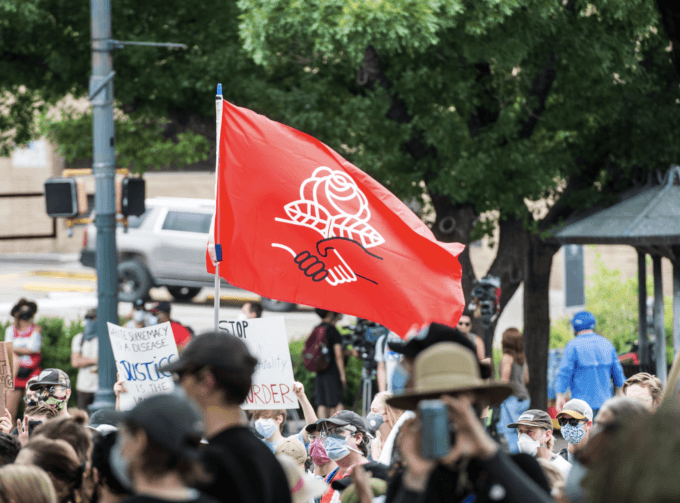
The ruling class appears shaken, their brains rattled, and their nightmare once thought vanquished—the Red Menace—appears reborn. Following the recent sweep of Democratic Socialists of America (DSA) in New York and Colorado elections, there has been a torrent of backlash and public meltdowns from President Trump claiming, “I’d be the greatest communist in history,” to humanity’s first billionaire posting the usual anti-communist nonsensical blather that communism has the “[h]ighest death count of any philosophy.” Elon Musk unabashedly cites inflated, unserious death counts that include in their tally of so-called “victims of communism” the Red Army’s liquidation of Nazis and fascists during the World War II.
Adding to the frenzy, one New York City council member even invoked the halcyon days of the FBI and the CIA, bragging that they would have “made sure unabashed revolutionaries” like the DSA National Political Community “were neutralized one way or another. In fact, that was basically the entire point of having them.” Vicki Paladino made a candid admission that domestic and foreign intelligence agencies were never designed to defend “democracy.” Rather, they were engineered as clandestine political police forces operating with lethal, counter-revolutionary violence.
And decades of disclosures and investigations reveal this. From the Church Committee convened five decades ago that investigated illegal intelligence operations to Florida Congresswoman Anna Paulina Luna’s recent hearing on the CIA’s mind control program called MK-ULTRA, domestic and foreign intelligence agencies have been mired in deeply nefarious practices, from illegal surveillance and counterintelligence operations to outright assassination. Put bluntly, the CIA and FBI, during the glory days of Cold War Red Scare politics, acted in service of capital, alleviating real or imagined threats to the profits of an increasingly paranoid ruling class, and building their own pile of bodies along the way as they waged a protracted and often secret war against those seeking to build power for the many rather than the few.
Indian Country itself paid a heavy price. And only recently have we begun to come to terms with the consequences, with the commutation of Leonard Peltier’s two consecutive life sentences for the killing of two FBI agents during the federal reign of terror waged against the American Indian Movement on the Pine Ridge reservation. While Peltier walked out of a federal prison, many more never went home and still more await justice. While we have yet to heal from the wounds of the past, this generation faces a different battle.
Putting aside whether the recent DSA electoral wins pose an existential threat to the capitalist class, the underlying fear has a material basis. As the billionaire class, and now, grotesquely, the trillionaire class, reap record profits, the quality of life in the heart of global capitalism and imperialism appears to be in rapid decline. Among the top leading causes of death for young people in the United States are drug overdoses, death by suicide, and gun deaths. Life expectancy has cratered across the board. For American Indian people, the decline in life expectancy is particularly acute, falling in recent years from an already abysmal of 71 years down to 65—with South Dakota reporting a median age of death for American Indian people of death at a staggering 58 years. Despite more than a million COVID deaths in the United States, the drop in life expectancy is caused by more than the pandemic; it includes massive inequalities and social and economic factors.
It should be no surprise this generation has little hope in the system that robbed them of a future, to say nothing of a bleak present. A poll last year by the rightwing think tank the Cato Institute found that more than a third of people under the age of 30 in the United States had a favorable view of communism. Still more, nearly two-thirds, looked kindly on socialism. While the turn towards anti-capitalism may be partially a natural reaction to the death drive of capitalism, it doesn’t mean the embrace of left wing and liberatory politics translates directly into socialist and communist movements or just societies. In fact, revolutions are quite rare events, and when they succeed or fail, they can be quite deadly, with much of the violence often stemming from the forces of counter-revolution. What is often misunderstood is that this counter-revolutionary violence doesn’t necessarily happen in the context of, or in reaction to full-blown revolution. It instead should be understood a structural phenomenon, something that is expressed in policing and intelligence agencies ready to crush even the most benign forms of resistance, such as the most recent sentencing a Prairieland defendant to 30 years in federal prison for moving a box of antifascist zines.
As historian Gerald Horne has pointed out in his aptly titled book The Counter-Revolution of 1776, the founding of the United States was borne of a counter-revolution against the abolition of slavery. Most African people sided with the British against the colonists, viewing the British empire as a more favorable ally in the ending the tyranny of chattel slavery. One might add that this counter-revolution also included the genocidal assault on Native people, whom Thomas Jefferson described as “merciless Indian savages” in the Declaration of Independence. Indigenous wars against the United States often entailed allying with the competing empires such as Britain against the American colonists, whom Indigenous nations viewed as a greater threat. This was in an effort to stave off the white invasion of Indigenous homelands. While counterfactual history has its limits, it is a worthy pursuit to examine the freedom dreams of Black and Indigenous people—and to understand exactly how U.S. imperialism has suppressed those aspirations. Those aspirations have sometimes coalesced with socialist movements and often not, but the general ignorance of their liberatory impulses is a symptom of the larger miseducation project.
To start, most people in the United States are ill-equipped to discuss the actual social policies of past or present communist societies. Decades of anti-communist indoctrination have effectively blunted the public’s ability to conceptualize alternatives to capitalism. This mass ignorance is no accident; it is the result of a deliberate miseducation that reduces socialism to a caricature of authoritarian misery, while sanitizing capitalism as a beacon of personal liberty and market choice. Consequently, history is viewed through a double standard: the structural failures of socialist states are deemed unforgivable atrocities, while the global body count of capitalism is dismissed as the unavoidable friction of an imperfect but necessary system.
These myths are supposedly backed up by the numbers, which attribute 100 million deaths to communist societies, numbers that far exceed the Nazi and fascist body counts and do not begin to offer up comparable studies of colonial and capitalist societies. It is worth noting that these overblown statistics come from the Victims of Communism Memorial Foundation, which was established by a unanimous act of Congress in 1993 and opened a museum in 2022. The foundation even counts deaths from COVID-19 as victims of communism. This asymmetric accounting leaves the capitalist empire entirely off the hook. If we apply the exact same rigorous, unforgiving metrics of state responsibility to U.S. capitalism alone, the narrative of Western benevolence completely collapses into an endless ledger of mass murder.
Factoring the true cost of U.S. capitalism and imperialism requires mapping what historian David Michael Smith terms the “endless holocausts” of U.S. empire. This global empire was built on the theft of a continent through Indigenous genocide and the theft of tens of millions of Black lives via the transatlantic slave trade. Smith places the total body count of the U.S. empire at close to 300 million dead. If we scrutinized global capitalism’s daily, preventable toll—from structural poverty and enforced starvation to imperialist wars and corporate healthcare monopolies—with the same metrics applied to communist societies, the free market might register 100 million deaths every few decades. Ultimately, the ruling class does not fear the Red Menace because they value human life; they fear it because they know their empire of accumulation by dispossession is fundamentally fragile, driving them to unleash the counter-revolutionary violence they have always weaponized to survive.
This piece first appeared on Red Scare.
When Trump Sounds the Alarm Against Mamdani’s “communists” and Their Electoral Triumphs!
 Image by NYC Mayor's Office/Wikimediacommons, licensed via CC BY 4.0
“Communism is the greatest threat to our country since its founding 250 years ago”! Undoubtedly, this thunderous statement by U.S. President Donald Trump, issued in writing on June 26, is intended to sound the alarm and rally behind him all the conservatives, reactionaries, and anti-communists in the United States ahead of the midterm elections this coming November. Nevertheless, with this statement, Trump is, for once, spot on. And this is much to the embarrassment of the liberal—or even “moderate” left-wing—media around the world, which persist in labeling Mamdani a… “Democrat” and pretend not to understand whom or what the U.S. president is referring to when they claim he is talking about the leaders of the… Democratic Party!
And yet, Trump is not only referring specifically to Zohran Mamdani and his fellow Democratic Socialists of America (DSA)—who just made a huge splash in last week’s Democratic Party primaries—but he is also fiercely attacking the Democratic Party leadership with these words because they are not fighting back and are letting “the communists do whatever they want”: “ In many ways, they’re allowing them to go their own way. They’re afraid they will lose their Election, they’re afraid of conflict. They’re not smart enough or tough enough to fight this plague. If they fought them the way they fight Republicans, or me, they’d be victorious, but they don’t have the courage to do so. ”. And to leave no room for doubt, Trump describes his assertions as “a statement on the recent election of communists in our country”, while clarifying that these newly elected officials ”are not social democrats. These are hardcore, godless communists“. Moreover, according to accounts from Republican senators who met with Trump in the wake of the Democratic Socialists’ electoral successes, he “at times let his emotions get the better of him, explaining in essence that communism was gaining the upper hand”…(1)
That said, it must be acknowledged that Trump is largely correct in dramatizing the situation. On the one hand, victories by DSA activists in the Democratic Party primaries are now becoming the norm, with or even without the overt support of Mamdani—whom the American media currently describe as a “kingmaker”—while there are already DSA mayors in New York, Seattle, soon in Washington, D.C., and in a few months likely in Los Angeles. On the other hand, the Democratic Party leadership is terribly unpopular, demoralized, completely discredited among its base, lacking in ideas, without a platform, without figures capable of rivaling Mamdani, Bernie Sanders, or Alexandria Ocasio-Cortez, and above all, devoid of any will to stand up to Trump. The result is that little-known or virtually unknown young women, as well as young men from the DSA, have recently managed to defeat—and often even crush—incumbent representatives and senators who are part of the Democratic establishment, supported and financed by the wealthy and other billionaires, and above all by AIPAC, the Israeli lobby that until recently was all-powerful.
At this point, it is worth digressing to highlight the decisive role of the “Mamdani phenomenon” in what amounts to the historic failure of Netanyahu and his Israel in the war in the Persian Gulf. By conquering New York, “the world’s largest Jewish city”—thanks in part to the active support of tens of thousands of young New York Jews, whom he himself had mobilized and organized—Mamdani accelerated and deepened what was already the “divorce” of American Jews from the Zionist state, as well as the historic shift in American public opinion in favor of the Palestinians. Given Israel’s extreme and long-standing dependence on financial, military, and diplomatic support from the United States—as well as from the Jewish community in that country— there is no doubt that the aforementioned events have greatly contributed to Israel’s weakening, to Trump and his administration distancing themselves from Israel, and ultimately to what has made the Jewish state, according to U.S. Vice President JD Vance, “the most hated in the world”. And all this at a time when Israel is facing its moment of truth and is plunged into a terminal crisis—a crisis from which there is likely no turning back!
But let’s return to Trump’s United States, which is also plunged into a historic crisis. Trump is right to be concerned and to sound the alarm, for he and his regime are in crisis, to the point of appearing almost incapable of standing up to Zohran Mamdani and his “communists.” For example, there is no Republican leader—Trump included—who can rival the leaders of the “communist” camp in popularity. In fact, all polls show Alexandria Ocasio-Cortez, Mamdani, and Bernie Sanders to be far more popular than any leaders of either the Democratic or Republican parties! As a result, a potential presidential run by Ocasio-Cortez in 2028 is gaining credibility and popular support…
All these events—which might have seemed impossible and pure political fiction just a few years ago—are now possible because they reflect the very real, unprecedented, and increasingly profound and rapid transformation that North American society has undergone over the past two tumultuous decades. As a result, the percentage of American citizens who believe it would be “a good thing” for their country to transition from capitalism to socialism now exceeds one-third (38%) of the population, up from just 18% in 2010. And in a very telling detail, it is now the vast majority of Democrats (72%) and Independents (60%) who believe that the capitalist system is not working well or is not working at all! (2)
In short, the recent avalanche of electoral successes by Democratic Socialist activists, the immense popularity of Zohran Mamdani, Ocasio-Cortez, and above all Bernie Sanders—or even the radical shift in public opinion in favor of the Palestinians and against Israel—did not come out of nowhere and are not fleeting products of some passing protest movement by American citizens. In reality, they are deeply rooted in the historic (multi)crisis facing the United States and its society, a crisis that has been greatly accelerated and deepened by the rise to power of that Nazified Caligula, Donald Trump. Not to mention, of course, the most popular American of all, that old independent senator Bernie Sanders, whose two presidential campaigns have radicalized and politicized an entire generation of young Americans—who now find themselves at the forefront of what Trump somewhat blithely calls the “communist threat” looming over the American superpower. And finally, we can be sure of only one thing: the course of events promises to be incredibly exciting…

“Communism is the greatest threat to our country since its founding 250 years ago”! Undoubtedly, this thunderous statement by U.S. President Donald Trump, issued in writing on June 26, is intended to sound the alarm and rally behind him all the conservatives, reactionaries, and anti-communists in the United States ahead of the midterm elections this coming November. Nevertheless, with this statement, Trump is, for once, spot on. And this is much to the embarrassment of the liberal—or even “moderate” left-wing—media around the world, which persist in labeling Mamdani a… “Democrat” and pretend not to understand whom or what the U.S. president is referring to when they claim he is talking about the leaders of the… Democratic Party!
And yet, Trump is not only referring specifically to Zohran Mamdani and his fellow Democratic Socialists of America (DSA)—who just made a huge splash in last week’s Democratic Party primaries—but he is also fiercely attacking the Democratic Party leadership with these words because they are not fighting back and are letting “the communists do whatever they want”: “ In many ways, they’re allowing them to go their own way. They’re afraid they will lose their Election, they’re afraid of conflict. They’re not smart enough or tough enough to fight this plague. If they fought them the way they fight Republicans, or me, they’d be victorious, but they don’t have the courage to do so. ”. And to leave no room for doubt, Trump describes his assertions as “a statement on the recent election of communists in our country”, while clarifying that these newly elected officials ”are not social democrats. These are hardcore, godless communists“. Moreover, according to accounts from Republican senators who met with Trump in the wake of the Democratic Socialists’ electoral successes, he “at times let his emotions get the better of him, explaining in essence that communism was gaining the upper hand”…(1)
That said, it must be acknowledged that Trump is largely correct in dramatizing the situation. On the one hand, victories by DSA activists in the Democratic Party primaries are now becoming the norm, with or even without the overt support of Mamdani—whom the American media currently describe as a “kingmaker”—while there are already DSA mayors in New York, Seattle, soon in Washington, D.C., and in a few months likely in Los Angeles. On the other hand, the Democratic Party leadership is terribly unpopular, demoralized, completely discredited among its base, lacking in ideas, without a platform, without figures capable of rivaling Mamdani, Bernie Sanders, or Alexandria Ocasio-Cortez, and above all, devoid of any will to stand up to Trump. The result is that little-known or virtually unknown young women, as well as young men from the DSA, have recently managed to defeat—and often even crush—incumbent representatives and senators who are part of the Democratic establishment, supported and financed by the wealthy and other billionaires, and above all by AIPAC, the Israeli lobby that until recently was all-powerful.
At this point, it is worth digressing to highlight the decisive role of the “Mamdani phenomenon” in what amounts to the historic failure of Netanyahu and his Israel in the war in the Persian Gulf. By conquering New York, “the world’s largest Jewish city”—thanks in part to the active support of tens of thousands of young New York Jews, whom he himself had mobilized and organized—Mamdani accelerated and deepened what was already the “divorce” of American Jews from the Zionist state, as well as the historic shift in American public opinion in favor of the Palestinians. Given Israel’s extreme and long-standing dependence on financial, military, and diplomatic support from the United States—as well as from the Jewish community in that country— there is no doubt that the aforementioned events have greatly contributed to Israel’s weakening, to Trump and his administration distancing themselves from Israel, and ultimately to what has made the Jewish state, according to U.S. Vice President JD Vance, “the most hated in the world”. And all this at a time when Israel is facing its moment of truth and is plunged into a terminal crisis—a crisis from which there is likely no turning back!
But let’s return to Trump’s United States, which is also plunged into a historic crisis. Trump is right to be concerned and to sound the alarm, for he and his regime are in crisis, to the point of appearing almost incapable of standing up to Zohran Mamdani and his “communists.” For example, there is no Republican leader—Trump included—who can rival the leaders of the “communist” camp in popularity. In fact, all polls show Alexandria Ocasio-Cortez, Mamdani, and Bernie Sanders to be far more popular than any leaders of either the Democratic or Republican parties! As a result, a potential presidential run by Ocasio-Cortez in 2028 is gaining credibility and popular support…
All these events—which might have seemed impossible and pure political fiction just a few years ago—are now possible because they reflect the very real, unprecedented, and increasingly profound and rapid transformation that North American society has undergone over the past two tumultuous decades. As a result, the percentage of American citizens who believe it would be “a good thing” for their country to transition from capitalism to socialism now exceeds one-third (38%) of the population, up from just 18% in 2010. And in a very telling detail, it is now the vast majority of Democrats (72%) and Independents (60%) who believe that the capitalist system is not working well or is not working at all! (2)
In short, the recent avalanche of electoral successes by Democratic Socialist activists, the immense popularity of Zohran Mamdani, Ocasio-Cortez, and above all Bernie Sanders—or even the radical shift in public opinion in favor of the Palestinians and against Israel—did not come out of nowhere and are not fleeting products of some passing protest movement by American citizens. In reality, they are deeply rooted in the historic (multi)crisis facing the United States and its society, a crisis that has been greatly accelerated and deepened by the rise to power of that Nazified Caligula, Donald Trump. Not to mention, of course, the most popular American of all, that old independent senator Bernie Sanders, whose two presidential campaigns have radicalized and politicized an entire generation of young Americans—who now find themselves at the forefront of what Trump somewhat blithely calls the “communist threat” looming over the American superpower. And finally, we can be sure of only one thing: the course of events promises to be incredibly exciting…
Notes
1. See also our article: Towards the inevitable clash to the death between Trump and Mamdani!: https://znetwork.org/znetarticle/towards-the-inevitable-clash-to-the-death-between-trump-and-mamdani/
2. How open are Americans to socialism, after all?: https://edition.cnn.com/2026/06/25/politics/democratic-socialism-primary-elections
1. See also our article: Towards the inevitable clash to the death between Trump and Mamdani!: https://znetwork.org/znetarticle/towards-the-inevitable-clash-to-the-death-between-trump-and-mamdani/
2. How open are Americans to socialism, after all?: https://edition.cnn.com/2026/06/25/politics/democratic-socialism-primary-elections