Saturday, July 04, 2026

The Forgotten Brits Who Lived Among the Cherokee

 July 3, 2026

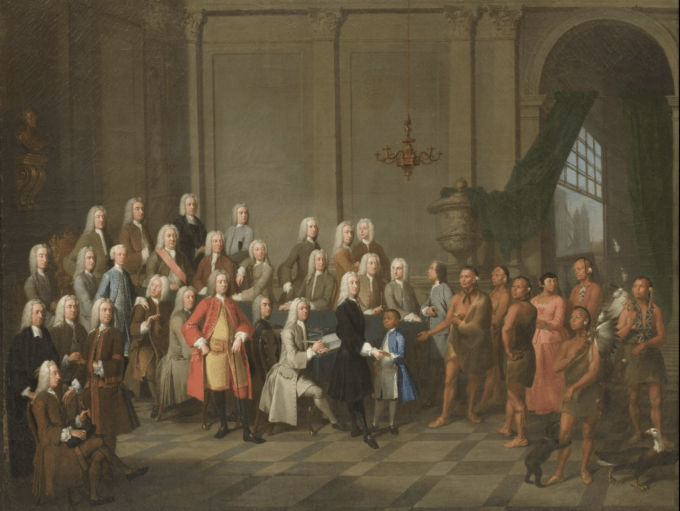
A Delegation of the Creek tribe meets with the Trustees of Georgia by William Verelst. Public domain.

It took a single sentence in Ken Burns’ documentary series The American Revolution to change the way I thought about the American Revolution.

It was a passing reference to British agents living among the Cherokee.

The documentary quickly moved on, but I couldn’t. Who were they? Were they soldiers, diplomats, or traders? Did they wear uniforms? Did they speak Cherokee?

What I found showed me an often overlooked side of the Revolution. Away from the famous battlefields, it seems Britain’s war was also fought through secretive Indigenous alliances, intelligence networks, and frontier agents who looked more grizzled than polished.

These men carried influence into parts of a continent where red coats rarely ventured as readily as a drawstring purse of gold.

Throughout, these frontier agents waged a conflict that stretched all the way from the Great Lakes to the southern Appalachians and into Georgia. Nor were they the over-romanticised characters imagined later by James Fenimore Cooper, such as Natty Bumppo. They were more mysterious than that.

A traveller approaching a Cherokee town in 1776 might notice a stranger among the warriors. At first glance he hardly looks British at all. No bright red coat. No polished gorget. Instead, a hunting shirt, buckskin leggings, moccasins stained from weeks of travel, and a hat pulled low against the summer sun.

Yet this man represents the British Crown.

Before anyone talks war, gifts are laid out: blankets, powder, lead, vermilion, kettles. Each is accepted with formal thanks before the council begins. The exchange is more than generosity. It shows respect, friendship, and Britain’s willingness to honour a relationship that both sides know carries obligations.

But the gifts are only the beginning. The man carries letters from distant officials, promises of detailed support, and intelligence. Behind him stands a packhorse—one can almost hear it snort—laden with gunpowder, lead, muskets, blankets, and other trade goods for the next undeclared port of call.

Alexander Cameron was one such man, an intrepid Scot who emigrated to Georgia and spent years among the Cherokee. Cameron showed us more than anyone an aspect of the Revolution that many readers, even well-educated ones, may never have encountered.

I hear the Revolution is still commonly taught as a struggle between Patriots and the British, rather than as a multinational civil war of Loyalists, numerous Indigenous nations, enslaved people seeking freedom, and imperial agents.

Fluent in Cherokee politics and deeply familiar with the nation’s big families, Cameron became one of Britain’s most influential representatives in the southern backcountry.

Another was Henry Stuart, brother of John Stuart, a veteran Indian Department official who knew that frontier influence depended less on rank than on relationships.

Like Cameron, Stuart travelled constantly between settlements and Cherokee towns, distributing presents, gathering intelligence and maintaining Britain’s presence.

By 1775, London faced a tricky problem. Its empire stretched around the globe, but North America was immense. There were simply not enough regular troops to garrison every frontier settlement or to police the huge interior. British officials had to rely on a different strategy. They had to bolster old alliances and forge new.

They relied on the Cherokee in the South, the Haudenosaunee nations in the North, and Native communities across the Ohio Country, supported by those Loyalist rangers, traders, interpreters and frontier agents. Together, they extended British influence far beyond the reach of regular troops.

Nowhere was this more visible than among the Cherokee.

During 1775 and 1776, British agents travelled through Cherokee country, warning of continuing Patriot expansion. The British Crown always presented itself as the power more likely to hold back colonial expansion and preserve Indigenous territory, however imperfectly.

To be fair, the Cherokee’s chief concern would have been territorial survival, not the constitutional disputes dividing Britain and her colonies.

The British found keen listeners among leaders such as Dragging Canoe, who already knew what American settlers meant to Cherokee lands. When war came, British diplomacy and supplies reinforced a decision many Cherokee leaders were already moving towards as the number of settlements grew and grew. The resulting British-backed Cherokee offensive swept across frontier settlements in present-day Tennessee, Virginia, North Carolina, South Carolina, and Georgia.

Yet these campaigns turned out to have been only one strand in a much larger British strategy.

Far to the north, another remarkable figure occupied a similarly unusual position.

Joseph Brant was Mohawk by birth, educated in English schools, familiar with both Native and British societies, and uniquely positioned to bridge the two worlds. To British officials he was priceless. To many frontier settlers he became one of the most feared men in North America.

The history of the Haudenosaunee Confederacy tells us that Brant’s warriors, again alongside Loyalists and other Indigenous allies, launched many raids across the New York frontier from bases along the Susquehanna, hitting settlements throughout the Mohawk and Schoharie valleys.

British supplies reached them through a strategic hub on the Niagara River. Fort Niagara served as the nerve centre of Britain’s northern frontier war, moving supplies, intelligence and diplomatic messages.

The Seneca Nation became one of Britain’s most formidable allies. In November 1778, Seneca warriors joined others in the devastating raid on Cherry Valley, one of the Revolution’s most notorious frontier attacks.

The violence became so severe that George Washington eventually ordered the Sullivan Expedition of 1779, a massive campaign intended to break the military power of the Haudenosaunee nations allied with Britain in New York.

Across thousands of miles of wilderness, the pattern remained remarkably the same: local allies fought for their own interests while Britain supplied the things that kept alliances alive—more gifts to honour old friendships, more powder and lead for war, more letters from distant officials, and more agents travelling from town to town with news, promises and instructions.

What makes the story especially fascinating to me is that many of the men holding the system together felt just as at home in Indigenous worlds as in British.

John Butler, commander of Butler’s Rangers and a skilled cultural broker, worked closely with Iroquois communities and could communicate in Mohawk, relying on interpreters when necessary.

Other British agents and traders married Native women, raised mixed families, and lived for years in Native towns, developing family ties that lasted generations.

Some spoke Cherokee, Mohawk or other Indigenous languages, while interpreters bridged the remaining gaps.

These were the indispensable go-betweens of Britain’s frontier empire.

What is more, successful frontier agents understood how Native politics worked. They knew who held influence, and that councils, ceremonies, kinship ties, and gift exchanges mattered just as much as military force. At the same time, the Americans faced a basic contradiction.

Many Patriot leaders waxed lyrical about liberty while their frontier settlers continued pressing westwards onto Native lands. For many Indigenous nations, that westward expansion posed the more immediate threat.

The American Revolution is remembered as one of marching armies, sieges and set-piece battles. Yet across the rich forests of eastern North America this other conflict kept unfolding.

The British representative most characteristic of such a hidden war was rarely the upright officer in a Costwolds-dyed red coat. More often he was the multilingual, deft and agile frontier agent, seated in a Cherokee council house or an Iroquois longhouse, listening far more than he spoke.

For all the forgotten intrigues and ingenuity of this frontier network, however, it could not alter the outcome of the war. The Crown’s agents succeeded in building remarkable alliances and extending British influence deep into the interior, but diplomacy and Indigenous partnerships proved no substitute for victory in the main theatres of the Revolution.

When Britain finally recognised American independence in 1783, many of the Native nations that had fought alongside Britain found themselves abandoned to an expanding United States, while frontier agents like Cameron, Stuart and Butler faded into the margins of history.

Britain lost the war, and with it the frontier system these men had spent years patiently building. That is precisely why they deserve to be remembered. They reveal to us today just how much larger, more complex and more deeply interconnected the American Revolution really was.

Happy 4th of July.

Peter Bach lives in London.

The US Supreme Court Opens the Door to White Christian Only Government


 July 3, 2026

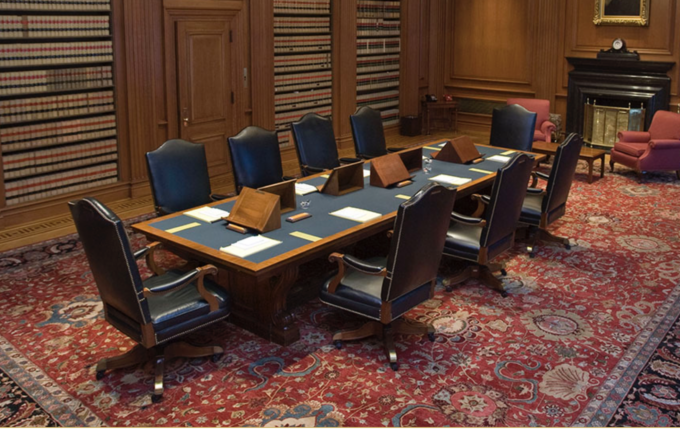
Conference room of the Supreme Court, where cases are decided. Photo: Supreme Court.

The Roberts Supreme Court is determined to earn the contempt with which it is viewed by most of the public. Its ruling this week essentially gave Donald Trump free rein to fire anyone in the government who doesn’t do what he wants. As corrupt as his administration has been to date, the Court’s ruling removed pretty much all remaining restraints.

Coupled with its recent ruling on revoking temporary protective status for immigrants from Trump’s list of “shithole” countries, the Court is effectively allowing Trump to make this a government of white Christian nationalists and for white Christian nationalists. The immigration ruling said that a long list of openly racist comments about people from the countries in question cannot be taken as evidence that Trump is motivated by racial animus in his immigration decision. In the same vein, Trump could fire every non-white or non-Christian person in the government as long as he insists his decisions were not based on race or religion.

But leaving Trump’s racism aside, let’s go back to the corruption that the Supreme Court felt it was important to unleash. As it stands now, agencies like the Food and Drug Administration (FDA) and Federal Aviation Administration (FAA) are supposed to be staffed by professionals who make decisions on approving prescription drugs for public use, or airplanes for flying, based on a careful examination of the evidence on their safety.

The Supreme Court just ruled that Donald Trump can fire the people overseeing these agencies for any reason whatsoever, or no reason at all. In their “unitary executive” theory, the writers of the Constitution felt it was essential that the president have the authority to fire anyone who makes decisions based on evidence or who refuses to lie for them.

This means that if the head of the FDA refuses to approve a drug based on the analysis of the experts who have examined the evidence, Trump can fire them. Similarly, if the FAA doesn’t greenlight a plane because it has failed safety tests, Trump can fire the FAA administrator.

Now, let’s bring Donald Trump’s family into the picture. (I’m always hesitant to mention a new grift on the possibility that the Trumpers would do it, if they had only thought of it.) Suppose Don Jr. has a 10 percent stake in a drug company that is pushing an ineffective, or even harmful, drug as a cure for cancer. The Supreme Court has ruled that Trump can tell the FDA commissioner that they must ignore the judgment of the experts who have examined the evidence and approve Don Jr.’s drug.

The same applies to planes. Eric can take a stake in an airplane manufacturer and demand that the FAA approve its latest plane, or his daddy will fire the commissioner. And if the commissioner happens to be a principled person who refuses to jeopardize public safety to keep their job, the Supreme Court says Trump can fire them and appoint an acting commissioner who will approve Eric’s plane.

If these stories sound far-fetched to you, then you haven’t been paying attention. Trump and his family are openly using the government to steal money in every way imaginable. The Supreme Court just gave them even more ways.

Of course, as the dissenters pointed out, it would not even make sense for Congress to have created these agencies in the first place if the president could put his political hacks in all the positions with any authority. What’s the point of having an FDA if it only approves the drugs of companies that make payoffs to the president’s family?

Trump has said he wanted to downsize government, and the Supreme Court has just come out strongly in favor of that view. Since it has ruled that federal agencies should all be cesspools of corruption, they might as well be shut down. Drug approvals based on payoffs to the Trump family are meaningless. Let’s just save the money and let drug companies push whatever crap they want in whatever way they want. At least no one will be fooled by a federal agency certifying the drugs as safe and effective.

This first appeared on Dean Baker’s Beat the Press blog.

Dean Baker is the senior economist at the Center for Economic and Policy Research in Washington, DC. 


Affirmative Action is Alive and Well . . . If You are Rich and White

 July 3, 2026

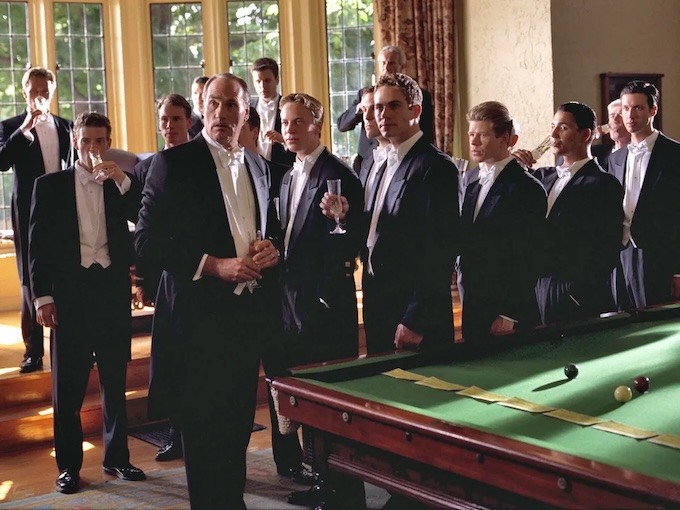
Still from The Skulls.

Three years ago, a major Supreme Court ruling struck down affirmative action in higher education admissions. Well, that is what they would like people to believe. In fact, there are still many preference policies in elite college admissions — especially if the student is rich and White. As the Trump administration continues to campaign against universities it claims are using race-related admissions policies that disadvantage White students, it has been silent about the many ways that White students are granted preferential treatment.

It is not hard to find high-profile examples. By his own admission, President George W. Bush was a C-student at Yale; he liked to remind people that even a C-student can become president. Bush also was a C-student in high school, and his SAT score was below the median for his class at Yale. Why might an academically mediocre student gain admission to an Ivy League university?

Bush had many characteristics that gave him advantages. The most important one is that he was a legacy — his father and grandfather both graduated from Yale. This meant that his chance of admission would be higher than other similar students without legacy status. And because of the history of racial discrimination, White students are more likely to have this type of legacy status.

Another admissions advantage is having a parent willing to make a hefty donation. The father of Donald Trump’s son-in-law, Jared Kushner, donated $2.5 million to Harvard in 1998. Kushner was then accepted there, even though reports suggest that he did not have an impressive high school academic record. The economist Raj Chetty and his colleagues found that being from a family in the richest 1 percent increases the odds of a student’s admission to an elite college by 34 percent.

This preference for the very wealthy has clear racial implications. Despite the visibility of a few rich Black celebrities, Black families are significantly underrepresented among the ultra-rich. While about 13 percent of high school students are Black, only 3 percent of the richest 1 percent of families are Black. Meanwhile, about half of high school students are White, but over 80 percent of the richest 1 percent of families are White. The admissions preference for the richest 1 percent functions as a White preference.

There are other policies that serve the same ends. Students at elite colleges aredisproportionately from the Northeast. To diversify their enrollment, elite schools give a preference to applicants from underrepresented states. As one admissions consultant stated, “You have a much better chance of getting in if you’re in a state that might be in a more rural area” rather than a major city. An analysis of data from Brown University found that applicants from the very White states of North Dakota and Montana had an admissions rate more than twice that of applicants from New Jersey, a much more racially diverse state. This kind of preference could have benefited someone like Vice President JD Vance, who may have gained an advantage in admissions to Yale Law School because he is from a small town in Ohio.

Or consider athletic recruiting, which has been called “the biggest form of affirmative action in American higher education.” Elite schools like Harvard recruit for sports such as skiing, sailing, water polo, rowing, squash, fencing, and golf, and the recruited athletes are overwhelmingly wealthy, White students. Elite colleges also rely more heavily on ‘early decision’ admissions programs that require a student applicant to agree to attend the school if accepted. The acceptance rate for such applicants is higher than for regular admissions, and the pool of applications tends to skew White and wealthier. As the journalist Jeffrey Selingo reasons, “Students from upper-middle-class and wealthy families are willing to trade the ability to compare financial aid offers for an increased chance of getting in.”

Using the Supreme Court decision as its guide, Trump’s Justice Department is working to make sure that Black and Hispanic students are extremely underrepresented in elite medical schools. The department claims to be working to prevent the use of “racial proxies”—policies that are race-neutral but that provide a disproportionate benefit to a particular racial group.

Although legacy, donor, geographic, athletic, and early decision admission preferences all tilt in favor of White applicants, the Justice Department does not have an interest in preventing the use of these proxies for White students. It only has an interest in proxies for Black and Hispanic students and in blocking these students’ admission into elite education. In other words, the Trump Justice Department is practicing racial discrimination, not fighting it.

This originally appeared on CEPR.

Algernon Austin, a senior research fellow at the Center for Economic and Policy Research, has conducted research and writing on issues of race and racial inequality for over 20 years. His primary focus has been on the intersection of race and the economy.