Progressive believe that the core claims of this nation—fairness, equality, freedom, and justice—are their own. And they are right
“This year as a time when democracy itself is under serious threat, progressives are seeking ways to claim their patriotism and recapture the flag,” write Dreier and Flack.
(Photo by Bradyn Shock on Unsplash)
Dick Flacks
Jul 04, 2026
Jul 04, 2026
Common Dreams
July 4 is the big occasion for Americans to express patriotism, none more so than this year, the 250th anniversary of the nation’s founding. But the ways we do so are as diverse as the country. People and groups from right to left celebrate in conflicting ways and with conflicting views—from “love it or leave it” to “love it and fix it.”
This year as a time when democracy itself is under serious threat, progressives are seeking ways to claim their patriotism and recapture the flag.
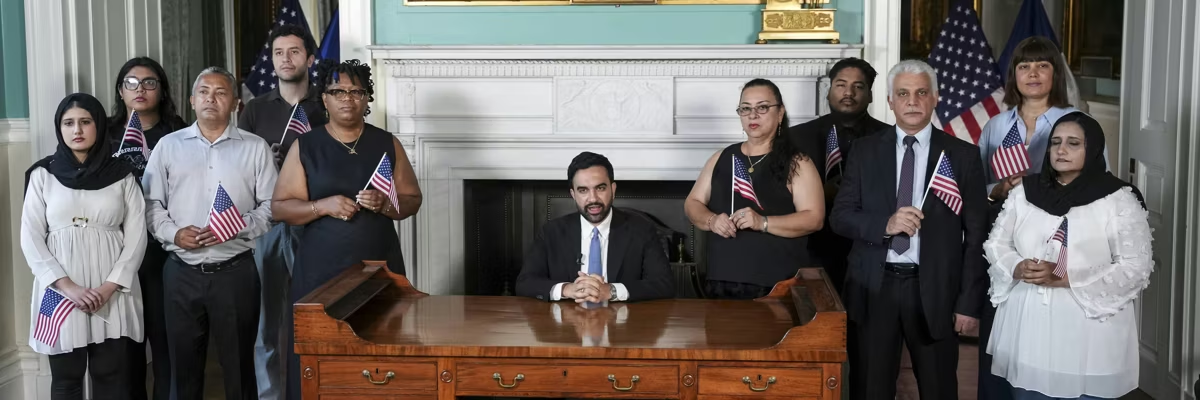
“America is beautiful, contradictory, unfinished,” wrote Zohran Mamdani last July 4 before he had been elected mayor of New York City. “I am proud of our country even as we constantly strive to make it better, to protect and deepen our democracy, to fulfill its promise for each and every person who calls it home. Happy Independence Day. No Kings in America.”
Since the American Revolution, each generation of progressives has expressed an American patriotism rooted in democratic values that challenged jingoism and “my country—right or wrong” thinking, rejecting blind nationalism, militaristic drum beating, and sheep-like conformism. Democratic movements—abolition of slavery, farmers’ populism, women’s suffrage, workers’ rights, civil rights, environmentalism, gay rights, and others—sought to overturn the established order while claiming to fulfill America’s promise. They believed that America’s core claims—fairness, equality, freedom, justice—were their own.
Even the founders would be aghast at how far Trump, and his courtiers, as well as most Republican politicians, have gone to establish an authoritarian state.
As Rev. Dr. Martin Luther King, Jr., declared in a speech during the Montgomery bus boycott in 1955, “The great glory of American democracy is the right to protest for right.”.
Donald Trump consciously and cynically has been re-enacting the long tradition of patriotism as jingoism, nationalism, flag waving, and “America first” sloganeering. What seems new is his systematic drive to debase major symbols of national identity—such as the White House, the reflecting pool, and Arlington Cemetery—while wrecking the entire national plan to celebrate America at 250.
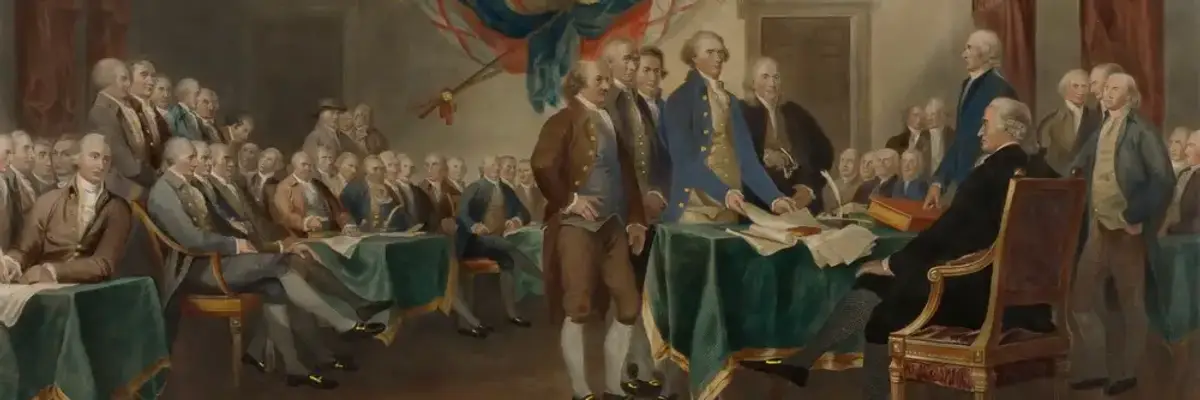
Although they disagreed on many issues, the founders were adamant that they didn’t want the country to be run by an all-powerful king. Yet here we are 250 year later, governed by a president publicly claiming such power, with a Supreme Court majority acting as his enablers,
Of course, many of the founders were skeptical of a robust democracy. They created institutions, including the Supreme Court, the Senate, and the Electoral College, that were never intended to completely reflect the voice of the people.
Even the founders, however, would be aghast at how far Trump, and his courtiers, as well as most Republican politicians, have gone to establish an authoritarian state, exploiting the opportunities provided by the Constitution’s elitist features.
The Gallup poll regularly asks Americans what the founders would think of America today. This year, only 19% think the signers of the Declaration of Independence would be pleased with how the country has turned out. Over three quarters (77%) now say the founders would be disappointed. This compares with 42% in 2001.
Americans’ disappointment with the country is obviously tied to Trump’s performance and his low favorability ratings in the polls. We expect our nation’s leaders, especially our president, to express a deep loyalty to a vision bigger than one person. But Trump has no overarching vision. Besides grabbing power and wealth for himself, his major commitment appears to white nationalism—turning America into a country for the uber rich and white people only. In contrast to the patriotism expressed in Emma Lazarus’ poem at the base of the Statue of Liberty (“Give me your tired, your poor, your huddled masses yearning to breathe free”), Trump wants, to rid the nation of immigrants of color, whom, in his eugenicist view, he thinks “pollute” the country with bad genes.
Trump and his coterie have systematically acted to undermine the spirit and letter of the Constitution. One of America’s core beliefs since its founding has been that elections should determine who becomes president and that it is important to ensure the orderly transfer of power. But insurrectionists at the Capitol building on January 6, 2021—urged on by and loyal to Trump— attempted to stop that process, while. carrying American flags. Many of these were convicted and sentenced for insurrectionary crimes. Trump’s blanket pardon and embrace of the convicted was an announcement of his autocratic hopes and plans.
As the 250th anniversary approaches, Trump is intensifying his campaign to end the right to vote—the fundamental idea of the American Revolution. Abetted by the Supreme Court majority’s dismantling of the Voting Rights Act (a key victory of the 1960s), and building on the ongoing GOP campaign to maintain power as they lose their capacity to win the national popular vote, Trump is trying to undermine states’ control over the electoral process.
He’s used his powers to eviscerate other cherished rights, including free speech, a free press, and freedom of assembly and dissent. He has used the tools of government—including the FBI, the Justice Department, and the IRS—to unleash his revenge on protesters, the media, immigrants, Democrats, and all others he considers his opponents.
Right wingers have always wrapped themselves in the flag under the guise of being the true patriots. ‘“Americanism” campaigns in the early 20th century were designed to undermine the labor movement and limit immigration. Congressional and state legislative “Unamerican Activities” committees collaborated with the FBI beginning in the 1930s, to build blacklists against leftwing activists and artists,
Even American Nazis sought to be seen as patriots. On Feb. 20, 1939, 20,000 of them filled Madison Square Garden for a “Pro-America Rally.” They erected a massive 30-foot banner of George Washington (it was timed to celebrate his birthday) surrounded by American flags and swastika banners.
Trump’s own MAGA rallies feel like modern-day versions of that Nazi event. He fetishizes the American flag and other patriotic symbols, even while displaying a shallow, ahistorical, and bizarre understanding of what they meant.
Once, at a campaign rally in Tampa, as his cult followers chanted, “Build that wall,” Trump interrupted his speech to give a bear hug to an American flag on the stage behind him.
“We want to make sure that anyone who seeks to join our country, shares our values and has the capacity to love our people,” Trump said at a rally at the Kennedy Center in 2017.
“We all salute the same great American flag,” Trump said in his 2017 inauguration address—a line he has repeated in many speeches since then.
To Trump and his followers, the flag is synonymous with “America First.” It was a slogan used to unite isolationists and Nazi sympathizers against involvement in the European war in 1939. For Trump, it means reporting undocumented immigrants and caging their children in detention centers, restricting visitors from Muslim countries, withdrawing from the Paris climate accord and other international agreements, and engaging in friendships with like-minded dictators.
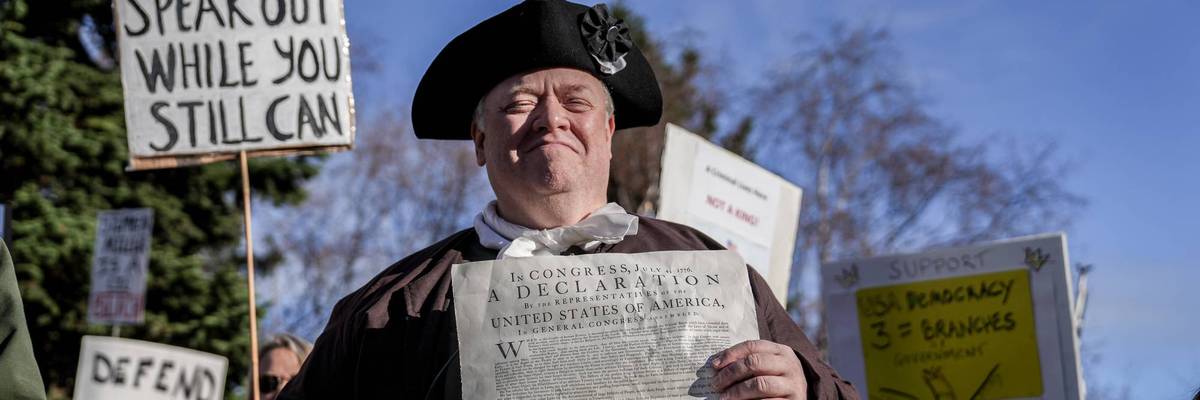
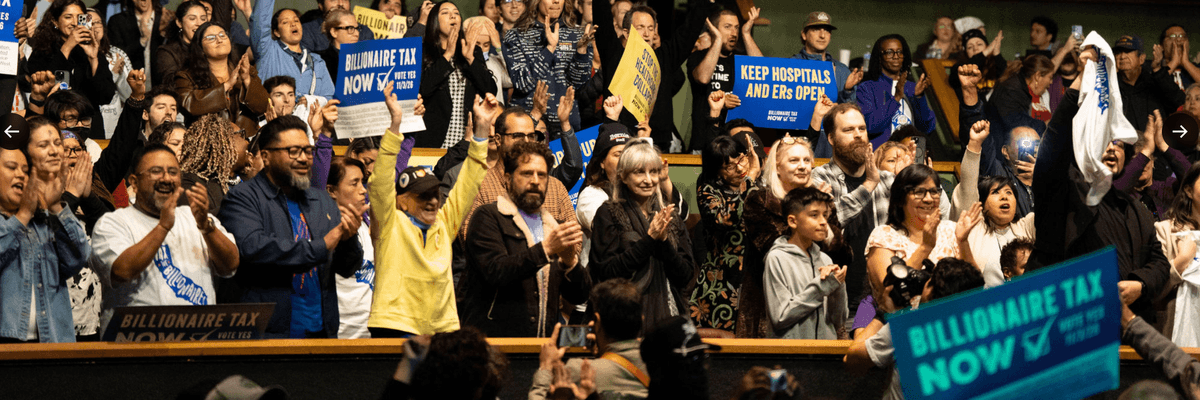
Trump’s faux patriotism and its clownish griftiness has been providing a wide space for coalitions of resistance. The “No Kings” protests and the slogan itself help provide a very fitting frame for revitalizing a progressive, democratic, populist patriotism. Many participants waved American flags.
America now confronts a new version of the Gilded Age, brought upon by Wall Street greed and corporate malfeasance.
President Barack Obama said: “I have no doubt that, in the face of impossible odds, people who love their country can change it.” He observed that, “loving your country shouldn’t just mean watching fireworks on the Fourth of July. Loving your country must mean accepting your responsibility to do your part to change it. If you do, your life will be richer, our country will be stronger.”
President Joe Biden said that “we’re all part of a chain of patriots” who fought for democracy, freedom, fair play, peace, security, and opportunity. Patriots, he explained, seek “the right to equal justice under the law; the right to vote and have that vote counted; the right to breathe clean air, drink clean water, and know that our children and grandchildren will be safe on this planet for generations to come; the right to rise in the world as far as your God-given talent can take you, unlimited by barriers of privilege or power.”
In the Sixties, as hundreds of thousands of American youth were radicalized by the senseless Vietnam war, resistance included acts of defiance of patriotic symbols and rhetoric. Flag burnings would sometimes combine with the burning of draft cards. But other radicals took a different stance. In 1968, in a famous speech against the Vietnam war, Norman Thomas, the aging leader of the rather moribund Socialist Party, proclaimed, “I come to cleanse the American flag, not burn it.”
“It was as a Socialist, and because I was a Socialist, that I fell in love with America,” wrote Michael Harrington, the founder of Democratic Socialists of America, in his 1973 book, Fragments of a Century. “In saying that, I am not indulging in romantic nostalgia about youthful days on the road but rather underlining a crucial political truth. If the Left wants to change this country because it hates it, then the people will never listen to the Left and the people will be right. To be a Socialist is to make an act of faith, of love even, toward this land. It is to sense the seed beneath the snow; to see, beneath the veneer of corruption and meanness and the commercialization of human relationships, men and women capable of controlling their own destinies. To be a radical is, in the best and only decent sense of the word, patriotic.”
Harrington was identifying with the many radicals and progressive reformers who proudly asserted their patriotism. To them, America promised democratic fulfillment—economic and social equality, mass participation in politics, free speech, and civil liberties, elimination of the second-class citizenship of women and people of color, a welcome mat for the world’s oppressed people. The reality of corporate power, right wing xenophobia, and social injustice only fueled progressives’ allegiance to these principles and the struggle to achieve them.
It is largely underrecognized that some of the most important and popular ways all Americans experience and express patriotism were the creation of radical writers and artists. What they created continues to inspire.
Francis Bellamy, a Baptist minister and Christian socialist who lived from 1855 to 1931, wrote the Pledge of Allegiance in 1892 to express his outrage at the Gilded Age’s widening economic divide. He had been ousted from his Boston church for his sermons depicting Jesus as a socialist, and for his work among the It was the Gilded Age, an era marked by major political, economic, and social conflicts. Progressive reformers were outraged by the widening gap between rich and poor, and the behavior of corporate robber barons who were exploiting workers, gouging consumers, and corrupting politics with their money. Workers were organizing unions. Farmers were joining forces in the so-called Populist movement to rein in the power of banks, railroads, and utility companies. Reformers fought for child labor laws, against slum housing, and in favor of women’s suffrage. Socialists and other leftist radicals were gaining new converts.
In foreign affairs, Americans were battling over the nation’s role in the world. America was beginning to act like an imperial power, justifying its expansion with a combination of white supremacy, manifest destiny, and the argument that it was spreading democracy. At the time, nativist groups across the country were pushing for restrictions on immigrants—Catholics, Jews, and Asians—who were cast as polluting Protestant America. In the South, the outcome of the Civil War still inflamed regional passions. Many Southerners, including Civil War veterans, swore allegiance not to the American but to the Confederate flag.
Bellamy, a cousin of Edward Bellamy, author of two bestselling socialistic books, Looking Backward and Equality, believed that unbridled capitalism, materialism, and individualism betrayed America’s promise. He hoped that the Pledge of Allegiance would promote a different moral vision to counter the rampant greed he argued was undermining the nation.
When composing the Pledge, Bellamy had initially intended to use the phrase “liberty, fraternity, and equality,” but concluded that the radical rhetoric of the French Revolution wouldn’t sit well with many Americans. So he coined the phrase, “one nation, indivisible, with liberty and justice for all,” to express his more egalitarian vision of America, and a secular patriotism aimed at helping unite a divided nation.
In 1891, Youth’s Companion, a magazine for young people published in Boston with a circulation of about 500,000, hired Bellamy to organize a public relations campaign to celebrate the 400th anniversary of Christopher Columbus’ so-called discovery of America by promoting use of the flag in public schools.
Bellamy gained the support of the National Education Association, along with President Benjamin Harrison and Congress, for a national ritual observance in the schools, and he wrote the Pledge of Allegiance as part of the program’s flag salute ceremony.
Bellamy thought such an event would be a powerful expression on behalf of free public education. Moreover, he wanted all the schoolchildren of America to recite the pledge at the same moment. He hoped the pledge would promote a moral vision to counter the individualism embodied in capitalism and expressed in the climate of the Gilded Age.
In 1923, over the objections of the aging Bellamy, the National Flag Conference, led by the American Legion and the Daughters of the American Revolution, changed the opening, “I pledge allegiance to my flag,” to “I pledge allegiance to the flag of the United States of America.” Ostensibly, it was revised to make sure that immigrant children—who might have thought that “my flag” referred to their native countries—knew that they were pledging allegiance to the American flag.
In 1954, at the height of the Cold War—when many political leaders believed that the nation was threatened by godless communism—the Knights of Columbus led a successful campaign to lobby Congress to add the words “under God.”
A year after Bellamy composed the pledge, Kathryn Lee Bates wrote the poem “America the Beautiful,” which was later set to music by Samuel Ward, the organist at Grace Episcopal Church in Newark, New Jersey
Like Bellamy, Bates was a Christian socialist. A well-respected poet and professor of English at Wellesley College, Bates (1859-1929) was also a lesbian who lived with Katharine Coman, an economics professor. They belonged to progressive circles in the Boston area that supported labor unions, advocated for immigrants, and fought for women’s suffrage. She was an ardent foe of American imperialism.
“America the Beautiful” was initially published in 1895 to commemorate the Fourth of July. The poem is usually heard as an unalloyed paean to American virtue. But a close reading of her words makes it clear that she had something more in mind. She wrote:
America! America!
God shed His grace on thee
Till selfish gain no longer stain,
The banner of the free!
Bates hoped that a progressive movement could overcome the Gilded Age’s greed. And when sung by Ray Charles and other African American artists, listeners can’t help but be inspired by the song’s plea for brotherhood – or, as the left calls it, solidarity.
Lazarus, author of the poem inscribed on the Statue of Liberty, was a Jewish poet of considerable reputation in her day, who was a strong supporter of Henry George and his “socialistic” single-tax program, and a friend of William Morris, a leading British socialist. Her welcome to the “wretched refuse” of the Earth, written in 1883, was an effort to project an inclusive and egalitarian definition of the American Dream.
In the Depression years and during World War II, the fusion of populist, egalitarian, and anti-racist values with patriotic expression reached full flower. The rise of fascism was countered in the US with efforts to build a center-left coalition in critical support of the New Deal and a parallel cultural upsurge.
Langston Hughes’ poem, “Let America Be America Again,” written in 1936, contrasted the nation’s promise with its mistreatment of his fellow African-Americans, the poor, Native Americans, workers, farmers, and immigrants:
O, let my land be a land where Liberty
Is crowned with no false patriotic wreath
But opportunity is real, and life is free
Equality is in the air we breathe.
It’s a poem that encapsulates the anger and the hope integral to the American experience.
In 1939, composer Earl Robinson teamed with lyricist John La Touche to write “Ballad for Americans,” which was performed on the CBS radio network by Paul Robeson, at the time one of the best-known performers on the world stage, accompanied by chorus and orchestra. This 11-minute cantata provided a musical review of American history, depicted as a struggle between the “nobody who’s everybody” and an elite that fails to understand the real, democratic essence of America.
Broadcasts and recordings of “Ballad for Americans,” (by Bing Crosby as well as Robeson) were immensely popular. In the summer of 1940, it was performed at the national conventions of both the Republican and Communist parties. The work soon became a staple in school choral performances, but it was literally ripped out of many public school songbooks after Robinson and Robeson were identified with the radical left and blacklisted during the McCarthy period. Since then, “Ballad for Americans” has been periodically revived, notably during the bicentennial celebration in 1976, when a number of pop and country singers performed it in concerts and on TV. This might be the year to revive and revise it.
Earl Robinson wrote the melody for another important patriotic song of the World War 2 era -- “The House I Live In.” The lyric was written by Lewis Allen, the pen-name of a New York teacher, activist and poet named Abel Meeropol, who had, a few years earlier, written the anti-lynching anthem “Strange Fruit” for Billie Holiday.
The song was the centerpiece of an Oscar winning short film starring Frank Sinatra. In the film, Sinatra uses the song to instruct a group of kids who were bullying a Jewish classmate. Sinatra made the song a hit in 1945. Other versions were recorded by Robeson and by Josh White. Sinatra kept it in his repertoire for his whole career, even though he publicly associated with the Republican right (abandoning his earlier left-wing sympathies). Sinatra performed the song as the finale to a nationally broadcast celebration of the Statue of Liberty centenary, addressing it to Ronald and Nancy Reagan on the platform with him. Only a few watching were aware of the song’s origins.
Composer Aaron Copland’s “Fanfare for the Common Man” and “A Lincoln Portrait,” both written in 1942, are now patriotic musical standards, regularly performed at major civic events. Copland was a member of a radical composers’ group as well as a gay man.
Many Americans consider Woody Guthrie’s song “This Land Is Your Land,” penned in 1940, to be our unofficial national anthem. Guthrie, a radical, was inspired to write the song as an answer to Irving Berlin’s popular “God Bless America,” which he thought failed to recognize that it was the “people” to whom America belonged.
The song reflects Guthrie’s belief that patriotism and support for the underdog were interconnected. He celebrated America’s natural beauty and bounty, but criticized the country for its failure to share its riches. This is revealed in the song’s last and least-known verse, which Pete Seeger and Bruce Springsteen performed at Obama’s pre-inaugural concert in 2009 in front of the Lincoln Memorial, with Obama in the audience:
One bright sunny morning;
In the shadow of the steeple;
By the relief office;
I saw my people.
As they stood hungry;
I stood there wondering;
If this land was made for you and me.
You can find Spanish and Native American versions of the song. Guthrie would have approved. Both he and Seeger, who were part of Communist circles, helped popularize socially conscious music reflecting the country’s diversity. They are now viewed as American icons.
During the 1960s, American progressives continued to seek ways to fuse their love of country with their opposition to the government’s policies. The March on Washington in 1963 gathered at the Lincoln Memorial, where Martin Luther King famously quoted the words to “My Country ‘Tis of Thee,” repeating the phrase “Let freedom ring” 11 times. That 19th century song seems politically neutral, but it was a defiantly anti-monarchy anthem, written as a kind of parody of “God Save the King.” An abolitionist version soon followed its initial release. Marian Anderson, the great African American contralto, sang the song on the steps of the Lincoln Memorial in 1939 because the Daughters of the American Revolution refused to allow her to perform at its Constitution Hall due to her race.
Phil Ochs, then part of a new generation of politically conscious singer-songwriters who emerged during the 1960s, wrote an anthem in the Guthrie vein, “The Power and the Glory,” that coupled love of country with a strong plea for justice and equality. The words to the chorus echo the sentiments of the anti-Vietnam War movement:
Here is a land full of power and glory;
Beauty that words cannot recall;
Oh her power shall rest on the strength of her freedom;
Her glory shall rest on us all.
One of its stanzas updated Guthrie’s combination of outrage and patriotism:
Yet she’s only as rich as the poorest of her poor;
Only as free as the padlocked prison door;
Only as strong as our love for this land;
Only as tall as we stand.
This song later became part of the repertoire of the U.S. Army band.
In recent decades, Springsteen has closely followed in the Guthrie tradition. From “Born in the USA” to his songs about Tom Joad (the militant protagonist in John Steinbeck’s The Grapes of Wrath), to his anthem about the 9/11 tragedy (“Empty Sky”), to his album Wrecking Ball (including its opening song, “We Take Care of Our Own”), Springsteen has championed the downtrodden while challenging America to live up to its ideals. In January, Springsteen wrote “Streets of Minneapolis,” which describe how “a city aflame fought fire and ice ‘neath an occupier’s boots,” which Springsteen calls “King Trump’s private army.” He wrote it in response to the second deadly shooting by federal immigration agents in Minneapolis and dedicated it to the people of that city. At the opening of Obama’s new presidential center in Chicago, Springsteen sang his song, “Land of Hope and Dreams,” which includes lines adopted from Guthrie’s song, “This Train is Bound for Glory.” The train – a metaphor for America -- carries “saints and sinners,” “losers and winners,” and “fools and kings.”
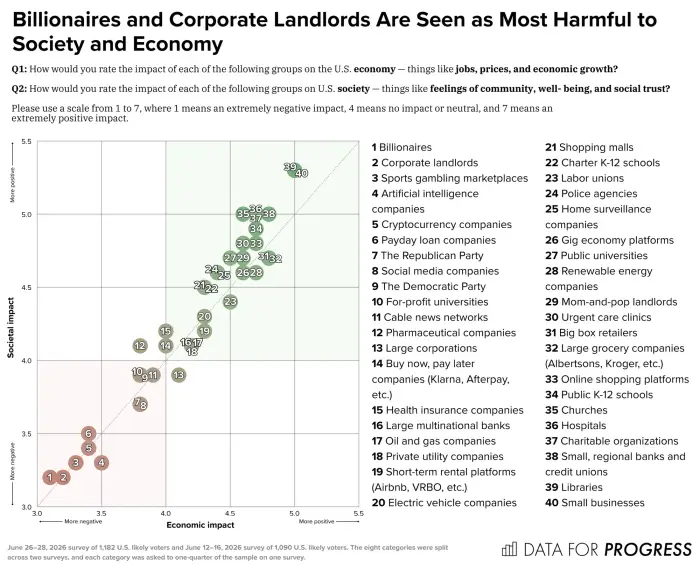
America now confronts a new version of the Gilded Age, brought upon by Wall Street greed and corporate malfeasance. Americans are upset by the unbridled selfishness and political influence-peddling demonstrated by banks, oil companies, drug companies, insurance companies, and other large corporations. They are angry at the growing power of American-based global firms who show no loyalty to their country, outsource jobs to low-wage countries, avoid paying taxes, and pollute the environment.
During the ICE raids in Minnesota a group called “Singing Resistance” emerged to encourage singing during protests. Troubadours of multiple generations sang new and classic songs of protest on stage and via You Tube.
One fascinating moment happened at this year’s Super Bowl when Coco Jones sang “Lift Every Voice and Sing.” For 100 years that song has been the African American national anthem. It lyrics include these lines:
Sing a song full of the faith that the dark past has taught us,
Sing a song full of the hope that the present has brought us;
Facing the rising sun of our new day begun,
Let us march on ‘til victory is won.
To have it performed at the Super Bowl, alongside the “Star Spangled Banner,” may have been an affront to right-wingers, , but it was an inspiring moment for many other Americans. Cong. James Clyburn (D-South Carolina) has sponsored a bill to make “Life Every Voice” the national hymn.
Throughout American history, progressive movements had won major victories and also experienced setbacks. When those setbacks occur, it is understandable that people sometimes lose hope, and even give up the fight. But our history also teaches us that we can’t give up, because we must keep the struggle alive for a new generation.
Our work is licensed under Creative Commons (CC BY-NC-ND 3.0). Feel free to republish and share widely.
Peter Dreier
Peter Dreier is the E.P. Clapp distinguished professor of politics at Occidental College. He joined the Occidental faculty in January 1993 after serving for nine years as Director of Housing at the Boston Redevelopment Authority and senior policy advisor to Boston Mayor Ray Flynn. He is the author of "The 100 Greatest Americans of the 20th Century: A Social Justice Hall of Fame" (2012) and an editor (with Kate Aronoff and Michael Kazin) of "We Own the Future: Democratic Socialism, American Style" and co-author of "Baseball Rebels: The Players, People and Social Movements That Shook Up the Game and Changed America" (2022).
Full Bio >
July 4 is the big occasion for Americans to express patriotism, none more so than this year, the 250th anniversary of the nation’s founding. But the ways we do so are as diverse as the country. People and groups from right to left celebrate in conflicting ways and with conflicting views—from “love it or leave it” to “love it and fix it.”
This year as a time when democracy itself is under serious threat, progressives are seeking ways to claim their patriotism and recapture the flag.
“America is beautiful, contradictory, unfinished,” wrote Zohran Mamdani last July 4 before he had been elected mayor of New York City. “I am proud of our country even as we constantly strive to make it better, to protect and deepen our democracy, to fulfill its promise for each and every person who calls it home. Happy Independence Day. No Kings in America.”
Since the American Revolution, each generation of progressives has expressed an American patriotism rooted in democratic values that challenged jingoism and “my country—right or wrong” thinking, rejecting blind nationalism, militaristic drum beating, and sheep-like conformism. Democratic movements—abolition of slavery, farmers’ populism, women’s suffrage, workers’ rights, civil rights, environmentalism, gay rights, and others—sought to overturn the established order while claiming to fulfill America’s promise. They believed that America’s core claims—fairness, equality, freedom, justice—were their own.
Even the founders would be aghast at how far Trump, and his courtiers, as well as most Republican politicians, have gone to establish an authoritarian state.
As Rev. Dr. Martin Luther King, Jr., declared in a speech during the Montgomery bus boycott in 1955, “The great glory of American democracy is the right to protest for right.”.
Donald Trump consciously and cynically has been re-enacting the long tradition of patriotism as jingoism, nationalism, flag waving, and “America first” sloganeering. What seems new is his systematic drive to debase major symbols of national identity—such as the White House, the reflecting pool, and Arlington Cemetery—while wrecking the entire national plan to celebrate America at 250.
Although they disagreed on many issues, the founders were adamant that they didn’t want the country to be run by an all-powerful king. Yet here we are 250 year later, governed by a president publicly claiming such power, with a Supreme Court majority acting as his enablers,
Of course, many of the founders were skeptical of a robust democracy. They created institutions, including the Supreme Court, the Senate, and the Electoral College, that were never intended to completely reflect the voice of the people.
Even the founders, however, would be aghast at how far Trump, and his courtiers, as well as most Republican politicians, have gone to establish an authoritarian state, exploiting the opportunities provided by the Constitution’s elitist features.
The Gallup poll regularly asks Americans what the founders would think of America today. This year, only 19% think the signers of the Declaration of Independence would be pleased with how the country has turned out. Over three quarters (77%) now say the founders would be disappointed. This compares with 42% in 2001.
Americans’ disappointment with the country is obviously tied to Trump’s performance and his low favorability ratings in the polls. We expect our nation’s leaders, especially our president, to express a deep loyalty to a vision bigger than one person. But Trump has no overarching vision. Besides grabbing power and wealth for himself, his major commitment appears to white nationalism—turning America into a country for the uber rich and white people only. In contrast to the patriotism expressed in Emma Lazarus’ poem at the base of the Statue of Liberty (“Give me your tired, your poor, your huddled masses yearning to breathe free”), Trump wants, to rid the nation of immigrants of color, whom, in his eugenicist view, he thinks “pollute” the country with bad genes.
Trump and his coterie have systematically acted to undermine the spirit and letter of the Constitution. One of America’s core beliefs since its founding has been that elections should determine who becomes president and that it is important to ensure the orderly transfer of power. But insurrectionists at the Capitol building on January 6, 2021—urged on by and loyal to Trump— attempted to stop that process, while. carrying American flags. Many of these were convicted and sentenced for insurrectionary crimes. Trump’s blanket pardon and embrace of the convicted was an announcement of his autocratic hopes and plans.
As the 250th anniversary approaches, Trump is intensifying his campaign to end the right to vote—the fundamental idea of the American Revolution. Abetted by the Supreme Court majority’s dismantling of the Voting Rights Act (a key victory of the 1960s), and building on the ongoing GOP campaign to maintain power as they lose their capacity to win the national popular vote, Trump is trying to undermine states’ control over the electoral process.
He’s used his powers to eviscerate other cherished rights, including free speech, a free press, and freedom of assembly and dissent. He has used the tools of government—including the FBI, the Justice Department, and the IRS—to unleash his revenge on protesters, the media, immigrants, Democrats, and all others he considers his opponents.
Right wingers have always wrapped themselves in the flag under the guise of being the true patriots. ‘“Americanism” campaigns in the early 20th century were designed to undermine the labor movement and limit immigration. Congressional and state legislative “Unamerican Activities” committees collaborated with the FBI beginning in the 1930s, to build blacklists against leftwing activists and artists,
Even American Nazis sought to be seen as patriots. On Feb. 20, 1939, 20,000 of them filled Madison Square Garden for a “Pro-America Rally.” They erected a massive 30-foot banner of George Washington (it was timed to celebrate his birthday) surrounded by American flags and swastika banners.
Trump’s own MAGA rallies feel like modern-day versions of that Nazi event. He fetishizes the American flag and other patriotic symbols, even while displaying a shallow, ahistorical, and bizarre understanding of what they meant.
Once, at a campaign rally in Tampa, as his cult followers chanted, “Build that wall,” Trump interrupted his speech to give a bear hug to an American flag on the stage behind him.
“We want to make sure that anyone who seeks to join our country, shares our values and has the capacity to love our people,” Trump said at a rally at the Kennedy Center in 2017.
“We all salute the same great American flag,” Trump said in his 2017 inauguration address—a line he has repeated in many speeches since then.
To Trump and his followers, the flag is synonymous with “America First.” It was a slogan used to unite isolationists and Nazi sympathizers against involvement in the European war in 1939. For Trump, it means reporting undocumented immigrants and caging their children in detention centers, restricting visitors from Muslim countries, withdrawing from the Paris climate accord and other international agreements, and engaging in friendships with like-minded dictators.
Trump’s faux patriotism and its clownish griftiness has been providing a wide space for coalitions of resistance. The “No Kings” protests and the slogan itself help provide a very fitting frame for revitalizing a progressive, democratic, populist patriotism. Many participants waved American flags.
America now confronts a new version of the Gilded Age, brought upon by Wall Street greed and corporate malfeasance.
President Barack Obama said: “I have no doubt that, in the face of impossible odds, people who love their country can change it.” He observed that, “loving your country shouldn’t just mean watching fireworks on the Fourth of July. Loving your country must mean accepting your responsibility to do your part to change it. If you do, your life will be richer, our country will be stronger.”
President Joe Biden said that “we’re all part of a chain of patriots” who fought for democracy, freedom, fair play, peace, security, and opportunity. Patriots, he explained, seek “the right to equal justice under the law; the right to vote and have that vote counted; the right to breathe clean air, drink clean water, and know that our children and grandchildren will be safe on this planet for generations to come; the right to rise in the world as far as your God-given talent can take you, unlimited by barriers of privilege or power.”
In the Sixties, as hundreds of thousands of American youth were radicalized by the senseless Vietnam war, resistance included acts of defiance of patriotic symbols and rhetoric. Flag burnings would sometimes combine with the burning of draft cards. But other radicals took a different stance. In 1968, in a famous speech against the Vietnam war, Norman Thomas, the aging leader of the rather moribund Socialist Party, proclaimed, “I come to cleanse the American flag, not burn it.”
“It was as a Socialist, and because I was a Socialist, that I fell in love with America,” wrote Michael Harrington, the founder of Democratic Socialists of America, in his 1973 book, Fragments of a Century. “In saying that, I am not indulging in romantic nostalgia about youthful days on the road but rather underlining a crucial political truth. If the Left wants to change this country because it hates it, then the people will never listen to the Left and the people will be right. To be a Socialist is to make an act of faith, of love even, toward this land. It is to sense the seed beneath the snow; to see, beneath the veneer of corruption and meanness and the commercialization of human relationships, men and women capable of controlling their own destinies. To be a radical is, in the best and only decent sense of the word, patriotic.”
Harrington was identifying with the many radicals and progressive reformers who proudly asserted their patriotism. To them, America promised democratic fulfillment—economic and social equality, mass participation in politics, free speech, and civil liberties, elimination of the second-class citizenship of women and people of color, a welcome mat for the world’s oppressed people. The reality of corporate power, right wing xenophobia, and social injustice only fueled progressives’ allegiance to these principles and the struggle to achieve them.
It is largely underrecognized that some of the most important and popular ways all Americans experience and express patriotism were the creation of radical writers and artists. What they created continues to inspire.
Francis Bellamy, a Baptist minister and Christian socialist who lived from 1855 to 1931, wrote the Pledge of Allegiance in 1892 to express his outrage at the Gilded Age’s widening economic divide. He had been ousted from his Boston church for his sermons depicting Jesus as a socialist, and for his work among the It was the Gilded Age, an era marked by major political, economic, and social conflicts. Progressive reformers were outraged by the widening gap between rich and poor, and the behavior of corporate robber barons who were exploiting workers, gouging consumers, and corrupting politics with their money. Workers were organizing unions. Farmers were joining forces in the so-called Populist movement to rein in the power of banks, railroads, and utility companies. Reformers fought for child labor laws, against slum housing, and in favor of women’s suffrage. Socialists and other leftist radicals were gaining new converts.
In foreign affairs, Americans were battling over the nation’s role in the world. America was beginning to act like an imperial power, justifying its expansion with a combination of white supremacy, manifest destiny, and the argument that it was spreading democracy. At the time, nativist groups across the country were pushing for restrictions on immigrants—Catholics, Jews, and Asians—who were cast as polluting Protestant America. In the South, the outcome of the Civil War still inflamed regional passions. Many Southerners, including Civil War veterans, swore allegiance not to the American but to the Confederate flag.
Bellamy, a cousin of Edward Bellamy, author of two bestselling socialistic books, Looking Backward and Equality, believed that unbridled capitalism, materialism, and individualism betrayed America’s promise. He hoped that the Pledge of Allegiance would promote a different moral vision to counter the rampant greed he argued was undermining the nation.
When composing the Pledge, Bellamy had initially intended to use the phrase “liberty, fraternity, and equality,” but concluded that the radical rhetoric of the French Revolution wouldn’t sit well with many Americans. So he coined the phrase, “one nation, indivisible, with liberty and justice for all,” to express his more egalitarian vision of America, and a secular patriotism aimed at helping unite a divided nation.
In 1891, Youth’s Companion, a magazine for young people published in Boston with a circulation of about 500,000, hired Bellamy to organize a public relations campaign to celebrate the 400th anniversary of Christopher Columbus’ so-called discovery of America by promoting use of the flag in public schools.
Bellamy gained the support of the National Education Association, along with President Benjamin Harrison and Congress, for a national ritual observance in the schools, and he wrote the Pledge of Allegiance as part of the program’s flag salute ceremony.
Bellamy thought such an event would be a powerful expression on behalf of free public education. Moreover, he wanted all the schoolchildren of America to recite the pledge at the same moment. He hoped the pledge would promote a moral vision to counter the individualism embodied in capitalism and expressed in the climate of the Gilded Age.
In 1923, over the objections of the aging Bellamy, the National Flag Conference, led by the American Legion and the Daughters of the American Revolution, changed the opening, “I pledge allegiance to my flag,” to “I pledge allegiance to the flag of the United States of America.” Ostensibly, it was revised to make sure that immigrant children—who might have thought that “my flag” referred to their native countries—knew that they were pledging allegiance to the American flag.
In 1954, at the height of the Cold War—when many political leaders believed that the nation was threatened by godless communism—the Knights of Columbus led a successful campaign to lobby Congress to add the words “under God.”
A year after Bellamy composed the pledge, Kathryn Lee Bates wrote the poem “America the Beautiful,” which was later set to music by Samuel Ward, the organist at Grace Episcopal Church in Newark, New Jersey
Like Bellamy, Bates was a Christian socialist. A well-respected poet and professor of English at Wellesley College, Bates (1859-1929) was also a lesbian who lived with Katharine Coman, an economics professor. They belonged to progressive circles in the Boston area that supported labor unions, advocated for immigrants, and fought for women’s suffrage. She was an ardent foe of American imperialism.
“America the Beautiful” was initially published in 1895 to commemorate the Fourth of July. The poem is usually heard as an unalloyed paean to American virtue. But a close reading of her words makes it clear that she had something more in mind. She wrote:
America! America!
God shed His grace on thee
Till selfish gain no longer stain,
The banner of the free!
Bates hoped that a progressive movement could overcome the Gilded Age’s greed. And when sung by Ray Charles and other African American artists, listeners can’t help but be inspired by the song’s plea for brotherhood – or, as the left calls it, solidarity.
Lazarus, author of the poem inscribed on the Statue of Liberty, was a Jewish poet of considerable reputation in her day, who was a strong supporter of Henry George and his “socialistic” single-tax program, and a friend of William Morris, a leading British socialist. Her welcome to the “wretched refuse” of the Earth, written in 1883, was an effort to project an inclusive and egalitarian definition of the American Dream.
In the Depression years and during World War II, the fusion of populist, egalitarian, and anti-racist values with patriotic expression reached full flower. The rise of fascism was countered in the US with efforts to build a center-left coalition in critical support of the New Deal and a parallel cultural upsurge.
Langston Hughes’ poem, “Let America Be America Again,” written in 1936, contrasted the nation’s promise with its mistreatment of his fellow African-Americans, the poor, Native Americans, workers, farmers, and immigrants:
O, let my land be a land where Liberty
Is crowned with no false patriotic wreath
But opportunity is real, and life is free
Equality is in the air we breathe.
It’s a poem that encapsulates the anger and the hope integral to the American experience.
In 1939, composer Earl Robinson teamed with lyricist John La Touche to write “Ballad for Americans,” which was performed on the CBS radio network by Paul Robeson, at the time one of the best-known performers on the world stage, accompanied by chorus and orchestra. This 11-minute cantata provided a musical review of American history, depicted as a struggle between the “nobody who’s everybody” and an elite that fails to understand the real, democratic essence of America.
Broadcasts and recordings of “Ballad for Americans,” (by Bing Crosby as well as Robeson) were immensely popular. In the summer of 1940, it was performed at the national conventions of both the Republican and Communist parties. The work soon became a staple in school choral performances, but it was literally ripped out of many public school songbooks after Robinson and Robeson were identified with the radical left and blacklisted during the McCarthy period. Since then, “Ballad for Americans” has been periodically revived, notably during the bicentennial celebration in 1976, when a number of pop and country singers performed it in concerts and on TV. This might be the year to revive and revise it.
Earl Robinson wrote the melody for another important patriotic song of the World War 2 era -- “The House I Live In.” The lyric was written by Lewis Allen, the pen-name of a New York teacher, activist and poet named Abel Meeropol, who had, a few years earlier, written the anti-lynching anthem “Strange Fruit” for Billie Holiday.
The song was the centerpiece of an Oscar winning short film starring Frank Sinatra. In the film, Sinatra uses the song to instruct a group of kids who were bullying a Jewish classmate. Sinatra made the song a hit in 1945. Other versions were recorded by Robeson and by Josh White. Sinatra kept it in his repertoire for his whole career, even though he publicly associated with the Republican right (abandoning his earlier left-wing sympathies). Sinatra performed the song as the finale to a nationally broadcast celebration of the Statue of Liberty centenary, addressing it to Ronald and Nancy Reagan on the platform with him. Only a few watching were aware of the song’s origins.
Composer Aaron Copland’s “Fanfare for the Common Man” and “A Lincoln Portrait,” both written in 1942, are now patriotic musical standards, regularly performed at major civic events. Copland was a member of a radical composers’ group as well as a gay man.
Many Americans consider Woody Guthrie’s song “This Land Is Your Land,” penned in 1940, to be our unofficial national anthem. Guthrie, a radical, was inspired to write the song as an answer to Irving Berlin’s popular “God Bless America,” which he thought failed to recognize that it was the “people” to whom America belonged.
The song reflects Guthrie’s belief that patriotism and support for the underdog were interconnected. He celebrated America’s natural beauty and bounty, but criticized the country for its failure to share its riches. This is revealed in the song’s last and least-known verse, which Pete Seeger and Bruce Springsteen performed at Obama’s pre-inaugural concert in 2009 in front of the Lincoln Memorial, with Obama in the audience:
One bright sunny morning;
In the shadow of the steeple;
By the relief office;
I saw my people.
As they stood hungry;
I stood there wondering;
If this land was made for you and me.
You can find Spanish and Native American versions of the song. Guthrie would have approved. Both he and Seeger, who were part of Communist circles, helped popularize socially conscious music reflecting the country’s diversity. They are now viewed as American icons.
During the 1960s, American progressives continued to seek ways to fuse their love of country with their opposition to the government’s policies. The March on Washington in 1963 gathered at the Lincoln Memorial, where Martin Luther King famously quoted the words to “My Country ‘Tis of Thee,” repeating the phrase “Let freedom ring” 11 times. That 19th century song seems politically neutral, but it was a defiantly anti-monarchy anthem, written as a kind of parody of “God Save the King.” An abolitionist version soon followed its initial release. Marian Anderson, the great African American contralto, sang the song on the steps of the Lincoln Memorial in 1939 because the Daughters of the American Revolution refused to allow her to perform at its Constitution Hall due to her race.
Phil Ochs, then part of a new generation of politically conscious singer-songwriters who emerged during the 1960s, wrote an anthem in the Guthrie vein, “The Power and the Glory,” that coupled love of country with a strong plea for justice and equality. The words to the chorus echo the sentiments of the anti-Vietnam War movement:
Here is a land full of power and glory;
Beauty that words cannot recall;
Oh her power shall rest on the strength of her freedom;
Her glory shall rest on us all.
One of its stanzas updated Guthrie’s combination of outrage and patriotism:
Yet she’s only as rich as the poorest of her poor;
Only as free as the padlocked prison door;
Only as strong as our love for this land;
Only as tall as we stand.
This song later became part of the repertoire of the U.S. Army band.
In recent decades, Springsteen has closely followed in the Guthrie tradition. From “Born in the USA” to his songs about Tom Joad (the militant protagonist in John Steinbeck’s The Grapes of Wrath), to his anthem about the 9/11 tragedy (“Empty Sky”), to his album Wrecking Ball (including its opening song, “We Take Care of Our Own”), Springsteen has championed the downtrodden while challenging America to live up to its ideals. In January, Springsteen wrote “Streets of Minneapolis,” which describe how “a city aflame fought fire and ice ‘neath an occupier’s boots,” which Springsteen calls “King Trump’s private army.” He wrote it in response to the second deadly shooting by federal immigration agents in Minneapolis and dedicated it to the people of that city. At the opening of Obama’s new presidential center in Chicago, Springsteen sang his song, “Land of Hope and Dreams,” which includes lines adopted from Guthrie’s song, “This Train is Bound for Glory.” The train – a metaphor for America -- carries “saints and sinners,” “losers and winners,” and “fools and kings.”
America now confronts a new version of the Gilded Age, brought upon by Wall Street greed and corporate malfeasance. Americans are upset by the unbridled selfishness and political influence-peddling demonstrated by banks, oil companies, drug companies, insurance companies, and other large corporations. They are angry at the growing power of American-based global firms who show no loyalty to their country, outsource jobs to low-wage countries, avoid paying taxes, and pollute the environment.
During the ICE raids in Minnesota a group called “Singing Resistance” emerged to encourage singing during protests. Troubadours of multiple generations sang new and classic songs of protest on stage and via You Tube.
One fascinating moment happened at this year’s Super Bowl when Coco Jones sang “Lift Every Voice and Sing.” For 100 years that song has been the African American national anthem. It lyrics include these lines:
Sing a song full of the faith that the dark past has taught us,
Sing a song full of the hope that the present has brought us;
Facing the rising sun of our new day begun,
Let us march on ‘til victory is won.
To have it performed at the Super Bowl, alongside the “Star Spangled Banner,” may have been an affront to right-wingers, , but it was an inspiring moment for many other Americans. Cong. James Clyburn (D-South Carolina) has sponsored a bill to make “Life Every Voice” the national hymn.
Throughout American history, progressive movements had won major victories and also experienced setbacks. When those setbacks occur, it is understandable that people sometimes lose hope, and even give up the fight. But our history also teaches us that we can’t give up, because we must keep the struggle alive for a new generation.
Our work is licensed under Creative Commons (CC BY-NC-ND 3.0). Feel free to republish and share widely.
Peter Dreier
Peter Dreier is the E.P. Clapp distinguished professor of politics at Occidental College. He joined the Occidental faculty in January 1993 after serving for nine years as Director of Housing at the Boston Redevelopment Authority and senior policy advisor to Boston Mayor Ray Flynn. He is the author of "The 100 Greatest Americans of the 20th Century: A Social Justice Hall of Fame" (2012) and an editor (with Kate Aronoff and Michael Kazin) of "We Own the Future: Democratic Socialism, American Style" and co-author of "Baseball Rebels: The Players, People and Social Movements That Shook Up the Game and Changed America" (2022).
Full Bio >
Dick Flacks
Dick Flacks is research professor of sociology at the University of California Santa Barbara. His books include: "Making History: The American Left and the American Mind;" "Beyond the Barricades: The Sixties Generation Grows Up;" "The Port Huron Statement: Sources and Legacies of the New Left's Founding Manifesto" His research and teaching centers on issues of political participation, commitment and protest. His weekly radio program, "Culture of Protest," has been on Santa Barbara radio for 25 years.
Full Bio >