It’s possible that I shall make an ass of myself. But in that case one can always get out of it with a little dialectic. I have, of course, so worded my proposition as to be right either way (K.Marx, Letter to F.Engels on the Indian Mutiny)
Sunday, July 05, 2026
CMA CGM, OOCL, and ONE Introduce Next-Generation Containerships
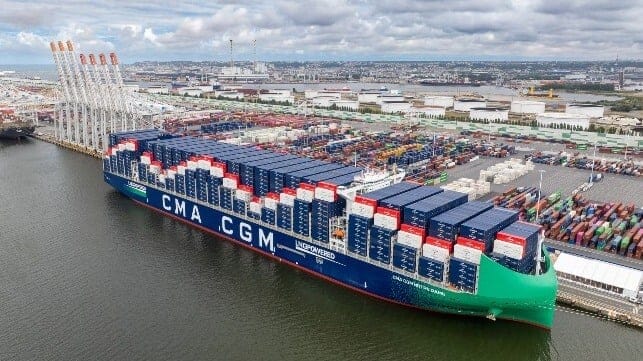
CMA CGM Notre Dame is the largest capacity LNG containership and the largest under the French flag (CMA CGM)
As the buildout of the record orderbook for new container vessels proceeds, a new generation of vessels is being introduced, incorporating new technologies. CMA CGM, Ocean Network Express (ONE), and Orient Overseas Container Line (OOCL) each marked milestones with their most recent deliveries.
CMA CGM christened its newest vessel in Le Havre, France, on July 2 at the conclusion of its first voyage from Asia. The company highlights that the CMA CGM Notre Dame is the largest capacity LNG-powered containership in the industry and the largest under the French flag.
The first of a class of 10 new ships, the CMA CGM Notre Dame is 399 meters (1,309 feet) in length. The design of the container systems, however, expands its capacity to a nominal rating of 24,212 TEU.
The CMA CGM Notre Dame is equipped with systems that enable real-time voyage optimization, improve energy efficiency, and enhance the vessel’s environmental performance. The ship is equipped with AI (Artificial Intelligence) systems, digital navigation, and energy efficiency technologies.
The company highlights the ship as part of its ongoing investment in France. It reports that the 10 new ships will require the hiring of 135 French seafarers over the next two years. By 2028, CMA CGM’s French-flag fleet will increase from 30 to 40 vessels. As the third-largest carrier, the company reports a total fleet of over 700 vessels and carried more than 24 million TEU last year.
The CMA CGM Notre Dame is remaining in Le Havre until July 4. The ship is assigned to the company’s route to the Far East, operated on a 102-day rotation. The route includes stops in China, Singapore, Rotterdam, Hamburg, and Tangier Med.
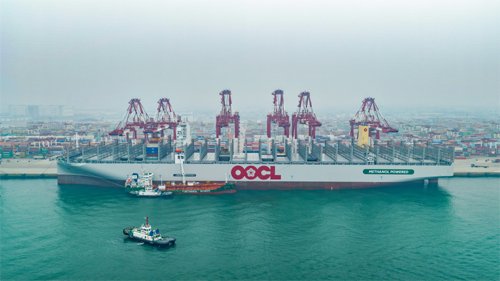
OOCL Wisdom bunkering green methanol as it prepares for its maiden voyage (OOCL)
At China’s Qingdao Port, the new OOCL Wisdom completed on July 3 the first green methanol bunkering before setting off on its maiden voyage. The vessel is reported to be the largest capacity methanol dual-container vessel.
The ship loaded 1,500 metric tons of methanol at Qingdao as well as 3,000 TEU. The ship is 225,000 dwt and has a total capacity of 21,168 TEU. OOCL highlights that it is the first of seven vessels and will be used to expand and improve the route between Asia and Northern Europe.
Ocean Network Express (ONE) is also launching a new series of mid-sized container vessels, its S-Series. The ONE Simplicity (160,200 dwt) was delivered at the end of March and was recently followed by her sister ship, One Solidarity.
Built by Imabari Shipbuilding in Japan, the vessels are designed for future fuel conversion to methanol and ammonia, and the installation of CO2 capture equipment. They measure 336 meters (1,102 feet), and the shipyard highlights that it developed an optimal hull shape that pursues high efficiency to match the frequently used ship speed and draft. In addition, by adopting energy-saving devices, a twist rudder, hull coatings that reduce friction with seawater, and a bow wind cover to reduce drag, it achieved a high fuel efficiency. Installed on the ships are a hybrid exhaust gas purification system (EGCS) and an exhaust gas recirculation system (EGR), as well as a ballast water treatment system.
ONE Solidarity has departed on its first voyage. It will be deployed on ONE’s Mediterranean Pacific South route.
Iran Threatens to Attack Ships for Using Non-Iranian Routes Through Hormuz
Amidst a reported disagreement within Iran's leadership over whether to prioritize control of frozen bank accounts or control of the Strait of Hormuz, the Iranian senior military command center is signaling a strong preference for the latter - and a continued willingness to use force.
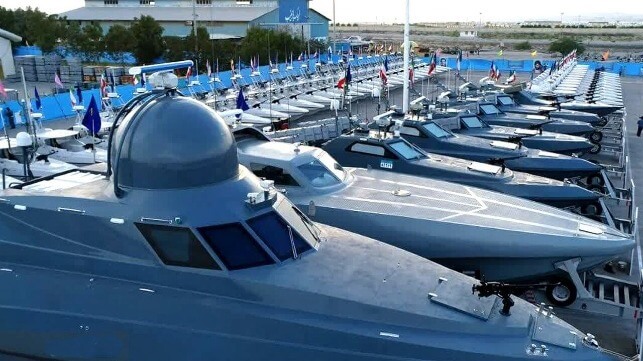
On Thursday, the Khatam al-Anbiya Central Headquarters - the Iranian equivalent of the Pentagon - threatened shipowners with attacks if they attempt to transit the Strait of Hormuz without approval. "Any failure to comply, deviation from the designated route, or disregard for the navigation protocols of the Islamic Republic of Iran in the Strait of Hormuz will be met with an immediate and forceful response from the armed forces," the headquarters staff said in a statement carried by state broadcaster IRIB.
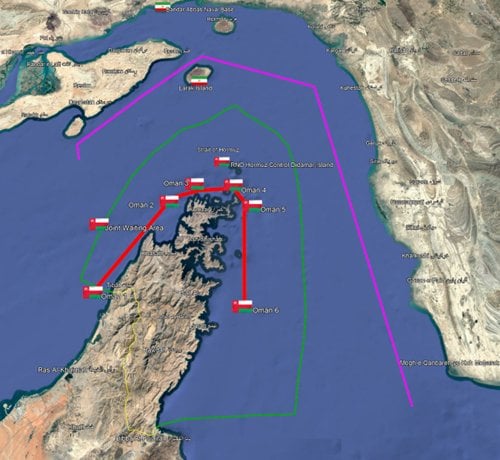
There are three general routes through the strait at present: the northern, Iranian-controlled route past Qeshm; the preexisting Traffic Separation Scheme, which is believed to be mined; and a southern route along the Omani coastline, approved by the IMO and defended by the U.S. military. All are nominally free of charge during the 60-day period of negotiations between the U.S. and Iran, and Iran has agreed to make arrangements for unobstructed passage (contingent on the rest of the agreement being met). The Iranian military wants to ensure that all unobstructed passages happen under Iranian control, within Iranian waters, facilitating a post-MOU transition to a permanent Iranian control system for the waterway.
The U.S. government has offered to unfreeze more Iranian money held in overseas accounts, in effect exchanging funding for a more compliant Iranian approach to the strait, so far without success. Officials close to the diplomatic talks told the Wall Street Journal that U.S. negotiators have offered Iran access to some of its own blocked bank accounts - worth somewhere in the range of $6 billion, three times the amount of the 2016 cash payment approved by President Barack Obama - if Tehran agrees to give up control of Hormuz and set aside its long-term ambition to charge "service fees" for vessel transits.
The access to foreign funds would be a swift and much-needed windfall for the Iranian government, whether to provide for its own citizens in a severe economic downturn or to increase military spending and rebuild its missile and drone programs. It reflects a newly pragmatic approach by the administration: while still reportedly preparing for a military option, the White House appears open to financial solutions to the Strait of Hormuz problem - though at least in public, Iran is not taking the offer. Deputy Foreign Minister Kazem Gharibabadi said Thursday that the strait remains "under Iran's command."
The short-term payment might be far less than the long-term payoff if Iran could control Hormuz permanently (which some question on practical grounds). The Iranian government hopes to earn up to $40 billion every year in fee payments for crossings, according to the Wall Street Journal.
Oman Clarifies its Stance on Hormuz as Talks with Iran Widen
Traffic is moving through the Strait of Hormuz as the talks continue over its future (IMO)
An uneasy calm appears to be prevailing in the Strait of Hormuz after the exchanges of fire between the United States and Iran, which followed the Iranian attack on the Singapore-flagged container ship Ever Lovely (IMO 9629110) on June 25. Both sides agreed on June 29 to stand down from these recent exchanges, to observe the ceasefire in a tighter manner, and also to resume technical discussions in Doha. In the background, and separate from the US-Iranian negotiations in Bürgenstock, bilateral discussions involving Iran and GCC states are taking place, with the GCC countries concerned that the talks in Switzerland will not deliver a lasting solution acceptable to all parties.
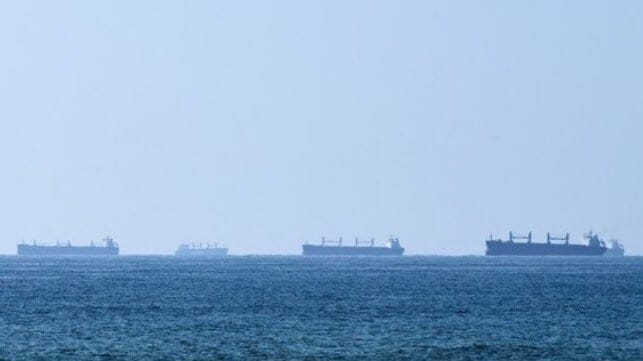
While a relative calm prevails, shipping is using both the Omani/IMO channel to the south, and a loosely-defined channel through Iranian waters to the north, with inbound and outbound shipping using the same channel, at a rate of about 60 transits a day. The volume of traffic is difficult to judge accurately, given that some ships are still traveling without switching on their AIS systems.
In the meantime, however, there had been some confusion about the Omani position regarding the Strait, attributable to poorly-sourced reporting and uncritical acceptance by the media of Iranian interpretations of the Omani position. Clarity was restored, however, when the Omani Foreign Minister, accompanying Sultan Haitham on a visit to France, gave an interview to Monte Carlo Doualiya, the French radio station broadcasting in Arabic. Sayyid Badr al Busaidi reiterated Oman’s position on Hormuz transits:
• Any bilateral understanding between Iran and Oman must fall within international law and UNCLOS.
• Oman is "not in favor of imposing transit fees. That is prohibited under international law, and we are committed to those rules."
• Oman is considering with Iran how environmental protection, navigational services, and emergency response can be improved in the Strait, drawing on the models in operation covering the Strait of Malacca and Singapore. Proposed future arrangements would be discussed and agreed upon with the international maritime community.
• Responsibility for mine clearance in the Strait rests with Iran, who should approach others for support if it was unable to fulfill its commitment to clearance of the Strait under the 14 Point MoU signed with the United States.
The statement makes it clear that while the scope and fee scale for services provided and charged for as Navigation Dues is under consideration in the discussions between Iran and Oman, charging tolls for passage, in effect creating a reconstruction fund, is not.
The statement also makes it clear that Oman will not unilaterally give permission for the European naval stabilization force to operate in the Strait. If the force is to be involved in mine clearance, then the permission of Iran needs to be sought.
Oman and Iran have already held a series of meetings to discuss management of the Strait, and a further such meeting occurred in Muscat on June 29. The meeting was chaired jointly by Oman's Sheikh Abdulaziz bin Abdullah Al Hinai and Iran's Deputy Foreign Minister Kazem Gharibabadi, who also led Iran’s delegation at the last similar such meeting in Muscat on May 24.
The Omani-Iranian Joint Committee meeting to discuss Strait of Hormuz navigation services, held in Muscat on June 29 (Omani MoFA)
Oman is keeping other GCC states closely informed on the progress of its talks with Iran over the Strait, in an effort to avoid misunderstandings, but also in an effort to build a new consensus. The Qatari Prime Minister Sheikh Mohammed bin Abdulrahman Al Thani visited Muscat to coordinate with the Omani Foreign Minister on June 23. The Omani Chief of Staff visited his opposite number in Bahrain also as part of this continuing dialogue on June 28.
The Omani Foreign Minister greets the Qatari Prime Minister in Muscat for a coordination meeting, June 23 (Omani MOFA)
At the same time, other GCC states are also conducting bilateral conversations with the Iranians. The Qataris are doing so as a consequence of holding a seat at the US-Iranian negotiations in Bürgenstock. The Saudi Foreign Minister Prince Faisal bin Farhan and his Iranian opposite number Abbas Araghchi held telephone discussions on June 24. The Times of Israel is reporting that these bilateral discussions with Iran outside the confines of the Bürgenstock talks will culminate in a regional conference involving Iran, to be held in Saudi Arabia, where the nations of the region will aim to establish a new political climate for living alongside each other.
Both Iran and the GCC have much to gain from a new security concord. If Pax Americana is not going to deliver peace in the region, then the nations of the region must establish a new modus vivendi among themselves, a development that would be equally welcome in the Gulf as in America, which would rather focus on problems elsewhere. The maritime community will breathe a sigh of relief if peace and stability can be established, at least some dividends to a highly disruptive war.
US Forces Still Poised in the Arabian Gulf Area
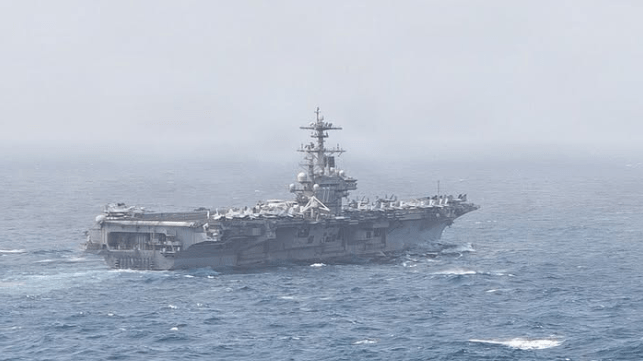
USS George H.W. Bush (CVN 77) in the Arabian Sea last week (CENTCOM)
With an uneasy ceasefire having held now for some three days, which is something of a local record in recent times, there appears to be a determination shared by both Iran and the United States that there should be no further interruptions to the negotiation process, which has now switched to Doha and which is well behind schedule.
Nonetheless, the diplomatic and political climate remains tense, particularly among parties whose interests are not being directly represented by those conducting the actual negotiations in Qatar.
In Iran, a split in the ruling political elite, in which Paydari and IRGC hardliners seem to have the support of the hologram Supreme Leader Mojtaba Khamenei, has spilled into the open. There is open criticism of President Masoud Pezeshkian, Foreign Minister Abbas Araghchi, and the lead negotiator Mohammad Bagher Ghalibaf for being willing to conciliate, even though the Supreme National Security Council has given the go-ahead for negotiations to proceed. This has not stopped the hardliners, who contend that Iran has established an ascendant position following the war, from using their influence within media organizations to drip vitriol on their domestic political opponents and to press for the Islamic Republic to exploit its advantages by further developing its regional dominance. Moreover, the Iranian negotiating team has been accorded very little flexibility, which means that the talks in Qatar are in danger of collapse as soon as substantive issues come up for discussion. For the moment, while the week-long funeral of the late Supreme Leader proceeds, divisions may be put to one side, but may emerge once again in the coming days, along possibly with a first public appearance by Ali Khamenei’s elusive son Mojtaba.
There are also divisions on the other side of the Gulf. Some GCC states, notably Qatar and Oman, believe that the reality of Iran as it is today needs to be lived with. At the other end of the scale, the UAE sees the logical end-goal of Iranian ambitions as the dismemberment of the Gulf monarchies and the establishment of Iran as a regional super-power, displacing all outside influences and by implication the embedded positions of GCC countries in the global economy. In the middle, other regional countries profoundly distrust Iran, no longer have any doubts about its malign intentions, but want somehow to avoid any nastiness in the short-term. The lack of a unified position amongst Iran’s counter-parties is again a recipe for massive instability, which Commander Central Command was evidently seeking to redress when on July 2 a conference in Bahrain assembled military commanders from Bahrain, Egypt, Jordan, Kuwait, Lebanon, Oman, Qatar, Saudi Arabia, Syria, the United Arab Emirates, and Yemen to discuss the current regional security situation and coordinate protective measures particularly in regard to air defense.
If this was not enough, Israel regards the take-down of the Islamic regime in Iran as unfinished business, and the potential threat posed by an IRGC nuclear weapons program, the IRGC’s missiles and drones, and the evident ambition to rebuild the military capabilities of its regional proxies, all of which are regarded as a long-term threat to Israel’s survival. For the moment, Israel is happy to concentrate on achieving a potential solution to the instability on its northern border. But this diversion from tackling the long-term threat posed by Iran is likely to be only temporary if the US-Iranian negotiations do not produce a permanent solution.
In these circumstances, it is no surprise to see that CENTCOM is maintaining a high readiness posture.
Some forces have been withdrawn. Notably B-52 aircraft have been pulled back from RAF Fairford, and F-16 aircraft deployed to Saudi Arabia have returned to Aviano in Italy. F-15Es and F-35As from the 48th Fighter Wing are returning to RAF Lakenheath. A-10C Warthogs have staged home to Moody Air Force Base to Georgia through RAF Lakenheath. All these aircraft could return to the Middle East very quickly, save for the Warthogs which could only re-deploy at a more sedate pace as befits their tactical flight profile.
In the meantime, should conflict erupt once again, the element of the CENTCOM force that provides the forward screen and quick reaction force remains in place, providing Commander CENTCOM with the means to respond while reinforcements are brought back into theatre. This force in place consists principally of ground-based air defenses and assets afloat. CENTCOM for obvious reasons is not posting a daily order of battle, but two carrier strike groups remain in theatre, flag-shipped by USS Abraham Lincoln (CVN-72) and USS George H. W. Bush (CVN-77); in current circumstances, only one of these two CSGs is likely to be held forward, with the duties of the forward screen in the Gulf of Oman scaled back to reflect the lifting of the blockade on Iranian shipping and ports.
USS Boxer (LHD 4), USS Portland (LPD 27) and USS Comstock (LSD 45) with 11th Marine Expeditionary Unit are now in theatre, which suggests that the Boxer Amphibious Ready Group may now be taking over front line duties from USS Tripoli (LHA 7), USS San Diego (LPD-22) and USS New Orleans (LPD-18) with F-35Bs, tactical helicopters and the 31st Marine Expeditionary Unit embarked.
A key component of the continuing CENTCOM readiness posture appears to the presence of Apache helicopters over the Strait of Hormuz, protecting and covering the movement of shipping through the Strait, particularly those moving through the southern channel who continue to use the Omani coastal route. Maintaining the free flow of commerce through the Strait of Hormuz is a key CENTCOM objective at present, and also maintenance of the capacity to respond instantaneously should there be any attempts to interdict traffic.
In summary, while US forces are being both withdrawn from the theatre and rotated within the theatre to give front-line units opportunities for rest, resupply, and recuperation, a forward posture is being maintained so that there can be an immediate response to any Iranian breaches of the ceasefire, in particular in the Strait of Hormuz.
Training Ship Golden Bear Nears End of its Final Voyage After 30 Years
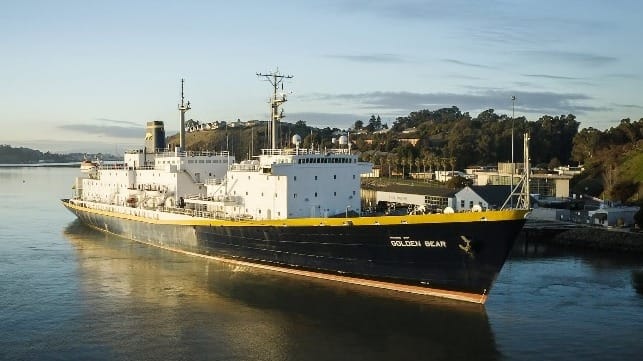
California's training ship Golden Bear is finishing her last voyage after 30 years of service (Cal Poly Maritime Academy)
The last of the older U.S. state maritime school training ships, the Golden Bear, is preparing for her retirement after completing her final training cruise. One of the older ships that was used to train merchant mariners, the ship will be replaced in 2027 by the last of the National Security Multi-Mission Vessel (NSMV) program being implemented by the Maritime Administration (MARAD).
Golden Bear is scheduled to return to Vallejo, California, on July 6, following the completion of Summer Sea Term 2026. She is bringing home 283 Cal Poly Maritime Academy cadets after a 12,500-mile voyage across the Pacific Ocean. This year's voyage took cadets across the Pacific Ocean with port calls in San Diego, Tahiti, Fiji, and Honolulu.
Along the way, students stood watch on the bridge and in the engine room, operated complex ship systems, participated in emergency drills, and developed the skills required of future maritime officers.
It is a bittersweet moment for the staff and crew. For three decades, Golden Bear has served as a floating classroom where thousands of cadets transformed classroom knowledge into practical experience at sea.
“Golden Bear has helped prepare generations of maritime professionals through hands-on training at sea,” said Rear Adm. Eric C. Jones, U.S. Coast Guard (Ret.), superintendent of Cal Poly Maritime Academy. “More than a training vessel, Golden Bear represented an ethos that has guided the education of maritime leaders at this academy for nearly a century. We are grateful for the ship’s service and the role it has played in shaping thousands of careers.”
She, along with another now former training ship, was built in the 1990s for the U.S. Navy as the fastest and largest oceanographic ship in the United States fleet. Known as USNS Maury (T-AGS-39) she was delivered to the Navy on March 31, 1989. However, her career would be short, as in 1994 she was placed out of service.
USNS Maury was transferred to California Maritime Academy on May 4, 1996, and rechristened as the TS Golden Bear. Her sister ship USNS Tanner (T-AGS-40), followed a year later, being delivered to the Maine Maritime Academy and assuming her role as a training ship, TS State of Maine, in June 1997.
The transition to the new training ship comes as the academy is also in transition. Founded in 1901, it became part of the California State University system in 1960. Cal Maritime recently merged with Cal Poly as part of a reorganization of the state school program. Now known as Cal Poly Maritime Academy, it remains the West Coast’s only degree-granting maritime academy.
The Academy has been operating its school at sea which began with Training Ship California State (1931–1946). Since then, there has been a series of Golden Bear vessels, including the first Training Ship Golden Bear (1946–1971), the second Training Ship Golden Bear (1971–1995), and the third and current Training Ship Golden Bear, which has been in service since 1996.
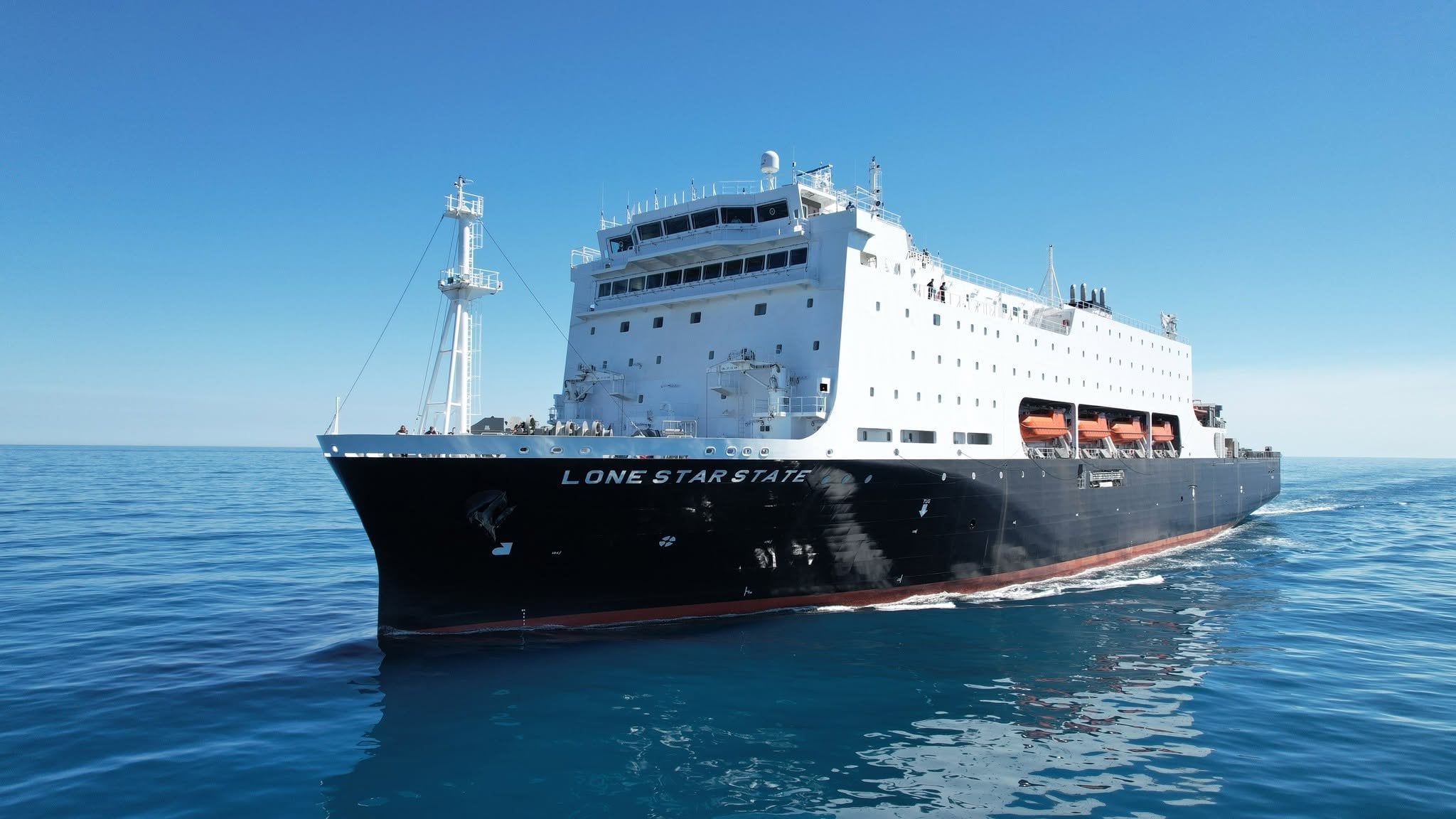
The fourth training ship, Lone Star State, recently conducted her sea trials (TOTE photo courtesy of Texas A&M Maritime)
Cal Poly Maritime Academy is preparing for the arrival of new Golden State, a National Security Multi-Mission Vessel (NSMV) that will become the academy’s next training ship. Expected to arrive in Vallejo in 2027, Golden State will provide expanded training capabilities, modern instructional spaces and new opportunities for hands-on learning at sea. She is the fifth vessel of the class, with New York, Massachusetts, and Maine having already deployed their ships on training missions.
Texas A&M Maritime Academy reported in June that its new vessel, Lone Star State, had returned from sea trials after spending several days off the coast of Delaware and Virginia testing propulsion and safety systems. The team reported that all went well, and only minor deficiencies needed to be corrected before delivery. The ship is nearing completion, and additional system startup and commissioning is ongoing.
U.S. Finalizes Contract for Six Arctic Security Cutters
The contracts finalized the initial awards from December 2025 for six Arctic Security Cutters (Aker Technologies)
The U.S. Coast Guard reported this week that it has finalized the contracts for six Arctic Security Cutters to be built by Finland’s Rauma Marine Constructions and Bollinger Shipyards Lockport. It completed the order, which was first announced in December 2025, for a total of 11 icebreakers, with the other portion going to the Davie partnership, including Helsinki Shipyard and the new Davie shipyard in Texas.
The finalized contracts awarded to Bollinger Shipyards Lockport, of Lockport, Louisiana, four ASCs, valued at approximately $2.2 billion, and Rauma Marine Constructions of Rauma, Finland, two ASCs, valued at approximately $1.1 billion. The first vessel under this contract is scheduled to be delivered in 2028, and all six vessels are scheduled to be delivered by 2031.
The interim agreements announced in December allowed the shipbuilders to begin planning, said the USCG, while the final details were negotiated. Helsinki Shipyard reported when it finalized its contract in May that it was already making preparations and that construction of the first vessel is scheduled to commence in the summer at the Helsinki and Pori shipyards. Reports indicate that Bollinger has also started work ahead of the finalized contract.
The Trump administration is placing a high priority on speed for this project. Reports have indicated the first two vessels will come from the two yards in Finland, and the Finnish partners will also work with their U.S. colleagues to develop the necessary shipbuilding skills for these icebreakers. It builds on a partnership between the United States, Canada, and Finland, first announced under the Biden administration.
Bollinger emphasizes that by leveraging a design already selected by close allies and supported by an established supply chain, the program offers significant advantages in sustainment, training, interoperability, and lifecycle affordability.
For the four cutters to be built by Bollinger, it emphasizes that it will leverage its integrated manufacturing network. Bollinger has a network of facilities along the Gulf Coast.
The other tranche of the program calls for two of five vessels to be built at Helsinki Shipyard in close collaboration with Sata Shipbuilding, with the remaining three to be built in the United States at the group’s Gulf Copper facilities in Texas. The first vessel is scheduled for delivery in 2028, with the program running through 2035.
The USCG reports the ASC program is a cornerstone of the strategy to defend U.S. sovereignty, secure critical shipping lanes, protect energy and mineral resources, and counter adversary presence in the Arctic. It says these new cutters will enable the Coast Guard to control, secure, and defend U.S. Alaskan borders, facilitate maritime commerce vital to economic prosperity and strategic mobility, and respond to crises and contingencies in the region.
The Coast Guard recently announced that two of the first of the new cutters would be homeported in Kodiak, Alaska. It also plans to put a third in Seward, Alaska, once port facilities can be built. It has been said that a fourth cutter will also likely be homeported in Alaska. This is in addition to the efforts underway to develop a homeport in Juneau, Alaska, for the Storis, which the USCG acquired as an interim vessel to expand its operations until the new vessels are delivered.
Bollinger is also executing the program for the new Polar Security Cutters. The project to build the heavy icebreakers to modernize the U.S. fleet has been badly delayed, with the first vessel now scheduled for delivery in May 2030.
Defiance Against Trump Drives Rise of Democratic Socialist in DC Mayor’s Race
Grassroots organizers offer a look inside the movement that helped Janeese Lewis George win the Democratic primary.
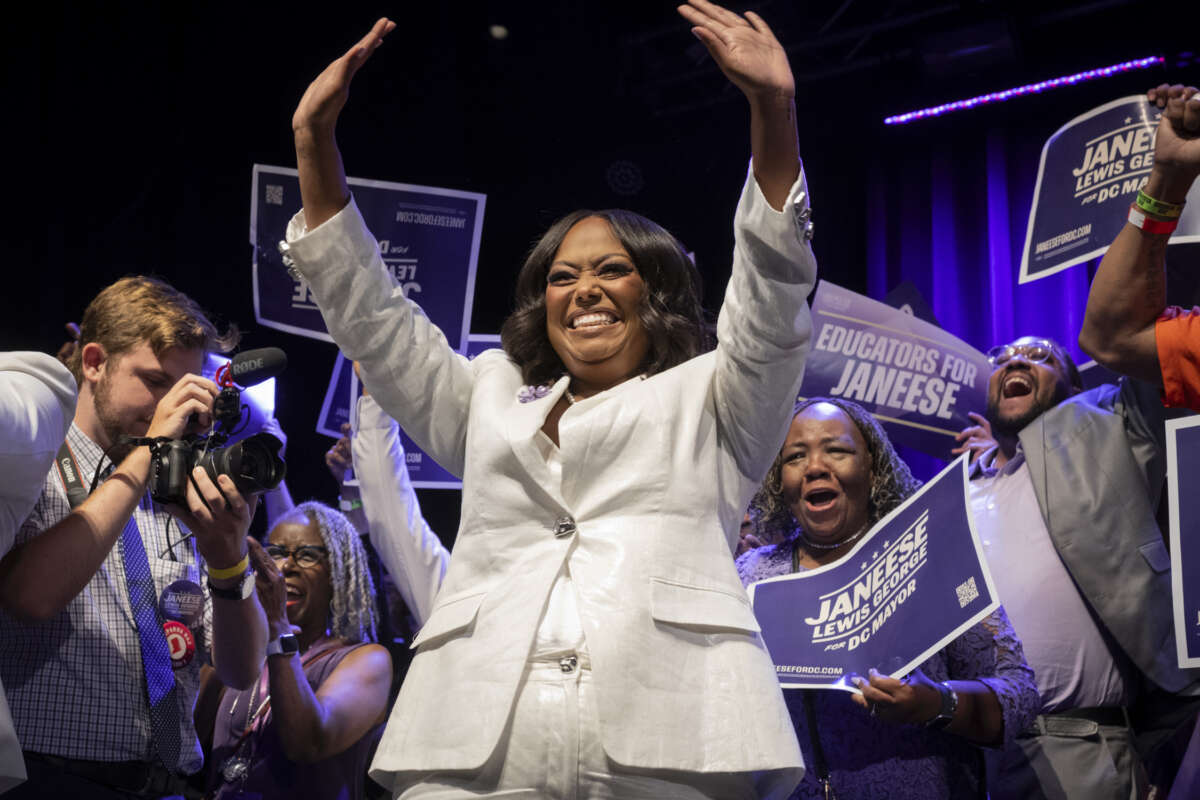
Mayoral candidate Janeese Lewis George celebrates her early lead at her election night party at the Howard Theatre on June 16, 2026, in Washington, D.C.Maxine Wallace / The Washington Post via Getty Images
On August 11, 2025, President Trump initiated a federal takeover of Washington, D.C. Nearly 11 months later, Washingtonians organized around one of the most progressive candidates in the District’s mayoral history, a democratic socialist named Janeese Lewis George.
Since August 2025, every corner of the District of Columbia has swarmed with thousands of National Guard troops, from major metro stations to residential neighborhoods. In September, thousands of residents gathered at Malcolm X Park and marched from Ward 1 all the way to the White House for the “We Are All DC” march. The event was attended by thousands and was the single largest demonstration against Trump’s takeover of D.C.
Countless bright red signs were scattered all over the marching masses, printed with the same words that the crowds were chanting: “Free DC.” This also happens to be the name of the organization that co-hosted the march, alongside labor unions and community groups. Free DC is a fiscally sponsored special project of Community Change, and according to Washingtonians, one of the biggest reasons that Lewis George won big in the Democratic primary.
“We are the only country in the world where the citizens of the capital city do not have full political protections, full legal protections,” said Alex Dodds, campaign director and co-founder of Free DC. “And we know from other countries where dictatorships have taken root, that dictators and authoritarian leaders will always seek to control the capital city, because it’s a really easy way for them to silence dissent.”
While this group was founded just a few years ago, the Free DC movement has roots in the 1960s, when Marion Berry, who would later be elected as the second mayor of Washington, D.C., mobilized students and communities to participate in acts of civil disobedience to protest the lack of representation for D.C. residents. In 1974, Washington got its very first elected mayor after Congress passed the Home Rule Act. The legislation gave power to D.C. residents in the form of day-to-day governance but still withheld representation from Washingtonians at the federal level. This lack of real representation is the power imbalance that was central to this year’s mayoral primary, according to organizers.
“She is a progressive Black woman who is not a status quo candidate. She is unapologetically a democratic socialist and someone who sees D.C. for exactly what it is, a city that should be a state.”
Lewis George was one of just two candidates that Free DC chose to endorse this cycle, alongside Robert White, who won his race for delegate to the U.S. House of Representatives. According to Dodds, the endorsement process involved an in-depth questionnaire, a forum, and a community voting process. After everything was tallied, Lewis George was head and shoulders above the other candidates being considered.
“Janeese’s campaign was really focused on building the power of the people together to do things very aligned with a Free D.C. … no one is coming to save us but us. And so we have to do this together,” Dodds told Truthout.
Lewis George’s platform included universal affordable child care, an issue of particular importance to Washingtonians as D.C. has the highest average child care costs in the country. Transportation was also a focus of her campaign, as she promised to make buses free for residents enrolled in SNAP food assistance programs and invest in bike lanes and the metro system. Lewis George also focused heavily on affordability, listing her intention to expand rent stabilization programs, fund affordable housing, and invest in down payment assistance programs to increase homeownership across D.C.
Lewis George’s candidacy as a democratic socialist came at a time when D.C. residents could see the effects of Trump’s takeover on every street across the city. Under the president’s orders, Washington, D.C., has become ground zero for Immigration and Customs Enforcement (ICE) raids and detentions. Just days before the election, Trump even threatened a deeper federal takeover if Lewis George is elected mayor. In response, Lewis George doubled down on her defense of her hometown.
“We are not going to get ICE off our streets by fearing this president. We are not going to protect our rights or Home Rule by obeying in advance,” Lewis George wrote in a statement. “Threatening Home Rule because you do not like how residents vote is an attack on democracy itself. The people of D.C. elect the mayor of D.C., and they want someone who will stand up to Donald Trump.”
Lewis George’s supporters say this response was one of many reasons why so many D.C. residents swung toward her platform.
The Free DC movement aims to do more than accomplish statehood — it is a response to authoritarianism and federal occupation.
“Donald Trump doesn’t get to decide who represents Washington, D.C.,” Delvone Michael told Truthout. “The voters do.”
Michael, who is a senior political strategist at the Working Families Party, another group that endorsed Lewis George, added: “I think they saw strength in her response to him. And just like any bully you stand up to, the bully will fold.”
Voters largely saw through these attacks, understanding that threats to home rule would be coming down the line no matter who won the primary; the biggest concern for many was how a leader handled those threats.
“The reality is, President Trump will do exactly what he wants to do. It doesn’t matter who is elected mayor of Washington, D.C.,” Preston Mitchum — a Black queer attorney, activist, and supporter of Lewis George — told Truthout. “I think people use that against Janeese in particular because she is a progressive Black woman who is not a status quo candidate. She is unapologetically a democratic socialist and someone who sees D.C. for exactly what it is, a city that should be a state.”
Lewis George is a D.C. council member, a third-generation Washingtonian, and a former prosecutor. On paper, her experience is not unlike that of the other leading candidate in the mayoral race, Kenyan McDuffie. McDuffie is a fourth-generation Washingtonian and, like Lewis George, is also a D.C. council member and a former prosecutor. McDuffie, however, was regularly aligned with current Mayor Muriel Bowser.
“Kenyan ran a very uninspiring campaign about what couldn’t be done,” said Michael. “We’re in a change moment, and right now the status quo is not going to be enough.”
While both candidates are former prosecutors, an issue that defines their differences is how they hoped to address public safety. One of the most heated issues this cycle was youth curfew zones and “teen takeovers.” The current mayoral administration has used emergency youth curfew zones, specific areas of the city where young people are not permitted after a certain hour, to address the mass gathering of teenagers. After a viral “teen takeover” at a Chipotle in D.C.’s Navy Yard neighborhood, McDuffie attacked Lewis George for her votes against curfew zones, labeling her soft on crime. Critics of the curfew strategy have labeled it as inherently racist, saying it targets Black young people for simply existing in public.
Lewis George has instead recommended expanded programming and job pathways for young people in the District. On another issue related to policing, while both candidates spoke in favor of defunding the police in 2020, they have also both voted to increase funding for the Metropolitan Police Department while serving on the Council of the District of Columbia. While McDuffie pledged to immediately add additional officers to the force, Lewis George ran on promises to invest in alternatives to policing while increasing police accountability.
Lewis George’s embrace of the movement against occupation was the magic that delivered her a victory by nearly 20 points.
According to voters and organizers, Free DC was the hinge that pushed Lewis George across the finish line. The vast majority of D.C. residents want statehood; that is no secret. But the Free DC movement aims to do more than accomplish statehood — it is a response to authoritarianism and federal occupation.
“Lewis George has commitments to stand up against Trump as opposed to Bowser and McDuffie’s stance of appeasement and compliance in advance,” said Kurtis Hagans, chair of the Metro D.C. Democratic Socialists of America (DSA). “We have laws on the books about the sanctuary status of the District. And we’ve been lied to by the current mayor, Mayor Bowser, about the cooperation of our police forces and our local government with ICE … Janeese Lewis George has said that she will make sure that that cooperation truly stops.”
Bowser’s administration has been criticized for its quickness to comply with the White House’s demands. In March 2025, Mayor Bowser folded to Trump’s pressure and painted over Black Lives Matter Plaza, a memorial to the racial justice protests of 2020 following the murder of George Floyd. In August 2025, Mayor Bowser praised the president for the federal takeover and its effects on crime in D.C., although recent data indicates the National Guard has had little to no effect on crime across the District.
According to a 2025 poll conducted by We Are Labor, the majority of D.C. voters rated Bowser’s performance as mayor unfavorably, 59 percent wanted a new candidate for mayor, and 72 percent disagreed with the mayor’s cooperation with Trump. Voters were looking for the change that Lewis George represented, and the defiance that she led with.
Lewis George was not the only progressive who won in D.C. this cycle. Aparna Raj, a democratic socialist and tenant organizer, won her race to represent Ward 1 on the D.C. Council. Robert White, a current council member, overwhelmingly beat a more moderate opponent in the primary for delegate to the U.S. House. D.C. shadow representative Oye Owolewa, also a democratic socialist, won the at-large council seat in a crowded field (D.C. representatives to Congress are known as “shadow representatives” because they are not granted voting power).
Organizers say these results prove that D.C. wants more people-powered movements and fewer machines that run on the status quo.
“The United States is descending at groundbreaking speed towards fascism and authoritarianism…,” said Dodds. “What works in moments like that is not lawyers. It is not legislation; it is not policy. It is not wealthy people coming in to save you. It is people power. It is mass movements.”
Free DC has been at the center of these mass movements since the takeover. Its members have done canvassing, engaged in election protection work, held community events, and organized protests attended by thousands. Lewis George’s embrace of the movement against occupation was the magic that delivered her a victory by nearly 20 points.
“Talking more about jobs and centering labor unions built the broadest coalition that I have ever seen D.C. create in the time I have been here,” said Mitchum. “It wasn’t just about the name of Free DC; it’s what Free DC and Janeese represented. This article is licensed under Creative Commons (CC BY-NC-ND 4.0), and you are free to share and republish under the terms of the license. Nick Fulton
Nick Fulton is a queer social movement journalist who has covered politics, protests, elections, and culture for over a dozen outlets, including Salon, Prism, Common Dreams, and Queerty. Nick is also the editor of The Fourth Estate, a publication covering the journalism industry’s fight for survival.
Op-Ed
The Anti-Indigenous Slur in the Declaration of Independence Speaks Volumes
The US Declaration of Independence frames Indigenous resistance as aggression and colonial violence as self-defense.
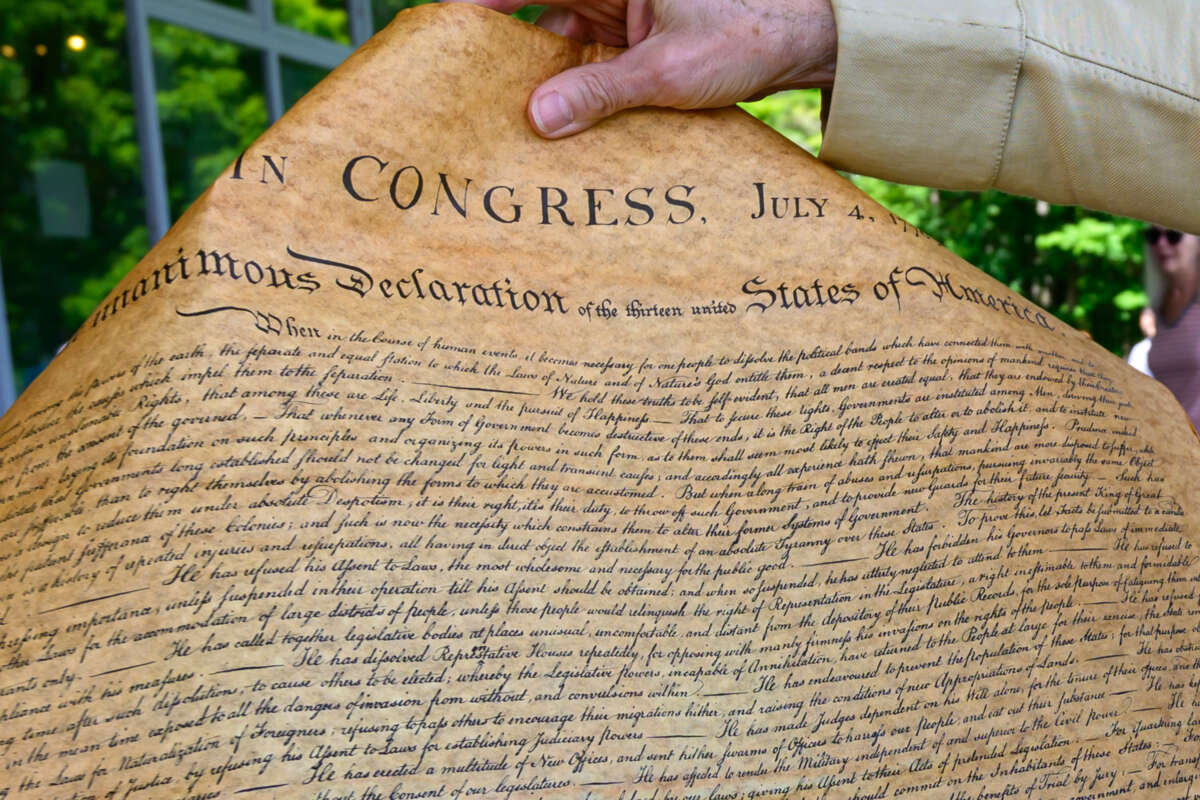
Joe Craig, a park volunteer, holds a copy of the Declaration of Independence on July 4, 2025, at the Saratoga National Historical Park in Stillwater, New York.Jim Franco / Albany Times Union via Getty Images
Every Fourth of July, the Declaration of Independence is the cornerstone of the U.S.’s celebrations. It’s read aloud in radio, television, and public celebrations. But it carries a contradiction expressed through a slur that Native people have never been able to ignore — a scathing reference to “merciless Indian Savages.” Even as the framers promised a nation of equality and liberty for all, they also made it clear that Indigenous people are not included in their notion of “all.” So, within Native communities, the yearly invocations of the Declaration Independence are also a reminder of how long we have been struggling to resist, survive, and defeat every effort to silence, erase, and eradicate us.
While most public readings of the Declaration of Independence include the full passage, others read around its anti-Indigenous slur or omit that line entirely. The omission says just as much as the words themselves. The U.S. wants the Declaration’s promises without its confession, its dreams of liberty without regard for the people it dehumanized and oppressed, and its proclamation of independence without any acknowledgment of the crimes against humanity that made it possible for the U.S. to exist.
The commemoration of this country’s founding every July 4 asks the public to celebrate a United States that begins with the myth of a nation born of nothing but courage and liberty, on lands not yet tamed or developed. Native people know another beginning. Our nations were already here, with governments, laws, languages, and infrastructure.
The United States is only the latest nation to exist on these lands. As it celebrates 250 years of “independence,” it still has not rescinded or made an effort to correct the violence and policies that followed from the framing of Native people as “merciless Indian Savages.” Instead, it has expanded the strategy of using dehumanizing language against migrants, trans people, anti-fascists, and other targeted communities in an effort to reframe their resistance as “antithetical to freedom and the American way of life.” “Merciless Indian Savages”
The phrase “merciless Indian Savages” isn’t just an unfortunate remnant of a different time; it was an intentional and strategic political move that set a precedent for anti-Native ideology and policies that persist today.
Historian and member of the Yamasee Nation Donald Grinde Jr. described the phrase as political rhetoric used to justify frontier wars and the taking of Native land. The phrase collapsed hundreds of Native nations into a new enemy and stripped them of their humanity. If Natives were “merciless savages,” their resistance could be framed as aggression, and colonial violence could then be positioned as self-defense, maintaining the optics of innocence and exceptionalism as the newly formed republic looked to build its empire.
“Merciless Indian Savages.” These three words set into motion centuries of brutal anti-Native policy from the Indian Removal Act of 1830 to the Dawes Act to the reservation and boarding school systems — every policy carrying the weight of those three words into every new era.
How the Phrase Impacts Natives Today
The intent and danger of the phrase “merciless Indian Savages” is alive and well. It’s threaded through our contemporary realities every time the federal government treats Native people, land, water, and treaty rights as acceptable casualties of profit and so-called progress.
In a commencement speech to the U.S. Naval Academy’s class of 2018, Trump praised settlers who “tamed a continent” and declared that: “We will not apologize for America.” His words appeared to do the same work as the phrase “merciless Indian Savages.” They dehumanize us, making Native people and lands sound wild and dangerous, while settlers are remembered as courageous. His administration carried that attitude into policy when the Interior Department moved to revoke the Mashpee Wampanoag Tribe’s land-in-trust status, pushed oil and gas leasing near Chaco Canyon in New Mexico, and treated treaty rights and federal trust responsibilities as barriers to development. In 2020, border wall construction near the Tohono O’odham Nation and Organ Pipe Cactus National Monument caused lasting environmental and cultural damage. During the COVID-19 crisis, tribes were left fighting each other over access to the $8 billion CARES Act tribal relief fund and then having to sue the government for the funds to be released, while the Native American Health Center reported receiving body bags instead of the personal protective equipment (like masks and gloves) it had ordered.
Trump’s second term has taken it a step further, increasing the danger to Native communities. Federal freezes and proposed cuts have threatened programs tied to treaty and trust obligations, including health care, education, housing, public safety, and social services. Reporting on Trump’s fiscal 2026 budget exposed proposed cuts of more than $700 million from Bureau of Indian Affairs programs and $239 million from tribal housing programs. His administration’s attack on birthright citizenship dragged Native citizenship back into public debate, forcing Native legal advocates to remind the country that Native people born in the United States are U.S. citizens and that tribal citizenship cannot be erased by federal political panic. Immigration raids have also raised alarms in Native communities, where Native citizens have reportedly been questioned, detained, or targeted because agents racially profiled them due to appearance, language, or proximity to the border. The legacy behind the three-word slur in the Declaration of Independence has not changed since 1776, and Trump’s administration has taken them to heart in its glorification of Manifest Destiny.
Ahead of the semiquincentennial, Trump leaned into the revival of national mythmaking and exceptionalism. In May, the White House released a statement celebrating the 222nd anniversary of the Lewis and Clark Expedition, praising it for fulfilling Manifest Destiny and carrying “prosperity” across the continent.
The Lewis and Clark story is personal for me. My people, the Otoe-Missouria, were the first Native people to hold council with Meriwether Lewis and William Clark. On August 3, 1804, near present-day Fort Calhoun, Nebraska, tribal leaders met the expedition at what became known as Council Bluffs. The official story treats that meeting as a diplomatic milestone. Lewis and Clark arrived in full military display, made some speeches and promises, gave some gifts, and showcased the technologies of the time: an air gun, a magnet, a spyglass, a compass, and a watch. But despite the pomp and circumstance, they didn’t really accomplish much beyond establishing a routine for future councils on the expedition.
For my people, the U.S.’s westward story does not begin with wonder nor does it end with conquest, the way the U.S. would like the world to believe. We are not a conquered people. We’re still here and still resisting the narratives and violence that have followed those three words from 1776 to our present day.
Who Have the “Merciless” and “Savage” Ones Been?
The semiquincentennial celebrations urge us to turn westward expansion into a patriotic stage set, but Native people know what gets left outside the frame: truth. Before the celebration moves on from the Declaration of Independence to the fireworks, the U.S. needs to acknowledge the gravity of the words the founding fathers chose for us — “Merciless Indian Savages” — and to recognize the brutality of colonialism.
When we look at history, who have the actual cruel ones been? Who was “merciless” and “savage” when Native communities were massacred? When treaties were signed and broken? When children were taken to residential boarding schools, and when their graves were found on those same school grounds? When sacred sites were destroyed, and pipelines were forced through our lands?
Who is “merciless” and “savage” now, as immigration raids tear through communities and as families live under the threat of detention, disappearance, and deportation? Who is acting with cruelty when federal troops are sent into cities in response to protests against immigration enforcement? When the genocide in Gaza is streamed in real time and the lives of Palestinians are treated as negotiable?
Who is “merciless” and “savage” when disabled people are threatened by policies that force institutionalization and punish people for needing support? When the trans community is targeted by executive orders, health care restrictions, school policies, prison restrictions, and public campaigns built to erase trans people from law and daily life? When women and pregnant people are forced to fight for bodily autonomy while reproductive health care is attacked across the country?
The words “merciless Indian Savages” taught the U.S. how to turn targeted people into threats. The authors of the Declaration of Independence called us “merciless Indian Savages” because they needed a justification for the violence and death upon which the U.S. was founded, for the violence and death that would continue to structure this nation. After 250 years, the phrase still carries the weight of that violence. This country needs to answer one question before asking anyone to celebrate: Is this legacy of violence really what we want to continue building on and celebrating for the next 250 years?
This article is licensed under Creative Commons (CC BY-NC-ND 4.0), and you are free to share and republish under the terms of the license.
Johnnie Jae (Otoe-Missouria and Choctaw) is a writer, speaker, and founder of Red POP! News and the late A Tribe Called Geek. Known for her journalism, mental health advocacy, and digital activism, she is dedicated to amplifying Native voices through storytelling, media, and art. You can find her in the Bluesky and Instagram.