Monday, July 06, 2026


Pope makes historic visit to Lampedusa, warns Europe: 'Deaths at sea are failures to act'


By Fortunato Pinto
Published on

Pope Francis has visited the island that symbolises the migrant crisis. Greeted by thousands, he stressed Europe’s duty to act and urged the faithful not to ignore the suffering of those forced to leave their homeland.

On the day of the 250th anniversary of the United States, Pope Leo XIV chose to visit Lampedusa, the island that has become a symbol of the migrant emergency in Italy and across Europe. The last time a pope visited Lampedusa was in 2013, when Pope Francis chose the island for his first apostolic journey, signalling from the very start of his pontificate his commitment to the migrant cause.

Immediately after landing, the pope headed to the Cemetery of the Nameless in Cala Pisana to pay tribute and pray at the graves of migrants who died at sea. The graves are marked with crosses made from the wood of boats that sank off the island’s coast.
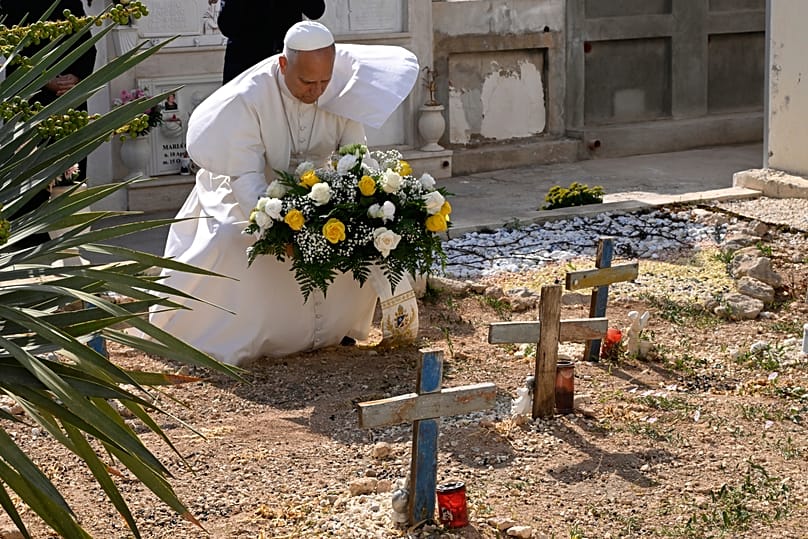
Pope Leo prays over migrants' graves, crosses fashioned from the wood of the boats
Pope Leo prays over migrants' graves, crosses fashioned from the wood of the boats Ciro Fusco/Copyright 2022 The AP. All rights reserved

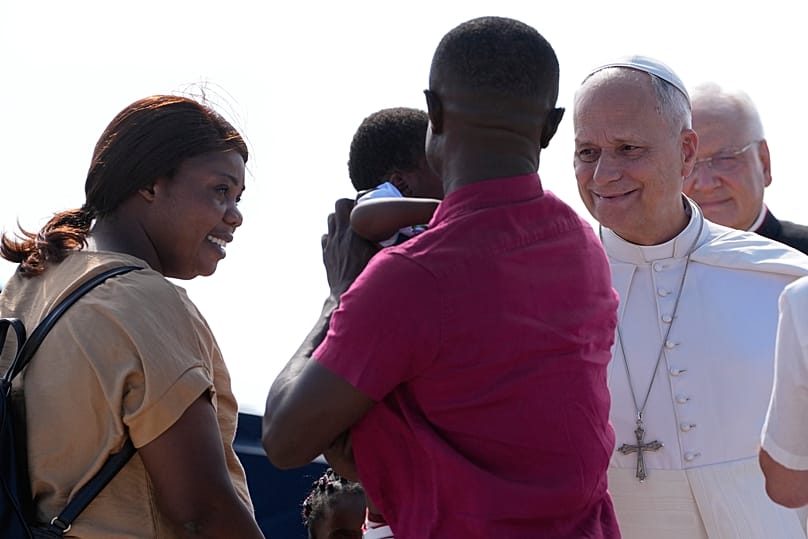
Pope Leo XIV then made his way to the Porta d’Europa, the symbolic ceramic-and-iron sculpture overlooking the Mediterranean. There, he met a migrant family, then walked through the arch, resting his hand on its right-hand side. The strong wind blew Leo’s skullcap off, and he then stood for a long time gazing out to sea, with a navy ship patrolling the waters off Lampedusa visible on the horizon.

The Pope also received a letter from a child migrant. "Dear Pope, I’m super excited to meet you! Ten years ago my story began here in Lampedusa. I was alone and had lost everything, especially my mum. They tell me I only stopped crying when they gave me a ball made out of paper; from that day the ball has stayed in my heart and I haven’t stopped playing. I really hope that this ball I’m giving you now can reach another child and make them happy just like me. Thank you, Leo," the boy wrote, handing the Pope a football as well

symbol
00:01
02:00
Read More
Pope Leo meets a migrant family in Lampedusa
Pope Leo meets a migrant family in Lampedusa AP Photo/Alessandra Taran

Pope Leo XIV blesses plaque dedicated to Pope Francis

The pontiff’s visit then moved on to Molo Favarolo, another symbolic site on the island where migrant boats are brought ashore. He unveiled and blessed a plaque dedicated to Pope Francis: from now on, the quay will be known as Molo Francesco.

The Pope met and shook hands with 15 migrants brought from the Contrada Imbriacola hotspot run by the Red Cross, which currently houses 138 people, including 51 unaccompanied minors. The most recent landing on the island was on Friday evening, when the coastguard rescued 17 people on board a small boat, among them five women and three children.

“By deciding to name Molo Favaloro after Pope Francis you are giving a sign of the bond my predecessor forged with your community and with migrant brothers and sisters: the Pope has stood by you in these very demanding times. And today I am here to tell you that the Pope continues to walk alongside you, to support you and encourage you,” Pope Leo XIV wrote in a letter sent to the mayor of Lampedusa on the occasion of his visit.
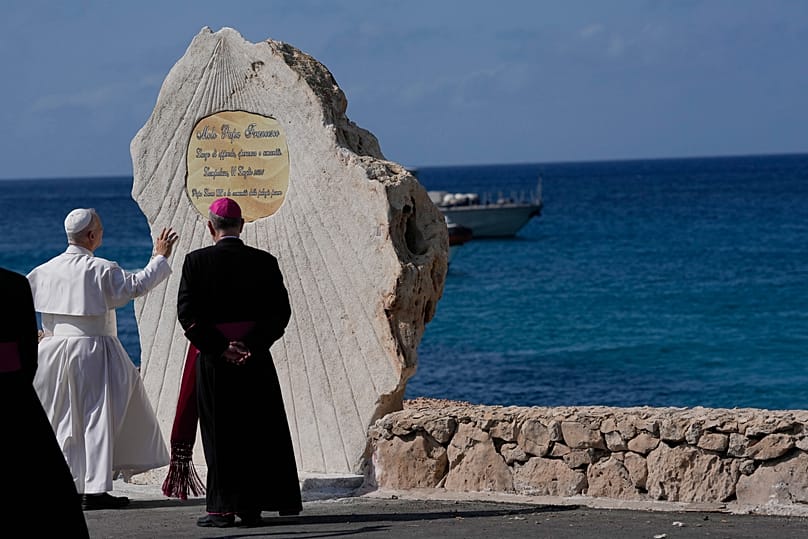
Pope Leo XIV blesses the plaque dedicated to Pope Francis in Lampedusa
Pope Leo XIV blesses the plaque dedicated to Pope Francis in Lampedusa AP Photo

“I have not come here to give speeches, but to celebrate the Eucharist, the supreme sign of Christ’s presence among us. The act of Jesus breaking the bread and giving himself lends meaning and strength to our daily gestures of care and sharing. Yes, this is a place where gestures speak louder than words. But for gestures to be truly human, they need a heart. That is why we have gathered here: to draw from Christ the love that only he can give us, so that today’s world, and tomorrow’s, may be more human, more human for everyone,” the pope went on in his letter.

The Pope urges Europe to confront the migrant crisis

Before the Mass held at the ‘Arena’ sports ground, the Pope travelled through the streets of Lampedusa in a giardinetta, a typical local car lent by an islander for the special occasion, greeting the crowds and stopping to bless children. Authorities said around four thousand people gathered at the ground to take part in the celebration led by the pontiff.

"I have come to thank you for the closeness so many of you have shown; once again the miracle of compassion has taken place. From this far-flung edge of Europe in the Mediterranean, the historic challenge that migration poses to European societies is all the clearer. Europe has a unique potential, rooted in its history and its culture, and with it an equal measure of responsibility," the pope said.

"Because of its geographical position and institutional set-up, Europe is able – in this region – to tackle the crisis in a coherent way, embedding first response within a long-term strategic plan capable of welcoming, protecting, promoting and integrating migrants and, at the same time, working for development, so that no one is forced to emigrate. All this must be done while ensuring respect for the dignity of every person. This is a task for public institutions, but also for the whole of civil society and for the Church,” he added, calling on Europe to live up to its responsibilities in welcoming migrants.
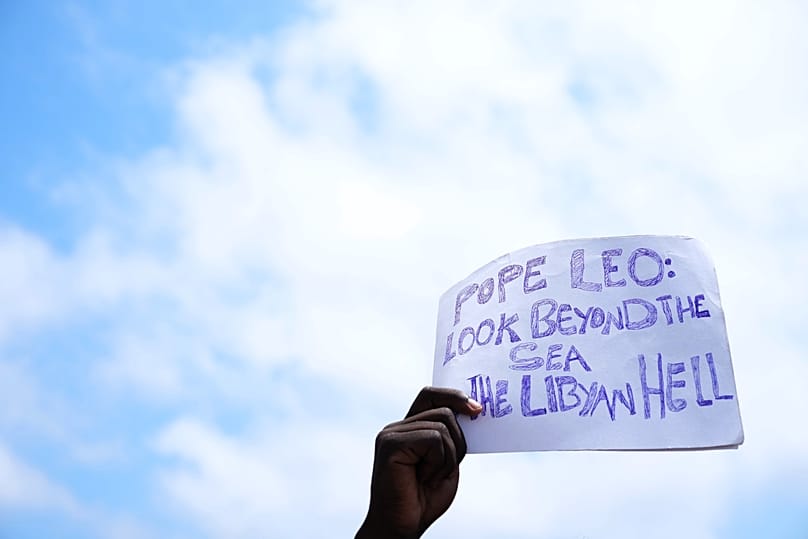
A sign urges the Pope to look beyond the sea, towards the 'hell in Libya'
A sign urges the Pope to look beyond the sea, towards the 'hell in Libya' AP Photo

The pope then pointed out that Lampedusa is an island that receives not only migrants but also holidaymakers. As he said recently in Tenerife, during his apostolic journey to Spain, he recalled that people must not feel threatened by migration routes or lapse into indifference.

“It is as if an invisible wall had to be raised between the sea of shipwrecked people and the sea of holidaymakers. Have the courage to think differently. Little by little, with creativity, you will succeed in ensuring that anyone who spends time on this island, even on holiday, can become more human by being confronted with your charity, with what the sea has taught you, with the encounters that have shaped you,” the pope said.
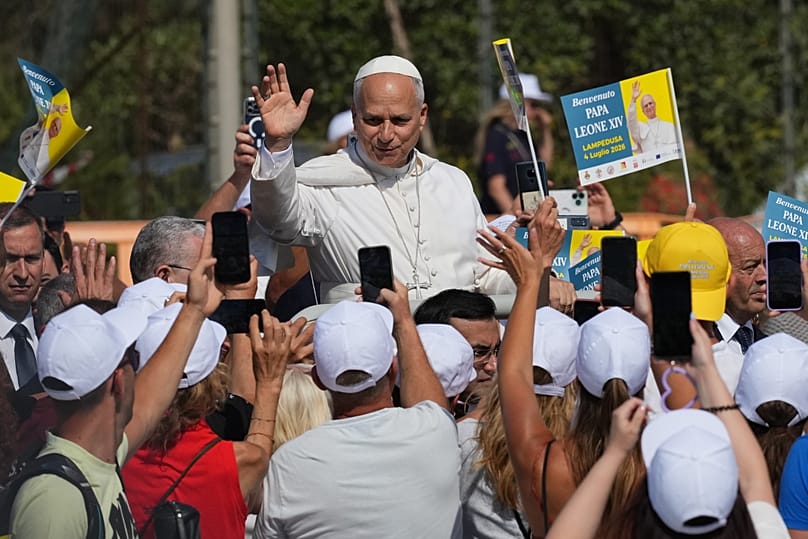
Pope Leo blesses the faithful in Lampedusa
Pope Leo blesses the faithful in Lampedusa AP Photo/Alessandra Tarantino

Criticising those who ignore the migrant crisis, the pope then turned his focus on indifference and corruption. “Love always lives in freedom, and freedom lies in our decisions. There are those who choose not to draw near, and those who choose not to choose. The dead in this sea are victims both of decisions taken and of decisions not taken. Indifference to the common good and corruption in countries of origin, a global economic system that generates poverty and exclusion, the fear that feeds prejudice and contempt, the idea that these problems have nothing to do with us, the criminal calculations of those who profit from other people’s suffering, the slow and difficult shift from merely managing emergencies to drawing up coherent, shared policies: all this today mirrors, in the Gospel account, the haste to ‘pass by on the other side", he said.

"Let us not be overcome by fear, but look at daily struggles as a time of opportunity and witness. May the venerated image of Our Lady of Porto Salvo once again speak to you with the same power as in the past, when those who handed this devotion down to you told you that we all have in God a safe harbour, and that every Christian community is called to be a reflection of it on earth. And to you, communities of Lampedusa and Linosa, may you never lack the breath of faith, hope and charity: "O'scià!", the Pope concluded, using the local Lampedusan greeting, which translates to “my breath”.

How World Cup Ads Reflect The Shift In Global Manufacturing – Analysis

July 5, 2026 
Anbound
By Yang Xite

Since the start of this year’s World Cup, a highly notable shift has emerged on the stadium’s advertising boards. One can notice that the presence of Japanese manufacturing brands has visibly waned compared to the past. From the 1980s and 1990s through the turn of the century, Japanese companies were among the most ubiquitous sponsors of global sporting events such as the World Cup, the Olympics, and Formula 1. Brands such as Sony, Toshiba, Panasonic, Canon, Fujifilm, and JVC were long synonymous with televisions, cameras, VCRs, film, household appliances, and office equipment.

Back then, Japanese manufacturing possessed both the core technology and the end-consumer market. More importantly, it was a direct part of the daily lives of households worldwide. A mega-event like the World Cup, with its massive concentration of global viewers, was the perfect stage for Japanese consumer electronics and home appliance brands to flex their muscles. Today, however, a glance at the pitch-side ads reveals that the spotlight has largely shifted to service-sector brands from China, South Korea, and the United States, alongside capital from the Gulf states. While Japanese manufacturing still exists, it no longer commands the front row of the advertising hoardings.

ANBOUND’s founder Kung Chan believes that global manufacturing is undergoing a transition of momentum, and the conspicuous decline of Japanese manufacturing ads at the World Cup serves as a clear signal. Gone were the days when Japanese corporations completely dominated World Cup billboards. As one of the world’s premier showcases for global commercial power, the World Cup reflects deeper shifts. Companies willing to pay a premium for global exposure, those seeking to use the tournament to amplify their international presence, and those shifting away from mass-consumer branding all reflect broader changes in industrial structures, corporate strategies, and national competitiveness. The billboards may look like mere commercial marketing, but they reflect shifts in the power structure of manufacturing.


This shift is far from being an isolated phenomenon. According to statistics from fDi Intelligence, World Cup sponsorships were almost entirely dominated by American, Japanese, and Western European enterprises before 2006. Since then, however, the sponsorship structure has visibly pivoted eastward. At the 2022 World Cup in Qatar, the number of Asian sponsors surpassed that of Euro-American companies for the first time. Chinese corporate sponsorship accounted for a share comparable to that of U.S. companies for two consecutive tournaments, while Japanese sponsors were conspicuously absent. Looking at the 2026 World Cup, FIFA’s core partners include Hyundai-Kia, Lenovo, Coca-Cola, Visa, and Adidas, alongside the likes of Qatar Airways and Saudi Aramco. The emergence of Gulf enterprises like Qatar Airways and Saudi Aramco demonstrates that sports sponsorship is no longer just a corporate marketing tool. Instead, it now carries undertones of national image-shaping and the spillover of capital influence. By leveraging a global mega-event like the World Cup, Gulf states are packaging their energy wealth, aviation hubs, tourism services, and national brands together, transitioning from mere energy exporters into major players on the global commercial and cultural stage. This signifies that both the manufacturing representatives and the capital forces on the global business stage are changing. Where Japanese corporations once stood as the face of Asian manufacturing, Chinese electronics, South Korean automobiles, and emerging-market capital now occupy far more space.


It is worth noting that Japanese manufacturing has not simply collapsed. Rather, its center of gravity has undergone a major shift. In the past, Japan’s strength was on the consumer side. Products like televisions, cameras, audio-video recording equipment, home appliances, and automobiles faced ordinary consumers directly, making global exposure a natural necessity for these brands. Today, many Japanese enterprises have shifted to the mid-to-upstream segments of the industrial chain, concentrating heavily on semiconductor equipment, precision materials, industrial robots, machine tools, sensors, automotive components, and power devices. Companies like Tokyo Electron, Shin-Etsu Chemical, Murata Manufacturing, Keyence, Fanuc, and Yaskawa Electric remain vital to the global industrial chain. However, because their clients are primarily chip fabricators, automakers, and industrial firms, they do not need to repeatedly assert their presence in mass-consumer arenas like the World Cup. In other words, Japanese manufacturing has shifted from “selling to global consumers” to “selling to the global industrial chain”, moving from frontline branding to backstage technology.

There is a positive side to this as Japan maintains formidable barriers to entry in many high-end segments. In semiconductor materials and equipment, for instance, Japanese firms remain irreplaceable in fields such as photoresists, silicon wafers, inspection equipment, etching and deposition systems, and high-end components. The AI-driven semiconductor investment cycle also continues to offer opportunities for Japanese businesses. SEMI forecasts that global sales of semiconductor manufacturing equipment will grow from USD 133 billion in 2025 to USD 145 billion in 2026 and reach USD 156 billion by 2027, driven primarily by AI, high-end logic, memory, HBM, and advanced packaging. Taiwan, South Korea, and Mainland China remain the most critical regions for equipment investment. This indicates that the new momentum in global manufacturing no longer stems from traditional home appliances and consumer electronics but from chips, computing power, data centers, advanced packaging, AI servers, and high-end equipment, and these are the exact sectors where Japanese firms are still highly influential.


Yet, this is also where the problem lies. If manufacturing remains “backstage” for too long, its technical barriers may endure, but its global brand influence will inevitably wane. In the past, Japanese manufacturing represented a lifestyle: Sony for televisions, Canon for photography, JVC for video recording, Panasonic for home appliances, and Toshiba for office equipment. Today, the direct impression of Japanese manufacturing among many young consumers has faded; instead, they are far more familiar with brands like Apple, Samsung, BYD, Xiaomi, Hisense, TCL, Hyundai, and Kia. While Japanese enterprises still hold immense value deep within the supply chain, their brand aggressiveness on the consumer side is a shadow of its former self. For a manufacturing powerhouse, this is no trivial matter. Global competition in manufacturing is not just a battle over components; it is equally a competition over brands, channels, ecosystems, and consumer mindshare. Being an “indispensable supplier” is certainly important, but if it cannot continuously roll out products aimed at global consumers, its image as a manufacturing superpower will inevitably contract.

Japan’s Ministry of Economy, Trade and Industry (METI) admitted in its White Paper on International Economy and Trade 2025 that the volume of Japanese goods exported has declined and that the nation needs to develop new export goods, export enterprises, and export markets while increasing digital and service value-add. This effectively shows that Japan itself recognizes that its traditional export model is no longer sufficient. The dilemma facing Japanese manufacturing is not just about high costs, an aging population, or corporate conservatism. This also stems from product lifecycles being rewritten by new technologies. Japanese companies used to excel at perfecting hardware engineering, but they have generally been slow to react to smartphones, platform economy, software-defined vehicles, AI terminals, and digital services.

At the same time, Chinese manufacturing is becoming more and more noticeable. In the past, China acted primarily as the provider behind the scenes, such as supplying World Cup merchandise, jerseys, display screens, stadium seating, venue equipment, and construction machinery. The products were in the stadium, but the brands were not. Today, Chinese enterprises are entering the sponsorship frameworks, broadcasting systems, and global marketing arenas directly. Companies like Hisense, Mengniu, vivo, Wanda, and Lenovo have consecutively leveraged the World Cup to expand their international footprint. Behind this trend lies a transformation in Chinese manufacturing from exporting contract-manufactured goods to exporting brands, technology, and application scenarios. Chinese companies are no longer content with being mere suppliers. Instead, they want to build global brand recognition. Particularly in display equipment, major home appliances, smart terminals, new energy vehicles, power batteries, photovoltaics, and construction machinery, China has forged distinct advantages in scale, cost, supply chain integration, and iteration speed. This is the reason for the confidence that emboldens Chinese enterprises to step up to the advertising boards.

However, one should not jump to the simplistic conclusion that “Chinese manufacturing has won a total victory” merely because Japanese ads have dwindled and Chinese ads have multiplied. The reduction in Japanese manufacturing ads signals a retreat of its consumer-facing brands, but it does not mean its underlying technology has vanished. Conversely, the rise in ads from Chinese brands shows a stronger desire for globalization among Chinese firms, but it does not mean all core dependencies have been resolved. The most prominent advantages of Chinese manufacturing right now are scale and speed, while its shortcomings remain in foundational software, high-end industrial software, core equipment, advanced materials, precision components, global service networks, and brand trust. Especially in fields like semiconductors, aviation engines, high-end machine tools, medical devices, and industrial control systems, China still requires long-term accumulation. While advertising on billboards means more visibility, the deep recesses of the supply chain represent hard power. This distinction must be kept clearly in view.


South Korean manufacturing offers an alternative point of reference. The sustained presence of Hyundai-Kia within the World Cup sponsorship ecosystem demonstrates that South Korean enterprises have successfully held onto the global consumer brand lifeline. The hallmark of South Korean manufacturing is its ability to blend automobiles, electronics, entertainment, design, and national image. Samsung, Hyundai, Kia, and LG, coupled with K-pop, K-dramas, gaming, and K-beauty, collectively form South Korea’s outward-facing brand ecosystem. South Korea may not possess China’s manufacturing scale, nor Japan’s deep accumulation in materials and equipment, but it excels at packaging manufacturing into global consumer culture. This is a lesson worth learning for China. When Chinese enterprises venture abroad, they cannot rely solely on price and production capacity. What they must also address should include brand aesthetics, user experience, after-sales service, cultural communication, and localized operations. Otherwise, no matter how much is spent on advertising, it will remain difficult to truly crystallize into enduring global brands.

All in all, Kung Chan’s observation of manufacturing shifts through the lens of World Cup advertising offers a highly piercing entry point. World Cup billboards are not industrial reports, yet they visually display the shifting dynamics of global industrial power. Japanese manufacturing has largely receded into the backstage of the industrial chain, Chinese manufacturing is accelerating its journey to the forefront of global branding, South Korean manufacturing continues to fuse consumer brands with cultural exports, and the Gulf states are reshaping their national images through sports sponsorship. This evolution indicates that global manufacturing competition has expanded from pure product rivalry into a comprehensive contest encompassing technology, branding, capital, and national image.

Final analysis conclusion:

As the ads at the World Cup shift, the era of manufacturing is also changing. For China, being seen by global consumers is merely the first step. What matter the most is whether it can establish a firm foothold in core technologies, global services, brand trust, and supply chain organization. Billboards can let it being seen and heard, but a manufacturing superpower ultimately depends on the structural fortitude of its industrial system.


Yang Xite is a Research Fellow at ANBOUND, an independent think tank.

About Anbound
Anbound Consulting (Anbound) is an independent Think Tank with the headquarter based in Beijing. Established in 1993, Anbound specializes in public policy research, and enjoys a professional reputation in the areas of strategic forecasting, policy solutions and risk analysis. Anbound's research findings are widely recognized and create a deep interest within public media, academics and experts who are also providing consulting service to the State Council of China.

Did he say 'Bismillah'? Cristiano Ronaldo’s penalty whisper ignites global debate

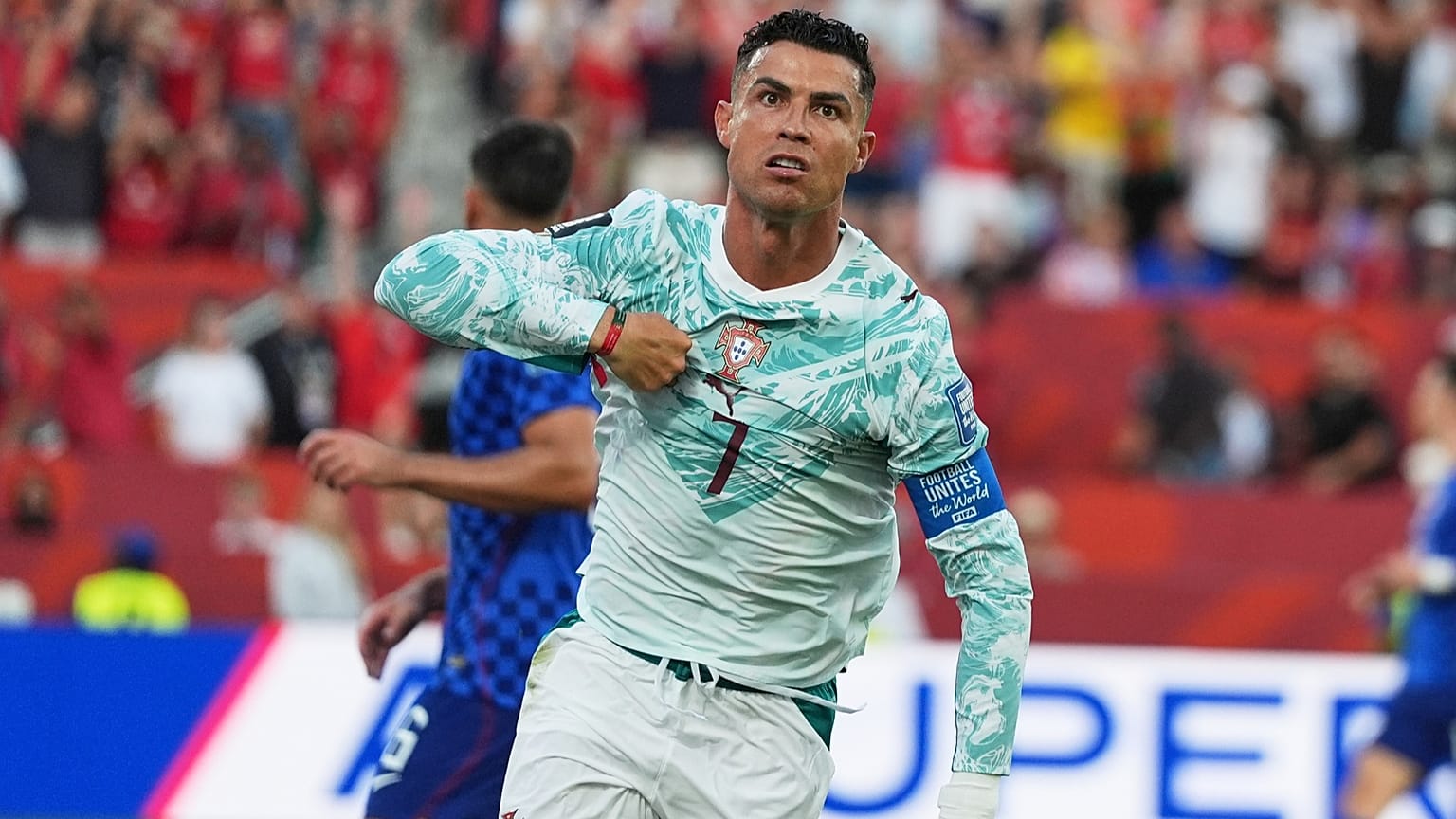
Portugal's Cristiano Ronaldo celebrates after scoring a goal during the World Cup round-of-32 match against Croatia in Toronto, 2 July 2026
Copyright AP Photo

By Peter Barabas & Euronews’ Doha and Dubai bureaus and Euronews Portuguese and Arabic services
Published on

Superstar striker Cristiano Ronaldo’s whisper broadcast live around the world before the decisive penalty against Croatia sparked a global debate over whether it was an Arabic-inspired sacred invocation or his own pre-Saudi encouragement routine in Portuguese.

The deeply personal moment of Cristiano Ronaldo's maximum concentration was captured by a camera close-up and broadcast live to billions around the world seconds before taking the decisive penalty in Portugal’s 2-1 dramatic victory over Croatia on Friday.

Yet it was his whisper to himself that ignited a worldwide debate on social media as to what exactly he said.

Social media users across the Arabic-speaking world erupted in cheers on Friday, proclaiming that he whispered “Bismillah” twice.

Meanwhile in Portugal, the nation held its breath for those endless seconds that decide in an instant between a hero and a villain. The debate appears to be divided between “vamos lá” (“come on”) and “vais marcar” (“you will score”).

“Bismillah,” or “In the Name of God,” is used across the Arabic-speaking and Muslim-majority world as an invocation for God’s help, guidance or blessing before taking any action, in hopes of good outcomes.

Cristiano Ronaldo joined the Saudi Professional League in 2022 to play for Al Nassr, much to the delight of the entire Arab world, and it was this crucial moment that captured their imagination with multiple social media videos showing men freezing in front of their TVs for a second and then erupting both in disbelief and in celebration to exclaim that “Ronaldo said Bismillah".

The Arabic-language media across the Gulf and beyond joined the deciphering movement by cautiously – or shyly – front-paging the unexpected, but the much-desired: that the global superstar may have indeed whispered “Bismillah” as a striking routine, signalling that the moment has now indeed arrived to consider CR7 not just Portugal’s champion and captain, but also a legend of the Arabic world.

The debate inevitably galvanised staff at Euronews’ Doha and Dubai bureaus and its Arabic service in analysing the moment, all of which converge on the conclusion that Cristiano Ronaldo did whisper “Bismillah”.

Our journalists also raised the crucial point that Cristiano Ronaldo has said “Bismillah” many times before while playing in the Saudi league for pre-strike inspiration, and that this may be the first time the champion’s intimate self-encouragement moment plays out on the global stage – and to global sensation.

In the social media arena, one user from Saudi Arabia exclaimed: “so moving how Cristiano Ronaldo has been influenced by Islamic culture since arriving in Saudi Arabia! And even more impactful how he repeated the phrase (Bismillah) in a moment of focus to score the goal."

Another user from Pakistan explained that “Ronaldo recites Bismillah before every penalty kick. He once said in an interview: whenever I say Bismillah, I score a goal.”

As the intense debate raged on, another social media user countered that “Ronaldo isn’t saying Bismillah. He’s saying 'vais marcar'. Basically telling himself ‘you’re going to score.’ His accent would make him pronounce it 'bais marcar' which looks a lot like Bismillah.”

Portugal’s and also Al Nassr’s captain has not yet shed light on the debate, focusing instead on greeting the Portuguese fans gathered outside the team’s hotel after the match to celebrate with them Portugal’s advance to the quarter-final stages, largely thanks to that quiet moment of inspiration that decided the qualifier and silenced his critics.