It’s possible that I shall make an ass of myself. But in that case one can always get out of it with a little dialectic. I have, of course, so worded my proposition as to be right either way (K.Marx, Letter to F.Engels on the Indian Mutiny)
Scandola, a UNESCO-listed nature reserve off the coast of Corsica, is attracting a growing number of visitors from around the world – drawn to its dramatic landscapes and rich marine life. However, protecting its unique wildlife and fragile marine ecosystem is becoming an increasingly delicate balancing act. Our colleagues at France 2 and FRANCE 24's Guillaume Gougeon report.
Analyst on Sudan says 'without international support, the war would not go on like this'
Sudan Affairs Analyst Jan Pospisil says the siege of El-Obeid has been ongoing for almost a year, with paramilitary group The Rapid Support Forces (RSF) appearing determined to seize the city. While he argues that Sudan's civil war is not a proxy war in the strict sense, he also makes clear that "without international support, the war would not go on like this”. However, none of the external actors involved – whether the UAE, which supplies arms to the RSF, or the US and Saudi Arabia – has the leverage to bring the warring parties to a ceasefire, let alone a negotiated settlement.
‘International law is our compass’ in global conflict, UN rights chief tells RFI United Nations High Commissioner for Human Rights Volker Türk tells RFI that repression in Iran and drone warfare and sexual violence in Sudan show that civilians are paying the highest price for conflicts around the globe.
Speaking to RFI this week, Türk warned that civilians are paying the highest price for the war between Iran, Israel and the United States – from worsening repression inside Iran to wider instability across the Middle East.
He also raised the alarm over the spread of drone warfare, the rise of autonomous weapons and the use of sexual violence as a weapon of war in Sudan, while insisting that international law still matters – even when powerful states break it.
RFI: Four months after the outbreak of war in the Middle East, the agreement reached between the US and Iran still seems very fragile. Are you concerned that the conflict might flare up again?
VT: It is exactly as you say. It is fragile and unpredictable. My thoughts are particularly with the Iranian people, who are caught between a rock and a hard place.
I can see that repression has intensified. We saw and experienced what happened in January – mass arrests, executions and killings. I fear that is exactly what is happening right now. So we must think of the Iranian people.
RFI: What was the point of this war? Is the world any safer as a result of this conflict?
VT: What we have seen, particularly with the closure of the Strait of Hormuz, is an impact on the global economy. That affects developing countries in particular, but also vulnerable people within those countries.
So it is clear that the economy is affected, people are affected and the impact on civilians is significant. We can see the situation in Lebanon too. So no, the world has not become a safer place.
RFI: The conflict in Iran has had a devastating effect on human rights throughout the region and across the globe. Do we have a proper understanding of the scale of the repression that has been unleashed upon the people? Do you, as High Commissioner for Human Rights, have a measure of that?
VT: One of the problems was that internet access was cut off. Iran did this for an extremely long period.
RFI: Three months.
VT: Almost three months. And that, of course, makes it extremely difficult to access information.
But at the same time, through all the contacts we have, we were still able to see that there have been at least 6,000 arrests since the outbreak of the war – probably more. We have seen shocking executions. In fact, we are seeing executions rise and the civic space that once existed has now disappeared.
RFI: So would you say the Iranian authorities have used this war to intensify the repression?
VT: Exactly. We are seeing an intensification of the crackdown on society.
It is clear that there is a lack of trust between the Iranian people and the government or state institutions.
RFI: From a broader perspective, do you think this war in the Middle East has marked a tipping point for international law?
VT: We often talk about tipping points. But it begins with every violation of the United Nations Charter.
Unfortunately, we saw what happened in Iraq 20 years ago. We saw what Russia did in Ukraine. We are seeing what is currently happening in the Middle East.
At the same time, international law is there. It is our compass. It also gives us a way of looking at things and establishing the facts. For that reason, international law is extremely important.
I often see cynicism towards it. But it is like – I think I have used this analogy before – traffic and the rules of the road. If someone drives through a red light or drives at much higher speeds, that does not mean the Highway Code is no longer valid.
RFI: But when those who do not follow them are the big players, the powerful ones, the empires – is the challenge even greater for you?
VT: Yes, but the vast majority of member states are still there. They too have power. And that power must be exercised.
For example, in the United Nations General Assembly, you still have the vast majority of states that must, and indeed do, speak out in favour of international law, the Charter and human rights.
I think we need to give a voice to those states that defend international law. We must not underestimate the power of the vast majority.
RFI: Do you think that is still possible, despite the current context?
VT: Yes, because we do not talk often enough about the situations where it works. In most situations, international law does work. Our lives depend on it.
Personally, I have a lot of contact with political leaders from small countries who tell me that they are, of course, very concerned, but at the same time, they are asking for more international law, not less – even when the issues are difficult for them.
RFI: We have seen with the conflict in Iran, but also in Ukraine, that drone warfare is becoming more widespread. We have entered a new era in terms of how war is waged. Is that a cause for concern?
VT: Yes. Just to give you an example: in Sudan, my office has documented an increase in the use of drones since the start of this year, and the impact on civilians is much more severe.
The majority of civilian deaths are due to the use of drones. This is also the case during the rainy season. Normally, there is a reduction in military activity, so there is less impact on civilians. But what we are now expecting with the rainy season is that there will probably also be an increase in deaths and injuries.
Drones are being used, including some autonomous drones controlled by artificial intelligence which, in a way, choose their own targets.
Because of that, we support a ban on all autonomous weapons capable of killing. I hope this ban will be implemented globally.
RFI: The ban is intended to raise the alarm about the development of these autonomous weapons. But do you think a majority of states would support the idea?
VT: I think the majority of states would probably be in favour of it. The problem is that, when it comes to the major powers, we need to convince them, we need to engage them and we need to tell them that the world does not want this.
RFI: You were on a mission in Sudan, where you also observed the use of sexual violence as a weapon of war and said that the use of rape is becoming widespread.
VT: I think we are probably talking about thousands [of victims]. This is an extremely serious issue. I met 20 victims myself... who told me of horrific experiences. Mass rapes. It is truly impossible to list them all.
Rape, gang rape, sexual slavery, forced marriage, forced prostitution and sexual torture – that is what the term “sexual violence” encompasses.
And it is used as a weapon of war. I think it is extremely important that we do everything we can to bring these cases to justice. There must be no impunity in this regard.
We are going to push very hard for this and I hope that, at some point, those responsible will be brought to justice.
Because it has consequences over the very long term, once sexual violence has been committed against the victims and their communities.
I must say, I was really struck by [the victims'] resilience [and] also by their determination to fight this phenomenon.
I found that very important for society, because they want justice. They want to tell their story. And that is not easy, culturally speaking, in a context like this.
But even so, I found a very powerful strength there. We must give them a voice.
RFI: As UN High Commissioner for Human Rights, are you limited to simply taking stock of the atrocities taking place around the world?
VT: No, because at the same time, we are making a difference. We do have a certain amount of influence.
Last year, we secured the release of 5,000 people who were being arbitrarily detained. We influenced the drafting of more than 140 pieces of legislation and policies worldwide to bring them into line with human rights.
RFI: So you are making a difference in some way?
VT: Yes, and we are also in demand. We are a beacon of hope for victims, for human rights defenders and for civil society.
I think we need to look at that too. There are millions who are counting on us to do our job, because, to a certain extent, we are their only hope.
This interview has been adapted from the original version in French on RFI's Grand invité international programme and lightly edited for clarity.
FOOD NOT BOMBS
Hunger in northern Nigeria reaches worst levels in nearly a decade, WFP says
More than 17 million people across nine conflict-hit states in northern Nigeria face severe hunger, the UN's food agency (WFP) has said, warning that violence and funding cuts are driving food insecurity to its worst level in nearly a decade. Stripped of their livelihoods, some people are fleeing across the border into neighbouring Benin.
Issued on: 05/07/2026 - RFI
Yakura Usman, 70, walks after receiving food assistance at a distribution centre from where WFP provides relief, including in-kind food rations, electronic food vouchers, and specialized nutrition support for vulnerable households and internally displaced persons in Dikwa, Borno State, Nigeria, May 13, 2026. via REUTERS - Khalid Hamza
The latest food security analysis showed the number of people facing crisis, emergency or catastrophic hunger had risen by almost two million from previous projections, the World Food Programme (WFP) said in a statement published Thursday.
The findings underline the deepening humanitarian cost of insecurity in Africa’s most populous country, where Islamist insurgents in the northeast and armed gangs in parts of the north have displaced communities, kept farmers from their fields and restricted aid access.
The crisis is worsening during the lean season, when households typically exhaust food stocks before the next harvest.
In Borno state, the epicentre of a long-running Islamist insurgency, more than 3 million people are acutely short of food. More than 750,000 of them are facing severe hunger conditions, WFP said.
"When people lose access to food, the risks of displacement, exploitation and instability increase," said WFP regional director for West and Central Africa Kinday Samba, adding that violence was spreading across a wider area and forcing people from farmland.
WFP said it can support fewer than half of the 1.3 million people it was able to assist last year in three northeast states, where 6.2 million are suffering from acute hunger – nearly 13 percent more than a year ago.
In some areas, the WFP has already recorded phase 5, the most critical level in the hunger classification system.
The agency said it needs $89 million over the next six months to maintain food, nutrition and logistics support across northern Nigeria.
A woman stands by the remains of her belongings following a fire that broke out as WFP was preparing for its food distribution exercise, in the Damasak IDP camp, in Damasak, Mobbar, Borno State, Nigeria, May 12, 2026. via REUTERS - Khalid Hamza
'Double Trap'
Unable to farm, some people have been forced to flee over the border to Benin.
More than 1,000 Nigerians received assistance in Benin last month, the WFP said.
The WFP describes a "double trap" as conflict cuts people off from essential services, while funding cuts cuts reduce humanitarian aid.
Many nutrition centres have closed due to the insecurity or lack of funding.
Some families are taking ever greater risks to survive.
Women who leave refugee camps to collect firewood risk kidnapping or sexual violence.
Some young people are joining armed groups for a few dozen cents a day, simply to be able to eat, the WFP said.
Zainab Abubakar eats cooked food with her children at Gubio IDP camp in Maiduguri, Nigeria October 28, 2024. REUTERS - Abraham Achirga
The Afghan women farmers keeping their village alive
Eshtiwi (Afghanistan) (AFP) – In a remote province of northeastern Afghanistan, women farmers are playing a vital role in their community's survival among the snow-capped mountains.
Mohammad Yahya Faizi, a 34-year-old agriculture graduate, said he respects the women's work.
"We would not have food anymore in the middle of the winter" without their work, he said.
Eshtiwi in summertime is only reachable by a dirt track and, before AFP's visit, it had been years since international media had reached the village.
Faizi said "tasks have been divided between men and women" for generations in the Parun Valley, where residents speak their own dialect.
"Women are busy with agriculture, planting, watering and cooking at home," said Faizi, a village farmer who volunteers with the Food and Agriculture Organisation (FAO) of the United Nations.
Men help with animal-drawn ploughs, handle livestock, and gather firewood for winter, when snow cuts the village off from the outside world for almost six months.
Habiba's day starts at around 4am, when she gets up to pray before preparing breakfast with her daughters on a wood-fired stove.
She makes bread using flour from her wheat, together with red beans from her fields, to eat alongside butter and dried yoghurt made by her husband.
The room, which doubles as a kitchen and bedroom, was decorated with flowers drawn by Habiba's 11-year-old daughter, Nahida, who was practising English that she had learnt at the village school.
While her mother never had the chance to go to school, Nahida's education will soon stop as girls nationwide are banned from education beyond the age of 12. 'Unrecognised'
FAO has declared 2026 the International Year of the Woman Farmer, with the agency highlighting how "unrecognised" their vital role is in supporting food security.
This is particularly true in Afghanistan, where almost a third of the population needs emergency food aid according to the UN.
The farmers often have surplus crops, she said, but "there is no structured market to sell our produce."
Being in such a remote area makes it impossible to sell direct to customers, and there are only limited options to meet traders who pass through.
"I sell my potatoes for 70 afghanis ($1.10) for seven kilos (15 pounds), but I would need 150 afghanis" to earn a decent income, Najia said.
'Help each other'
Storage units have been financed by the UN, to allow harvests to be kept and sold when the market improves, and some of the women have received better seeds.
FAO has also introduced agroforestry – the combination of trees and crops on the same plot – to diversify their income.
Faizi said that the village, which once produced only apples and walnuts, now has cherry, pear, and peach trees, among others.
But climate change is a big concern, with less predictable snow and rain, or bringing floods that destroy the crops.
The UN Development Programme has found that Afghanistan is among a group of countries that "have contributed the least to global warming yet bear its heaviest costs".
For Najia, the weather was a further challenge: "We can't predict it; it just hits us."
But despite the difficulties, she said women love working outdoors together.
"We can help each other," she said, while also providing the village with nutritious food.
"What we grow with our own hands is very healthy."
CRIMINAL CAPITALI$M
France's richest man Bernard Arnault ordered to pay €22.5m in back taxes Bernard Arnault, head of the luxury goods group LVMH, has been ordered to pay nearly €22.5 million in back taxes after a Paris appeals court overturned earlier rulings in his favour in a long-running dispute with the tax authorities.
Issued on: 05/07/2026 - RFI
France's top court has ordered Bernard Arnault and his wife Helene Mercier to pay more than €22 million in additional taxes. REUTERS - BENOIT TESSIER
The decision, first reported by the investigative news website L'Informé and seen by AFP, reverses a 2020 judgment that had cleared the LVMH chairman and his wife of the tax assessments and penalties.
According to the ruling, published on 2 July, the couple must pay €12.96 million in additional taxes, social contributions, penalties and interest relating to the 2010 tax year, as well as €9.5 million in wealth tax for the period from 2012 to 2015.
Arnault's representatives said they would challenge the ruling before France's highest administrative court – the Conseil d'Etat.
The case has gone back and forth through the courts for several years. After the Paris administrative court ruled in the Arnaults' favour in 2020, the economy ministry – under then finance minister Bruno Le Maire – appealed twice.
The Paris appeals court initially rejected that appeal, but the Conseil d'Etat later overturned its decision and sent the case back for reconsideration. Role of holding companies
The Arnaults argue that the tax authorities effectively carried out a full examination of their personal tax affairs without respecting the legal safeguards that apply to such investigations.
The dispute centres around the ownership structure through which the Arnault family controls luxury goods group LVMH.
Rather than holding shares directly, the family's stake is controlled through a series of holding companies, headed by the Belgian company Pilinvest. The court found that Bernard Arnault owned almost all of Pilinvest, valued at €368.4 million.
Part of the dispute concerns a 2010 capital reduction by the Belgian company. The court ruled that €32.18 million of the €49.97 million paid to Arnault and his wife following that transaction should be treated as taxable income.
The investigation also involved requests for assistance from authorities in Luxembourg and the Bahamas.
High-profile tax disputes
Arnault,77, whose LVMH conglomerate includes brands such as Louis Vuitton, Dior and Moet Hennessy, has an estimaed net worth of $165 billion according to the Bloomberg Billionaires Index. That makes him France's richest person and the world's eighth richest.
France scrapped its wealth tax on everything except real estate in 2017, shortly after Emmanuel Macron came to power. Attempts to reintroduce it have failed to get parliamentary approval.
The case is the latest in a series of high-profile tax disputes involving some of France's wealthiest families.
In 2024, members of the Wildenstein family – a French-American dynasty of art dealers, collectors, and horse breeders – were convicted on appeal of tax fraud.
Liliane Bettencourt, the late heiress of L'Oréal, received a tax reassessment exceeding €100 million in 2011 after undeclared bank accounts in Switzerland and Singapore came to light.
From memes to political movement, India's 'Cockroach' party leads youth revolt
India's Cockroach Janata Party began life as a series of internet memes and has grown into a real-life movement, bringing together young people angry about unemployment and alleged exam fraud. What began five weeks ago as a satirical response to comments by India's chief justice has become a fast-growing campaign which now has political ambitions, even as observers question whether it can survive without more effective organisation.
Issued on: 05/07/2026 - RFI
Abhijeet Dipke, founder of the Cockroach Janata Party, holds a portrait of anti-colonial revolutionary Shaheed Bhagat Singh at a protest in Amritsar against alleged irregularities in India's national entrance exams on 13 June. AFP - NARINDER NANU
Protesters have been camping out day and night beneath the trees at Jantar Mantar, New Delhi's best-known protest site, despite a ban by authorities. Many are wearing cockroach masks and carrying placards inspired by satirical internet memes, and carrying copies of the Indian constitution.
A few weeks earlier, nothing suggested those memes would grow into such a movement.
Most of the protesters are students or recent graduates protesting against unemployment and alleged fraud in medical college entrance exams.
"There are no more opportunities for young people," Devika, who was attending her second rally, told RFI. "We are worried about the future of Generation Z. Our fight is a fight against corruption."
From Instagram to the streets
The Cockroach Janata Party (CJP) was launched on 16 May by Abhijeet Dipke, a 30-year-old communications specialist educated at Boston University.
Based in the United States, he was reacting to comments by India's chief justice, who compared unemployed young people to "cockroaches" and "parasites". Shocked, he decided to turn the insult back on its author.
"We created this party as satire," Dipke said. It quickly exceeded every expectation.
Within four days, its Instagram account drew almost 10 million followers. Within a few weeks it had reached 22 million, overtaking the account of Indian Prime Minister Narendra Modi's Bharatiya Janata Party (BJP).
"That made me realise the enormous frustration among young people over unemployment and the fraud that tainted the medical entrance exam," Dipke said.
The movement quickly spread beyond social media.
Abhijeet Dipke, 30, founder of the Cockroach Janata Party. He says the movement is ready to protest for as long as necessary after its rapid rise on social media.
Dipke returned to India at the end of May and organised seven rallies across six states and territories before returning to Delhi, where supporters decided to occupy Jantar Mantar.
Psychiatrist Rajendra Prasad, who attended the first rally, said the movement's spontaneous nature stood out. "No one brought them here," he said. "They came by themselves."
However, Prasad also questioned whether it could survive without clearly identified leadership.
This concern is echoed by other observers. Nandita Narain, a former professor at Delhi University and president of the Federation of Central Universities Teachers Associations (Fedcuta), said she had not seen student mobilisation on this scale for several years.
"These young people rise above political loyalties," Narain said. "Many probably come from families that support the government. They have little experience and everything seems improvised, but they are expressing real anger and, above all, they are beginning to overcome their fear." Political ambitions
While the CJP had succeeded in capturing the anger of part of India's educated youth, it still lacked a clear ideological foundation, said Mehina Fatima, a researcher at Delhi University.
"The question is where it will be in five years," she said.
Dipke rejected that assessment.
"Our ideology is based on secularism, social justice and the constitution," he argued. "We draw inspiration from Ambedkar, Gandhi and Nehru."
Those references to India's founding figures mark a change for a movement that only weeks earlier was an Instagram account parodying official posters, government slogans and AI-generated images.
Its organisers now openly say they have political ambitions and have taken their campaign into public spaces.
However the movement remains highly decentralised. Decisions are made through online discussions that students join and leave freely. Meanwhile teachers, doctors and retirees supporting the protests do not always speak with one voice.
That flexibility appeals to young people who distrust traditional political parties, but it is also seen as the movement's greatest weakness. Uncertain future
Even its name remains a joke. Asked why it was called Cockroach Janata Party – with the CJP initials echoing those of the ruling Bharatiya Janata Party – Dipke smiled.
"It was a satire," he told RFI. "A wink at the ruling party."
Dipke insisted, however, that the CJP was more than just a communications exercise.
"Everything we do is political," he said. "If we stop doing politics, then the government is no longer held accountable."
Five weeks after its creation, the Cockroach Janata Party remains difficult to define. Its rapid rise has exposed deep frustration among young Indians, but its political future remains uncertain.
An international team has identified a new amphicyonid species, named Paludocyon moyasolai, from a skull found 30 years ago at Els Casots near Barcelona. The discovery, reported in the Journal of Mammalian Evolution, expands knowledge of these Miocene carnivores.
The skull was unearthed in the 1990s during one of the excavation campaigns at Els Casots, the site in the municipality of Subirats (Alt Penedès) that over time has become one of the key Miocene locations in Europe.
At the time, researchers assumed it belonged to an already known specimen of the genus Paludocyon, of which fragmentary remains had been found in the area and in other countries. With nothing new to investigate, the piece was put into storage.
It was not until 2014, in the course of a doctoral thesis, that someone took another look at that skull and realised something did not quite add up. The species it had been compared with was much more robust, roughly the size of a lion or tiger and with a weight close to 200 kilograms.
What they actually had in front of them seemed smaller and probably less muscular. The team at the Institut Català de Paleontologia Miquel Crusafont spent the last two years confirming their suspicion: it was not a known Paludocyon, but a species that no one had described before.
The newly identified species has been named Paludocyon moyasolai, in honour of the palaeontologist Salvador Moyà-Solà, and makes Els Casots the global reference site for this species.
Alongside the ICP, the study involved the National Museum of Natural Sciences (CSIC), the University of Valencia, the Autonomous University of Barcelona, Complutense University of Madrid, Ecuador’s National Institute of Biodiversity and the Iziko museum in South Africa.
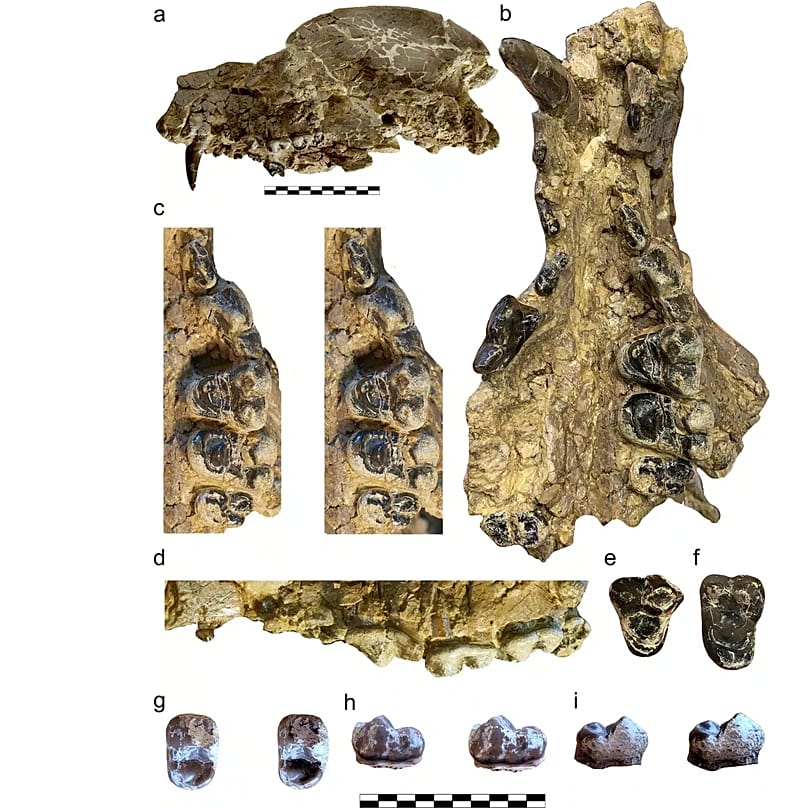
Skull and teeth recovered at Els Casots, Catalonia, Spain Journal of Mammalian Evolution
A medium-sized predator in a tropical lagoon
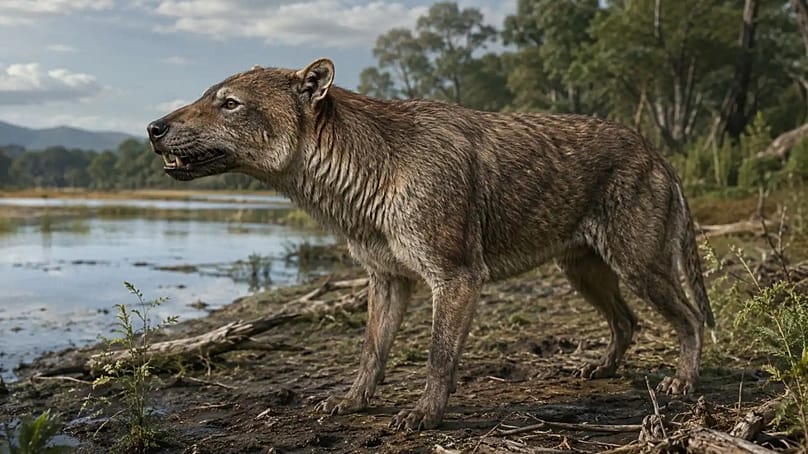
According to the researchers’ calculations, this amphicyonid, a member of an extinct group of carnivores that combined dog-like and bear-like traits without truly belonging to either, was about the size of a large dog and weighed between 50 and 70 kilograms.
The remains recovered include the skull, much of the dentition and a single isolated lower molar, enough material to reveal something that caught the team’s attention: the unusual development of the posterior molars, with a second upper molar that is especially broad and a third that is larger than usual for the genus.
That dentition points to a varied diet, consistent with a mesocarnivorous hunter capable of chasing small and medium-sized prey – primitive deer, bovids, ancestral pigs – without being the most powerful animal in its environment. In fact, the same site yielded a second, considerably larger amphicyonid species, roughly the size of a leopard, which has not yet been formally described.
The setting in which it lived around 15.9 million years ago was very different from today: a shallow lagoon surrounded by tropical forest, with crocodiles, snakes, fish and a striking diversity of mammals sharing the same space.
That aquatic environment, the excavation leaders point out, is precisely what allowed such good preservation of the fossils: after death, the bodies became trapped in the mud, which protected them from decomposition.
Reconstruction of the bear-dog discovered in Catalonia that lived 15.9 million years ago Recreación IA
Another piece in the map of Miocene carnivores
The find adds to a broader body of research on how communities of large carnivores were organised during the Miocene on the Iberian Peninsula. A previous study, involving Complutense University of Madrid, had already examined slightly more recent sites, Los Valles de Fuentidueña in Segovia and Cerro de los Batallones in Madrid, where an unusually high number of carnivore species lived side by side: bear-dogs, felids, hyenas and bears.
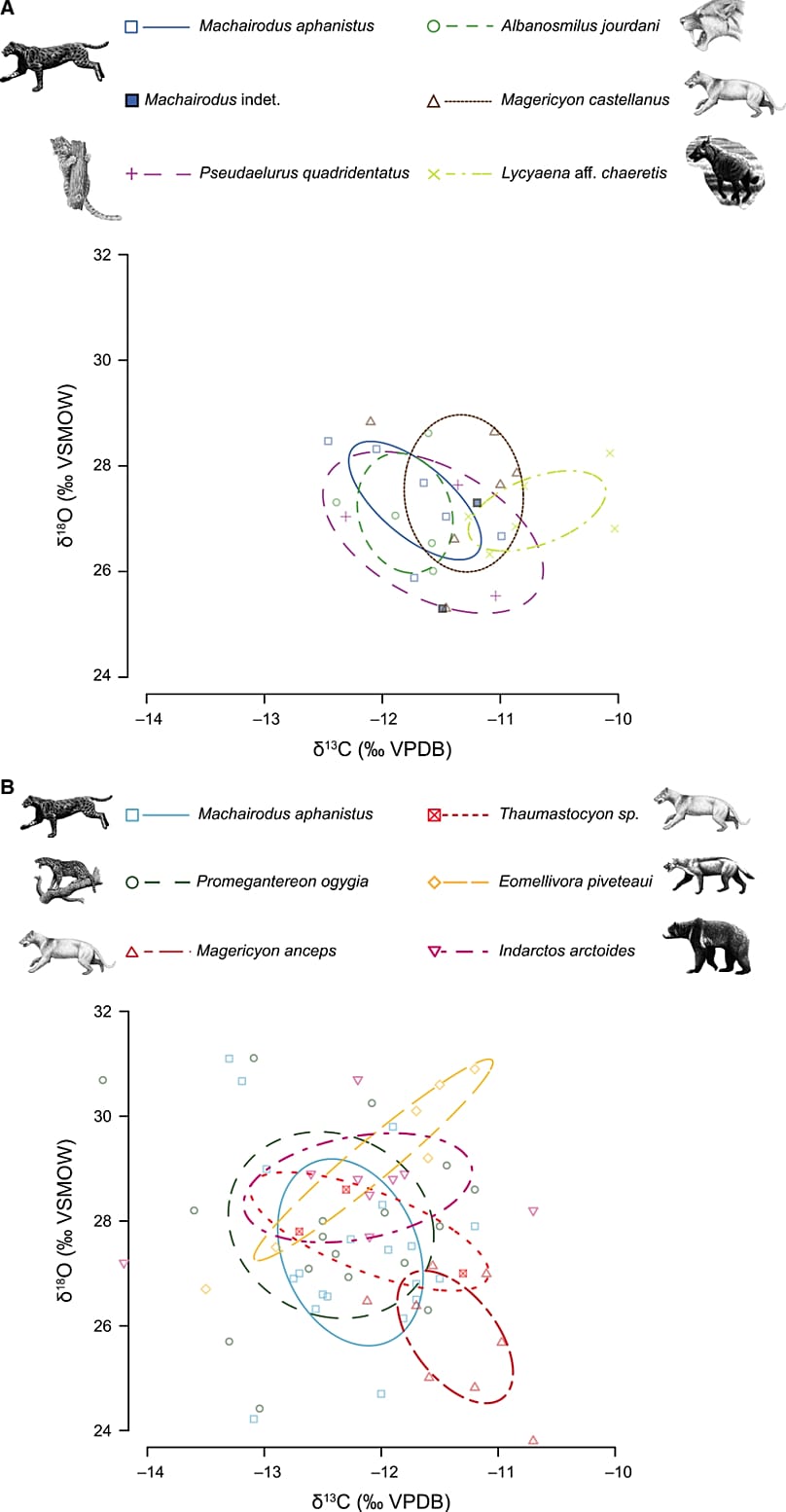
Using stable isotope analysis on more than 200 samples of tooth enamel, that study, published in Palaeontology, showed that competition between them was intense, except in cases such as the amphicyonid itself or the primitive hyena, which hunted different prey in more open habitats.
This kind of work with isotopes makes it possible to reconstruct with considerable precision what each animal ate while barely damaging the fossil: just a few milligrams of enamel need to be extracted with a dentist’s drill and analysed by mass spectrometry.
Carnivores from the Miocene period in the area Paper UCM
Applied to different sites and different moments of the Miocene, this approach is gradually building an increasingly detailed picture of how fauna responded to the environmental changes of the time – the shift from dense forests to more open, arid landscapes – and of the strategies that allowed some species to coexist despite such fierce competition for the same territory.
Paludocyon moyasolai fits into that story as one more piece of the puzzle, slightly earlier in time than the episodes studied at Fuentidueña or Batallones but belonging to the same amphicyonid family that dominated much of Eurasia and North America during the Cenozoic. Every new specimen described, researchers agree, helps to refine the group’s evolutionary tree and to better understand how it became completely extinct a few million years ago.
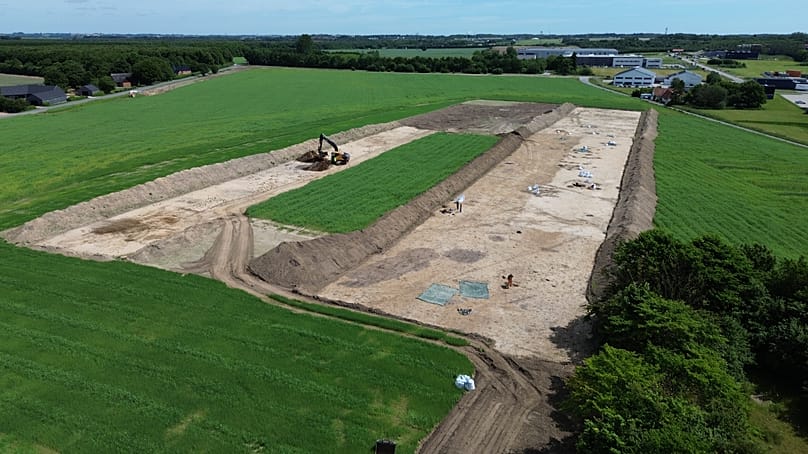
An excavation near Aarhus in Denmark may fundamentally alter how we see the Viking Age: 82 pit houses identified as specialised textile workshops have been uncovered.
The Vikings were apparently not only a warlike people: In Søften, a small village in the Mid Jutland region north of Aarhus, archaeologists have uncovered the remains of an exceptionally large craft settlement. The complex dates from the 7th to 10th centuries and covers 100,000 square metres. In total, the archaeologists excavated 82 pit houses.
The area seems to have served as a specialised craft zone, with numerous workplaces operating in parallel. The large number of identical workshops suggests that division of labour, and possibly centralised control, played a role.
An aerial photograph shows the archaeological excavation site in Søften near Aarhus, Denmark. AP Photo
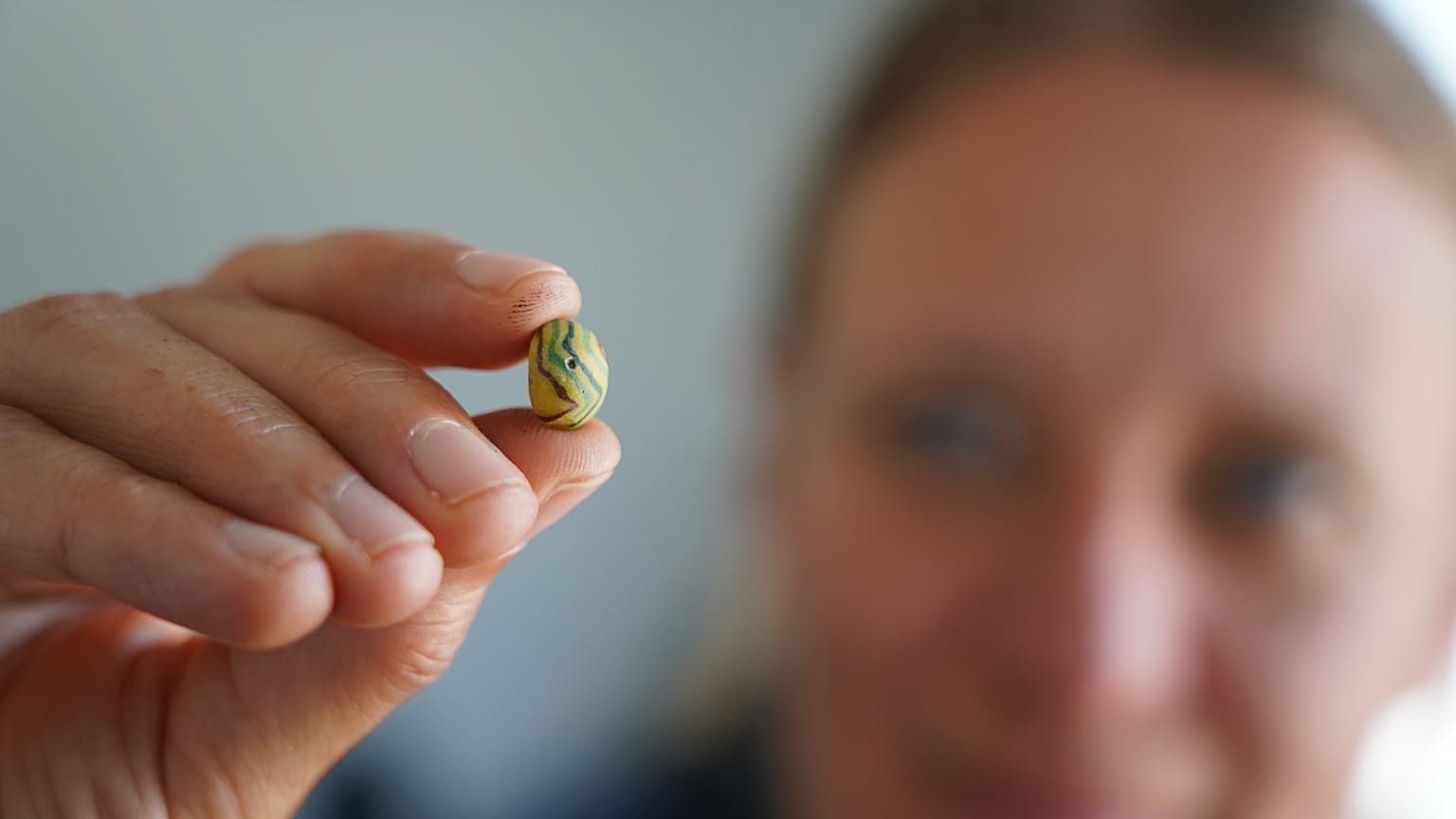
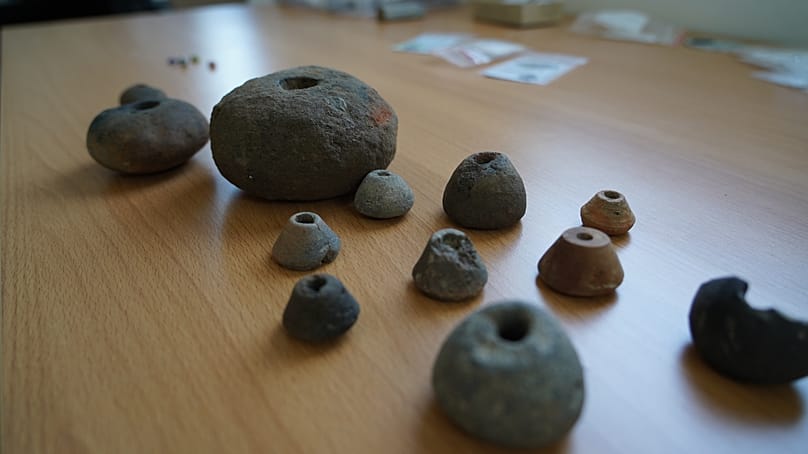
The excavations brought to light an enormous number of loom weights, spindle whorls and glass beads, indicating that textiles were produced there on a scale far exceeding the needs of the local population. The finds document a complete production chain, from processing the fibres to the finished fabric.
Loom weights and spindle whorls were found during the excavations in Denmark. AP Photo
The researchers also found Arabic coins from the Middle East, as well as mintings from what is now France and Germany. These artefacts show that the inhabitants of Søften were part of far-reaching trade networks that extended as far as Asia.
The site was strategically well placed near the then trading centre of Aros. Its location made it easy to channel the goods produced into trade and export them.
In the researchers' view, the finds prove that the Vikings had a highly developed economy. Historian Kasper H. Andersen from the Moesgaard Museum stressed: 'It shows us that the Viking Age was not just an uncivilised, barbaric and backward era, as is often assumed.'
It is not yet clear when the artefacts, probably including those to be displayed at the Moesgaard Museum, will be available for public viewing. The analysis of the finds is still ongoing and could take several months to several years.
400,000-year-old intact cave found in Israel sheds light on pre-Neanderthal era
A prehistoric cave found near Foreidis in northern Israel is offering a rare glimpse into a little-known phase of human evolution. Sealed for hundreds of thousands of years, the site preserves tools, animal remains and evidence of prolonged occupation.
Archaeologists seldom encounter a site that has remained virtually untouched by natural and human interference for hundreds of thousands of years.
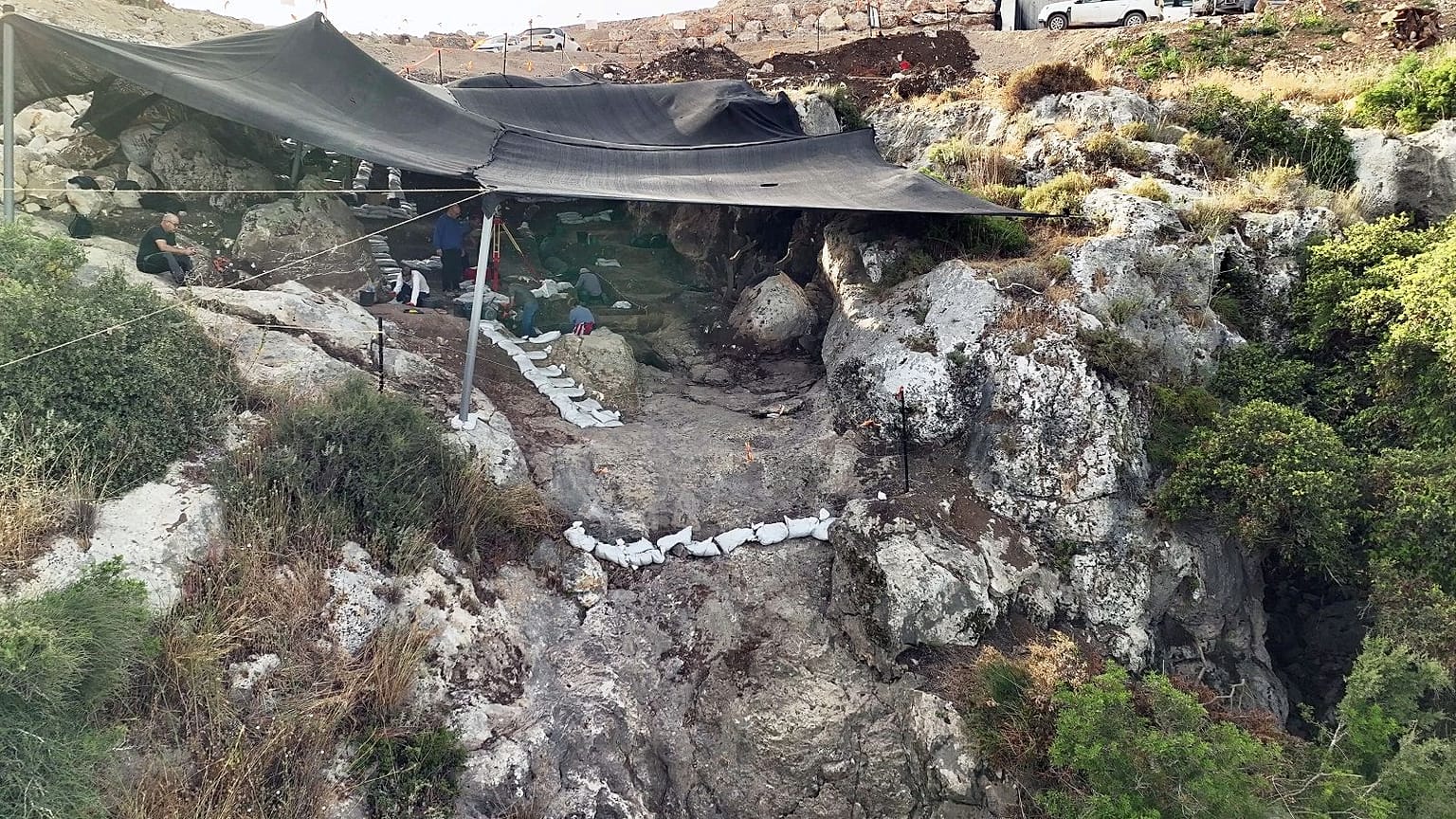
That is precisely what has been found in a cave on the outskirts of Foreidis, near the Zichron Yaakov junction, where researchers from the Israel Antiquities Authority and the University of Haifa are excavating a site dated to between 400,000 and 250,000 years ago.
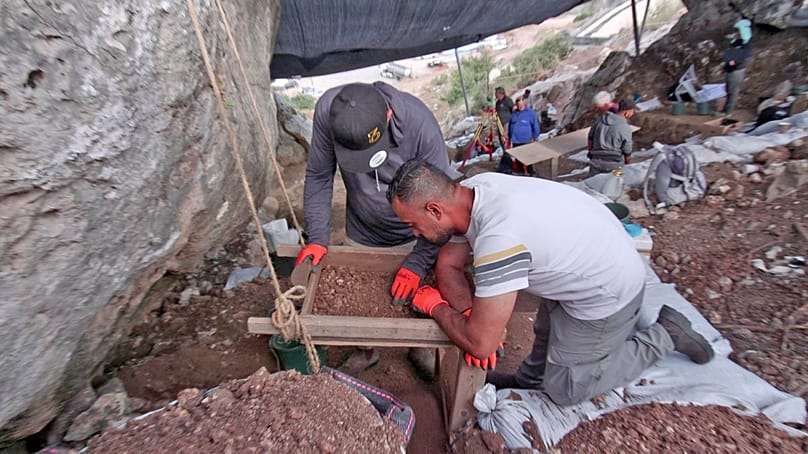
The excavation is led (source in Spanish) by archaeologist Kobi Vardi and Amit Gabay, together with Professor Ron Schimmelmitz. The team describe the site as one of the most significant discoveries of recent decades for understanding a stage in human evolution for which very little evidence has been preserved.
The cave is associated with the so‑called Acheulo-Yabrudian culture, a technological tradition characteristic of the Levant during the late Lower Palaeolithic. According to the researchers, its exceptional state of preservation makes it a genuine “time capsule” capable of yielding information that is difficult to obtain at other sites in the region.
Inside the Foreidis cave during excavation Emil Aljam - Israel Antiquities Authority
A decisive moment in the history of our species
The period to which the site belongs predates the spread of Neanderthals and anatomically modern humans. Specialists view it as a time of profound change in ways of living, relating to one another and adapting to the environment.
According to Schimmelmitz, during these millennia behaviours began to emerge that would later become commonplace among human populations. These include the formation of larger groups, the long-term occupation of specific places and a more complex social organisation.
The evidence recovered also points to an intensive use of fire and to relatively long stays in caves, something usually associated with greater cooperation between individuals and the systematic transmission of knowledge within communities.
The researchers believe that these changes laid some of the cultural and technological foundations that would later characterise Neanderthals and Homo sapiens.
Tools, animals and a landscape rich in resources
Among the finds already documented are numerous flint tools produced using techniques that were advanced for the time. Archaeologists have identified small hand axes, scrapers and cutting blades made with great precision.
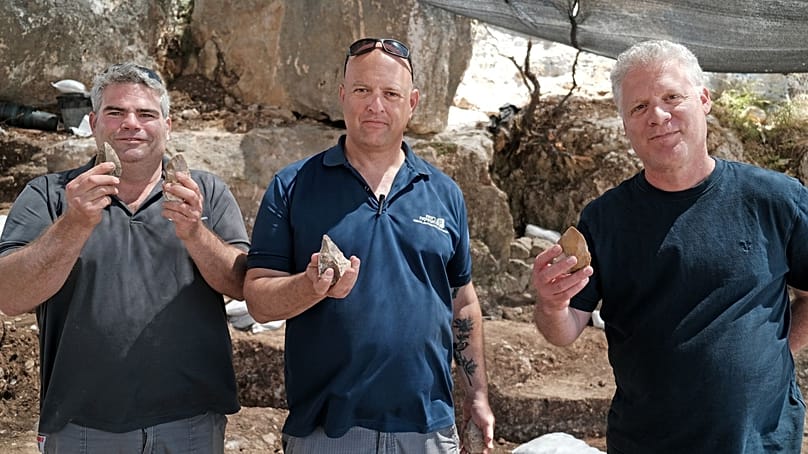
From right to left: researchers Prof Ron Schimmelmitz of the University of Haifa, Dr Kobi Vardi and Amit Gabay of the Israel Antiquities Authority. Emil Aljam - Israel Antiquities Authoritiy
The excavation has also brought to light animal bones from species such as horses, deer and wild asses. Alongside them were traces indicating the presence of water in the surrounding area, a resource that would have made the site particularly attractive to groups of hunter-gatherers.
Vardi compares the scientific importance of the discovery to that of the renowned Nahal Me'arot site (source in Spanish), designated a UNESCO World Heritage Site and also crucial for the study of prehistory in the Levant.
The Israel Antiquities Authority and the University of Haifa plan to develop an extensive research programme to reconstruct in greater detail how these human groups lived, how they exploited the resources available to them and how their technologies evolved.
Once the studies have been completed, the institutions involved hope to prepare the site for public visits, with the aim of bringing these discoveries closer both to local residents and to students and visitors interested in human evolution.


 Being in such a remote area makes it impossible to sell direct to customers © Wakil KOHSAR / AFP