Monday, July 06, 2026


Samsung sees quarterly profit jump more than 1,800% on AI boom

07.07.2026,

Photo: Rolf Vennenbernd/dpa

Samsung Electronics said on Tuesday it expects second-quarter operating profit to surge more than 1,800% from a year earlier, as strong demand for artificial intelligence infrastructure boosted sales of its memory chips.

The South Korean technology giant forecast consolidated operating profit of 89.4 trillion won ($58 billion) for the April-June quarter, according to a preliminary earnings estimate.

The figure would mark Samsung's third consecutive quarter of record operating profit and exceed its operating profit for all of 2025, which totalled 43.6 trillion won.

Samsung, one of the world's largest semiconductor makers, has benefited from booming demand for advanced memory chips used in AI data centres and other computing infrastructure.

The forecast also topped the average market forecast compiled by South Korea's Yonhap news agency by 6.2%.

The earnings boom has fuelled debate in South Korea over how the benefits of the AI-driven semiconductor surge should be shared. Earlier this year, members of Samsung's labour union accepted a pay deal that included large annual bonuses for workers in the company's highly profitable chip division.

Samsung's quarterly figures are preliminary estimates. The company is expected to release detailed earnings results later this month.


Germany wins landmark Canadian submarine deal ahead of NATO summit

06.07.2026

Photo: Christian Charisius/dpa

By Carsten Hoffmann, André Klohn and Elena Radwan, dpa

Canada has awarded German naval shipbuilder TKMS a historic multibillion-euro contract to build up to 12 submarines, Prime Minister Mark Carney said on Monday, handing Berlin a major defence industry win on the eve of a NATO summit in Turkey.

Carney announced the decision at the Canadian Forces Base in Halifax before departing for the two-day meeting in Ankara, where alliance leaders are expected to discuss further strengthening NATO's defence capabilities.

Germany, which faced competition from South Korean supplier Hanwha Ocean, had pushed hard for the Canadian order as allies seek to counter the growing threat posed by Russia, including in the Arctic and Atlantic.

"In a more dangerous and divided world, Canada must be prepared to defend our interests, protect our citizens, build our economy, and secure our future. To that end, we are making the largest defence procurement in our nation's history with speed, ambition, and discipline," Carney said in a statement issued by his office.

"Together with our German and Norwegian Allies, we will build at speed and scale to expand our strategic capabilities and create greater strategic autonomy."

Under the deal, TKMS will supply Canada with up to 12 Type 212CD submarines, a new class jointly developed by Germany and Norway. The "CD" designation stands for "Common Design," a standardized platform intended to reduce costs and improve interoperability.

The order is the largest in TKMS's history and makes Canada the third major operator of the Type 212CD, alongside Germany and Norway.

The submarine agreement is intended as the centrepiece of a wider economic pact with Canada as Ottawa seeks to reduce its dependence on the United States.

Canada currently obtains around 80% of its military equipment from the US, but relations have been strained since President Donald Trump returned to office last year, imposing steep tariffs on the northern neighbour and repeatedly threatening to annex the world's second-largest country.

Neither Canada nor TKMS disclosed the value of the deal, but the submarines and related support are expected to be worth around €20 billion ($22.8 billion), according to information obtained by dpa. 

Including maintenance and operation over the coming decades, the overall programme could reach about 100 billion Canadian dollars ($70.3 billion), Canadian media reported.

The submarines are to be built at TKMS shipyards in Kiel and Wismar in northern Germany, where the company plans to create up to 1,500 jobs. TKMS employs more than 9,100 people worldwide, including around 3,300 in Kiel.

Canada aims to bring the first submarines into service by 2035, though recent indications suggest deliveries could begin earlier.

"Today's decision will provide the Royal Canadian Navy a critical capability, ensuring we can defend and secure Canada's vast coastline," Canadian Defence Minister David McGuinty said.

"From coast to coast to coast, this historic investment in the Canadian Armed Forces will bring strong economic benefits and jobs across the country."

German Defence Minister Boris Pistorius welcomed Canada's decision, describing it as a milestone in efforts to strengthen trans-Atlantic security.

"Together, we will build the world's largest and most advanced conventional submarine fleet," Pistorius said. "The information gathered by our 24 submarines in the North Atlantic, the Arctic and the High North can be exchanged, analysed and used quickly among us."

German Chancellor Friedrich Merz said Canada's decision to procure the German-Norwegian-designed submarines sent "a strong signal" of strategic cooperation.

"Ahead of tomorrow's NATO summit, the Canadian government is sending a strong signal of trans-Atlantic and European cooperation in the defence industry," Merz said in a statement.

Germany, Canada and Norway entered into a maritime security partnership in July 2024 that also covers defence cooperation. Denmark has since joined the alliance.

Death toll from DR Congo Ebola outbreak passes 500 as healthcare workers threaten strike


The deadly Ebola outbreak in the Democratic Republic of Congo has killed more than 500 people, the UN health agency's figures showed Monday. Healthcare workers in Ituri province, the heart of the outbreak, on Sunday issued a 24-hour notice threatening to strike if the government did not improve their working conditions and pay them promised benefits.


Issued on: 06/07/2026 
By: FRANCE 24

A child returning from school stops to look at Ebola awareness illustrations displayed on the signboards of the Ebola Treatment Center in Munigi on June 2, 2026. © Jospin Mwisha, AFP


More than 500 people have now died in the Ebola outbreak gripping the Democratic Republic of Congo, World Health Organization figures showed Monday.

A newly updated count issued by the UN health agency showed that there have been 1,561 confirmed cases in the DR Congo since the outbreak was declared in mid-May, including 506 confirmed deaths.

Two others have also died in neighbouring Uganda, where the situation is more stable. The country has seen 16 patients recover out of 20 total confirmed cases.

The WHO's figures for the DR Congo, which come from the health authorities in the vast country, show that the outbreak there has a case fatality rate of 32 percent.

A total of 254 patients have recovered, while 354 suspected cases of the viral haemorrhagic fever are currently under investigation.

The outbreak is being driven by the rare Bundibugyo species of Ebola, for which there are no approved vaccines or treatments.

The trial of two potential treatments for Bundibugyo began in the DR Congo on Thursday.

The trial is evaluating the safety and effectiveness of the monoclonal antibody MBP134 and the antiviral drug remdesivir, alone and in combination.
Breaking point

Frontline workers deployed in Ituri province, the epicentre of the outbreak, issued a 24-hour notice on Sunday threatening to strike if authorities fail to pay them and improve their working conditions.

The workers include mostly health professionals who have been labouring with little rest as they battle attacks from angry residents and widespread scepticism about the virus.

In the notice to the government, a copy of which was seen by the Associated Press, the workers both in and outside hospitals said they had not been paid benefits since the outbreak began and they do not have adequate supplies for their work.


Ebola outbreak 'serious' but not 'out of control', head of Africa CDC says
 TÊTE À TÊTE © FRANCE 24
12:45


They also complained of poor salaries, the "arrogance" of teams sent from Congo's capital of Kinshasa, and the “excessive” use of labour from other provinces without prioritising local labour in Ituri, as well as the lack of adequate equipment.

The strike threats come just days after enrollment for clinical trials started.
'The threat never truly goes away'

The milestone of 500 confirmed deaths comes as WHO member states reconvene to negotiate the missing section of the landmark pandemic agreement struck last year, aimed at avoiding a repeat of the international disarray in response to the Covid-19 pandemic.

"The next pandemic will not wait for us to be ready," WHO chief Tedros Adhanom Ghebreyesus warned countries on Monday.

"The Ebola outbreak still unfolding in the DRC right now is proof of that. It is not some distant, hypothetical scenario in a briefing document. It is happening.

"Ebola may not be the next pandemic. But it is a reminder, a painful one, that the threat never truly goes away."

The DRC's 17th Ebola outbreak was declared on May 15 after several unexplained deaths in mineral-rich but volatile Ituri, which is plagued by armed groups.

The virus spreads through close contact and infected bodily fluids.

(FRANCE 24 with AFP and AP)
Death toll from Venezuela quakes rises to 3,535 as more than 17,000 left homeless

The death toll from the back-to-back earthquakes that hit Venezuela on June 24 has risen to 3,535, official figures released on Monday showed. More than 17,000 people have been left homeless by the twin disasters.


Issued on: 06/07/2026
By: FRANCE 24


Workers prepare graves on the day of the burial of earthquake victims, in the aftermath of the June 24 earthquakes, at La Esperanza Cemetery, in La Guaira, Venezuela, July 6, 2026. © Adriano Machado, Reuters


The death toll from Venezuela's twin earthquakes has risen to 3,535, with more than 16,700 injured in the disaster, according to updated official figures released on Monday.

The massive June 24 earthquakes flattened entire neighbourhoods in La Guaira state north of the capital Caracas, and thousands are still reported missing.

The government said 16,740 people were injured in the powerful back-to-back shocks and that more than 17,000 were left homeless.

The government has not given a figure for those still missing under mountains of rubble, but the UN estimates that as many as 50,000 people may still be unaccounted for.


Many of the survivors are living in temporary camps on the street, in public parks or car parks.


Venezuelans mobilise to deal with earthquakes' consequences: FRANCE 24 reports
'Not a single person hasn't helped' dealing with the aftermath of Venezuela's earthquakes © France 24
02:58


As focus shifts from rescuing survivors to burying the dead and clearing the debris, international rescue teams have begun leaving Venezuela.

But the UN ​said it was continuing to ramp up aid operations ​in coordination with the government in Caracas.

"Some search and rescue teams remain deployed in the affected areas, while ​other specialised engineering teams and medical support continue to arrive," UN spokesperson Stephane Dujarric told reporters on Monday.

Families meanwhile continue to search for their dead in the hope of giving them a dignified burial.

On Sunday, authorities began burying dozens of unidentified victims in a mass grave.

A line of simple white crosses with small bouquets at their foot marked a long row of individual graves in La Esperanza cemetery in La Guaira.

Each one had the same date of death: June 24, 2026.

(FRANCE 24 with AFP and Reuters)
Hamas dissolves Gaza governing body, clearing way for technocratic committee

The Palestinian movement Hamas announced Monday that it had dissolved its governing body in the Gaza Strip after nearly 20 years in power, paving the way for a technocratic committee to administer the territory.


Issued on: 06/07/2026 
FRANCE 24
Video by: Noga TARNOPOLSKY

Buildings that were destroyed during the Israeli ground and air operations stand in the northern Gaza Strip as seen from southern Israel on July 2, 2026. © Leo Correa, AP
03:29


Palestinian Islamist movement Hamas announced Monday the dissolution of the body that has governed the Gaza Strip for nearly two decades, clearing the way for a technocratic committee to administer the territory.

The move marks a significant political shift by Hamas, which has run Gaza since its fighters seized control from rival Palestinian movement Fatah in 2007 after winning legislative elections the year before.

Since a ceasefire took effect in Gaza last October between Hamas and Israel, the group has repeatedly said it is prepared to step aside from day-to-day governance, but the thorny issue of its disarmament remains unresolved.

Ismail al-Thawabta, head of Hamas's media office in Gaza said the head of the government's emergency committee had "decided to dissolve the committee to facilitate the administrative and governmental transition to the National Committee for the Administration of Gaza (NCAG)".

Hamas spokesman Hazem Qassem told AFP that the group took the decision to relinquish charge "in order to remove any pretexts for the occupation, which continues its aggression and war of extermination".

The dissolution of the Hamas body paves the way for the National Committee for the Administration of Gaza (NCAG), headed by Palestinian official Ali Shaath, to assume administrative responsibilities.

Shaath, head of NCAG, said his committee was "fully prepared to assume its national responsibilities as soon as the necessary resources and capabilities are available".

"The fundamental requirements for the committee's success are a single authority, a single law with a clear mandate, and a single armed force under the authority of this single entity," Shaath said on X.

READ MOREHamas says ready to transfer Gaza governance to Palestinian technocratic committee

The NCAG was established by the Board of Peace, which was in turn set up by US President Donald Trump when he brokered the ceasefire between Hamas and Israel last October.

But it has remained based outside Gaza for months, reportedly due to Israeli objections to its entry into the war-devastated territory.

The Board of Peace insisted on X on the "the consolidation of all weapons under the control of the NCAG as provided for in the Comprehensive Gaza Peace Plan and United Nations Security Council Resolution 2803".

Hamas and other Palestinian factions have held several rounds of talks in Cairo with mediators to narrow differences, particularly over the second phase of the Gaza ceasefire.

The first phase involved the release of the last Israeli hostages held by Hamas in exchange for Palestinians detained by Israel.

The transition to the second phase, which was to involve Hamas's disarmament and a gradual withdrawal of Israeli forces from Gaza, has been stalled for months.

Israeli forces have actually expanded their occupation of the territory in recent months, taking control of nearly 70 percent.

Meanwhile, Hamas is demanding the establishment of a Palestinian administration before it will consider handing over any part of its arsenal.

The question of Gaza's post-war governance remains one of the main sticking points in negotiations on implementing phase two.

Israel rejects any return of Hamas to power, but also rejects a direct takeover by the Ramallah-based Palestinian Authority at this stage.

(FRANCE 24 with AFP)


Hamas says ready to transfer Gaza governance to Palestinian technocratic committee

Hamas is ready for a "complete transfer of governance" to a technocratic committee in the Gaza Strip, a spokesman for the militant group told AFP on Wednesday, adding that the critical Rafah border crossing with Egypt must be opened in both directions, "without any Israeli obstacles".

By: FRANCE 24


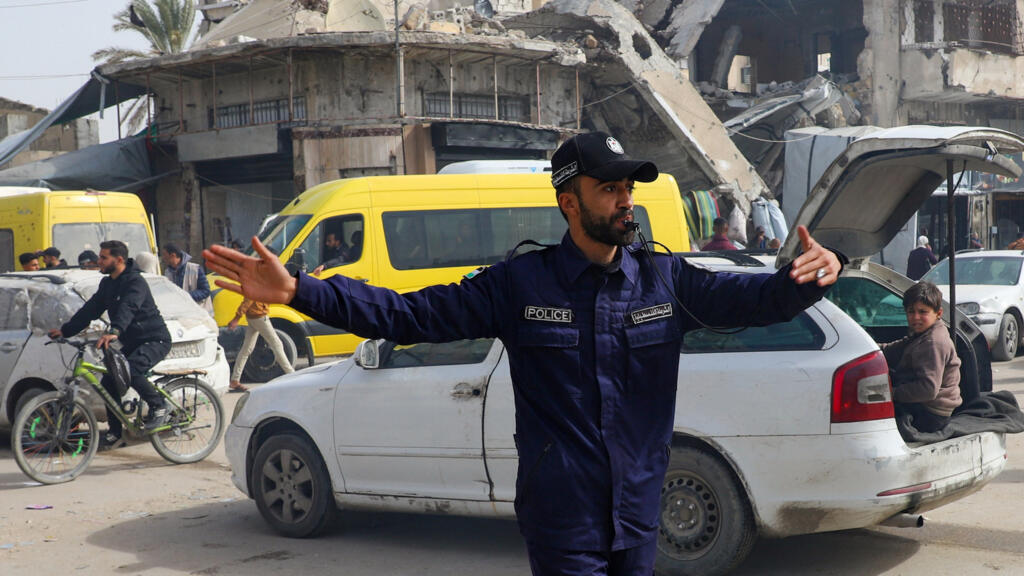
A Hamas police officer directs traffic in Gaza City on January 28, 2026. © Reuters stringer

Hamas said Wednesday it was ready to transfer the governance of Gaza to a Palestinian technocratic committee, while insisting the key Rafah border crossing be fully reopened within days.

"Protocols are prepared, files are complete, and committees are in place to oversee the handover, ensuring a complete transfer of governance in the Gaza Strip across all sectors to the technocratic committee," Hamas spokesman Hazem Qassem told AFP.

The 15-member National Committee for the Administration of Gaza (NCAG) is a team of Palestinian technocrats created as part of the US-sponsored ceasefire agreement which came into effect on October 10.

It is charged with managing the day-to-day governance of post-war Gaza and will work under the supervision of the "Board of Peace", which US President Donald Trump will chair.

The NCAG, headed by former Palestinian Authority deputy minister Ali Shaath, is expected to enter the Gaza Strip once the territory's Rafah crossing, on its border with Egypt, reopens.

Hamas spokesman Qassem added that the Rafah crossing "must be opened in both directions, with full freedom of exit and entry to the Gaza Strip, without any Israeli obstacles".

Rafah is Gaza's only gateway to the outside world that does not lead to Israel and is a key entry point for both people and goods.

It has been closed since Israeli forces took control of it in May 2024, except for a limited reopening in early 2025, and other bids to reopen have failed to materialise.

NCAG head Shaath announced last week that Rafah would reopen in both directions the following week.

Qassem told AFP the "independent national committee's announcement of the opening of the Rafah crossing is important".

"What is more important is that we monitor this committee's handling of citizens' departures and entries in full freedom in accordance with the agreement, and not according to Israeli conditions," he added.

Israel has said it would only allow pedestrians to travel through the crossing as part of its "limited reopening" once it had recovered the remains of the last hostage, Ran Gvili.

Israeli forces brought back Gvili's remains on Monday and his funeral was held in the southern town of Meitar on Wednesday.

Qassem said Wednesday that "it is clear that Hamas is committed to the agreement to stop the war on the Gaza Strip", which began after the militant group's deadly attack on southern Israel on October 7, 2023.

"It has carried out everything required of it in the first phase and is ready to enter all tracks of the second phase," he added.

With the technocratic committee's creation and the last hostage held in Gaza returned to Israel, the ceasefire deal's next important milestones will be Hamas's disarmament and Israel's withdrawal from Gaza.

Though Hamas said the return of Gvili's body showed its commitment to the ceasefire deal, it has so far not surrendered its weapons.

The group has repeatedly said disarmament is a red line, but it has also suggested it would be open to handing over its weapons to a Palestinian governing authority.

Neither Israel nor Hamas have committed to a clear date or strategy for withdrawal or disarmament.
China conducts long-range ballistic missile test in South Pacific

China said it test-launched a long-range ballistic missile in the South Pacific on Monday, after countries in the region reported having been warned of an imminent test.


Issued on: 06/07/2026 
By: FRANCE 24


A Chinese nuclear-powered ballistic missile submarine during a military display in the South China Sea on April 12, 2018. © China Stringer Network, via Reuters


China’s military test-launched a long-range ballistic missile Monday from one of its nuclear-powered submarines in the South Pacific, drawing protest and concerns from countries in the region.

The missile was launched at 12:01pm and carried a dummy warhead, according to an announcement by the official Xinhua News Agency. China last conducted a missile test in the Pacific two years ago, then firing an intercontinental ballistic missile with a dummy warhead.

The launch was part of routine annual training, complied with international law and practice, and was not directed against any country or target, according to the statement from Xinhua, which was reposted by the Ministry of Defence.

Australia and New Zealand criticised the launch.

The New Zealand government said it was informed of the planned launch hours beforehand and noted that the missile was fired into the South Pacific Nuclear Free Zone.

The nuclear-free zone was established by the 1986 Treaty of Rarotonga, which prohibits nuclear weapons throughout the region. China in 1987 ratified the protocols pledging not to test nuclear weapons within the zone, or to threaten to use them against signatories with territory in the region.

“It appears that despite our long-standing concerns about this type of activity, China carried out the test within hours of informing us,” Foreign Minister Winston Peters told The Associated Press in a statement.

The launch took place the same day Australia and Fiji signed a new mutual defence treaty that is meant to counter Chinese influence in the Pacific.

“Australia has been clear with China that we regard this as destabilising to the region,” Australia's Foreign Minister Penny Wong told reporters in Fiji, in response to the test.

(FRANCE 24 with AP)
Macron lands in Syria in first post-Assad visit by Western head of state

French President Emmanuel Macron landed in Syria on Monday alongside a delegation including representatives of French companies and investors. It is the first such visit by a head of state from a Western power since the 2024 ousting of longtime ruler Bashar al-Assad.


Issued on: 06/07/2026 - 
By: FRANCE 24
Video by: Matthew-Mary Caruchet


 France's President Emmanuel Macron (L) is welcomed by Syria's Foreign Minister Asaad al-Shaibani (R) as he arrives for a state visit at the Damascus International Airport in Damascus on July 6, 2026. © Ludovic Marin, AFP
05:52


French President Emmanuel Macron arrived in Damascus on Monday for the first visit by a Western European head of state since the 2024 toppling of longtime ruler Bashar al-Assad, an AFP journalist said.

Macron, who will depart on Tuesday, will advocate for "a free, pluralist Syria that respects each of its components" and plays a role in moderating Middle East tensions, the French presidency told journalists ahead of his arrival.

State news agency SANA, citing the Syrian presidency's media office, said "Macron is expected to visit Syria to discuss ways of strengthening bilateral relations and issues of common interest".

It said he would be accompanied by a delegation "including investors and representatives of French companies" as part of efforts to strengthen economic cooperation.

Discussions would also address "regional and international" developments, it added.

Syria's President Ahmed al-Sharaa hailed France's "constructive role" in the transition since Assad's fall.

"Macron has sought to engage with us in Syria and followed every step and stage of the transition," Sharaa said in an interview with French channel BFMTV aired on Monday evening. He added that France also "helped Syria in lifting the sanctions imposed on it" under Assad.

The last French president to visit was Nicolas Sarkozy in 2009, before Assad's government brutally crushed pro-democracy protests in 2011, sparking a prolonged conflict that killed more than half a million people and devastated Syria's infrastructure and industry.

Early last year, Qatar's Emir Sheikh Tamim bin Hamad Al-Thani became the first foreign head of state to visit Damascus after the new authorities led by Sharaa took power.
France's Macron in first post-Assad visit to Damascus : why the Syria stopover ?


 Le président français Emmanuel Macron est accueilli par le ministre syrien des Affaires étrangères Asaad al-Shaibani à son arrivée à l'aéroport international de Damas, dans le cadre d'une visite d'État, le 6 juillet 2026. © Ludovic Marin, AFP
44:30


European Commission chief Ursula von der Leyen visited in January this year, and Ukraine's President Volodymyr Zelensky followed in April.

But Macron is the first head of an EU state and prominent Western leader to head to the Syrian capital, after hosting Sharaa in Paris last year.

The announcement came after a bombing on Thursday at a Damascus cafe killed 10 people, the latest challenge to Syria's new authorities as they seek to reunify the country after more than 13 years of civil war.

(FRANCE 24 with AFP)
PINK PANTHER REDUX

Thieves steal around €4 million in jewellery from French museum


Jewellery worth several million euros has been stolen from the Lalique Museum in northeastern France after burglars broke into the site early on Sunday and targeted its jewellery collection. Around 20 pieces were taken in the raid, with losses estimated at close to four million euros, according to an investigation source.


Issued on: 05/07/2026 - 
By: FRANCE 24

This photograph shows the logo of French luxury crystal manufacturer Lalique displayed on the facade of the group's factory in Wingen-sur-Moder, eastern France on December 5, 2007. © AFP, Olivier Morin


Jewellery worth millions of euros was stolen in a burglary at the museum of French luxury glassmaker Lalique on Sunday, the company and an investigation source said.

The thief or thieves broke in to the museum in Wingen-sur-Moder in northeastern France around 5:30 am (0330 GMT) and headed straight for the jewellery room, the source close to the investigation told AFP.

"Around twenty pieces of jewellery were stolen. The loss is currently being assessed but could amount to several million euros, likely close to four million," the source said.

The museum said on its website that it will be closed for several days because of the burglary.

"An alarm went off, but by the time the security company had completed its checks, it was a cleaning lady who arrived first on the scene and called the police," the investigation source added.

The CCTV footage is currently being examined.

The museum, dedicated to the Art Nouveau and Art Deco jeweller and glassmaker Rene Lalique, was opened in 2011 near the company's factory.

A dramatic daytime jewel heist at the Louvre museum in Paris in October last year put security at French museums and galleries under the spotlight.

Thieves made off with $102 million worth of jewellery from the Louvre in a raid lasting less than eight minutes.

(FRANCE 24 with AFP)


Alibaba bans Claude for staff – Anthropic didn't want them using it anyway

Cover image: France 24 © France 24

Issued on: 05/07/2026 - 
05:42 min  From the show

Chinese tech giant Alibaba has ordered staff to stop using Anthropic's Claude Code, after it was found to be flagging users connecting from China. But Anthropic is already trying its best to stop Chinese firms from using Claude at all, and accuses Alibaba of running large "distillation" campaigns against it, saying it deployed around 25,000 fake accounts to train its own models on Claude.


Technology Editor Peter O'Brien explains what's behind the beef between the two leading AI companies.


Anthropic to restore global access to most powerful AI models

Anthropic said on Tuesday it would restore global access to its most advanced AI models after the US government lifted export restrictions imposed earlier this month over national security concerns. The decision marks a reversal after the company worked with Washington to strengthen safeguards around the technology.


Issued on: 01/07/2026

By: FRANCE 24
Video by: Peter O'Brien


Anthropic logo, a keyboard, and a robotic hand as seen on June 5, 2026.
 © Dado Ruvic, Reuters
01:32


Anthropic will soon begin restoring access globally to its most powerful AI models, Fable 5 and Mythos 5, after the US government lifted a restriction on where they could be released, the company said on Tuesday.

"We've received notice that the Department of Commerce has lifted export controls on Claude Fable 5 and Mythos 5," Anthropic posted on X. "We'll begin restoring access tomorrow."

Earlier this month, US authorities blocked access to the models on national security grounds.

Just four days ago, the company said it had received authorisation from the government to allow a small group of American cybersecurity firms to access Mythos 5.

Secretary of Commerce Howard Lutnick said in a June 26 letter to the company that "Anthropic has worked with the US government to address risks associated with the Covered Models," Politico reported.

 SPOTLIGHT © FRANCE 24
17:28


The government abruptly forced Anthropic to cut off access to its two cutting-edge artificial intelligence models on June 12 after discovering vulnerabilities in the safeguards put in place to prevent misuse of the tool.

On Tuesday, Lutnick told Anthropic in a letter that the Trump administration had "withdrawn" its previous restrictions on the release of the company's models, Politico reported.

The letter indicated that the Trump administration was satisfied, at least for now, that Anthropic had "taken steps in close coordination with the US government to address the risks associated with Claude Mythos 5 and Claude Fable 5."

Like Anthropic, rival AI lab OpenAI has also complied with Washington's requests to restrict its own release of a new, powerful model called GPT-5.6 to a limited set of approved partners.

"This isn't quite the process that we think is optimal," OpenAI CEO Sam Altman said on Friday in a post on X, alongside an explanation of the GPT-5.6 launch.

Anthropic did not immediately respond to a request for comment on Tuesday.

The Trump administration issued an executive order on June 2 calling for the federal government to take multiple steps over the subsequent two months to take action on AI and cybersecurity – including creating a voluntary "framework" for private companies, such as Anthropic and OpenAI, to test and release their powerful "frontier" AI models in collaboration with the government.

Susie Wiles, the president's chief of staff, posted on Tuesday on X that the Trump administration was grateful for the cooperation from tech companies, though she did not name any.

"My gratitude to companies across industries who continue to work closely with the White House to implement the President's" executive order on AI and cybersecurity, Wiles said. "This includes excellent work around advanced model access and guardrail testing and security."

Earlier in the day, CIA Director John Ratcliffe compared the capabilities of the most advanced artificial intelligence models to nuclear weapons, in a tacit defence of the Trump administration's recent hard line on controlling the release of the most powerful AI technology.

"In conversations with many of the president's other national security and economic security advisers, we're talking about the impact of these frontier AI models," Ratcliffe said during a speech at the AWS summit in Washington.

"It would be ... not misplaced to refer to their capabilities as akin to digital nuclear weapons," Ratcliffe said.

(FRANCE 24 with AFP)


EU ‘tech sovereignty’: Uncoupling from the US and China?

Cover image: TALKING EUROPE © FRANCE 24


Issued on: 03/07/2026 
12:24 min  From the show


The EU is trying to assert its strategic independence in an unstable world – a world of bullies, as some members of the EU Parliament describe it. That means independence in matters of defence and energy supplies, but also in the whole field of tech. The European Commission says non-EU companies provide more than 80 percent of the EU’s digital products and services. One of the key proposals aimed at changing that is the “Tech Sovereignty Package”, which was presented in early June. With our guests, we dive into the initiative, explain the geopolitical context and ask what it would take for the bloc to achieve real technological sovereignty.


Programme prepared by Isabelle Romero, Perrine Desplats and Oihana Almandoz


Talking Europe © FRANCE 24


OUR GUESTS

Jörgen WARBORN Swedish MEP, European People's Party

Alex Agius Saliba  Maltese, MEP, Socialists and Democrats

BY: Armen GEORGIAN