Tuesday, July 07, 2026


The U.S. Army Just Took a Historic Step to Break China's Rare Earth Dominance


The U.S. Army has placed REalloys at the center of America’s drive to rebuild its heavy rare earth supply chain, selecting the company to build and operate the first-ever commercial critical mineral processing operation on a U.S. military installation.

REalloys (NASDAQ: ALOY) plans to build a heavy rare earth processing complex at the Tooele Army Depot in Utah capable of refining dysprosium and terbium, two of the most strategically important rare earth elements used in high-temperature permanent magnets for defense systems.

For the first time, commercial critical mineral processing is being integrated directly into America’s national security infrastructure. The Tooele platform is expected to support the U.S. Army, the Defense Logistics Agency, the Department of Energy and NASA, placing REalloys at the center of one of the country’s most strategically important industrial buildouts.

Commercial development is targeted to begin in 2027, with initial operating capability expected no later than 2028. That urgent timeframe is scheduled to coincide with the January 1, 2027, federal procurement ban on Chinese rare earth materials used in American defense systems. 

REalloys expects to finance, build, and operate the facilities under an Enhanced Use Lease structure, creating a commercial processing platform on federal military property while keeping ownership, financing, and operations in private hands.

The Army award moves REalloys upstream. Earlier this year, the Defense Logistics Agency backed the company’s metallization technology through a contract to expand domestic samarium and gadolinium metal production. The Tooele project reaches further into the supply chain, adding commercial heavy rare earth processing to a platform that already includes metals and alloys.

Washington is compressing years of supply chain development into a matter of months. An integrated domestic rare earth industry is taking shape in real time.

Why The U.S. Army Chose REalloys

Much of REalloys’ heavy rare earth platform was already in place when the Army selected the company for Tooele.

Over the past two years, REalloys (NASDAQ: ALOY) has assembled feedstock agreements, processing rights, metallization technology, and downstream manufacturing capacity designed for what is expected to become the largest heavy rare earth metallization facility outside China through its partnership with the Saskatchewan Research Council.

The company committed approximately $20.6 million to upgrades at the Saskatchewan Research Council’s rare earth processing facility, securing exclusive supply rights for 80% of the facility’s expanded output, including NdPr metal and dysprosium and terbium oxides.

SRC’s initial commercial production remains targeted for early 2027, with REalloys is building a dedicated heavy rare earth metallization facility for dysprosium and terbium metals. Engineering is underway, major equipment procurement has begun, and qualification materials are expected as early as the fourth quarter of 2026

That gives REalloys something few companies in the Western rare earth sector can claim: access to separated heavy rare earth output, a path to metallization, and a U.S. manufacturing base in Euclid, Ohio.

The company has also secured long-term feedstock, including a definitive long-term offtake agreement for 15% of Phase 1 production from Critical Metals’ Tanbreez project in Greenland, a strategic alliance and offtake commitment tied to the Sheep Creek rare earth deposit in Montana, and a proposed supply framework with Ramaco Resources for coal-hosted rare earth material from the Brook Mine platform in Wyoming.

And it’s pursuing additional supply arrangements with domestic and allied sources, including coal-hosted rare earth material from Ramaco’s Brook Mine platform in Wyoming.

The result is a company already moving across multiple stages of the chain that the Army is trying to rebuild: feedstock, processing, metallization, alloys, and eventually permanent magnets.

Washington Is Building An Industry

The Tooele announcement is about far more than a single processing facility.

Over the past year, Washington has introduced procurement restrictions, awarded defense contracts, backed commercial processing, accelerated qualification programs, and now opened the gates of a U.S. military installation to commercial rare earth production. 

Those decisions are reshaping an industry that scarcely existed outside China only a few years ago.

Building a domestic rare earth industry requires far more than opening new mines. 

Ore must first be mined and concentrated before it can be chemically separated into individual rare earth elements. Those materials are then converted into high-purity metals, alloyed into specialized magnetic materials and ultimately manufactured into the permanent magnets that power everything from precision-guided weapons and fighter aircraft to electric motors, radar systems and naval platforms. 

For decades, China built nearly every step of that industrial chain while much of the West allowed those capabilities to disappear.

The effort extends well beyond the rare earth sector itself. 

Earlier this month, President Trump invoked the Defense Production Act to address production bottlenecks across the defense industrial base, citing limited manufacturing capacity, fragile supply chains and long-lead dependencies. 

This week, President Trump met with the heads of Lockheed Martin, RTX, Boeing, Northrop Grumman, General Dynamics and L3Harris as the administration pressed the defense industry to accelerate production and replenish U.S. weapons stockpiles. 

Three of those companies show exactly why the timeline matters.

Lockheed Martin (NYSE: LMT) builds the F-35, and that jet alone carries more than 900 pounds of rare earth materials, including roughly 50 pounds of samarium-cobalt magnets built to hold their strength at extreme heat. All of it falls under the same January 1, 2027, deadline REalloys is racing to meet at Tooele.

RTX (NYSE: RTX) carries similar exposure through its Patriot missile system and its radar and electronic warfare lines, both of which run on high-purity dysprosium and terbium. Those inputs still trace back through Chinese processing chains, the same chokepoint REalloys’ Tooele complex is meant to break.

Northrop Grumman (NYSE: NOC) has the same problem on its B-21 Raider bomber and its radar and space-surveillance work, including the Deep Space Advanced Radar Capability program. Like Lockheed Martin and RTX, it has to prove its magnet supply chain is free of Chinese material by the 2027 deadline or risk losing eligibility for covered contracts.

Those efforts coincide with the January 1, 2027, procurement restrictions, which require covered defense systems to source compliant rare earth materials and permanent magnets.

Meeting those requirements involves far more than finding new suppliers. Rare earth oxides, metals, alloys, and permanent magnets must all be qualified before they can enter defense production, a process that can take months or even years depending on the application.

That process is already underway. 

REalloys (NASDAQ: ALOY) is expected to began qualification efforts for defense-grade heavy rare earth materials by the end of 2026, allowing prospective customers to validate North American-produced dysprosium, terbium and other rare earth materials ahead of the January 1, 2027, procurement deadline.

The result is one of the most coordinated industrial reconstruction efforts the United States has undertaken in decades, and REalloys is at the heart of it. 

By. Michael Kern


Congo sees no major threat from Middle East crisis to copper, cobalt output


Mutanda copper mine. (Image: Fleurette Group)

Democratic Republic of Congo does not expect significant disruptions to copper and cobalt production this year due to chemical supply constraints stemming from conflict in the Middle East, a senior mining official told Reuters.

The US-Iran conflict that broke out on February 28 and has largely drawn to a halt after last month’s interim peace treaty, has disrupted sulfuric acid supplies, an essential input for copper and cobalt production.

Zambia, a major supplier to Congo, has curbed sulfuric acid exports to prioritize domestic users, prompting some Congolese miners to assess potential output reductions after record first-quarter exports, Reuters previously reported.

The world’s top cobalt producer and second-largest copper miner exported 823,887 metric tons of copper in the quarter, up 4.8% from a year earlier, official data showed.

Cobalt hydroxide exports soared 24.5% to 51,940 tons, or about 17,054 tons of cobalt metal, in the quarter, while gold exports totaled 6.3 tons, valued at $732 million.

“At this stage, we have not observed any major impact on national production related to the supply of mining inputs,” said Grace Mabaya, a senior official in the Mines Ministry.

The outlook for the rest of 2026 remains broadly positive, supported by strong copper demand and stable mining operations, Mabaya said, adding that most miners have long-term supply contracts, maintain strategic inventories or source chemicals from regional suppliers, limiting the risk of major production losses.

Still, he would not rule out higher costs and longer delivery times if disruptions persist.

Congo’s cobalt exports are increasingly shaped by government quotas and export controls, according to Mabaya, as Congo pushes reforms to exert greater influence over the market.

China’s CMOC remained the largest exporter during the first quarter, while Glencore was also a major contributor to copper and cobalt shipments.

(By Fiston Mahamba and Maxwell Akalaare Adombila; Editing by Andrei Khalip)


Op-ed: The paradigm shift in critical mineral investment –Tungsten is just the beginning.


Stock image. Credit: Tulio Mattos

Every critical minerals strategy today is built on a massive, expensive assumption: If governments invest enough money into processing, refining and domestic supply chains, eventually they’ll catch up (and maybe even out-compete) with China.

I’ll say it plainly, that approach will not work.

The Ecosystem Problem

Look at the tech sector. Imagine trying to launch a new search engine to compete with Google today. Technically, it’s possible. Given enough money, engineers and infrastructure, you could probably build something just as good.

But would you? Of course not. Because Google didn’t become dominant simply by building a better search engine. It became dominant by building the ecosystem first. By the time everyone else realised how valuable that position was, the market had already evolved around it.

Yet, as logical as this sounds at face value, this is the exact strategic mistake Western governments are repeatedly making in the global race for critical raw materials (CRMs). Policymakers assume that supply chains can simply be systematically dismantled and rebuilt through diversification, reshoring and investment, failing to recognise when a race is already functionally over.

Simply put, some markets eventually reach a point where they become structurally closed. New entrants can still build capacity, but displacing them becomes progressively more expensive, less profitable and strategically less meaningful.

In other words, there comes a point where it is no longer economically rational to invest in certain midstream market, and that doing so becomes an expensive lesson in path dependency. It forces Western capital into a continuous cycle of playing catch-up, giving dominant players like China the necessary headroom to quietly monopolise the next generation of commodity value chains.

This is where much of the current debate falls short. We tend to think of processing as a collection of individual plants that can simply be replicated elsewhere. In reality, processing dominance is an ecosystem, built on decades of experience and integrated supply chain logistics. By the time a country controls most of a processing market, it has usually accumulated thousands of small competitive advantages that are extraordinarily difficult to recreate.

Calling it “critical” doesn’t make it feasible

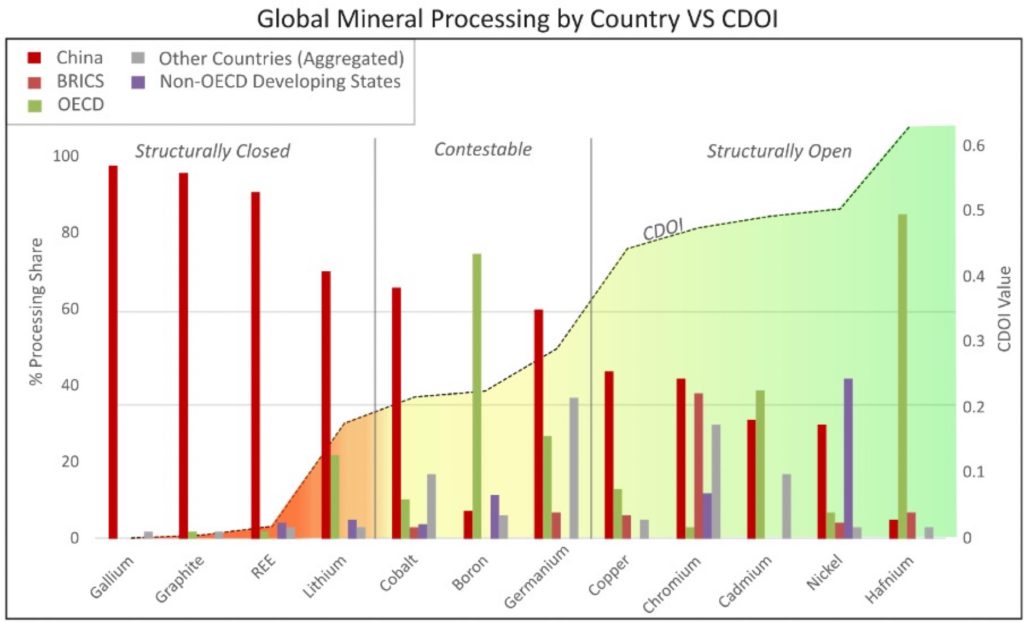
To bridge this analytical blind spot, we must look beyond current market concentration and apply a new metric. This is the Critical Dominance Opportunity Index (CDOI). Rather than taking the typical approach to investment by measuring where processing is concentrated today, it asks a different question:

How much room is actually left for new players to successfully enter a market and build strategic leverage?

When seen through this lens, the realities of the global transition become starkly visible. The processing markets for elements such as gallium, graphite, rare earth elements, and even lithium are already structurally closed. China isn’t just the largest processor, it occupies a midstream position that cannot logically be broken. Could Europe or the United States still build processing plants? Absolutely, but could they realistically overturn China’s position? That is a very different question.

Figure 1. Global mineral processing by country vs CDOI (Source: Vafeas, 2026)

On the other hand, despite having visually intimidating market shares held by single nations, the midstream markets for base metals such as copper, nickel and chromium remains comparatively open. No single global actor has yet achieved overwhelming control. The double-edged reality, however, is that whilst these markets are open to Western positioning, they are equally vulnerable to hostile monopolisation if left ignored.

Then lies the institutional blind spot, and arguably the most interesting area: a market that appears securely closed, until it suddenly isn’t. Markets like hafnium and boron appear protected because they are dominated by OECD nations, but that dominance is an illusion that is entirely dependent on institutional coordination across allied countries. Simply put, if cracks emerge within that coordination, a backdoor opens for strategic competitors to rapidly buy up control.

This distinction fundamentally shifts the paradigm. For the past decade, governments have largely obsessed with identifying which minerals are “critical”, but that is only half the story. The more important question is: which critical minerals remain strategically contestable? These are not the same. One measures today’s dependence, whilst the other measures tomorrow’s opportunity.

The €10 Billion Shift

The solution lies in how we classify “critical”. We tend to treat all critical raw materials as equally actionable. But they’re not. Some markets still have room for new dominance to emerge, and others don’t. That distinction matters.

Imagine two governments each investing €10 billion into refining capacity. One chooses gallium. The other chooses nickel. On paper, both have invested in strategic minerals. In reality, they have made completely different bets. In gallium, they are entering a market where structural dominance has already crystallised. They may improve domestic resilience, but they are unlikely to reshape global market power and remain vulnerable to market shifts beyond their control. In nickel, however, the market remains structurally contestable. The same investment has a far greater chance of creating genuine long-term strategic leverage.

That is why measuring contestability matters. It helps distinguish between investments that improve resilience and investments that can genuinely reshape future market structure. Both have value, but they should never be confused with one another.

China appears to have figured this out. We can see the risk of ignoring this logic in the tungsten market. The midstream processing market (CDOI) for tungsten is effectively closed, comparing well with graphite. But whilst Western nations have failed to recognize this, China has mapped it out perfectly, aggressively campaigning to monopolise the circularity frameworks and secondary processing of tungsten waste streams.

Why would the world’s dominant tungsten processor suddenly become interested in industrial waste? Because they recognise that when a primary processing market is structurally closed, the next contestable frontier automatically becomes secondary supply. China isn’t changing strategy. It is extending exactly the same strategy that built its original dominance. Control every remaining pathway through which future leverage can be created.

If they succeed, they will secure absolute, closed-loop control over the entire global tungsten value chain, from raw extraction to downstream recycling.

A New Architecture for Industrial Policy

This is where contemporary Western industrial policy makes its most costly mistake. Much of today’s geopolitical discussion still revolves around “catching up”. But catching up assumes the race is still being run. In many markets, it isn’t.

Pouring billions into structurally closed processing markets might improve local resilience, or create domestic jobs, but it does so at an unsustainable opportunity cost. It demands permanent capital subsidies to survive and leaves fewer resources available to compete where genuine opportunities still exist.

That doesn’t mean governments should abandon these markets. Resilience, recycling and strategic stockpiling do matter. But defensive resilience should not be mistaken for competitive advantage. There is an important difference between reducing dependence and building dominance, and successful critical minerals strategies need to recognise when each objective is appropriate.

If the US, EU, and wider OECD bloc proactively adopt a structure-aware approach, it will fundamentally transform the mining and investment landscape. The implications here are profound. If governments begin focusing capital according to contestability rather than simple criticality, today’s investment landscape changes dramatically. Projects targeting already-consolidated processing markets may continue attracting public funding for resilience, but they are less likely to reshape global market power. Meanwhile, companies positioned within still-open markets could suddenly find themselves aligned with an entirely new generation of industrial policy. In other words, the next mineral winners may not be those producing the most fashionable critical minerals, but those operating in the “dull” markets that remain open.

But to do this, we must first accept a harsh dose of realism. We must acknowledge where the race has already been lost, so we can focus capital on where the greatest gains are yet to be made. This is not an admission of defeat, but a tactical recognition of reality. If we can do this, the change will be significant. Capital will stop blindly chasing the same handful of over-saturated, “obvious” battery metals, Policy will become ruthlessly selective, and industry will pivot toward massive, currently under-recognized value chains.

Because strategy has never been about stubbornly trying to win every race, but rather about recognising which races are still worth running.

Bio

Dr. Nicholas Vafeas is an economic geologist specializing in critical raw materials, mineral value chains, and strategic resource investments.


De Beers cuts diamond prices, axes 25 elite buyers


The exact scale of the price cuts was not immediately clear. (Image courtesy of De Beers Group.)

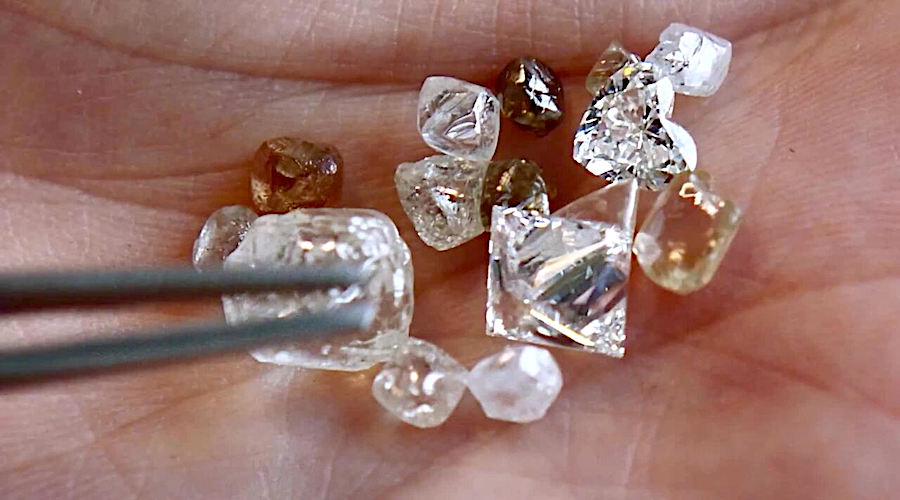
Giant diamond miner De Beers has made sweeping cuts to its official prices at its first sale since culling nearly a third of its handpicked buyers, a strategy aimed at directing more stones to its strongest customers.

The price reductions mark a sharp break from De Beers’ long-running effort to keep official prices above prevailing market levels to avoid undermining confidence in the diamond industry. 


The Anglo American (LON: AAL) unit introduced the changes during its July sales cycle, the first under new supply contracts that reduced the number of sightholders from about 70 to between 45 and 50.

De Beers’ prices, which had ranged from 5% to 50% above secondary market levels depending on the category of stones, seem to be now much closer to prevailing market prices, according to Bloomberg News. A company spokesperson declined to comment.

The move reflects mounting pressure on the world’s largest diamond producer as weak Chinese luxury demand, the rapid rise of laboratory-grown diamonds and increased flux of roughs from producers such as Angola have fuelled one of the industry’s deepest and longest downturns. 

US tariffs and conflict in the Middle East have added further uncertainty, making it increasingly difficult for De Beers to maintain official prices above the market while quietly offering discounts through private sales.

Strategic reset

The exact size of the reductions remains unclear because De Beers earlier this year switched to one-line invoicing, providing buyers with a single total rather than itemized prices for each box of rough diamonds. The company has also altered the composition of some assortments, making direct comparisons difficult, according to people familiar with the sales.

The price cuts come at a pivotal time for De Beers and parent Anglo American, which has been pursuing a sale of the business since May 2024, after years of disappointing performance.


Russian steelmaker Severstal weighs another investment cut


Severstal’s Cherepovets metallurgical plant. Stock image.

Russian steelmaker Severstal may cut its investment program by another 24% to around 85 billion roubles ($1.1 billion) in 2027 due to falling steel demand, according to a company presentation for investors seen by Reuters on Friday.

The measures should help ensure positive free cash flow, the company said.


The forecast for 2027 is preliminary and will remain under review until the end of 2026, according to the presentation.

Steel demand shrinking

Russian steelmakers are under pressure from Western sanctions, high interest rates and weak steel demand, which has fallen by around 30% from 2023 levels.

Demand from Russia’s construction, energy, automotive and machinery sectors — key consumers of steel — is shrinking as companies postpone investment because of high interest rates aimed at curbing inflation.

Steel consumption in Russia fell by about 14% last year, and Severstal, ranked among the country’s top four steelmakers, expects it to decline by a further 7% to 9% this year.

In March the company announced cost-cutting measures in response to weakening demand and a significant deterioration in market conditions, cutting its 2026 investment program by 24% to 112 billion roubles from the 147 billion roubles previously planned.

At the same time it said it intended to continue implementing major strategic projects.

Severstal’s billionaire owner Alexei Mordashov, ranked by Forbes as Russia’s richest businessman, warned in June that the steelmaker would continue cutting investment after slipping into a negative cash position.

($1 = 77.3300 roubles)

(By Anastasia Lyrchikova; Editing by Jan Harvey)


Column: Battery metals recovery runs into stop-start EV market


Stock image.

The battery metals bust has run its course. Prices of lithium, cobalt and nickel have all recovered from their 2024-2025 lows.

This has largely been a story of supply restraint.


The world’s dominant cobalt producer, the Democratic Republic of Congo, has restricted exports since February last year.

Indonesia, which exerts similar control over the nickel supply chain, has used quotas to rein in its runaway mining sector.

Lithium’s recovery has been largely down to the market. Two years of super-low prices took a heavy toll on both incumbent producers and new projects. But Chinese authorities’ suspension of the giant Jianxiawo lithium mine has helped.

This is still very much a work in progress, with immediate price evolution beholden to policy makers in Kinshasa, Jakarta and China’s Jiangxi province.

But some of the previous gloom has lifted from these markets. The focus now turns to whether demand is strong enough to underpin higher price levels.

CME Lithium, CME Cobalt and LME nickel
Battery metals recover from 2024-2025 lows.

Bumpy road

While changes in supply dynamics have shaped the most recent boom-and-bust cycle in battery metals, demand has not stopped growing.

Global lithium-ion battery deployment in 2025 was six times that of 2020, according to the International Energy Agency (IEA).

The driver has been the electric vehicle (EV) sector, which accounts for 70% of total lithium-ion battery deployment.

But after surging 20% year-on-year in 2025, EV sales have hit a bumpy patch this year.

Global sales growth was just 0.9% in January to May, according to consultancy Benchmark Mineral Intelligence (BMI).

The headline figure masks sharply divergent regional performance, however.

Sales in North America fell by 25% year-on-year, reflecting the removal of US tax credits in September.

China, the world’s largest EV market, also saw sales contract by 15% in the first five months of 2026. The drag on battery demand has been partly cushioned by a shift to larger vehicles requiring larger batteries, BMI notes.

Europe, by contrast, registered 26% year-on-year growth and the rest of the world grew even faster at 89%, reflecting an acceleration of Chinese EV exports, particularly to the rest of Asia.

IEA Lithium Battery Deployment by Application
Lithium battery deployment by application.

Powering up

Grid-scale battery storage is rapidly emerging as an additional lithium demand driver.

Global installations have grown more than 20-fold in the last five years and the sector accounted for 15% of battery demand in 2025, according to the IEA.

The global roll-out of renewable energy systems means rising demand for batteries to improve grid reliability when the sun doesn’t shine and the wind doesn’t blow.


China is halfway through a three-year plan to more than double new energy storage capacity to 180 gigawatts by 2027. More installations will be required if Beijing is to meet a five-year target of generating half the nation’s power from renewable energy by 2030.

Battery storage offers lithium some offset to the rise of sodium-ion batteries in the Chinese automotive market but does little to help either cobalt or nickel.

Grid storage batteries use lithium-iron-phosphate (LFP), which contains neither metal.

Not all battery metals created equal

It’s a reminder that not all battery metals are created equal in what is an ever-evolving arms race for cheaper, more efficient chemistries.

LFP is currently the winner of this race, both for energy storage and automotive batteries, where it has taken a 50% market share, according to the IEA.

But some Western automakers are understandably reluctant to commit to what is a Chinese-dominated chemistry.

Cobalt and nickel are, for now, holding their own.

Consultancy Adamas Intelligence provides a granular monthly snapshot of metals deployed in passenger EVs.

While the average amount of lithium used per battery was up by 7% year-on-year in April, reflecting the shift towards LFP and bigger batteries, average cobalt and nickel usage were both unchanged from a year earlier.

Price problem

Higher battery metal prices mean higher battery prices, which can themselves act as a drag on demand.

Lithium carbonate prices may already be testing buyers’ ability to absorb a near-threefold cost increase since the middle of last year.

Analysts at consultancy Project Blue estimate that current pricing has reached break-even levels for some grid storage projects. They go on to warn that “the risk of demand destruction grows if prices keep rising.”

That’s a strong reason to believe that the recent battery metal bust won’t once again become a battery metal boom.

But market forces are now intertwined with policymaking, adding an extra layer of unpredictability to metals that have until now been defined by an inability to align supply and demand.

(The opinions expressed here are those of Andy Home, a columnist for Reuters.)


Op-Ed: The copper the world needs is already above ground


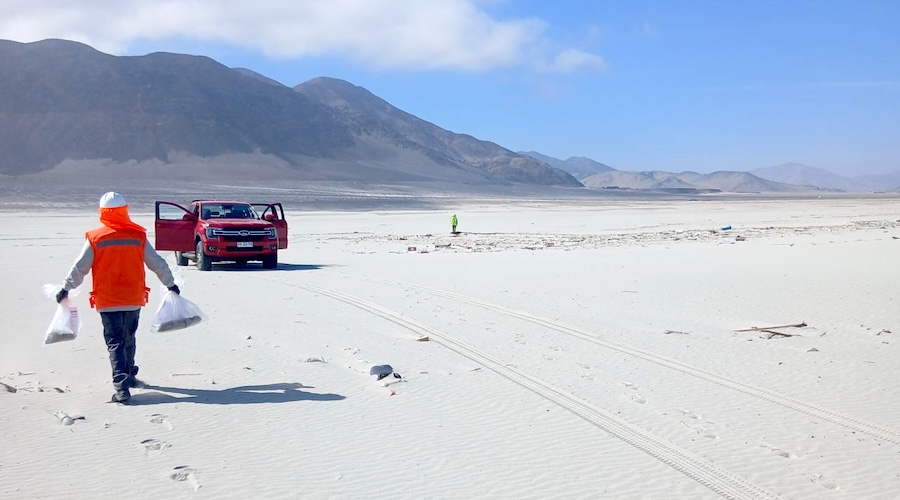
Environmental baseline sampling and fieldwork at Playa Verde. (Image courtesy of Halo Minerals | LinkedIn.)

The mining industry has a habit of looking down when it should be looking around. With global demand for copper skyrocketing, the industry’s default response to this is to build more mines. Meanwhile, one of the solutions is already sitting above the ground. With much shorter production timelines compared to primary mines, copper tailings processing should be taken seriously as a response to the global supply deficit.

S&P Global estimates that copper demand will increase from 28 million metric tonnes in 2025 to 42 million metric tonnes by 2040 – a 50% increase. Several factors are driving this boom in demand. The first is the growing trend towards electrification and decarbonization. Electric vehicles, renewables and grid upgrades are all highly copper-intensive.


The other major factor is the AI revolution. With AI now reshaping virtually every industry across the world, data centres are being built at an unprecedented scale to accommodate this.

BHP estimates that copper used in data centres will increase sixfold by 2050, and a single hyperscale AI data centre can consume up to 50,000 tonnes of copper, compared with 5,000 – 15,000 tonnes for a conventional facility.

The need for copper is not a long-term problem to be solved at some point in the future, it is a very real and immediate need. Supply cannot wait. New mines will be part of the answer, but they come with a significant constraint that should not be underestimated. New copper mines take many years to come into production.

According to S&P Global, the average is 17.9 years for mines coming online in 2020–23. By 2035 production from existing and planned copper mines is on track to meet only 70% of global demand and the 30 largest undeveloped greenfield projects globally will contribute to just 14% of total copper supply by that date. This will simply not meet the scale of demand in the short to medium term. Other solutions are desperately needed.

This is where copper tailings can come in and where, in my view, the industry has been too slow to act. For those unfamiliar with the term, copper tailings consist of historic mining waste containing residual copper, processed decades ago using less efficient technology. Modern extraction methods make this material far more viable to recover than in the past, and tailings projects possess several advantages over traditional mines.

The first is lower capex: extraction is often less capital-intensive, and tailings deposits are frequently located near existing infrastructure close to primary mines. Most significantly, development timelines are far shorter than for greenfield primary mines. Tailings are above ground and often contained in known, previously permitted sites, meaning no exploration is required, an important advantage given the urgency of the supply gap.

There are sceptics, of course, who point to lower grades, harder extraction and higher costs. Much of the time these concerns are not justified. Technology has advanced significantly, particularly in flotation, leaching and fine-particle recovery. Copper prices now support the economics of lower-grade material, although it is worth noting that new copper mines often contain grades similar to many tailings deposits. Yet, those primary mines still require the most energy-intensive steps of mining: blasting, extraction and crushing. With tailings, those steps are already done. 


There are also significant environmental benefits of copper tailings processing over primary mining. When copper deposits are extracted through conventional methods, they can be highly damaging to the local environment generating toxic byproducts including high arsenic content that leaches into surrounding land and water systems. Meanwhile, copper tailings projects offer the opportunity to reverse decades of historical harm, not simply minimise new damage.

Halo Minerals’ Playa Verde project in Chile, where the UN described the surrounding area as one of the Pacific’s most serious cases of pollution, is a case in point. Between 1938 and 1978, the Potrerillos and El Salvador mines discharged around 250 million tonnes of tailings into the Salado River, which carried the material downstream to form the beach deposit that exists at Chañaral today. Reprocessing that material today means returning a coastline to the local community that has lived with the consequences of that pollution for generations.

The copper industry is good at identifying problems. It is less good at accepting that the solutions to those problems might look different from what has come before. With an estimated 282 billion tonnes of tailings existing globally, copper tailings present a credible, near-term solution to the mounting copper supply deficit. Of course, new mines will be part of the answer, but copper tailings have a vital role within that mix too. 

* Andrew Dennan is CEO of Halo Minerals


Op-Ed: Molybdenum and the geopolitics of substitution


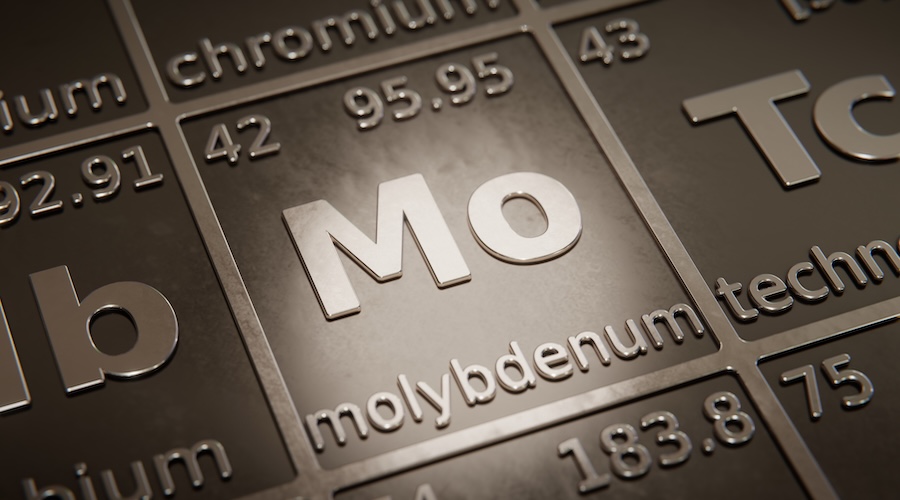
Molybdenum’s rally signals a shift from mineral scarcity to a scarcity of functionality in the market. (Stock image by HT Ganzo.)

Molybdenum’s recent price strength should not be read simply as another by-product rally linked to the steel cycle. It signals how critical minerals stress is spreading across adjacent materials with overlapping industrial functions.

The price move is material. The IMF molybdenum spot series reached $65,503/t in May 2026, up 48.9% year over year, broadly a shift from about $20/lb to nearly $30/lb. This is not just a demand story. It reflects a security premium around alloying metals used in high-performance manufacturing.

The link with tungsten is central. Tungsten’s hardness, density and heat resistance make it difficult to replace in cemented carbides, cutting tools, drilling, defence, aerospace, penetrators and high-temperature applications. But tungsten is also one of the most geopolitically concentrated industrial metals because China dominates mine supply, processing and export availability. For Western users, the risk is no longer only price but permissioned access.

That risk became explicit in February 2025, when China imposed export controls on items related to tungsten, tellurium, bismuth, indium and molybdenum. For downstream consumers, this creates licensing risk, longer lead times and procurement uncertainty across defence, electronics, aerospace, mining equipment and clean energy supply chains.

Molybdenum is not a universal substitute. In many hard-metal and defence applications, tungsten carbide’s hardness, wear resistance, density and thermal stability are not easily replicated. The mechanism is instead metallurgical re-optimization, including reducing tungsten intensity, redesigning alloys, qualifying alternative carbides and changing specifications to preserve performance under supply stress.

In that process, molybdenum becomes strategically more valuable. Molybdenum carbide can substitute for part of the functionality of cemented tungsten carbides in selected applications, while molybdenum-bearing steels and superalloys improve hardenability, creep resistance, high-temperature strength and corrosion performance. The substitution channel is therefore not binary but a spectrum of partial replacement and functional complementarity.

Demand creation

This matters for market sizing. The better question is not how many tonnes of tungsten can be directly replaced but how much molybdenum demand is created when users redesign materials to reduce exposure to a restricted metal.

In a global molybdenum market of roughly 300,000 tonnes per year, an additional 5,000 to 10,000 tonnes from substitution, inventory rebuilding and requalification would represent only a few percentage points of demand. In specialty applications, however, that can be enough to tighten availability and reprice high-purity material.

The effect is amplified by molybdenum’s supply structure. Much of it is produced as a by-product of copper mining, especially in porphyry systems. Supply is therefore not highly elastic to molybdenum prices. Output depends on copper mine plans, ore grades, recovery circuits and by-product processing capacity.

Chile and Peru illustrate the point. In both countries, molybdenum is a secondary product of copper mining, yet it is already a significant export. Chilean molybdenum exports reached around US$2.48 billion in 2025, ranking as the country’s eighth-largest export product. Peru exported about US$1.65 billion of molybdenum ore in 2025, making it its thirteenth-largest export product. In both cases, higher prices improve by-product credits, reduce net copper costs and support margins for operations with molybdenum recovery.

For miners, by-products are no longer peripheral. Molybdenum, rhenium, vanadium, niobium, tellurium, bismuth and indium may be small relative to copper, iron ore or lithium by volume, but they can be decisive within industrial systems. Their value depends on where they sit in high-performance materials, whether they reduce exposure to controlled supply chains and how difficult they are to qualify.

This is the emerging geopolitics of substitution. China’s export controls do not need to shut off supply completely to change the market. They need only make access uncertain enough for manufacturers to redesign their materials strategies. Once requalification begins, the effects can persist even if the immediate shock later eases.

Molybdenum’s rally is therefore not only a price event but also a symptom of a shift from mineral scarcity to functionality scarcity. The strategic winners will be those who understand how materials interact within real industrial systems, and how substitution can turn a once-overlooked by-product into a critical supply-chain asset.

* Juan Carlos Guajardo is the executive director of Plusmining consultancy.


Mine operators face worsening wildfire seasons  


Fighting the Pocket Knife Creek wildfire in northeastern British Columbia in June, 2025. Credit: BC Wildfire Service

With drought conditions persisting across parts of British Columbia and forecasters calling for a warmer-than-average summer amid a looming ​​El Niño, mining companies are preparing for a wildfire season that could test operations across Western Canada.  
 
Some areas of the province experienced below-normal snowpack and limited spring precipitation, variables that can elevate wildfire risk, Forrest Tower, spokesperson for the B.C. Wildfire Service, said in an interview.  

“We’re not seeing as many early wildfire starts this year as we have for the past three years,” Tower said. “It could take a two-day period with a large number of ignitions and from that point on, that’s basically what we’re dealing with for the rest of the summer.” 
 
This year’s El Niño, a climate pattern where Pacific Ocean surface temperatures warm up, is predicted to be very strong and significantly alter weather, amplifying drought and warm winds, which contribute to a more intense wildfire season, according to a seasonal outlook released in June by Environment and Climate Change Canada.  

“Once we have fire on the landscape, then all the other conditions come into play, and it just makes those fires more difficult to put out,” Tower told The Northern Miner.

The B.C. Wildfire Service identified several areas of concern, including the Chilcotin, Cariboo and Thompson-Okanagan regions. Teck Resources (TSX: TECK.A/TECK.B; NYSE: TECK) operates the Highland Valley Copper project in the Thompson-Okanagan area, 17 km west of Logan Lake and 50 km southwest of Kamloops.

“We closely monitor wildfire risks across our operations and have comprehensive management plans in place, with employee health and safety being the top priority,” the company said in an emailed statement to The Northern Miner about the compounding effects of El Niño in the back half of the year. The Vancouver-based miner had to suspend operations at the project in August 2021 due to wildfire risk and an evacuation order issued by the District of Logan Lake.

Growing concern

Wildfire seasons in Western Canada have intensified over the past five years, culminating in the record 2023 season when more than 2,240 fires burned about 2.84 million hectares in British Columbia, while Alberta recorded over 1,080 fires. Saskatchewan had roughly 500 wildfires that year.  

“Typically, what happens in seasons [like 2023] is we’ll have two to three weeks of really stable air mass over some parts of the province,” Tower said. “Then we’ll have a breakdown of that air mass, a big lightning storm, and hundreds of ignitions.”

While the wildfire risk has always existed, 2023’s record season marked a turning point for miners, Raul Munoz, mining leader at risk adviser Marsh, said by phone. “It shifted the discussion from occasional perils that would happen to now something that is being discussed at more of a board level,” Munoz told The Northern Miner.

“Wildfires can significantly affect operations even when the fire doesn’t touch the site,” Munoz said. 

While 2023 was particularly intense, many wildfire seasons have triggered widespread evacuations, major highway closures and disruptions across key resource corridors.

In B.C., Artemis Gold (TSX-V: ARTG) evacuated all non-essential personnel in 2023 and 2024 from its Blackwater gold and silver mine due to regional wildfires. Osisko Development (TSX; NYSE: ODV) temporarily paused non-essential activities at its Cariboo Gold project in B.C. and removed staff following a local wildfire evacuation order in 2024. In 2021, Cameco (TSX: CCO; NYSE: CCJ) evacuated all non-essential personnel from the Cigar Lake uranium mine in northern Saskatchewan in response to wildfires. 
 
As wildfires intensify, they’re increasingly disrupting access roads and power infrastructure. That pressure is creating operational bottlenecks that are influencing mine planning, emergency preparedness and capital allocation decisions.

Business interruption

Power reliability has become a growing concern. Many remote operations rely on long transmission corridors that can be vulnerable to wildfire activity far from the mine itself. Even if a site remains outside an evacuation zone, damage to power infrastructure can interrupt production and affect critical systems, Munoz said.  
 
As a result, some companies are evaluating backup generation capacity and other contingency measures to maintain essential services during prolonged outages. BC Hydro also uses preventative measures alongside regular inspections, including applying fire retardant or fire-resistant steel-mesh pole wraps coated with heat-activated barriers. 
 
The disruptions have also attracted attention from insurers. The 2023 Okanagan and Shuswap wildfires cost Canadian insurers over $720 million. The 2024 Jasper wildfire’s insured losses were estimated at $1.3 billion. 
 
Insurance providers are increasingly asking companies detailed questions about wildfire exposure and preparedness, similar to the scrutiny environmental, social and governance issues received several years ago, Munoz said.  
 
While coverage remains available, insurers are paying closer attention to business continuity planning, emergency response procedures and how companies assess climate-related risks.  
 
Those risks extend beyond fire, Munoz said. He points to the drier, hotter conditions created by ​​El Niño. “We’re starting to see that temperature rise across the world, particularly in some of the northern latitudes,” he said. “How is the company dealing with rising temperatures for staff and working conditions outdoors?”

Designing for fire

The growing focus on wildfire risk is changing how mining projects are planned, built and operated.  
 
“[Wildfire mitigation] starts back in the planning of a new facility,” Rob Carter, senior principal risk assessor at engineering firm WSP Canada, said. “Don’t build it halfway up a slope . . . fire goes up slopes. You want to be at the top, set back from the ridge.”  
 
Natural barriers like lakes, rivers and mountain ridges, as well as human-made barriers like hydro and pipeline cut lines, are also being factored into project development plans to protect facilities against wildfires. Distance between buildings, materials used, and design are also being influenced by the growing threat.  
 
“Don’t have complicated roof systems because that’s where embers and debris will start to accumulate,” Carter said. “If we get these ideas in early to put a steel roof on versus an asphalt roof, the cost is minimal. We’re trying to save them from having to make those choices later.” 
 
The other side of risk assessment is looking at when a company’s operations might be a direct cause of the wildfire. It often involves identifying planned periods of higher energy draw during the drier part of the season, and where energy systems might be close to dry vegetation.  
 
“We can’t forecast out years, but at least now, maybe weeks out, we can start budgeting where maintenance should happen,” Carter said. “We can start looking at vegetation management and maybe pre-position crews based on the probability of something happening next week.”

Compounding risk

“Climate change is a modifier of risks,” Sean Capstick, principal and senior climate change specialist at WP, said. Capstick worked with the Mining Association of Canada in 2020 to develop guidance on climate adaptation for mine infrastructure.

As part of the association’s guidance, Capstick said it’s imperative that mine operators ask themselves what’s a future risk and what mitigation or resilience activities are critical now. Capstick said the Canadian Centre for Climate Services recently released a tool forecasting the climate’s normal for the next 30 years, which mine operators can use to see how far out of the normal range the regional temperature will be.

“You want to say what are my decade projections for fire? Am I still okay?” Capstick said. “It’s too late to say, what am I going to do for this season? You’re going to be reacting.”