Thursday, July 09, 2026

Robert Reich: Trump’s Iran Debacle Has Become A ‘Neverending War’ – OpEd


Key Takeaways

The US-Iran Ceasefire Has Collapsed — Trump declared the June Memorandum of Understanding “over” after Iranian attacks on shipping in the Strait of Hormuz triggered new US strikes, returning the region to active conflict.

No Clear Strategy or Exit Plan — The author criticizes Trump for starting the conflict without consulting Congress or allies, lacking defined objectives, and having no viable exit strategy — resulting in higher oil prices, closed shipping lanes, and rising casualties.

Significant Human and Financial Costs — The conflict has already caused 13 American deaths, hundreds of wounded, thousands of Iranian casualties (including civilians), and billions in military spending, with risks of becoming another prolonged “forever war.”


By now you’ve probably heard the latest news that Iran’s Revolutionary Guard has officially surrendered to Trump and American soldiers are now occupying Tehran.

I just made that up. But who the hell knows? Two weeks ago, Trump declared: “For the first time in 3,000 years, we are going to have peace in the Middle East.”

Today, he declared that the ceasefire is “over.”

Weeks ago we had a ceasefire and a “memorandum of understanding” with Iran that, according to Trump, gave us everything we wanted, including an end to Iran’s nuclear program.

But the so-called “memo of understanding” left almost everything to be negotiated, including Iran’s nuclear program, its missile program, its support for terrorist groups, and its repression of its own people.

Before that — at the end of February — we had the promise of a quick “four-to-six-weeks” intervention.

The cold, hard fact is that America is far worse off today than we were before Trump started this conflict — without consulting with Congress or our allies. The Strait of Hormuz is once again effectively closed. Oil prices are moving upward.

Iran’s nuclear stockpile remains hidden. The regime in Tehran is more extreme and resolute about gaining a nuclear bomb than ever before.

Meanwhile, 13 Americans have been killed and some 425 have been wounded in action. Over 3,400 Iranians have been killed, including 120 schoolchildren, and 26,000 Iranians have been injured. The Pentagon has already asked Congress for about $70 billion to cover the early operations around Iran, and the cost rises every week.

Trump never gave the American people a good reason for attacking Iran in the first place. He had no objective and no exit strategy.

The likeliest future is a low-level continuation of this conflict as far as the eye can see — coupled with sporadic announcements from Trump that it’s over and America has won, which are then contradicted by another set of attacks by Iran’s missiles and drones, followed by another round of American aggression and Iranian retaliation.

This is the “forever war” that Trump criticized when he ran for office in 2024.

The question is whether he and the spineless Republican Congress that have supported this debacle will be held to account.This article was published at Robert Reich’s Substack


About Robert Reich
Robert B. Reichis Chancellor's Professor of Public Policy at the University of California at Berkeley and Senior Fellow at the Blum Center for Developing Economies, and writes atrobertreich.substack.com. Reich served as Secretary of Labor in the Clinton administration, for which Time Magazine named him one of the ten most effective cabinet secretaries of the twentieth century. He has written fifteen books, including the best sellers "Aftershock", "The Work of Nations," and"Beyond Outrage," and, his most recent, "The Common Good," which is available in bookstores now. He is also a founding editor of the American Prospect magazine, chairman of Common Cause, a member of the American Academy of Arts and Sciences, and co-creator of the award-winning documentary, "Inequality For All." He's co-creator of the Netflix original documentary "Saving Capitalism," which is streaming now.
View all posts by Robert Reich →
China’s ‘Artificial Sun’: The Holy Grail Of Energy – Analysis


Key TakeawaysChina Achieves Major Fusion Milestone — Two domestically developed superconducting magnets (including the world’s largest Toroidal Field magnet) successfully passed full-load testing, advancing China’s “artificial sun” program.
Rapid Progress Toward Commercial Fusion — China aims to complete a compact fusion device by 2027 and demonstrate fusion-based electricity generation around 2030, supported by heavy investment and self-reliant technology development.
Strategic Implications — This breakthrough positions China as a leader in next-generation clean energy, but the article stresses the need for global cooperation, governance, and standards to prevent monopolies and geopolitical rivalries in fusion technology.
Analysis

China has achieved a major milestone in its pursuit of commercial nuclear fusion, with two domestically developed superconducting magnets designed for a fusion reactor successfully passing technical acceptance and full-load testing.[1] This is an important step towards building more efficient and scalable nuclear fusion energy systems. Over the years, China’s sustained financial investments and significant technological breakthroughs by its scientific community have placed it as a global leader in the development of advanced nuclear fusion technologies.

At present, the global nuclear energy industry relies on the technique of nuclear fission for energy generation. Here, heavy atoms (say, uranium 235) are split through a controlled chain reaction to release heat for electricity generation. For decades, based on this basic principle, nuclear energy has been generated in various parts of the world. Nuclear fission is a reliable source of low-carbon baseload electricity, but there are challenges related mainly to radioactive waste management and safety concerns. Cost is definitely an important factor.


There is growing global interest in developing nuclear fusion energy systems due to their imminent advantages. One of the most important aspects of this form of energy generation is that it could provide a clean, sustainable, and low-carbon energy source, significantly contributing to global Net Zero goals.

Nuclear fusion generates energy by forcing light atomic nuclei (like hydrogen isotopes) to combine under extremely high temperatures and pressures to form heavier atoms like helium. It is the same process that powers the Sun. Fusion has the potential to produce significantly higher energy output with negligible radioactive waste. At present, this technology remains in the development phase.

However, countries such as China have achieved significant progress in recent years, particularly in advanced superconducting technologies, magnets and plasma confinement systems. Also, for some years now, there has been a push towards developing commercially operational fusion power reactors. In recent years, global private investment in fusion has exceeded US$ 10 billion. The World Fusion Energy Group, established in 2024, is promoting global cooperation and coordination in fusion research.[2]

One of the most important multi-agency projects, the International Thermonuclear Experimental Reactor (ITER), was formally established in 2006. It is located in southern France, and a group of 34 countries, including China, the European Union (EU), India, Japan, South Korea, Russia and the United States (US), are working jointly on this project. It is based on the tokamak concept (a tokamak is an experimental machine designed to harness fusion energy; inside a tokamak, a fusion plasma is created and confined by strong magnetic fields).


It was first proposed for international collaboration in 1985 and aims to demonstrate the scientific and technological feasibility of fusion as a large-scale, carbon-free energy source. Currently, ITER remains in the construction and assembly phase, with experiments planned to pave the way for future commercial fusion power reactors.[3]

China had begun investing in nuclear fusion before joining ITER. Construction for China’s Experimental Advanced Superconducting Tokamak (EAST) began in 2000, and the reactor officially began operations with its first plasma in 2006. China officially joined the ITER programme in 2006 as its seventh member. Under the agreement, China is responsible for approximately 9 per cent of the project’s construction and operation.[4]

On 27 June 2026, China marked a significant milestone in the global nuclear fusion race by successfully developing advanced superconducting magnets for a fusion reactor. These magnets are a critical technology for generating the powerful magnetic fields required to confine and control ultra-hot plasma, a key challenge in achieving sustained fusion energy production. They are required to control and sustain superheated plasma at temperatures far exceeding those in the Sun’s core.

This recent success demonstrates China’s growing capabilities in advanced superconducting technologies, precision engineering and fusion reactor development. These magnets are central to controlling plasma heated beyond 100 million °C, the core challenge in recreating the Sun’s energy-generation process on Earth. The development supports China’s plans to complete a compact fusion experimental device by 2027 and to target fusion-based electricity generation demonstrations around 2030.[5]

Currently, various scientific institutions in China are contributing to the mega project to achieve nuclear fusion. The Institute of Plasma Physics under the Chinese Academy of Sciences was responsible for the development of superconducting magnets, which is also known as the ‘artificial sun’ programme. The achievement, realised under the Comprehensive Research Facility for Fusion Technology (CRAFT), demonstrates China’s growing self-reliance with 100 per cent domestic production of critical fusion technologies.


The highlight of the development is the Toroidal Field (TF) superconducting magnet, which is possibly the largest ever built for a fusion device, measuring 21 metres in length, 12 metres in width, and 3.3 metres in height, and weighing 582 tonnes. This magnet surpasses ITER’s TF magnets in size and energy storage capability. Alongside this successful test, China also successfully tested a high-temperature superconducting central solenoid coil capable of operating at 60 kiloamperes, a crucial technology for generating and controlling plasma currents. This success is an outcome of six years of research. China has multiple patents in this field.[6]

China’s ‘artificial sun’ programme aims to achieve its first fusion-based electricity output around 2030. This recent breakthrough needs to be viewed not merely as a scientific advancement, but as a strategic step towards gaining leadership in next-generation clean energy technologies. It reflects China’s strategic push to establish leadership in one of the most important emerging technology domains of the 21st century. China is expanding its capabilities in challenging technological arenas such as high-temperature superconducting materials, precision manufacturing and magnet engineering.

China’s rapid progress in nuclear fusion highlights its ambition to emerge as a dominant force in next-generation energy technologies. Since this technology was in its infancy for many years, no efforts have likely been made to establish globally accepted definitions, safety standards, and regulatory frameworks for commercial fusion power plants. As the world moves closer to commercially viable fusion energy, technological advancement must be accompanied by responsible global governance. Nuclear fusion represents a potential pathway towards clean, sustainable, and plentiful energy for the benefit of humanity as a whole. Hence, all efforts should be made to avoid any technological monopolies, supply chain control, narrow market-driven interests and geopolitical rivalries.

Views expressed are of the author and do not necessarily reflect the views of the Manohar Parrikar IDSA or of the Government of India.About the author: Group Captain (Dr) Ajey Lele (Retd.) is the Deputy Director General, MP-IDSA. Earlier, he was a Senior Fellow at the Manohar Parrikar Institute for Defence Studies and Analyses and a part of its Centre on Strategic Technologies. He started his professional career as an officer in the Indian Air Force, and took early retirement from the service to pursue his academic interests. He has a Masters degree in Physics from Pune University, and Masters and MPhil degrees in Defence and Strategic Studies from Madras University. He has done his doctorate from the School of International Studies, Jawaharlal Nehru University (JNU), New Delhi. His specific areas of research include issues related to Weapons of Mass Destruction (WMD), Space Security and Strategic Technologies. He has contributed articles to various national and international journals, websites and newspapers. He has authored ten books and has also been an editor for eight books. He is a recipient of the K. Subrahmanyam Award (2013) which is conferred for outstanding contribution in the area of strategic and security studies

Endnotes:


International Atomic Energy Agency, 28 October 2025; “IAEA World Fusion Energy Group (WFEG)”,

 International Atomic Energy Agency. “What is ITER”, 

International Thermonuclear Experimental Reactor. “Experimental Advanced Superconducting Tokamak”, 

 Chinese Academy of Sciences, “Chinese ‘Artificial Sun’ Sets A Record towards Fusion Power Generation”, Phys.org, 21 January 2025.

“World’s Largest Superconducting Magnet Completed in China”, World Internet Conference, 28 June 2026

Source: This article was published by Manohar Parrikar IDSA

About Manohar Parrikar Institute for Defence Studies and Analyses (MP-IDSA)
The Manohar Parrikar Institute for Defence Studies and Analyses (MP-IDSA), is a non-partisan, autonomous body dedicated to objective research and policy relevant studies on all aspects of defence and security. Its mission is to promote national and international security through the generation and dissemination of knowledge on defence and security-related issues. The Manohar Parrikar Institute for Defence Studies and Analyses (MP-IDSA) was formerly named The Institute for Defence Studies and Analyses (IDSA).
View all posts by Manohar Parrikar Institute for Defence Studies and Analyses (MP-IDSA) →


A Black Hole Theory Comes To Life In The Lab


Artistic rendering of Penrose super-radiance: electromagnetic waves with selected rotation patterns are amplified as they interact with a system that appears to rotate at superluminal speeds. CREDIT: Dalila Pasotti and Hadiseh Nasari


July 9, 2026 
By Eurasia Review


More than half a century ago, Sir Roger Penrose envisioned a scenario in which energy could be extracted from a black hole spinning at extreme speeds. He proposed that a particle entering its ergosphere—a region of space dragged around by a rotating black hole— could split into two. One part could fall into the black hole while the other escaped carrying more energy than the original particle. Building on this theory, physicist Yakov Zel’dovich later predicted that a wave interacting with a sufficiently fast, rotating object could extract energy from it and become amplified.

Inspired by this theoretical construct, researchers at the Advanced Science Research Center at the CUNY Graduate Center (CUNY ASRC) have published a paper in Nature demonstrating a new approach to wave amplification through interaction with rotating bodies. Rather than mechanically rotating matter, however, the team engineered a radio-frequency device with properties modulated in space and time to mimic spinning. The device creates a synthetic form of ultrafast rotation that enables access to rotational speed far beyond what can be achieved mechanically, allowing researchers to overcome limitations that have long hindered experimental studies of ultrafast rotational dynamics.

“Our approach facilitates a new method of wave–matter interaction in which waves with selected rotational properties extract energy from synthetic time-engineered rotation, producing a form of broadband selective amplification,” said principal investigator Andrea Alù, Distinguished Professor and Einstein Professor of Physics at the CUNY Graduate Center and founding director of the CUNY ASRC’s Photonics Initiative.

“This successful experiment moves ideas about extreme rotational dynamics from theory to practice and creates a versatile experimental platform for exploring a broad range of phenomena at the intersection of astrophysics, wave physics, and quantum science,” said lead author Hadiseh Nasari, a post-doctoral researcher with the CUNY ASRC’s Photonics Initiative. “The work has implications for advances in fundamental science and in communications, optics and photonics.”


At the core of the team’s work was a fundamental question: Can electromagnetic waves sent to a device that remains still behave as though they were interacting with an object rotating at ultrafast speeds and extract energy from this form of synthetic motion?

To answer their question, the researchers built a ring-shaped network of electronic resonators whose properties were rapidly modulated in a carefully timed sequence, producing a traveling pattern around the ring. Although the device itself did not move, the traveling pattern made the electromagnetic waves perceived the system to be rotating at ultrafast speed.

“Waves with the appropriate rotational characteristics extracted energy from the system and became amplified, reproducing the essential physics of the Penrose–Zel’dovich process,” said co-lead author Hady Moussa, a former PhD student with the CUNY ASRC Photonics Initiative. “Our approach relies on engineered metamaterials that are designed to control how waves propagate.

Synthetic rotation’s ability to simulate movement past the speed of light gives researchers a powerful way to study extreme regimes in a controlled laboratory setting. The team’s achievement opens a new experimental playground for investigating physics that would otherwise remain inaccessible and provides remarkable opportunities for wireless communications and classical and quantum optics applications.

Looking ahead, the findings will need to be adapted in practical technologies, and the same concepts can be extended to photonic and quantum platforms, enabling new ways to manipulate light, process information and investigate wave phenomena inspired by some of the most extreme environments in the universe.

The research was supported by the U.S. Department of Defense, the U.S. National Science Foundation, and the Simons Foundation.


What Your Tears Could Reveal About Your Brain

July 9, 2026 
By Eurasia Review


A few tears may someday reveal important clues about a person’s neurological health. Researchers reporting in ACS Omega developed a low-cost electrochemical sensor designed to detect dopamine, a neurotransmitter involved in movement, learning, motivation, and emotional regulation. They tested the device using artificial human tears, where it accurately detected a range of dopamine concentrations. The technology could support the development of new tools for monitoring Parkinson’s disease and other conditions linked to atypical dopamine levels.

By creating this sensor, “we aim to facilitate the ultra-early detection of neurological disorders, creating opportunities for clinical interventions before major symptoms manifest,” says corresponding author Neftalí Lênin Villarreal Carreño.

Changes in dopamine levels — whether higher or lower than normal — are associated with neurological and psychiatric conditions. For example, with Parkinson’s disease, concentrations of dopamine tend to decrease. Current monitoring methods, such as blood samples, urine analysis, or implanted devices, take time or require invasive procedures. As an alternative, tears could be a source of health information because they can be collected quickly and painlessly. So, Carreño and colleagues built and tested a sensor to explore whether tears could provide a noninvasive way to monitor dopamine levels.

To create the sensor, the researchers used a laser to convert portions of a thin plastic film into electrically conductive graphene. The device, about the size of a postage stamp, produces an electrical signal when dopamine reacts with graphene. In laboratory tests, the researchers added dopamine to artificial human tears and measured the sensor’s performance. The sensor accurately detected dopamine levels, including concentrations that were similar to levels previously reported in tears from people with Parkinson’s disease, and maintained its performance even in the presence of other compounds commonly found in tears.


“Our sensor can detect dopamine from levels well below the healthy baseline and up to three times higher,” says coauthor Lucas Minghini Gonçalves. “This capability ensures that a person’s initial dopamine drop can be identified early on, which is crucial to enabling timely, proactive therapeutic interventions.”

The researchers say their findings establish a foundation for future studies using human tear samples and will help them develop point-of-care devices that monitor neurological biomarkers through a simple tear sample.
The Problem With Trump’s Baby Accounts – OpEd


July 9, 2026 
By Dean Baker

Key Takeaways

Misleading Projection on Growth — The claim that $1,000 grows to $6,000 in 18 years is presented in nominal dollars and assumes an unrealistically high 10% annual return, ignoring inflation and sky-high current stock valuations.

Inflation Adjustment Matters — In today’s dollars, $6,000 in 2044 would be worth roughly $4,000 — a point the NYT piece failed to clarify, leaving readers with an inflated sense of the accounts’ value.

Biggest Issue is the Policy Trade-off — While giving $1,000 to every child, Trump is cutting essential programs like Medicaid, food stamps, and housing aid — meaning poor families will have locked-away savings they can’t access while struggling with basic needs.

I usually find Claire Cain Miller’s pieces in the New York Times very useful, but her piece on Trump accounts badly misled readers in three ways. While the gist of the piece — that the Trump accounts will increase inequality since they are yet another way for the rich to avoid taxes — is correct, there is no excuse for misleading readers.

The key problem is the comment:

“A $1,000 investment at birth could be worth $6,000 at age 18, the Trump administration has estimated.”

While this assertion is attributed to the Trump administration, it is essentially accepted as fact. In reality, the idea that the account would increase sixfold over 18 years is close to absurd.

The first point here is a simple crime that reporters often commit, it reports the numbers in nominal dollars. I know the New York Times’ readers are very well educated, but I guarantee that next to none of them have any idea how much $6,000 in 2044 will be worth in today’s dollars. It would be roughly $4,000, using the Congressional Budget Office (CBO)’s inflation projections.

I know that it is the norm to just report things in nominal dollars, but it is supposed to be a news outlet’s job to convey information. This is not conveying information. It takes ten seconds to adjust nominal dollars for projected inflation. The value in today’s dollars can be written in fewer than ten words. There is zero excuse not to do it.

This is a peeve I’ve had with the New York Times and other news outlets for many decades. Why can’t they write numbers in ways that are meaningful to their audience? The worst abuse is with big budget numbers that are meaningless to almost everyone who sees them, as in the $5 billion cost of the Africa AIDS program that Elon Musk nixed.


Is that sum a big deal? It’s a lot of money to most of us, but it’s less than 0.08 percent of the budget. Why wouldn’t news outlets provide this information? For what it’s worth, former New York Times Ombudsman Margaret Sullivan agreedcompletely on this point, as did then Washington editor David Leonhardt. Anyhow, this is not a crime that’s unique to Miller’s piece, but it is a huge issue that matters a great deal in this context.

The second point is that the $6,000 number assumes a 10 percent nominal return on stocks. While that has been a historic average for the market, the current price-to-earnings ratio for the stock market is near a record 40, more than twice the long-term average.

As much as it is stylish to pretend the stock market returns are independent of the economy, in real- world land that is not the case. The CBO projections imply that nominal corporate profits will be around 55 percent higher in 2044 than in 2026. If stock prices have increased six-fold, but profits are up by just 55 percent, it implies that the price-to-earnings ratio in the stock market will be over 150 in 2044. Is that what Claire Cain Miller wants to tell NYT readers? (The rise will be a bit less if we take account of dividend payouts, but companies will not be paying much in dividends relative to their share price when PEs get over 60.)

The final point is that Miller does not discuss the biggest obscenity about Trump accounts. Trump is putting $1,000 in kids’ accounts while he is cutting back on Medicaid, food stamps, housing assistance, and other programs that benefit the poor.

Now remember, you literally cannot touch this money until the kid turns 18. That is different from the rules on 401(k)s or 529 accounts, where you can pull the money out under some circumstances at no charge, or with a penalty if you don’t meet these circumstances.

This means that we can be absolutely certain that in a few years we will have hundreds of thousands of hungry and homeless three-year-olds who have $1,000 sitting in a Trump account that their parents can’t touch. That’s pretty damn MAGA!


If Your Financial Advisor Recommends

Putting Money Into Trump Accounts, Fire

Them!


July 9, 2026

Trump announcing his Trump Accounts for kids. (Screen capture from Fox News.)

I’m serious, and this is not just my disgust with everything Trump. There is no good reason for the overwhelming majority of people in the country to ever put a dollar in a Trump account for their kids.

To be clear, I’m not in favor of tax-sheltered accounts in general. They strike me mostly as a very inefficient way to accomplish public goals, in this case making education more affordable. The more efficient route would be to have more public funds go to support public colleges and community colleges.

The tax-sheltered account route also favors higher-income people. Over a quarter of households owe no income tax, meaning they would get no benefit whatsoever from putting money in a tax-sheltered account. Another 20 percent are in the 10 percent bracket, meaning the account would just save them just 10 cents on every dollar invested. By contrast, the highest income households save 37 cents on every dollar invested in a tax-sheltered account.

In addition, tax-sheltered accounts put a lot of money in the hands of the financial industry. Tens of billions of dollars go to the people and companies who administer these accounts, creating a pointless layer of wasteful bureaucracy.

To be fair, the Trump accounts limit fees to 0.1 percent of assets, far lower than is charged by many accounts. This is an important point. People can get low-cost funds in other accounts also. Stock index funds generally have the lowest fees, and most people would be wise to take advantage of them. People will tell you that they will beat the market, but most won’t, and you’ll just end up wasting money in higher fees and trading costs.

But that has nothing to do with individuals’ decisions on where to put their money. For better or worse, Trump accounts exist. The question is whether people will be helping their kids by putting money into them. And, as I said above, the answer for almost everyone is no.

The main reason is that we already have 529 accounts for the purpose of saving for a kid’s education. The big difference between the accounts for this purpose is that it is possible to withdraw money from a 529 account, if it’s needed, where it is not possible to withdraw money from a Trump account for any reason, until the kid turns 18.

People do pay a penalty for taking money out of a 529 early, but at least they can have access to it if they need it. And unexpected events do happen. People can lose a job, have serious medical expenses, or get divorced. These and other unanticipated situations can require people to dip into whatever savings they have. With a 529 plan, they can use the money if they really need it. With a Trump account, they are out of luck.

It is important to recognize that withdrawals for non-education purposes are fairly common. A recent study by Vanguard found that 2 percent of accounts had an unqualified withdrawal in an average year. If an account is open on average for 20 years, this would mean that 40 percent of accounts have an unqualified withdrawal. People don’t expect bad things to happen, but they do.

Also, since the penalty is based only on the earnings portion of the 529 plan, not the whole sum in the plan, in most cases it is likely to be small. Suppose someone pulls $5K out of a 529 plan, where earnings are currently 40 percent of the money in the plan. That means they would pay taxes on $2,000, plus a penalty of 10 percent. If they are in the 10 percent bracket, their taxes would be $200, and their penalty would $200. If they were in the zero bracket, say because they had lost their job, they would only pay the $200 penalty. That compares to being unable to touch their money at all in a Trump account. (The money in a 529 is not taxable at all if used for educational purposes. The earnings in a Trump account are taxable.)

It’s also worth mentioning that it’s not even possible to change asset allocations in a Trump account. Suppose your kid is 17, one year too young to make a withdrawal. If you’re worried there is an AI bubble likely to burst, and you would rather have your money in Treasury bonds, you’re out of luck. Trump accounts won’t let you make the switch; you have to go down with Elon Musk and the rest of the market.

The silliest argument given by proponents of Trump accounts is that they can be rolled over into an IRA to allow for lifelong wealth accumulation. So can the money in 529 accounts, up to a ceiling of $35,000.

The Trump gang makes a big issue of the $35,000 ceiling, but this is something only elite types with lots of money would care about. Very few people ever accumulate more than $35,000 in a 529 account, and the vast majority of people who do will find some education-related expense that would reduce the value of the account to less than $35,000. Remember, even food and housing can count as education-related expenses.

But let’s say someone ends up with an amount over $35,000 that they can’t use for education-related expenses. Suppose they have $40,000 that they want to roll over into an IRA. In this situation they would have to pay a 10 percent penalty on the amount over $35,000. That would be $500 on the $5,000 difference.

They would also have to pay taxes on the $5,000. The beneficiary is the one receiving the money, so they would be paying the tax. Since they are just beginning their working career, they likely have a relatively low income. This means they will almost certainly be in the 10 percent or 15 percent tax bracket, and quite possibly the zero bracket.

So, this is the bad scenario that Trump account proponents say it is important to avoid, and therefore skip a 529 and put your money in a Trump account instead? That seems pretty whacky, and why you need to fire your financial adviser if they suggest putting money in a Trump account.

To be clear, take the $1K that Trump wants to give newborn kids. It would be a much better use of tax dollars if we provided food and medical care to kids from low-income families than giving out $1K checks to millions of families that don’t need it. But you aren’t going to change the policy by turning down the money. If it bothers you, donate the money to a good cause, but do take the money and don’t ever put another penny in a Trump account.


This first appeared on Dean Baker’s Beat the Press blog.

About Dean Baker
Dean Baker is the co-director of the Center for Economic and Policy Research (CEPR). He is the author of Plunder and Blunder: The Rise and Fall of the Bubble Economy.
View all posts by Dean Baker →
GAO Says Debt Held By Public To Grow Faster Than U.S. Economy – OpEd

published by the Independent Institute
By Craig Eyermann


Key Takeaways

US Public Debt is on an Unsustainable Path — Debt held by the public is projected to grow much faster than the economy, reaching dangerous levels as a percentage of GDP through 2056.

Spending, Not Revenue, is the Core Problem — Persistent primary deficits are driven by rising costs in Social Security, Medicare, and other health programs due to an aging population and higher per-beneficiary expenses.

Interest Payments are Exploding — Net interest on the debt is the fastest-growing part of federal spending and is projected to reach nearly 10% of GDP by 2056 — more than triple current levels — risking a debt default if unchecked.


They say, “A picture is worth a thousand words.”

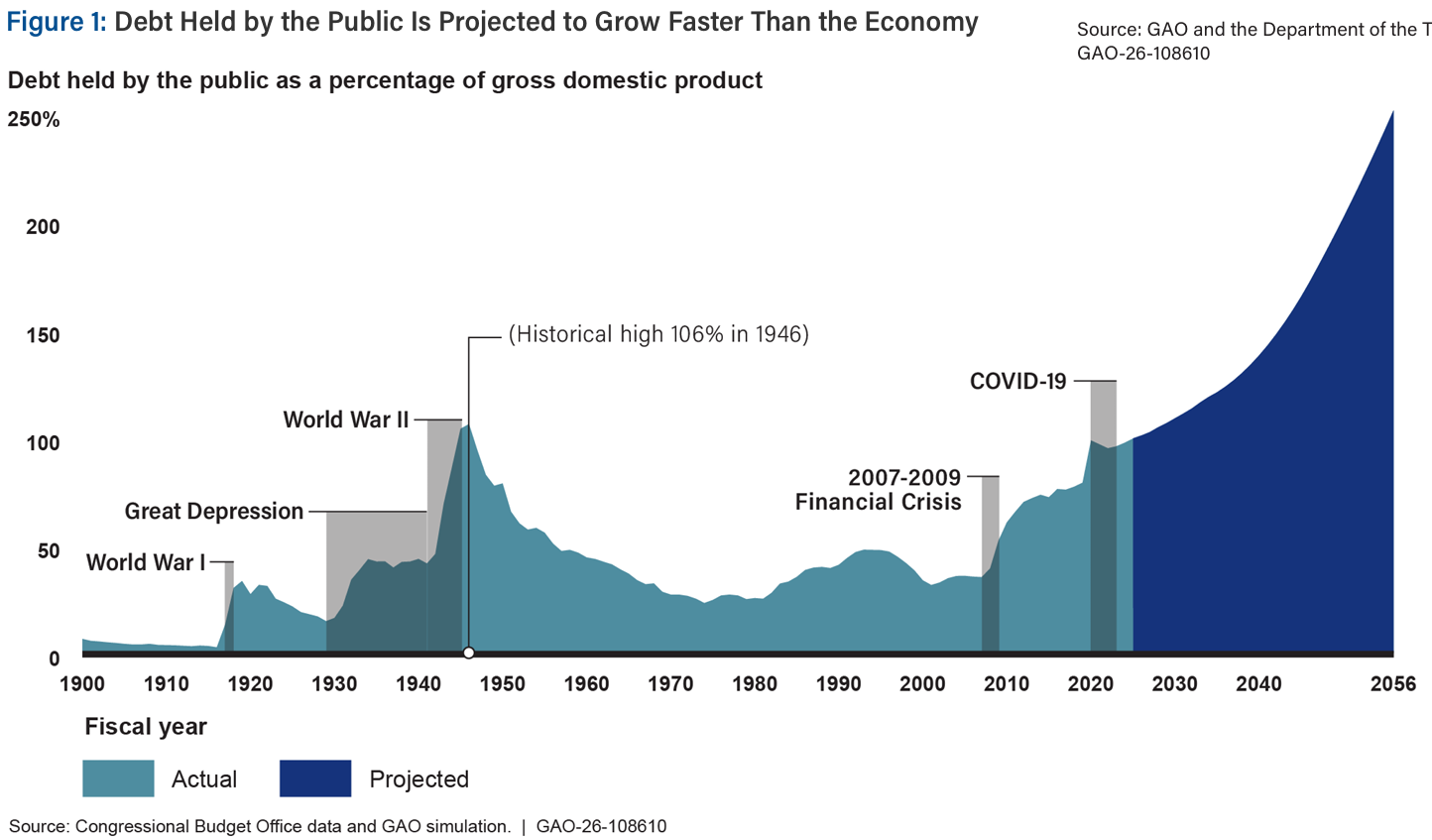
Here then is a picture that tells a long, depressing story. It is the first figure that appears in the General Accounting Office’s June 2026 Annual Report to the U.S. Congress on the Nation’s Fiscal Health, entitled “Debt Held by the Public Is Projected to Grow Faster Than the Economy”. All it does is show how the publicly held portion of the U.S. government’s total public debt outstanding has changed and is projected to change as a percent of the nation’s Gross Domestic Product (GDP) over the years from 1900 through 2056.


The GAO’s report explains why this problem exists and why it will continue to get worse without serious fiscal reforms:


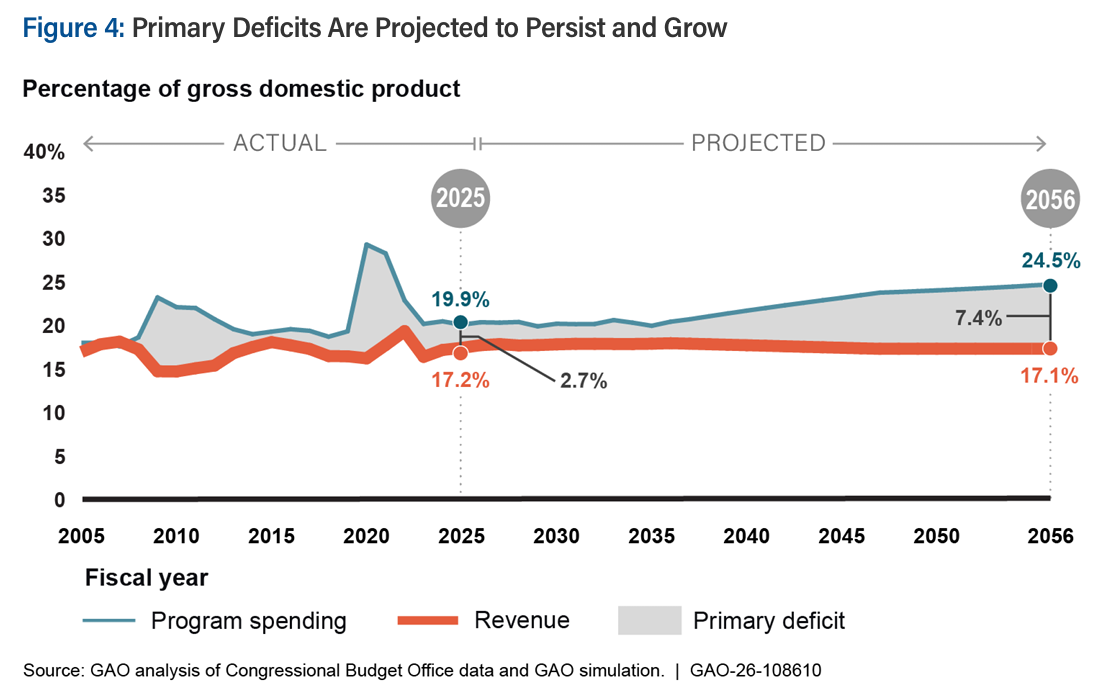
For over two decades, the government has consistently run primary deficits (i.e., excluding interest payments), as revenue averaged 16.7 percent of GDP annually compared to annual average program spending of 20.7 percent of GDP. The primary deficit of $805 billion for fiscal year 2025 represented 2.7 percent of GDP.

Under current policies, revenue is projected to increase (as a percentage of GDP) but not enough to keep pace with spending increases, resulting in increasingly large primary deficits.

The GAO’s report features another figure that clearly illustrates the cause of the problem. Here it is:


Notice how steady the line representing the U.S. government’s projected revenues as a percent of GDP is, while the line representing spending curves upward. That’s a clear sign the true threat to the nation’s fiscal health is excessive spending under the government’s fiscal policies.

The GAO identifies the programs that are responsible for the growth of the government’s projected excessive spending:


Projected growth in program spending is largely driven by Social Security, Medicare, and other federal health care programs. The American population is aging, which increases the number of Social Security and Medicare beneficiaries relative to the overall population. In addition, Medicare and other federal health care programs face increasing health care costs per beneficiary. Federal health care spending consists of Medicare, Medicaid, the Children’s Health Insurance Program, and subsidies for insurance purchased through the health insurance exchanges.

The GAO also confirms that paying interest on the national debt has become the fastest-growing component of the federal government’s spending:


Interest costs have increased rapidly since 2021 becausedebt has accumulated quickly as large annual deficits have required more borrowing, and
higher interest rates have increased the cost of borrowing.

Under current policy, we project that spending on net interest will grow quickly, reaching almost 10 percent of GDP in 2056—more than three times current levels.

Paying interest on the national debt is the only truly mandatory portion of the government’s spending. If the government fails to pay that interest, it will default on the national debt. A default would ensure enormous and negative consequences.

That’s quite a scary story to tell with a picture!


This article was published by the Independent Institute


About Craig Eyermann
Craig Eyermann is a Research Fellow at the Independent Institute. He is also the creator ofMyGovCost.org: Government Cost Calculator. He received his M.S. in mechanical engineering from New Mexico State University and M.B.A. from the University of Phoenix, having received a B.S. in both mechanical and aerospace engineering from the Missouri University of Science and Technology.
View all posts by Craig Eyermann →
AI, Data Centers, And European Strategic Autonomy In A U.S.-China Tech Rivalry – Analysis

July 9, 2026 
By Atuf Guliyev

Key Takeaways

AI Infrastructure Has Become a Geopolitical Asset — Control over data centers, energy, chips, and networks is now central to great-power competition, determining economic competitiveness, military strength, and global influence.

Europe Lags Behind the US and China — While strong in regulation (AI Act), Europe is heavily dependent on US hyperscalers, faces energy and investment constraints, and struggles to build sovereign AI infrastructure.

Europe Needs a Realistic Path to Strategic Autonomy — It cannot fully replicate the US private-sector model or China’s state-driven approach. Instead, it should focus on sustainable computing, secure sovereign systems, and a “framework nations” strategy where countries like France, Germany, and the Nordics lead in specific areas.


How Europe can navigate the new geopolitics of compute infrastructure

The field of artificial intelligence has gone beyond just technology. It is now a key part of great-power competition, with physical infrastructure—like data centers, energy supplies, semiconductor chips, and ultra-fast networks—gaining geopolitical importance. In 2026, developing and controlling this infrastructure will reshape the global landscape, affecting alliances, industrial policies, energy strategies, and even the idea of strategic independence. In this context, artificial intelligence offers both opportunities and risks for the European Union, which could lose its strategic independence and become a follower in technological progress. (Atlantic Council, 2026; IFRI, 2018)

The United States leads in creating advanced AI models and investing in data centers, while China has quickly expanded its infrastructure and is exporting energy and digital solutions through coordinated state efforts. Despite Europe’s strong regulatory framework—embodied by the AI Act—it still relies on U.S. hyperscalers for cloud and AI workloads and faces capacity and investment constraints. (Bruegel, 2025; Carnegie Endowment, 2025).

But the issue goes beyond technology. Control over AI infrastructure impacts economic competitiveness, military strength, intelligence capabilities, and the ability to set global standards. Countries and regions that do not develop or acquire cutting-edge AI technologies risk economic stagnation and reduced influence. For Europe, the key question isn’t whether to pursue strategic autonomy in AI and data infrastructure but how to do so in a world where the U.S. and China follow different rules.


This paper will analyze the geopolitics of AI infrastructure and suggest strategies for Europe to achieve strategic autonomy—ambitious yet feasible. It will propose ways for Europe to develop sustainable infrastructure, maintain sovereignty in critical areas, and show selective leadership through a framework nation strategy.

The New Geopolitics of Compute

AI computing infrastructure has become a strategic asset, similar to ports, oil pipelines, semiconductor manufacturing facilities, and power grids during times of geopolitical competition. Training and operating advanced AI models require enormous amounts of power, specialized hardware like GPUs, extremely high-speed Internet access, secure locations, and effective cooling systems. Increasingly, ownership of these resources will determine which countries, companies, or other actors can develop and profit from advanced AI technology. (Standford HAI, 2026)

The scope of this development effort is unprecedented. In 2024 alone, the United States is building 5.8 GW of data center capacity, while the European Union is deploying an additional 1.6 GW. China’s demand for electricity used by data centers is expected to reach 277 TWh annually by 2030—twice the level of 2023. It’s no longer just about engineering feats; it’s about managing enormous amounts of power. The infrastructure race is closely tied to the broader competition between the U.S. and China. Export restrictions on advanced chips imposed by the U.S. aim to hinder China’s progress in innovative AI technologies.

China is striving to develop its own chip production, supply chains, energy generation, and data centers. Other countries and regions must decide whether to adopt U.S.-developed technology, which offers security guarantees, or to rely on China’s infrastructure, which currently lacks political strings but may create future dependence. Energy now plays a crucial role, as AI data centers demand substantial energy resources. One large center can consume as much electricity as a small city. This leads to new dependencies on energy infrastructure, production, and grid stability. Countries capable of producing affordable, reliable energy will have a competitive edge in attracting AI investments. (OECD, 2025)

American Advantages and Structural Vulnerabilities

Currently, the U.S. holds a significant edge in developing innovative AI systems and private sector investments in data centers. American companies have secured a dominant position in the global cloud computing market and are investing hundreds of billions of dollars in building new data centers. These trends, along with a strong venture capital system, advanced research organizations, and a culture of continuous improvement, position the country to outperform competitors in innovation and implementation.

However, this advantage comes with some weaknesses. Energy constraints, for instance, pose a major challenge for expanding the U.S. data center network. Permit delays, power grid limitations, local opposition, and outdated transmission infrastructure complicate construction efforts. Additionally, the U.S. still depends on semiconductor manufacturers from Taiwan, making it vulnerable to supply disruptions. Furthermore, the heavy concentration of AI capabilities among a few tech giants presents significant risks.

American policies, such as the CHIPS and Science Act, export control measures, and diplomatic efforts, aim to secure allied supply chains. However, these policies could strain relationships with European allies, as they risk entanglement in great-power competition or force choices among competing technologies.

The U.S. appears to be reconsidering the sustainability of its model. Private investments in AI infrastructure are driven by high profits, but energy limitations and supply chain issues could hinder growth. Intense global competition is likely to compel not only the U.S. but also China to invest more heavily in achieving technological self-sufficiency.

China’s State-Driven Infrastructure Surge


Unlike the US approach, the Chinese method appears quite different. The Chinese government actively coordinates investments and planning related to energy and digital infrastructure. It also promotes national champions in artificial intelligence and related fields. For example, the “Eastern Data, Western Computing” project enables China to build large data centers in its western regions, which are then connected to consumption centers in the east. (Strider Technologies, 2025)

Undoubtedly, there are several advantages to China’s approach. On one hand, the government can coordinate permitting processes, energy supply, land use, and industry policies more swiftly to meet its goals. On the other hand, China exports its strategy through the Belt and Road digital infrastructure projects, offering partner countries energy systems, data centers, and connectivity under fewer regulations.

However, China also faces a new set of challenges. Due to US export controls, China cannot access the most advanced chips and must rely on domestically produced, less efficient alternatives. The rapid increase in energy consumption is notable; despite being a leader in renewable energy, integrating these sources to support AI remains difficult. Additionally, there is growing geopolitical resistance to Chinese technology in Europe, North America, and parts of Asia.

There are potential issues with over-investment in China. State-led investments may lead to misallocations and projects that are economically unjustified but driven by political motives. Ultimately, as the technology matures, it will be necessary to reevaluate the infrastructure investments.

Europe’s Strategic Autonomy Dilemma


The structural disadvantage of Europe is clear. Europe has excellent research facilities, regulation, and industry in specific sectors. However, when it comes to innovation in AI frontier areas and building the necessary infrastructure, Europe lags behind not only the USA but also China. European private and government institutions heavily depend on American cloud providers (AWS, Microsoft Azure, Google Cloud), creating a reliance on US technology companies for their AI efforts. (Bruegel, 2025)

A significant issue is energy, which is especially restrictive. Running a data center requires a reliable, green, and affordable power source. Many European countries face delays in building data centers due to complex licensing, inadequate grid infrastructure, local protests, and competition for renewable resources from other industries. Despite robust data protection and security regulations, Europe’s regulatory environment has been criticized for limiting innovation and investment compared to the more lenient frameworks in the United States and China.


However, technological sovereignty has become a key concern for Europe, gaining political importance, especially in France and within EU institutions. Initiatives include the AI Continent Action Plan, AI gigafactories, and the Cloud and AI Development Act. Still, turning these ambitions into practical industrial and infrastructure capabilities is challenging. Europe lacks both the level of private investment seen in the US and the coordinated state effort demonstrated by China.

This creates a critical dilemma for Europe. It cannot replicate the American model based on private and venture capital investments, nor can it adopt China’s approach without altering its political and economic systems. On the other hand, it must find its own way to leverage regulatory power and develop its industrial base.

Pathways for European Leadership


Despite the challenges listed above, there are still certain areas where Europe can leverage its advantages.

First, Europe may be particularly well-positioned to develop sustainable, energy-efficient data centers and cloud services. With its experience and knowledge of energy production and energy system engineering, along with high levels of industrial efficiency, European companies might create unique solutions in sustainable computing.

Second, Europe could focus on developing secure infrastructures of cloud and AI technologies tailored to specific uses. Even if it will be rather difficult for Europe to outpace American hyperscalers in the commercial use of these technologies, it is still possible to develop infrastructure within Europe that will be useful to government, the military, critical infrastructure, and regulated industries. (European Comission, 2025)

Third, another idea, using “framework nations,” which European countries have already used for defense and capability development, could also prove successful for technological infrastructure development. Nations with specific capabilities could be leaders in different sectors while coordinating actions and requirements with their allies. Thus, for example, France, with its capabilities in nuclear energy and supercomputing, would be an excellent candidate for framework nations in AI infrastructure with high energy use. Meanwhile, the Netherlands and Nordic countries excel at designing energy-efficient data centers. Finally, Germany has the necessary capabilities to use AI technology in industry. (Fiott, 2026)

The decision-making process may prove extremely difficult. It was impossible for Europe to catch up with the US and China in terms of the development of the AI infrastructure. Europe will need to choose the sectors in which it can achieve interdependence and autonomy.

Thus, an analysis of the EU’s weaknesses will be needed.None of the nations belonging to the organization can move forward at the same pace or with the same zeal. Perhaps it may be more rewarding to form an alliance of those who wish and grow independently with their flexible systems. (OECD, 2025)

Bibliography

European Commission (2025) “AI Continent Action Plan” and related initiatives. Available at: https://digital-strategy.ec.europa.eu/en/policies/ai-continent-action-plan

Atlantic Council (2026) “Digital Sovereignty: Europe’s Declaration of Independence?”. Available at: https://www.atlanticcouncil.org/in-depth-research-reports/report/digital-sovereignty-europes-declaration-of-independence/

Carnegie Endowment for International Peace (2025) “The EU’s AI Power Play: Between Deregulation and Innovation”. Available at: https://carnegieendowment.org/russia-eurasia/research/2025/05/the-eus-ai-power-play-between-deregulation-and-innovation

Bruegel (2025) “How to accelerate investment in sovereign AI computing infrastructure, models and services in the EU?”. Available at: https://www.bruegel.org/event/how-accelerate-investment-sovereign-ai-computing-infrastructure-models-and-services-eu

IFRI (2026) Reports and analysis on European Technological Sovereignty. Institut Français des Relations Internationales. Available at: https://www.ifri.org/en/thematiques/technology/technological-competition-and-digital-sovereignty/european-technological

Stanford HAI (2026) “The 2026 AI Index Report”. Available at: https://hai.stanford.edu/ai-index/2026-ai-index-report

Brookings Institution (2026) “How will the United States and China power the AI race?”. Available at: https://www.brookings.edu/articles/how-will-the-united-states-and-china-power-the-ai-race/

Special Competitive Studies Project (2025) “Gaps Analysis 2025 Report”. Available at: https://www.scsp.ai/wp-content/uploads/2025/01/Gaps-Analysis-2025-Report.pdf

Strider Technologies (2025) “China’s AI Infrastructure Surge”. Available at: https://content.striderintel.com/wp-content/uploads/2025/05/Strider-SCSP-China-AI-Infrastructure-Surge-Report.pdf


About Atuf Guliyev
Atuf Guliyev is a specialist in international relations, with extensive interest in diplomacy, and global governance. He is currently pursuing studies in Diplomacy and Global Governance at the Brussels School of Governance (Vesalius College, Vrije Universiteit Brussel) and is developing a doctoral research project examining the selective Europeanisation of French foreign policy since 2010 and its consequences for European strategic autonomy. His academic interests include French foreign and security policy, the EU's Common Security and Defence Policy (CSDP), norm entrepreneurship in European crisis management, and the nexus between security and humanitarian action in the Mediterranean and Sahel regions.
View all posts by Atuf Guliyev →