Thursday, July 09, 2026

'Monty Python twist': MS NOW in awe as Trump UK ally forced to run against a trash can

Daniel Hampton
July 9, 2026 
RAW STORY


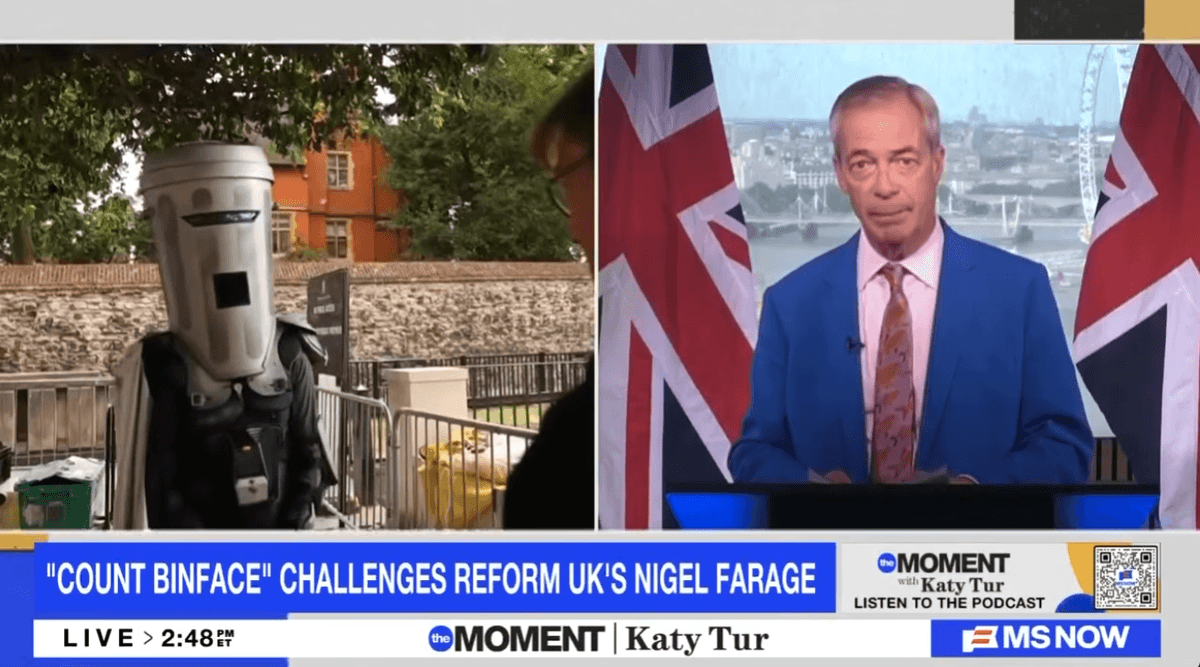
(Screengrab via MS NOW)

MS NOW anchor Katy Tur could hardly keep a straight face this week as she walked viewers through the strange fate of one of President Donald Trump's most loyal foreign allies, who is now on track to campaign against a man wearing a trash can on his head.

The ally is Nigel Farage, leader of the United Kingdom's hard-right Reform party, who resigned his seat in Parliament this week amid an investigation into millions of pounds in undisclosed gifts from wealthy backers. Farage, who has denied any wrongdoing, quit to trigger a special election he can re-contest. Tur and much of the British political class read the move as a thinly veiled attempt to sidestep the scrutiny and paint himself as a victim of the liberal establishment.

The gambit quickly backfired.

Every major U.K. party refused to field a candidate, calling it a stunt, which left Farage's only declared opponent a satirical figure who wears a bin over his head and goes by Count Binface.

"In a twist only a Monty Python writer could deliver," Tur said, "Farage will be running against a trash can."

Behind the costume is comedian Jon Harvey, whose intergalactic-space-warrior character has needled British politicians for years, running against Boris Johnson and Rishi Sunak, and against Theresa May earlier under his previous guise, Lord Buckethead. His pledges include reviving the Ceefax teletext service, building at least one affordable house, and forcing cyclists who break traffic laws to ride unicycles.

Asked by the BBC why a space warrior wanted the Clacton seat, Binface breezily saw no reason not to, and admitted he had never visited, joking he understood from Farage that staying away was part of the job.

The vote is expected around Aug. 6.

"The U.S. isn't the only place where politics can feel like a flying circus," Tur quipped.


Burnham moves closer to becoming British PM, Farage runs against Count Binface


Issued on: 09/07/2026 

Veteran politician Andy Burnham is taking another step towards becoming the UK's next prime minister o, July 9 as nominations to replace Keir Starmer as Labour leader formally opened. He is the only Labour member of Parliament to have publicly said they are a candidate to succeed Starmer. Another key election is taking place in Clacton, where far-right Nigel Farage will be facing Count Binface. 

FRANCE 24's Benedicte Paviot tells us more.


Burnham will make good PM, Starmer says as Labour nominations open

09.07.2026, 

Photo: Alastair Grant/PA Wire/dpa

British Prime Minister Keir Starmer has said Andy Burnham will make a good prime minister as Labour MPs begin formally nominating his successor.

Burnham, the former mayor of Greater Manchester, is the only declared candidate for the Labour leadership and appears to be on course for a coronation within two weeks.

As nominations formally opened on Thursday, the prime minister praised his likely successor.

Asked whether Burnham would make a good prime minister, Starmer told reporters: “Yes, I do.

“I have known him a long time, I’ve worked with him when I first came to Parliament, in his team directly.”

The Prime Minister said he had worked closely with Burnham on the Investigatory Powers Bill when the latter was shadow home secretary in 2015, adding the legislation was “really important in terms of the powers and capabilities that our security and intelligence services need.”

He also referred to their collaboration since 2024 on Northern Powerhouse Rail, which he said was “an example of devolution at its best,” and Burnham’s response to the attack on the Heaton Park synagogue last year.

Starmer said: “Andy was the first person I phoned to find out what was happening, where things were at.

“When I went to Manchester, I spent the whole time with him, with the community and with others. So, I’ve always worked very well with Andy.”

Asked whether Burnham would be a better prime minister than him, Starmer replied laughing: “These are things best judged by other people.”

Nominations for the Labour leadership remain open until July 16, but Burnham’s last possible rival Al Carns ruled himself out of the running on Wednesday, leaving a clear path for the Makerfield MP.

Burnham said he had nominated himself on social media while a steady trickle of Labour MPs could be seen making their way to the Parliamentary Labour Party (PLP) offices on Thursday morning to make their nominations.

One MP leaving the PLP offices in Westminster told the Press Association there is “no-one else” who appears a likely challenger.

Several joked about the possibility of voting for Count Binface as the next Labour leader.

The satirical candidate is standing against Nigel Farage in the Clacton by-election triggered by the populist Reform UK leader.

Prospective candidates need the backing of 81 MPs, which can include themselves, to get onto the ballot to replace Starmer, who resigned last month under increasing pressure from his party.

If Burnham reaches the “magic number” of more than 321 nominations, then it will no longer be possible for another challenger to get the backing of 81 MPs as there are 403 Labour MPs and the party leader by convention does not take part.

In the absence of any other candidates, Burnham will be formally declared Labour leader at a special conference on July 17 and is expected to then become prime minister on July 20.

The Makerfield MP will still take part in an online hustings with Labour MPs on Monday evening, even if he is the only one in the running.

Writing in The Times on the eve of nominations opening, Burnham said he would seek stability in his foreign policy as prime minister as he set out his commitment to NATO, the nuclear deterrent, maintaining close ties with the US and support for Ukraine as well as continuing to bolster relations with the EU.

Starmer's national security adviser Jonathan Powell will be kept on in the role, he said.

The boost to defence spending set out in Starmer’s defence investment plan should be used to back British businesses and economic growth with a focus on inward investment, he said.

He also said he was committed to “levelling with” the public over spending decisions.

He added: “I want to be more open with the public about how and where defence funding is spent.”


Against Amnesia: The Venezuelan Earthquake, the Historical Moment and the Continental Question


 July 9, 2026

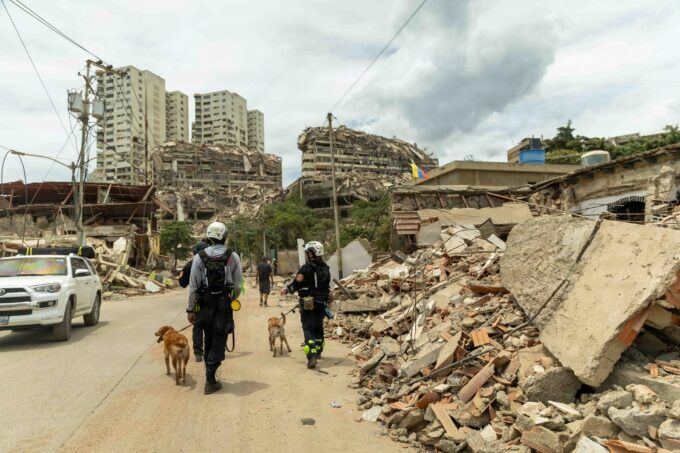
Photograph Source: U.S. Marines 24MEU by Lance Cpl. Allison White – Public Domain

Earthquakes interrupt everyday life, but not history. Nor do they suspend politics. If anything, they compress history into a few dramatic days, revealing social relations, political projects, and geopolitical forces that ordinarily remain beneath the surface. The Venezuelan earthquake is no exception.

As we argued in a recent article, the quake’s impact spread along material and social fractures that were already carved deep by a decade of crippling sanctions and other imperialist aggressions. In its wake came inevitable struggles over sovereignty and meaning. Although centered in Venezuela, these struggles belong to a broader historical picture: the increasingly aggressive attempt to reassert U.S. domination over Latin America.

The ground had hardly stopped shaking before Washington began advancing its agenda. A naive or hopeful observer might have expected the U.S.-led campaign against the Venezuelan government to ease at this point. After all, Caracas had made a series of concessions to the U.S. under extraordinary military and economic pressure in the post–January 3 period. Instead, the opposite happened.

Within hours of the earthquake, an intense information war got going. Even as thousands of firefighters, civil protection personnel, members of the Venezuelan armed forces, health workers, communal organizations, and volunteers were being deployed to the hardest-hit areas, most of the international media moved in lockstep to deny it. Against all evidence, they insisted that the Venezuelan government was absent—that there was no state response, no civil defense, no organized rescue effort.

Of course, no country is ever fully prepared for a disaster of this magnitude, much less one that has endured years of imperialist economic war. Yet the actual response, impressive in both scale and commitment, was systematically erased from public view. Later, corporate media portrayed every government measure—from coordinating rescue operations and organizing shelters to regulating the flow of humanitarian aid—as evidence of “authoritarianism.”

To be clear, these narratives did not emerge only from the pro-imperialist corporate press. They also spread through social media and ostensibly “independent” voices. Yet the remarkable uniformity of these messages points to their being part of an organized campaign. That is the only way to account for their employing the same framing devices, containing the same omissions, and arriving at the same conclusions.

Moreover, the corporate media lost no time in amplifying the most aggressive social media posts as part of its effort to delegitimize the Venezuelan government and sow political discontent amid legitimate grief and mourning, thereby reinforcing the notion that only external intervention could rescue the country.

This reveals that Washington’s objective has never been limited to the extensive economic concessions it obtained after January 3. In fact, it pursues the complete dismantling of Venezuela’s revolutionary project, which integrates state power and organized popular forces. What is ultimately at stake is the unfinished project of recolonizing Venezuela—and, in a broader sense, the Latin American region.

That is why the information war matters. It is not simply about dominating the news cycle. It is about preparing the political ground for further advances in the project of recolonization. The pattern is familiar. Throughout the history of U.S. intervention in Latin America and elsewhere, before it intervenes, a story must first be fabricated: that the state has collapsed and what remains of it is authoritarian, that the government has abandoned its people—in short, that sovereignty itself has become an obstacle to humanitarian relief.

The battle over narratives is therefore not secondary or superficial—it is one of the principal theaters through which imperial power seeks to manufacture political consent for intervention against a Global South nation.

Washington wants the whole nine yards

In 1999, long-time anti-imperialist Muammar Gaddafi started a process of reconciliation with the US and Europe. This came after a long period of cruel sanctions and other imperialist aggressions against the Libyan people. The first step Gaddafi took was handing over the Lockerbie suspects for trial in the Netherlands. Then came the diplomatic normalization that happened in 2002–03 and further rapprochement in the years to come.

The outcome represents an important lesson for anti-imperialist projects ever since. In 2011, Libya—concessions and rapprochement notwithstanding—would be bombed by NATO and Gaddafi murdered by British special forces. This occurred as U.S. Secretary of State Hillary Clinton pronounced, “We came, we saw, and he died!”

The parallels between Libya and Venezuela are many, but it is important to locate the historical moment with precision. As in Libya before 2011, Venezuela has, in recent months, responded to sanctions and other attacks with concessions and rapprochement, but it has not been defeated, and it continues to represent a symbolic and material threat. Washington knows this very well. For its leaders and strategists, the persistence of a Venezuelan revolutionary bloc that connects the leadership and masses remains unacceptable. That is the next target of imperialism, and it is also what we must defend.

There is ample evidence that the Chavista revolutionary bloc still survives in Venezuela today. Despite years of sanctions, financial siege, military threats, the naval blockade, and the traumatic events of January 3, the essential architecture of the Bolivarian Process remains in place. The state has not collapsed. The armed forces have not fractured. The communal movement continues to organize social life and participate in governance all across the country. Thousands of middle-level cadres serve as a conveyor belt between the masses and the leadership. Thus, Chavismo continues to constitute a mass political subject tempered in three decades of revolutionary experience.

This explains why the corporate media offensive following the earthquake has been so relentless. The objective is not simply to criticize the government’s response. It is to weaken the entire Bolivarian Process by driving a wedge between the organized people and the state, while preparing the ground to justify a permanent ground invasion nationally and internationally. For imperialism, it is the people-state relationship—not merely a president, a party, or any particular policy—that constitutes the decisive target.

For all these reasons, people who cry out, “All is lost and Venezuela is a mere US protectorate” are failing to understand the concrete situation and historical moment. All is not lost, and imperialism knows this very well. Our enemies understand the shape of the current battlefield. Too bad so many opinion-makers historically on our side—alleged leftists and anti-imperialists—are helping them destroy the revolutionary bloc by attempting to turn the masses against the leadership.

A continental turning point

The Venezuelan earthquake and the events surrounding it must be understood within a broader continental context: an increasingly rapacious U.S. effort to reassert its hegemony over Latin America through economic coercion, military pressure, and political intervention. The arrival of U.S. Marines under the banner of humanitarian assistance to Venezuela is not an isolated episode. Across the continent, imperialist domination is becoming more direct, more overtly military, and less inclined to hide behind the language of cooperation and development.

It is precisely under these conditions that Latin America must recover Simón Bolívar’s project of continental integration as the Patria Grande and remember José Martí’s warning about “the giant with seven-league boots.” Both understood that true independence could never be secured by fragmented republics confronting imperialist power one by one. Sovereignty required the unity of Nuestra América (Latin America and the Caribbean). That lesson has lost none of its urgency.

What is changing today is not imperialism’s substance but its form. The United States is increasingly abandoning the pretense that hemispheric control can be exercised through trade agreements and soft power. Economic coercion remains central, but it is now accompanied by naval blockades, military deployments, kidnappings, extraterritorial bombings, lawfare, shameless electoral intervention, and an increasingly explicit willingness to project brute force throughout the region.

Venezuela illustrates this with particular clarity, but it is not unique. Cuba is living through a cruel tightening of the already genocidal U.S. blockade and facing new levels of military threat. In Ecuador, the restoration of a U.S. military foothold signals the country’s reintegration into Washington’s regional strategic architecture. Meanwhile, newfangled forms of dictatorship and fascism (Bukele, Milei, de la Espriella) promise complete prostration of their countries before imperialism and Zionism. These developments are pieces of a larger imperialist agenda and speak to Latin America’s urgent need to defend its sovereignty collectively against an aggressive project of de facto recolonization.

Solidarity with awareness

Solidarity with earthquake-stricken Venezuela has taken many forms, and most of it has been valuable both materially and in raising morale. However, friendly nations, organizations, and individuals who wish to help Venezuela in the most effective way should not do so with historical amnesia or political naïveté. In the current context, meaningful solidarity can take material form, but it also requires challenging narratives that erase the work of the Venezuelan government and the organized people, thereby facilitating further imperialist domination.

It is therefore important to emphasize that, even if the earthquake exposed the devastating consequences of the U.S. sanctions regime and other aggressions, it also brought to light the potential of the emerging social metabolism of communal organization. The rapid mobilization of communes, workers, and volunteers did not emerge spontaneously from the disaster itself. It was the product of a long process of political organization whose significance extends well beyond emergency response.

More broadly, defending Venezuela’s sovereignty is not simply a Venezuelan question. It is part of a broader struggle over whether Latin America will remain a collection of isolated republics each confronting imperialist power alone or become, at last, the Patria Grandeenvisioned by Bolívar and defended by Martí, Fidel, Chávez, and so many others.

The earthquake did not interrupt that history. It merely reminded us that, even amid tragedy, the continent’s unfinished struggle continues. The essential task is to ensure that the peoples of Latin America emerge from both the literal and metaphorical rubble of the broader imperialist offensive with their sovereign projects and emancipatory goals intact.

This first appeared on MROnline.


#Venezuela: La Guaira's mass #graves take in unclaimed bodies

Issued on: 08/07/2026 -

With #Venezuela continuing its search for #victims of the twin #earthquakes that hit the country on June 24, people have started burying the #dead. Mass #graves are being dug up to take in those identified bodies who remain unclaimed. France 24's Maxime Pluvinet went to one of them in #LaGuaira, one of the most affected areas.


Climate-smart apartments designed to beat the heat

Cover image: down to earth © France2
Issued on: 07/07/2026 
02:29 min

While most of France suffered from last week's heatwave, a certain number of Montpellier residents were in total comfort in their apartments – without air conditioning. From Middle Eastern-inspired latticework maximising ventilation to curved facades acting as giant sunshades, everything has been designed to keep the heat at bay. And it works: indoor temperatures rarely rise above 25°C. In this edition, we look at the design keeping people cool in the heat.


In Japan, authorities question dependence to air conditioning

Issued on: 09/07/2026 - 

In Japan, air conditioners are everywhere in people’s daily lives. 100% of subway lines are air-conditioned, as are 90% of apartment, often with one unit in every room. These practices are even encouraged by the government when temperatures rise above 31 degrees Celsius. A report from Tokyo with Ayana NISHIKAWA, Mélodie SFORZA and Adam Hancock.


'I feel forgiveness': Daniel Gwynn on life after 30 years on death row

Cover image: TÊTE À TÊTE © FRANCE 24
Issued on: 08/07/2026 - 
12:43 min

Daniel Gwynn spent 30 years on death row for a murder he did not commit. In an interview with FRANCE 24, the Pennsylvania man, exonerated in 2024 after his conviction was found to be deeply flawed, said he now feels "forgiveness" towards those who wronged him – but that the state has offered him "not even an apology".

Speaking to FRANCE 24, Daniel Gwynn described his release in February 2024 as "unreal", saying it took him weeks to accept that he was free after three decades awaiting execution for a 1994 murder.

His conviction rested in part on a confession he said was coerced by Philadelphia detectives – one that "did not match the crime scene evidence at all". A photo lineup that could have cleared him surfaced only 15 years later, but courts ruled it came too late to overturn his conviction.

Gwynn said he "didn't have no hope" at first, and began to heal only after taking up painting.

'A deliberate assault on the Black community'

Gwynn said his years on death row exposed what he called "a deliberate assault on the Black community", pointing to the many Black men he saw imprisoned and later exonerated.

Pennsylvania, however, has offered him nothing for those lost decades. "There is no compensation in the state of Pennsylvania," he said, adding that he now hopes to file a petition seeking redress.

Now touring Europe to speak out against the death penalty, Gwynn said he feels "so blessed". "I'm just a humble servant of God," he said.


The fight to save Bosnia's wild rivers: Scientists and locals oppose mega dam project


Cover image: FOCUS © FRANCE 24

Issued on: 08/07/2026
05:52 min

In Bosnia, parts of the scientific community are opposing the construction of a massive hydroelectric dam, warning of potentially serious environmental consequences. The project comes as dam construction has surged across the country, fuelled by the fact that it has become a highly lucrative business – one critics say is largely controlled by those with close ties to the authorities.


The issue affects both of Bosnia and Herzegovina's entities – the Federation of Bosnia and Herzegovina and Republika Srpska – but in the latter, the situation appears to be spiralling out of control.

Report by Laurent Rouy, Pero Pavlovic, Dino Secic and Ed Godsell.


Ebola cases in Congo rise 25% within one week

09.07.2026, 

Photo: Eva Krafczyk/dpa

The number of confirmed cases of the Ebola virus in the Democratic Republic of the Congo has risen by 25% within a week, the African Union's public health agency reported on Thursday.

According to the Africa Centres for Disease Control and Prevention (Africa CDC), the number of cases is rising more rapidly in the current outbreak than in previous outbreaks.

The Congolese government has reported 1,759 laboratory-confirmed cases of the disease and 600 fatalities.

Capacity for treating Ebola patients is running short, with 95% of beds occupied. "We have to increase the number of hospital beds available by around 50% without delay," Africa CDC infections specialist Wessam Mankoula said.

He noted at the same time that control of the disease was possible, pointing to the example of neighbouring Uganda. Uganda has seen 20 cases, but only one patient is still being treated. Two people have died in the country.

Time remains a critical factor. According to Africa CDC, health authorities receive information in more than half the cases only 72 hours after the initial Ebola symptoms become apparent.

There are also delays in taking and transporting specimens. Africa CDC said that one positive sign was that a capacity of 2,000 Ebola tests per day had now been reached in Congo, although with regional differences.

Ebola is transmitted through direct contact with infected bodily fluids. The current outbreak involves the Bundibugyo variant, which has proved difficult to contain due to the absence of a vaccine or specific treatment.

However, two antiviral therapies have recently entered clinical testing and have been undergoing evaluation since last week.


Africa CDC warns of ‘fastest-growing Ebola outbreak ever’ as DR Congo death toll climbs to 600

The number of confirmed deaths in the Ebola outbreak in the Democratic Republic of Congo has risen to 600, figures published by the UN health agency showed Thursday. The WHO's figures show the worsening haemorrhagic fever outbreak has a case fatality rate of 34 percent.


Issued on: 09/07/2026 
By: 
FRANCE 24

Health workers tend to an Ebola patient at the Rwampara Treatment Center in Ituri, DR Congo, Thursday, June 18, 2026. © Moses Sawasawa, AP


The Ebola outbreak in the Democratic Republic of Congo has now claimed 600 lives, figures published by the World Health Organization showed Thursday – only three days after the figure topped 500.

Updated numbers issued by the UN health agency showed there have been 1,759 confirmed cases in DR Congo since the outbreak was declared in mid-May, including 600 confirmed deaths.

Two other people have died in neighbouring Uganda, where 17 patients have recovered out of 20 total confirmed cases.

"The outbreak continues to expand, and its true scale has not yet been fully established," Anne Ancia, the WHO's representative in the DRC, said Tuesday.

The Africa Centres for Disease Control and Prevention (Africa CDC) on Thursday said the current outbreak was the "fastest-growing ever".

"This is the fastest-growing Ebola outbreak ever, not only among the previous Bundibugyo outbreaks, but all the different viruses that are causing Ebola," Dr Wessam Mankoula, head of emergency preparedness and response, told reporters.

The WHO's figures for the DRC, which come from the health authorities in the vast country, show that the outbreak there has a case fatality rate of 34 percent.

A total of 285 patients in the DRC have recovered, while 304 suspected cases of the viral haemorrhagic fever are under investigation.

The Congolese government's latest report, published late Wednesday, said two new cases were suspected in Kisangani in the Tshopo province, where cases had not been previously recorded.

According to the report, one of the two suspected cases was linked to the Nia-Nia health zone in Ituri province, where the first cases were reported, while the other case “has no apparent geographical connection to known outbreaks”. Authorities were investigating.
Danish Refugee Council on importance of coordinated response to Ebola, wider humanitarian crisis

Cover image: PERSPECTIVE © FRANCE 24
11:02


The outbreak in northeastern DRC has hit four provinces but is focused on Ituri province.

The outbreak is being driven by the rare Bundibugyo species of Ebola, for which there are no approved vaccines or treatments.

The trial of two potential treatments for Bundibugyo began in the DRC on July 2.

The trial is evaluating the effectiveness of the monoclonal antibody MBP134 and the antiviral drug remdesivir, alone and in combination.

Ebola spreads through close contact and infected bodily fluids.
Outbreak in 'expansion phase'

The DRC's 17th Ebola outbreak was declared on May 15 after several deaths in mineral-rich Ituri province, which is plagued by armed groups.

"It is still in the expansion phase, unfortunately. We would like to say it is stabilising, but frankly we cannot say it yet," Ancia told a press conference in Geneva on Tuesday.

"Transmission is still ongoing."

Speaking from Bunia, the capital of Ituri, she said the fight against the outbreak was facing major challenges.

"Population movements, persistent insecurity, and the fragility of the health system continue to complicate efforts to bring the outbreak under control," she said.

"Humanitarian needs remain substantial, particularly regarding civilian protection, access to food, and essential health services, while other diseases such as malaria and measles continue to spread."

She said there were now around 700 beds across 22 treatment centres, with efforts under way to add 300 more beds.

The centres are operating at around 90 percent capacity, "placing significant pressure on the response", Ancia said.

More than 10,000 contacts of infected people are being monitored, at a follow-up rate of 82 percent. The WHO believes a rate of 95 percent is needed to get on top of the outbreak.

Laboratory capacity has increased from 30 tests per day in the capital Kinshasa to more than 2,000 tests daily in decentralised labs in the affected provinces.

The WHO wants $115 million to strengthen its Ebola response, of which 32 precent has been received to date.
Mexico: TotalEnergies Ships To Asia First Cargo Produced By ECA LNG Plant


July 9, 2026
By Eurasia Review


TotalEnergies said Thursday it has shipped to Asia the very first cargo from ECA LNG Phase 1, a liquefied natural gas (LNG) export terminal currently under commissioning on Mexico’s Pacific Coast, in Baja California. TotalEnergies, which holds a 16.6% stake in the project alongside operator Sempra Infrastructure, will offtake 1.7 million tonnes per year (Mtpa) of LNG for 20 years from the start of commercial operations. TotalEnergies will be the sole offtaker of LNG during the ramp-up phase.

ECA LNG Phase 1 consists of a single-train liquefaction facility with a nameplate LNG capacity of 3.25 million tonnes per annum (Mtpa), supplied with U.S. feed gas sourced from the Permian Basin in Texas and New Mexico. ECA LNG has leveraged synergies with the existing regasification plant to optimize construction costs. A second larger phase is also under development at the same site.

Thanks to its strategic location on Mexico’s west coast, ECA LNG enables U.S. natural gas to be exported to Asia and other Pacific Basin markets via the shortest maritime route, reducing transportation times and costs. The project is expected to reach substantial completion in the summer 2026, with long-term LNG sales agreements taking effect shortly thereafter as the facility enters commercial operations.

“The start-up of ECA LNG, whose strategic location provides privileged access to Asian markets, strengthens the quality of our integrated LNG portfolio in North America. TotalEnergies is pleased to contribute to the project’s ramp-up by exporting its first LNG cargoes,” said Patrick Pouyanné, Chairman and Chief Executive Officer of TotalEnergies.


“At a time of increased uncertainty in the global LNG trade, we are excited to begin shipping a new and reliable source of natural gas from North America’s Pacific Coast to customers around the globe,” said Justin Bird, chief executive officer of Sempra Infrastructure. “This achievement underscores the exceptional talent of the entire ECA LNG Phase 1 team and our company’s steadfast commitment to safe and strong project execution.”
Why Recognition Of The 1971 Bangladesh Violence Is Re-Emerging At The UN – OpEd

Call for Formal Recognition of 1971 Atrocities — Human Rights Without Frontiers (HRWF) has urged the UN and international community to recognize the 1971 violence in Bangladesh (during the war of independence) as genocide, particularly highlighting the systematic targeting of Hindu communities on religious grounds.

Link Between Historical Justice and Present-Day Religious Freedom — The article argues that unresolved historical injustices contribute to ongoing vulnerabilities for religious minorities in Bangladesh today, making formal recognition essential for prevention and protection.

Broader Implications for International Norms — Recognition is framed not just as symbolic but as a mechanism to strengthen global standards against identity-based violence, consistent with approaches to other historical atrocities (e.g., the Holocaust). It calls for collective international engagement beyond Bangladesh alone.


The question of whether the 1971 violence in Bangladesh should be formally recognised as genocide has resurfaced at the United Nations, following a statement by Human Rights Without Frontiers (HRWF) on 3 July. While the issue is not new, its renewed visibility reflects a broader shift in international human rights discourse: the growing recognition that unresolved historical injustices continue to shape contemporary vulnerabilities.

Commenting as the 62nd session of the UN Human Rights Council took place, HRWF director Willy Fautré framed the issue not as a matter of retrospective classification, but as a pressing concern for present-day religious freedom. His intervention highlights an increasingly prominent idea within global governance—that accountability for past atrocities is inseparable from the protection of rights today.

The 1971 conflict, which accompanied Bangladesh’s war of independence, has long been associated with widespread violence, including mass killings, displacement, and systematic repression. However, HRWF underscored a dimension that remains insufficiently acknowledged in international forums: the religious targeting embedded within that violence. Hindu communities, in particular, were disproportionately affected, identified and persecuted on the basis of their religious identity.

This omission is not merely academic. The failure to fully recognise the religious dimension of the 1971 atrocities has consequences that extend into the present. As HRWF argues, the absence of formal recognition contributes to a fragmented historical narrative—one in which the experiences of minority communities risk marginalisation. In turn, this weakens the foundations upon which effective protections for those communities can be built.

Today, religious minorities in Bangladesh—including Hindus, Buddhists, and Christians—continue to face a range of challenges, from land dispossession to periodic outbreaks of communal violence. While Bangladesh has made notable progress in economic development and certain social indicators, these persistent issues point to deeper structural vulnerabilities. Fautre’s argument is that such vulnerabilities cannot be fully addressed without confronting their historical roots.

Recognition, in this context, is not simply symbolic. It functions as a mechanism of prevention. By formally acknowledging that the violence of 1971 included systematic persecution on religious grounds, the international community would reinforce norms against identity-based violence. It would also send a clear signal that such crimes—whether past or present—will not be overlooked or minimised.

This perspective aligns with a broader trend in international human rights policy, where memory, justice, and prevention are increasingly understood as interconnected. From Holocaust remembrance to the recognition of other genocides, the act of naming and acknowledging past atrocities has become a cornerstone of efforts to prevent their recurrence. The case of Bangladesh raises the question of whether similar standards should be applied more consistently.

Importantly, the responsibility does not lie solely with Bangladesh. HRWF’s intervention explicitly calls on UN member states, European institutions, and civil society actors to support recognition efforts. This reflects an understanding that international norms are shaped collectively—and that silence or hesitation at the global level can contribute to the persistence of ambiguity and denial.

At the same time, the issue is not without sensitivity. Questions of historical recognition are often entangled with national identity, political narratives, and diplomatic considerations. For Bangladesh, a country whose founding is rooted in the events of 1971, external calls for reinterpretation or reclassification may be perceived as complex or even contentious. This underscores the need for a careful, evidence-based, and inclusive approach to any recognition process.

Nevertheless, the broader principle remains compelling. Sustainable religious freedom cannot be built on incomplete memory. Where past atrocities are insufficiently acknowledged, their legacies can endure in subtle but significant ways—shaping institutions, social relations, and patterns of discrimination.

As debates over historical accountability gain renewed attention globally, the re-emergence of the Bangladesh case at the UN serves as a reminder of a persistent challenge in international relations: how to reconcile the demands of justice with the realities of politics. Yet it also offers an opportunity. By engaging seriously with the question of recognition, the international community can move closer to a more consistent and principled approach to both memory and prevention.

In this sense, recognising the 1971 violence as genocide is not only about the past. It is about defining the standards by which the present—and future—will be judged.


About Graham Matthews
Graham Matthews is a foreign affairs journalist who writes about Europe, the Middle East and Africa. He contributes to London Loves Business, as well as writing a regular foreign affairscolumn.Graham is currently working on a book about the 2026 conflict between Iran and the US/Israel.
View all posts by Graham Matthews →