It’s possible that I shall make an ass of myself. But in that case one can always get out of it with a little dialectic. I have, of course, so worded my proposition as to be right either way (K.Marx, Letter to F.Engels on the Indian Mutiny)
Tuesday, July 22, 2025
New study clarifies catalyst design for cleaner ammonia production
Advanced Institute for Materials Research (AIMR), Tohoku University
Researchers at Tohoku University have uncovered key principles that could advance sustainable ammonia production by electrochemically converting nitrate waste. Their findings clarify how the coordination structure of metal-nitrogen-carbon (M-N-C) catalysts influences their performance in the nitrate reduction reaction (NO3RR), a process that can potentially treat agricultural runoff while producing ammonia for fertilizers.
Ammonia production today relies heavily on energy-intensive industrial processes. By contrast, the electrochemical approach offers a path to generate ammonia under ambient conditions using renewable electricity.
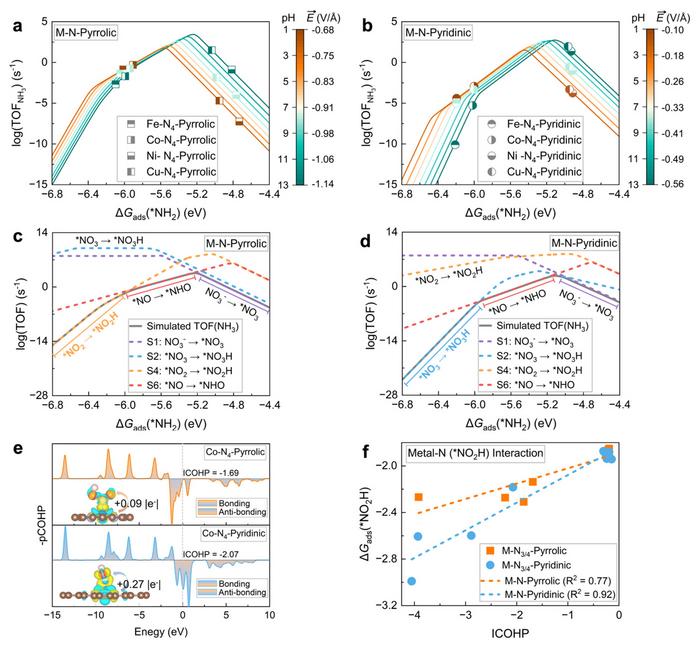
"We systematically compared pyrrolic- and pyridinic-coordinated M-N-C catalysts and found that pyrrolic structures generally achieve higher turnover frequencies for ammonia production," explained Hao Li, who led the study. "Our analysis also revealed that the adsorption and protonation of nitrate - often overlooked in previous models - are in fact the rate-determining steps in this reaction."
The team combined systematic data analysis of over 60 catalysts with pH-field coupled microkinetic modeling on a reversible hydrogen electrode scale. Their subsequent experiments under both neutral and alkaline conditions validated the theoretical predictions.
"The results challenge the classical thermodynamic 'limiting-potential model' used in many prior studies, showing it does not accurately capture the catalytic performance trends for different M-N-C materials," said Li. "This opens up new design strategies for more efficient catalysts."
Looking ahead, the group plans to develop machine learning potentials capable of modeling electric field interactions with weakly-adsorbed species such as *NO3H and *NO2H. This will support automated screening of diverse M-N-C configurations to identify promising candidates for nitrate-to-ammonia conversion.
All data from this study are available through the Digital Catalysis Platform, the largest experimental catalysis database developed by Hao Li Lab.
"This work is part of our broader goal to create better tools for catalyst design," noted Li. "Ultimately, we hope to contribute to cleaner, more sustainable ammonia production technologies that benefit both industry and the environment."
About the World Premier International Research Center Initiative (WPI)
The WPI program was launched in 2007 by Japan's Ministry of Education, Culture, Sports, Science and Technology (MEXT) to foster globally visible research centers boasting the highest standards and outstanding research environments. Numbering more than a dozen and operating at institutions throughout the country, these centers are given a high degree of autonomy, allowing them to engage in innovative modes of management and research. The program is administered by the Japan Society for the Promotion of Science (JSPS).
Advanced Institute for Materials Research (AIMR) Tohoku University
Establishing a World-Leading Research Center for Materials Science AIMR aims to contribute to society through its actions as a world-leading research center for materials science and push the boundaries of research frontiers. To this end, the institute gathers excellent researchers in the fields of physics, chemistry, materials science, engineering, and mathematics and provides a world-class research environment.
Potential of zero charges (PZCs) and electric field effects.FacebookMessage
 \\
\\
No comments:
Post a Comment