Art Under Seige
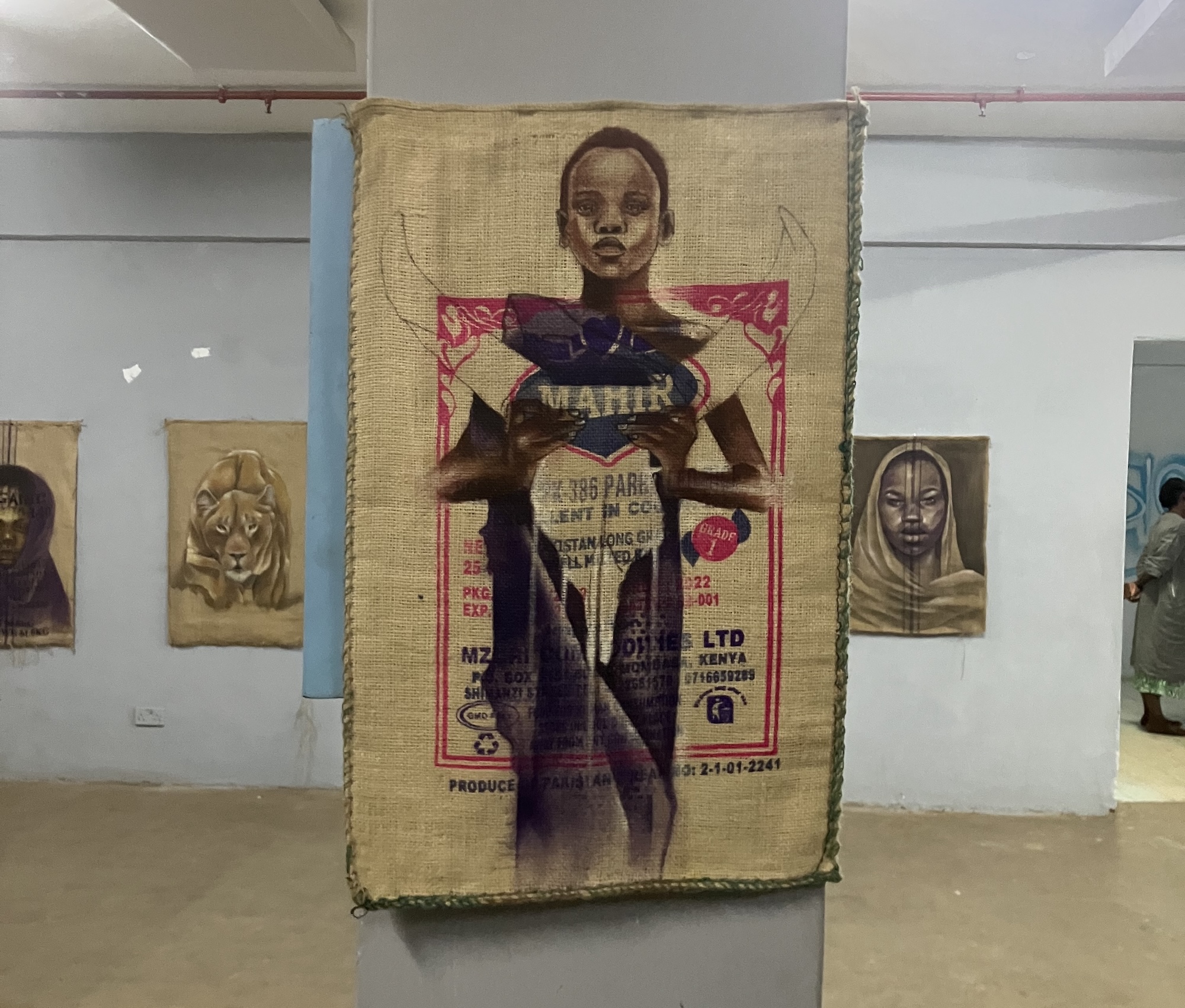
I have attended many artistic forums and hangouts around the continent. You soon realize that there are two types of artistic enclaves: those that have made it and whose framing and outputs fetch a good fortune from non-locals primarily, and the struggling artistic spaces, which are sighing in relief that somebody at least cared to keep the lights on, which they direly need, not just to sell, but also to make themselves affordable and accessible. I have noticed that expats don’t necessarily or quickly relate to local artistic expressions, new money types often lack the sophistication to appreciate them, and the struggling but appreciative class may be too broke to afford what is on offer.
Thus, most artistic spaces tend to be more of a charity affair, and none of the parties involved can derive the maximum anticipated utility from such exhibitions. A westerner may, for instance, buy a painting, but the motivation may be more sympathetic than authentic. For Africans who genuinely appreciate art, they may be locked out on two levels: sometimes artists and creatives feel obliged to cater to Eurocentric sensibilities, so locals may struggle to appreciate their work, and sometimes pricing may lock them out, as art becomes a luxury at that level.
This same dynamic is easy to trace as it ripples across the continent. The layered dynamics of desire, affordability, accessibility, and appreciation for artistic expression are the subject of the inaugural edition of this digital magazine published by the Pan-African Network for Artistic Freedom (PANAF) in December 2025. It brings together writers, artists, and activists from Zimbabwe to Nigeria, Uganda to Ethiopia, Kenya to South Africa, to examine the subject of artistic freedom—or more precisely, the grinding, daily assault on it. But what makes this collection remarkable is not its catalogue of outrages, although those are plentiful. It is the insistence that art, even under siege, remains the most potent weapon the dispossessed possess.
The introductory essay opens with a class-level observation and establishes the collection’s central tension. It describes a range of artistic expressions around the question of cost and affordability: the African nouveau riche lacks the sophistication to appreciate what they might purchase, and the struggling but appreciative class—the people who would most value the work—cannot afford the entry price.
This is not merely an economic problem. It is a structural one that weaves through every contribution in this collection. Writing from Sudan and Egypt, Reem Aljeally puts it plainly: “Class determines not only who creates art, but who gets to witness it, collect it, and sustain a career within it.” She describes how, in Khartoum, access to art education was theoretically open but practically constrained by social expectations that funneled young people toward practical fields. Those with family resources could study abroad; others taught themselves in informal workshops, only to have their work later dismissed as folkloric by the very institutions that should have nurtured it.
Aljeally’s piece is devastating because it refuses easy villains. The problem is not simply corrupt officials or indifferent elites—although those appear throughout. It is the way the entire architecture of cultural production, from art schools to galleries to grant applications written in fluent English, systematically excludes anyone without the right class credentials. “A young artist with fluent English could navigate these circles,” she writes. “Language barriers excluded others before their talent was even considered.”
If class is the collection’s first preoccupation, the female body is its second. Sanya Osha’s “Art by Rock Hard African Women” traces a lineage from San rock art to contemporary South African photographers Zanele Muholi and Ingrid Masondo, from the brutal exhibition of Sarah Bartmann in 19th-century London to Tracey Rose’s defiant performances. The through-line is violence: the colonial impulse to enslave, violate, and exterminate the black female body, and the artistic counter-impulse to reclaim it.
Osha recalls the attempted staging of Eve Ensler’s Vagina Monologues in Kampala in 2005. The then Minister for Information claimed the play would “undermine the morals of society.” The Uganda Medical Council offered support, arguing that the play promoted lesbianism and homosexuality. What they could not say—what Osha says for them—is that the play’s frank discussion of female anatomy and pleasure confronted the core that patriarchy strives to protect and conceal.
“The fear, ultimately, is of the vagina itself, and of the political reorganization that would follow if women controlled their own bodies.”
Muholi’s photographs—which prompted a South African arts minister to walk out of an exhibition, calling them pornographic—operate in the same register. They are not merely documentation but reclamation. “In a good number of her photographs,” Osha writes, “Muholi is able to wrest power away from her masculinist oppressor, thereby asserting her own strength, resilience, and individuality.”
Joel Mukisa’s “Artistic Repression Goes Regional in East Africa” traces a chilling pattern of transnational censorship. When Ugandan opposition politician Kizza Besigye was abducted from Nairobi in November 2024 and driven across the border to face a military court, it was not an isolated incident. It was part of a coordinated jumuiya—a regional strategy of silencing dissent across borders. Mukisa notes that some of the laws used to block Bobi Wine’s concerts were passed during British colonial rule. “The British also prosecuted any artist who practiced their traditional dances and culture, which were deemed satanic and obscene.” The postcolonial state, in other words, inherited the machinery of suppression and painted it in national colors.
Philani A. Nyoni’s “How Not to Go to Jail for Drawing Stuff” offers the collection’s most intimate account of this machinery in action. He tells the story of Owen Maseko, a Zimbabwean artist who created an exhibition called Sibathontisele—“Let’s drip on them”—depicting the torture methods used by the Fifth Brigade during the Gukurahundi massacres of the 1980s. Maseko was arrested and charged with “undermining the authority of the president,” spending years in legal limbo. His exhibition space remained cordoned off for half a decade, its windows eventually taped over with newspapers, then sealed with black-tinted film.
Nyoni’s genius is in the details he adds. He describes flying from Harare to Nairobi, worried about whether security would find 28 grams of dagga in his luggage—not because he carries drugs, but because Maseko, who has locs and is therefore presumed to be a Rastafarian, was recently caught with cannabis at the airport. The absurdity compounds: a state that once arrested a man for drawings now arrests him for the drugs he must surely possess, because everyone knows how artists look.
Not everything in PANAF Voices is despair. The collection repeatedly returns to the internet as a space of possibility, however compromised. Social media allows artists to bypass traditional gatekeepers. During Kenya’s Gen Z protests against the Finance Bill in 2024, protesters created Spotify playlists, turned their profile pictures into filters honoring the slain, and transformed X into a living archive of dissent. Darius Okolla’s own “Art is Maandamano”—which closes the collection—describes how young Kenyans weaponized their high school curriculum, pulling characters from Francis Imbuga’s Betrayal in the City and Timothy Arege’s Mstahiki Meya to articulate their grievances.
This is not naive techno-optimism. Chief Nyamweya’s Q&A on AI and art is a bracing corrective for anyone who thinks algorithms will save us. He describes training an AI storyboard agent and discovering that he spent more time crafting prompts than he would have spent simply drawing. He raises the ethical nightmare of AI models trained on artists’ work without their consent or compensation. And he points to the hidden cost: underpaid Kenyan workers exposed to violent content while cleaning AI training data for western users. “We can disrupt the production pipeline all we want,” he concludes, “but if we don’t disrupt the cold, capitalist logic of distribution and profit, we’re merely rearranging the deck chairs on the Titanic.”
The collection’s most hopeful contribution may be Soreti Kadir’s “Finfinnee is the Third Space.” Kadir distinguishes between Addis Ababa—the heavily surveilled capital of the Ethiopian state, where survival depends on selling one’s labor—and Finfinnee, the Oromo name for the same geographical location, which once served as a convergence point for the five Gadaa assemblies, where dialogue could continue for months under the branches of the sycamore tree. “Finfinnee is the site within Ethiopia where a multi-national class revolution becomes a possibility,” Kadir writes. “It provides the depth of recalibration needed for us to re-enter the communion of person-to-person dialogue, to extend mutual care and solidarity, and to remember a relationship to land that goes beyond extraction.”
This is the collection’s implicit argument, threaded through every piece: that the work of art is not only to protest but to prefigure. To imagine a space—Finfinnee, the digital commons, the occupied street—where different rules apply. Where the artist is not a criminal, the female body is not a battlefield, and the person who works the land is not an object of ridicule.
PANAF Voices Issue One is not a comfortable read. It is a meticulously assembled document of an ongoing catastrophe. But it is also a document of persistence. The artists described here—Maseko, Muholi, Babirye, the Gen Z protesters in Nairobi—have not stopped creating. They have found ways to speak when speaking is illegal, to draw when drawing is a crime, to sing when the state has banned the venue. The collection closes with an appeal: “Here is a call for the elite to appreciate the aesthetic aspect of life, and for the masses to join in the consumption of art.” It is a modest plea, given everything that precedes it. But perhaps modesty is the point. Art, after all, does not need to save the world. It only needs to survive it.

No comments:
Post a Comment