“It cannot be said enough that people aren’t being ‘lifted’ or ‘moved off’ SNAP—struggling families are losing the help they need to afford groceries because of HR 1’s cuts,” said one expert.
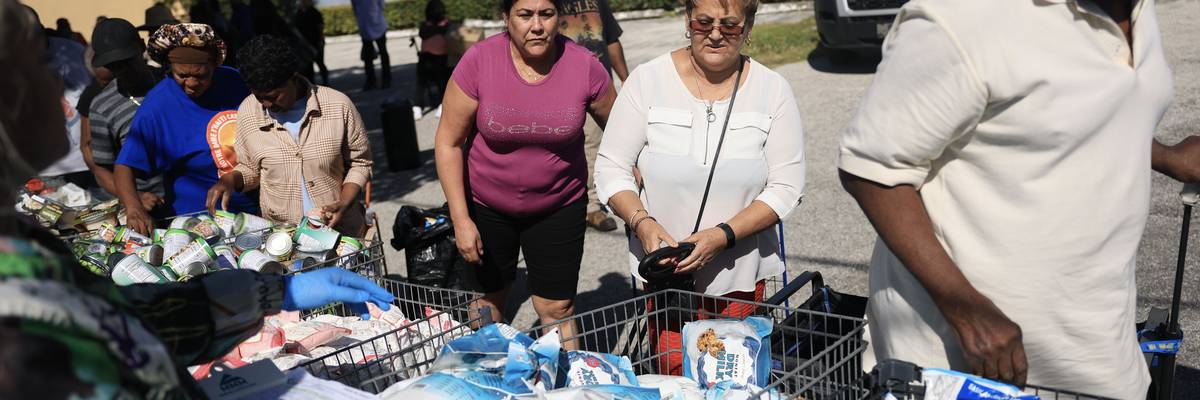
People receive donated food in Miami on October 30, 2025.
(Photo by Joe Raedle/Getty Images)
Brett Wilkins
May 12, 2026
COMMON DREAMS
Food banks across the United States are experiencing increased demand not seen since the Covid-19 pandemic as higher consumer prices and food aid cuts enacted by congressional Republicans and President Donald Trump cause pain for millions of vulnerable families.
The so-called One Big Beautiful Bill (OBBBA, or HR 1) passed by the Republican-controlled Congress and signed into law by Trump last July 4 contains the biggest cuts to Supplemental Nutrition Assistance Program (SNAP), or food stamps, in the nation’s history.
According to US Department of Agriculture data, participation in SNAP dropped by 8% nationwide in the six months following the law’s signing. A recent analysis by the Center for Budget and Policy Priorities found that around 2.5 million people have lost food aid since the legislation took effect.
Laura Lester, CEO of Feeding Alabama, told Al.com that the state is “on track to lose up to 100,000 people off of SNAP benefits by the end of this year.”
“We are already hearing from those impacted who no longer have access to food,” said Lester. “Homeless children and seniors are the ones who are suffering. We have absolutely seen an increase in the number of people who don’t have enough to eat coming to our pantries.”
The OBBBA contains new qualification requirements for people experiencing homelessness, veterans, former foster youth, and older adults. The Trump administration says the new rules are meant to ensure that only the truly needy receive benefits. However, the more stringent requirements are harming some of the most vulnerable people.
“To see seniors and young women with children lose their benefits, it’s heartbreaking,” Dan Saltzman, president of Dave’s Markets, a Cleveland-area grocery store chain, told Signal Cleveland. Saltzman said his business’ revenue from SNAP has declined by about 10% over the past year.
Compliance procedures are proving an exclusionary barrier to qualified aid applicants.
“Tens of thousands of SNAP participants are facing new hurdles just to maintain assistance,” New Jersey Human Services Commissioner Stephen Cha said last week. “Many residents who remain eligible for assistance could still lose coverage or food support because complex paperwork or missed deadlines prevent them from completing required steps.”
Kristin Warzocha, CEO of Greater Cleveland Food Bank—which served more than 400,000 people last year—said that she has “talked to quite a number of people lately who are seniors who are struggling to get by with rising prices.”
“They’re worried about the cost of groceries. They’re worried because their rent has gone up. And they just can’t make ends meet anymore,” she added. “They just can’t do it. So they’re coming here for food.”
Jennie Jean Davidson, executive director at Neighborhood House, a Louisville food bank, told Spectrum News 1 that “honestly, demand for what we do is up in every area.”
“We have waiting lists in our child development center and in our youth programming,” she explained. “Demand in our food pantry has been going up month-over-month for about three years now and it’s just continuing to climb. We’re seeing a lot of need in the community.”
Trump’s tariffs, war of choice on Iran, and attacks on the social safety net are driving up inflation, and household debt, exacerbating the struggles of millions of Americans. While he campaigned on promises to lower prices on “day one,” Trump admitted Tuesday that Americans’ financial struggles aren’t on his mind, “not even a little bit,” as he tries to negotiate an end to the war he started with Israel against Iran.
“We’re seeing a lot of uneasiness amongst people in general,” Community Food Bank of Southern Arizona president and CEO Natalie Jayroe told KGUN on Tuesday. “So many things are changing. Nobody knows when this inflation is going to stop. They don’t know when the price of gas is going to start to go down again. We’ve had cuts in some of the funding that families normally depend on.”
“Right now, we’re reaching about 6,200 children and we do that primarily through our summer feeding programs that take place in schools and other camps,” she added. “So many of our children depend on school breakfast and lunch during the year. In our case here in Southern Arizona and the five counties that we serve, that’s 88,000 children.”
As Inflation Soars Under Trump, US Families Face Record High Household Debt
“These numbers tell the real story,” said one campaigner. “His administration has failed to address—and in many cases, worsened—an historic cost-of-living crisis that is crushing everyday Americans.”
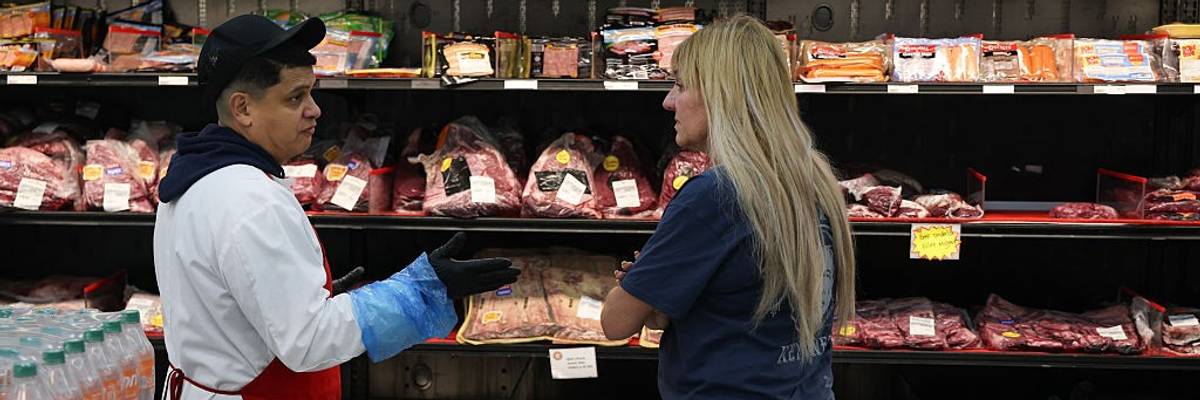
An employee helps a shopper in the meat aisle of a grocery store in Miami, Florida.
(Photo by Joe Raedle/Getty Images)
Jessica Corbett
May 12, 2026
COMMON DREAMS
While inflation hit a three-year high on Tuesday and President Donald Trump publicly confessed that he doesn’t consider how his illegal war on Iran impacts Americans’ finances, a Federal Reserve bank revealed that US household debt has risen to a record high of $18.8 trillion.
The Federal Reserve Bank of New York’s Center for Microeconomic Data found that household debt increased by $18 billion in the first quarter of this year.
It specifically found that by the end of March, mortgage balances increased by $21 billion to $13.19 trillion, home equity line of credit balances jumped by $12 billion to $446 billion, and automobile loan balances rose by $18 billion to $1.69 trillion.
The center further found that “while student loan balances remained essentially flat, decreasing by $6 billion and standing at $1.66 trillion,” the delinquency rate “increased to 10.3% of balances 90+ days delinquent, up from the 9.6%” in the last quarter of 2025.
The analysis notes that credit card balances dropped by $25 billion to $1.25 trillion, a seasonal decline that generally occurs after the winter holidays. However, in its coverage of the New York Fed’s findings, CNBC highlighted another report out Tuesday that shows how Americans are struggling with current economic conditions.
As CNBC detailed:
More than half—53%—of consumers carry credit card balances to cover essential expenses, according to a report released Tuesday by debt management company Achieve.
“For many households, higher balances are less a sign of economic optimism and more a sign that wages and savings are struggling to keep pace with essential expenses like groceries, utilities, and housing,” Austin Kilgore, analyst for the Achieve Center for Consumer Insights, said in a statement.
Among respondents in Achieve’s survey of 2,000 consumers, 57% of borrowers said it would take six months or longer to pay off all their credit card debt.
According to ABC News, “On a call with reporters Tuesday morning, researchers at the New York Fed described Americans’ overall credit as ‘stable,’ but noted there are weaknesses among younger consumers and lower-income households.”
Mike Pierce, co-founder and executive director of the advocacy group Protect Borrowers, was far more scathing, declaring in a statement that “working families are at a breaking point and desperately need relief. Instead, President Trump is bragging about his plans for a new White House ballroom while his head economist touts families’ surging debts as a sign of a booming economy.”
“These numbers tell the real story: Trump’s economy has driven up costs,” Pierce continued. “His administration has failed to address—and in many cases, worsened—an historic cost-of-living crisis that is crushing everyday Americans under stagnant wages and rampant price gouging by grocery conglomerates, data centers, corporate landlords, and private equity firms.”
“Making matters worse, Trump’s war with Iran is pushing inflation to record levels and forcing Americans to feel the economic pain at the pump,” he added, as gasoline prices topped $4.50 a gallon on Tuesday. “It is clear that President Trump is not only failing to ‘Make America Affordable Again’ but is actively pushing millions of families further into the red.”
Last week, Pierce’s group and The Century Foundation published an analysis about soaring US auto loan debt. Report co-author and Protect Borrowers senior fellow Tara Mikkilineni said at the time that “for millions of working families, a car is not a luxury, it is an essential economic lifeline. Working families deserve relief, and they deserve to have a government that is watching out for them, not allowing lenders and auto dealers to rake in record profits at their expense.”
Meanwhile, Trump—who is facing intense disapproval from the US public, particularly regarding the economy—has repeatedly made clear he doesn’t care how his policies, from sweeping tariffs to the Iran War, impact Americans’ pocketbooks.
Trump’s assault prompted Iran to restrict ship traffic through the Strait of Hormuz, a key trade route, which has driven up the prices of fossil fuels worldwide. Speaking with journalists outside the White House last month, Trump suggested that $4 a gallon for gas is “not very high.”
Asked about the war’s impact on the US public’s finances again on Tuesday, Trump said that “the only thing that matters when I’m talking about Iran—they can’t have a nuclear weapon. I don’t think about Americans’ financial situation. I don’t think about anybody. I think about one thing—we cannot let Iran have a nuclear weapon. That’s all.”
Those remarks came just hours after the latest consumer price index from the US Bureau of Labor Statistics, which shows that prices increased by 3.8% on an annual basis in April—above economists’ expected 3.7% jump—and the cost of living rose above average monthly wage gains. Various experts responded by taking aim at the president.
University of Michigan economist Justin Wolfers said that “Trump campaigned on bringing down the cost of living ‘starting on day one,’ and then: started a trade war; deported much of the farm workforce, bombed Iran, allowed healthcare subsidies to expire, cut food assistance, ran an interest-rate boosting deficit, and attacked Fed independence.”
“These numbers tell the real story,” said one campaigner. “His administration has failed to address—and in many cases, worsened—an historic cost-of-living crisis that is crushing everyday Americans.”
An employee helps a shopper in the meat aisle of a grocery store in Miami, Florida.
(Photo by Joe Raedle/Getty Images)
Jessica Corbett
May 12, 2026
COMMON DREAMS
While inflation hit a three-year high on Tuesday and President Donald Trump publicly confessed that he doesn’t consider how his illegal war on Iran impacts Americans’ finances, a Federal Reserve bank revealed that US household debt has risen to a record high of $18.8 trillion.
The Federal Reserve Bank of New York’s Center for Microeconomic Data found that household debt increased by $18 billion in the first quarter of this year.
It specifically found that by the end of March, mortgage balances increased by $21 billion to $13.19 trillion, home equity line of credit balances jumped by $12 billion to $446 billion, and automobile loan balances rose by $18 billion to $1.69 trillion.
The center further found that “while student loan balances remained essentially flat, decreasing by $6 billion and standing at $1.66 trillion,” the delinquency rate “increased to 10.3% of balances 90+ days delinquent, up from the 9.6%” in the last quarter of 2025.
The analysis notes that credit card balances dropped by $25 billion to $1.25 trillion, a seasonal decline that generally occurs after the winter holidays. However, in its coverage of the New York Fed’s findings, CNBC highlighted another report out Tuesday that shows how Americans are struggling with current economic conditions.
As CNBC detailed:
More than half—53%—of consumers carry credit card balances to cover essential expenses, according to a report released Tuesday by debt management company Achieve.
“For many households, higher balances are less a sign of economic optimism and more a sign that wages and savings are struggling to keep pace with essential expenses like groceries, utilities, and housing,” Austin Kilgore, analyst for the Achieve Center for Consumer Insights, said in a statement.
Among respondents in Achieve’s survey of 2,000 consumers, 57% of borrowers said it would take six months or longer to pay off all their credit card debt.
According to ABC News, “On a call with reporters Tuesday morning, researchers at the New York Fed described Americans’ overall credit as ‘stable,’ but noted there are weaknesses among younger consumers and lower-income households.”
Mike Pierce, co-founder and executive director of the advocacy group Protect Borrowers, was far more scathing, declaring in a statement that “working families are at a breaking point and desperately need relief. Instead, President Trump is bragging about his plans for a new White House ballroom while his head economist touts families’ surging debts as a sign of a booming economy.”
“These numbers tell the real story: Trump’s economy has driven up costs,” Pierce continued. “His administration has failed to address—and in many cases, worsened—an historic cost-of-living crisis that is crushing everyday Americans under stagnant wages and rampant price gouging by grocery conglomerates, data centers, corporate landlords, and private equity firms.”
“Making matters worse, Trump’s war with Iran is pushing inflation to record levels and forcing Americans to feel the economic pain at the pump,” he added, as gasoline prices topped $4.50 a gallon on Tuesday. “It is clear that President Trump is not only failing to ‘Make America Affordable Again’ but is actively pushing millions of families further into the red.”
Last week, Pierce’s group and The Century Foundation published an analysis about soaring US auto loan debt. Report co-author and Protect Borrowers senior fellow Tara Mikkilineni said at the time that “for millions of working families, a car is not a luxury, it is an essential economic lifeline. Working families deserve relief, and they deserve to have a government that is watching out for them, not allowing lenders and auto dealers to rake in record profits at their expense.”
Meanwhile, Trump—who is facing intense disapproval from the US public, particularly regarding the economy—has repeatedly made clear he doesn’t care how his policies, from sweeping tariffs to the Iran War, impact Americans’ pocketbooks.
Trump’s assault prompted Iran to restrict ship traffic through the Strait of Hormuz, a key trade route, which has driven up the prices of fossil fuels worldwide. Speaking with journalists outside the White House last month, Trump suggested that $4 a gallon for gas is “not very high.”
Asked about the war’s impact on the US public’s finances again on Tuesday, Trump said that “the only thing that matters when I’m talking about Iran—they can’t have a nuclear weapon. I don’t think about Americans’ financial situation. I don’t think about anybody. I think about one thing—we cannot let Iran have a nuclear weapon. That’s all.”
Those remarks came just hours after the latest consumer price index from the US Bureau of Labor Statistics, which shows that prices increased by 3.8% on an annual basis in April—above economists’ expected 3.7% jump—and the cost of living rose above average monthly wage gains. Various experts responded by taking aim at the president.
University of Michigan economist Justin Wolfers said that “Trump campaigned on bringing down the cost of living ‘starting on day one,’ and then: started a trade war; deported much of the farm workforce, bombed Iran, allowed healthcare subsidies to expire, cut food assistance, ran an interest-rate boosting deficit, and attacked Fed independence.”

No comments:
Post a Comment