Neither “Black” Nor “White”: Coming to Grips with Anti-Asian Racism
The US social formation, as a capitalist entity, was fundamentally shaped by genocide against and the removal of indigenous peoples, and the construction of racial slavery for Africans. These forms of oppression were related but quite distinct. Understanding the USA as a settler state is only part of the equation. It is a particular, if not peculiar, form of a racial settler state that has created specific niches for various populations depending on how the ruling elite sees their relationship to the all-important, yet difficult to define, white bloc. The racial settler state became the most effective means of reshaping—and often distorting—class struggle and other forms of anti-oppression struggle. “Race,” it must be understood, was not inherited but was built in the context of emerging capitalism as a system or entity integral to the growth and success of capitalism.
The problem has always been, what does the racial construction of the USA mean for groups that are not “white”, “black” or indigenous? The first part of the problem has always been the establishment of the “white” category which, contrary to our 21st century understanding, never immediately equated with or automatically meant all Europeans. Those who were not British, Scottish, French, German, or Nordic were “placed” into the category of “provisional whiteness.”
Yet the situation became more problematic over time. In fact, the United States had to address what it meant to have a large Mexican population annexed—with their land—in 1848, as a result of the US war of aggression against Mexico. A few years later the situation was further complicated by the introduction of Chinese immigrants, largely in association with the California Gold Rush and the creation of a transcontinental railroad.
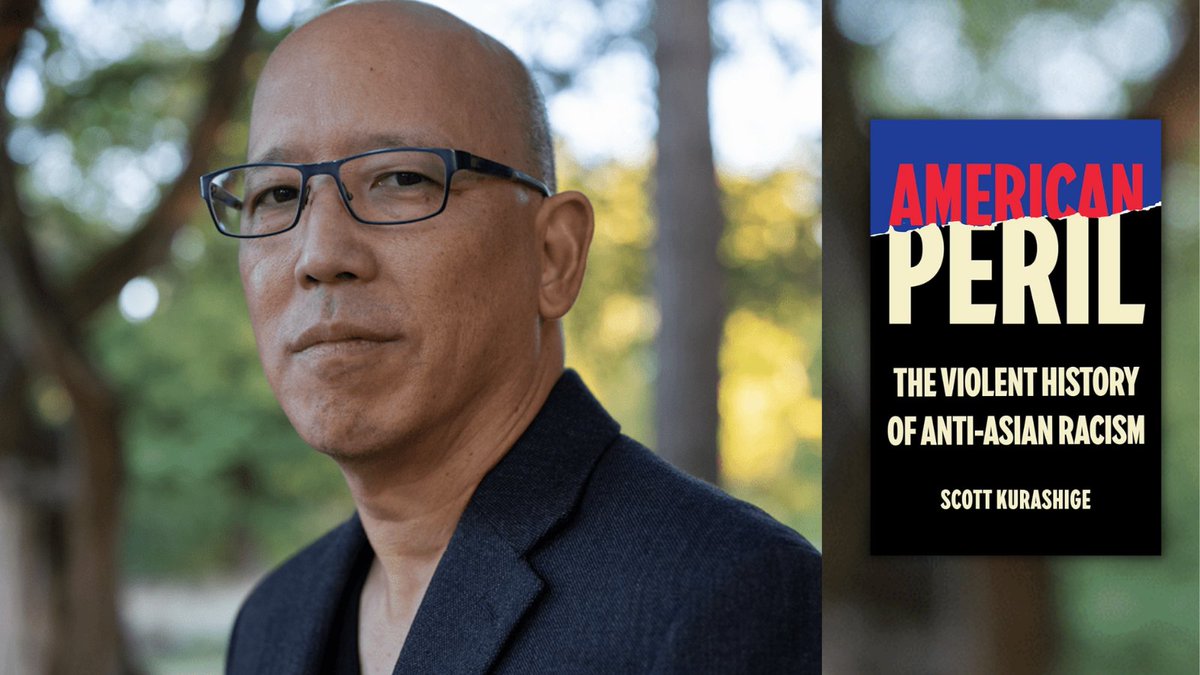
Scott Kurashige’s book, American Peril: The Violent History of Anti-Asian Racism, helps to fill in blanks that have existed in much of US history, only relatively recently addressed by a growing number of progressive Asian American writers and activists. Kurashige’s work is powerful and well written and deserving of attention well beyond an academic audience.
Kurashige helps to contextualize the broader Asian AND Pacific Islander experience in the USA in more than a linear description of events. In fact, one reason for the importance of this book in the current moment is helping to explain the pre-1965 and post-1965 experience of Asians in the United States, something that is frequently overlooked and has become a source of confusion and misunderstanding. In fact, many people shy away from even discussing the matter. We shall return to this point later.
Asians, beginning with Chinese, were “imported” en masse beginning in the 1850s as cheap labor. They entered a United States already in the midst of intense and vitriolic anti-immigrant sentiment and action. Kurashige helps the reader to distinguish the two different forms of anti-immigrant discrimination and hatred that were playing out in the USA at that time. While it was absolutely the case that immigrants from Ireland, and later in the 19th century immigrants from southern and eastern Europe faced nativist hostility from so-called non-immigrants, Asians faced something very different. The hostility they encountered was not simply about being immigrants but being from Asia with completely different cultures and not being able to make any claim to whiteness. White supremacy shaped the construction of the Asian experience in the USA.
Violence inflicted upon Asian and Pacific Islander immigrants—and Kurashige makes a point of not lumping the two groups together as one—shared much in common with the racist violence perpetrated against African Americans, Chicanos/Mexican Americans, and Native Americans. Brutal lynchings as well as the driving of Asians out of town was quite common (an example being the anti-Chinese riots of 1880 in Denver, Colorado, in which a white mob attacked Chinese businesses, leading to the expulsion of Chinese from the city). The ghetto-ization of Asians emerged almost immediately upon their arrival in the USA, and the creation of “Chinatowns.”
What I have always found interesting about Asian “towns”, e.g., Chinatowns, Japantowns, is the way they have been turned into an odd, almost cute myth. Growing up in the 1960s, they were associated with restaurants, but also with various shops, and congestion. The formation of these “towns” was, however, darker. They were the only places that various Asian nationalities were permitted to settle, and it was the principal location of Asian-owned businesses. And, interestingly, they were the locations of certain levels of white establishment-accepted criminal activity that was not permitted in white neighborhoods, but where the engagement of whites was permitted, e.g., white men obtaining Asian prostitutes; buying and selling of narcotics, such as opium. In this sense one can better understand the subtext to the iconic 1974 film Chinatown.
Over time Asian communities occupied a niche in the racial hierarchy similar to Jews in Europe, whereby they were permitted to engage in certain forms of business. In the case of the USA, Asians were generally not relegated to the status of people of African descent; but Asians were always a standing target for violence and other forms of oppression. Interestingly, as Kurashige notes, the violence against Asians was frequently associated with the violence that the USA inflicted on Asian and Pacific countries in the course of the 19th and 20th centuries. The racist war against the Filipinos in the first decade of the 20th century was noteworthy not only due to its genocidal proportions, but also in terms of how US troops thought of the war, i.e., an extension of anti-Black violence that had become ever present in the USA at that time.
Probably the most noted example of the connection of US foreign wars and the persecution of Asians was found during World War II with the imprisonment of thousands of Japanese and Japanese Americans on the basis of being enemy aliens, this in contrast to the much milder way in which German, German American, Italian and Italian Americans were treated at the time. Yet it did not stop there. The caricatures of Japanese during the war due, supposedly, to the Japanese atrocities against prisoners and citizens, was way beyond that carried out against Germans and Italians, something quite ironic considering the German persecution and attempt at annihilation of the Jews in the Holocaust and the earlier Italian atrocities against Ethiopians during the 1935 Italian invasion.
In the aftermath of the Vietnam War, resentment against Vietnamese, Laotian, and Cambodian refugees became a part of the US fabric leading to attacks on Asians—regardless of their actual ethnicity—with explanations frequently offered that this was due to anger regarding the nature of the wars in Indochina and the supposed benefits refugees were receiving at the expense of veterans (or non-refugee US citizens). And, of course, there was the notorious murder of Vincent Chin by individuals who saw in this particular Asian (Chinese American) a representation of the Japanese who, in the 1980s, were outperforming the USA in the auto industry thereby, allegedly, leading to a loss of jobs for US workers.
Two points rang in my head while reading the book. How to explain the “model minority” phenomenon among Asians? The other question concerned the strategy and tactical question of how to respond to acts of anti-Asian violence? Indeed, there is a third question: how to respond to efforts by the far Right to engage many Asian Americans in a process of a neo-apartheid reformation of the USA.
Kurashige directly takes on the question of “model minority”. The model minority is, again, reminiscent of the manner in which European Jews were viewed by antisemites. Specifically, the Jew was viewed as an almost magical creature who can accomplish outstanding achievements, while at the same time being inscrutable and malignant. Much the same has haunted many Asian nationalities in the USA. Since 1965, with immigration reform, Asian immigrants to the USA have encountered a very different experience with white supremacy than their predecessors which has, in some cases, played into the model minority myth. Coming to the USA with more skills and education, in many but certainly not all cases, post-1965 Asians have often been looked upon differently than their predecessors. Unless very poor (e.g., refugees from war zones), they are not trapped in Asian “towns” like their predecessors and, as witnessed in the battle at Harvard University around affirmative action, many post-1965ers believe they are losing out because of perceived preferences given to other people of color who may not have the same academic standing as they believe they possess. In fact, it is not clear that there is anything close to a consensus among post-1965 Asian immigrants that they are “people of color” in the way that we understand this concept in the USA.
A second question concerns combating anti-Asian violence. This was a fascinating section of Kurashige’s book. Deep divisions exist among and between Asians—and their allies—regarding the extent to which anti-Asian violence should be countered by an appeal to the repressive apparatus of the state. There are those who believe that whatever means necessary should be employed, including but not necessarily limited to an appeal to the state to stop and smash anti-Asian violence. On the other side are those, particularly those influenced by the Black Lives Matter movement, who see in an appeal to the state a strengthening of the repressive apparatus that can be used not only against perpetrators of anti-Asian violence but also against Asians themselves and other people of color.
The resolution of this dilemma has not and will not be easy. Appeals to “restorative justice” will not necessarily stop fascists, for instance, who see in many Asians a further threat to their existence and a pollution of the gene pool. Is the answer the construction of new (or old) forms of community self-defense? But how different is this challenge than that of a situation where a woman is raped and demands that actions be taken against the rapist by government?
American Peril left me thinking about the bloc that segments of MAGA and other neofascists wish to construct in the USA. The thinking goes like this. Short of annihilation, i.e., genocide, the demographics of the USA will shift into a non-majority population meaning that so-called whites will no longer be the majority. For white supremacists the question is what to do about this?
The Trump administration has been attempting to address this quandary through attacks on immigrants, deportations, plus the suppression of African Americans, Chicanos, and Native Americans. This will not be enough and, as such, one can see elements of a neo-apartheid vision emerging. Trump’s cabinet and some key members of MAGA are representative of this. South Asians, for instance, have become a minority of choice for segments of MAGA who can both be upheld as well as denigrated. Filipinos have been courted as being allegedly legitimate immigrants as opposed to undocumented and otherwise supposedly unworthy immigrants.
In other words, the conditions have been laid to create a neo-apartheid alignment where certain populations are guaranteed they will not be treated as Black or Indigenous, but there is no route for them to the stability of whiteness. The objective? As with all forms of racist and national oppression, to both justify oppression but also to ensure social control. Whether MAGA will be successful will depend both on the extent to which MAGA can arrive at a full consensus on the ‘race question,’ but also it will depend on the willingness and capacity of progressive forces to build a neo-Rainbow alignment; an alignment towards what many people call a Third Reconstruction.
American Peril is a contribution toward our answering these questions. Don’t hesitate: read the book!

No comments:
Post a Comment