Cuba Joins ‘Lego Resistance Front’ With Iran-Style Video Decrying Trump Warmongering
Content creator María Teresa Felipe Sosa hailed Cubans as “a people who refuse to submit to the true regime of horror, which the United States represents, as it goes around starting wars throughout the world.”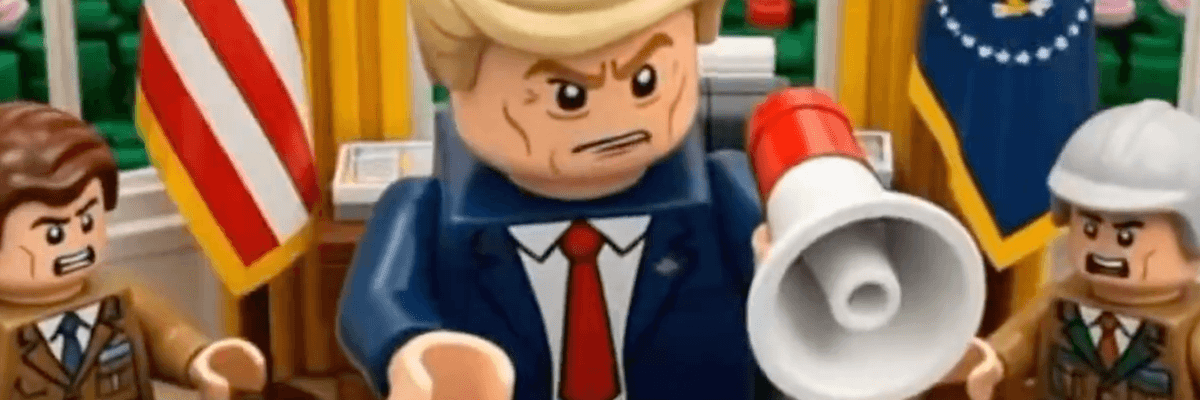
US President Donald Trump is depicted in a Cuba-themed Lego-style video inspired by the viral pro-Iran clip series.
(Photo by screen shot/Tere Felipe/X)
Brett Wilkins
May 12, 2026
COMMON DREAMS
As the team at Tehran-based Explosive Media keeps churning out viral artificial intelligence-generated Lego-style animated videos condemning the US-Israeli war on Iran, a Cuban version of the clips reacting to President Donald Trump’s threats to attack the island appeared Monday on social media.
First posted by Havana art historian and digital content creator María Teresa Felipe Sosa, the video was shared by users including US investigative journalist Ryan Grim and Explosive Media, which added, “Welcome to the #LRF Cuba,” or Lego Resistance Front.
RECOMMENDED...
‘This Is Insane’: Alarm Bells Follow New Report of Looming US Plan to Attack Cuba
“The threat that Cuba represents to the United States is the dignity and principles of a people who refuse to submit to the true regime of horror, which the United States represents, as it goes around starting wars throughout the world,” Felipe said Tuesday on social media.
According to the video’s lyrics:
They seek to stifle the lifeblood of this land with the talons of empire and the drums of war, from the north they unleash their poisonous breath seeking to seize what belongs to others. But this soil has roots of steel and a people who cannot be bought with money.
They raise walls of hatred and lies while the island, relying on its own strength, breathes amid 60 years of constant hostile siege—yet we continue to march forward with a firm step. There is no threat that can break our faith; the Cuban knows well how to stand tall.
Here dignity has neither price nor master; we are the guardians of our own dream. My people, stand tall, with fists held high against the invader and their dark assault.
There’s no surrender beneath this burning sun, for it’s known that the homeland must be defended. Resist my brother with your head held high for every victory in the battle-hardened struggle, your love is the compass of our people, for you know that the homeland must be defended.
The video comes amid more than 65 years of US-based terrorism, assassination attempts, and a tightened economic embargo targeting Cuba, as well as Trump’s threats to attack or “take” the island. Despite extreme hardship caused or exacerbated by these internationally condemned policies, the Cuban people have been resolute in their resistance to US aggression.
With no victory in sight in the US-Israeli war on Iran and the American people increasingly wary of yet another war of choice waged by the self-described “president of peace” who’s now attacked 10 countries over the course of his two terms in office, even some Republican lawmakers are warning Trump against attacking Cuba.
Asked if he would support such an attack, Sen. James Lankford (R-Okla.) told The Hill on Tuesday, “No, I would not.”
“There’s a lot of economic pressure you can put on Cuba that makes a big difference by itself,” the hawkish senator added.
Numerous Democratic lawmakers have consistently opposed any attack on Cuba; however Democratic Sen. John Fetterman (D-Pa.) recently helped sink a Senate war powers resolution aimed at blocking Trump from attacking the country.
More than 6 in 10 Americans surveyed by multiple pollsters in recent months said they oppose a US war on Cuba.
Responding to the renewed US menace under Trump, Felipe recently wrote that “the current threats aren’t anything new, they only confirm a dangerous insistence—that of replacing international law with the law of the strongest.”
“In the face of that, Cuba responds with an uncomfortable and persistent idea—its people does not give up,” she continued. “Cuba is not seeking confrontation. It demands respect. And history, although some prefer to ignore it, has been clear—independence is not negotiated under threat.”
“Once again,” Felipe added, “and against all imperial odds, Cuba will win.”
Cuba: “We Cannot Accept the Suffocation of an Entire People”
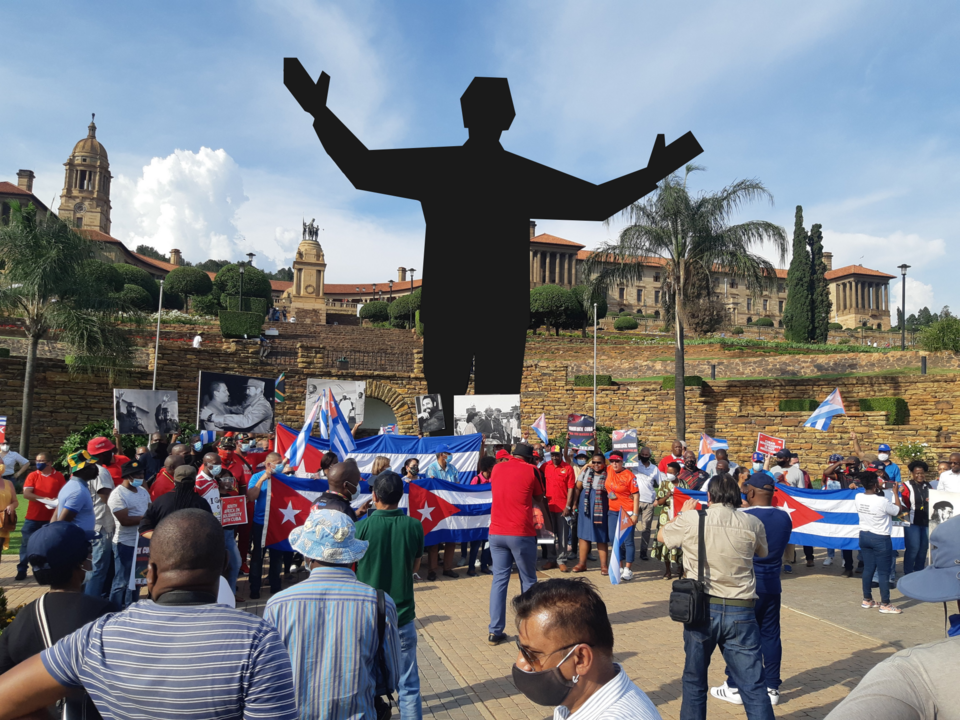
U.S. pressure on Cuba is entering a new phase of escalation. Economic sanctions, financial restrictions, and limits on energy supplies are worsening the situation on the island.
In this interview, Salim Lamrani, a specialist in relations between Cuba and the United States, analyzes the consequences of the blockade, Washington’s motivations, and the regional political context.
How do you assess Cuba’s current situation in the face of increasing U.S. pressure?
Cuba is going through an extremely difficult period, probably the most complex since 1959, apart from the 1962 crisis. Never before had U.S. pressure, aggression, and hostility toward the island reached such levels.
It is important to remember that Washington has imposed an economic blockade for more than six decades that affects every sector of the Cuban population. During his first term, Donald Trump significantly tightened these sanctions.
Between 2017 and 2021, he imposed 243 additional coercive measures. That amounts to a new sanction every five days for four years. These measures directly targeted Cuba’s three main sources of revenue: tourism, remittances, and international medical cooperation.
What happened afterward under the Biden administration?
The Biden administration did absolutely nothing to change this policy. It also maintained an extremely serious decision made by Trump in January 2021: Cuba’s reinstatement on the list of countries sponsoring terrorism.
This is a unilateral list created by the U.S. State Department and completely lacking in legitimacy. One need only remember that Nelson Mandela remained on that list until 2008, even after serving as president of South Africa.
The consequences for Cuba were immediate: more than one hundred international banking and financial institutions severed ties with the island. This greatly complicated foreign investment and further worsened the economic crisis.
You speak of an unprecedented escalation. Concretely, what does that mean?
The new Trump administration has pushed hostility to unprecedented levels, particularly through the oil blockade.
Between December 2025 and April 2026, only one oil tanker entered Cuba, representing the equivalent of just twelve days of national consumption. And when we talk about fuel, we must understand the concrete consequences for daily life.
Cuba’s electrical system depends on oil for 50% of its operation. This means paralyzed hospitals, suspended surgeries, insufficient transportation, difficulties accessing drinking water, closed schools, and serious problems with waste collection.
At present, around 100,000 patients are waiting for surgery, including 11,000 children. In some regions, power outages can last up to thirty hours.
These are unilateral, inhumane measures that are completely contrary to international law.
Why have the United States maintained this policy for so many decades?
Cuba represents a symbol in Latin America. Unlike other countries, Cuba’s main strategic resource is not material but symbolic. Cuba succeeded in challenging the world’s leading power in its own “backyard” and in building a different society, with free education, universal healthcare, access to culture, and sovereignty over its natural resources. That is precisely what the United States has never accepted.
Cuba demonstrated that it was possible to follow an alternative path, even as a small island with limited resources and under intense external pressure. It showed that it was possible to regain national control over resources and build a sovereign project.
This represented an extremely dangerous precedent for Washington because it could inspire other Latin American countries. Historically, the United States has always feared the “demonstration effect.”
Donald Trump recently stated that he wants regime change in Cuba. How do you interpret those remarks?
I believe Donald Trump must understand one fundamental thing: Cuba is an independent and sovereign country. Cuba’s destiny depends exclusively on the will of the Cuban people. No U.S. president has the legitimacy to decide the island’s political future.
And no Cuban worthy of the name should call for sanctions against their own people. No one can demand the economic suffocation of their own population.
Washington often justifies these sanctions in the name of human rights. What is your response?
If the United States truly cared about human rights in Cuba, it would immediately lift the economic sanctions. The main obstacle to the well-being of the Cuban people is precisely this blockade.
Its concrete impact must be understood: last year alone, the cost amounted to $7.55 billion, or $20 million per day. With that same amount, Cuba could guarantee essential goods for the entire population for six years. Since their imposition in 1960, the sanctions have cost Cuba more than $170 billion, and over 80% of the Cuban population was born under this state of siege.
Moreover, the latest measures have caused a decline in the country’s three main sources of revenue: tourism fell by 60%, family remittances by 40%, and international medical cooperation by 20%.
All of this directly affects the population.
You also mentioned pressure on Cuban medical missions. What is happening?
U.S. pressure is extremely intense. For example, the U.S. ambassador to Cuba even traveled to Calabria, Italy, to ask regional authorities to terminate an agreement with Cuban doctors. These are around 300 professionals who are essential to the local healthcare system.
This illustrates the level of diplomatic interference: a U.S. ambassador traveling to another country to demand the end of a medical cooperation agreement.
What should the international community do in response to this situation?
Political courage is needed. Russia has already shown one possible path by sending oil to Cuba. Other oil-producing countries should do the same. Brazil, Colombia, and China have the necessary capacities to help the island and resist the logic of might makes right.
Historically, the Cuban people have shown solidarity with Latin America, Africa, and Asia. It is time for the world to return some of that solidarity. The Cuban people are not asking to interfere in the internal affairs of the United States. They are simply asking for the right to decide their own destiny in a sovereign manner.
Cuba only wants the right to choose how to organize its society, free from foreign interference.

This Has to Stop: The Criminal U.S. Blockade of Cuba
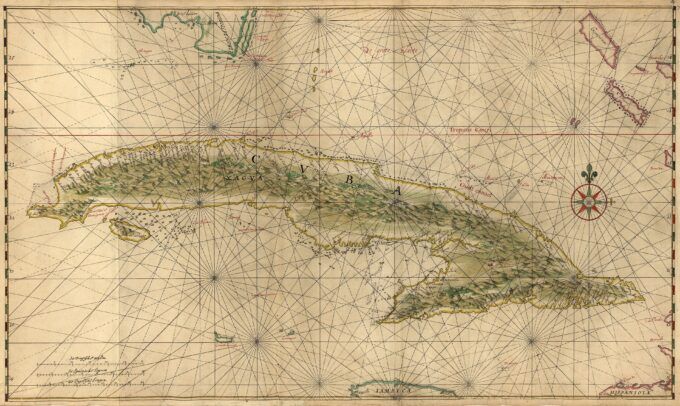
Map of Cuba from 1639 – Public Domain
He has blockaded Cuba, and now he’s expanded the sanctions. Donald “Uber-Capitalist” Trump is relentless in his war on this tiny nation of 11 million people, whose courage, solidarity and grit has inspired all ends of the global political spectrum, from Claudia Scheinbaum’s left-leaning Mexico to Vladimir Putin’s traditional-values-championing Russia. Fortunately, some of these onlookers have even been inspired to act. Moscow already broke the blockade by dispatching one enormous oil tanker to Havana and is sending another, while other nations have donated various necessities. Beijing has been especially generous with everything from rice to thousands of solar panels. It kinda invites the comparison between Trump and Ebeneezer Scrouge. Not a good look for a man obsessed with his appearance.
On May 1, Trump’s new sanctions took aim at “officials, entities…as well as people operating in Cuba’s energy, defense, mining and financial sectors,” reported Democracy Now! “Foreign banks and companies that do business with sanctioned Cuban entities could also be cut off from U.S. markets.” Never has the planet’s need for a new, non-U.S. financial architecture glared more apparently, because Washington wages relentless, endless economic war on any nation anywhere that refuses to bow to it. Though U.S. financial assaults on Cuba are not, unlike those on BRICS countries, liable to catapult the dollar into its grave as the world’s chief reserve currency, you can be sure China and Russia have taken note. It’s one more nail in the coffin of dollar supremacy, one more argument, come the next BRICS summit – and BRICS, by the way, speaks for 45 to 55 percent of the world’s population and holds 40 to 44 percent of the world’s purchasing power parity – for expanding the yuan as a reserve currency and, even, for BRICS creating its OWN currency.
In other words, American sanctions, which have already backfired spectacularly in certain corners of the globe (think Russia), are still used as promiscuously by Mr. Trump as by his predecessors, to the fury of just about everybody, a fury that’s far from impotent. The irony here is that Trump periodically erupts with threats against anyone who harms the almighty dollar; but with his refusal to kick the sanctions habit, he’s got the same self-defeating addiction as all his predecessors. His sanctions temper-tantrums, like those of every other recent president, kill people in the global south. This is a form of warfare, leading everyone who can quite rightly to shun the dollar. So sooner rather than later, the dollar will no longer hold the world reserve currency prize, and we lucky dogs in the heart of the Empire will get smacked with eye-popping inflation.
Also on May Day came the Cuban government’s International Worker’s Day celebration. “With a severe energy crisis that has sent food prices soaring, morale plummeting and transportation halting,” reported the New York Times that day, over half a million Cuban Communist Party supporters attended the celebration. Meanwhile Trump’s executive order, issued that day, claims that Cuba “constitute[s] an unusual and extraordinary threat…to the national security and foreign policy of the United States.” As Cuban president Miguel Diaz-Canal riposted: “One has to ask: What is the threat? What is extraordinary about that threat? What is unusual about that threat, when Cuba is a country of peace?”
Then, according to an X summary May 2, “at a dinner in West Palm Beach on Friday, Trump joked about using the USS Abraham Lincoln to force Cuba’s quick capitulation.” Two days later X added that Diaz-Canal “called the U.S. a ‘fascist government’…amid the island’s deepening crisis of food shortages, blackouts and inflation.” Again, who is aiding the grotesquely bullied Cubans? Front and center stand the Russians. Moscow’s first tanker arrived in the port of Matanzas March 31, with roughly 730,000 barrels of oil. Meanwhile, by May 5, a second Russian tanker got about 1000 miles from the Cuban coast, with 270,000 barrels of diesel. But according to Bloomberg May 5, that second tanker has stalled.
“For the last two weeks,” wrote the Guardian May 3, “U.S. surveillance aircraft have been circling the island in an echo of what happened in Venezuela before the January 3 abduction of Nicolas Maduro.” Clearly Trump wants to drive Diaz-Canal from office, because just as clearly, the Trump who posed as an anti-interventionist candidate and bragged that as president he had started no new wars, is in fact all-in with the neoconservative putsch fanboy agenda. He failed spectacularly in Iran; assaults on China are on hold; Russia is beating the crap out of the NATO army in Ukraine; so what does the U.S. power elite have left? Not much. Kidnapping socialist presidents and lording it over tiny communist islands 90 miles from Key West. Simultaneously, however, as reporter Richard Medhurst has written copiously on X for weeks and in a stunning substack investigation May 1, under Trump the U.S. has pursued global energy supremacy and largely achieved it. Venezuela – check. Gaza/Syrian gas fields – check. Kettling Arctic transit of oil to China – check. What remains? I’ll tell you: a tiny country called Russia, which Washington had hoped to balkanize but failed, so instead, its Ukrainian puppet flies hundreds of drones at Russian energy installations, rashly risking a nuclear war with NATO.
Which is to say that while the U.S. military can’t beat anyone else’s military, and hasn’t been able to since the Korean War, the U.S. is very good at “stealing the oil.” That’s because here in the USA, we have the smartest, most ruthless, most experienced, most cohesive, most amoral capitalists in the world. They may not be able to defeat Iran in a fair fight, but they can make it darn difficult for Tehran’s oil to get to market. And while Iranian oil is largely blockaded, Washington price-gouges the world for its ridiculously expensive LNG. So the oil companies make bank, the white house plays and rigs the stock market, and Wall Street smiles, while the rest of us go flat broke. As Trump said on television just recently about the barrel price of oil, “even if it’s $200, it’s worth it.” Worth it to whom? I mean, it’s easy for him to say. He’s a billionaire – not a farmer paying $300 to fill the tank of his work vehicle.
So now Trump evidently thinks toppling Diaz-Canal would be a glittering anti-communist feather in his cap. He has all but told the Cuban president to get out or else. Diaz-Canal hasn’t budged. So what next? A repeat of the Venezuelan acrobatics? Or have U.S. spooks not as thoroughly infested the Cuban military as they did the Venezuelan one? That’s probably no concern for the white house, which doubtless has plenty of other dirty tricks up its sleeve and fiendishly commie-hating advisors – the alarming and shadowy Elliott Abrams comes to mind though he is not officially in this iteration of Trump’s rule – quite capable of implementing them.
In short, we have the clever bandits in Washington pillaging the globe and apparently winning at that hands down via market manipulation, other financial skullduggery and, when needed, deploying the military as its paramount “gangster for capitalism.” That gangster is possibly headed for Cuba, though why and why now are the wildly ostentatious questions of the hour. Well, there’s a reality TV star in the white house, and the Trump show must go on.


No comments:
Post a Comment