Tom Boggioni
May 12, 2026
RAW STORY
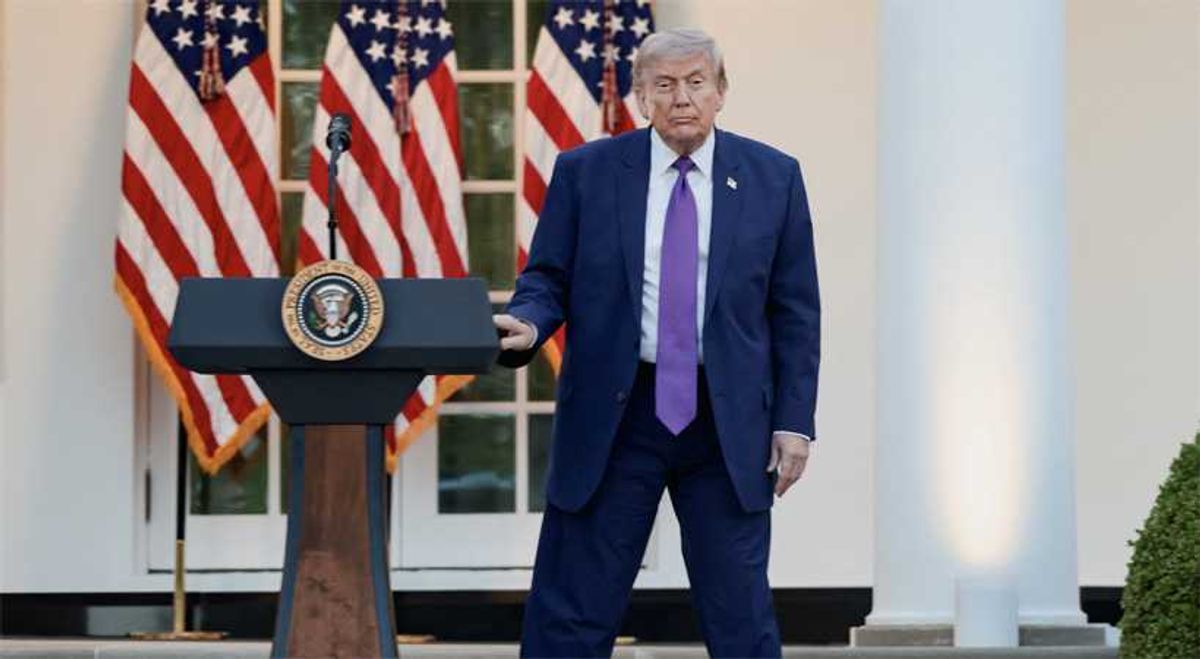
U.S. President Donald Trump after delivering remarks during his second 'Rose Garden Club' dinner in honour of Police Week at the White House in Washington, D.C., U.S., May 11, 2026. REUTERS/Evelyn Hockstein
Donald Trump's trip to Beijing to meet with Chinese leader Xi Jinping comes as the leadership of China is buoyed by an internal report that their country has seen its profile in the world rise above the US in large part due to American president.
With Reuters reporting that Trump needs some “wins” due to his horrific approval numbers at home, the New York Times is reporting that a “Beijing think tank affiliated with Renmin University published a triumphant report about Mr. Trump’s first year back in office. The report argued that his tariffs, attacks on allies, anti-immigration policies and assaults on the American political establishment had inadvertently strengthened China while weakening the United States. Its title: ‘Thank Trump.’”
According to the Times the analysis argued that Trump's erratic decision-making across domestic and foreign policy has inadvertently unified China while fracturing American institutions with the authors characterizing Trump as an "accelerator of American political decay," and the United States teetering on "Latin American-style instability."
Trump's hostility toward China, the report argued, functioned as a "reverse booster" that strengthened Beijing's strategic self-reliance. "At this turning point in history," the authors wrote, "what we hear is the heavy and haunting toll of an empire's evening bell."
In light of the current state of affairs, the Times is reporting that use of the term "American decline" in official Chinese sources nearly doubled in 2025, citing a Brookings Institution study.
Chinese scholars are openly discussing how to exploit Trump's desperation. "Only China can save Trump," said Huang Jing, a professor at Shanghai International Studies University during a late 2025 media event. With midterm elections approaching, Huang argued, Trump needs visible wins such as Chinese purchases of American soybeans, corn, and natural gas that could help Republicans in the red states the GOP relies upon.
"Since Trump, the United States has become increasingly prone to compromise," Huang reportedly advised
Chinese scholars are also strategizing about the possibility of a Republican midterm collapse. According to Wu Xinbo, a leading American studies scholar at Fudan University, if Republicans lose control of the House in November, Trump, handcuffed domestically by a Democratic-controlled House would likely lean into foreign policy legacy-building — opening the door for China's leaders to use that to their advantage, with Wu remarking, "China should make good use of this opportunity."
Bennito L. Kelty
May 12, 2026
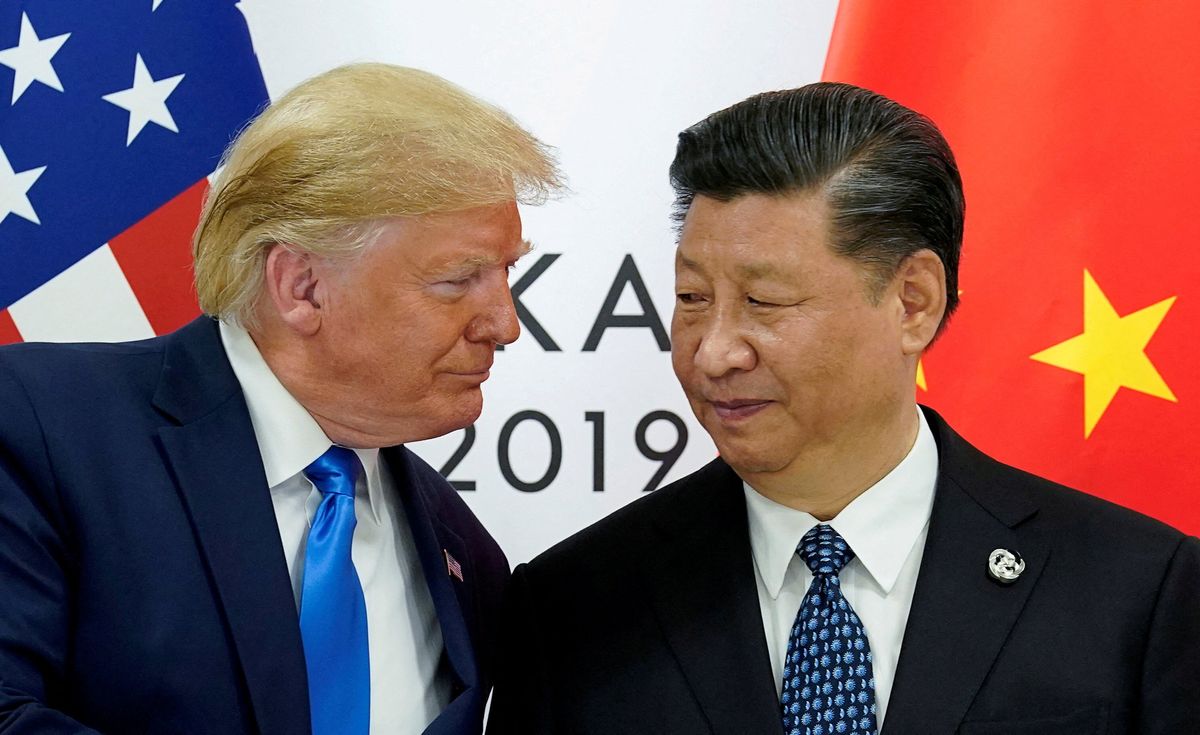
FILE PHOTO: U.S. President Donald Trump meets with China's President Xi Jinping at the start of their bilateral meeting at the G20 leaders summit in Osaka, Japan, June 29, 2019. REUTERS/Kevin Lamarque//File Photo
Trump has already delivered China's ambitions with "self-inflicted" wounds, an ex-GOP strategist warned ahead of the president's visit with the country's leader, Xi Jinping.
"China's ambitions, whether they are military or economic, have been delivered up by Donald Trump," Rick Wilson said on a Tuesday episode of his podcast. Trump was set to meet with Chinese leader Xi Jinping from May 12-15 with business leaders like Elon Musk, and Wilson noted he's going in with "cataclysmically low poll ratings" and "tremendous political weakness" amid the war in Iran.
However, while "we've lost the war in Iran," Trump started delivering "self-inflicted" wounds that benefit China's ambitions well before that, Wilson said.
"Trump starts a trade war. Almost every nation in South America is on the wrong side of Trump's trade war," Wilson explained. "What happens in South America? They cut deals with China. They're selling their products to China."
Looking at Trump's government cutbacks, Wilson said that the DOGE decision to dismantle USAID is also helping China's global standing rise above that of the United States.
"If you had gone into any African country two years ago, where there's a famine, where there's sickness, where there's poverty, where there's disease, where there's misery, you would have seen USAID workers," Wilson said. "You know what you'd see now? China. Because Elon and DOGE cut USAID and killed the program. So now those bags of food don't say, 'A gift from the people of the United States.' Now those bags of food say 'A gift from the people of the People's Republic of China.'"
Wilson predicted that as people watch Trump's visit to China, they'll see him "with a sense of discomfort, with a sense of embarrassment," even though Trump will "bluster and yell and try to pretend that he's got the strong hand here. He does not. Xi Jinping has the strong hand."
Voters Outpace Washington Hawks on China Strategy Before the May Summit
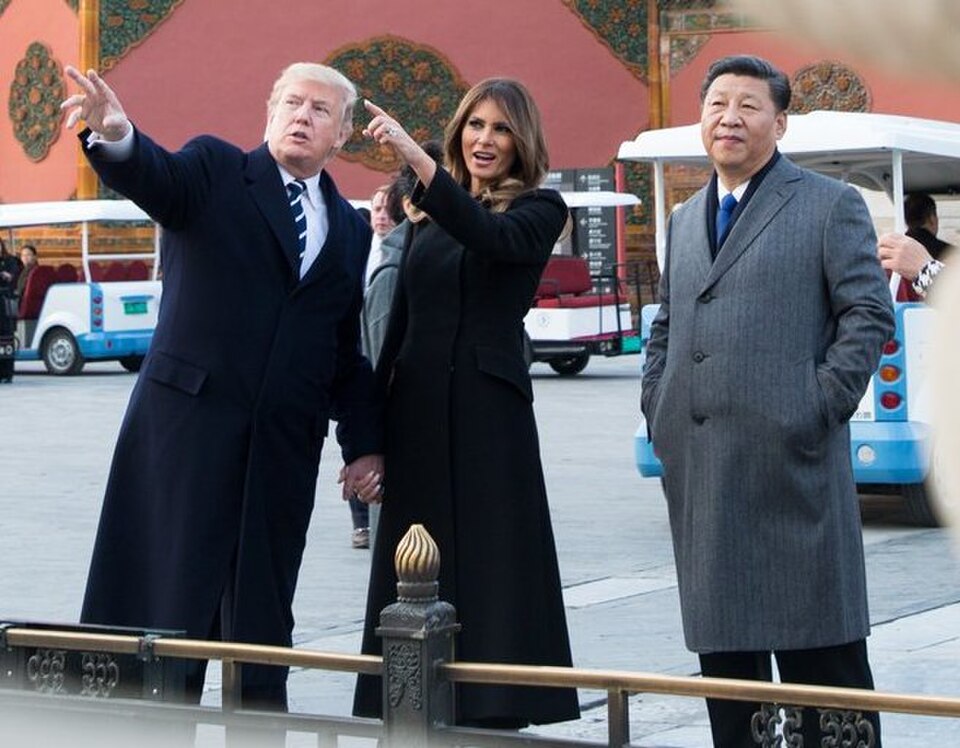
As the diplomatic machinery in Beijing grinds into high gear for the May 14 summit between Donald Trump and Xi Jinping, a profound disconnect has emerged. While Washington’s policy corridors remain anchored to a narrative of inevitable conflict, the American public is quietly conducting a strategic pivot of its own. To understand the stakes of the summit, one must look past naval deployments in the Pacific and examine the shifting sociological foundations of American power.
Recent data suggests that the “China Hawk” consensus in the United States is facing its first major structural challenge from the electorate. According to the March 2026 Pew survey, American favorability toward China has climbed to 27 percent, nearly doubling since the post‑pandemic lows. More critically, the share of Americans who label China an “enemy” has dropped to 28 percent, down from 42 percent just two years ago. This shift is not cosmetic; it signals a deeper recalibration of how Americans view their place in a multipolar world.
First, the mechanical reality of global trade. The “de‑risking” narrative often feels disconnected from actual flows. Attempts to bypass Chinese inputs have not produced a clean exit, but a more complex dependency. We are seeing a “China Shock 2.0,” where Beijing’s dominance in high‑tech manufacturing and green energy is becoming a permanent fixture of the global baseline. Even in sectors where diversification is underway, Chinese firms remain embedded in supply chains through indirect sourcing and component dominance.
This industrial reality is now reflected in American sentiment and legal challenges. The July 2025 Chicago Council survey revealed that 53 percent of Americans favor “friendly cooperation” with China, the first such majority in seven years. This economic realism is now a necessity; with the Supreme Court’s February 2026 ruling forcing a messy recalibration of the U.S. tariff regime, the May 14 summit offers a timely exit ramp from a trade policy that is becoming as legally precarious as it is economically taxing for the average consumer.
Second, the generational shift. The International Crisis Group reports a staggering divide: only 10 percent of young Democrats and 32 percent of young Republicans view China as an enemy. For the under‑50 demographic, China is not a Cold War antagonist; it is a peer competitor that produces their technology and manages their climate future. This cohort grew up in a world where Chinese products, apps, and investments were part of daily life. Their threat perception is shaped less by ideology and more by pragmatic concerns about jobs, innovation, and climate change.
This creates a “permission space” for Trump that he lacked in 2017. If the youth vote – already disillusioned by traditional entanglements – views China as a management problem rather than a moral crusade, the political cost for Trump to strike a “grand bargain” on May 14 disappears. Washington’s hawks are effectively screaming into a demographic vacuum. The generational realignment is not just a polling quirk; it is a structural shift that will define U.S. foreign policy for the next decade.
Finally, “containment fatigue.” In Pakistan, the recent stalemate in the Islamabad Talks and subsequent naval friction in the Gulf have only deepened the American public’s wariness of open-ended regional entanglements. This same exhaustion is appearing in American polling. The public is wary of “forever competitions” that yield no domestic dividend. The containment model, once the backbone of U.S. strategy, is losing legitimacy among voters who see little payoff in endless rivalry.
When Americans look at the “Silicon Shield” of AI hardware restrictions, they see a policy that might protect national security but also inflates living costs. The counter‑intuitive conclusion is that the public is now more “Trumpian” than the politicians: they want a deal that secures interests without the baggage of ideological struggle. This fatigue is not isolationism; it is a demand for efficiency. Just as we see the drawdown of forces in Germany and the withdrawal from Ramstein, the shift in Beijing signals a broader transition: the era of the “World’s Policeman” is being replaced by the era of the “National Interest Broker.”
If the summit results in a de‑escalation of the tariff war, it will not be because of newfound trust between Trump and Xi. It will be because both leaders are staring at internal data that demands stability. Xi needs to protect export markets to manage China’s manufacturing rebound, and Trump needs a “win” that lowers inflation before the midterm season begins. Both leaders are constrained by domestic realities that push them toward compromise.
The American public is no longer the obstacle to a U.S.–China détente; they are the engine of it. The real conflict on May 14 is not between Trump and Xi, but between the American people and their own foreign policy establishment. The electorate is signaling that it wants pragmatic engagement, not ideological crusades. As we watch the motorcades in Beijing, we should remember that the most important shift isn’t occurring in the Great Hall of the People, but in the living rooms of the American Midwest. The era of the “China Enemy” is ending, replaced by the era of the “China Competitor.” It is a subtle distinction, but in geopolitics, subtleties are where deals are made. For Newsweek’s readers, the message is clear: the summit is not just about two leaders, but about how public opinion is reshaping the trajectory of U.S.–China relations.

No comments:
Post a Comment