A commitment to left-wing Andalusian nationalism
Wednesday 13 May 2026,
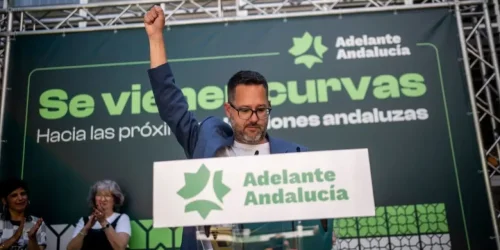
Regional elections will take place in Andalusia on 17 May in a context marked by the consolidation of the PP, which in 2018 broke decades of Socialist dominance, and the rise of an increasingly aggressive right wing. Against this backdrop, the most striking development of the campaign is the growth of Adelante Andalucía: according to the latest CIS [1] poll, the party is on course to secure 8.5% of the vote and win six seats, overtaking the coalition led by the Communist Party, which has historically dominated the Andalusian left.
Re-founded in 2021 under the leadership of Teresa Rodríguez, Adelante defines itself as Andalusian nationalist, anti-capitalist, feminist and eco-socialist. It brings together organisations such as Anticapitalistas Andalucía, Defender and Izquierda Andalucista, alongside a growing number of independent activists organised into local assemblies. The aim is as simple to state as it is difficult to sustain: to articulate the defence of working people - the majority of the population, Andalusian sovereignty and a strategy of rupture; without diluting any of the three pillars into the others.
Heading the list is José Ignacio García, an educational counsellor, activist with Anticapitalistas Andalucía and co-founder of Adelante. Martín Mosquera and Brais Fernández spoke with him about the current situation in Andalusia, the relationship between nation and class, the assessment of the cycle that began with 15M, the Indignados movement [2], and the challenges posed by the rise of the far right.
Martín Mosquera and Brais Fernández (MF): Andalusia is often portrayed as an internal periphery of the Spanish state. Subordinate within the territorial division of labour, plagued by precariousness, low wages and the deterioration of public services. How would you characterise the current situation in Andalusia, and what does this subordinate position signify, in deeper terms?
José Ignacio García (JIG): Andalusia is a subaltern nation within the Spanish state. We speak of the concept of a sacrificial zone, whereby certain territories of the state fulfil the role that some academics, such as Delgado Cabeza, have termed the backyard of capitalist development.
But the key to understanding the territorial configuration of the Spanish state and Andalusia’s role is that this has not worked in favour of the working classes in other parts of the state, but has instead brought enormous benefits to the winners of Spanish capitalism.
The Spanish state is a mechanism with two complementary parts: class contradiction and territorial-national contradiction, alongside issues of gender and race. Both elements have shaped a series of territories whose economy is essentially extractive, serving as a source of cheap labour, raw material extraction, the expansion of productive sectors with a massive negative social and environmental impact, or as a source of a vast reserve army through internal migration.
At different points in history, this extractivism has placed greater emphasis on one or other of these areas, but the process of expropriating wealth from the Andalusian working classes and transferring it to the oligarchies remains similar. These oligarchies may be from outside or within Andalusia, but they always have a huge interest in ensuring that the territorial configuration of the state remains the same and that Andalusia continues to play the role of a backyard.
This is what the Andalusian labour movement has traditionally denounced about the great landowners, such as the House of Alba or the Duke of Infantado. An extractivist oligarchy which, whilst in some cases being Andalusian itself, built its wealth and political power thanks to Andalusia’s subordinate role within the state.
Today, land in Andalusia is in fewer hands than it was half a century ago. The situation for agricultural workers remains very harsh, and we are witnessing what we might call the “uberisation” of the countryside, with the arrival of new landowners in the form of investment funds and foreign capital.
But there are other sectors where we can clearly see this process at work in the current climate. One of them is tourism. In the international division of labour, Andalusia is relegated to an enormously unfair tourism model.
This model is based on extremely precarious working conditions, on the increasing concentration of wealth in large hotel chains, and on an increasingly concentrated hospitality sector with links to the property market. This leads to the emergence of phenomena such as the tourist apartment sector: Andalusia has the highest number in Europe, and this sector tends to be monopolised by large landlords and investment funds.
Tourism is a crucial sector in Andalusia, based on cheap labour, enormous profit margins and the extraction of wealth towards a minority alien to the interests of the Andalusian working classes. A model that is today a clear example of 21st-century economic extractivism. One fact illustrates this very well: we receive over 33 million tourists a year, yet almost 50% of the Andalusian population cannot take a single week’s holiday a year.
Another interesting example is the role assigned to us in the ecological transition led by so-called green capitalism. Right now, in rural Andalusia, there is a very serious conflict because large-scale photovoltaic plants or biogas plants are being installed, causing a devastating environmental impact, destroying the livelihoods of many regions and blackmailing the population, often forcing them to choose between employment and health.
They have decided that Andalusia should be the “battery” of southern Europe, producing energy in the hands of multinationals whilst centuries-old olive groves are destroyed. This is happening at the same time as there are protests in neighbourhoods of Seville, Córdoba and Granada due to repeated power cuts during the hot summer.
All these are prime examples of Andalusia’s subordinate role in the service of capital, to which a response can only be found through a perspective that combines Andalusian sovereignty and eco-socialism.
MF: Adelante Andalucía seeks to combine anti-capitalism and Andalusian nationalism within a single project. In a left that has often oscillated between prioritising the social question or the national question, what new strategic idea does this articulation introduce, and how do you conceive, within this framework, the relationship between nation and class? More specifically, how can the national question function as a mediator to radicalise social conflict and advance a socialist perspective, rather than diluting it?
JIG: If we are aware of the construction of the Spanish state with these two well-oiled cogs—the class contradiction and the national contradiction—and that both are what relegate Andalusia to a subordinate position and make it a sacrificial zone, the response must necessarily subvert both contradictions.
In Adelante Andalucía we argue that class emancipation and national emancipation are inseparable. In Andalusia this takes on very visible features; it is something deeply ingrained in the Andalusian people and their struggles. The banner of the workers’ struggle here has always been the green-and-white flag. It is symbolic, but it is no minor matter. It is the historical development of capitalism, the social institutions that were built and the struggles that were waged that shaped Andalusia as a nation.
Our proposal is to build a party for the Andalusian working class in the 21st century. This involves having two very clear elements and, at the same time, avoiding two dangerous tendencies that have characterised other historical experiences.
We want to build a political organisation that represents the interests of the Andalusian working classes, of the vast majority of the population who suffer under this system, whilst being aware that class conflict runs through Andalusia as a nation, and that implies accepting that in Andalusia we do not all share the same interests. An investment fund, however Andalusian its shareholders may be, owning thousands of hectares, is not the same as a farm worker; just as the owner of a large hotel chain is not the same as his or her workers. Our programme is very clear that we reject interclassism.
And, on the other hand, Adelante inherently incorporates a pro-sovereignty perspective into our proposal. Class struggle takes place within a specific context, within a national structure and in a particular place in the world. It does not occur in the abstract. This implies that the Andalusian working class has its own specific issues and faces territorial-national oppression. It is therefore essential that the response also aims to subvert the subordinate role that Andalusia plays within the structure of the State.
All too often, the left in Spain has failed to grasp the need to formulate a pro-sovereignty response from and for Andalusia. In fact, on many occasions, the existence of specific oppression in Andalusia and the Andalusian territorial conflict has been effectively denied, despite the social data. The perspective has been exclusively reductionist in terms of class, which has rendered all responses inadequate and limited the ability to connect with the sentiments and identity of the Andalusian people.
I sometimes give an example in this regard which, although it may seem exaggerated, clarifies the perspective that other left-wing currents have always held regarding Andalusia. Imagine that in the future a socialist republic were to be established within the Spanish state; if that process were not driven by Andalusian sovereignty—that is, by the ability of the working people of Andalusia to plan and decide on life in our land—the end result would be a public energy company that would cover the Andalusian countryside with solar panels.
Beyond this hypothetical example, we are clear that any political process of emancipation for the Andalusian working class must be based on a sovereignist perspective if we want Andalusia to cease being a sacrificial zone for the sake of capital. Furthermore, we are convinced that this is the only possible way.
Our Andalusian nationalism is anti-capitalist and our anti-capitalism is Andalusian nationalist. Not because of some sort of alliance, tactical or strategic, between political currents, but because we are trying to give birth to a new political movement. A political proposition adapted to the needs of the current situation, but with a long-term perspective that shapes a new model of society for Andalusia.
This idea strikes me as fundamental: we are trying to build a party-based political tool and a political movement in the broadest sense (social, cultural, etc.) that combines the overcoming of capitalism with the shaping of a society we call eco-socialist. From Andalusia, drawing on the problems, virtues, heterogeneities and potential of the Andalusian working class, with the aim of subverting the subordinate role that has been assigned to it for centuries.
This requires a clear understanding that this political innovation of combining the social and the national must be reflected in two elements: both in the programmatic aspects and in the newly forged Andalusian identity we are shaping.
The political identity that Adelante Andalucía is forging must be defined in this way. 21st-century Andalusianism must be anti-capitalist, and anti-capitalism south of Despeñaperros must be Andalusianist. Without forgetting the intersection with feminism or anti-racism.
In fact, it is precisely within feminism that a most interesting innovation has developed, which in some way illuminated the path we needed to build. Around Andalusian feminism, a symbiosis has been theorised and put into practice – through female authors, communicators, collectives, etc. – that combined feminisms with the community practices of Andalusian women, historical struggles, the reinterpretation of traditions, and so on.
Clearly, all this within Adelante Andalucía is by no means a finished process, far from it. And, of course, it is not without risks. Contradictions may arise, as well as problems of all kinds, inter-class tensions and centralist perspectives, or even reformist temptations.
But we are working on it. There is no magic formula: it will be the future development of Adelante as a party, political analysis, debate, the struggles that arise in Andalusia, political battles, mistakes and lessons learnt that will enable us to move forward. We have a long way to go.
MF: An Andalusian pro-sovereignty force is immediately confronted with the question of internationalism, against a backdrop of the crisis of capitalist globalisation and the rise of war and militarisation. How can we combine a pro-sovereignty strategy with an internationalist one that goes beyond formal solidarity and coordinates the struggle on an international level?
JIG: This is an important point. We are an Andalusian pro-sovereignty force, but we are not indifferent to what happens outside Andalusia, nor is it a minor issue. On the contrary, in a way we feel part of the international movement of the working class and the peoples fighting against capitalism and imperialism.
This translates into some basic principles. Since the founding of Adelante Andalucía, we have defined ourselves as internationalists and anti-imperialists. Although within Adelante there are comrades who may hold different views on certain aspects of international politics or on the interpretation of current conflicts, we share a strong strategic consensus.
In this regard, it is clear to us that our primary task, consistent with internationalism and anti-imperialism, is to confront the imperialist power of which Andalusia forms part—that is, the United States and NATO.
What is more, Andalusia is by no means a minor player in NATO’s warmongering policy, as we have two US military bases here, in Rota and Morón. We are a clear example of a territory placed at the service of imperialist interests. That is why we have always declared ourselves opposed to the existence of these bases.
In fact, it is no coincidence that Andalusia was specifically chosen to host bases such as these. It is yet another example of our land being treated as a sacrificial zone in the service of interests that have nothing to do with those of the working people of Andalusia.
But beware, in Andalusia this cannot be separated from the social perspective. To address the issue of the bases whilst ignoring that they are a form of blackmail of the working classes in the affected regions is to tackle only half the problem. In Andalusia, we have often been blackmailed by being forced to choose between “jobs and peace”, between “jobs and health” or between “jobs and solidarity”. We must abolish this dichotomy because that is precisely where our adversary wants to lead us.
With the same vigour with which we must oppose NATO and the existence of the Morón and Rota bases, we must demand employment schemes, sustainable industrialisation and development alternatives for those regions. Both are inseparable and can only be resolved through the active involvement of workers – that is, through the democratic control of resources – which will enable us to tackle the structural problems that the capitalists are incapable of resolving. Of course, internationalism and the building of solidarity movements, particularly with Palestine or Western Sahara—which is closely linked to Andalusia—are political priorities in this context.
I would like to add something that I believe is also important. We must incorporate this internationalist perspective across the board into all our political priorities when analysing the territorial configuration of the Spanish state. Spanish nationalism in Andalusia has on many occasions masqueraded as a supposed “Andalusianism” that is nothing more than anti-Catalanism.
It taps into a real impulse within the Andalusian people, a pain that has a material basis in how Andalusia has been sidelined, and it is channelled against another people rather than against the political and economic elites.
The best way to counter this idea is precisely through an Andalusianism that puts Andalusia’s rights on the table without any qualms, but which sees the working people of Catalonia or Madrid as allies against the 1978 regime.
MF: The rise of the far right is a global phenomenon, and the Spanish state is not immune to this trend. How do you interpret this? What, in your view, is the real threat? And faced with the possibility of a government involving Vox, does this force the left to rethink its tactics or strategic direction?
JIG: There is a real threat, and I believe any left-wing political force that tries to ignore it or underestimate its danger is mistaken. The worst is never the best.
Furthermore, I have the feeling that some on the left anticipate that Vox in government will suffer the same fate as the forces to the left of the PSOE when they held ministerial posts: ending up as outsiders to the real deep state, incapable of social transformation, or being co-opted by the most socio-liberal form of progressivism.
Unfortunately, I do not believe this would be the case with Vox. Because Vox is not an outsider to the capitalist state or to the class that has always held power. On the contrary, Vox is the offspring and heir to all of that and has it embedded in its DNA. Vox is no stranger to the upper echelons of the state’s security forces, nor to the judicial hierarchy, the state’s ruling circles, or the major economic powers. It is part of it, and its entry into government would not be an external element fighting against all that, but its perfect complement.
I believe that the state, to put it theoretically, is not neutral in class terms. And a government is not a control room where you arrive and start giving orders and everyone listens to you; rather, it is more like the metaphor of a train running on established tracks, where dismantling and laying new railway lines is a far more complex process requiring much more than a government.
But Vox would fit perfectly onto those tracks, with the wind in its sails and much of Power with a capital P on its side. It could gather pace to the point of causing great suffering to the majority of the population, transforming precisely those elements of the State that are the achievements of the working classes, the labour movement, feminism or the LGTBIQ movement.
That is why I do not underestimate the danger posed by Vox in any way. And that is also why I do not believe the strategy of cordons sanitaires in alliance with other right-wing parties—which positions Vox as an element external to liberal democracy—is useful, because I believe that fails to grasp what that danger really consists of.
So one might ask why, if we are so concerned about the threat of the far right, we do not opt for a strategy of electoral unity with other left-wing forces. It is a sensible question that requires an explanation.
We must assess the political situation to chart our strategy. It is precisely in this context that we believe the far right in Spain is drawing strength, amongst other things, from widespread popular disaffection and disappointment with a left which, generally speaking, has failed, after almost eight years in central government, to deliver far-reaching reforms that improve the situation of the working classes in the face of the main problems.
Notable issues include the housing crisis, working conditions, the cost of the shopping basket, the deterioration of public services, and the erosion of civil and democratic rights, such as the repeal of the Gag Law. The status quo perceived by the vast majority of the working classes is that very little or nothing has improved under the self-proclaimed most progressive government of the democracy [period since the end of the dictatorship].
There is a massive crisis of credibility on the left in the broadest sense, which comes across as a group that promises much and delivers very little. This is fuelling a shift to the right among the working classes.
We believe that the most effective way to stem the tide of young people and working-class individuals who are increasingly drawn to far-right rhetoric is precisely to propose an alternative that challenges this status quo, but from the left.
The best way to combat the far right is the emergence of forces such as Adelante Andalucía, which offer a challenge to an unjust status quo and do so from an Andalusian identity, which acts as a refuge in times of neoliberal uncertainty and the disappearance of the great communities of the 20th century.
MF: If we look at the cycle that began with 15M, the rise of Podemos, the municipalist coalitions and also the pro-independence left in perspective, it seems clear that this sequence has run its course. What is your strategic assessment of that cycle? Where were its main achievements, its limitations and its hopes?
JIG: We have learnt from that cycle. The first thing to be clear about is that that cycle has ended. From my point of view, it ended with Podemos joining the PSOE government in late 2019. That moment marks the end of the cycle.
At Adelante Andalucía, we are clear that we do not see ourselves as an epilogue to that cycle, but as something new. We learnt from that experience, with its successes and mistakes, and since 2021, with the refoundation of Adelante, we have built ourselves as a political project that is entirely distinct from that.
Much has been written about the assessment, and in a highly contradictory manner. To be brief, I believe the cycle had the enormous virtue of being able to bring many people into politics in a democratic sense, which was very positive, but that it either failed to, or did not wish to, create the necessary mechanisms to ensure that this potential was not simply absorbed by social liberalism, or driven into impotence.
Perhaps the mistake, amongst others, was precisely to pivot everything around enthusiasm. Enthusiasm is fleeting; it is an emotion that cannot be permanent. It would have been more interesting to move from enthusiasm towards other emotions that would allow us to sustain a coherent, constant, difficult, costly and collective struggle—such as transformative politics—and that would enable us to wage a long-term battle.
I believe the times were misjudged and the adversary underestimated. It was even thought that this would be a quick battle, with rapid success, and that it depended on the cunning of very clever and very skilful individuals (all very neoliberal, incidentally). And parties and organisations were created precisely for that conception of politics.
And when that quick success failed to materialise, collective and personal frustration led to outcomes such as joining the bloc dominated by the PSOE, or disengagement from politics altogether.
From this we must learn that our politics must start from today, from engagement with the present, whilst mapping out a long-term future. And for that, we need stable political organisations that go beyond individual leaderships, that are internally democratic, with plenty of political debate and training, and that look to the future.
Adelante Andalucía is not there yet, far from it, but we are working on it. There is no such thing as a perfect organisation, but we are clear that we do not want to repeat the mistakes of previous cycles and we must learn from them.
There is another important element. I do not believe that the class background of an organisation’s leadership is a minor issue. It is important that political representatives live like those they represent—something the left has, incidentally, abandoned, and which Adelante strictly upholds. But furthermore, an organisation that aims to represent the working class cannot always be led by civil servants, university lecturers, people with a certain degree of economic stability, and the children of civil servants. And I say this speaking from personal experience, as I too represent that.
This is going to sound very old-fashioned, but we must make our political leadership more working-class and forge stable, organic links with the key sectors of our working class. We must not be content with merely representing them institutionally, but must bind ourselves to them in a vital way.
As I say, these are not things we have done. They are tasks that lie ahead of us.
MF: Faced with the end of that cycle and the advance of the right, the fundamental question once again is how to rebuild a popular force with real roots. What kind of left is needed today to reconnect with the working majorities? How do you envisage that reconstruction?
JIG: These matters are not declared, they are built. Put another way, they are not spoken of, they are done.
I must admit that I increasingly dislike those intellectuals who declare the sort of left we need but never get round to building it, to giving it shape, substance, legs, hands, tasks, successes and failures.
Having said that, I shall try to explain some characteristics of the left we are attempting to build in Adelante Andalucía.
As has been explained, to stem the flow of working-class people drifting towards the far right, we need a left that challenges the system and the current status quo. For this, independence from the bloc dominated by the PSOE is crucial; we must maintain a clear qualitative distinction from that bloc. That said, without falling into sectarianism. We know they are our adversaries and that they form part of the regime we are fighting against. We are prepared to reach specific agreements that improve the balance of power in favour of working people, to promote united front policies where appropriate, and to strike together against the right in the arena of social mobilisation. But without renouncing our programme or our strategy, which is clearly distinct.
It is precisely this independence and firmness in our objectives that gives us far greater confidence to reach agreements on specific issues that leave no room for the right or the far right. We are prepared to govern, but to implement our programme and transform Andalusia in favour of the working classes, not to join governments dominated by the PSOE, thereby turning governance into something that serves capital and thus generating more frustration than anything else. There are already several historical examples of that strategic error.
On the other hand, we need a left that recovers the best tradition of militant parties. The mistake of building organisations that were practically just small communication apparatuses must not be repeated. We must build parties: something far more complex and against the grain, but which generates a militant culture based on participation, perseverance, a long-term vision, plurality, debate and democracy. Our model is not a large Telegram group.
And furthermore, that party must be outward-looking and active in all fields: from communication to trade unionism, from culture and community centres to institutional spheres. It is not easy, as I say, but it is essential.
There is another aspect we have given a great deal of thought to: if we are building an organisation for the Andalusian working class, we must in some way merge with it, be part of it, and not appear as some sort of outsiders parachuted in from outside. This also requires a critical, complex and heterodox reflection on traditions, festivals and community practices.
The party is not the working class; it does not replace it, but it is of the working class, drawing its strength from it, with as many contradictions, heterodoxies and complexities as our people have.
All this is not a job done but a task still ahead of us. At the founding congress of Adelante Andalucía in Granada in 2021, my comrade Teresa Rodríguez said something that the Adelante membership took to heart from the very beginning: “We are not going to build a candidacy for the next elections, but a party for the next generations.” We are still working on it.
30 April 2026
Translated by International Viewpoint from Vientosur. Also published in Jacobin América Latina.
Footnotes
[1] (Centre for Sociological Research) is a Spanish public research institute.
[2] The anti-austerity movement in Spain, also referred to as the 15-M Movement (Spanish: Movimiento 15-M), and the Indignados Movement, was a series of protests, demonstrations, and occupations against austerity policies in Spain that began around the local and regional elections of 2011 and 2012. Beginning on 15 May 2011, many of the subsequent demonstrations spread through various social networks such as Real Democracy NOW (Spanish: Democracia Real YA) and Youth Without a Future (Spanish: Juventud Sin Futuro). See wikipedia.
Brais Fernández
Brais Fernández is an activist of Anticapitalistas in Madrid.
Martín Mosquera
Martín Mosquera is a member of Democracía Socialista, Fourth International in Argentina, and a lecturer at the University of Buenos Aires.
José Ignacio García
José Ignacio García is a member of Anticapitalistas Andalucía and co-founder of Adelante Andalucía.
.png)
.png)

No comments:
Post a Comment