Why J Street Does Not Go Far Enough

An illegal auction of stolen Palestinian land at an elite Upper East Side synagogue, and the swift condemnations from groups like J Street launched against New Yorkers who attempted to protest it, reveal the Zionist rot at the heart of the American Jewish elite establishment that is bastardizing and corrupting the religion from within, and why liberal Zionist groups present only an impotent challenge to it.
“The Great Israeli Real Estate Event,” held last Tuesday at Park East Synagogue on Manhattan’s Upper East Side, was organized to assist prospective buyers in the United States, Canada, and the U.K. purchase land in the occupied West Bank, with the expo’s website advertising land for sale in Gush Etzion, a cluster of West Bank settlements illegal under international law. At least one company present, Harey Zahav, displayed maps and brochures advertising properties in Kfar Eldad, Karnei Shomron, and other West Bank settlements. Karnei Shomron is the subject of a $633 million Israeli government development agreement to nearly triple its population, an effort that Israeli Construction Minister Haim Katz called “a clear policy of settlement and building the land of our forefathers,” with a separate land designation designed to prevent Arab construction in the area.
In response to those illegal land sales, New Yorkers used their First Amendment rights to congregate at Park Avenue Synagogue to protest the contentious practice, with demonstrators arguing that it is inappropriate to use a religious institution to shield what is purely a political activity.
As Jewish Voice for Peace explained in their call to action statement, such “events are attempting to cynically shield themselves from protest by holding their sales at a synagogue. No one should enable the sale of stolen land, let alone a religious institution.”
Though instantly labeled antisemitic – the label reflexively deployed against any criticism of Israeli policy regardless of the identity of the critic, and one applied with particular cynicism given that many of the demonstrators outside Park East were themselves Jewish – those protesters were fairly targeting what has become the broader ideological capture of elite American Jewish institutions by a foreign government engaged in genocide and apartheid, and their transformation into a financial backbone for the Greater Israel Project.
Since 2023, American synagogues and Jewish federations have raised millions for ZAKA – founded by an accused serial rapist known in Jerusalem’s Orthodox community as “the Haredi Jeffrey Epstein,” exposed by Haaretz for defrauding the Israeli government, and the originating source for the beheaded babies hoax Joe Biden and Donald Trump continue to repeat – and for its rival United Hatzalah, whose director told a room of Republican Jewish donors in Las Vegas that Hamas had baked a baby alive in an oven. The Jewish National Fund, a tax-exempt American nonprofit institutionally embedded in synagogues nationwide, has for decades purchased land from which Palestinians are legally barred. Hillel International sponsors American Jewish college students on trips that include volunteering at IDF military bases. The Central Fund of Israel, JGives, and Israel Gives conduct tax-deductible fundraising for IDF units in Gaza and the West Bank through similar Jewish institutional networks that gathered at Park East last Tuesday to sell stolen land.
Israel has always depended on diaspora wealth for its survival, which is precisely why its sprawling and aggressive lobby exists. Under those conditions, what B’Tselem, Israel’s own leading human rights organization, has called “a regime of Jewish supremacy from the river to the sea” cannot be seriously challenged without directly confronting the American Jewish institutional infrastructure that bankrolls it, which is precisely what New Yorkers attempted to do last Tuesday at Park East Synagogue.
But those New Yorkers, including many Jewish ones, who showed up to protest those illegal land sales were swiftly condemned – including by J Street, the self-described “pro-Israel, pro-peace” lobby that has pitched itself as the liberal alternative to AIPAC. “Two things can be true,” J Street wrote. “Protests that glorify violence, wave Hezbollah flags and chant for the destruction of Israel are wrong. Using our synagogues to promote home sales in West Bank settlements is also wrong.”
Americans are, of course, free to “glorify violence, wave Hezbollah flags, and chant for the destruction of Israel.” That is all permissible speech which anyone on American soil has the constitutionally protected right to utter, despite an intense ongoing effort by the Israel lobby to criminalize it.
But J Street’s response to those protests – condemning both the protesters and the land sales in equal measure – is indicative of the balancing act the organization has attempted to manage, one that is unstable and contradictory, with its guiding (or rather, mis-guiding) principle that Zionism can ultimately be reformed into something that is morally good, that the solution is a better Israeli government, and that the American Jewish elite institutions which have funded settlement expansion, armed soldiers to ethnically cleanse Gaza, and laundered Israel’s atrocity propaganda bears no meaningful responsibility for what Israel does.
That incoherence was highlighted by a recent memo put out by the group that ostensibly calls for an end to unconditional U.S. aid to Israel which, even while calling for an end to certain weapons transfers, insists that the United States should continue to “sell short-range air and ballistic missile defense capabilities to Israel,” including Iron Dome and David’s Sling and Arrow, interceptors and other system components, which J Street says are “purely defensive and have saved countless civilian lives by intercepting attacks from Hamas, Hezbollah, Iran and others.”
If the purpose of J Street’s new position is to change Israeli behavior, it is not a serious one; the Iron Dome system is what allows Israel to wage its wars of aggression across seven fronts simultaneously without fear of costly retaliation from the populations it targets.
Just as unserious is J Street’s neutered and impotent critique of Israel’s current campaign in Lebanon as “Netanyahu’s and Smotrich’s” war.
“Netanyahu and Smotrich,” the group’s Senior Vice President Ilan Goldenberg wrote in a May 1st statement, “are carrying out their West Bank and Gaza playbook in southern Lebanon. We’re failing to stop them.”
Since March 2, Israel has killed over 2,700 people in Lebanon and displaced more than 1.2 million. Israel’s defense minister demanded for southern Lebanon to be ethnically cleansed following “the model of Gaza” and images published by local journalists demonstrate that is exactly what IDF soldiers have done, with complete U.S. backing. Haaretz reports that Israeli soldiers are engaged in extensive looting of private homes and businesses in southern Lebanon, with many soldiers justifying theft by telling themselves the property will be demolished anyway. As Haaretz puts it, the soldiers are “stakeholders in destruction and in prolonging the war.”
Yet one would believe from J Street’s statement that Benjamin Netanyahu and Bezalel Smotrich are single-handedly demolishing entire villages in southern Lebanon — and not the conscript army and Israeli civilian volunteers who are committing those crimes on a daily basis.
The conclusions that J Street cannot bring itself to reach are now being stated openly by a growing number of American Jews, particularly younger ones, who have watched their communal institutions mobilize in defense of an apartheid state and the genocide it has just committed. That the protesters outside Park East are labeled antisemitic is a measure of how completely the establishment has fused Jewish identity with Israeli state policy – a fusion that younger American Jews are increasingly rejecting. Until American Jewish institutions can separate themselves from Zionism, the antisemitism charge will only grow cheaper, and the religion it has been weaponized to protect will grow hollower.
Harrison Berger is a correspondent at The American Conservative. He has contributed to Drop Site News, The Nation, and Responsible Statecraft. Previously, he was a researcher and producer for System Update with Glenn Greenwald. His work focuses on civil liberties and U.S. foreign policy. He studied Political Science and Russian Studies at Union College (NY).
Officials and Activists Are Working to Overturn Illinois’s Anti-BDS Law. Could Their Campaign Become a National Model?
Since 2014, U.S. lawmakers have introduced over 200 bills targeting the Boycott, Divestment and Sanctions (BDS) movement. The vast majority of these efforts have failed to pass, but more than 30 states have adopted anti-BDS laws.
The first state-based measure to take specific action against Israel boycotts was passed in Illinois in 2015; 49-0 in the Senate and 102-0 in the House. “This historic legislation is an important first step in the fight against boycotts of Israel and I hope other states move quickly to follow our lead,” declared then-Governor Bruce Rauner after signing it into law.
Rauner’s hope was quickly realized, as the right-wing American Legislative Exchange Council (ALEC) adopted the Illinois law as a model for pushing anti-BDS laws in other states. According to Palestine Legal, 38 states have enacted laws or executive orders designed to designed to penalize the boycott movement.
Many of these measures have had a significant economic impact. In 2021, the Illinois board overseeing state employee pensions voted to bar funds to the company Unilever over Ben & Jerry’s’s decision to limit sales of its ice cream in Israel. A a result of the ruling, the state was forced to sell between $150–200 million in pension holdings and activating nearly $1 billion in coordinated state divestments nationwide.
Now, Illinois officials and activists are pushing the Illinois Human Rights Advocacy Protection Act, or HB 2723. The bill would repeal the state’s anti-BDS law and potentially serve as a model for legislatures across the country. The effort currently has 22 cosponsors in Illinois House and 12 in state’s Senate.
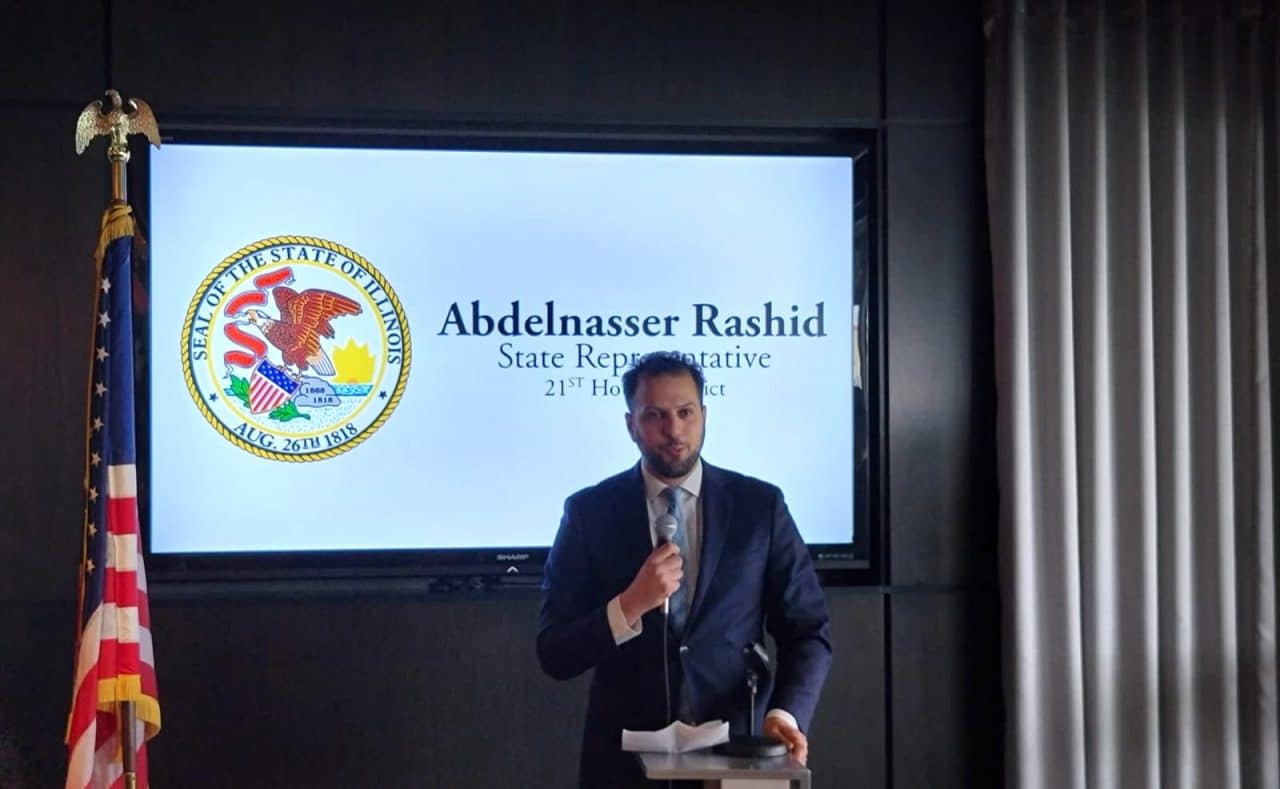
The bill’s chief sponsor is Palestinian-American Rep. Abdelnasser Rashid.
At a recent hearing on the bill, Rashid explained how the the existing law violates the First Amendment.
“This law uses the retirement security of teachers, university workers, state employees and judges to punish peaceful protest,” said Rashid. It coerces American companies—including Illinois companies—into changing their lawful behavior to satisfy a foreign government. And it does all of this with no fiduciary duty, no published rules, no formal appeal, and no audit.
“Boycotts are foundational to who we are as Americans, are an instrumental tool in achieving democratic change, and are as American as baseball and apple pie,” declared Chicago attorney Richard Goldwasser. “Penalizing the politically motivated boycott..is of a piece with the growing fascism in our country.”
HB 2723 is opposed by a number of pro-Israel groups, including the Anti-Defamation League (ADL). During the hearing Rebecca Weininger, the Senior Regional Director ADL Midwest, claimed that “anti-Israel sentiment was powering the rise of anti-Jewish violence.”
“This committee should not tolerate antisemitism dressed up as a foreign policy critique,” said Weininger.
Andrew Herrera, a lobbyist for the Illinois Coalition for Human Rights told Mondoweiss that he expects the bill to succeed if state leadership has the political will to consider it.
“This is the kind of bill that once it moves, it wins,” said Herrera. “Were going to cruise through both chambers.”
“This is narrative fight,” he continued. “It has become impossible to publicly support genocide, ethnic cleansing, and needless war in Iran. It’s about shifting the national conversation and and showing people that this messaging works with voters.”
Recent polling backs up Herrera’s assertion.
According to Pew Research poll from last month, 60% of U.S. adults have a negative view of Israel, up from 53% last year. The same survey found that a majority of Democrats and Republicans under the age of 50 now view the country negatively.
Rebekah Levin, a local activist and Jewish Voice for Peace member who has been organizing around the repeal for years, also cited public opinion while speaking with Mondowiess, and said it had undeniably shifted the position of lawmakers.
“When we first started doing this work in the legislature our job was to educate people who voted for it,” she explained. “Over the past 2 years with the genocide in Gaza, the war in Iran and gas prices going up so high legislators finally saw this as something they could take action on and I would guess they see what’s happening nationwide, not just within the Democratic party at this point, but within the Republican party as well.”
Levin says that, if the anti-BDS law is repealed, it could serve as a model for other activists hoping to overturn such legislation in their states.
“People in other states have reached out to us,” she said. “They want to know what we did and how we did it. “If we overturn this it would be a boost to other states. It’s a powerful message. This is why pro-Israel groups are afraid of this passing. It’s about more than just Illinois.”
These sentiments were echoed by Rep. Rashid.
“Thats what makes the stakes so high,” said Rashid. “I believe this will have a domino effect, we are already talking to states about how to run a campaign. I’m hoping these conversations begin in earnest in other states as they find ways to repeal their laws.
“It is a challenge as it would be many in other states, but I’m hopeful we will set a positive precedent of repealing this shameful law,” he added.
Illinois’s legislative sessions runs until May 31, and proponents of the bill are hoping it gets a hearing before then.


No comments:
Post a Comment