Fanon’s Rainbow: The Lithium Under Appalachia
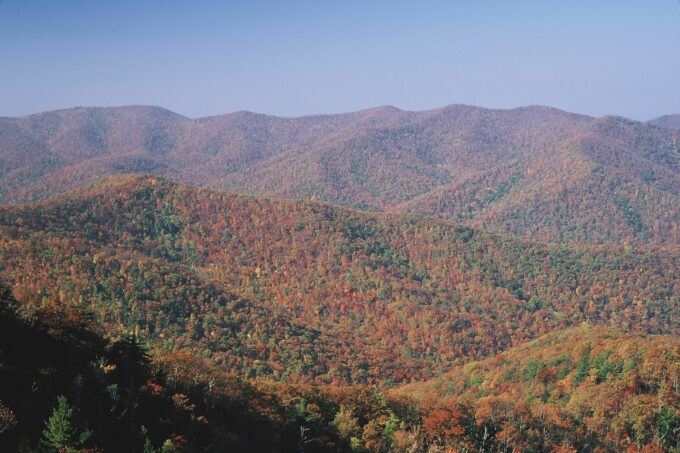
Photograph Source: Shenandoah National Park from Virginia – Public Domain
Geologists have confirmed what preliminary surveys suggested for years: the Appalachian mountain corridor, running from Maine down through New Hampshire, Virginia, the Carolinas, and into Georgia, sits atop one of the largest lithium deposits in North America. The find is concentrated heavily in North Carolina and West Virginia, with significant deposits running the full length of the range. It could represent enough reserves to supply domestic battery production for decades. The timing is fortuitous. The United States has been scrambling to secure lithium supply chains for electric vehicles, grid storage, and defense technology. Turns out it was here all along. Right under the Appalachian Trail, which some optimists still hike end to end, Maine to Georgia, imagining a country that rewards persistence.
II.
Appalachia has been here before. Not the lithium part, but the part where something valuable gets discovered underneath people who have been poor for a very long time. Coal built fortunes, just not locally. Timber came through like a haircut. Tobacco kept the Carolinas and Virginia in a kind of indentured agricultural grace for generations until the lawsuits arrived and the companies discovered that contrition, properly structured, is also profitable. Each boom followed the same basic script: outside capital arrives, extracts, departs, leaves behind a workforce with damaged lungs and a political class grateful for the attention.
I know something about the lungs part. I spent time as a claims representative for the Social Security Administration, processing black lung cases. You read the files. You look at the X-rays. Van Gogh had the same reaction when he visited the miners in Belgium — the Borinage — early in his life, long before anyone knew there would be paintings. What Van Gogh wanted, more than anything, was to be a minister. Failing that, a writer. Painting was third on the list, which tells you something about how God allocates talent. He went down into those mines anyway, in his ministerial capacity, and came back a changed man.
The potato eaters he painted later have that same underground quality, that sense of people who have been somewhere the light doesn’t reach. I have an unfounded but not entirely unreasonable theory that those potato eaters, hunched over their table in that candlelit dark, could have been sitting in any hollow in West Virginia. Same posture. Same exhaustion. Same sense that the meal is smaller than the labor that produced it. Van Gogh just happened to find them in the Netherlands first.
[Image: Van Gogh, The Potato Eaters, 1885 — insert here from Wikimedia Commons, public domain]
It wasn’t the worst day at that office. The worst day was when a woman came in with a number tattooed on her forearm. She was filing under a totalization agreement with Germany. I processed her claim and went to the men’s room and cried. Just so you know I’m not entirely made of stamp ink.
III.
Then came OxyContin. If coal took the lungs over generations, the Sacklers took everything else in about fifteen years. Appalachia got hit harder than anywhere. The reasons were not complicated: depressed economy, physical labor jobs that destroyed bodies, doctors who were either complicit or overwhelmed, and a pharmaceutical company that knew exactly what it was doing and did it anyway. I was living in Australia when I first read Patrick Keefe’s account of the Sackler family. I gave it a grain of salt because Keefe was the same writer who’d argued that the CIA had a hand in writing “The Wind of Change” by the Scorpions, which supposedly helped bring down the Berlin Wall. That seemed like a lot to ask of a German rock band. So I was perhaps more skeptical than the material warranted.
Then I discovered Tasmania.
Johnson and Johnson, it turns out, had been growing opium poppies on that small island off the bottom of Australia, supplying something close to ninety percent of the oxycodone base going into the American market. Most people of my generation knew Tasmania primarily as the home of the Tasmanian devil, that compact, shrieking, whirling catastrophe of an animal that spins through everything in its path — trees, bones, logic, smaller animals — like a blender someone dropped down a staircase. Like a whirling dervish in dark clothing, high on hippie acid. Turns out that was an apt mascot for the island’s primary export industry. They were down there in the antipodean sunshine and if they knew where it was all going, which they did, they were probably not losing sleep over it.
Tasmania. Who knew.
IV.
Which brings us back to lithium. Because lithium, it should be noted, is not only a battery component. It has been prescribed for decades as a mood stabilizer, primarily for bipolar disorder, formerly known as manic depression, formerly known as just how some people are. The pharmaceutical application involves lithium salts, administered carefully, monitored closely, because the therapeutic dose and the toxic dose are uncomfortably proximate. You are, in other words, always fairly close to the edge. Appalachian residents will recognize the feeling.
The interesting thing about the current find is that not all ore is created equal. The high grade goes to the batteries. The rest — the impure stuff, the material that doesn’t meet the technical specifications for your electric vehicle or your phone or Elon Musk’s satellites — will need somewhere to go. One imagines the market will find a use for it. We are, after all, a creative species.
There is something almost poetic about the convergence. Machines run on lithium. An increasing number of humans run on lithium. We have been moving toward each other for some time now, humans and machines, and it appears we were always going to meet somewhere in the Appalachian mountains, which hikers have been walking the length of for decades, feeling inexplicably calm, not entirely sure why.
V.
It will not have escaped anyone’s notice that the announcement of a massive strategic mineral deposit in the United States arrives at a moment when the people best positioned to exploit it are already orbiting the situation like very expensive satellites. Elon Musk needs lithium the way the rest of us need oxygen, possibly more. His batteries, his rockets, his neural implants, his social media platform — all of it downstream of the same supply chain question. Bezos has his own infrastructure ambitions, his own energy appetites, his own talent for arriving somewhere after the hard work of discovery is done and leaving with the majority of what was found. Donald Trump, who has never personally carried anything heavier than a grievance, will want his cut. One imagines a tower. Gold-plated, presumably, though at current lithium prices he may have to reconsider the finish.
The federal government, for its part, will likely declare the deposits a matter of national security, which is the administrative equivalent of calling dibs. Eminent domain has a long and colorful history in Appalachia. The people who live above these deposits have heard variations of this speech before. The details change. The outcome has a way of remaining consistent.
There will be jobs. There will be a period of optimism. There will be a ribbon cutting and possibly a congressional visit. Someone will use the word renaissance. Someone always does.
VI.
And somewhere in the hollers, a jump tower will rise. Gleaming. Possibly branded. The same mountains that watched the coal companies arrive, that absorbed the timber crews, that distributed the OxyContin with the quiet efficiency of a distribution network that knew its market — those mountains will watch the tower go up and say nothing, because mountains don’t, and because they have seen this before.
The hikers will still come. They’ll walk the trail from Maine to Georgia, feeling that familiar inexplicable calm, stepping over the survey markers without noticing, breathing the air, carrying their lithium-powered phones, their lithium-stabilized moods, their packs full of optimism.
Appalachia has always been generous with its gifts. The problem was never the giving. It was who got to keep them.

No comments:
Post a Comment