“Neighborism” Is Not Having “a Moment”
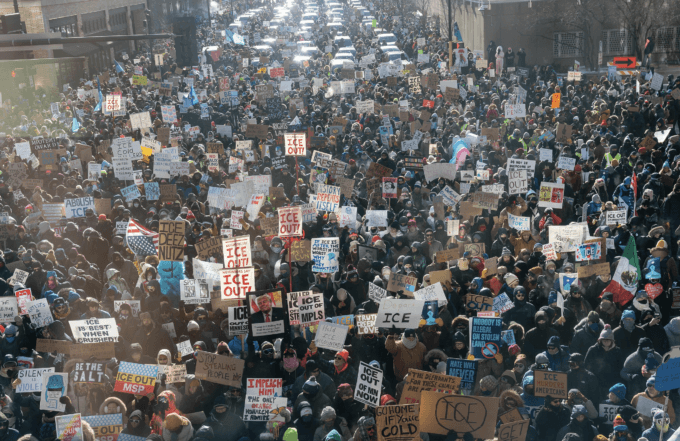
Downtown Minneapolis protest, January 2026. Image Wikipedia.
Earlier this year, when ICE invaded Minneapolis in a horrific siege that is no longer discussed but is absolutely ongoing, my home in the heart of “flyover country” was again thrust into the national and international spotlight, as it was after George Floyd’s murder. And again—as if the Twin Cities’ vibrant literary community is somehow unequipped to write about the happenings of their home with the nuance necessary for reporting that’s not only accurate, but actually sophisticated—the parachute reporting laced with intellectually lazy observations and pedestrian analyses from publications that are somehow still considered prestigious began.
Doing what all good parachute reporters do, one such writer from The Atlantic brought his superior ability to understand places he has seemingly never been with him on safari through the Twin Cities in order to, assuming that Minnesotans are considered part of these publications’ readership, mansplain our resistance to us.
“If the Minnesota resistance has an overarching ideology, you could call it ‘neighborism’—a commitment to protecting the people around you, no matter who they are or where they came from,” Adam Serwer crowed. “Minnesotans have found and loved one another in a world atomized by social media, where empty men have tried to fill their lonely soul with lies about their own inherent superiority,” apparently unaware of the superiority inherent in his own incorrect reporting.
Minnesotans didn’t “find” each other in the ICE raids; we activated and mobilized the community, care, and connections we already have which were cultivated and nurtured long before the masked military wannabes arrived. This effort of coastal parachute reporters to comprehend what they see as some kind of novel, spontaneous and nearly unfathomable care for those who aren’t themselves or those closest to them most recently took the form of a Vox story titled “Why ‘neighborism’ is having a moment”. In it, Sara Radin frames the “neighborism” of which she cites Minneapolis as an example as “the growing practice of treating proximity as a resource [emphasis mine]. Increasingly, digital tools aren’t replacing local relationships—they’re helping activate them.”
There are two central flaws present in Radin’s thinking. The first is in regard to the use of Minneapolis as some kind of case study of this resource-based understanding of community and connection. The second is crediting technology as the vehicle.
Real community, actual connectedness, and genuine care don’t just spontaneously materialize. Yes, they can coalesce and solidify in new ways as they did in Minneapolis after George Floyd was suffocated in our streets by “law enforcement” and as they did earlier this year again, but this kind of connectedness does not just magically appear—because that which is always already there cannot spontaneously materialize.
“Gifts from the Earth or from each other establish a particular relationship, an obligation of sorts to give, to receive, and to reciprocate,” Robin Wall Kimmerer writes in Braiding Sweetgrass. What Kimmerer illustrates so brilliantly through her pairing of botany with Indigenous knowledge is the fact that the natural world, of which humans are an inseparable part, is an inherently interconnected, communicable, reciprocal, and generous place. It’s our incarceration within the extractive, rapacious capitalist system that has brainwashed us into seeing otherwise, that has led writers like Rodin to erroneously describe the community present in Minneapolis with capitalist concepts like “resources”.
Now the technology part. Radin credits digital communication technology with “helping translate online awareness into offline care.” In reality, it’s the other way around.
Community is built on a Tuesday morning at 7 am, outside in -20F degree weather, digging your car out of a pile of fresh snow next to your neighbor, before you both turn your efforts to the car of your elderly neighbor who has to get to the doctor. Care is crafted by neighbors like ours (shout out to Joan!) who put in the endless and largely thankless effort, year after year, of bringing our block together for progressive dinners, fifth Friday festivities, and block parties. Reciprocity is established through tiny gestures that consistently take place over time, like inviting the neighborhood to enjoy the fruit of our peach tree whose bounty is far too plentiful for my husband and I alone and the neighbor who made us a peach pie in return. This is how community is “activated,” not through social media.
I spent the majority of the ICE raids here in Mexico City, my heart breaking for my home as everyone who found out where I was from wanted to talk to me about it. Friends of friends from New York and Los Angeles remarked how foreign the idea of actually knowing your neighbor is to them. Having lived in other cities like New York for some time before choosing to move back to Minneapolis in 2016, this is, in my estimation, an extension of the egotistical notion that everyone would live in places like Los Angeles or New York if only they could “make it” there as those who live there have. It’s unfathomable to them that some of us may actually prefer to live in other places, places like Minneapolis, where community isn’t hard to come by.
Like a plant shooting up through a crack in the sidewalk, real community is created where capitalism fractures, not where it festers. It doesn’t surprise me that community is richer in places where everyone you meet isn’t primarily concerned with themselves, their career, and what, if anything, it is you can do, if anything, for them and their ambitions. This, the fact that true connection thrives outside of capitalism, is precisely what Radin gets so wrong when she frames the connection she calls neighborism as a resource that offers relief from the costs of childcare, rent, and groceries all thanks to technology.
Connection and community cannot be understood through the capitalist framework because they cannot actually be commodified, despite what a world saturated in everything apps that run the gamut from dating to housing might have you think. Minneapolis hasn’t been doing what it’s been doing to gather resources. Minneapolis has been doing what it’s been doing out of care, plain and simple—care that may be logistically communicated through the communication mechanisms of our time, but care that is certainly not because of them.
Real community doesn’t turn on what it is that we can do for each other; it turns on the understanding that we must do for each other because—contrary to the rampant individualism that underlies capitalism—the natural world of which we are an inseparable part is inextricably interconnected. Going it alone simply isn’t possible. That’s what Minneapolis’ “neighborism” has shown.

No comments:
Post a Comment