Disney Is Encouraging and Exploiting the Rise of “Kidults”
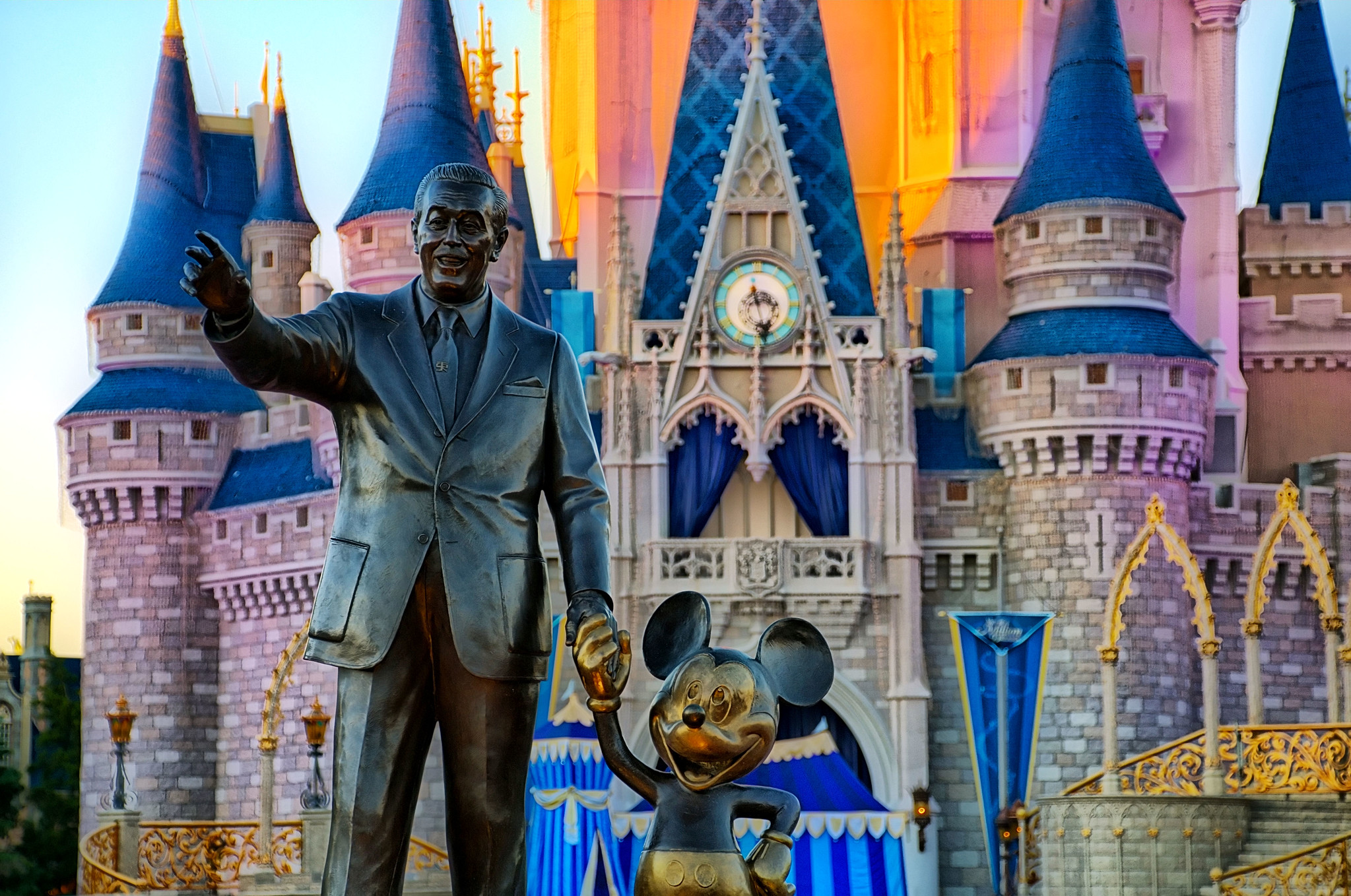
Earlier this month, the New Yorker published a mesmerizing if bleak article about the “Disney adult” — that distinct American subspecies of grown man or woman who is stuck in Peter Pan consumer mode, who trembles in delight at the trailer for the silly new Baby Yoda movie and can’t wait to splurge $80 on a light-up Star Wars popcorn bucket.
What’s worse, the story reveals, many Disney adults are going broke on their frequent pilgrimages to the Holy Land. For the blissfully unaware, Disney experiences are staggeringly expensive. Surveys show nearly half of parents borrow money to fund Disney vacations. One couple who made headlines reportedly borrowed around $70,000, partly for Disney trips; another fan went $17,000 in debt due to ten Disney vacations in five years.
The internet responded to the New Yorker story with a predictable mix of horror and mockery: Who are these giant babies going broke to stand in line for a $15 bucket of Galactic Fries? There’s no especially dignified answer. Going into five-figure debt for a week of manufactured joy at a theme park is, on its face, a bad decision. It can be difficult to muster sympathy for the plight of the Disney adult. After all, adults are responsible for their finances; no wicked stepmother is casting a spell on you to make you do this.
Yet Disney is not some passive beneficiary of the whimsies of childhood nostalgia. It is building the machinery to identify it, cultivate it, finance it, and keep it coming back. How? By catering more explicitly to the wealthy and convincing the rest of us to cough up more hard-earned cash through class envy. For most of the twentieth century, amusement parks and Disney’s properties in particular operated on a rough egalitarian premise: buy a ticket, stand in line, ride the ride. The line was the great democratizer. A wealthy family and a working-class family paid the same and waited the same forty-five minutes to ride Space Mountain.
But now, Disney has built a resort experience where the baseline “good” visit requires purchasing access to the good version of the park on top of the already expensive base admission. Disney’s Lightning Lane system, which includes paid line-jumping, ranges from a multipass costing tens of dollars per person to a Premier Pass that costs between $129 and $449 per person per day, in addition to regular admission.
Enthusiast guides describe it as essentially the line-skipping option for the 1 percent. It means that the rich experience and the poor experience at Disney parks are now visibly distinct. The pressure to spend more comes, in part, from watching your kid’s face fall when you explain that no, we’re not doing the Premier Pass, we’re waiting in the regular line with the regular people. Sorry, children, let me explain something called the class divide!
Thus, even when attendance itself is not booming, Disney is winning because per-capita guest spending is climbing through VIP tours, premium dining, and the resort’s various line-skipping passes. As a result, the “Experiences” part of the Disney portfolio — theme parks, cruise lines, resort hotels — hit a fiscal second-quarter record of nearly $9.5 billion in revenue, up 7 percent year over year, while the stock jumped roughly 7 percent on the news.
Disney’s ambitions don’t stop at the park gates. The company’s new CEO is Josh D’Amaro, who, a colleague told the Wall Street Journal, is laser-focused “on how to extract the most value” from people — code for harvesting money from customers’ wallets. D’Amaro is pushing the company toward building what insiders are calling a “super app,” a unified platform that would merge Disney+ with mobile platforms such as the Disneyland Resort and Disney Cruise Line Navigator apps into a single portal where users can book park tickets, buy merchandise, play games, and watch movies.
The goal is a frictionless enclosure in which streaming content, theme park reservations, merchandise purchasing, and video gaming all flow through a single Disney-controlled pipe, each element reinforcing the others, with none of them leading anywhere outside the ecosystem. You watch the movie, you book the park that recreates it, you buy the movie’s toy at the park, and then you stream it again on the way home. Mark Zuckerberg’s Metaverse may be dead, but the metaverse as an idea — one company, one ecosystem, no exits — is thriving. Unlike Meta’s original vision, Disney’s metaverse has no distinct boundaries between physical and virtual worlds.
Consider that Disney adults don’t even have to leave the house to fully commune with their favorite corporation in the flesh because they can live full-time in a branded city. For a million dollars or two, you can buy a sprawling house at Cotino, a 618-acre gated community in Rancho Mirage, California — the first in Disney’s Storyliving venture, which is developing master-planned suburban developments throughout the United States.
There, you can take “holistic wellness” classes at a $20,000-a-year clubhouse modeled on the Parr family home from The Incredibles 2. This is a retirement community for affluent boomers with the same desire to literalize escapism and live inside an engineered fantasy as the millennials who go tens of thousands into debt for quarterly park visits. The Disney company is happy to exploit it.
You’d be mistaken to think that this cradle-to-grave perma-childhood is merely a Disney phenomenon. For most of this century, the diagnosis was that American pop culture was stuck in adolescence. Comic book movies ate Hollywood. The Twilight and Hunger Games franchises colonized adult fiction. Star Wars, a fairy tale about a chosen boy with a magic sword, became a primary reference point for cultural conversation — rivaled only by Harry Potter, a fairy tale about a chosen boy with a magic wand.
But adolescence, it turns out, was not the floor. Over the past few years, something has shifted further down the developmental ladder, from the angsty teenager to the contented small child. Cozy games — low-stakes, pastel-colored, fundamentally about tending a little virtual garden — have exploded into a major gaming category. Labubu dolls, those pricey monster-faced plush figures, became last year’s inexplicable status symbol. Last year, theaters were full of grown men and women singing along with KPop Demon Hunters songs.
It’s so prevalent in the 2020s that marketers have created a brand-new consumer identity around it: the Kidult. For the first time in American history, sales to adults buying toys for themselves have overtaken sales of toys for preschoolers. Kidults now account for 28.5 percent of all toy sales in the United States, and the market’s Eye of Sauron has fully swiveled toward them, actively encouraging and exploiting the phenomenon. As it turns out, Disney adults are just the tip of the iceberg.
In Simulacra and Simulation, French theorist Jean Baudrillard once wrote that Disneyland is “presented as imaginary in order to make us believe that the rest is real.” But the pretense that Disney is fiction has been discarded because the veil between what’s real and imaginary is fast fading from view. You can now have a full Disney life, complete with the cruise, the collectibles, the master-planned community, and an algorithmic everything app to track it all.
Meanwhile, America has become more Disney-like: sentimental, stage-managed, branded, surveilled, and — of course — expensive. Adulthood in America has been progressively stripped of its familiar compensations: stable work, affordable housing, and the kind of thick community that doesn’t require a monthly subscription. Into that vacuum arrives the manufactured enchantment of IP, which is at least reliably available and accepts most major credit cards.
In the end, Disney didn’t hollow out adulthood. It just noticed it was gone and is building a better mousetrap — sorry, Mickey — to make more money. And the thing about kingdoms, even “Magic” ones, is that if you’re not a king, you’re more than likely a serf.

No comments:
Post a Comment