National Security Requires Energy Security
The lack of a sizeable ocean-going fleet puts the U.S. at risk.
(Article originally published in Mar/Apr 2026 edition.)
Oil is the lifeblood of the global economy. Without it, economies regress, living standards decline, and a future of subsistence looms.
The current Iranian war is the largest oil shock in history and will force governments, businesses and societies to rethink how they operate. How do they institute policies to ensure their energy is secure?
Weeks before the war was launched, U.S. Secretary of State Marco Rubio delivered a moving speech at the Munich Security Conference. He emphasized the importance of U.S.-Europe ties and the need to defend a shared cultural heritage and national sovereignty.
He also highlighted the delusional policies that emerged from the end of the Cold War, especially in Europe: "We embraced a dogmatic vision of free and unfettered trade, even as some nations protected their economies and subsidized their companies to systematically undercut ours – shuttering our plants, resulting in large parts of our societies being deindustrialized, shipping millions of working and middle-class jobs overseas and handing control of our critical supply chains to both adversaries and rivals."
Rubio went on to note that "To appease a climate cult, we have imposed energy policies on ourselves that are impoverishing our people, even as our competitors exploit oil and coal and natural gas and anything else – not just to power their economies but to use as leverage against our own." Clearly, Rubio was identifying – while not naming – China, but some European countries fit that mold, too.
DEINDUSTRIALIZATION
According to Rubio, the most significant policy embraced by liberal governments in the post-Cold War Era was deindustrialization.
"Deindustrialization was not inevitable," he explained. "It was a conscious policy choice, a decades-long economic undertaking that stripped our nations of their wealth, of their productive capacity, and of their independence. And the loss of our supply chain sovereignty was not a function of a prosperous and healthy system of global trade. It was foolish. It was a foolish but voluntary transformation of our economy that left us dependent on others for our needs and dangerously vulnerable to crisis."
Yes, supply chain weakness is a serious but seldom-considered risk for countries.
Few in the audience realized how soon countries would be exposed to that vulnerability. The Iranian military has closed the Strait of Hormuz to penalize the West for its attacks. The result is a world struggling with the loss of upwards of 20 percent of its global oil and natural gas flows. Additionally, there's been a significant reduction in fertilizer supplies and petrochemical feedstocks. Nations in Asia and Europe are rapidly learning how vulnerable they are when the global oil market experiences more than a hiccup.
The lesson is that national security requires energy security. And energy security requires energy freedom. Energy freedom requires the unfettered ability to import and export petroleum, and not every country has that ability.
SELECTIVE BOYCOTT
Although Iran declared Hormuz closed, instead it implemented a selective boycott against nations unfriendly to the Iranian regime. On a typical day, roughly 150 ships pass through the strait, entering and exiting the Persian Gulf.
When war broke out, vessels dropped anchor on both sides of the strait as they assessed the risk of transiting this narrow stretch of water. The risk escalated when maritime insurance pools dropped war-risk policies, leaving any ship venturing through the strait vulnerable to damage to the vessel, its cargo and the environment. The latter risk is extremely high as 65 desalination plants line the Persian Gulf, supplying water to populations in an extremely arid region.
Soon, ship-tracking companies discovered that 10-15 ships a day were transiting the strait. Shutting down non-Iranian oil and gas exports was Iran's strategy.
Ships exiting the Gulf under this selective boycott use one of three methods. They turn off their Automatic Identification System transponders, essentially traveling "dark." They're Iranian or friendly oil tankers hauling domestic output to customers in China and India. Or they disguise themselves as Chinese-owned, an ally of Iran, and ask the Iranian military to allow them to pass.
According to reports, Iran is averaging one to two VLCCs per day exiting the Gulf, carrying two million or more barrels of oil. Iran announced it was exporting 2.1 million barrels per day – more than it did in the weeks leading up to the war's outbreak. Since China purchases most of Iran's crude oil, this supply, albeit substantially less than normal, is helping mitigate the disruption to China's energy supplies.
Analyses of 2025 global oil inventories showed that 60 percent of the increase was attributable to Chinese storage growth. The U.S. was responsible for 10 percent of the inventory increase, followed by Egypt, which is storing oil for Saudi Arabia, and India.
China also has a large strategic oil reserve, which it has been building over the past 12-18 months to protect itself against disruptions such as those it's currently experiencing. However, this has not stopped China from banning the export of refined products, choosing to keep the supply at home to mitigate domestic shortfalls. Reportedly, gasoline station lines are stretching for miles.
GLOBAL IMPACT
From a global perspective, the Pacific region is most affected by the loss of Middle Eastern oil.
Asian countries are working to mitigate the economic impacts of reduced oil supply. Besides banning oil exports, several are considering shifting to four-day workweeks and encouraging carpooling for travel. Asian nations aggressively sought U.S. LNG supplies, to the dismay of European buyers.
Two fuels critical to Asia's functioning are jet fuel and heavy fuel oil. Traveling throughout the region requires significant amounts of both. Diminishing jet fuel supplies have not only boosted airfares but also led to canceled flights.
Shipping companies say they need two things to operate – cargoes and fuel availability. Ships need to be confident that wherever they go, there will be sufficient fuel to continue their journey. Without that assurance, ships will be reluctant to sail to specific ports, thereby curtailing global trade.
The U.S. West Coast is another problem area. Despite the U.S. being energy self-sufficient, California lacks pipeline connections to domestic crude oil and refined product supplies. For decades, it's relied on local oil production and Alaskan supplies to feed its refining industry. Both flows have been shrinking as environmental policies have curbed new drilling and production.
Additionally, California's anti-oil policies have led to refineries shutting down, leaving the state increasingly dependent on imported refined products. At the same time, it provides fuel to 50 military installations in the West. More imported oil and petroleum products increase California's and the nation's energy vulnerability and generate additional emissions from increased ship traffic.
Lacking Jones Act-compliant oil tankers to move product from the Gulf Coast to California, the state has increased its imports of gasoline, diesel and jet fuel from Asia. To get around the Jones Act, it's resorted to shipping Gulf Coast gasoline to the Bahamas and then reshipping it to California, thereby boosting its delivered cost.
President Trump has issued a waiver of Jones Act requirements to enable direct Gulf Coast shipments to California. Unsurprisingly, those opposed to any changes to the Jones Act have already waded in to voice their objections.
ENERGY SECURITY REQUIRES A NATIONAL FLEET
The debate over the Jones Act highlights the energy-freedom aspect of the national security/energy security connection.
The U.S. has a fleet of only 190 ocean-going ships, both Jones Act-compliant and non-compliant. It has only one Jones Act LNG carrier, operating under a provision that allows gas shipments from the mainland to Puerto Rico. It has no other LNG carriers to handle the roughly 15 billion cubic feet per day of exported gas, which accounts for 25 percent of the world's LNG trade.
This is a $60+ billion business that generates $8+ billion in U.S. tax revenues. What happens to this business if the owners of LNG carriers elect to boycott the U.S.?
A tiny U.S.-flag oil tanker fleet risks the export of the net four million barrels per day of oil we produce. Furthermore, we import about eight million barrels of oil per day to feed our refineries. Could the U.S. be held hostage by an adversary?
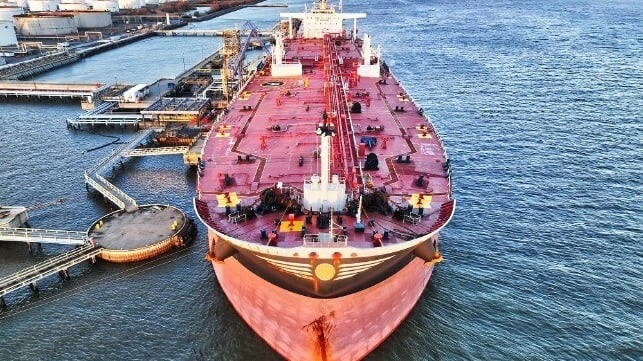
Our national and energy security are at risk because we lack a shipping fleet guaranteeing our energy freedom. The closure of the Strait of Hormuz has highlighted the critical role shipping plays in keeping the global economy operating and how a lack of ships can magnify that risk for countries.
The U.S. is at such a risk. It's time to correct this vulnerability.
The opinions expressed herein are the author's and not necessarily those of The Maritime Executive.

No comments:
Post a Comment