Researchers Want to Use AI and Robotics to Find Ship Defects in Outfitting
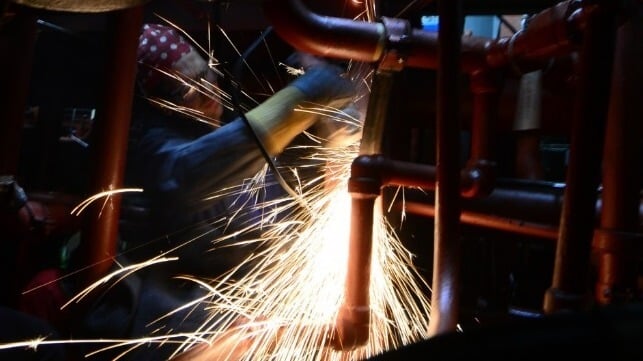
The outfitting process for newbuilds could benefit from a new University of Michigan project to develop autonomous robots and AI models that can help shipbuilders detect anomalies and fix them fast.
Shipbuilders across the globe have to build in strict adherence to design drawings and deliver the product on schedule and on budget. Though building the hull is often the easy part in shipbuilding, the complexity of the job becomes more obvious during outfitting of internal components like pipes, cables, electrical systems and other equipment. Due to time pressure and human error, faults can and do occur during construction, resulting in costly rework.
Researchers at the University of Michigan (U-M) want to solve this common problem by developing autonomous robots and AI models that are capable of helping shipyard workers spot a problem when a ship’s newly-built structure differs from design drawings, thus allowing workers to fix problems or adapt sooner - saving time and money.
In the project, the researchers from U-M and the Massachusetts Institute of Technology will collaborate to design and prototype AI and robot teammates that can track what was actually built inside the growing ship and compare it to a digital twin of the intended structure. The system will then create reports of mismatches that workers can use to make adjustments.
The researchers want to deploy robots that can roam the growing ship structure and collect LiDAR and camera data that will be fed to an AI model, along with human-made measurements. The AI model will then construct a digital model of the built structure to be compared with the intended design. With the digital model, the AI will look for deviations from the plan and predict problems that may arise based on how equipment has been installed.
Of importance is that when the model finds a problem, such as a pipe that no longer fits as expected or a build sequence that will likely be disrupted, the system will generate a list of potential solutions and the tradeoffs between them. With the information, the yard can verify problems and decide how to resolve them.
“We want to build a co-pilot system that uses AI and robotics to take some of the detective work off workers’ shoulders,” said Alan Papalia, the lead researcher. “The system should automatically map what’s installed, identify where reality is drifting from the design, and suggest workable alternatives when something needs to change.”
The University of Michigan-led project is being funded through a $6.2 million grant from the Japanese Ministry of Land, Infrastructure, Transport and Tourism. Overseen by the Monohakobi Technology Institute, an R&D Center within NYK Line, it builds on related research projects that were led by Japanese universities on automated welding and hull construction.

No comments:
Post a Comment