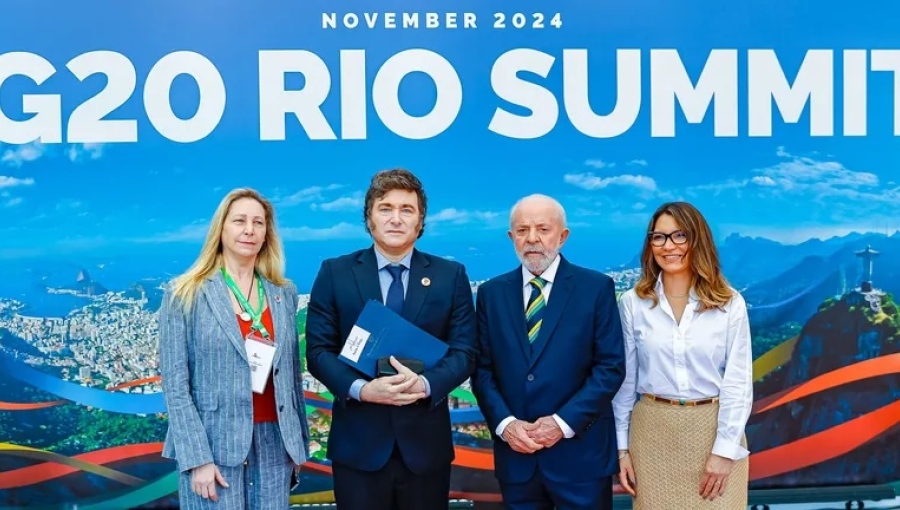
The 68th Mercosur Summit kicked off in Luque, Paraguay, on June 29 as the South American trade bloc strains to project external expansion and stem its own accelerating disintegration. While chancellors gathered at the Conmebol Convention Centre to greenlight an Economic Partnership Agreement (EPA) with Japan and iron out the details of a landmark European deal, Argentina's President Javier Milei was hosting a key rival to Brazil's Luiz Inácio Lula da Silva in Buenos Aires, then cancelled his own attendance at the summit to avoid the blowback.
The structural paradox of Mercosur was on full display: a bloc underpinning the world's largest free trade zone — a combined EU-Mercosur market covering more than 700mn people and close to a quarter of global GDP — attempting to showcase a unified commercial front while its two largest economies fight openly over the rules of the game itself.
Milei's calculated absence
In a snub that signals Buenos Aires's growing contempt for the multilateral constraints the bloc imposes, Milei pulled out of the summit at the eleventh hour. The official reason, a domestic cabinet reshuffle, with chief of staff Manuel Adorni's resignation and the imminent swearing-in of Diego Santilli, satisfied no one.
The real calculation was simpler and uglier. Hours before his planned departure, Milei had hosted Brazilian senator Flávio Bolsonaro — son of convicted former president Jair Bolsonaro and the far-right's leading candidate for Brazil's October presidential election — at the presidential residence in Olivos, then posted on social media that "the blue wave is coming to Brazil." Sitting opposite Lula in Asunción the following morning was never going to happen after that. The last time the two presidents shared a room was at the Mercosur summit in Foz de Iguazú in December. Lula himself skipped the January signing of the EU-Mercosur accord in Asunción after complaining the deal had taken too long for Brussels to finalise.
Foreign Minister Pablo Quirno, already on the ground in Paraguay for the chancellors' session, will represent Argentina at the leaders' table, a significant downgrade that shows how little Buenos Aires regards its Mercosur obligations when they become diplomatically inconvenient.
The personal friction is the symptom; the structural conflict is the disease. Brazil's diplomacy formally raised concerns at a March preparatory meeting over Argentina's bilateral tariff deal with the United States, which eliminated duties on more than 1,675 products and, in Brasilia's view, threatens the bloc's Common External Tariff. Argentina's subsequent formal application to join the Comprehensive and Progressive Agreement for Trans-Pacific Partnership (CPTPP) — a 12-nation framework including Japan, Canada, Australia and the United Kingdom — deepened the breach further. Quirno simultaneously demanded that London negotiate the Falkland Islands' sovereignty before the UN Decolonisation Committee. The spectacle of Argentina seeking a trade bloc with a country it is simultaneously challenging over territorial sovereignty has not gone unnoticed in Brasilia, and has been noted with visible displeasure at the Itamaraty.
Milei's broader ambition is equally disruptive: he aims to renegotiate Mercosur's architecture so each member can strike bilateral commercial deals independently, directly contradicting the model of joint external negotiation that defines the bloc's purpose.
The quota fight
The summit's most immediately contentious agenda item is the distribution of tariff-free export quotas under the EU-Mercosur free trade agreement, whose commercial pillar entered provisional force on May 1 following ratification across Mercosur's parliaments. The deal took more than 25 years to negotiate, and the question of who gets what from it is already tearing the bloc apart.
Paraguay's position is non-negotiable: a flat 25% split across all product categories, including sectors where Asunción is not yet a major producer. Without a prior allocation mechanism, Viceminister of Trade and Services Alberto Sborovsky warned plainly, the bloc would operate by "the law of the jungle": first come, first served. He was right on the money. Within weeks of ratification, Argentine exporters had exhausted Mercosur's preferential EU quotas for honey, eggs and rice. Argentina shipped its first natural honey consignment to European markets just one week after signing the accord.
Foreign Minister Rubén Ramírez put the cost in plain arithmetic at the chancellors' session on June 29. Some partners have proposed capping fresh Paraguayan beef exports to the EU at between 300 and 600 tonnes, against a total Mercosur quota for that category of more than 6,000 tonnes. Paraguay's existing export capacity already exceeds those proposed ceilings. An allocation at those levels is not market access: it is exclusion presented in diplomatic language.
Uruguay's vice-chancellor Valeria Csukasi acknowledged the obvious, noting that the quota debate had ceased to be technical. In fact, four countries with divergent commercial positions are each attempting to maximise their individual share of a fixed pool of benefits. Csukasi described the potential outcome of continued deadlock as "absolute failure," a statement that carries real weight when applied to the bloc's most important commercial achievement in a generation.
Looking east
Beneath the internal warfare, Mercosur is attempting to build outward. The summit is expected to formally announce the launch of EPA negotiations with Japan, a consumer market of more than 120mn people, following a bilateral meeting between Lula and Japanese Prime Minister Sanae Takaichi on the sidelines of the G7 summit in France. Uruguay's incoming pro-tempore presidency has also flagged plans to deepen Mercosur's existing trade accord with India and launch formal negotiations with Vietnam.
The Japan announcement is not purely a commercial strategy. Brazil's push for a Mercosur-Japan framework serves a second purpose: if the bloc can offer Japan as a collective prize, individual members lose the primary incentive to pursue CPTPP membership separately. Whether Buenos Aires will be deterred is a separate and increasingly doubtful matter.
The wider stage
Chile's newly inaugurated ultra-conservative President José Antonio Kast arrives in Luque on only his second international trip since taking office in March. Ecuador's Daniel Noboa is also present. Bolivia's President Rodrigo Paz makes his first international appearance since the social unrest of May, when unions and farmer groups demanded his resignation just seven months into his mandate. Bolivia has held full membership since 2024 but remains in a transitional period, as it slowly adapts its legal and tariff framework to the bloc's rules.
Venezuela's potential readmission in the wake of Nicolas Maduro's ouster hangs over the proceedings as the elephant in the room, despite not being on the official agenda. Brazil has shown openness to revisiting the suspension; Colombia (under the outgoing leftist administration of Gustavo Petro) has not opposed it; Argentina has vetoed it absolutely. Milei's government argues that Caracas remains in violation of the democratic clause of the Ushuaia Protocol and various normative commitments, a position Buenos Aires has retained even after Venezuelan earthquakes killed more than 1,500 people and prompted limited humanitarian coordination between the two governments. Venezuela was suspended indefinitely in August 2017 under the Ushuaia Protocol after Maduro installed a regime-controlled constituent assembly, and the bloc's current Venezuelan interlocutor remains interim president Delcy Rodríguez.
Paraguay closes its pro-tempore presidency with a major win, having hosted the EU-Mercosur signing ceremony in January and capped a long-stalled negotiation on its watch. The question it could not fully answer is whether a bloc this fractured can convert that historic deal into something that benefits all its members equitably, or whether the largest and fastest will simply take what they can reach first.

No comments:
Post a Comment