
Unchecked Billionaire Oligarchs

Not long after the second Trump administration took office, a new power center emerged in Washington under the banner of “government efficiency.” Through the Department of Government Efficiency, or DOGE, Elon Musk was handed extraordinary influence over federal agencies, and USAID became an early target, as legal challenges and reporting on DOGE’s efforts to control USAID’s funding streams make clear.
Inside USAID, I saw global health, humanitarian response, democracy and governance, and conflict prevention work abruptly stripped down or eliminated. Career colleagues with decades of experience were pushed out or sidelined, partners abroad were left with collapsing funding streams, and thousands of employees, including me, lost our jobs. The larger damage fell on communities that depended on those programs for disease control, humanitarian relief, peacebuilding and institutional survival. None of this followed a serious national debate. It reflected the preferences of a narrow set of actors who viewed expertise and accountability as obstacles, not safeguards.
Similar cuts, purges and “efficiency” drives hit other departments and agencies, from CDC and HHS to FEMA and State, quietly hollowing out capacity across the U.S. government, a pattern analyzed in overviews such as the Brookings Institution’s commentary on DOGE and reflected in broader discussions of oligarchic power. The machinery that once underpinned global health, disaster response, diplomacy and development has been hobbled far more than most Americans realize. This is what oligarchic power looks like up close: a small, insulated class using its wealth and access to reshape the institutions everyone else depends on, with minimal debate and even less accountability.
Despite the scale of the damage, there has been no serious attempt to hold Musk, DOGE or their accomplices to account. A few depositions and cursory hearings have taken place, and watchdogs have filed lawsuits and opened investigations, but one year after USAID’s dismantling there is still no real reckoning proportionate to the harm, no clear plan to repair what was broken, and no consequences for those who broke it, as seen in litigation and oversight efforts.
The same fusion of private interest and public power is visible in foreign policy. Instead of seasoned diplomats or nuclear experts, Trump has leaned on Jared Kushner and fellow real estate developer Steve Witkoff, businessmen with no prior government experience, to lead high stakes talks with Iran, as reported by major national outlets. Their financial entanglements in the region, including investments tied to sovereign wealth funds and Trump aligned ventures, create glaring conflicts of interest at the very moment when disinterested judgment is most needed. Diplomats and analysts have warned that Kushner and Witkoff lack the technical expertise and diplomatic grounding for serious nuclear negotiations, yet they have been entrusted with decisions that could affect global security for decades.
Yet while this quiet dismantling and self enrichment proceeds, Americans are bombarded with warnings about a different supposed danger.
As several democratic socialists swept primary races in New York City and Washington, D.C., including congressional contests and the mayoral race, national attention snapped to their victories and familiar voices warned that America was sliding toward socialism and eventually communism. President Donald Trump seized on the results to brand Democrats as “hardcore, godless communists” and to describe communism as “the most serious threat to our country since its existence” in a June 2026 speech to the Faith & Freedom Coalition in Washington, D.C. In the same speech, he also warned that “communists, Marxists, socialists and globalists” were taking over the Democratic Party, framing recent democratic socialist victories as proof that the party was embracing a “communist agenda.”
Republicans are not alone in using “socialism” as a political warning label. After democratic socialists won key primaries, a group of moderate House Democrats led by Rep. Tom Suozzi signed a “Promise to America” letter declaring, “We are capitalist, not socialist,” explicitly distancing themselves from their party’s left wing. More broadly, prominent Democrats often rush to assure voters that they oppose socialism whenever rent stabilization, universal childcare or stronger public services are floated, reinforcing the idea that such policies are inherently suspect rather than ordinary choices in much of the world. In practice, “socialism” has become the label slapped on any effort to strengthen public services, even when those services are the very supports most Americans need to survive and participate fully in society.
That panic serves the status quo well. Americans are told to fear socialism and communism while the social safety net they actually depend on, from humanitarian aid and public health to Medicaid, Medicare and SNAP, is chipped away under soothing slogans like “efficiency” and “fiscal responsibility.” Independent policy analyses show how recent federal budgets cut hundreds of billions of dollars from Medicaid and food assistance while preserving tax advantages for corporations and high income households. These are not neutral policy choices. They are part of a pattern in which those at the top write rules that enrich themselves and their families while shifting risk and austerity onto everyone else. The loudest opponents of “socialism” are not people wondering how they will pay for groceries or a doctor’s visit, but politicians insulated by secure salaries, taxpayer funded health care, generous pensions and often sizable investment portfolios, even as they vote to strip away what little protection their constituents have left.
Many of the policies being proposed by New York Mayor Zohran Mamdani and other democratic socialist candidates, and reflexively branded as “socialism” in the United States, are treated in other advanced democracies as basic public policy. Rent stabilization and strong tenant protections are common in cities like Berlin and Vienna, and rent regulation exists in places such as Paris and Stockholm, where governments have long tried to prevent speculative spikes and displacement, as outlined in overviews like Fieldfisher’s guide to rent controls in Europe. Universal or heavily subsidized childcare is treated as basic infrastructure in much of Europe, Canada and the Nordic states, making it possible for parents to work and for children to thrive, as shown in comparative analyses of early childhood policy and successful childcare models. When American politicians attack these kinds of measures as “socialist,” they are not defending some neutral center; they are defending a uniquely harsh status quo in which the basic supports that let people participate fully in society are treated as suspicious, while the privileges and protections enjoyed by the wealthiest and most powerful are treated as normal.
Most Americans do not lie awake at night worrying that democratic socialists will turn the United States into a communist state. They lie awake wondering how they are going to make ends meet, feed their families and pay their bills. A recent survey by the National Endowment for Financial Education and Verasight found that 88 percent of U.S. adults felt some form of financial stress as they entered 2026, and more than three in four said they had experienced a financial setback the previous year. Another study from Allianz, summarized in coverage of the company’s retirement survey, reports that roughly two in three Americans say they worry more about running out of money than about death. That anxiety is not an accident. It is the predictable outcome of a system that strips away protections and shifts risk onto everyone except the people who profit from it, hidden behind dollar signs and net worths.
The real threat to American democracy was never a democratic socialist winning a city primary. It is a system in which a handful of billionaires can reshape public institutions overnight, enrich themselves through the levers of government, and leave the rest of us to argue about labels while we live with the damage.
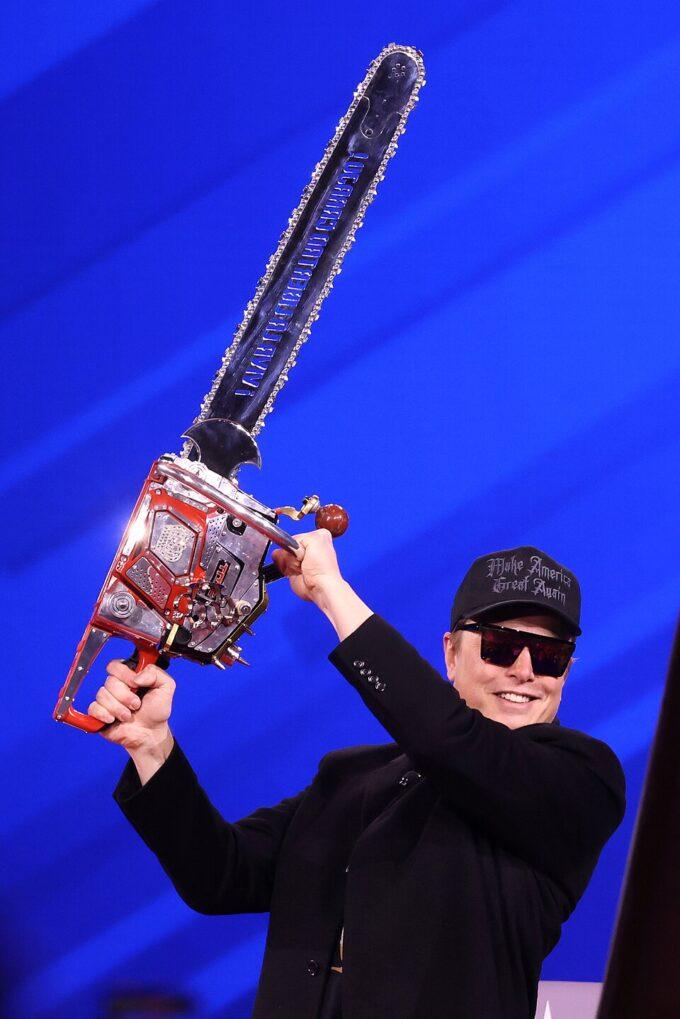
Elon Musk wielding a chainsaw at the Conservative Political Action Conference (CPAC) in 2025. Photo: Gage Skidmore. CC BY-SA 2.0
The red emergency light is flashing on America’s democracy dashboard, like a damaged aircraft teetering toward a mountain. Elon Musk becoming the planet’s first trillionaire should make us tremble for the future of self-governing republics. It’s as if we’re bringing back modern pharaohs to dominate our societies.
Musk’s SpaceX company recently went public with a (probably inflated) market capitalization of $2 trillion. SpaceX’s IPO increased Musk’s net worth by an estimated $188 billion, and the stock’s first-day surge subsequently pushed his fortune to roughly $1.1 trillion, according to Forbes.
The concern here isn’t with wealth per se. It’s the tremendous power of concentrated wealth to distort markets, politics, and society. When you have Musk’s level of wealth, you’re no longer just buying another mansion or private jet (of which he already has several). You’re buying a media outlet, a senator, and maybe, in the case of Musk, elevating a president.
Musk has no inhibitions about deploying the power of his considerable wealth. He bought Twitter, one of the public squares of our time, and transformed it into X, a partisan and disinformation platform rife with hate speech and extremism.
In the 2024 election cycle, he donated $291 million to President Trump and Republican candidates, according to Open Secrets. As Michael Mechanic wrote in Mother Jones, “Musk expended 0.1 percent of his wealth in the process and got far more in return.” Mechanic notes “The Trump administration promptly shelved dozens of investigations into Musk’s companies.”
Musk was rewarded with a rogue government agency — the so-called Department of Government Efficiency (DOGE), named for a crypto meme coin Musk invested in — to advance a self-interested data grab and chainsawing away at government capacity. Public Citizen found that 70 percent of the agencies that were targeted by DOGE had conflicts of interest for Musk’s businesses. For example, Musk directed DOGE to dismantle the Consumer Financial Protection Bureau, which would have overseen X’s move to become a payment processor.
More dire still, DOGE cuts to USAID and other humanitarian aid programs have contributed to an estimated 750,000 lost lives. The projected deaths from these cuts run into the millions.
Musk was further rewarded with lucrative government contracts for SpaceX, Starlink, and other Musk-companies. In early 2025, The New York Times reported on a boost in multi-billion-dollar contracts for Musk’s companies as the Trump administration took power.
That was Musk as a “mere” centi-billionaire. What other power might Musk be able to wield as the world’s first trillionaire?
But it’s not just Musk. America’s 16 centi-billionaires (including Musk) have a combined wealth of $4 trillion. And the 977 billionaires on the Forbes U.S. wealth list now own a combined $9.24 trillion, according to analysis by Americans for Tax Fairness.
This isn’t a partisan concern. Whether it’s liberals like George Soros and Tom Steyer or right-wingers like Musk and Peter Thiel, this concentration of power and influence should trigger the flashing red light. It’s never a good thing for anyone to have the power of modern-day pharaohs. Musk was the top political donor in 2024, but five other billionaire households gave over $100 million to candidates.
Billionaires — and soon trillionaires as well — are spending hundreds of millions of dollars to influence our elections while working Americans struggle to afford food, housing, and health care. It’s clearer than ever that those two facts are connected. We need to get serious about curbing this billionaire influence and supporting regular people — starting with a wealth tax.
Oxfam observes Musk could give $100 to every person on earth and remain one of the 10 richest people on earth. A 10 percent wealth tax on Musk’s fortune alone, they estimate, could end global extreme poverty and lift 800 million people above the extreme poverty line. Imagine the revenue and investment possibilities of a global wealth tax on all billionaires.
The planet’s first trillionaire is not a sign of economic health. It’s an indicator of extreme inequality and the dangers of concentrated power.
Chuck Collins directs the Program on Inequality and the Common Good at the Institute for Policy Studies, where he also co-edits Inequality.org.


No comments:
Post a Comment