Showing posts sorted by date for query FRACKING GEOTHERMAL. Sort by relevance Show all posts

Saturday, June 27, 2026

Can geothermal power Central Europe’s energy transition?

FRACKING BY ANY OTHER NAME

Can geothermal power Central Europe’s energy transition?
/ Image by Arcturian from PixabayFacebookTwitter


By Clare Nuttall in Glasgow June 26, 2026

Beneath the Central and Southeast Europe region lies one of Europe’s most underexploited energy resources. Geothermal energy, long associated with Iceland’s volcanic landscapes, is attracting fresh attention as countries seek cleaner, more secure and less import-dependent sources of energy. The appeal is especially strong in a region where the 2022 gas crisis exposed the strategic vulnerability created by dependence on imported fossil fuels.

Unlike solar or wind, geothermal offers something energy planners prize: continuous, weather-independent baseload energy. But in Central Europe, geothermal’s most important role may not be electricity generation, but heating.

The region possesses two advantages. The first is geological; much of Central and Southeast Europe lies above the Pannonian Basin, a geothermally promising sedimentary basin stretching across countries including Croatia, Hungary, Romania and Serbia. The second relates to existing infrastructure as many cities retain large district heating networks built during the socialist era, creating ready-made systems into which geothermal heat can be fed.

“There’s a lot of potential because there’s been so little geothermal put in place so far,” says Philip Michael Gosney, chief commercial officer at Innargi, a Danish developer active in Poland. “I would expect strong incremental growth as markets mature, and people become more confident in the technology.”

Geothermal remains one of the most complex renewable energy technologies to deploy. Unlike solar or wind projects, whose resource can be measured relatively accurately before construction, geothermal developers must spend heavily on drilling before knowing whether the underground reservoir will perform as expected. That geological uncertainty explains why, despite vast theoretical potential, the sector remains underdeveloped across much of the region.

Central Europe’s new energy map 

Both the promise and the limitations of geothermal are perhaps best understood by looking at the projects now reshaping Central Europe’s energy map.

In Szeged, geothermal is already part of large-scale urban infrastructure. The Hungarian city has transformed much of its district heating system to run on geothermal energy, reducing gas use while cutting emissions.

Szeged vice mayor Sándor Nagy says the significance extends beyond climate implications. “Obtaining the heat source from beneath our feet instead of importing it from far away lands is a sure way of increasing security of supply, decreasing emissions and generally cutting costs,” he says.

Szeged’s geothermal overhaul was financed through a combination of EU structural funding and private investment. According to Nagy, neither the municipality nor the district heating company could have financed the transition alone.

“EU sources for green transitions are widely available and private investment into a public service in monopoly position is a rather safe bet for a steady return,” he says.

The city’s experience offers an example for the region. Large geothermal systems are capital intensive to build, but operating costs are highly predictable once infrastructure is in place because there is no fuel to purchase. Nagy says the system can operate without municipal subsidy, though Hungary’s regulated residential heating tariffs create market distortions.

“Once built the infrastructure requires no municipal subsidies at all,” he says. “It’s financially viable from end-user payments.”

Szeged is often portrayed as a special case, but Nagy cautions against overstating its uniqueness. “Europe boasts close to 300 large-scale geothermal district heating plants similar to ours, so the word ‘anomaly’ is probably an exaggeration.”

Real potential 

Still, geothermal success depends heavily on local conditions. “There is no off-the-shelf solution but I believe that the potential to switch a fossil fuel based heating system to some form of renewable is very much real for most municipalities across Europe,” Nagy says. He adds: “A detailed look at a location’s geological features, energy market, national regulations, existing infrastructure is certainly needed.”

The most immediate opportunity lies in heating rather than electricity generation. In practical terms, this comes down to temperature. Producing heat requires much lower underground temperatures than generating electricity. As Gosney points out: “We don’t heat houses to 200 degrees.”

Because of this, heating projects are scaling faster than geothermal power generation across Central Europe. Innargi is developing two large public heating projects in Łódź and Poznań with utility partner Veolia. Once completed, the projects could supply up to 15% and 20% respectively of each city’s district heating demand.

The decision to introduce geothermal heating in those two cities was based on a combination of geography and demand.

“Poland has a large area in the Polish trough which is good for geothermal heating,” says Gosney. “The subsurface temperatures are pretty good if you want to use it for heat.”

But geology alone is not enough. Heat must be consumed close to where it is produced. “We’re always looking for where you match the most subsurface potential to the most district heating,” he says. “For our business we need the two to geographically match so there’s a customer to off-take the heat when it’s produced.”

That existing demand infrastructure gives Central and Eastern Europe a major advantage over countries such as the UK, where district heating is far less developed. “In the UK there might be the subsurface there, but if there’s no one to take the heat there’s no customer for it,” according to Gosney. 

Investors eye Romania 

Romania offers another example of geothermal’s expanding commercial relevance. Historically, geothermal in Romania was associated primarily with thermal spas and balneological tourism. Today, developers increasingly view it as industrial infrastructure.

Green Tech International controls one of Europe’s largest geothermal portfolios, with 83 deep wells and around 300 MW of installed thermal capacity. Its operations are centred in Romania’s Călimănești-Căciulata area of Romania, where it supplies geothermal energy to local businesses, tourism facilities and heating systems.
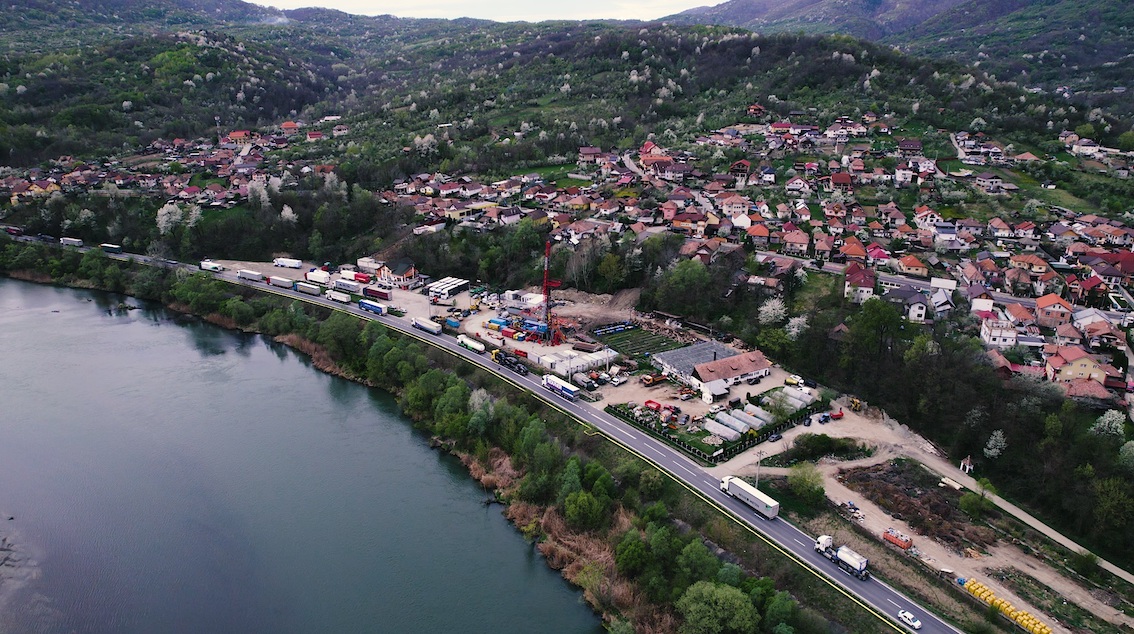
Călimănești, Romania, where Green Tech's operations are centered. Source: Green Tech. 

“Our strategy is not simply to sell geothermal energy,” says Dragoș Gavriluță, chief operating officer of Green Tech. “Instead, we focus on sectors where heating or cooling represents a significant operating cost and where access to reliable, low-cost thermal energy creates a sustainable competitive advantage.”

That strategy targets sectors ranging from district heating and greenhouse agriculture to a newer opportunity: AI-era data centres, where cooling costs are becoming increasingly important.

Green Tech’s planned geothermal district heating project in Bucharest illustrates the scale developers now envision. The project, valued at around €200mn, could generate more than 595,000 MWh of clean thermal energy annually while cutting carbon emissions by roughly 127,000 tonnes per year.

“Romania has some of the strongest geothermal resources in Europe and is generally considered to be among the top five EU countries in terms of geothermal potential,” says Gavriluță. “Yet utilisation remains relatively limited.”

Electric frontier 

If heating is geothermal’s near-term growth story, electricity generation remains its more ambitious frontier.

That is evident in Croatia, where developers are attempting to build commercial geothermal power plants.

ENNA Geo is developing two projects — Zagocha near Slatina and Babina Greda — that could help establish Croatia’s geothermal power sector.

According to ENNA Geo director Ivana Meašić, Croatia’s resource base is substantial. “Estimates indicate a total potential capacity of 1,000 MW for geothermal power plants. This represents a generation potential approximately three times greater than Croatia’s share in the Krško nuclear power plant, which covers 16 per cent of electricity consumption in Croatia,” she says. “ Therefore, the potential is enormous, although we are still far from achieving it, as Croatia currently does not have a single geothermal power plant producing electricity.”

 

ENNA Geo director Ivana Meašić. Source: ENNA Geo. 

The Zagocha project offers evidence of that promise. Drilling has reached 4,582 metres, making it the deepest geothermal well in Croatia. Tests confirmed geothermal water at 212°C — hot enough for electricity generation.

Once operational, the plant could generate more than 130,000 MWh annually, enough to power over 42,000 households.

But Croatia also illustrates geothermal’s core challenge: risk. “Geothermal projects always involve both geological risk and technical risk associated with well construction,” says Meašić.

“The cost of a single well averages between €10mn and €15mn,” she adds, while a power plant usually requires at least four wells.
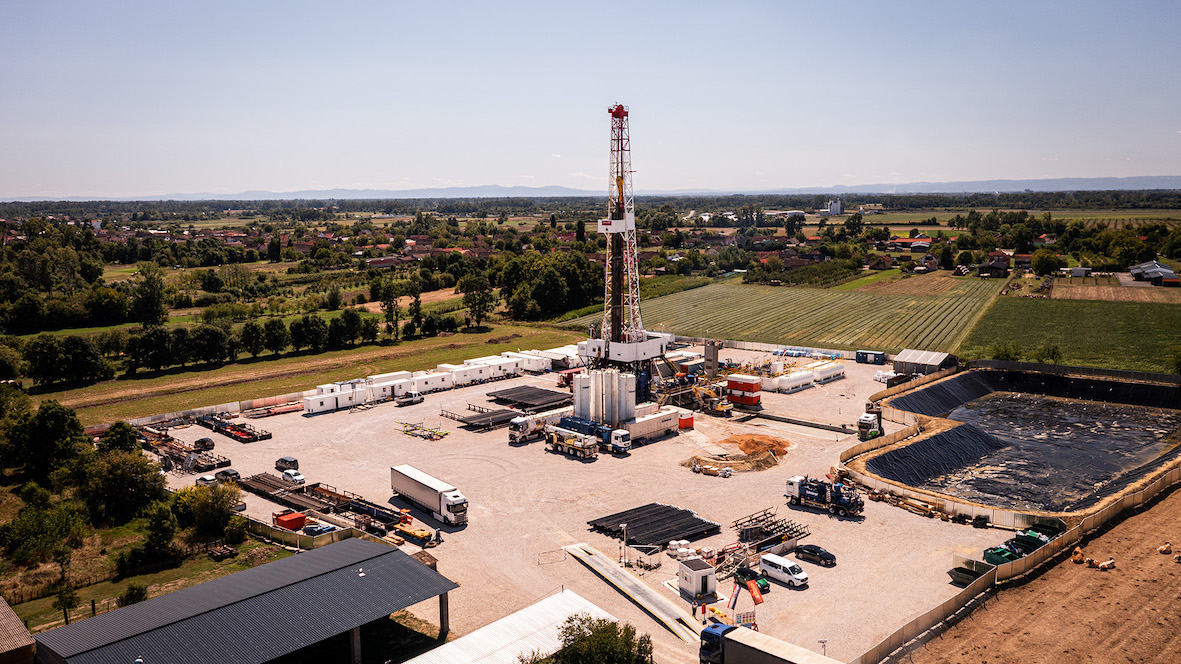
 

ENNA Geo's Babina Greda project. Source: ENNA Geo. 

Risks and rewards

Because exploration risk is so high, bank financing is often unavailable in the early stages. “One of the specific challenges of geothermal energy is that, due to geological risks, it is impossible to attract bank financing during the exploration phase.”

This financing problem helps explain why geothermal electricity has developed far more slowly than other renewables.

Slovenia already uses geothermal energy, but overwhelmingly for heat. According to Mojca Božič, project manager at Dravske elektrarne Maribor, d. o. o., total geothermal energy utilisation in Slovenia reached 2,275 TJ in 2024, with shallow geothermal heat pumps accounting for roughly 74 per cent. Deep geothermal use remains modest, and electricity generation is still experimental.

A pilot power plant installed by the company at the abandoned Pg-8 gas well near Lendava tested an innovative closed-loop geothermal gravity heat pipe system using ammonia as a working fluid.

“The concept of a closed-loop system based on a geothermal gravity heat pipe is technically functional,” Božič says. However, the reservoir itself disappointed. “The available thermal power of the well is lower than expected and does not allow stable continuous operation.”
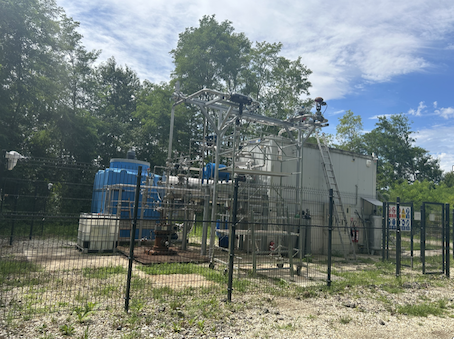
 

The pilot geothermal power plant in Lendava in Slovenia. Source: DEM. 

That distinction captures geothermal’s peculiar difficulty: the surface engineering may work perfectly while the underground resource still fails commercially.

Lithuania offers perhaps the clearest cautionary tale. According to Artūras Razbadauskas, rector of Klaipeda University and a representative of the Lithuanian Geothermal Association, western Lithuania possesses “the highest geothermal potential in the entire east European platform.” He estimates deep geothermal potential for heating and power at more than 20 GW. Yet the country’s geothermal contribution to its energy balance remains negligible.

“Theoretical capacity is immense,” Razbadauskas says, “but past operational failures and a lack of political and business backing have kept this resource almost entirely untapped.”

Built in 2000, the Klaipėda geothermal demonstration plant proved the underlying resource existed. But operations were plagued by reinjection problems, mineral scaling and poor economics. When biomass and waste-based alternatives became cheaper, the project could no longer remain viable.

This raises the central question facing geothermal in Central Europe: if the resource is so promising, why has deployment been so slow? Part of the answer lies in capital intensity. Another concerns policy. 

Meašić argues that subsidy frameworks remain essential, especially for geothermal electricity projects. Countries such as Germany and Italy provide long-term support mechanisms that reduce investor risk.

Without such frameworks, even promising projects can stall. “Today, it is particularly important to have access to a clean and reliable source of energy,” she says. “There is no need to import fuel, as geothermal water lies beneath our feet.”

On top of this, she says, “What should also be emphasised is that geothermal energy is a European “product”. The first geothermal power plant was built in Italy and, interestingly, it is still operating after more than 100 years. … Today, more than ever, we recognise that clean, secure and import-independent energy is essential to Europe’s economic resilience and security.” 

The technology will not replace all other renewables. Nor will every city prove geologically suitable. Geothermal is expensive, slow to develop and highly site-specific. However, it offers something rare in the energy transition: constant, local, low-carbon heat. For a region trying to reduce emissions while strengthening energy sovereignty, that combination is increasingly attractive.
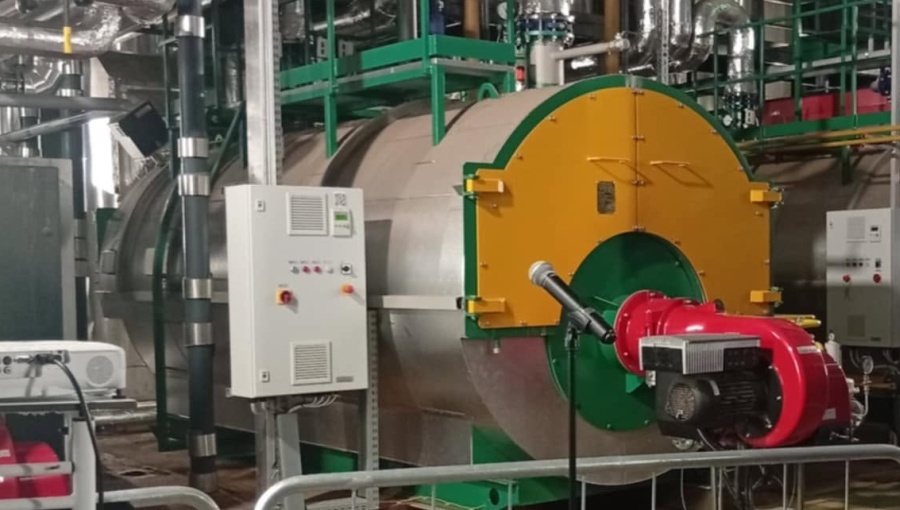
The geothermal revolution beneath the streets of Szeged

The geothermal revolution beneath the streets of Szeged
Nine geothermal systems in Szeged now feed into a vast network of heating plants, substations and underground pipelines. / Szegedi Távfűtő Kft. via FacebookFacebook
By IntelliNews June 26, 2026

On winter days in Szeged, warmth rises quietly through radiators in thousands of Soviet-era apartment blocks. Increasingly, that warmth is no longer generated by imported natural gas, it comes from deep beneath the city itself. In a continent still grappling with energy insecurity, volatile gas prices and the challenge of decarbonisation, Szeged, a university city in southern Hungary near the Serbian and Romanian borders, has become a laboratory for one of Europe’s most ambitious urban geothermal transitions.

Over the past eight years, the city has transformed what was once a gas-dependent district heating system into the largest geothermal district heating overhaul in Europe. Today, geothermal energy supplies heat to roughly 95% of the city’s 27,000 apartments connected to district heating, as well as hundreds of public buildings. Nine geothermal systems now feed into a vast network of heating plants, substations and underground pipelines.

Sándor Nagy, the city’s vice mayor, tells IntelliNews the benefits are about energy security as much as sustainability. “The fact that obtaining the heat source from beneath our feet instead of importing it from far away lands is a sure way of increasing security of supply, decreasing emissions and generally cutting costs,” he says.

That argument resonates strongly in Central Europe, where dependence on imported fossil fuels remains politically sensitive. Szeged’s district heating system once relied entirely on imported natural gas, making the municipally owned utility one of the city’s largest carbon emitters. The geothermal transition has already cut annual gas consumption by millions of cubic metres and sharply reduced carbon emissions, improving local air quality while insulating the city from some fossil-fuel volatility.

The idea itself is not new. Southern Hungary has long been known for its favourable hydrogeology. The Earth’s crust is thinner here, meaning heat rises closer to the surface. Thermal water has historically been used in spas, bathing and agriculture. But scaling geothermal energy to heat a dense urban district heating system required a far more sophisticated approach.

Under the Szeged project city, wells were drilled reaching depths of approximately 1,700 to 2,000 metres, extracting thermal water at temperatures around 90°C. The hot fluid is piped to heating plants, where heat exchangers transfer thermal energy into the district heating network. After its heat is extracted, it is reinjected underground to be reheated naturally, a closed-loop model designed for long-term sustainability.

“So far all geothermal energy systems in Szeged use reinjection,” Nagy says. “The extracted water gets pumped back to the reservoir after energy utilisation. There the water gets reheated by the Earth and we can extract it again and again.”

He says constant monitoring of water pressure, contamination and reservoir conditions ensures the system remains sustainable.

Yet even successful green transitions raise difficult questions, including whether a model like Szeged’s can survive without subsidies. 

“The geothermal overhaul of the district heating system in Szeged was financed from EU funding and private investment,” Nagy says. “Neither the district heating company nor the municipality had the financial means to carry out such a robust project.”

In Szeged’s case, European funding, including support from the European Regional Development Fund, was essential. Private capital also played a critical role, attracted by the predictability of district heating revenues in a monopoly public utility, and therefore, as Nagy says, “a rather safe bet for a steady return”.

Now it has entered operation, however, the system largely pays for itself. “Once built the infrastructure requires no municipal subsidies at all, it’s financially viable from end-user payments,” he says. 

However, residential heating tariffs are heavily controlled by the state, limiting how pricing signals can reward cleaner energy. “Energy prices are government regulated in Hungary and are kept so low for private users … that not even geothermal can match that level,” Nagy says.

Szeged’s experience also raises the question of whether the model is replicable. Nagy argues that the city is not unique in having positive conditions for geothermal. “Szeged does have good geothermal potential and the fact that there already had been a district heating system in place certainly helped,” he says.

However, he added, “Europe boasts close to 300 large-scale geothermal district heating plants similar to ours so the word ‘anomaly’ is probably an exaggeration.”

Replication, he argues, depends less on copying a template than on matching geology, regulation and urban demand. “A detailed look at a location’s geological features, energy market, national regulations, existing infrastructure is certainly needed to confirm if a project is viable. There is no off-the-shelf solution,” he says. 

“I believe that the potential to switch a fossil fuel based heating system to some form of renewable is very much real for most municipalities across Europe.”

Engineering, however, is only half the challenge. Geothermal projects can be messy, noisy and deeply disruptive during construction. In Szeged, drilling rigs operated around the clock while kilometres of underground pipes were installed beneath residential neighbourhoods.

“The project was well received at the urban level,” Nagy says, “but indeed, we had a number of local, neighbourhood level complaints.” Residents complained about noise, traffic and construction disruption. “It required constant negotiations with the drilling company to mitigate the effects.”  

That proved manageable because the disruption was temporary and the environmental gains were tangible. “The public understood the positive environmental effect of the project,” he says, and points out that even without immediate reductions in heating bills, public support remained strong. “Here, where the only promise we could make was of better air quality, the development resonated with the people and probably even won votes.”

Szeged has attracted major foreign manufacturers, including Chinese electric vehicle giant BYD, whose planned production facilities could significantly increase local energy demand.

“We as a ‘green city’ obviously encourage sustainable developments, and we are aware that some big industrial projects are planning to use geothermal energy too,” Nagy says. “If the new players reinject, and, more generally, take care of our water base as we do … then we do not expect any conflict with them.”

For investors, however, geology and engineering are only part of the equation. Sovereign risk remains a concern across Central and Eastern Europe, where regulatory shifts can alter infrastructure economics overnight.

Asked what assurances municipalities can offer foreign investors, Nagy is pragmatic. “This has to vary from country to country, depending on the functions and the budget of municipalities.”

Local governments cannot always guarantee long-term stability themselves, he adds, saying: “It may just mean that investors should try and get guarantees from the central government.”

Yet Nagy believes the opportunity is substantial. “The district heating system in Szeged serves 28,000 apartments in a monopoly position,” he says. “There are lots of smaller towns and many larger cities in Central Europe where investments in the energy sector are very much sought after.”

With limited public capital available, foreign investment could prove decisive. “Foreign investors … may see an opportunity that justifies the risks.”

Szeged’s geothermal transition does not offer a universal blueprint. Its success rests on unusually favourable geology, inherited district heating infrastructure and substantial external financing. Yet its significance lies precisely in showing that decarbonisation is not always about futuristic technologies or distant targets. Sometimes it means redesigning the hidden systems beneath existing cities. As Europe searches for ways to strengthen energy sovereignty while cutting emissions, Szeged suggests one answer may already be underfoot.


Thursday, May 14, 2026

Groundbreaking: ‘Controlled’ quakes triggered under Swiss Alps


ByAFP
May 11, 2026


ETH Zurich professor of geology Domenico Giardini inside the BedrettoLab - Copyright AFP Ennio LEANZA


Nina LARSON

Researchers have made the ground shake in southern Switzerland, triggering thousands of tiny earthquakes in a monitored setting, as they seek to discover seismicity insights that could reduce risks.

“It was a success!” said Domenico Giardini, one of the lead researchers on the project, as he inspected a crack in the rock wall lining a narrow tunnel far below the Swiss Alps.

Wearing a fluorescent orange jumpsuit and helmet, the geology professor at the Federal Institute of Technology in Zurich (ETH Zurich) switched on his headlight to get a better look.

“We had seismicity,” he said excitedly, explaining that the goal was “to understand what happens at depth when the Earth moves”.

Giardini was standing in the BedrettoLab carved out in the middle of a narrow 5.2-kilometre (3.2-mile) ventilation tunnel leading to the Furka railway tunnel.

Reached by specially adapted electric vehicles that slide through the dank darkness along concrete slabs laid over a muddy dirt floor, the deep underground laboratory is the ideal location to create and study earthquakes, Giardini said.

“It is perfect, because we have a kilometre and a half of mountain on top of us… and we can look very close at the faults, how they move, when they move, and we can make them move ourselves,” he told AFP.

– ‘Earthquake machine’ –

Typically, researchers seeking to study earthquakes place sensors near known faults and wait.

In the BedrettoLab, by contrast, researchers filled a pre-selected fault with sensors and other instruments, and then sought to trigger movement.

For the experiment, dubbed Fault Activation and Earthquake Rupture (FEAR-2), dozens of scientists from across Europe spent four days in late April injecting 750 cubic metres of water into boreholes drilled into the tunnel’s rock walls, aiming to provoke a magnitude-1 earthquake.

“We don’t create a new fault… We only facilitate that it moves,” Giardini said.

During the experiment, no people were in the tunnel for safety reasons, with everything managed remotely from the ETH Zurich lab in northern Switzerland.

When AFP visited the Zurich lab a day into the experiment, scientists were excitedly discussing the first signs of seismicity on the monitors.

“This is kind of pushing the frontier of science,” said Ryan Schultz, a seismologist specialised in man-made earthquakes.

The excitement was interrupted by a sudden power cut in the tunnel that sent the scientists in Zurich scrambling for answers.

“We have our earthquake machine… Now we have to play with the parameters,” said Frederic Massin, a French seismologist and technical expert, as he studied his screen for clues to what had caused the outage.

The glitch was short-lived and pumping soon resumed.

– 8,000 earthquakes –

In the end, some 8,000 small seismic events were induced along the targeted fault, but also, surprisingly, along other faults running perpendicular to the main one, sparking local magnitudes ranging from -5 to -0.14.

“We did not reach the target magnitude that we had set, but we reached just below,” Giardini said.

That alone was a huge success, he insisted, pointing out that although there had been previous efforts to create tiny earthquakes in lab settings, it was “never at this scale and never this deep”.

“It’s simply never been tried.”

The findings, he said, would help determine the best injection angles for reaching magnitude 1 at the BedrettoLab when researchers next give it a try in June.

Magnitudes on the Richter scale are measured logarithmically, with each whole number increase representing ten times more in measured amplitude.

Magnitudes below zero are still palpable. Anyone standing near the fault during the largest triggered quakes, at -0.14, would have felt an acceleration of “1.5 G”, or 1.5 times the standard acceleration due to gravity, Giardini said.

They would have flown “in the air with a big jump”, he explained.

– ‘Safe’ –

Nothing was felt at the surface, and Giardini stressed that by lubricating an existing fault, the team was adding only “about one percent of what is the natural risk”.

The experiment, he insisted, was completely “safe”.

Giardini explained the importance of the research, stressing: “If we master how to produce quakes of a certain size, then we know how not to produce them.”

This was particularly important in connection with underground activities like excavation and extraction, he said, pointing for instance to quakes triggered by disposal of wastewater from the fracking industry in Texas.

He also highlighted South Korea’s 5.4-magnitude Pohang quake in November 2017, triggered by water injections at the country’s first experimental geothermal power plant.

“Without realising it, they started injecting and initiating induced seismicity on a large fault, (creating) a very serious quake,” Giardini pointed out.

“We’re not saying we should not go underground,” he insisted.

“We need to learn how to do it more safely.”

Monday, April 27, 2026

FRACKING BY ANY OTHER NAME

Quaise moves closer to building world’s first superhot geothermal power plant


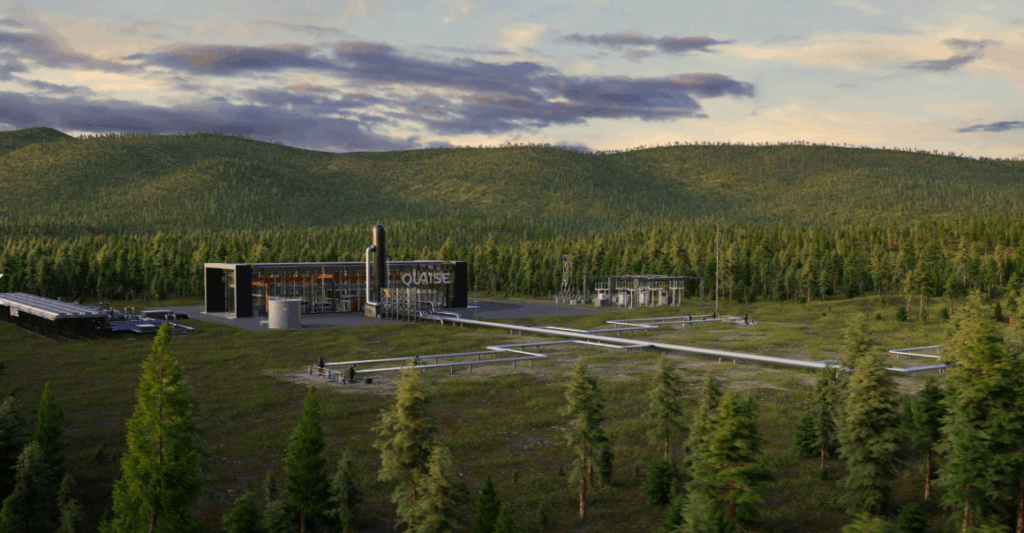
Image: Quaise Energy

Quaise Energy, a startup out of MIT, said it is on track to build the world’s first power plant using superhot geothermal energy: that obtained by tapping into rock with temperatures greater than 300°C (572°F).

The first phase of the company’s complex, Project Obsidian, is currently under construction in Oregon.

A study presented at the 2026 Stanford Geothermal Workshop has validated the company’s belief that its first plant could produce at least 50 megawatts (MW) of clean, renewable electricity, Quaise said. That energy, produced from only a handful of wells, would be available 24/7, it added.

Subsequent expansions at the same location are expected to bring even more energy, and the second phase targets 250 MW.

“Our goal is to build out to a gigawatt in the area,” Quaise CEO Carlos Araque said in a news release.

“We believe our breakthrough drilling technology could ultimately make gigawatt-scale geothermal plants viable across the globe, including in regions where geothermal has never been possible before,” Araque said.

Because Project Obsidian is the first of its kind, there are many unknowns, such as the geochemistry of the rock it will tap into. Daniel Dichter, a senior mechanical engineer at Quaise, is first author of a paper exploring these unknowns that he presented at Stanford earlier this year.

“Most of our analysis, which is based on several models, was dedicated to trying to understand some of these uncertainties,” Dichter said.

Quaise also supports research at Oregon State University aimed at doing the same thing by recreating extreme underground conditions in the lab.

“This analysis validates our long-held hypothesis that higher subsurface temperatures entail substantial improvements in power production,” Dichter said. “It shows us that we can get to a capacity of 50 megawatts of power with this system.”

“If these first wells work the way we think they will, they will be on par with exceptionally productive oil and gas wells in terms of equivalent power output,” he said.

The confirmation well is expected to be in operation later this year, and the first phase of the complex is expected to be operational by 2030.

Thursday, January 01, 2026

The Renewable Energy That Trump Has Not Targeted

BECAUSE IT'S FRACKING BY ANY OTHER NAME

  • Geothermal power has avoided political pushback and is receiving federal support under the Trump administration.

  • Enhanced geothermal systems and fast-track permitting are accelerating project development nationwide.

  • Cities, universities, and utilities are adopting geothermal networks to decarbonise heating and provide reliable clean energy.

Geothermal is one of the few renewable energy sectors that President Donald Trump has not tried to quash in favour of fossil fuels in the United States. There is significant promise for the future of geothermal power in the United States, even though most projects are still in the nascent stage of development. Both public and private funding are expected to bolster the sector in the coming years. 

According to the European Commission, geothermal energy is a renewable energy source harnessed from the thermal energy stored in rocks and fluids deep within the Earth’s crust. Drilled wells connect the fluid to the earth’s surface, allowing it to be used for a range of purposes such as to generate electricity or provide direct heat for district heating, water heating or industrial processes. 

Countries with easily accessible geothermal reserves have been harvesting power from these sources for centuries. Meanwhile, countries with harder-to-reach reserves can now use enhanced geothermal systems (EGS) to access vast, clean power sources. EGS is based on technology used in fracking operations, which emerged over the last century. Unlike solar and wind that depend on the weather, geothermal power can run at all hours of the day, making it a highly attractive renewable energy source.

In May, the U.S. Department of the Interior announced plans to implement emergency permitting procedures to accelerate assessments of geothermal energy projects across the country, in line with President Trump’s energy agenda. Projects selected for fast-tracking included three in Nevada, operated by Ormat, which received funding during President Trump’s first term in office in 2020. The move is expected to reduce approval times from months or even years to a maximum of just 28 days for energy or mining projects on federal lands that are deemed urgent.

“Geothermal energy is a reliable energy source that can power critical infrastructure for national security and help advance energy independence,” Interior Secretary Doug Burgum said at the time. “We’re fast-tracking reliable energy projects while strengthening national security and supporting American workers.”

In December, U.S. geothermal energy leader Fervo Energy announced it had raised $462 million in its Series E funding round to accelerate growth and support the ongoing construction of Cape Station and early development of several other projects. Cape Station in Utah is expected to deliver 100 MW of geothermal power to the grid starting in 2026, before expanding to 500 MW by 2028. 

“Fervo is setting the pace for the next era of clean, affordable, and reliable power in the U.S.,” said Jeff Johnson, General Partner at B Capital. “With surging demand from AI and electrification, the grid urgently needs scalable, always-on solutions, and we believe enhanced geothermal energy is uniquely positioned to deliver.”

In New Haven, Connecticut, works have commenced on a geothermal energy network that will offer clean heating and cooling to the city’s Union Station and a new public housing development. It is the start of a project aimed at decarbonising all municipal buildings and transportation by the end of 2030.

“At the end of the day, you’re going to have the most efficient heating and cooling system available for our historic train station as well as roughly 1,000 units of housing,” said New Haven’s executive director of climate and sustainability, Steven Winter. ?“Anything we can help do to improve health outcomes and reduce climate change–causing emissions is really valuable.”

Nearby, at Yale University, development has started on a geothermal loop serving several science buildings. An energy bill that passed earlier this year and established a grant and loan programme is expected to spur the development of more thermal energy networks in the state. 

However, it was in Framingham, Massachusetts, where the first utility-owned geothermal network in the United States came online in June 2024. In December, the Boston-based non-profit, the Home Energy Efficiency Team (HEET), announced that it had been awarded an $8.6 million grant by the U.S. Department of Energy’s Geothermal Technologies Office. The funding will contribute to the expansion of an existing networked geothermal system. HEET’s existing project provides clean heating and cooling to around 140 residential and commercial customers. 

“This award is an opportunity and a responsibility to clearly demonstrate and quantify the growth potential of geothermal network technology,” said HEET’s Executive Director Zeyneb Magavi, “Which we will do, together with our partners and colleagues on the project team and at GTO. This project also represents the continuation of a collaboration that began when HEET first pitched our idea of geothermal networks to gas utilities in 2017.”

There are high hopes for the United States geothermal energy industry, particularly as it is continuing to garner federal support under the Trump administration. The expansion of geothermal power projects across the country are expected to support decarbonisation aims and help reduce reliance on fossil fuels in the coming years.

By Felicity Bradstock for Oilprice.com

Sunday, November 30, 2025

What’s Driving the US Electricity Price Hike and What Can We Do About It?

Electricity prices can’t keep going up and up something’s got to give: A hybrid supply-demand response would minimize the economic pain of high electricity prices while putting the country on a more sustainable path.


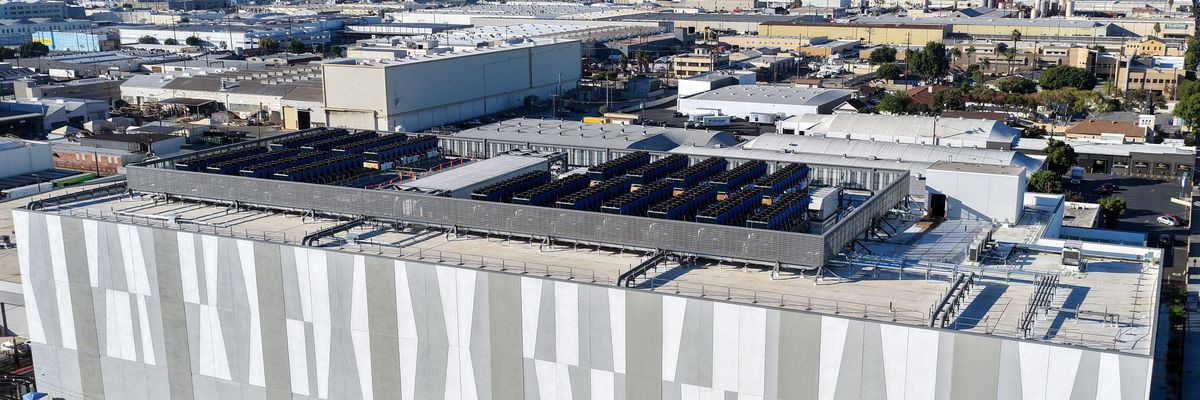
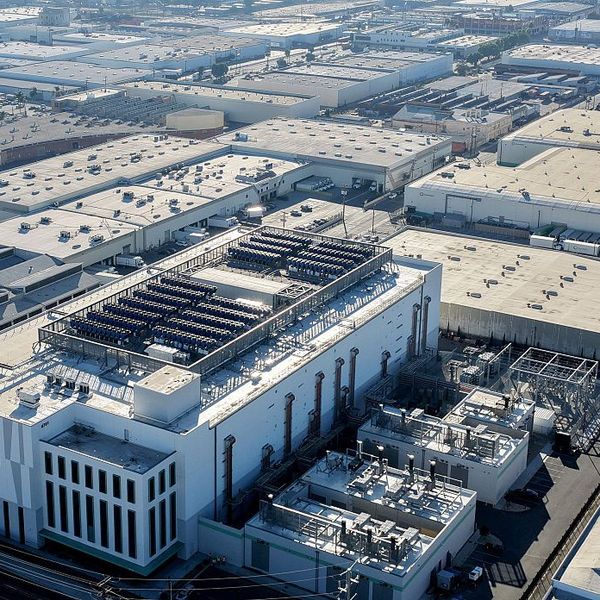
An aerial view of a 33 megawatt data center with closed-loop cooling system is seen on October 20, 2025 in Vernon, California.
(Photo by Mario Tama/Getty Images)

Richard Heinberg
Nov 29, 2025
Common Dreams


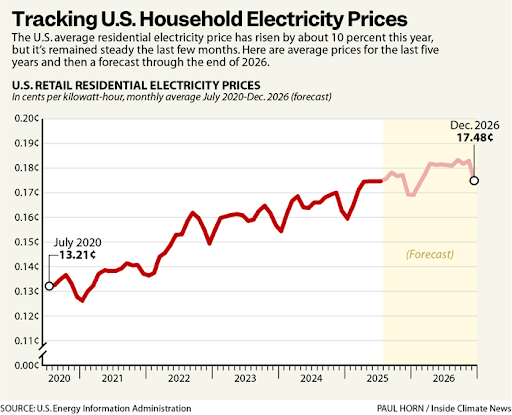
Using current economic trends to predict the future can be misleading, since all trends are subject to limits and countertrends. In this article, I’ll apply that truism to a trend that a lot of people are talking about—soaring electricity prices in the United States.

Across the US, electricity prices are rising more than twice as fast as the overall cost of living. The main driver of costs is the enormous electricity demand of over 1,000 new data centers, built mostly for artificial intelligence (AI) applications. Each data center, depending on its size, requires anywhere from a few kilowatts up to 100 megawatts of power (enough to power a medium-sized city). Installations of new data centers are growing at more than 10% annually; at that rate, the total number of data centers will double in less than seven years. Indeed, the International Energy Agency expects global electricity demand from data centers to double by the end of this decade, when it will total more than the entire electricity demand of Japan. Goldman Sachs Research predicts that 60% of this increased demand will be met by fossil fuel sources.
RECOMMENDED...


‘Another Trump Lie’: Despite Campaign Pledges, Electricity Costs Up $100 Per Family


More Americans Fall Behind on Utility Bills as AI Data Centers, Trump Attacks on Renewables Raise Costs


Understanding why rising electricity demand from data centers is a serious problem requires more than a glance at your latest utility bill. Energy isn’t just one of many inputs into the economy; in effect, it is the economy, since doing anything requires it. Of all the energy used in the US and globally, only a little over 20% is in the form of electricity; the rest entails the direct burning of fossil fuels (most electricity is generated also by burning fossil fuels; in the US, 60% of electricity comes from fossil fuel sources—mostly natural gas). Electricity is not a direct source of energy; it’s an energy carrier. But, for households and industries alike, it is an extremely useful way of conveying energy to end users. Just flip a switch or push a button, and electricity makes something happen. It does many things for us, but its role in enabling communications and data processing gives electricity a pivotal importance in the overall energy mix of modern society.

Energy usage for data processing and communications doesn’t tend to rise and fall in response to short-term changes in power prices; economists call it “inelastic.” So, when electricity prices soar, households and businesses must adjust. For households, that typically means buying fewer discretionary consumer products; for businesses, it means raising prices for services or goods. The whole economy grinds slower. We have a storied history of recessions in 1973, 1979, and 2008 that were related to rising fossil fuel prices impacting the entire economy (see photos of gasoline lines and shortages from 1973). What happened with fossil fuels could happen with electricity: As electricity assumes a central role in our energy system, future price spikes could conceivably be as crippling as the OPEC oil embargoes of the 1970s.

A bursting AI bubble could at least temporarily halt electricity price increases tied to new data centers. But it might be a dreadful “solution,” especially for people who are neither wealthy nor politically connected.

Growing electricity demand for data centers is also a problem because of climate change. Almost all of society’s “progress” in reducing emissions has been in the electricity generation sector (e.g., using solar panels instead of coal to generate electricity). But if electricity demand grows fast, that makes it harder to continue increasing renewables’ share of electricity generation: Demand spikes put utility companies in panic mode, so they deploy any new generating capacity they can quickly obtain—and, so far, they’re resorting to new natural gas turbines more often than new wind projects or solar arrays.

Data centers may be a largely unforeseen disruption to an enormous project that energy planners call the energy transition. As society moves away from fossil fuels, more of its energy usage will occur via electricity—which is the energy output of solar panels, wind turbines, and hydroelectric dams. The transition depends on an ongoing electrification of the economy, starting with electric vehicles. With data centers sucking up so much electricity, it becomes all the harder to deploy electricity to other uses and sectors, which is what planners had been counting on.

Electricity prices can’t keep going up and up. Something’s got to give. Let’s first explore the more obvious solutions to the electricity price dilemma, and then the systemic limits and countervailing trends that will determine which of those solutions is more feasible and likely. I’ll finish by proposing a hybrid supply-demand response that would minimize the economic pain of high electricity prices while putting the country on a more sustainable path.


More Electricity Demand? Just Increase Supply!


The obvious solution to rising electricity prices is to meet new demand with new supply. Just generate more power. What energy sources are available for that purpose?


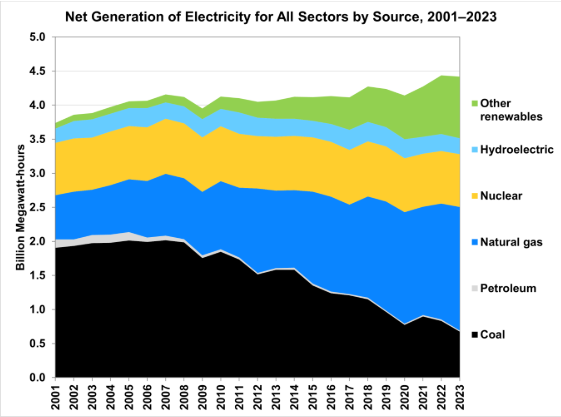
(US electricity generation by energy source, US Department of Energy. The Trump DoE may have stopped updating its data, as its website features no graph carrying these trendlines forward to 2024.)

Natural gas is currently the main energy source for electricity generation in the US, and its share of total generation has grown sharply in recent years. Also, the US is the world’s biggest gas producer. Further, natural gas is the cleanest-burning fossil fuel, though it still produces carbon emissions. These factors together make natural gas the obvious solution for most utility companies. But there are some caveats regarding the future of natural gas, which we’ll unpack in the next section when we explore limits and countertrends.Nuclear power has been stagnant in the US for the past three decades: 12 commercial reactors were retired between 2013 and 2021, and two new ones (in Georgia) were recently put into service. The average age of US nuclear plants is 42 years. The nuclear industry, eager for a comeback, has proposed construction of small modular reactors (SMRs) that would allegedly be cheaper and safer than existing nuclear plants, which typically have been slow and costly to build and have been targeted by citizen opposition due to safety concerns. However, the industry’s rosy claims for SMRs are disputed. In the meantime, Microsoft has partnered with the owners of the Three Mile Island nuclear facility, site of the worst nuclear disaster in US history.Renewables consist mostly of solar, wind, hydro, and geothermal. Power generation in this sector is expanding quickly, but likely not enough to avert supply shortages or price spikes if AI keeps growing at its current pace. The Trump administration is doing all it can to stall the further expansion of renewables, which continues despite these headwinds. President Donald Trump’s opposition to renewables appears to be political rather than economic, perhaps aimed to repay campaign donations from fossil fuel companies. The oil industry’s drilling technology could be used for deep geothermal electricity generation, the potential scale of which is enormous. The first commercial plants are now under construction; upfront costs are projected to be high, with low and stable operational costs. However, scaling up deep geothermal production to a significant fraction of the nation’s electricity supply might take decades.Coal has seen a dramatic and relentless fall in its share of overall power generation in the US (though not in China or India). This is due not just to the pollution and climate policies of previous federal administrations. Fuel supply issues (most of America’s higher-quality coal is already largely depleted), together with cheaper natural gas, have persuaded most electric utility companies that coal is a fuel of the past. The Trump administration is calling for a return to coal, but few utility companies appear to be listening. That’s likely because the federal push for new coal power plants seems driven more by an appeal to voters in mining states like West Virginia, Kentucky, Ohio, and Wyoming than by economics.

None of those supply solutions seems ideal. Moreover, before we try to choose a candidate and say, “Problem solved,” it’s essential that we examine limits and countertrends that could cause the current electricity price trajectory to shift.
Why the Electricity Price Trend Could Change

US electricity prices could rise even faster, or the current trend could go into reverse and electricity could get cheaper. What are the foreseeable limits or countertrends that could lead to either of those outcomes?

One factor is natural gas prices, which have been relatively low and stable for the past couple of decades; indeed, adjusted for inflation, they have declined significantly. This has been due to rising North American shale gas supplies released by fracking. Cheap natural gas, in turn, has kept US electricity prices relatively stable until recently. Now, however, two factors are contributing to a likely increase in natural gas prices.

The first is the growth of the US liquefied natural gas (LNG) industry. Currently Europe is, for political and security reasons, phasing out Russian natural gas delivered by pipeline. Instead, Europeans are buying more LNG imported by tanker, a costly substitute. Gas producers in the US, flush with shale gas, are eager to serve these new customers, who are willing to pay much more for natural gas than Americans do currently. So, new LNG export terminals are springing up on the US Gulf Coast, with some already shipping their first cargoes. With a growing share of US natural gas being exported (projected to be over 10% of total production by 2030), domestic prices for the fuel will likely rise, forcing gas-burning utility companies to hike up electricity prices further and faster.

When the people own the means of generation, they can collectively decide to promote renewables over fossil fuels as a source of power.

Meanwhile, America’s shale gas miracle may soon start to peter out. As I noted in a recent article, shale gas fields suffer from rapid depletion of individual wells and thus require high rates of drilling. Most US shale gas regions have already passed their peak of production and are in their plateau or decline phase of extraction. One prominent resource analytics firm forecasts that total US shale gas production will peak between 2027 and 2030. If natural gas production falls, it may be difficult for other electricity sources to grow fast enough to avert power supply problems or rate hikes.

A factor that could conceivably slow electricity price increases, or perhaps even cause prices to fall, is investors’ potential unwillingness to further finance the build-out of AI. In recent months, many Wall Street analysts have expressed dismay at the expanding gap between AI spending—projected to hit $1.5 trillion this year—and actual revenues for companies developing and using AI. Many investors now believe AI stocks are a financial bubble whose bursting could cause a recession or depression for the entire US economy, even the global economy.

A bursting AI bubble could at least temporarily halt electricity price increases tied to new data centers. But it might be a dreadful “solution,” especially for people who are neither wealthy nor politically connected. Past financial crises have been stanched with bailouts for banks and investors, thereby transferring wealth from the public to risk-taking entrepreneurs, while ordinary folks deal with job losses and vanishing retirement nest eggs.
A Better Solution to Unaffordable Electricity

Any realistic solution to soaring electricity prices must address both supply and demand.

Supply: Of the sources of energy for electricity generation, renewables make the most sense, even though they are subject to their own limits and drawbacks, including unsustainable requirements for scarce raw materials and major concerns about environmental, social, health, and security impacts.

Demand: Since materials limits mean that electricity generation from renewables cannot be scaled up indefinitely, it is essential that planners identify ways to reduce electricity demand over the long-term.

Investor-owned utilities have an incentive to sell more product so as to generate more profits and returns for investors. Investor ownership is therefore an impediment to stabilizing electricity supply at a sustainable scale over the long run. Fortunately, there are two other ownership models: electric cooperatives and publicly owned utilities. These kinds of power producers currently supply almost 30% of all US electricity, and typically charge their customers less for power.

When the people own the means of generation, they can collectively decide to promote renewables over fossil fuels as a source of power, as my own local provider, Sonoma Clean Power (SCP), already does.

Community-owned power companies can also promote the reduction of electricity demand. For example, SCP incentivizes the purchase of energy-efficient electric appliances, rooftop solar, and EVs. States can also help with demand reduction; for example, the State of California provides rebates for home efficiency measures.

Here’s another demand reduction strategy, one that’s tailored to the specifics of our current dilemma: States and counties could refuse to grant building permits for new data centers. Failing that, they could wall off AI’s rising electricity demand from electricity markets by requiring data center builders to provide dedicated power plants not connected to the grid. Some data center operators are already doing this, though only a tiny minority so far; most of the off-grid generators rely on natural gas.

This strategy will likely face pushback. The Trump administration is working on ways to keep individual states from regulating AI. Further, even if these efforts fail, AI companies can be expected to hire expensive lawyers and lobbying firms to oppose regulations such as a requirement for off-grid power.

But suppose all new data centers do supply their own off-grid generators. If those generators use natural gas, then competition for fuel with grid-tied power plants could raise natural gas prices, again likely causing electricity prices to soar. The best work-around would be to require data centers to build only renewable-energy generators (including deep geothermal). Again, expect pushback.

Altogether, it’s hard to see any of this happening without a broad base of public support, which would in turn require the public to be better informed on energy issues. It would also require leadership from grassroots activists and politicians. It’s a big ask, when there are already plenty of other priorities for problem solvers. However, unless more electric utilities come to be publicly owned, and a large majority of data centers start generating their own off-grid power from renewable sources, electricity price hikes for households and businesses are likely to continue until the AI financial bubble bursts or electricity prices rise enough to cripple the economy.

Electricity is our energy future, but the details of that future are still sketchy. Right now, the picture is being drawn by billionaire investors, but it looks dark and dystopian. Surely more imaginative artists could do better.


Our work is licensed under Creative Commons (CC BY-NC-ND 3.0). Feel free to republish and share widely.


Richard Heinberg
Richard Heinberg is a senior fellow at the Post Carbon Institute and the author of fourteen books, including his most recent: "Power: Limits and Prospects for Human Survival" (2021). Previous books include: "Our Renewable Future: Laying the Path for One Hundred Percent Clean Energy" (2016), "Afterburn: Society Beyond Fossil Fuels" (2015), and "Peak Everything: Waking Up to the Century of Declines" (2010).
Full Bio >