Monday, March 08, 2021

#IWD

Mexican president defends 

10-foot barriers to wall off 

women protesters 


AMLO MACHISMO MISOGYNY DENIES FEMICIDE

 Mexico City erects barricades ahead of expected violence in Women's Day march

·2 min read

MEXICO CITY (Reuters) - Mexican President Andres Manuel Lopez Obrador on Saturday said a metallic barrier to wall off the presidential palace ahead of a planned women's march on International Women's Day was to avoid provocation and protect historic buildings from vandalism.

In a country where femicides rose nearly 130% between 2015 and 2020, critics said the decision to erect the 10-foot-high (3-meter) barriers was symptomatic of Lopez Obrador's apathy toward the crisis of violence afflicting women.

Ahead of International Women's Day on Monday, barriers were also installed around other emblematic buildings and monuments in downtown Mexico City where a year ago tens of thousands of people protested rampant violence against women and impunity.

"We have to avoid provocation of people who only want to cause damage," Lopez Obrador said at an event in Yucatan. "Imagine, if we don't take care of the national palace and they vandalize it. What image will this send to the world?"

Lopez Obrador reiterated that women had the right to protest and cited his own movement in 2006 as an appropriate form of peaceful protest.

"The presidency was stolen from us ... and we protested but never broke glass. ... I walked two, three times all the way from Tabasco to Mexico City," he said. Lopez Obrador has repeatedly accused opponents of electoral fraud over the years.

At least 939 women were victims of femicide last year in Mexico, official data shows.

Interior Minister Olga Sanchez Cordero said on Twitter that the barriers were "for the protection of the women."

Anger among women was stoked this year after Felix Salgado, who has been accused of rape, announced his candidacy for governor for the southern state of Guerrero.

A representative for Salgado did not reply to repeated requests for comment; media reported that he has denied the allegations.

Lopez Obrador has said that those calling on him to drop support for Salgado, a member of the ruling Morena party, are politically motivated.

(Reporting by Stefanie Eschenbacher and Adriana Barrera; Editing by Leslie Adler)

Meet Afghanistan's fearless Gen Z influencers, who are blowing up on TikTok and have more Instagram followers than the president


Ali Latifi
Fri, March 5, 2021, 

Ayeda Shadab does a photo shoot at a scenic overlook in Herat, Afghanistan. Roya Heydari for Insider


A group of women in Afghanistan are breaking through as Gen Z influencers on TikTok, Instagram, and YouTube.


More Afghans are online, and dozens of Afghan women have 50,000 or more followers on at least one social platform.


As tastemakers, they're offering a fresh point of view on what it means to be Afghan in 2021.


A generation of Afghan women in their 20s have mastered the art of living their lives on social media.


Digital natives as much as any young person in Istanbul or Los Angeles, they are doing more than shaping what's cool in Afghanistan. Over Instagram, TikTok, YouTube and Facebook, these influencers are proving they are more than the "post 9/11" generation, as they've been labeled for 20 years. Afghanistan is what they make of it.

Mixing traditional and streetwear styles, they blast Travis Scott, Rihanna, Nina Simone, and Afghan musicians like Ahmad Zahir. They post selfies in front of Kabul's graffiti walls and carefully timed videos of the Turkish chef putting on an elaborate show in the city's new high-end steakhouse. They make Tik-Toks of Megan Thee Stallion' Savage challenge and redub Bollywood clips to poke fun at their own country.
n.


Put simply, they're young, gifted and Afgha

By broadcasting to the public, these influencers are taking real risks, but also reaping big rewards. In Afghanistan, they've earned reputations as tastemakers who are sought out by savvy business owners for their marketing power. They work out for free at Kabul's flashy new high-tech gym. But in a country still at war, safety is a serious concern. Recently, there has been a pattern of targeted killings aimed at the nation's journalists, rights workers, politicians and other influential figures. No influencer has been targeted so far, but it's a threat that's never far from their minds.
Ayeda Shadab is one of Afghanistan's social media stars.

The 26-year-old posts several times a day, and she has more followers on Instagram than the country's president, Ashraf Ghani. She models the dresses for sale in her luxury Kabul boutique and shares glossy selfies from her trips around the country. Her devoted followers flood the comments with style questions and words of encouragement.

"Our intention is to show people the possibilities, that they can live life as they want," she told Insider. "There is always fear in your heart, that's just part of living in Afghanistan. But we have to stand up and live our lives."


Ayeda Shadab photographed at the ancient Citadel in Herat, Afghanistan. 
Roya Heydari for Insider

On a recent trip to Herat, the historic city in western Afghanistan best known for its ancient Citadel, Shadab documented her every move, excited to find fresh content for her 230,000-plus Instagram followers and her nearly 390,000 followers on TikTok.

The trouble was that everything she wanted to do seemed needlessly dangerous in a city known for kidnappings and where, just recently, police officers were killed by IEDs planted near the hotel where she was staying.

But Shadab was undeterred.

One evening during the trip, Shadab and her crew drove to the Roof of Herat, a scenic overlook with panoramic views of the city that's a popular sunset hangout spot. As they pulled in, her friends (and this journalist, at work on this story) began to wonder if it was a good idea to stage a photo shoot in such a public place.

Just behind the lookout was a mosque belonging to a controversial mullah who had taken out billboards across Herat reprimanding women for inappropriate attire. Nearby was a guest house owned by a local jihadi warlord who only a decade ago had criticized the city's rock bands for carrying guitars, rather than guns.

For the occasion, Shadab wore an embroidered top with billowing sleeves and a skirt that fanned out into kaleidoscopic waves of color. Before stepping out of the Lexus borrowed from a wealthy local businessman and onto the dirt and gravel road, Shadab slipped into a pair of Manolo Blahniks she had bought during a recent trip to Dubai.


Ayeda Shadab Roya Heydaari for Insider

Not too far away, groups of men idled in their cars and rickshaws smoking hashish. Two children were begging Shadab for coins, not remotely comprehending that they might be getting in the way of her Likes.

While Shadab twirled and grinned for the camera, a group of young men hopped out of a Land Cruiser with black government plates. They started doing their own braggadocious photoshoot, with one brandishing an AK-47 for the camera.

Sensing the tension passing between Shadab's crew, one of the men called out, "Don't worry, we'll be right here. We won't get in your shots!" But they kept staring.

Shadab continued posing, oblivious to everything except the camera.

And then something happened that confirmed Shadab's confidence and left her friends in fits of laughter.

With sudden recognition, the young man with the AK-47 called out, "That's Ayeda, she's on Instagram!"

For the rest of the trip "That's Ayeda!" became a running gag among the group. Including, a few days later, at Herat International Airport, when workers stopped her for a selfie.

"We follow you!" an airport policeman said as Shadab and her friends headed towards the departures gate.

As for the adventure that night at the lookout, it earned Shadab more than 12,000 likes.
The number of Afghans online lags far behind other countries, but they're catching up.

Just 14% of the population uses the internet as a source of news and information, according to the Asia Foundation's 2019 "Survey of the Afghan People." In 2015, only 25% of households could get online using a cellphone with Internet access, but that number was up to nearly half in 2019.

Mariam Wardak, an Afghan-American who is working with Facebook to bring the anti-bullying and anti-extremism "We Think Digital" campaign to Afghanistan, said she has signed up 14 Afghan women, including Shadab, to be digital ambassadors.


Ayeda Shadab exploring the historic Citadel in Herat, Afghanistan. 
Roya Heydaari for Insider

She has identified 60 Afghan women with 50,000 or more followers, Wardak told Insider, adding: "They are building cultural tolerance in our society one post at a time."

Shadab sees herself principally as a businesswoman, and she uses social media to drum up business for her eponymous shop, which has become one of Kabul's hottest boutiques since she opened it a year ago.

Shadab comes from a prominent Afghan family. Her mother is a Senator from a Northern province and her step-father was the deputy governor of Logar province. (He was killed two years ago whole traveling to the capital.) As a student in Malaysia and China, where she got a masters degree in business, she learned about social media from her classmates. "They were Muslim, but they were willing to show off their style and personality," she said.

Her posts started getting the attention of other women in Kabul, who would reply by asking her to bring the clothes she was wearing in photos back to sell in Afghanistan. That's how she got the idea to open her own store.

"It was my followers who said we need a physical shop to come to," she said.

On the racks, denim jackets adorned with traditional embroidery from northern Afghanistan hang alongside voluminous dresses with subtly-dropped necklines. There are brightly-colored full-length faux fur coats that have appeared on the accounts of several other influencers. Her purchases from Herat -- like the second-hand velvet dresses she found at the antiques market -- will be repurposed into original designs.

"My entire business is reliant on my social media," she said. "Sometimes I fear what will happen to my business if Instagram ever shuts down."

As the number of influencers grows, Shadab's shop has become a place where they run into one another.

One of them is Sadiqa Madadgar, a former contestant on the popular reality singing competition Afghan Star.

She ended up placing seventh, but she stayed on social media, and now has a combined following of 239,000 on Instagram, TikTok, Facebook and YouTube. (One performance, in particular, has been viewed millions of times.)

Where Shadab is seen as aspirational, Madadgar, who's 22, is approachable. YouTube videos that show her cutting open a melon or describing a recent leg injury to a friend get tens of thousands of views. In showing her struggles with basic household chores in her modest Kabul apartment, she has become the girl next door.

Most YouTubers have professional studios with special lighting, specific backdrops, HD cameras and Pro-level computers to shoot and their videos on. Madadgar does it all with the most basic of tools. Each of these videos are shot, edited and published directly from her iPhone.

She's also known for being deeply religious, and has become a model for how to broadcast your life over social media while maintaining a sense of modesty.


Sadiqa Madadgar trying on a dress in Ayeda Shadab's Kabul shop. 
Rroya Heydaari for Insider

"When I first went on Afghan Star, everyone said 'there's no way you can remain a good Muslim girl and be a singer,'" Madadgar said. "So I set out to prove them wrong."

After her first appearance on the show in 2018, Madadgar received a frantic phone call from her mother in Quetta, who was incensed to see her daughter (who had moved to Kabul to study dentistry) singing on live TV.

"I'm still the same girl," Madagar remembers telling her mother. "I didn't do anything bad, say anything disrespectful or wear anything inappropriate."

Madadgar has found it much more difficult to monetize her following compared to Shadab. Yes, she enjoys the social perks and freebies, but what she really wants is to fund her music career, which means raising enough to record an album and film some music videos.

One recent morning, needing a dress for a photo shoot, Madadgar came into Shadab's shop with a couple of friends. The staff recognized her immediately and began to pull gowns from the racks. With an armored car idling outside, she spent 30 minutes trying on different looks.

Finally, Madadgar decided on a burgundy dress with an embellished belt and fully-covered sleeves. With that settled, she rushes out and into the waiting car.

"Oh, she didn't buy it. She's just borrowing it," Wardak, the "We Think Digital" leader, would later explain. "Sadiqa being photographed in it will help the business."
Shadab's success depends on posting a steady stream of content.

She is constantly looking for potential photo ops and video setups.

One evening during her trip to Herat, after a day spent rushing between photo shoots at the city's historic sites, Shadab relaxed in a wood and glass gazebo in the garden of the high-end ARG Hotel.

She was scrolling through the images they'd taken that day, wishing that they had been able to accomplish more. In this conservative city, there had often been nowhere for her to change modestly into different outfits, and so they lost time in traffic as they went back and forth to the safety of her hotel room.

The confidence that exudes from Shadab in person is also evident from what she posts online. What she wants most of all, she said, is for her followers, especially other young women, to understand is that she is an educated female entrepreneur who has built her own business on her own terms.

There are of course sexist and hateful comments that she has to reckon with too, including from people telling her she should cover her hair more. But for the most part she dismissed that as part of living your life online.

"It's so strange, all of these people are so curious about our lives," she continued. "They want to know what this boy or this girl is doing, but then, instead of supporting you, they use that same content to attack you."

Still, for Shadab it was all worth it. Trips like this offered new content, yes. But Shadab also saw them as a chance to show off her country. When she and her friends were growing up, most of the images of Afghanistan came from foreign war photographers. The country's story was often reduced to violence and tragedy.

But today, with just a mobile phone and an Internet connection, influencers like Shadab can show another side to their country - the banalities, the beauty, the luxury and the laughs - that war and displacement couldn't steal from them.

Shadab sips from a glass of saffron tea, scrolling through her comments. Suddenly, she lets out a heavy sigh.

Her friends, each busy with their own stories and tweets, turn to look at her.

"Listen to this," she says, and begins to read an Instagram DM.

"Thank you for showing my homeland that I haven't seen in 11 years," she reads aloud. Her friends sigh along with her. Shadab continues: "I miss it. You're very lucky."

Read the original article on Business Insider

#IWD

Whose Family Values?


Women and the Social Reproduction 

of Capitalism


"proletarii, propertyless citizens whose service to the State was to raise children (proles).” 1

WAGES FOR HOUSEWORK 

NO SOCIALISM WITHOUT WOMEN'S LIBERATION


1 Classical Antiquity; Rome, Perry Anderson, Passages from Antiquity to Feudalism, Verso Press 1974


No more phony press releases. Women deserve more than a capitalist takeover of International Women’s Day


Olivia Petter
Mon, March 8, 2021, 


(Getty Images/iStockphoto)

What does celebrating female empowerment mean in 2021? Here’s what my inbox says. It means buying a pillow with Frida Kahlo’s face on it for £45. It means feeling inspired by a bouquet of flowers containing one red rose as a reference to gender inequality. It means eating a tub of salted caramel ice cream that’s been named after a “trailblazing woman”.

Social media has a different definition. Several, in fact. It’s telling everyone how much you love your mates, your girlfriend, and your mum. It’s showing everyone how hot you look in a selfie above a quote from Gloria Steinham. It’s drinking wine and having good times with the women that inspire you.

Every year, on 8 March, the world marks International Women’s Day, an event dedicated to championing the advancement of women’s rights and gender equality. The annual celebration began as a way of honouring the 1908 garment workers’ strike in New York, which saw women protesting against working conditions and demanding equal political and economic rights. Now, though, this meaning seems to have been watered down to the point of parody.


Brands have capitalised on the day with increasing gall in recent years. Like so many other well-intentioned events, it seems as if IWD has become little more than just another marketing opportunity. Every year, I receive hundreds of emails from brands promoting IWD campaigns and products that serve only to devalue a day by, well, sticking an actual value on it.

Today, it seems like everything can be reshaped and repackaged into an IWD product, whether it’s a bottle of gin that promises to “bring an empowering meaning to cocktail hour” or a campaign purporting to unite the UK’s 33 million women through a bar of chocolate.

None of this is reserved for IWD, of course. There is a long history of brands jumping on the feminist bandwagon as a virtue signalling exercise. Remember Dior’s “We should all be feminists” T-shirt that was inspired by the words of Chimamanda Ngozi Adichie and caused a ruckus because it retailed at €620 (£534) with zero profits from the product going to charity? We should all be feminists, but only if we’re taking home a healthy paycheck, it seems. Or how about all of the feminist branded merch available from fast fashion brands, many of which have been accused of abuses of employment law, that have very possibly been made by female garment workers not earning a living wage?

Look, I get it. I drank from a mug with breasts on the front once and felt cool, too. But don’t tell me that’s a way of honouring the suffragettes. And yes, I understand that many brands do donate a percentage of their profits from IWD products to organisations that support women in various ways. But many also do not. And even if a small percent of your purchase does profit a charity, the percentage is usually so small they can hardly claim to be making any sort of direct impact on improving women’s rights.

Capitalism has completely taken over a day that is supposed to be about gender equality. And all too often, these products are created at the expense of the very equality they purport to be supporting. Women don’t need feminist T-shirts. What we need is equal pay and proper working conditions. Sure, you can buy the slogan tee, but what will that do to benefit the woman who made it?

This paired with the way the IWD has become just another opportunity to post filtered photos of you and your friends on social media has put this annual celebration of women’s rights on par with other equally hashtaggable events, like Valentine’s Day and International Cupcake Day.

You can get away with empty branding on these occasions, but not on a day that’s supposed to be about female empowerment. And while there are companies doing meaningful activities for IWD beyond a small charitable donation - Bodyform has launched a campaign on closing the gender pain gap while tech accessories company PopSockets is donating 50 per cent of its sales to the Malala Fund for the duration of March - they are few and far between.

Things have been this way for a few years, but in 2021, it feels all the more inappropriate. The pandemic has hit women hard. So much so, in fact, that UN Women has suggested the coronavirus outbreak could set gender equality back by 25 years. There are many reasons for this, the most obvious being the myriad ways in which the pandemic has put additional strains on issues already known to affect women more profoundly than men, including childcare, employment, and healthcare.

In February, a study carried out by Unison found that almost a third of women in frontline roles will be forced to dip into their savings to “manage financial difficulties in pandemic”. Elsewhere, reports have found that working mothers have been refused furlough by their employers, while growing numbers of women are turning to sex work as they say the coronavirus crisis pushes them into “desperate poverty”. Then there is the startling rise in domestic violence cases that have emerged in the last year, with the National Domestic Violence helpline surging by more than 100 per cent on a single day in April 2020.

The truth is, the over-branding of IWD threatens to dilute the true, and very important, meaning of this day and allow the real issues women are facing to be swept under the adorable pink “feminist” carpet. There’s nothing wrong with brands wanting to celebrate femininity, but until they’ve taken into account that women already shoulder the burden of the pay gap, and reduced prices accordingly, isn’t it just another way of women losing their hard-earned cash?

Are these brands making real systemic change to support women within the ranks of their own corporations? Unlikely. With all this in mind, forgive me for not feeling empowered by your “solidarity” hand cream and your limited edition pink sandals.

IWD BREAD & ROSES


Bread and Roses

As we go marching, marching, in the beauty of the day,
A million darkened kitchens, a thousand mill lofts gray,
Are touched with all the radiance that a sudden sun discloses,
For the people hear us singing: Bread and Roses! Bread and Roses!

As we go marching, marching, we battle too for men,
For they are women's children, and we mother them again.
Our lives shall not be sweated from birth until life closes;
Hearts starve as well as bodies; give us bread, but give us roses.

As we go marching, marching, unnumbered women dead
Go crying through our singing their ancient call for bread.
Small art and love and beauty their drudging spirits knew.
Yes, it is bread we fight for, but we fight for roses too.

As we go marching, marching, we bring the greater days,
The rising of the women means the rising of the race.
No more the drudge and idler, ten that toil where one reposes,
But a sharing of life's glories: Bread and roses, bread and roses.

Our lives shall not be sweated from birth until life closes;
hearts starve as well as bodies; bread and roses, bread and roses


Saturday, March 08, 2008

100 Years Of Bread and Roses


Today marks the 100th Anniversary of International Women's Day one of two Internationalist Workers Holidays begun in the United States. And it is one that recognized women as workers, that as workers women's needs and rights are key to all our struggles hence the term Bread and Roses.

Women have led all revolutions through out modern history beginning as far back as the 14th Century with bread riots. Bread riots would become a revolutionary phenomena through out the next several hundred years in England and Europe.

It would be bread riots of women who would lead the French Revolution and again the Paris Commune, led by the anarchist Louise Michel.

Bread riots occurred in America during the Civil War.

It would be the mass womens protest and bread riots in Russia in 1917 that led to the Revolution there. The World Socialist Revolution had begun and two of its outstanding leaders were Rosa Luxemburg and Clara Zetkin, both who opposed Lenin's concept of a party of professional revolutionaries leading the revolution and called for mass organizations of the working class. Their feminist Marxism was embraced by another great woman leader of the Russian Revolution; Alexandra Kollontai.

Women began the Winnipeg General Strike of 1919 by shutting down the phone exchange.
Women began the Winnipeg general sympathetic strike. At 7:00 a.m. on the morning of Thursday, May 15, 1919, five hundred telephone operators punched out at the end of their shifts. No other workers came in to replace them. Ninety percent of these operators were women, so women represented the vast majority of the first group of workers to begin the city-wide sympathetic strike in support of the already striking metal and building trades workers. At 11:00 a.m., the official starting point of the strike, workers began to pour out from shops, factories and offices to meet at Portage and Main. Streetcars dropped off their passengers and by noon all cars were in their barns. Workers left rail yards, restaurants and theatres. Firemen left their stations. Ninety-four of ninety-six unions answered the strike call. Only the police and typographers stayed on their jobs. Within the first twenty-four hours of the strike call, more than 25,000 workers had walked away from their positions. One-half of them were not members of any trade union. By the end of May 15, Winnipeg was virtually shut down.


Again it would be mass demonstrations of women against the Shah of Iran that would lead to the ill fated Iranian revolution.

Today with a food crisis due to globalization bread riots are returning.

When women mobilize enmass history is made.

March is Women's History Month, March 8 is International Women's Day (IWD), and March 5 is the birthday of the revolutionary Polish theorist and leader of the 1919 German Revolution, Rosa Luxemburg. It was Rosa Luxemburg's close friend and comrade, Clara Zetkin, who proposed an International Women's Day (IWD) to the Second International, first celebrated in 1911.

Clara Zetkin, secretary of the International Socialist Women's Organization (ISWO), proposed this date during a conference in Copenhagen because it was the anniversary of a 1908 women workers' demonstration at Rutgers Square on Manhattan's Lower East Side that demanded the right to vote and the creation of a needle trades union.

The demonstration was so successful that the ISWO decided to emulate it and March 8 became the day that millions of women and men around the world celebrated the struggle for women's equality.

Actually, International Women's Day is one of two working class holidays "born in the USA." The other is May Day, which commemorates Chicago's Haymarket martyrs in the struggle for an eight-hour day.


Clara Zetkin

From My Memorandum Book


CLARA ZETKIN & ALEXANDRA KOLLONTAI


“Agitation and propaganda work among women, their awakening and revolutionisation, is regarded as an incidental matter, as an affair which only concerns women comrades. They alone are reproached because work in that direction does not proceed more quickly and more vigorously. That is wrong, quite wrong! Real separatism and as the French say, feminism Ã  la rebours, feminism upside down! What is at the basis of the incorrect attitude of our national sections? In the final analysis it is nothing but an under-estimation of woman and her work. Yes, indeed! Unfortunately it is still true to say of many of our comrades, ‘scratch a communist and find a philistine’. 0f course, you must scratch the sensitive spot, their mentality as regards women. Could there be a more damning proof of this than the calm acquiescence of men who see how women grow worn out In petty, monotonous household work, their strength and time dissipated and wasted, their minds growing narrow and stale, their hearts beating slowly, their will weakened! Of course, I am not speaking of the ladies of the bourgeoisie who shove on to servants the responsibility for all household work, including the care of children. What I am saying applies to the overwhelming majority of women, to the wives of workers and to those who stand all day in a factory.

“So few men – even among the proletariat – realise how much effort and trouble they could save women, even quite do away with, if they were to lend a hand in ‘women’s work’. But no, that is contrary to the ‘rights and dignity of a man’. They want their peace and comfort. The home life of the woman is a daily sacrifice to a thousand unimportant trivialities. The old master right of the man still lives in secret. His slave takes her revenge, also secretly. The backwardness of women, their lack of understanding for the revolutionary ideals of the man decrease his joy and determination in fighting. They are like little worms which, unseen, slowly but surely, rot and corrode. I know the life of the worker, and not only from books. Our communist work among the women, our political work, embraces a great deal of educational work among men. We must root out the old ‘master’ idea to its last and smallest root, in the Party and among the masses. That is one of our political tasks, just as is the urgently necessary task of forming a staff of men and women comrades, well trained in theory and practice, to carry on Party activity among working women.”

SEE:

IWD: Raya Dunayevskaya


IWD Economic Freedom for Women

Feminizing the Proletariat


Women in Afghanistan worry peace accord with Taliban extremists could cost them hard-won rights


Homa Hoodfar, Professor of Anthropology, Emerita, Concordia University 
and Mona Tajali, Assistant Professor in IR and WGSS, Agnes Scott College
Fri, March 5, 2021, 


Audience members listen to Afghan parliamentarian Fawzia Koofi speak in 2014. Women's access to politics increased greatly after the Taliban's 2001 ouster. 
Sha Marai/AFP via Getty Images

Three Afghan women who worked at a media company were gunned down in Jalalabad in early March. In January, unidentified gunmen killed two female Supreme Court judges in Kabul.

These are the latest victims on a long list of assassinations and attempted assassinations of female politicians and women’s rights activists. Such attacks have intensified since the government began peace negotiations with the Taliban militant group in September 2020. In the past year, 17 human rights defenders have been killed in Afghanistan.

The Taliban’s rule of Afghanistan from 1996 to 2001 was the darkest time for Afghan women. Assuming an austere interpretation of Islamic Sharia and Pashtun tribal practices, the group limited women’s access to education, employment and health services. Women were required to be fully veiled and have male escorts in public.


We are scholars of women’s rights in Muslim majority countries, including in Afghanistan. We have been following Afghanistan’s peace talks with an eye on gender, seeking to understand how Afghan women view the prospect of their government striking a power-sharing agreement with the group that oppressed them.


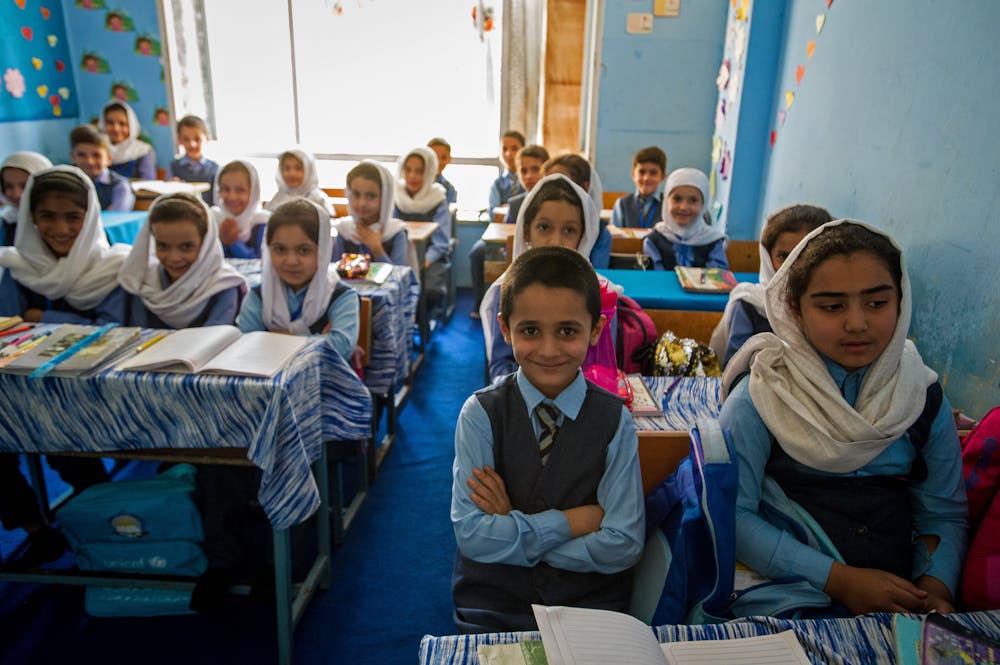
Sunny, blue-painted classroom full of smiling Afghan boys and
girls


Seat at the table

Women are a pale presence in the on-again, off-again, U.S.-brokered Afghanistan peace process underway in Doha, Qatar. The Taliban, which still controls roughly 30% of Afghanistan’s territory, has no women on its negotiating team. Only four of the Afghan government’s 21 negotiators are women – even though several women play prominent roles within the national government.

The past six months of talks have demonstrated the contradictions between each side’s stance on women’s equality and other central issues.

The government intends to preserve Afghanistan’s democratic institutions and constitution, which guarantees the rights of women and minorities as equal citizens of an Islamic republic.

The Taliban, on the other hand, is pushing for an Islamic emirate controlled by a nonelected council of religious leaders who rule based on their conservative interpretation of Islam, according to unpublished analysis by the nonprofit Women Living Under Muslim Laws, where we are board members.


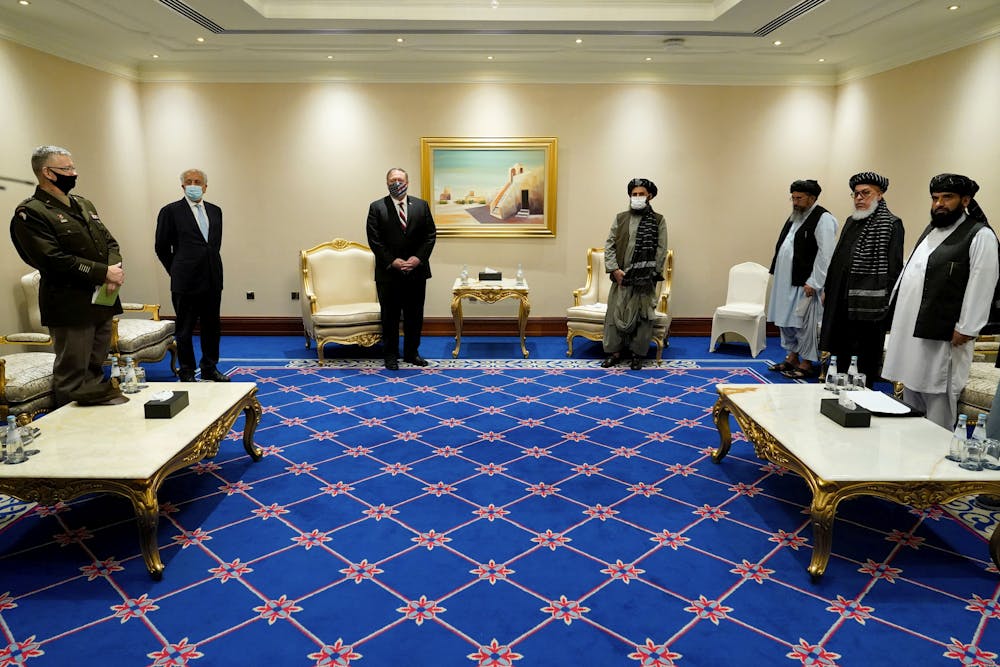
Men, some in suits and other in traditional Pashtun clothing, stand in a hotel conference room at a distance from each other, wearing face masks

Roya Rahmani, the Afghan ambassador to the United States, says having women on its team gives the Afghan government more leverage to negotiate on women’s rights. That’s important because our research indicates that the Taliban maintain their extremist stance on women.

“The Taliban live in their 1990s universe and they refuse to see the reality of Afghanistan and in particular the young generations today who see themselves entitled to human rights, education, and an open public sphere,” Palwasha Hassan, an Afghan women’s rights activist, told us in an interview in December 2020.

The Taliban claims its views on women have evolved. But in some Taliban-controlled regions of Afghanistan girls are barred from getting an education after puberty – in violation of the Afghan constitution. And while women are elected and appointed to high-level posts nationally, their political participation is restricted in Taliban-controlled regions.

There is a “gap between official Taliban statements on rights and the restrictive positions adopted by Taliban officials on the ground,” according to the international nonprofit Human Rights Watch.


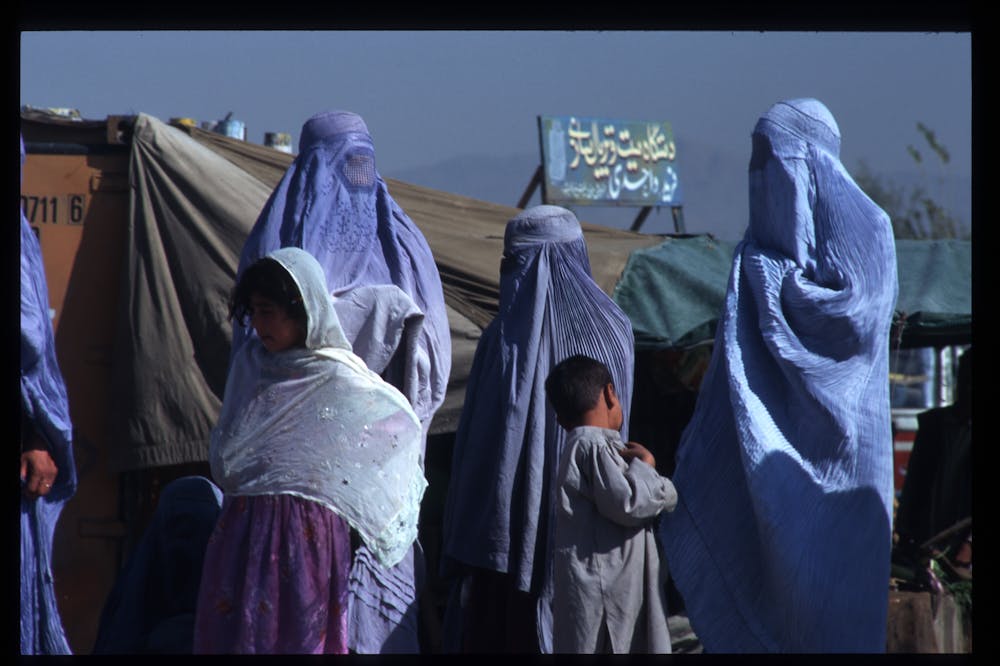
Veiled women and some children stand on the street


Women and war


Armed conflicts may be primarily fought by men, who are killed or injured, but women are war victims in a different way – and therefore have different needs when it ends. Many lose their husbands and children, and thus their income, and are disproportionately displaced by violence. Rape is one weapon of war, and in some places women may be sexually assaulted en masse.

In 2000, the United Nations adopted a resolution emphasizing that women should be included in all post-conflict reconstruction efforts.

Colombia was the first country to ensure gender equity in its peace process. In its landmark 2016 accord with the FARC insurgents, which was mediated by Sweden, women were on both the insurgent and government negotiating teams, and the final accord included a chapter outlining what assistance women in conflict zones would need to start businesses, participate in politics, thrive in rural areas and the like.

Afghanistan, the first big globally brokered peace deal to follow Colombia’s, does not follow this model.

In interviews with more than 15 Afghan women’s rights leaders, we heard frustration over women’s exclusion from the peace talks given that women are the main victims of Afghanistan’s 40-year conflict.

These women support the effort at national reconciliation. But they cited the targeted killings of women over the past year as reason for concern that the Taliban’s disregard for human rights jeopardizes the longevity of any peace deal.

As one interview subject put it, “Taliban’s win is a win for ISIS, Boko Haram and other extremist groups.”
Targeting women

Outspoken critics of the Taliban’s undemocratic vision of peace have been threatened or killed.

In August 2020, Fawzia Koofi, an Afghan government negotiator and long-time Afghan parliamentarian, was shot in the arm in an attempted assassination. The attack is an instance of the gendered violence that women often face as a way to deter them from participating in politics.

Koofi refused to be silenced. Just days after her injury, she flew to Doha to attend the peace talks.

The Afghan government has made recent missteps on women’s rights, too.

In 2020, the Afghan government dissolved the State Ministry of Human Affairs, led by Dr. Sima Samar, a key advocate for women’s rights with nearly two decades of experience at the Afghanistan Independent Human Rights Commission.


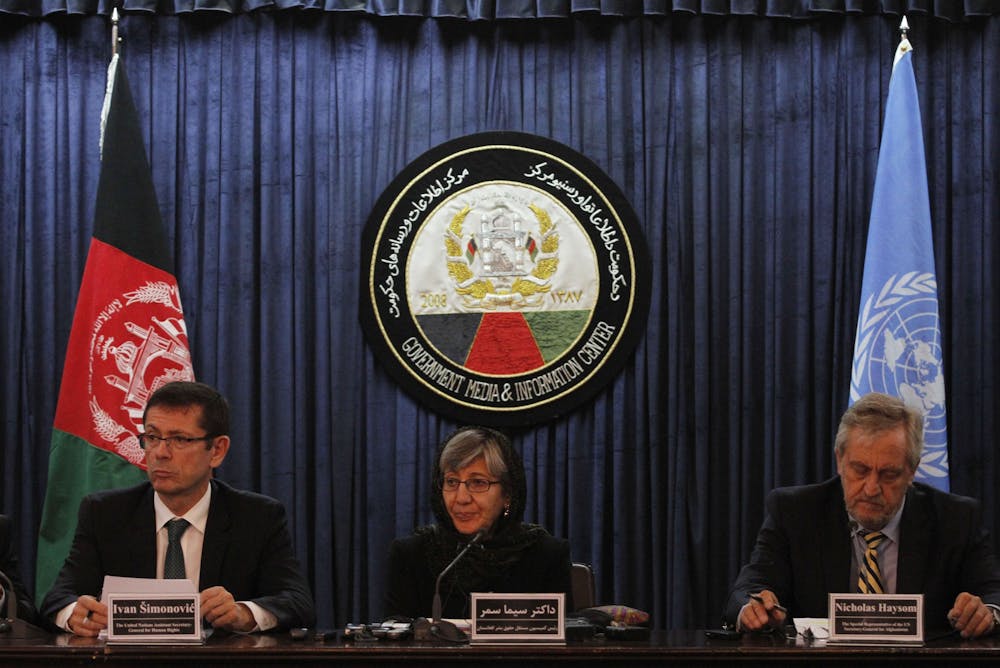
Woman in hijab sits at a table with microphones between two men in sits, with international flags behind them


This ministry, as the main body documenting and reporting on Afghanistan’s human rights status, could have played an instrumental role in the negotiations.

After the fall of the Taliban in the 2001 U.S. invasion, women eagerly embraced every opportunity to advance professionally in diverse sectors, from politics to social services. Today women compose around 27% of the Afghan Parliament, one of the highest rates of women’s political representation in the region.

“There is no going back,” Zarqa Yaftali, a women’s rights activist told us. “Women intend to guide their country towards peace and stability.”


Read more:

Afghanistan peace talks begin – but will the Taliban hold up their end of the deal?


The Taliban are megarich – here’s where they get the money they use to wage war in Afghanistan


This article is republished from The Conversation, a nonprofit news site dedicated to sharing ideas from academic experts. It was written by: Mona TajaliAgnes Scott College and Homa HoodfarConcordia University.

Mona Tajali is affiliated with Women Living Under Muslim Laws, a transnational feminist research network.

Homa Hoodfar is affiliated with the organization Women Living Under Muslim Laws, a transnational Feminist Research Network

Unions call for total strike in Myanmar; 

Suu Kyi party official dies in custody


By Reuters Staff


(Reuters) - Myanmar’s major trade unions called on members to shut down the economy from Monday to back a campaign against last month’s coup, raising pressure on the junta as its forces fired weapons and occupied hospitals in the main city Yangon after a day of massive protests.


Witnesses reported sounds of gunfire or stun grenades in many districts of the commercial capital after nightfall, as soldiers set up camp in hospitals and university compounds, local media reported. It was not clear whether anyone was hurt.

The Assistance Association for Political Prisoners, a non-profit, said the army was “intentionally terrorizing residents” in Yangon.

The show of force came after some of the largest nationwide protests since the Feb. 1 coup, and an alliance of nine unions said they planned a “full extended shutdown” of the economy.

“To continue economic and business activities as usual...will only benefit the military as they repress the energy of the Myanmar people,” they said in a joint statement. “The time to take action in defence of our democracy is now.


A spokesman for the military did not answer calls seeking comment and Reuters was unable to reach police for comment. The army has said it is dealing with protests lawfully.

An official from the party of deposed leader Aung San Suu Kyi died overnight in police custody. National League for Democracy (NLD) official Khin Maung Latt had worked as a campaign manager for one of two Muslim MPs elected in 2020.

Ba Myo Thein, a member of parliament’s upper house which was dissolved after the coup, said reports of bruising to Khin Maung Latt’s head and body raised suspicions that he had been abused.

“It seems that he was arrested at night and tortured severely,” he told Reuters. “This is totally unacceptable.”

Police in Pabedan, the Yangon district where Khin Maung Latt was arrested, declined to comment.

STUN GRENADES


Sunday saw some of the biggest protests in recent weeks. Police fired stun grenades and tear gas to break up a sit-in by tens of thousands of people in Mandalay, the Myanmar Now media group said. At least 70 people were arrested.

Police also launched tear gas and stun grenades in the direction of protesters in Yangon and in the town of Lashio in the northern Shan region, videos posted on Facebook showed.

A witness said police opened fire to break up a protest in the historic temple town of Bagan, and several residents said in social media posts that live bullets were used.

Video posted by Myanmar Now showed soldiers beating up men in Yangon, where at least three protests were held despite overnight raids by security forces on campaign leaders and opposition activists.

Sithu Maung, the NLD MP who worked with Khin Maung Latt, said soldiers and police detained his father on Sunday night.

“They broke into the house… and point with guns, I was told,” he said in a Facebook post, adding that his father was also beaten.

The United Nations says security forces have killed more than 50 people to quell daily demonstrations and strikes since the military overthrew and detained Suu Kyi on Feb. 1.

“They are killing people just like killing birds and chickens,” one protest leader said to the crowd in Dawei, a town in Myanmar’s south. “What will we do if we don’t revolt against them? We must revolt.”

State-run Global New Light Of Myanmar newspaper quoted a police statement as saying security forces were dealing with the protests in accordance with law. It said the forces were using tear gas and stun grenades to break up rioting and protests that were blocking public roads.

CONDEMNATION

Well over 1,700 people had been detained under the military junta by Saturday, according to figures from the Assistance Association for Political Prisoners advocacy group.

The killings have drawn anger in the West and been condemned by most democracies in Asia. The United States and some other Western countries have imposed limited sanctions on the junta.

China, Myanmar’s giant neighbour to the northeast, said on Sunday it is prepared to engage with “all parties” to ease the crisis and is not taking sides.

Australia said it suspended a bilateral defence cooperation program with the military following the coup and its development program would engage only with non-government organizations.

Myanmar protests: Demonstrators 'fired on' amid funeral of political organiser said to have died in custody

A ward chairman from Aung San Suu Kyi's party is said to have been found dead in a military hospital on Sunday morning.

Philip Whiteside
SKY News reporter
Sunday 7 March 2021
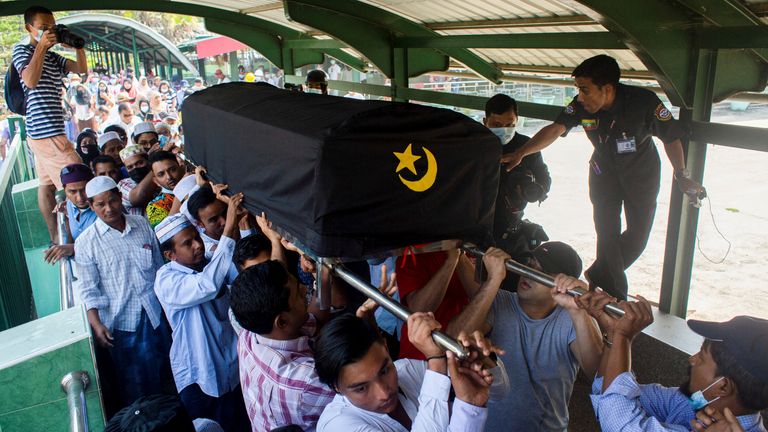
People attend a funeral of U Khin Maung Latt a National League for Democracy (NLD)'s ward chairman

Witnesses have said police have opened fire on protesters in Myanmar, amid reports at least one political organiser from the democratically elected government's party has died in custody.

Several people were wounded in the historic temple city of Bagan, according to witness accounts and videos on social media, while demonstrations were held in at least half a dozen other Myanmar cities.
Sponsored link

Residents in the southeastern city of Dawei said soldiers and police moved into several districts overnight, firing shots. They arrested at least three people in Kyauktada Township, residents there said.

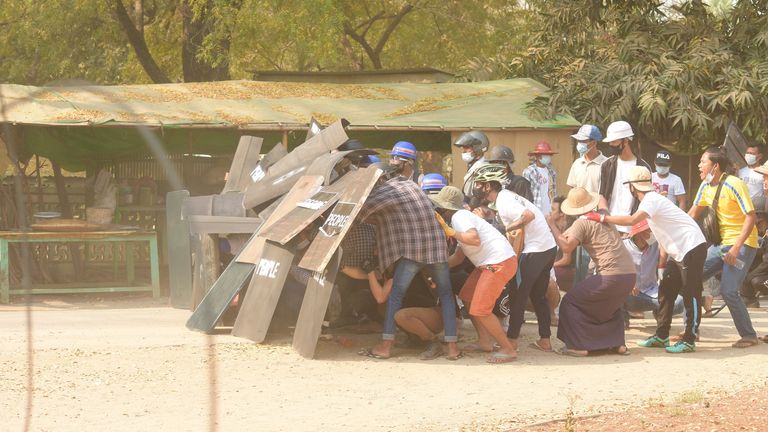
Protesters create a shield formation in Nyaung-U

One protest leader said to the crowd in Dawei: "They are killing people just like killing birds and chickens. What will we do if we don't revolt against them? We must revolt."

A ward chairman from Aung San Suu Kyi's National League for Democracy (NLD) party was found dead in a military hospital on Sunday morning by people who lived in his Yangon neighbourhood, according to a post on Facebook by NLD MP Sithu Maung.

Several on social media speculated that U Khin Maung Latt, 58, died after being beaten in custody after being taken from his home, but no official cause of death was immediately announced.

Reuters news agency said it saw a photograph of his body with a bloodstained cloth wrapped around the head.

Another Facebook poster said he had been arrested on Saturday in 30th Street in Pabedan Township.

There were emotional scenes in Yangon as his funeral was held in accordance with Islamic tradition later on Sunday.

At least three protests were held in Yangon, despite overnight raids by security forces on campaign leaders and opposition activists, and video posted by media group Myanmar Now showed soldiers beating up men.

Meanwhile, police fired tear gas to break up a sit-in demonstration by tens of thousands of people in Mandalay on Sunday.

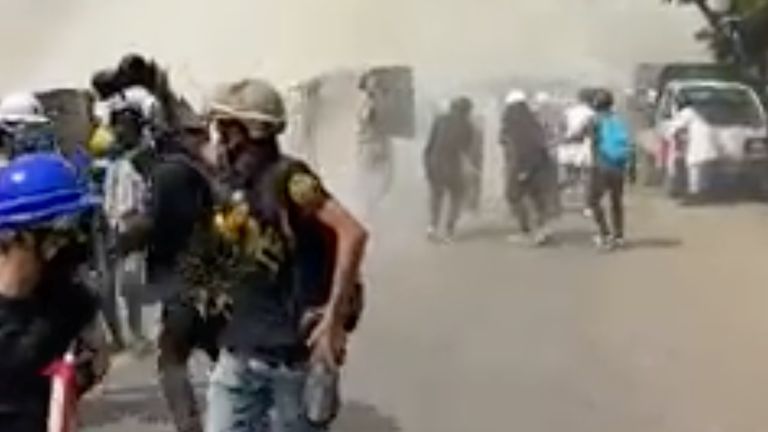
Protesters run away from tear gas in Mandalay

Security forces continued to crack down on many of the other protests, which have erupted following last month's coup.

The United Nations says more than 50 people have been killed by security forces since the military overthrew and detained elected leader Aung San Suu Kyi on 1 February.

A junta spokesman did not respond to Reuters requests for comment.

The state-run Global New Light Of Myanmar newspaper reported that police said security forces were dealing with the protests in accordance with law.

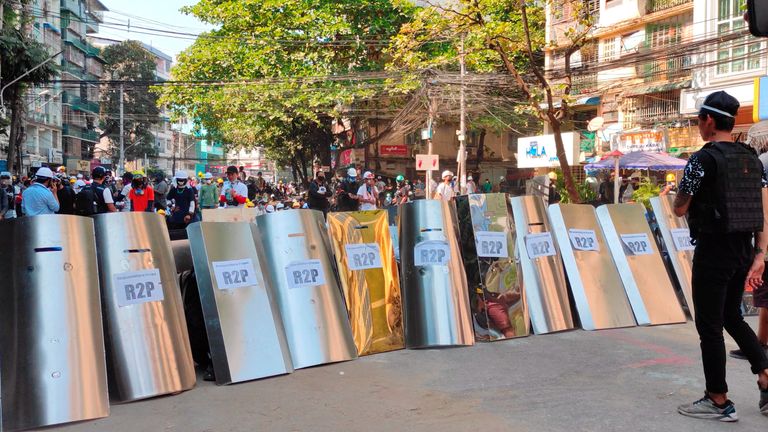
Protesters set up a makeshift shield formation in preparation for potential clashes in Yangon

More than 1,700 people have been detained by the police and military in Myanmar, the Assistance Association for Political Prisoners advocacy group said. The latest figure did not include overnight detentions.

Meanwhile, Myanmar's authorities claimed an activist who was shot dead could not have been killed by police because the wrong sort of projectile was found in her head.

They had exhumed the body of 19-year-old Kyal Sin, who died during the protests in Mandalay on Wednesday wearing a T-shirt that read "Everything will be OK".

State-run MRTV said a surgical investigation showed she had been shot from behind, while police were in front.

Photographs taken on the day showed her head turned away from security forces moments before she was killed.

Opponents of the coup accused the junta of attempting to cover-up their responsibility.

Protesters have demanded the release of Ms Suu Kyi and that military leaders respect the result of November's election - which her party won in a landslide.


Play Video - Myanmar soldier points gun at hidden resident

The army has said it will hold more elections at a date in the future yet to be set.

Israeli-Canadian lobbyist Ari Ben-Menashe, hired by Myanmar's junta to act as a spokesman, told Reuters the military leaders want to leave politics and improve relations with the United States and to distance themselves from China.

He said Ms Suu Kyi had grown too close to China.