Wednesday, January 05, 2022

‘Do you realize you’re describing a coup?’ 

Peter Navarro gets schooled during train wreck MSNBC interview

John Wright
January 04, 2022

White House trade adviser Peter Navarro. (Fox Business screengrab)

Former Trump trade adviser Peter Navarro appeared on MSNBC on Tuesday night to explain his plan to overturn President Joe Biden's victory — dubbed "the Green Bay sweep."

It didn't go well for Navarro.

Asked by host Ari Melber to explain the "Green Bay sweep," Navarro claimed he compiled a report beginning in late November 2020 that "proved that the election was in all likelihood stolen through fraud and election irregularities."

"That's false!" Melber responded, cutting off Navarro. "The question is, what was the plan itself and who was in on it?"

Navarro went on to explain that 100 GOP lawmakers were prepared to "implement the sweep," by challenging the election results in six battleground states on Jan. 6.

Melber eventually cut him off again.

"You just described this plan as a way to take an election where the outcome was established by independent secretaries of state, by the voters of those states, and legal remedies had been exhausted, with the Supreme Court never even taking let alone siding with any of the claims you just referred to," Melber said. "So legally they went nowhere. Then, you will use the incumbent losing party's power — that was the Republican Party that was losing power — to overtake and reverse that outcome. Do you realize you're describing a coup?"

Navarro denied Melber's allegation, claiming that some secretaries of state "were put in power by George Soros with the express purpose of shifting the playing field."

"We were following the Constitution and rules of the Senate to simply get a recount of what the votes were," Navarro claimed.

Melber then noted that Trump adviser Steve Bannon is "risking going to jail rather than just provide testimony about" the plan to overturn the election.

"You by contrast are describing it in your book, some of the same stuff," Melber said. "I don't know what he's afraid of that you're not. But when you describe in your book a system where after all the legal remedies are exhausted, the people who lost just make noise and say that they won and seize power, don't you understand that if that actually were the system, it would be dumb and dangerous?"

"We have an entire system designed to thwart — and I want to say this respectfully, but it's the truth — people like you," Melber added. "To stop people like you who think that you can anoint themselves the reviewers of the voters, of the American people, of what they lawfully did, that you trump the Supreme Court. People like you are what the Constitutions is designed to stop, and it worked, it did stop you."

Watch the full interview in two parts below.


Ex-Trump aide Peter Navarro says 100 House members were "ready" to carry out election coup

Coup plot called "a well thought-out plan based on sound, constitutional law and existing legislative precedent"


By JON SKOLNIK
PUBLISHED JANUARY 4, 2022 4:04PM (EST
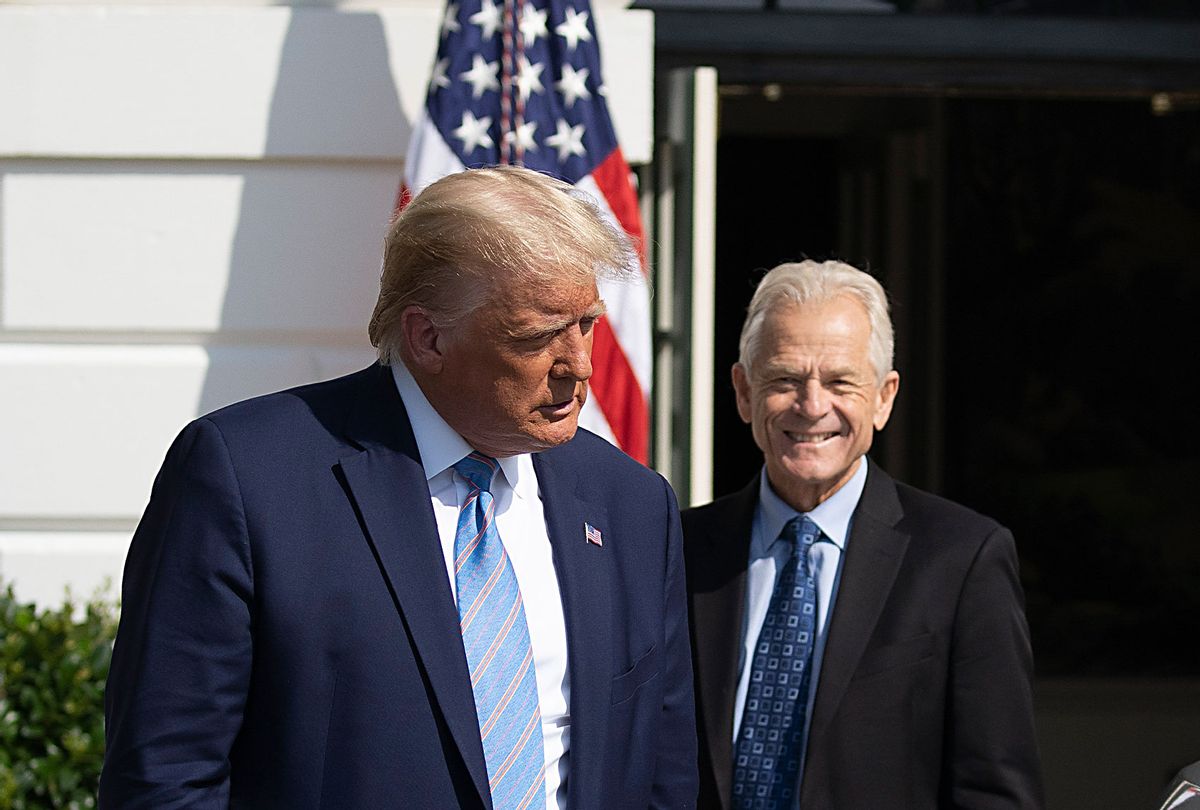
U.S. President Donald Trump and White House Trade Adviser Peter Navarro check out the new Endurance all-electric pickup truck on the south lawn of the White House on September 28, 2020 in Washington, DC. They bought the old GM Lordstown plant in Ohio to build the Endurance all-electric pickup truck, inside those four wheels are electric motors similar to electric scooters. (Tasos Katopodis/Getty Images)

In the year since last Jan. 6, we've heard numerous accounts of unsuccessful "coup plots" allegedly or reportedly devised by Donald Trump's allies and followers. But this week, in an interview with Rolling Stone, former White House adviser Peter Navarro revealed a scheme that, by his account, nearly worked to keep the former president in office.

Although officially a Trump adviser on trade and economic issues, Navarro has become a leading promoter of Trump's grandiose claims that the 2020 election was "stolen" through widespread voter fraud.

RELATED: 6 ways to overturn an election, according to Team Trump memos

Following Trump's defeat in November of that year, Navarro told Rolling Stone, the adviser did "research" on how Trump could be legally and rightfully reinstalled — at least in Navarro's mind — for a second term.

That research apparently laid the foundation for the "Green Bay Sweep," an ambitious scheme that would have required the cooperation of former Vice President Mike Pence and every Republican member of the House of Representatives. During the certification of electoral votes on Jan. 6, Pence would "provide a public forum" in which grievances and complaints about "fraud and election irregularities could be aired in 24-hours of televised hearings to the American public."

Once Congress had created a legal basis for challenging the Electoral College votes, in Navarro's narrative, there would have then been an unspecified "mechanism" — definitely not mentioned in the Constitution — "that would allow those likely illegal [Electoral College] votes to be sent back to the states for further review."

At this juncture, Navarro said, at least some Republican-dominated states would "withdraw any certification" of their electoral votes, making an Electoral College majority impossible. That would have thrown the presidential election into the House — and that part actually is in the Constitution — with each state's delegation casting one vote. Since Republicans controlled more states than Democrats, Trump would presumably have been "elected" to a second term.

RELATED: No, Pence can't start a coup: Despite Trump's bullying, VP has no power to "reject" Joe Biden's win

"My role in the whole thing was basically to provide Congress, via my reports, the analytical material they needed to actually make the challenges," Navarro explained. "And the president himself had distributed Volume One of the report to every member of the House and Senate a week or so earlier.

"It's a well thought-out plan based on sound, constitutional law and existing legislative precedent. And all it required was peace and calm on Capitol Hill for it to unfold," he added.

Navarro's "well thought-out plan" fell apart when Pence refused to object to the electoral results, after various legal experts made clear that the vice president's constitutionally-mandated role is ceremonial: He or she supervises the vote count, and nothing more.

The scheme, which allegedly had the support of 100 members of Congress, was originally concocted by Steve Bannon, who was indicted for contempt of Congress in November after refusing to comply with a subpoena issued by the House committee investigating the Capitol riot.
Advertisement:

RELATED: Steve Bannon's criminal indictment is the best thing that's ever happened to him

In recent months, the committee's findings have broadly indicated that Trump incited the Capitol insurrection. Navarro claimed, however, that the former president never wanted a violent coup carried out in his name. "My premise," he explained, "is that President Trump wanted only peace and calm so that we could meticulously implement the Green Bay Packers Sweep play."

In a more entrepreneurial vein, Navarro this week unveiled an "election fraud" board game of his own design, complete with designated "safe spaces" and "fake news" cards. Its retail price is $49.95.

"Want to know how the Democrats stole the 2020 election? Play the game," he said in a promotional video. "Want to know how Tony Fauci likely helped create a deadly virus in a communist Chinese bioweapons lab? Play the game. Want to get to the bottom of the Russia collusion hoax? Yep. Play the game."

JON SKOLNIK
Jon Skolnik is a staff writer at Salon. His work has appeared in Current Affairs, The Baffler, and The New York Daily News.
How Abraham Lincoln dealt with traitors and insurrectionists: A history lesson

Matthew Rozsa, Salon

Composite image. Donald Trump’s official portrait and Abe Lincoln,
 photo by Alexander Gardner.

Only one president, before the current one, won a national election only to see a large proportion of the country outright refuse to participate in our democracy rather than accept the result. That president was, of course, Abraham Lincoln. He concluded that those who conspired in an illegal plan to undo the American experiment in democracy had to be permanently banished from politics. It is a lesson Lincoln's successors forgot, and arguably one that should be studied carefully today.

There are key differences, to be sure, between the situation faced by Lincoln and what confronts Joe Biden today. Lincoln's victory in the 1860 election was controversial because of his opposition to slavery. No one claimed the election result itself was fraudulent — a region of the country simply despised him for being a Republican, with Lincoln's name being left off the ballot on the ballot in most Southern states. What's more, the aftermath of Lincoln's victory led to a literal civil war, and despite some dire predictions we are not close to that in the 21st century. In addition, while the 1860 election tore America apart because of one grave and highly divisive issue (that being slavery), the 2020 election posed a major threat to democracy largely because of the damaged ego of a highly narcissistic candidate.

In both cases, however, we see a large, reactionary faction rejecting an election loss, and that act serving as the catalyst for a crisis of democratic legitimacy. Lincoln faced a violent rebellion that literally caused armed conflict, resulting in hundreds of thousands of deaths. What Biden faces today is more difficult to define, but looks to be an effort to subvert the rules of democracy in practice while maintaining rhetorical support for them, and while nominally abiding by existing laws and working through existing institutions.

The political question made visible in both cases is one of self-preservation rather than principle. To what degree can a democracy tolerate the actions of those who wish to destroy it? How much defiance and resistance is permissible before democratic institutions lose all meaningful authority?

READ: 'I don't know what treason is’: Trump rioter arrested after incriminating herself on Instagram

We can never know how Lincoln would have governed during Reconstruction, since he was assassinated shortly after the Confederacy surrendered. But in waging war against the seceding states in 1861, Lincoln acted decisively to save democracy, something his immediate predecessor James Buchanan was clearly unwilling to do. Lincoln considered his legitimacy as the democratic leader of the entire nation to be beyond question, and did not hesitate to send men to kill and die for that principle.
ADVERTISEMENT

Based on the reconciliation policies Lincoln discussed during his lifetime, he clearly had an intended strategy for bringing former Confederates back into the Union. We could call it a carrot-and-stick approach: Go relatively easy on most defeated rebels, below the highest ranking political and military leaders, and make it relatively easy for Southern states to begin governing themselves again (once they accepted the abolition of slavery). The so-called Radical Republicans disagreed with Lincoln on many details and wanted a much harder line taken against former Confederates in the South, and even Lincoln understood that tolerance and generosity would only go so far.

With Lincoln's approval, Congress addressed this question directly. "The laws enacted by Congress to prevent former Confederate leaders from acquiring power after the Civil War provide an object lesson for our time," Harvard law professor Laurence Tribe wrote Salon by email. They have been enshrined in law as precedent for stopping those who would commit violence against a democratic government. Of the resulting statutes, Tribe identified this one as the "most pertinent":

Whoever incites, sets on foot, assists, or engages in any rebellion or insurrection against the authority of the United States or the laws thereof, or gives aid or comfort thereto, shall be fined under this title or imprisoned not more than ten years, or both; and shall be incapable of holding any office under the United States.


This principle — that involvement in direct insurrection or rebellion must lead to being exiled from politics — was added to the Constitution itself through Section 3 of the 14th Amendment, one of three amendments passed in the immediate aftermath of the Civil War. Every former Confederate state had to ratify these amendments before rejoining the Union.
No person shall be a Senator or Representative in Congress, or elector of President and Vice President, or hold any office, civil or military, under the United States, or under any state, who, having previously taken an oath, as a member of Congress, or as an officer of the United States, or as a member of any state legislature, or as an executive or judicial officer of any state, to support the Constitution of the United States, shall have engaged in insurrection or rebellion against the same, or given aid or comfort to the enemies thereof. But Congress may by a vote of two-thirds of each House, remove such disability.

Tribe explained the rationale behind the "disqualification provision" this way: "The will to violate one's oath to uphold the Constitution of the Union couldn't be relied on to evaporate just because the rebellion had been put down when the Union Army defeated the Army of the Confederacy. The authors of the 14th Amendment knew better than to trust the treasonous insurrectionists with the power of any public office, state or federal, ever again" — allowing for exceptions by way of a supermajority vote in both houses of Congress.

After Lincoln's death, however, nothing went according to plan. The new president, Andrew Johnson, was a Southerner and an overt white supremacist. He had opposed secession, but in every other way was sympathetic to the Confederacy.

Under Johnson, the government's approach "was pretty lenient in terms of whether to exclude or allow ex-Confederates to return to power" says Harold Holzer, one of the leading authorities on Lincoln. Although former Confederate president Jefferson Davis was barred from running for office, his vice president, Alexander H. Stephens — who had given the infamous Cornerstone Speech in 1861, clearly identifying slavery and white supremacy with the Southern cause — was allowed to serve as a congressman from Georgia in his later years.

Holzer also told Salon by email that Stephens "even got a speaking role at the ceremony at which Congress accepted the gift of a painting of Lincoln's first reading of the Emancipation Proclamation. That's how far sectional reconciliation went, in the absence of real racial reconciliation." This was a mistake, Holzer believes: "In my view, lax rules and laws allowed far too many ex-Confederates to return to state and federal government." The clear result of this was the end of Reconstruction and the beginning of the Jim Crow regime, in which formerly enslaved people — supposedly granted the right to vote under the 15th Amendment — were effectively disenfranchised and subjected to a reign of terror that lasted almost another hundred years.

Holzer draws a clear conclusion from this history. "If there is a lesson to be learned," he wrote, "then anyone who participated in, or fomented, the January 6 insurrection should be barred from ever serving in government again — from the top down."

Tribe expressed a similar view, citing "mounting evidence" that Trump and various Republican allies — including members of Congress — conspired to overturn the 2020 election. If Civil War precedents are followed, he said, "All of those who were involved in that plot, and those involved in the rally fueling and 'inciting' that 'insurrection,' ought to be investigated and, if the evidence is as it appears to be, prosecuted." Under the language quoted above from federal law and the 14th Amendment, that would also mean permanent disqualification from public office.

There is no indication, however, that Biden or Attorney General Merrick Garland are likely to heed Tribe's advice in general terms, still less seek to prosecute Donald Trump himself. For many critics, this looks to be a matter of putting PR or optics ahead of principle. It might also be described as ignoring or avoiding an important lesson from American history: Don't allow traitors to get away with it.

The risk of a coup in the next US election is greater now than it ever was under Trump


Republicans are busy undermining the next election. But giving up on democracy isn’t an option. We must fight back, and here’s how


‘The temptation to seize power will surely tantalize a political party that seems openly hostile to the very premises of democracy.’ 
Photograph: Tom Brenner/Reuters

Laurence H Tribe
Mon 3 Jan 2022 

Only free and fair elections in which the loser abides by the result stand between each of us and life at the mercy of a despotic regime – one we had no voice in choosing and one that can freely violate all our rights. So everything is at stake in the peaceful transfer of power from a government that has lost its people’s confidence to its victorious successor. It was that peaceful transfer that Trump and his minions sought to obstruct and almost succeeded in overthrowing when Joe Biden was elected president.

A year has passed since Donald Trump’s attempted coup and his supporters’ violent storming of the United States Capitol on 6 January 2021, in a nearly successful effort to prevent Congress from certifying Trump’s decisive loss of the election to Biden. Watching the images that day of the seat of US democracy overtaken and defiled, it was impossible not to viscerally feel the grave danger that confronted the republic. In the tumultuous year since, the immediacy of that sensation has waned – and the magnitude of the stakes has receded from memory.

In the rubble of the insurrection, the sheer shock of the moment jarred loose hints of long-lost bipartisanship and national unity and rekindled an appreciation of why a successful coup would have meant the end of all we care about. The House of Representatives expeditiously moved to impeach Trump for his role in fomenting the attack and 57 senators, including seven Republicans, voted to convict him on 13 February after a masterful presentation led by Representative Jamie Raskin, a Democrat of Maryland. After Trump had become the first American president to be impeached twice, the Senate Republican leader, Mitch McConnell, delivered a blistering rebuke of Trump from the Senate floor, justifying his and many other Republicans’ votes to acquit only on the thin reed that, by the time of his Senate trial, Trump was no longer president.

Alas, the moment was short-lived. With Trump himself out of office and in exile at Mar-a-Lago, public attention quickly faded, Republicans abandoned their increasingly half-hearted search for accountability, and the leaders of their party began planning their next bite at the poisoned apple of power, an apple they told themselves had been stolen from them despite all evidence to the contrary.

Rewriting history and turning reality on its head, Republicans in Congress and their allies in rightwing media began absurdly to describe the deadly insurrection as a “mostly peaceful” protest, described rioters who brutally beat Capitol police as “political prisoners”, and suggested that any violence was attributable to some unidentified group of leftwing “antifa”.

To be sure, we have seen the rise of a veritable cottage industry of commentary warning sharply that America remains subject to what some have called a “slow-motion insurrection” or that “Trump’s Next Coup Has Already Begun”. Yet the vast majority of Americans have turned their attention back to other concerns – from new and more infectious variants of the Covid-19 virus, to burgeoning inflation and increasingly palpable signs of global warming, to the myriad other problems that bedevil our nation and the world.

But for those of us who have continued to investigate the sources and facets of the assault on constitutional democracy, a sobering realization has become unavoidable: our country, and the legal and political institutions that prevent it from descending into despotism, are in even greater peril today than they were at the time of last November’s election.

That assault began in the runup to the 2020 election, when Trump and his cultlike followers spread the corrosive view that American elections had become inherently untrustworthy as demographic changes broadened the eligible electorate and thus that any outcome other than victory for Trump would necessarily be the result of fraud and must therefore be rejected by all means necessary.

With each passing day, more details about the means Trump’s team devised to undo the results of the November 2020 election have cascaded into public view, even though Republicans in Congress have made concerted efforts to obstruct the work of the special House committee created to uncover the sources of the attempted coup and the ensuing insurrection. The committee was charged to propose legislation to reduce the danger of a repeat performance, but because curing a disease requires diagnosing its cause, Republicans have seized on the committee’s search for causes to claim that its purposes were solely vindictive and not legislative.

In the course of designing possible remedies, the committee has uncovered evidence of a conspiracy broader, more far-reaching and better organized than was initially thought. That conspiracy featured deceptive PowerPoint presentations and duplicitous talking points designed to propagate the big lie that Democrats had indeed stolen the election and to lay out a blueprint for “stopping the steal”.

Understanding that blueprint requires appreciating the byzantine constitutional structure dating to our founding, a structure in which the presidency is awarded not to the winner of the national popular vote but to the candidate receiving the most “electoral votes”. Those votes are allocated among the states according to a formula slanted toward less densely populated states – states that have tended over time to favor the Republican candidate – with each state’s legislature determining the method for deciding how its electoral votes will be awarded.

As Representative Raskin, a leading member of the special House committee, described it to me, the basic plan for Trump to seize power despite his loss of both the popular vote on 3 November and the electoral vote on 14 December had been to pressure various officials to “find” enough nonexistent votes to flip the results of several key states in which the election’s outcome had been the closest.
Advertisement


Failing that, the plan was to pressure Vice-President Mike Pence, presiding over the 6 January joint session of Congress required under the constitution to count the certified electoral votes, to reject and return the slates of electoral votes certified by Arizona, Georgia and Pennsylvania, depriving both candidates of the requisite majority of the electoral votes cast.

At that point, the choice of president would fall “immediately” to the US House of Representatives, with each state’s delegation casting a single vote in the resulting “contingent election”. That in turn would have made Trump the president-elect despite having lost the election, because more state delegations in the House were in Republican hands at that point than in the hands of the Democrats.

Part of the plot, we are now learning, featured Trump’s invocation of the Insurrection Act to declare something like martial law to put down the chaos and bedlam he and his inner circle would by then have unleashed on the Capitol, all the time blaming the speaker of the House, Nancy Pelosi, for not keeping order, a form of sinister gaslighting the Republicans have deployed ever since 6 January. Talk of that military option led the CIA Director to predict that “we are on the way to a right-wing coup”.

But most terrifyingly, we have learned over the past year that the Republican party plans to do it again. Some retired generals are warning that, without decisive action to hold all the wrongdoers to account, we will witness a march to another coup attempt, and one more likely to succeed, if Trump or another demagogue runs and loses. Trump’s Republican party has all but erased or openly embraced the violence of 6 January. And the party faithful have already set out to use state-level elections and legislative processes to better set the table to steal the 2024 election should that be necessary to their return to power.

And why wouldn’t they?
Myths of wrongful defeat at the hands of enemies within or without are invariably part of the demagogue’s narrative

Those involved in the last attempt have – at least as of today – faced few if any social, political or legal penalties. Only the foot-soldiers, those who physically invaded the Capitol, have faced criminal punishment. And even they have been charged with no offense more serious than corruptly obstructing an official proceeding. As I have elsewhere argued, it would seem more fitting to charge those who organized, funded, and otherwise led the nearly successful overthrow of our government with insurrection or sedition.

Indeed, in the topsy-turvy world of Trumpian logic, the political base of the Republican party now appears by a large majority to believe that the real coup and insurrection took place not on 6 January 2021 but on 3 November and 14 December 2020, when Joe Biden and the Democrats supporting him were guilty of a “big steal” of the national election.

Students of how democracies fail and tyrannical regimes arise from the dust they leave behind uniformly teach that such groundless myths of wrongful defeat at the hands either of enemies within or of enemies without are invariably part of the demagogue’s narrative and of its hold on popular consciousness.

The specter of another coup attempt in 2024-25 may, at first blush, seem counterintuitive. After all, whether Donald Trump or another aspiring despot runs next time as the Republican party’s nominee, that candidate will have no access to the powers of the presidency when the national election occurs. But the corrupt actions that threaten soon to bring our constitutional republic to an ignoble end sadly do not require either an exercise of presidential power or the abdication of presidential duty.

They require only that the cult of Trump repopulate with party hacks the bureaucracy of honest vote-counters and nonpartisan election personnel at the state and local levels, and that Trump-backed lawmakers elected to state legislatures rig the voting rules to dilute the influence of all who might oppose a Republican victory. Because these steps are well under way, we face a challenge more daunting than we did even when the powers of the presidency were in Trump’s hands.

Nor can we count on the congressional voting integrity measures brilliantly designed with the help of Adam Schiff and Jamie Raskin, the Democratic representatives who led Trump’s two Senate impeachment trials, to save us from what the growing number of Republican state legislatures seem only too eager to do. For one thing, even before the 2022 midterm elections, Democrats control too few seats in the Senate to overcome the antiquated filibuster rules that make enactment of such voting rights measures with fewer than 60 votes an impossibility. For another, the US supreme court, as packed by means of dubious legitimacy by Trump during his presidency, is poised to hold unconstitutional virtually any meaningful voting protection or electoral reform Congress might enact even if that 60-vote obstacle could be carved away in a limited class of cases.

Even if something should derail another Trump run at the presidency, the means for another coup exist, and the temptation to seize power, this time cementing it more permanently, will surely tantalize a political party that seems openly hostile to the very premises of democracy.

Of particular concern to students of fascism – a governing form that almost always comes wrapped in violence – was the violence woven through the rise of Trumpism to the siege of the Capitol which was, of course, brutally violent. Participants came armed with body armor, firearms, knives, bear mace, Tasers and everything in between. They brought a gallows and chanted that they were going to hang the sitting vice-president. They brutally beat Capitol and DC police officers.

Far from being condemned, violence has been increasingly glorified by the mainstream conservative movement

Nor was the violence limited to that day. Leading up to the 2020 election, Trump supporters had run a Biden campaign bus off the road in Texas, plotted to kidnap the Democratic governor in Michigan and stirred up brutal attacks across the country. In the period after that election, they physically surrounded and intimidated senators on an airplane and in an airport, calling them “traitors” and promising consequences for their perceived defection from Trump. They showed up at state capitols armed to the teeth and threatening retribution if state legislators did not allocate their electoral votes to Trump, or at least pursue fraudulent “audits” of the election results.

Far from being condemned, in the intervening year that sort of violence has been increasingly glorified by the mainstream conservative movement. In recent weeks, a congressman posted a Photoshopped video of himself murdering a Democratic colleague. A Fox News host discussed – to a crowd of radicalized anti-vaxxers – how they might most appropriately assassinate our nation’s chief epidemiologist with a “kill shot” in “an ambush”. Large crowds venerated a juvenile vigilante who shot three people on an American street.

The base is being primed for more violence in the run-up and aftermath of the next election. And the Trump-packed supreme court is poised to do its part by gutting what is left of America’s laws against carrying guns anywhere and everywhere – including maybe in courthouses, polling places and the like. It is no accident that the 6 January hotel command center of the group led by Steve Bannon and Roger Stone was christened the “war room”.

So what is to be done?

We must resist state-level attempts to make voting more difficult. Instead, we must make vote-counting easier and use all legal means at our disposal to challenge publicly and in state and federal courts legislative district maps designed to dilute minority voters’ influence or to amplify the power of incumbency, as well as laws empowering state officeholders to designate presidential electors at odds with their state’s popular election results.

We must use boycotts and grassroots political organizing to oppose the replacement of honest with corrupt election officials and the enactment of anti-democratic state laws.

We must encourage the 6 January committee to complete its work thoroughly but quickly, including holding public hearings that spotlight the damning details of the plot that nearly succeeded, and making criminal referrals to the Department of Justice of all public officials – from members of Congress to the former president – suspected of such federal crimes as obstructing an official proceeding, aiding and abetting an insurrection or conspiring to commit sedition.

We must fight back against suggestions that the justice department’s criminal investigations of the highest-ranking public officials should await any such criminal referrals from the committee.

We must redouble our determination to hold criminally accountable, and potentially disqualify from ever again holding public office in the United States, everyone involved in the obscene trashing of constitutional democracy.

We must publicly repudiate whatever misguided notions have led the Biden administration’s attorney general, Merrick Garland, to exercise extraordinary restraint in the pursuit of such full accountability, effectively placing the highest officeholders above the law.

Above all, we must not let the difficulty of the task ahead turn realism into resignation and sap the energy we will need to bring to this mission. As the distinguished Yale historian Joannne Freeman recently wrote, “Accountability – the belief that political power holders are responsible for their actions and that blatant violations will be addressed – is the lifeblood of democracy. Without it, there can be no trust in government, and without trust, democratic governments have little power.” And when democracy loses its grip as a guiding ideal, despotism fills the void and liberty is lost.

This is a battle we must not, cannot, will not lose.

Laurence H Tribe is the Carl M Loeb University professor emeritus and professor of constitutional law emeritus at Harvard University and an accomplished supreme court advocate

Top CEOs in Canada were paid at second-highest level ever during the pandemic

OTTAWA — Canada's 100 highest-paid CEOs had their second-best year ever in 2020, even as the COVID-19 pandemic left this country in the worst economic downturn since the Great Depression.

© Provided by The Canadian Press

“Despite the pandemic being a pretty bad year for most Canadians, particularly on the unemployment front, it wasn't really that bad for Canada's richest CEOs,” said David Macdonald, a senior economist at the Canadian Centre for Policy Alternatives.

Macdonald authored a report released Tuesday examining how much the top 100 best-paid CEOs of publicly traded companies earned in 2020. The report said that by noon on Tuesday, the average CEO of these companies would have already earned what the average Canadian worker will make all year.

In 2020, as many Canadians had hours cut or lost their jobs completely during repeated lockdowns and forced closures, those highest-paid CEOs earned an average of $10.9 million.

That was down from the record high of $11.8 million in 2018, but an increase of $95,000 compared with 2019.

Macdonald said that CEOs receiving the second-highest pay on record is “quite an achievement” given the pandemic was damaging to many of the companies they were running.

More than 82 per cent of the average pay came through bonuses including cash or stock options, which Macdonald said companies creatively calculated to ensure poor performance during the pandemic didn't affect CEO pay.

“This only happens in bad times,” said Macdonald. “When things go badly for the company, CEOs are protected in many cases. When things go well for the company, the sky's the limit.”

Macdonald said CEOs often justify their bonuses with claims they are compensation for being exceptional at their jobs, but he said half the CEOs who got bonuses in 2020 worked at companies which received government aid like the Canada Emergency Wage Subsidy or only received the bonus because of an adjustment to the bonus formula.

“I think it really illustrates the bankruptcy of the idea that this is somehow based on merit,” he said.

The top-paid CEOs made 191 times more than the average worker in 2020, which was down from 202 times as much in 2019, and the lowest gap between CEOs and average workers in six years.

VIDEO Despite the pandemic, Canada's 100 top-paid CEOs saw their compensation increase in 2020: Report Duration: 07:27 


But that's not, Macdonald said, because average workers got a raise. Instead, so many of the lowest paid workers were laid off for part of the year that their wages were missing entirely as the average numbers were calculated.

The report makes several recommendations for tackling excessive executive pay through a review of tax systems, including how capital gains and stock options are treated.

Macdonald also recommends the federal government create a wealth tax for the richest Canadians, as the wide gap between the average income of Canadians and the highest-paid CEOs is set to broaden further over time.

“When we're thinking about how should we structure taxation, so that it's based on what people can pay, a wealth tax then makes a lot more sense,” he said.

NDP Leader Jagmeet Singh campaigned last fall on a promise to create a wealth tax of one per cent on anyone with a net worth of more than $10 million, and impose a 35 per cent tax on income over $210,000.

In their first year in office, the Liberals raised the tax rate from 29 per cent to 33 per cent for people earning more than $200,000. Because of inflation, the top tax bracket now starts at $216,511.

Finance Minister Chrystia Freeland has now been tasked with establishing a minimum 15 per cent tax rule for top-bracket earners, which would include an attempt to prevent the wealthiest Canadians from reducing their tax burden through various tax planning loopholes.

She was also told in her mandate letter to fund the Canada Revenue Agency to combat tax avoidance, and raise corporate income tax for banks and insurance companies that make more than $1 billion.

Adrienne Vaupshas, a spokesperson for Freeland, said in a statement Tuesday that the government has been "consistently focused" on addressing income inequality in Canada by putting in place higher personal income taxes for the wealthiest Canadians, a tax on multinational digital giants, and limiting stock option deductions in the largest companies.

NDP finance critic Daniel Blaikie said in a statement that the Liberals have let everyday Canadians down because they have not made the ultrarich pay their fair share, such as by closing tax loopholes and tax havens.

The Tories did not immediately respond to a request for comment.

This report by The Canadian Press was first published Jan. 4, 2022.

---

This story was produced with the financial assistance of the Facebook and Canadian Press News Fellowship.

Erika Ibrahim, The Canadian Press
Warren, Jayapal blast Google over efforts to "bully" and "sideline" DOJ's top antitrust official

Google must stop attempting to intimidate US antitrust enforcers at the Justice Department, according to two congressional Democrats.
© Tom Williams/CQ-Roll Call, Inc/Getty Images
 Sen. Elizabeth Warren, D-Mass., right, and Rep. Pramila Jayapal, D-Wash., conduct a news conference in the Capitol to introduce the Ultra-Millionaire Tax Act which would tax high net worth households on Monday, March 1, 2021.

By Brian Fung, CNN 

On Wednesday, Sen. Elizabeth Warren and Rep. Pramila Jayapal wrote to Google CEO Sundar Pichai lambasting his company's efforts to get Jonathan Kanter — DOJ's top antitrust official — to recuse himself from all matters related to the company.

"These efforts to bully regulators and avoid accountability — which are similar to those of Facebook and Amazon this year — are untethered to federal ethics law and regulations, and we urge you to cease them immediately," the lawmakers wrote. "Google should focus on complying with antitrust law rather than attempting to rig the system with these unseemly tactics."

Google (GOOG) didn't immediately respond to a request for comment.

The lawmakers' letter comes amid an ongoing Justice Department lawsuit targeting Google's dominance in search and search advertising. It follows a request by Google in November seeking Kanter's recusal a day after his Senate confirmation.

It also comes on the heels of a pair of similar requests that Amazon and Facebook submitted to the Federal Trade Commission last year seeking recusal of Chair Lina Khan from matters involving those businesses.

In its initial request, Google argued that Kanter's previous representation of clients opposed to the search giant, such as Yelp, disqualified him from DOJ's Google oversight. But in Wednesday's letter, Warren and Jayapal charged that Google was misrepresenting federal ethics laws and that Kanter was "eminently qualified."

The lawmakers said Kanter would only be required to recuse himself if he stood to benefit financially from the litigation; if he had previously represented a party directly involved in the suit; or if a "reasonable person" might question his neutrality based on the public record.

Google has a "clear financial interest in weak antitrust enforcement," the two Democrats wrote, but Kanter's record "has aligned with the federal government's interest in robust enforcement of antitrust law."

"Your efforts to sideline key federal regulators... simply serve as further evidence that you will go to all lengths to ward off necessary scrutiny of your immense market power," the letter said. "We urge you to cease these actions and allow federal officials to do their jobs and enforce federal antitrust law."
Google boosted base pay for 4 top execs to $1 million and handed them up to $34 million in stock, weeks after refusing to raise wages to meet inflation

mcoulter@businessinsider.com (Martin Coulter)
Google CFO Ruth Porat 

Google has boosted base pay of four top execs to $1 million.

Two have are set to be awarded $34 million in stock grants.

The move comes weeks after the search giant declined to raise employee pay in line with inflation.

Four Google C-suite executives are set to get a salary bump to $1 million, plus a hefty increase in stock awards.

According to a summary of executive salaries disclosed in SEC filings, the four Google execs — chief financial officer Ruth Porat, senior VP Prabhakar Raghavan, chief business officer Philipp Schindler, and legal chief Kent Walker — will see their annual salaries bumped from $650,000.

All are also eligible for a $2 million bonus if they help Google to meet its "social and environmental goals" for 2022.

The execs' total compensation packages are considerably chunkier when taking equity into account. As well as their increased annual pay, the executives were granted millions of dollars' worth of performance and restricted stock units, which variously vest at different times and depend on the execs sticking around.

According to the filing, Porat and Walker were each granted $23 million total in stock units, and Raghavan and Schindler $34 million total each.

As of December 2019, chief executive Sundar Pichai's annual base salary comes in at $2 million. He's eligible for a further $150 million in restricted and performance stock units if he stays at Google and meets certain performance targets.

Google's finances are in good health following another record quarter in October, raking in revenue of $65.1 billion and almost $20 billion in profit.

But the move comes just weeks after a December all-hands meeting in which Frank Wagner, Google's compensation chief, told rank-and-file staff that the company would not be offering any "across-the-board" adjustment in line with inflation, which recently surged in to its highest level in decades.

"As I mentioned previously in other meetings, when we see price inflation increasing, we also see increases in the cost of labor or market pay rate," Wagner told employees, according to NBC. "Those have been higher than in the recent past and our compensation budgets have reflected that."

Insider approached Google for comment.
US population growth stalled to its lowest rate on record thanks to the pandemic — even slower than during the Great Depression
jepstein@insider.com (Jake Epstein) 
 A detail photo of the information table for the 2020 Census in Reading, Pennsylvania, on September 25, 2020. 
Photo by Ben Hasty/MediaNews Group/Reading Eagle via Getty Images

US population growth stalled to its lowest rate on record.

The population grew by just 0.1% in 2021 — measured from July 2020 to July 2021, according to Wells Fargo economists.

Economists blamed the slowdown on increased mortality rates, decreased birth rates, and less migration.

US population growth stalled to its lowest rate on record — even slower than during the Great Depression — because of the pandemic.


The population grew by just 0.1% in 2021 — measured from July 2020 to July 2021 — which is the slowest growth rate on record since 1900, according to an analysis released by Wells Fargo economists on Wednesday based on US Census data.


For comparison, population growth during the Influenza Pandemic and the First World War hovered just below 0.5% — rising slightly during the Great Depression to around 0.6%, according to the data.


The economists pinned the current growth slowdown on increased mortality rates, decreased birth rates, and less international migration during the COVID-19 pandemic.


"The period from 2010 to 2020 marked the second-slowest decade in history for U.S. population growth," Wells Fargo economists Mark Vitner, Charlie Dougherty, and Nicole Cervi wrote in their analysis.

Thirty-three states however marked a net gain in their population in 2021 — including Florida, Texas, and Arizona — while 17 states and Washington DC saw their net populations shrink, according to the data.

Hawaii, Minnesota, and Maryland led the pack of states with the lowest net domestic migration from July 2020 to July 2021.

The data comes as the US readies to mark two full years of the pandemic, a milestone preceded by a current surge in COVID-19 cases led by the highly transmissible Omicron variant. Over 1 million new COVID-19 cases were reported on Monday, according to Johns Hopkins University data, which shattered the previous record.
US agencies investigate Navy fuel leak's effect on civilians

HONOLULU (AP) — U.S. public health officials on Tuesday began investigating how civilians have been affected by the leakage of petroleum into Pearl Harbor's tap water from a Navy fuel storage facility.

The Hawaii state Department of Health said it asked the Centers for Disease Control and Prevention and the Agency for Toxic Substances and Disease Registry to conduct the study.

The department said the officials will survey civilians living in homes served by the Joint Base Pearl Harbor-Hickam water distribution system. They will also try to reach people who may have been exposed to contaminated water at work or school.

The Navy's water system serves some 93,000 people in residential homes, offices, elementary schools and businesses in and around Pearl Harbor.

Starting in late November, about 1,000 people complained that their tap water smelled like fuel or reported physical ailments like nausea and rashes after ingesting it.

Shortly after the Navy said it detected petroleum in a drinking well that serves its water system. Navy officials say they believe leaks from its Red Hill tank farm near Pearl Harbor polluted the well.

Dr. Diana Felton, the state toxicologist, said it’s vital that authorities track how the incident affected all Hawaii residents.

Meanwhile, Hawaii's congressional delegation urged the Navy to comply with a Monday order from the Hawaii Department of Health to drain fuel from the tanks to protect Oahu's drinking water.

“Defueling safely will require a coordinated effort, and the delegation will do everything possible to support this effort,” they said in a statement. "Clean drinking water is essential to our health and safety, and our future — we all agree this cannot be compromised for anything.”

The delegation consists of four members, all Democrats: U.S. Sens. Brian Schatz and Mazie Hirono and U.S. Reps. Ed Case and Kaiali‘i Kahele.

So far only the Navy's water system has been affected by the contamination. But Honolulu's water utility draws from the same aquifer as the Navy, and Hawaii officials are concerned leaks will contaminate its water too.

The Red Hill facility holds 20 giant underground tanks built into the side of a mountain during World War II. Each tank is roughly the height of a 25-story building. Collectively, they can hold up to 250 million gallons (946 million liters) of fuel, though two of the tanks are now empty.

The tank farm sits just 100 feet (30 meters) above the aquifer shared by the Navy and the Honolulu Board of Water Supply. It supplies petroleum to all branches of the military.

Audrey Mcavoy, The Associated Press
Experts puzzled by continuing South Carolina earthquakes

COLUMBIA, S.C. (AP) — Yet another earthquake has struck near South Carolina's capital city, the ninth in a series of rumblings that have caused geologists to wonder how long the convulsions might last.

Early Wednesday, a 2.6-magnitude earthquake struck near Elgin, about 25 miles (40 kilometers) northeast of Columbia, according to the U.S. Geological Survey. It was measured at a depth of 0.5 kilometers, officials said.

That area, a community of fewer than 2,000 residents near the border of Richland and Kershaw counties, has become the epicenter of a spate of recent seismic activity, starting with a 3.3-magnitude earthquake on Dec. 27. That quake clattered glass windows and doors in their frames, sounding like a heavy piece of construction equipment or concrete truck rumbling down the road.

Since then, a total of eight more earthquakes have been recorded nearby, ranging from 1.7 to Wednesday's 2.6 quake. No injuries or damage have been reported.

According to the South Carolina Emergency Management Division, the state typically averages up to 20 quakes each year. Clusters often happen, like six small earthquakes in just more than a week last year near Jenkinsville, about 38 miles (61 kilometers) west of the most recent group of tremors.

Earthquakes are nothing new to South Carolina, although most tend to happen closer to the coast. According to emergency management officials, about 70% of South Carolina earthquakes are located in the Middleton Place-Summerville Seismic Zone, about 12.4 miles (20 kilometers) northwest of Charleston.

In 1886, that historic coastal city was home to the largest recorded earthquake in the history of the southeastern United States, according to seismic officials. The quake, thought to have had a magnitude of at least 7, left dozens of people dead and destroyed hundreds of buildings.

That event was preceded by a series of smaller tremors over several days, although it was not known that the foreshocks were necessarily leading up to something more catastrophic until after the major quake.

Frustratingly, there's no way to know if smaller quakes are foreshadowing something more dire, according to Steven Jaume, a College of Charleston geology professor who characterized the foreshocks ahead of Charleston's 1886 disaster as “rare.”

“You can't see it coming,” Jaume told The Associated Press on Wednesday. “There isn’t anything obvious moving or changing that you can put your finger on that you can say, ‘This is leading to this.'"

Typically, Jaume said that the recent quakes near Elgin — which lies along a large fault system that extends from Georgia through the Carolinas and into Virginia — would be characterized as aftershocks of the Dec. 27 event, since the subsequent quakes have all been smaller than the first.

But the fact that the events keep popping up more than a week after the initial one, Jaume said, has caused consternation among the experts who study these events.

“They're not dying away the way we would expect them to,” Jaume said. “What does that mean? I don't know.”

___

Meg Kinnard can be reached at http://twitter.com/MegKinnardAP.

Meg Kinnard, The Associated Press
Scientists taught goldfish how to drive a tank on land
Joshua Hawkins 
© Provided by BGR Glass fishbowl on table

A new study from researchers has proven that goldfish are capable of learning how to navigate on land. No, they haven’t suddenly grown legs and started parading around in people’s backyards. Instead, the study showcases how researchers taught goldfish to traverse the land in a tank on wheels. The idea behind the study appears to have been an attempt to better understand animal navigation, including how animals change strategies to overcome certain obstacles.
Scientists made a fish operated vehicle

The tank that the researchers made is called a fish-operated vehicle, or FOV for short. It’s essentially just a tank attached to a wheeled terrestrial platform. The platform also has a LIDAR sensor, computer, and camera attached to it, to help process the animal’s navigational movements.

Basically, the platform works by moving in a direction based on where the fish is in the tank. Once they had it set up, researchers used color-coded environments to teach the goldfish how to navigate around a room. The results of these animal navigation tests are honestly intriguing.

Previously, researchers learned that goldfish are able to orient themselves using both allocentric and egocentric maps. Egocentric and allocentric are often used to help differentiate between two types of spatial information. For example, egocentric framing is when you frame the location based on the individual’s location in the environment. Allocentric framing, then, has to do with the general spatial information of the area, without taking the individual into account.

With this study, the researchers were able to dig a bit deeper into animal navigation as a whole.

To teach the fish how to drive, the researchers used visual targets. These targets were easily observable through the walls of the tank. Using those targets, the goldfish were able to successfully navigate terrestrial environments. Scientists even tried starting the fish out in different parts of the room. Each time, the goldfish were able to successfully navigate to the target. This showed that animal navigation can continue even when the target has to overcome certain obstacles.

But what does it all mean? That’s a great question. The researchers set out to study how animals navigate the world around them. Using the information that they’ve learned; they can dig a bit deeper into how those animals learn and change their navigation habits based on their environment. In this instance, the fish had to overcome several challenges. First, it had to learn the motor skills needed to drive the vehicle.

This meant that the fish had to be taught how the tank worked, and how its movements in the water could correspond with the tank’s movements. Furthermore, the fish had to learn how to navigate the world through its distorted view. Because the fish lives within the water, it sees the world in a distorted vision due to refraction in the water. So, the fish had to overcome this obstacle to navigate the world correctly.

Despite those challenges, the researchers were able to get the fish moving around the room quite well. As such, they say these behavioral results suggest that the fish has a level of universality in space representation, and its navigational strategies.

The post Scientists taught goldfish how to drive a tank on land appeared first on BGR.
How climate change primed Colorado for a rare December wildfire


Elizabeth Chuck
Sun, January 2, 2022

The rare December blaze that tore through Boulder County, Colorado, at frightening speed this week may not be that unusual in the future, wildfire experts warn, as climate change sets the stage for more.

Wildfires do not historically happen during the winter, particularly in areas like Boulder County, where the ground is normally moist from snow.

But in recent months, Colorado has experienced a severe drought. From July 1 through Dec. 29, Denver recorded its lowest amount of precipitation by over an inch, with snowfall at record low levels, too. Meanwhile, Boulder, which typically gets about 30 inches of snow from September to December, got just 1 inch in that period leading up to the day of the fire.

Combine that with an unseasonably warm fall, and the ground had significantly less moisture in it than it normally would — creating perfect conditions for a fire to flourish.

“Everything is kind of crispy,” said Keith Musselman, a snow hydrologist and assistant research professor at the University of Colorado Boulder. “In addition to the extreme drought, just 1- or 2-degree warmer days can really dry out the landscape quite a bit more, so everything is that much drier and flammable.”

Officials say wind gusts up to 105 mph fanned the flames, rapidly destroying 500 to 1,000 homes and giving residents barely any time to evacuate.

While gusts of that magnitude are somewhat out of the ordinary this time of year, they cannot be directly tied to climate change, said Daniel Swain, a climate scientist at UCLA and the nonprofit Nature Conservancy.

However, he said, climate change was definitely the reason the ground was primed for the wind-whipped fire to take off, and wildfire seasons could lengthen similarly in other areas.

“Climate change is clearly making the pre-conditions for wildfires worse across most fire-prone regions of the world,” he said.

In addition to the time of year, Colorado’s fire stood out for another reason, said Philip Higuera, a professor of fire ecology at the University of Montana. Very few burn as many structures.

“Unfortunately, this illustrates one of the worst-case scenarios,” he said of the fact that the blaze burned through densely populated neighborhoods. “These are these high-wind events under these extremely dry conditions, and you’re basically crossing your fingers and hoping there isn’t a human-caused ignition in the wrong place.”

Addressing the problem

The solution, the experts say, is two-pronged: Attack climate change through actions and discussions within communities and households in the long term and, in the short term, do not assume that certain areas are immune from fires.

“We as a society need to recognize that wherever we’re living in the West with vegetation is a fire-prone environment,” Higuera said. “This can happen anywhere.”

That might mean changing how homes are built or reinforced to make them more fire-proof or changing infrastructure so power lines are buried or shut off during high-wind events, he said.

Officials initially suspected that a downed power line caused the blaze Thursday in Colorado but said later that the investigation had revealed that there had not been any. They said they were still investigating.

While fires are likely to become more common year-round, Swain said, winter still would not be a time of high fire activity.

“I still don’t think winter is ever going to be peak fire season in the West,” he said. “But it used to be a fire non-season, and I really don’t think that’s the case anymore.”