Tuesday, February 07, 2023

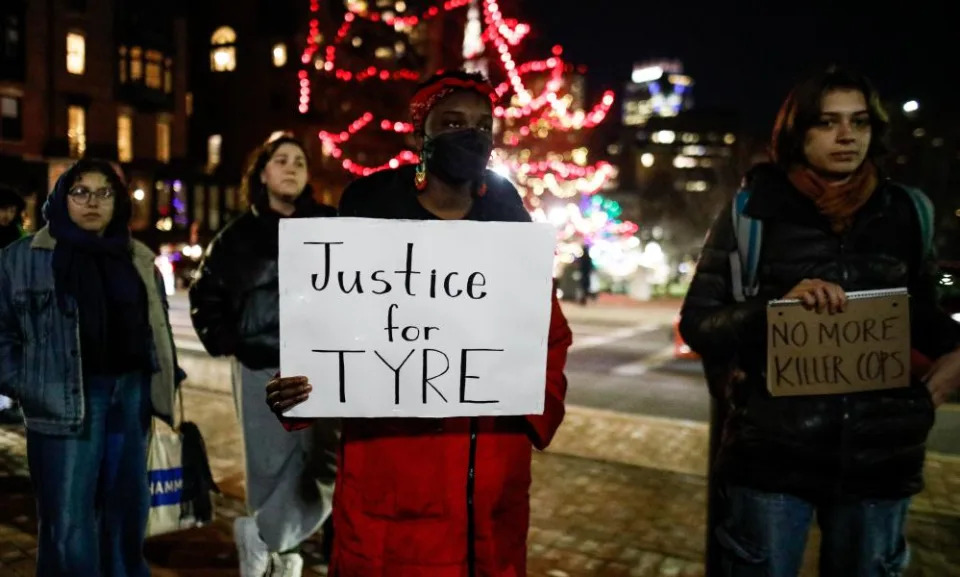
Black skateboarders on the life and death of Tyre Nichols: ‘He was one of us. That could have been me’

Niloufar Haidari
Mon, 6 February 2023 

It has been nearly a month since Tyre Nichols died after a beating by Memphis police. Even by the standards of a country with a long legacy of police violence, his death was breathtaking in its brutality – both in the severity of the beating by the police officers, and the negligence shown by the EMTs who stood around for 19 minutes while he fought for his life on the ground.

Nichols, 29, was a lot of things: a father, photographer, lover of sunsets and a skater. Due to its public image as a nuisance to polite society, skateboarding is a hobby intimately familiar with skirmishes with law enforcement; for Black skaters, who are often seen as outsiders in a world of outsiders, these interactions can be particularly fraught.
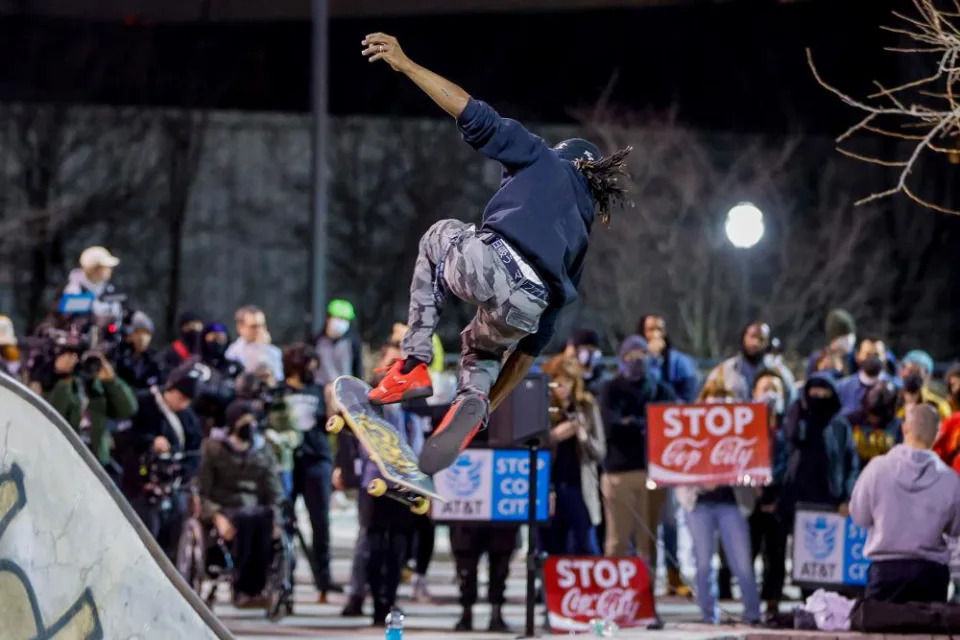

Dimitri Crippen rides his skateboard as a group of people protest over Tyre Nichols’ death at the Old Fourth Ward Skatepark in Atlanta last month.
Photograph: Erik S Lesser/EPA

Since the news broke, the skateboarding community has come together to condemn the death and spread a joyful video of Tyre doing what he loved – skating. Celebrated Black skaters such as Stevie Williams have spoken out about the murder on social media, and this weekend saw skaters take to the streets from Memphis to Los Angeles to Keep Pushing for Tyre in remembrance.

‘I felt this deep, personal grief’: Patrick Kigongo 
Acting executive board chair for the Harold Hunter Foundation and co-host of the Mostly Skateboarding podcast

That could have been me. It’s a recurring thought for any Black person in America when there’s a Black person killed by police officers, but this one really hit close to home. We often talk about the way that Black people are portrayed in media, and the clip that has been circulating of him skating has been refreshing because it’s something so joyous, this stark contrast to the footage of him being beaten by cops. When I saw that video I felt this deep, personal grief, something I didn’t anticipate.

Skateboarding is not a monolith, but something that every skateboarder has experienced is some sort of frightening or traumatizing experience dealing with either police officers or security guards. I remember the first time I got lined up with a bunch of my friends for skating at a loading dock behind a photo studio. There was something bizarre about it, in that we all knew what to do – you sit on your hands, you don’t say anything, nobody talks out of turn, and ideally, they let you go. I’ve had friends who have been slammed into police cars, friends who have been arrested and detained – I’ve certainly been handcuffed, I’ve been stopped and frisked.

I think there has been an increased political awareness in the wider skate community since the George Floyd protests, but certain scenes have always had a political bent. The difference now is that although the industry might still be mostly white, the ridership has diversified significantly. The skateboarder Na-Kel Smith went on Instagram Live around the time of the Floyd protests to talk about microaggressions and racism that he’s experienced in the van [on tour], and it awakened something – I really have to give credit to that conversation to get more people talking about race and identity within skateboarding.

A lot of skaters are putting together memorials for Tyre Nichols, digging into the fact that he was one of us. Skateboarders are very good at commemorating skaters’ lives, but that’s not enough, because it’s not going to bring Tyre back, and it’s not going to answer the fundamental question of what needs to be done. We showed up in 2020 in a lot of different ways, and the reaction, the pushback, was so big and so violent that it’s difficult to think about the idea of mobilizing in those numbers again. It feels as though we continue to expend so much energy, organizing, reacting, making posts, and we still can’t seem to create foundational changes to American federal or state laws that will protect Black people – and all Americans – from these kinds of violent or deadly encounters with the police.


‘The beauty of skateboarding is you become allies with anyone who’s on a skateboard’: Aaron Wiggs  
Supreme NYC employee and community organizer

When I look at Tyre, I look at him as a Black man first and a skateboarder second. As a Black person in America, you grow to be a little numb – there’s the grief that you have for these victims, and also the not knowing if you’re going to be the next casualty while going about your day to day.

I’ve had run-ins with the cops and been in situations where I’ve been scared shitless – both on and off the skateboard. They will go to extremes to instill fear and let you know that they are the law. Even just driving while being Black – I’ve been pulled over for that, so you can imagine [what it’s like] when we’re skating and destroying property. There was a time we were skating a spot at a school and a cop came and called three cop cars, came walking out with hands on the gun – it’s so unnecessary, just tell us to leave.
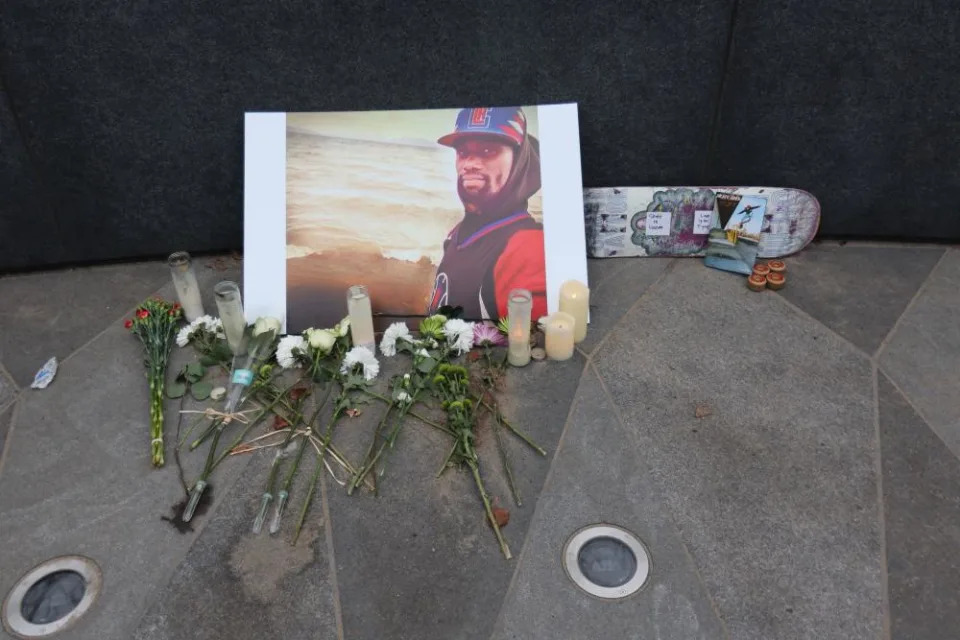

A Tyre Nichols memorial at The Embrace sculpture on Boston Common. 
Photograph: MediaPunch/Rex/Shutterstock

A skateboarder at the protest on behalf of Tyre Nichols in Atlanta. 
Photograph: Erik S Lesser/EPA

I’m originally from California. My family moved further inland because of the aftermath of the LA riots, and that’s how I got into skating – having white friends. They turned me on to it, but then you discover there are Black skateboarders. Back then there wasn’t a lot of us, and we stuck out like a sore thumb. I definitely experienced racism within the [skate] community that I was trying to be a part of, and the Black community at the time was so detached from it, they just viewed you as wanting to be white. You’re left in the middle questioning your identity: what is it about me doing something that I really want to do, and the way I express myself, that makes people treat me this way?

The beauty of skateboarding is you become allies with anyone who’s on a skateboard – you can go anywhere in the world and meet someone with a skateboard and you become friends. Your sense of community is stronger. As a skateboarder you’re already in the streets, so putting that energy out there in the form of protest during the BLM movement was something natural for skateboarders.

Going forward, I think the United States needs to be a lot more selective about who becomes a cop. If you understand the history of policing in the United States, it’s built from racism, from slave catchers who turned into the police force. It would be amazing if guns weren’t a thing, if police training was more tactical [so] they’re not trained to kill. This is something that my grandfather was petrified of when he was my age, and it still exists. It’s exhausting.

‘If you’re an adult Black skateboarder, you are seen as a problem’: Josh Adams
Memphis skater and activist with Decarcerate Memphis and the Official BLM Memphis Chapter

As a Memphis skateboarder, the anger is that I could have met Tyre Nichols through skating, but that’s not a possibility now. As an activist, it angered me because on December 6, Decarcerate Memphis presented data to the city council about the dangers of these traffic stops. The police here have used messaging that couples reckless driving with violent crime – in [Tennessee], there are a lot of traffic maneuvers that can be deemed “reckless driving”, even just running a stop sign. Once you’ve linked these two things together, the police now have probable cause, and you’ve created a perfect situation for police to treat people with utter disregard for their life over a simple traffic stop, which was what led to Tyre Nichols’s death.

Black people deal with inequities around policing no matter what they’re doing and where they are. When I was younger, the police might see me skateboarding and say things like, “Oh, well, at least you’re not doing anything bad like the other [Black] kids are doing.” But as I got older, they see me and immediately jump to the assumption of drug use. If you’re an adult Black skateboarder – especially if you have facial hair and tattoos – you are seen as a problem. I was pulled over in 2013 and the officer saw a skateboard in the back of the car and said, “It seems like you’re on your way to the skate park,” which he [seemed to] associate with drug possession, and asked us to step out of the car, patted us down, asked if he could search the car, and then tried to call for a canine unit when I refused.


The whitewashing of skateboarding by the mainstream media leads to a false ostracization that happens when you start skateboarding – people think that you’re not into Black culture, or that you might not be from a certain type of background. Most of the skaters I skate with are Black people from a working-class background who have been through the justice system. The only thing people know about skateboarding here is major competitions like the X Games, so we don’t see skaters like Antwuan Dixon, Terry Kennedy, Tyshawn Jones – he’s won skater of the year twice, but a lot of people don’t even know his name.

One thing that I hope we do is begin to reduce police funding – we don’t need armed patrolmen to help us have safe traffic. The police need to be defunded, social programs need to be invested in, and we need to pass policy to make sure that the police are held accountable for any criminal activity they engage in.

Yes, Black officers killed Tyre Nichols. What is the correct response to that?


Reverend William Barber and Jonathan Wilson-Hartgrove
Tue, 7 February 2023 
Photograph: Xinhua/Rex/Shutterstock

On Wednesday 1 February, family and friends of Tyre Nichols, along with Vice-President Kamala Harris and other representatives from the White House, gathered at the Mississippi Boulevard Christian church in Memphis, Tennessee to grieve the brutal murder of a young Black man. Such public grief on the first day of Black History Month echoes the moans of millions of Black Americans who have mourned the incomprehensible violence of the Middle Passage and auction blocks, slave patrols and lynch mobs, Klan assaults and police beatings. God only knows the name of every person who has been brutalized by the racial caste system that America’s plantation economy created.


But in this moment we must mourn and cry another pain. The men who killed Tyre Nichols were Black, as he was. This is not a case of individual racists, but another example of a policing system rabid with brutality and death. This kind of death is not new, and a true remembering of Black history must address this too. This most recent atrocity that the world witnessed in the video from Memphis is a symptom of a deeper social sickness that must be confronted before we as a nation can be whole.

To remember Black history is to also recall how Black overseers were recruited to maintain order on America’s plantations. When an enslaved person defied the slaveholder’s orders, it was often another Black person who was tasked with strapping the defiant bondsman to a whipping post and brutalizing him in front of other enslaved people. During the civil rights movements, Black and white activists reported terrible beatings in southern jails at the hands of Black men – sometimes fellow inmates – who did the bidding of local sheriffs. The hierarchy of racial terror has never been only enforced by white people. Nor has it only harmed Black people.

From Black and white abolitionists to Black, white, brown and Native civil rights workers, anyone who has directly challenged America’s racial hierarchy has been subject to brutality. But moral fusion movements have also been clear that our goal is to transform systems that devalue the lives of all poor and marginalized people.

Over the past decade, the Black Lives Matter movement has done important work to raise consciousness about the way that non-white people disproportionately suffer from police brutality. But this brutality can also be directed at white people. Just last year a white officer in Concord, North Carolina, shot and killed a poor white man, then lied about what had happened until the body-camera footage of the incident was released. When law enforcement is tasked with defending an order in which inequality is normal, brutality is what poor people come to expect from their interactions with the law.

This is why moral fusion movements that have challenged America’s system of racial hierarchy have never been made up of Black people only. It is also why these movements have not directed their challenge solely at the enforcers of an unjust system.

To focus only on “police reform” in our present crisis would be akin to working for an end of the whipping post during slavery. Abolitionists did not simply demand better treatment of enslaved people. They insisted that slavery was wrong. Likewise, the civil rights movement did not simply protest the brutal enforcement of Jim Crow segregation. They insisted that segregation was wrong because it dehumanized Black people and propped up an economic system in which poor white people were offered the “psychological wages” of whiteness while they continued to struggle to feed their families.

The public lynching of Tyre Nichols is a harsh reminder that we live in an America where some people’s lives are considered expendable. The officers who murdered this man did not act alone. Who else killed Tyre? Every politician who has been silent of the issues of violent public policy that denies some Americans basic human rights like housing, healthcare and a living wage. Also, every preacher and moral leader who remains quiet and doesn’t challenge the value gap in our society until another fatality is caught on camera. Who else bears responsibility for this brutality? Every American who has refused to believe on-the-ground activists who are crying for justice, and every politician who forfeited the chance to say: “No others bills in Congress until we have police reform, voting rights, living wages and universal healthcare.”

Yes, the officers who brutalized Tyre must be held accountable for their actions. Far too often, officers who abuse their power and the public trust face no consequences in cases like these. But we must also acknowledge that their brutality is a byproduct of too many Americans passing the buck and abdicating responsibility for a society where 700 people die every day, not because God has called them home but simply because they are poor.

Fifty-five years ago, Dr King went to Memphis because two Black garbage workers had been killed on the job by faulty equipment. He wasn’t there simply because the workers were Black, nor was he there only to demand repair of the equipment that had killed them. King, who was in the midst of organizing the Poor People’s Campaign, was in Memphis because working people were standing together to demand dignity under the slogan “I Am A Man”. Until Black, white, Native and brown people unite to insist that our present economic reality is wrong and can be changed by policies that lift from the bottom so everyone rises, we cannot truly say that we have learned the lessons of our history or honored the life of one more soul who has died at the hands of law enforcement.

The Rev William Barber is president of Repairers of the Breach and founding director of the Center for Public Theology and Public Policy at Yale University


Jonathan Wilson-Hartgrove is assistant director of the Center for Public Theology and Public Policy at Yale University
Neo-Nazi and girlfriend arrested for allegedly plotting attack on Maryland power grid

Graig Graziosi
Mon, 6 February 2023 at 11:34 am GMT-7·3-min read

A Neo-Nazi leader and his girlfriend have been arrested and charged with plotting an attack on the Maryland power grid.

Brandon Russell, 27, and Sarah Clendaniel, 34, have been charged for conspiring to destroy an energy facility, and face up to 20 years in prison, according to The Washington Post.

Mr Russell met Ms Clendaniel while they two were incarcerated at different prisons. The former, the founder of the violent neo-Nazi group Atomwaffen Division, had been arrested for possessing bombmaking materials, and the latter had been robbing convenience stores with a machete.

In 2017, Mr Russell's roommate, another Atomwaffen member named Devon Arthurs, killed two of their other roommates. He was taken into custody and allegedly told investigators that had been planning attacks on nuclear power plants and power lines in the US.

Police responding to the scene found bombmaking materials in the house reportedly belonging to Mr Russell. He was arrested, charged, and imprisoned after he pleaded guilty to possession of an unregistered destructive device and improper storage of explosive material.

During his time in prison, he met Ms Clendaniel and was eventually released in 2021. He later met and began discussing his future ambitions with a government informant.

According to prosecutors, Mr Russell began discussing potential attacks on power infrastructure with an undercover government informant last summer while he was still on probation.

Mr Russell allegedly told the informant that they should target transformers, as they were "custom made" and would "take almost a year to replace."


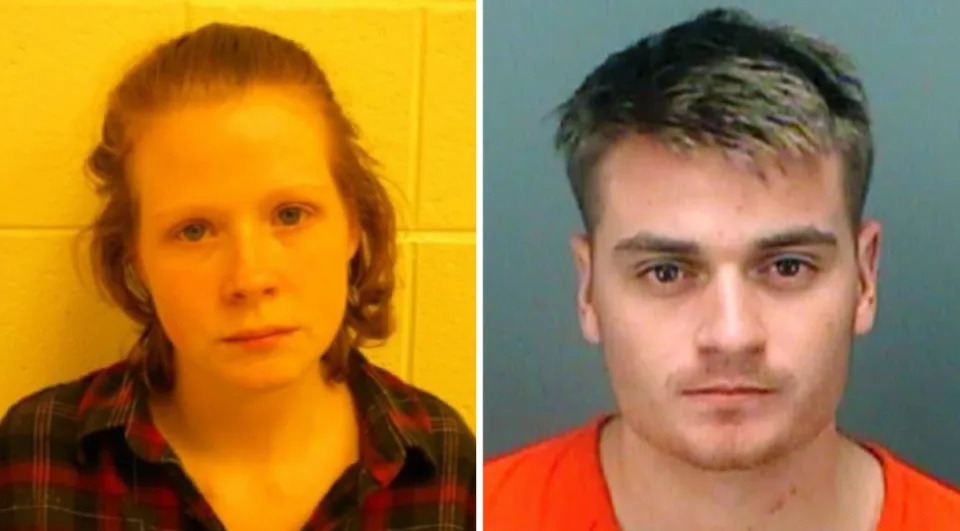
Sarah Clendaniel and Brandon Russell, the founder of the neo-Nazi group Atomwaffen, in mug shots
(Maryland State Police / Pinellas County Sheriff’s Department)

He also said it would be best to wait for a winter storm, attacking at the moment when "most people are using max electricity."

Ms Clendaniel, who also met with the informant, was reportedly convinced she was going to die of kidney disease in the near future and wanted to carry out an attack quickly so she could "accomplish something worthwhile."

“If we can pull off what I’m hoping ... this would be legendary,” Ms Clendaniel allegedly told the informant.

She reportedly left a statement that contained references to Hitler, the Unabomber, a Norwegian mass shooter, and claimed that she would "sacrifice **everything** for my people," according to a criminal complaint reviewed by the Post.

The complaint also revealed that she was reportedly looking to purchase a new rifle after hers was confiscated after a fight with one of her neighbors. She allegedly asked the informant to obtain a rifle for her while she scoped out possible attack sites in the Baltimore area.

Baltimore Gas and Electric issued a statement in the wake of the announcement outlining its fortification efforts to protect its facilities.

“We hold the safety of our employees and the safety and security of our customers and communities as top priorities. In the last decade, we have increased our level of investment on grid hardening capital projects, and monitoring and surveillance technologies to work to prevent both physical and cyber-attacks,” the company said in the statement. “We remain focused on improving the resiliency of the grid by stocking critical back-up equipment while designing a smarter grid that isolates damage and routes power around it.”


DOJ Charges 2 In Extremist Plot To Attack Baltimore Power Stations


Sanjana Karanth
Mon, 6 February 2023 

Federal authorities say this photo is of Sarah Beth Clendaniel, one of two people charged with plotting to attack the Baltimore-area power grid.


Federal authorities say this photo is of Sarah Beth Clendaniel, one of two people charged with plotting to attack the Baltimore-area power grid.

Federal authorities have arrested and charged two neo-Nazis for allegedly plotting to attack Baltimore-area power substations, in what would be the latest attempt by far-right extremists to destroy energy facilities across the country.

The Justice Department announced Monday that law enforcement arrested Sarah Beth Clendaniel of Maryland and Brandon Clint Russell of Florida on charges of conspiracy to damage energy facilities. The two planned “to inflict maximum harm” on the power grid with the aim to “completely destroy” Baltimore, U.S. Attorney Erek Barron said at a press conference.

According to authorities, Clendaniel told an FBI confidential source on Jan. 29 that she planned to shoot up energy substations surrounding Baltimore, including in Norrisville, Reisterstown and Perry Hall, Maryland. The 34-year-old said she was “determined” to carry out the infrastructure attacks and said they would “probably permanently completely lay this city to waste,” according to a criminal complaint unsealed on Monday.

Clendaniel, under the online moniker “Nythra88,” told the source that she had a kidney-related terminal illness and was unlikely to live more than a few months, the complaint said. She allegedly wanted the FBI source to purchase a rifle for her “within the next couple of weeks” so she could “accomplish something worthwhile” before she died.

The complaint included a photo of a woman, who authorities say is Clendaniel, wearing tactical gear bearing a swastika, holding a rifle and carrying a pistol in a drop holster on her left leg. The FBI also said a search of Clendaniel’s Google accounts revealed a document she allegedly wrote that referenced the Unabomber and Adolf Hitler.

“I would sacrifice **everything** for my people to just have a chance for our cause to succeed,” the document said, according to the complaint.

Clendaniel is accused of conspiring with Russell, the 27-year-old leader of the neo-Nazi group Atomwaffen who was sentenced to prison in 2018 after the FBI found an explosive device and extremist materials belonging to him. Russell’s roommate, who was charged with killing their other two roommates in 2017, told authorities they were planning to attack U.S. infrastructure.

According to the complaint, Russell encouraged attacks on power stations and gave guidance on how to inflict the most damage while speaking to the same FBI source. Russell allegedly said the attacks would cause a “cascading failure” of the power grid, and that “putting holes in transformers ... is the greatest thing somebody can do.”

Russell directed the source to speak with Clendaniel, who allegedly discussed potential attack sites during the first week of February. She sent links to the FBI source for infrastructure maps that showed the locations of five specific electrical substations, according to the complaint.

“Driven by their ideology of racially-motivated hatred, the defendants allegedly schemed to attack local power grid facilities,” Assistant Attorney General for National Security Matthew Olsen said in a statement. “The Justice Department will not tolerate those who threaten critical infrastructure and imperil communities in the name of domestic violent extremism.”

In a statement, the power company Exelon said it had been notified that the alleged plot targeted several Baltimore Gas and Electric power stations. BGE is a subsidiary of Exelon.

“Law enforcement acted before the perpetrators were able to carry out their plan, and there was no damage to any of the substations, nor was any service disrupted,” the statement read. “The substations are not believed to have been targeted out of any connection to BGE or Exelon, or because of any particular vulnerability.”

Various extremists have recently attempted to destroy a number of electrical facilities across the country. In the last three months, people have attacked at least nine substations in Nevada, Washington, Oregon, and North and South Carolina. The attacks resulted in massive power outages for tens of thousands of people during the winter months, exposing the U.S. electrical grid’s vulnerability to domestic terrorism.

The federal charge of conspiracy to attack energy facilities is punishable by up to 20 years in prison.
SCI FI TECH
World-first ‘super’ magnet sparks nuclear fusion breakthrough

Tokamak Energy says magnet is nearly a million times stronger than the Earth’s magnetic field

Anthony Cuthbertson

A UK firm has announced a world-first set of “super” magnets that can be used for testing nuclear fusion power plants.

Tokamak Energy said the Demo4 magnet has a magnetic field strength that is nearly a million times stronger than the Earth’s magnetic field, making it capable of confining and controlling the extremely hot plasma created during the fusion process.

Nuclear fusion has been hailed as the “holy grail” of clean energy, with scientists working on the technology since the 1950s.

Scientists achieve historic fusion ‘ignition’ to produce ‘near-limitless’ clean energy

The process involves mimicking the natural reactions that occur within the Sun, providing near-limitless energy without requiring fossil fuels and without producing hazardous waste.

Tokamak Energy is aiming to be the first private company to produce commercial fusion energy, with the goal of demonstrating grid-ready fusion in the early 2030s.

“This is a huge, visible moment that we’re really excited about,” said Dr Rod Bateman from Tokamak Energy.

“Our magnets enable the construction and operations of spherical tokamaks, and so are a game changer for getting clean, limitless fusion energy on the grid faster.”

Commercialisation of the power source still remains a long way off, though several major breakthroughs in recent years have given hope that it will be attainable within the next decade.

Last year, scientists from the Lawrence Livermore National Laboratory (LLNL) in California became the first to achieve a net energy gain using nuclear fusion power.

LLNL described the feat as “one of the most significant scientific challenges ever undertaken by humanity” that would supercharge efforts to make fusion energy a reality.

Tokamak Energy CEO Chris Kelsall said the company’s new magnet technology would help push forward advancements by providing a key component of the fusion process.

“The learnings from Demo4 will be a key catalyst for delivering the global deployment of compact, low-cost spherical tokamak power plants,” Mr Kelsall said.

“We are proud to be delivering this world-first, complete system of HTS magnetic coils, which will now be assembled into a full tokamak configuration for testing.”


Ancient statue of Hercules discovered during sewage repair works in Rome

Theo Farrant
Mon, 6 February 2023 

A statue believed to be around 2,000 years old has been found in Rome during repair work to a sewage system.

The life-sized marble statue portraying a male figure dressed as the mythological Roman hero Hercules was discovered in a public garden in Rome during works to restore sewage pipes, in the surroundings of the archaeological area of Appia Antica.

It emerged, face first, as a bulldozer was tearing through old pipelines that needed replacing. An archaeologist in charge of the project immediately intervened.

While these kind of findings are very common in Rome during excavations, workers from Acea (a multi-utility company in the field of water and energy) only encountered the statue after weeks of work without prior trace of any archaeological evidence, 10 metres under the ground.

How the discovery of these ancient bronze Italian sculptures will "rewrite history"

Ancient Herculaneum fresco among dozen of treasures returned to Italy from US


An ancient life-size Roman statue of Hercules lies on its back in Rome's Appia Archeologial Park, 30 January2023, - Domenico Stinellis/AP Photo

The site underneath the ancient Appian Way in Rome where the ancient life-size Roman statue of Hercules was discovered - Italian Culture Ministry/AP Photo

Archaeologists so far believe the statue could date to the Imperial age, and hypotheses on the identity of the portrayed man have already been made.

According to archaeologist Francesca Romana Paolillo, one of the archaeologists working at the Appia Antica Archaeological Park, the statue’s traits resemble those of the Roman emperor Decius, who lived in the 3rd century AD.

The artefact was discovered near the ancient Appian Way, the 650 kilometre long road which connected Rome to the city of Brindisi on the heel of the boot-shaped peninsula.

This was one of the most important roads ever constructed by the Romans.
Other recent discoveries

A Pompeiian style fresco from Herculaneum titled "Young Hercules and the snake", dated to the I second A.C - Andrew Medichini/AP Photo

In other Herculean news, last month an ancient fresco depicting the demi-god was returned to Italy, along with 59 other important artefacts after being illegally trafficked to the US.

Last summer, US authorities announced that the fresco and dozens of other trafficked objects, which ended up in private collections in the United States, would go back to Italy.

Among the more precious pieces returned to Rome is a B.C. kylix and a shallow two-handled drinking vessel, believed to be around 2,600 years old.

Furthermore, in November last year an “exceptional” trove of bronze statues, preserved for thousands of years by mud and boiling water, was discovered in a network of baths built by the Etruscans in Tuscany.

The discovery of the 24 statues, in the sacred baths of the San Casciano dei Bagni archaeological dig near Siena, is one of the most significant ever in the Mediterranean and certainly the most important since the 1972 underwater discovery of the famed Riace bronze warriors.

Jacopo Tabolli, who coordinated the dig for the University for Foreigners in Siena, said the discovery was significant because it sheds new light on the end of the Etruscan civilisation and the expansion of the Roman empire, which was marked by wars and conflicts across today's Tuscany, Umbria and Lazio regions.
Tropical French territory battles green monkey invasion
THOUGHT TO BE THE ORIGIN OF HIV
Mon, 6 February 2023 


French officials on the Caribbean island of Saint-Martin are seeking ways to battle an invasion of green monkeys, blamed for threatening the tropical tourism hotspot's fragile biodiversity, local authorities said.

The primates, which originate from Africa, are reproducing at an alarming rate, threatening the survival of some indigenous species, they said.

The island of Saint-Martin, split between France and the Netherlands, is a popular tourist destination boasting sandy beaches and varied wildlife.

Green monkeys, which originally came to Saint-Martin as pets owned by foreign colonisers or on trade ships, have spread across the island with a remarkable ability for adaptation.

The Dutch authorities recently took a radical step, ordering 450 of the primates, named after their golden-green fur, to be put down.

The Nature Foundation St. Maarten, an NGO, will be charged with capturing the green monkeys for culling as part of a three-year plan to contain their population growth.

On the French side, the authorities said they were still fact-finding.

The animal species' spectacular population growth could affect the region's biodiversity, said Julien Chalifour, a scientist for the island's Natural Nature Reserve.

The monkeys have earned a reputation among locals for acting aggressively to residents and pets as well as overturning garbage bins, destroying gardens and defecating on people’s property.

The non-indigenous monkeys are not picky eaters and will consume just about anything including bird eggs, crops and ornamental and fruit plants and trees.

"They are benefiting from an abundance of food thanks to lots of rain, which in turn increases the possibility of reproduction," Chalifour said. "We can't let them continue to multiply. They're everywhere."

There was a noticeable rise in the green monkey population in 2017 following Hurricane Irma, he said.

"These omnivorous mammals then found themselves in an environment with no food source, which led them to spread out in order to feed themselves," the scientist said.

Officials have appointed a zoologist, Nathalie Duporge, to lead an "environmental impact assessment" before deciding on the next steps.

France's half of Saint-Martin became a French overseas territory in its own right in 2007, having previously belonged administratively to Guadeloupe, France's biggest possession in the Caribbean.

It had a population of just over 32,000 in 2020.

Former Australian PM Tony Abbott joins board of UK climate sceptic thinktank

Graham Readfearn
Mon, 6 February 2023

Photograph: REX/Shutterstock

The former Australian prime minister Tony Abbott has joined the board of a UK-based thinktank that has been highly critical of climate science and action on global heating.

Since its launch in 2009, the Global Warming Policy Foundation has become known for its consistent attacks on climate science, the risks of global heating and – more recently – policies to reach net zero greenhouse gas emissions.

The group, founded by the former Thatcher government treasurer Sir Nigel Lawson, is facing a complaint from three UK MPs and a not-for-profit campaign group accusing the GWPF of inappropriately claiming status as an educational charity while carrying out lobbying and skewed research.

Abbott said he was pleased to join the foundation “because it’s consistently injected a note of realism into the climate debate”.

Related: Tony Abbott dares us to reject evidence on climate, but reveals a coward | Graham Readfearn

“All of us want to save the only planet we have but this should not be by means which impoverish poorer people in richer countries and hold poorer countries back,” he said.

“Right now, in countries like Australia, the impact of climate policy is to make electricity less affordable and less reliable rather than perceptibly to cool the planet.”

Experts have consistently rejected the argument that climate policy has caused electricity prices to rise, instead pointing to the war in Ukraine and the high price of gas.

Abbott added: “We need more genuine science and less groupthink in this debate – that’s where the GWPF has been a commendably consistent if lonely voice.”

Dr Jerome Booth, the foundation’s chairman, said Abbott brings “a global perspective and policy insight at the very highest level” and he would help the group “to foster a culture of debate, respect and scrutiny in policy areas that are currently dominated by intolerance, high emotions, moral reasoning and confusion”.

Abbott is currently an adviser to the UK government’s Board of Trade. His name was raised last month as a possible replacement for the late senator Jim Molan in the upper house.

During his prime ministership between 2013 and 2015, Abbott drove to dismantle much of the country’s public policy architecture on climate change, successfully repealing a legislated price on carbon, defunding the independent Climate Commission but failing to dismantle the Climate Change Authority and the Australian Renewable Energy Agency.

In 2017, he flew to London to deliver the GWPF’s annual lecture, where he suggested natural factors could be to blame for global warming, that CO2 was a trace gas and hinted at a global conspiracy to tamper with temperature data to make global heating seem worse.

The foundation is seen as influential among some conservatives. Conservative MP Steve Baker resigned as a GWPF trustee when he became minister for Northern Ireland.

A group of Conservative MPs and peers – several with links to the foundation – have formed the Net Zero Scrutiny Group, which has used the GWPF’s work as part of its advocacy.

The GWPF’s non-charitable arm – the Global Warming Policy Forum – runs a project called Net Zero Watch, which claims to scrutinise climate and decarbonisation policies.

The foundation has several Australian links. As the Guardian reported, one of its earliest funders was Australian billionaire hedge fund manager Sir Michael Hintze, who last year was handed a seat in the House of Lords at the recommendation of the former UK prime minister Boris Johnson.

Four Australian climate sceptics sit on the GWPF academic advisory board, including mining industry figure Prof Ian Plimer and controversial marine scientist Dr Peter Ridd of the Institute of Public Affairs, an Australian thinktank known to promote climate science denial.

The late Cardinal George Pell also delivered a GWPF annual lecture in 2011.

Presenting a report last year, the GWPF’s director, Dr Benny Peiser, said: “It’s extraordinary that anyone should think there is a climate crisis.”

Related: Climate sceptic thinktank reported to charity commission over fossil fuel interest funding

Last year three MPs – one each from Labor, the Greens and the Liberal Democrats – joined with a not-for-profit campaign group to complain to the UK’s Charity Commission.

The group questioned if the GWPF was breaking charity rules by commissioning unbalanced research and carrying out political advocacy from charitable funds.

Peiser has reportedly written to the commission about the concerns, telling the charity sector publication Third Sector he had written to the commission, but there was no official investigation and he “looked forward to hearing the commission’s conclusions”.

A spokesperson previously said in response to the allegations: “It is right and proper that non-charitable activities are not funded by charitable donations and we take great care to ensure this does not happen. Any suggestion to the contrary, or attack on the academic credibility of the foundation’s publications, is unfounded. We will, as always, cooperate fully with any questions the Charity Commission considers it appropriate to ask of us.”

FRANCO'S CATHOLIC FASCISTS MASSACRED THE REPUBLICANS

Inside a real-life chamber of horrors: How mass graves like Pico Reja haunt present-day Spain

Graham Keeley
Mon, 6 February 2023


Hundreds of skulls and bones, neatly packed into plastic boxes, fill the small room almost up to the ceiling.

This real-life chamber of horrors, in an anonymous room at the San Fernando cemetery in Seville, holds the remains of 1,786 people. All were dug out of one of Spain’s biggest mass graves.

Behind the bullet-ridden craniums and mangled bones at Pico Reja are the stories of those condemned to death for being on the wrong side in the Spanish Civil War between 1936-1939.

Within the boxes are human brains, preserved over 80 years since they were silenced by a single gunshot, and the short bones of children who died from malnutrition.

Pico Reja, a two-metre deep grave, lies in the corner of a huge cemetery next to flamboyant gravestones dedicated to bullfighters, flamenco dancers or, in one case, ‘The Son of the King of Gypsies’.

Three years after digging started, relatives of the dead retrieved from this mass grave will gather for a ceremony later this month to remember their loved ones.

The grim ceremony will be a closure – of sorts – but the fight goes on for justice for these people cut down by the victorious fascist forces of General Francisco Franco.

A national DNA bank


Historians estimate that about 114,000 people lie in mass graves scattered across Spain massacred by supporters of Franco during or after the civil war.

Eighty years on from one of the country’s darkest chapters, Spaniards are no nearer to resolving how to deal with their murky past.

Spain’s left-wing government last year passed the Democratic Memory Law which contains dozens of measures that Prime Minister Pedro Sánchez said would help “settle Spanish democracy’s debt to its past”.


The bones of some of the remains in Pico Reja are coloured using computer technology to differentiate between the bodies. - Seville Council/Aranzadi, non-profit scientific association.

The law will set up a census and a national DNA bank to help locate the remains of those who still lie in unmarked graves like Pico Reja.

But as Spaniards head to the polls this year in local elections in May and a national election probably in December, this law could be repealed if, as polls predict, the conservative People’s Party (PP) triumphs.

After Spain returned to democracy following Franco’s death in 1975, it passed an Amnesty Law two years later to prevent retrospective prosecutions.

Many on the Spanish right have opposed legislative efforts to deal with the wrongs of the past. Alberto Núñez Feijóo, the PP leader, has promised to repeal the Democratic Memory Law.

'We just want justice'


For Ana Sanchez, any attempt to stop her finding out what happened to her two uncles, would dash years of effort.

Antonio and Ramon Sanchez Moreno were 26 and 20 respectively when they were shot after mock trials at the start of the fascist uprising in 1936. Antonio never saw his baby son.

Sanchez, a retired teacher, believes their remains may lie in Pico Reja. Like scores of others, she has given a sample of DNA which she hopes will be matched with the remains of one or other of her uncles as part of a project organised by Seville council, the University of Granada and Aranzadi, a non-profit scientific association.

“We just want justice and to find out the truth. Not just for me but for everyone, so that we have a real democracy that does not hide these things,” she told Euronews.

Her uncles’ remains may lie in Pico Reja or another mass grave that has yet to be excavated. El Monumento, which lies close by, should be opened later this year, revealing more horrors.

But the ghosts of the past may haunt modern-day politics.

'Like something from Medieval Spain'


Ana Sanchez, with photographs of her uncles whose remains are believed to lie in Pico Reja. - Graham Keeley

Paqui Maqueda, of Our Historical Memory association in Seville, fears if the PP unseat the ruling Socialists at elections in May, the conservatives will slow down plans to open El Monumento.

“It could make a difference if the PP wins the council election in Seville. They have always been against trying to find out what happened to our loved ones,” she told Euronews.

Maqueda has been fighting for years for reparation for her family which was shattered by the civil war.

Her great-grandfather Juan Rodriguez Tirado and his three sons, Enrique, Pascual and José spent years in prison camps and were persecuted by the Franco regime. The family home in the village of Carmona, near Seville, was seized.

“No Spanish government has addressed this. The (recent) Memory law was a step forward. But it was not enough. I have been denied access to the state archives to find out what really happened to my family and where they are,” Maqueda said.

“I don’t want compensation for what happened. I want reparation. My relatives were not delinquents and rapists.”

Juan Manuel Guijo, an archaeologist who specialises in bones from Aranzadi, who worked on the Pico Reja excavation, said the grim work at the graveside had taught everyone a lesson.

“It has improved (the team) as people as we have come to know the victims and their suffering and how they have been suffering for years to do this,” he said.

“At the same time, we have witnessed a horror which seems like something from Medieval Spain. We have found hundreds of children who died from malnutrition in the 1940s and people who were tortured before they died.”

As we stood in the small room, surrounded by boxes full of skulls and bones, Guijo paused before he went on.

“Sometimes you must put aside science and you have to remember the people. This is not something we are doing for heritage but for human rights,” he said.
Iran protest song 'Baraye' wins new Grammy Award for sparking social change
WE USED TO CALL THEM FOLK SINGERS

Tokunbo Salako
Tue, 7 February 2023 

Iran protest song 'Baraye' wins new Grammy Award for sparking social change

There are many tales of triumph over adversity behind the dozens of winners at this year's Grammy Awards but perhaps none are more deserving than Shervin Hajipour, the Iranian singer who was jailed for his song in support of protests over the death of the Iranian-Kurdish woman Mahsa Amini.

On Sunday night, Hajipour, won the inaugural best song for social change special merit award for “Baraye” of "For" in English. It begins with: “For dancing in the streets,” “for the fear we feel when we kiss.” The lyrics list reasons young Iranians have posted on Twitter for why they had protested against Iran's ruling theocracy.

Hajipour, 25, appeared stunned after hearing Jill Biden, the wife of President Joe Biden, announce he'd won An online video showed Hajipour in a darkened room, wiping tears away after the announcement.

Picking up the honour on his the singer's behalf Biden said that a song “can unite, inspire and ultimately change the world.”

US First lady Jill Biden accepts the award for best song for social change on behalf of Shervin Hajipour for "Baraye" at the 65th annual Grammy Awards - Chris Pizzello/Invision/AP

For some what makes Hajipour's rise to prominence is the fact that he was a little known pop singer and songwriter before the protests begain. His anthem has been widely seen as the symbolic rising of ordinary people against the morality police.

Shervin was arrested, but this song continues to resonate around the world with its powerful theme: Women, life, freedom.

His song weaves together messages posted on Twitter about the reasons for protests. The emotional performance became a viral hit on different social media platforms, with millions of views within days.

It ends with the widely chanted slogan that has become synonymous with the protests since the September death of Amini: “For women, life, freedom.”

Released on his Instagram page, the song quickly went viral. Hajipour then was arrested and held for several days before being released on bail in October. He now faces charges of “propaganda against the regime” and “instigating the violence,” according to Human Rights Activists in Iran, a group that's been monitoring the demonstrations.

Acclaimed Iranian director Jafar Panahi is released from Evin Prison following hunger strike


Iran frees top actress Taraneh Alidoosti jailed for government protest


Words have power: What are the origins of Iran's protest chant 'woman, life, freedom'?

The charges Hajipour faces can carry as much as six years in prison all together. The singer is also banned from leaving Iran.

“This song became the anthem of the Mahsa Amini protests, a powerful and poetic call for freedom and women's rights,” Biden said. “Shervin was arrested, but this song continues to resonate around the world with its powerful theme: Women, life, freedom."

Those gathered cheered Biden's remarks. On Instagram, Hajipour simply wrote: “We won.”

There was no immediate reaction in Iranian state media or from government officials to Hajipour’s win. The singer is among over 19,600 people arrested amid the demonstrations, according to Human Rights Activists in Iran. At least 527 people have been killed amid a violent suppression of the demonstration by authorities.

On Sunday, Iran’s supreme leader reportedly ordered an amnesty or reduction in prison sentences for “tens of thousands” of people detained amid the protests, acknowledging for the first time the scale of the crackdown.
What is a windfall tax? BP profits more than double to £23 billion

Seren Morris,Lowenna Waters,Nuray Bulbul and William Mata
Tue, 7 February 2023 


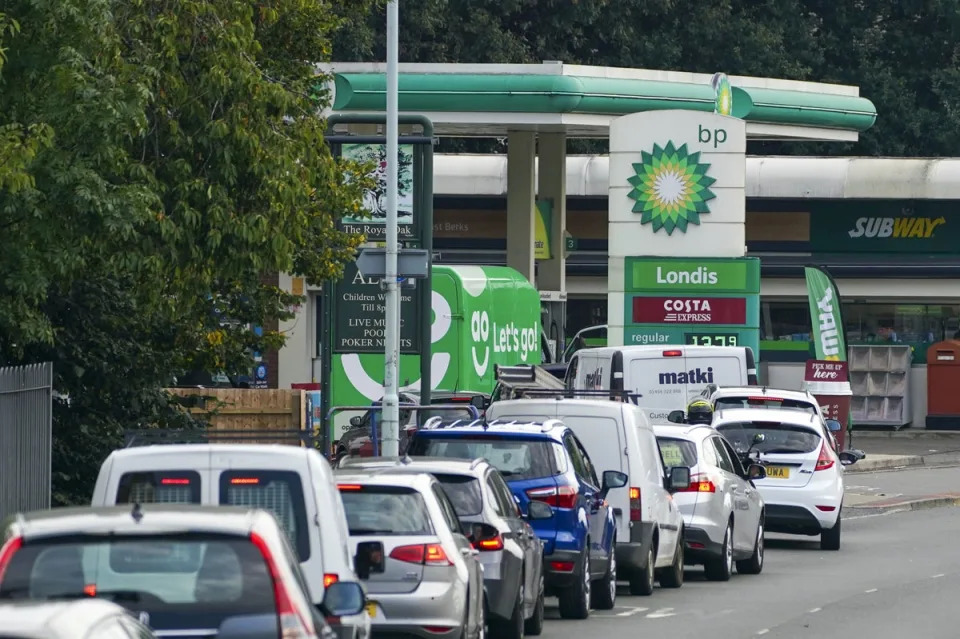
BP has announced that its annual profits more than doubled to £23 billion in 2022 following Russia’s invasion of Ukraine.

It follows Shell last week reporting a £32.2 billion profit, the largest in its 115-year history — also attributed to a rise in gas prices following Russia’s invasion.

In announcing its profit on Tuesday, BP said that it had cut its pledge to lower emissions and is now expected to double down on the production of gas and oil.

The announcement triggered new calls for a windfall tax to be placed on energy giants to fund support for households struggling during the cost of living crisis.

But what is a windfall tax? Here’s everything you need to know.

What is a windfall tax?

A windfall tax is a one-off tax that the Government imposes on a company or a group of companies when they benefit from something that happened outside their control.

Energy companies are benefiting from the increased demand for energy following the Covid-19 pandemic and Russia’s invasion of Ukraine.

Who is calling for a windfall tax on oil and gas companies?


Ed Miliband, the shadow secretary of state for climate change and net zero, said: “As the British people face an energy price hike of 40 per cent in April, Rishi Sunak is letting the fossil-fuel companies making bumper profits off the hook with his refusal to do a proper windfall tax. Labour would stop the energy price cap going up in April.”

Last year, he said: “Another day, another oil and gas company making billions in profits, and yet another day when the Government shamefully refuses to act with a windfall tax to bring down bills.”

Richard Burgon, Labour MP for Leeds East, posted on Twitter: “Shell just reported record profits of £32,000,000,000. Such outrageous profits are why your bills are so high.

“We need to hike the Windfall Tax so North Sea oil and gas giants don’t make a single penny in excess profits off the back of higher energy bills for ordinary people.”

Another Labour MP, Nadia Whittome, who represents Nottingham East, said: “Not everyone is suffering from a cost-of-living crisis. In 2022, Shell made £32,200,000,000 in profit — by far the most in its entire history. Time to end this profiteering from misery. Instead of another bill hike, we need a proper windfall tax.”

Philip Evans, Greenpeace UK’s oil and gas campaigner, last year called for a windfall tax. “By using a big chunk of the bloated profits that Shell, BP, and others are raking in, to make homes warmer, more energy efficient, and kitted out with heat pumps, the Government could start to really tackle the climate and cost of living crises simultaneously,” he said.

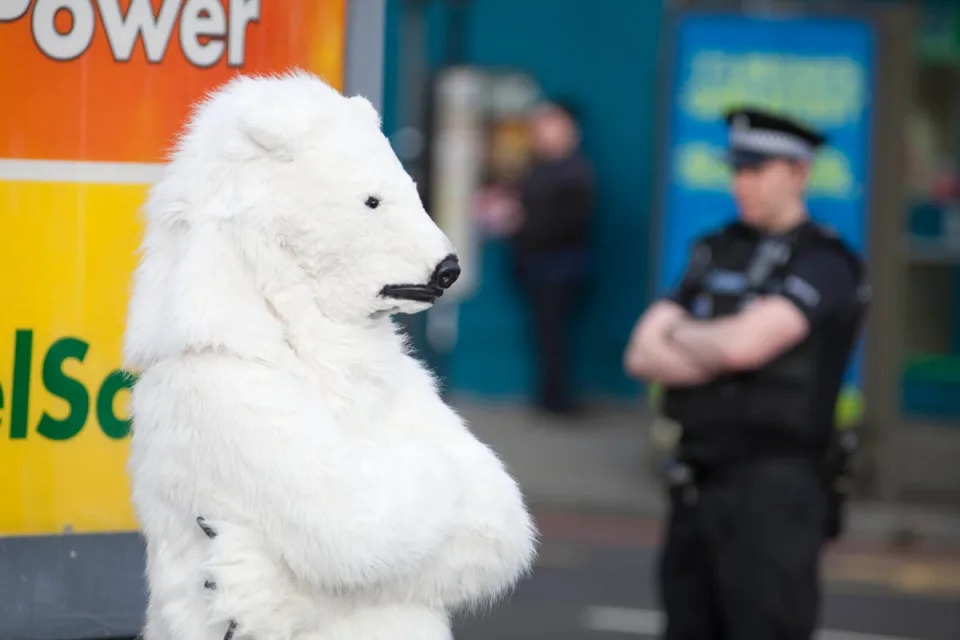
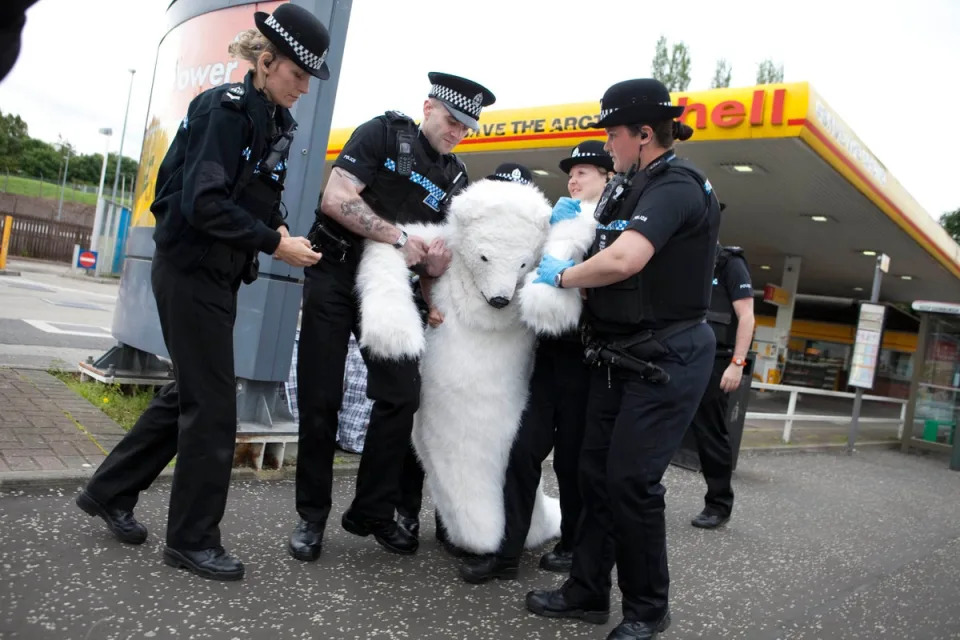
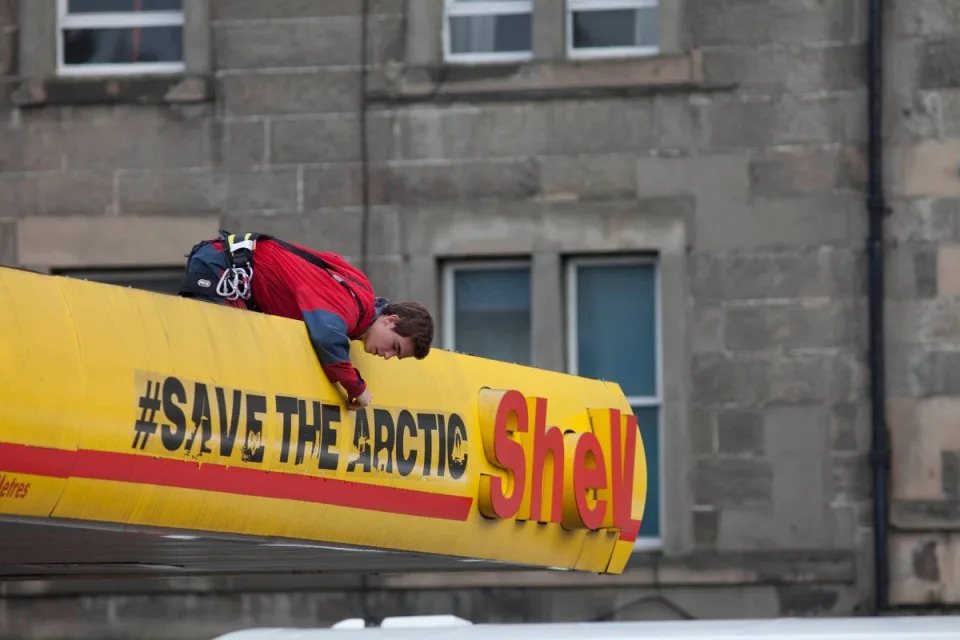
Protesters shut 40 of Shell’s London garages


AN6019028Handout photo issu.jpg:

AN6019030Handout photo issu.jpg:

AN6019020Handout photo issu.jpg:

AN6019019Handout photo issu.jpg:

AN6019015Handout photo issu.jpg:

AN6019011Handout photo issu.jpg:

What has the Government said about a windfall tax?

Chancellor Jeremy Hunt revealed in the Autumn Budget that he would be increasing the windfall tax paid by energy companies.

“I have no objection to windfall taxes if they are genuinely about windfall profits caused by unexpected increases in energy prices,” he said.

“But any such tax should be temporary, not deter investment, and recognise the cyclical nature of energy businesses.”

Mr Hunt said that from January 1 until March 2028, the Government would increase the Energy Profits Levy from 25 per cent to 35 per cent.

Furthermore, the Government will introduce a temporary 45 per cent levy on electricity generators. Mr Hunt said that increasing these taxes would raise £14 billion next year.
How one African country is putting a multi-million dollar price on its nature


Tue, 7 February 2023 

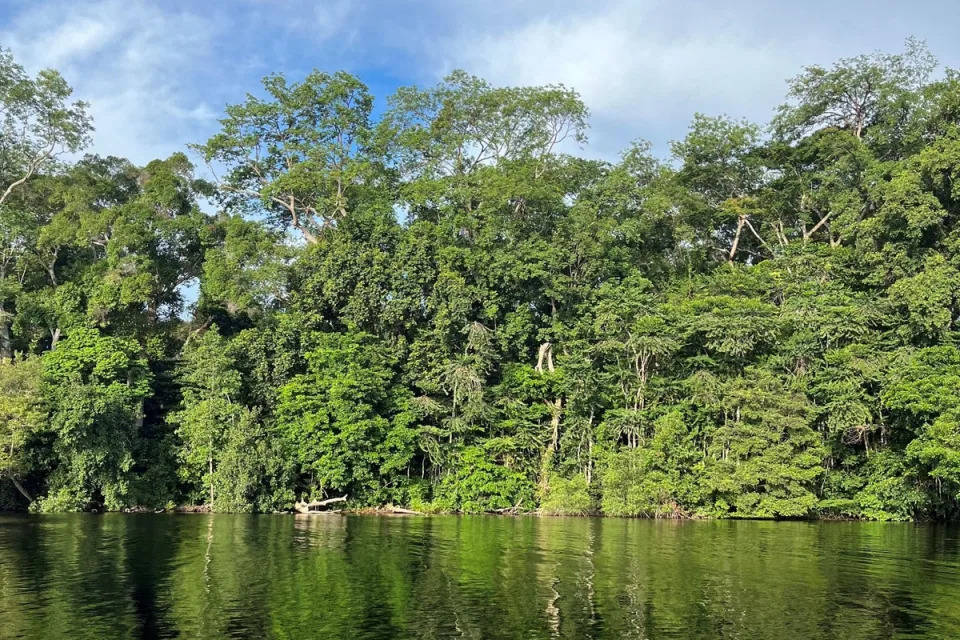
A view of forest by the water’s edge in Gabon (Emily Beament/PA)

Health is an unorthodox economic commodity. Its value, barely acknowledged when we have it, becomes priceless when we don’t. The instant a person falls seriously ill, finding a cure is immediately more important than the price paid for it. The same asymmetry in valuation applies to the health of our planet.

For centuries, the value humankind placed on the environment was nothing compared to the valuation given to economic development. European colonialists arriving in 19th-century New Zealand received compensation to cut and burn down its vast temperate rainforests. The market of the day valued sheep pasture over biodiversity. Those rules are changing – thanks to the mounting evidence that the climate and biodiversity crises are fundamentally interlinked, for better or worse. Putting a price on nature and creating a market that can finance efforts to protect and restore is, therefore, mission-critical if we’re serious about saving our planet and securing our shared prosperity.

That is the context in which my country, Gabon, can now offer a new financial instrument, the issuance of 90 million tons of sovereign carbon credits – the world’s largest – to transform global carbon markets with the speed and scale needed to make an impact. The voluntary carbon market is growing exponentially - up 60 per cent in 2021 to a total traded value of just under $2 billion – and they have a crucial role in scaling up nature-based solutions.


But given the current size of the market – only 344 million tonnes traded last year – sovereign carbon credits need to be part of the solution. Today, a market that has up-to-date traded on carbon credits from piecemeal projects focused in particular areas is being presented with a different model – a whole nation committed to green growth that delivers for people, nature and the planet. Gabon has laid out its entire environmental policy portfolio and territorial estate, from sea to shining rainforest. It is precisely the kind of transformative moment needed by the voluntary carbon market - still new, somewhat fragmented – towards its journey to maturity.

The compliance market, worth a multibillion-dollar annual turnover, shows the scale of the environmental financing available.

Now, Gabon can shift the dial in the voluntary market by offering a tranche of what might be regarded as” gilt-edged” carbon credits. I do not believe applying “gilt-edged”, a term usually reserved for high-grade bonds issued by national governments and private organizations, to Gabon’s carbon credits is an exaggeration. The scrutiny applied by experts from the United Nations Framework Convention on Climate Change was extraordinary in judging the impact of Gabon’s policy interventions from 2010-2018.

It was an exhaustive and, at times, exhausting experience that took us more than four years and several rounds of review. But from our point of view, this investment of time and comprehensive effort was made well worth it just ahead of COP27 with the UNFCCC’s final assessment. With our rich forests, which cover 88 per cent of our land mass, we had long known we were better than net-zero for carbon emissions as our forests take in much more carbon than our 2.3 million-strong population produce.

UNFCCC confirmed a baseline between 2000 and 2009 of 107,186,873 tonnes of CO2 taken out annually from the world’s atmosphere. Against this stringent baseline, Gabon was then evaluated to the extent to which its implemented policy portfolio (effectively its `good behaviors’) had taken yet more CO2 from the atmosphere. The answer was clear: From 2010-2018, an additional 90,636,103 tonnes had been removed from the atmosphere nationwide. It is based upon this assessment that we are today able to bring to market a tranche of 90,636,103 sovereign carbon credits. It is not just the UNFCCC retrospective research that makes our credits a class above. Gabon’s use of the proceeds from the sale of these credits makes them even more valuable. We are keen to show the multiplier effect of how those earnings will cascade down through our economy.

The plan is clear, a four-way split. A quarter of earnings from the sale of Gabon’s carbon credits will be reinvested directly into the forest through initiatives that will split the funding between rural development, i.e., the forest, its conservation and communities. Health, education and national infrastructure will take up 25% of the proceeds and the remaining 50% will be equally divided between sovereign fund investments to benefit future generations and debt relief. Each stage will be subject to public scrutiny and transparent accounting, a commitment that, once again, marks out sovereign carbon credits as a strong new player in the global carbon market.

In Gabon, we are proud to be first and are fully aware others will follow when we succeed.

Honduras has strongly indicated it will be the second nation to go down this route. It will not be the last. The crux of the matter, if we are to keep our planet healthy, is that we must tackle both climate and nature crises at the same time, with equal force and focus. It is why Gabon is betting on monetizing its efforts to safeguard the Congo Basin, the world’s largest carbon sink and our last line of defence in the fight against climate change. This region constitutes one of the most important wilderness areas left on Earth, covering five other countries with a 1.2 million square mile area.

What was once the “lungs” of Africa now services the world, as the Amazon has become a net emitter. If we lose our forests, every other measure becomes as pointless as putting a band-aid on a broken leg. The world has come to a defining moment – a challenge to wealthier nations and Global Business to test the veracity of their climate commitments to tackle environmental change and protect nature.

Gabon’s sovereign carbon credits present a tangible and ready tool to mobilize capital at scale towards mitigating climate change and improving the lives and livelihoods of billions across the continent and the globe. They also present a vital opportunity to shape a stronger global carbon market towards impact at scale. Gabon is happy to go “all in” but we can’t continue to go it alone.

Akim Mohamed Daouda is the Chief Executive Officer of Gabon’s Sovereign Wealth Fund