Home Office minister says people could be sent to south Atlantic island if Rwanda policy fails
Kevin Rawlinson, Diane Taylor and Aletha Adu

Plans to send people who enter the UK on small boats to a volcanic island in the south Atlantic are being considered in Whitehall, a government minister has confirmed.
On Monday, the Home Office minister Sarah Dines said the proposal to send people to Ascension Island could replace the government’s plan to deport people to Rwanda, should that policy fail.
“We are pretty confident that Rwanda is a legal policy. The high court and the lord chief justice found that it was, so that is what we are focusing on. But, like any responsible government, we look at additional measures. So we are looking at everything to make sure our policy works,” she told Times Radio.
While the high court did rule the policy was legal, the court of appeal has since ruled it is not. The government has indicated it will seek a final decision in the supreme court – the highest in the country.
Dines added: “We need to reduce the pull factor of illegal criminal gangs getting people to this country, basically abusing the system.”
Pressed on the potentially high cost of sending refugees 4,000 miles to be processed, Dines said the focus continued to be on delivering the agreement with Rwanda, but that ministers were looking at “every other additional measure, as you would expect”.
Later on Monday, Rishi Sunak’s spokesperson said the Rwanda removal scheme remained “the right approach to progress”. It is understood that fresh advice about the Ascension Island plan was sought within the Home Office after the current government was formed last October.
There have not been any recent or active discussions about the policy, suggesting it remains a hollow threat. However, ministers have yet to formally kill it off – meaning talk of the plan will continue.
The Ascension Island idea was suggested in Whitehall three years ago at the request of the then home secretary, Priti Patel. The Financial Times reported that she had asked officials to look into the idea, while a Home Office source later told the Guardian it was suggested to her after she sought advice on how other countries dealt with asylum applications.
However, under the original policy, people whose asylum claims were accepted as genuine would have had the possibility of returning to the UK. But now under the government’s Illegal Migration Act any person deemed to have tried to enter the UK through irregular means will be permanently excluded from coming back.
In 2020, the plan was also described as “implausible” by a Home Office source.
Jacob Rees-Mogg, who was a cabinet minister when the plans were first considered, said the idea was dropped because “it was just thought to be impossibly expensive to do”.
He told GB News: “I was involved in some of the discussions looking at this whilst I was a member of the government and unfortunately it would cost at least a million pounds per person you sent there to do it.
“You’ve got to send out Portakabin residences for your builders, then you’ve got builders who have to live there whilst they’re doing the building, then you have to build the premises for the migrants to live in, then you’ve got to persuade people that they want to go and live on Ascension Island for long periods to run the centre.”
Asked why it was being considered again, Dines told Sky News: “Well, times change … This crisis in the Channel is urgent, we need to look at all possibilities and that is what we are doing.”
For years, however, the Conservative government has ignored advice from humanitarian groups and refugee and asylum experts, who have said the way to reduce the number of attempted crossings is to offer alternative “safe and legal” routes to the UK to claim asylum.
Labour hit out at the “Groundhog Day” briefings about people being flown to Ascension Island. Yvette Cooper, the shadow home secretary, called the latest briefings the “same headline-chasing” as 2020. She said other mooted plans – such as pushbacks and wave machines to stop the boats – were “unworkable” but ministers continued to talk them up as a possibility.
Dines’s comments came as it was revealed that an immigration detention centre close to Gatwick was two-thirds empty due to a shortage of Home Office staff to work there.
A report from HM’s chief inspector of prisons showed that the capacity at Tinsley House immigration removal centre was 162 but there were just 50 detainees there at the time of the inspection due to “staff shortages among the onsite Home Office team”.
While the report found the centre was generally well-run, concerns were raised about cases of torture and other vulnerabilities. The report was published soon after the Illegal Migration Act passed into law. A key plank of the new act is to significantly increase immigration detention.
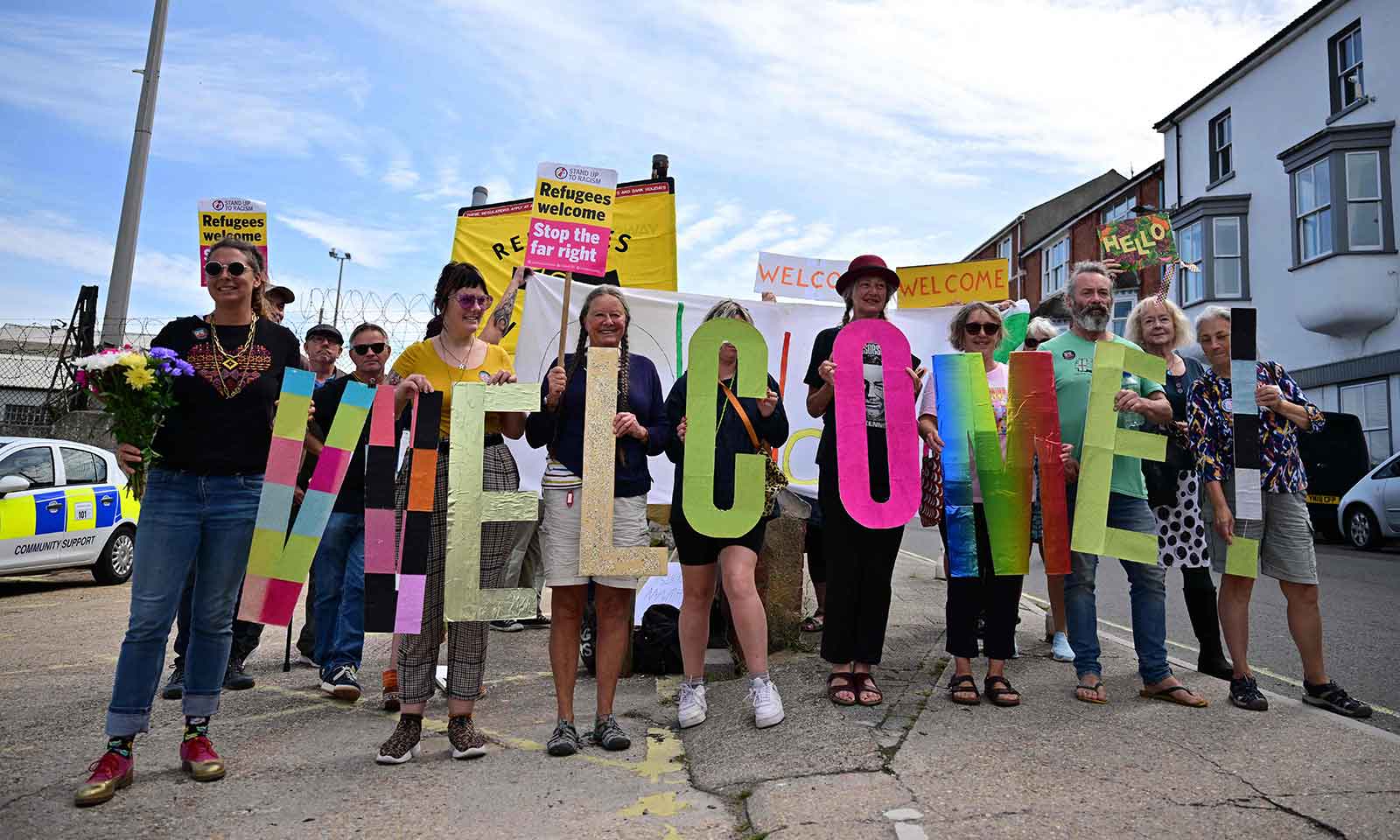
People hold up signs and placards to welcome incoming migrants, who are expected to soon be arriving at the Bibby Stockholm accommodation barge. AFP
Differently-abled asylum seekers, torture victims and migrants who have suffered “traumatic experiences at sea” are among those that the Home Office has attempted to put on board the Bibby Stockholm – in violation of its own rules.
The Bibby Stockholm is one of a number of alternative sites the Home Office is using to end reliance on expensive hotels for asylum seekers, according to another report.
The Independent understands that a man who is blind in one eye, another partially-sighted person, and migrants with phobias of water were issued with transfer orders that were successfully challenged by lawyers.
The department has so far been forced to reverse decisions to move at least 20 people and is now facing a wider challenge against the Bibby Stockholm.
Steve Smith, chief executive of refugee charity Care4Calais, said all of the asylum seekers it was supporting had their transfers to the barge “cancelled” after lawyers wrote to the Home Office.
“Amongst our clients are people who are disabled, who have survived torture and modern slavery and who have had traumatic experiences at sea,” he added.
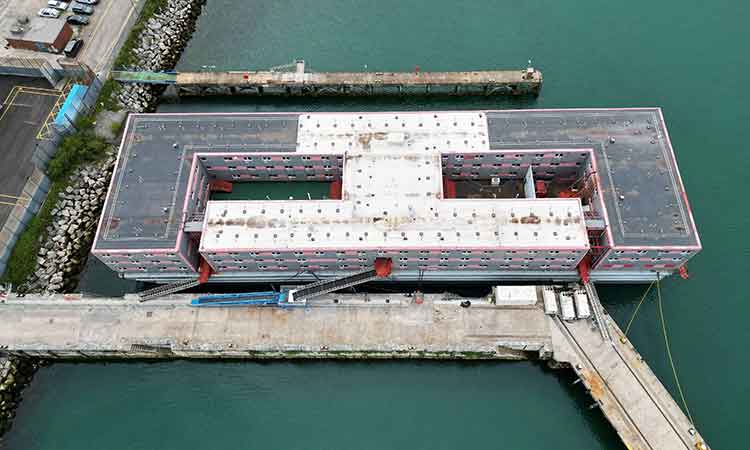
An aerial view shows the Bibby Stockholm barge moored at Portland Port, near Poole, Britain.
“To house any human being in a ‘quasi-floating prison’ like the Bibby Stockholm is inhumane. To try and do so with this group of people is unbelievably cruel.”
A small group of 15 migrants, each with standard-issue backpacks, arrived on Monday, following delays caused by last-minute safety checks, and the government is now believed to have identified all 500 people it eventually hopes to house on board.
The charity Migrants Organise has sent a pre-action letter to the Home Office calling for it to stop transfers “until and unless all concerns regarding the safety and suitability of the barge have been adequately addressed, including the necessary fire safety checks”.
The letter, sent on Sunday, demanded a new screening process for asylum seekers selected for the barge, and a minimum of 72 hours’ notice of transfer.
It warned of “serious risks” of unlawful detention, targeting by far-right groups, virus outbreaks, fire, overcrowding and a lack of privacy.
Rules imposed by the government itself exclude categories of vulnerable people from the barge, where they will be housed in tiny cabins stuffed with bunk beds, but charities believe many asylum seekers issued with transfer notices have not received advice or support.
Brian Dikoff, legal organiser at Migrants Organise, said: “The Bibby Stockholm is not safe and no amount of repurposing can make it so.
Not the right place
“It will never be an appropriate place to put people who are seeking safety here to rebuild their lives.”
The Independent understands that the Home Office intends to only house people on the barge for between three and nine months.
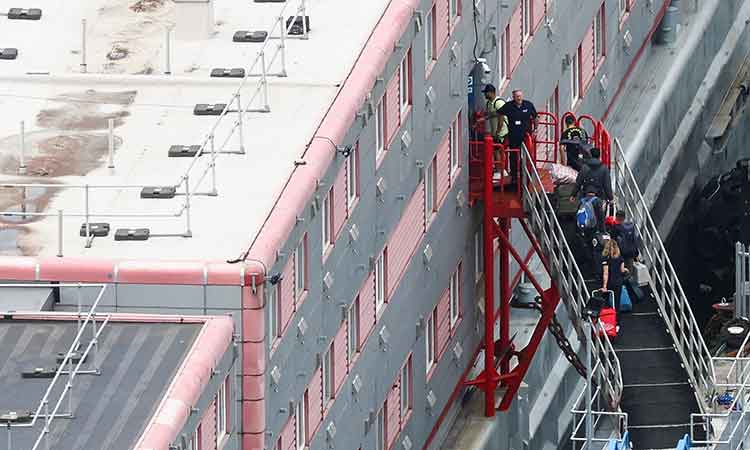
People carrying bags board the Bibby Stockholm barge at Portland Port, near Poole, Britain, on Monday. Reuters
Asylum seekers who arrived in the UK before March are being moved on board from hotels, rather than directly from processing centres near Dover, and if their claims are not decided in the period they may be sent back to hotels.
Internal guidance states that only single men between the ages of 18 and 65 can be put on the Bibby Stockholm, and that they cannot be victims of modern slavery or trafficking.
They cannot be differently-abled, elderly, or victims of torture, rape or other serious forms of psychological, physical or sexual violence.
Those with “complex health needs”, such as tuberculosis and infectious diseases, are also excluded, as is anyone with serious mental health issues.
The Home Office bars anyone who is at risk of suicide or “serious self-harm”, or who has a “history of disruptive behaviour”.
Official letters to selected asylum seekers said there will be access to an on-site nurse, “recreational space”, English classes, “voluntary sector activities” and “entertainment areas”, as well as a worship room and private space for legal consultations and phone calls.
The vessel contains 222 cabins lining narrow corridors over three decks, with at least one bunk bed crammed into every room to increase the capacity to around 500.
In the latest blunder, Home Office minister Sarah Dines appeared to suggest the full capacity could be reached by the end of this week, telling BBC Radio 4’s Today programme: “Quite possibly it will be 500 [this week]. We are hoping.”
But when asked about the comments, the prime minister’s official spokesperson, said: “We are looking to [reach] that number over time — I don’t think we are aiming to do it by the weekend.”
Even if it reaches its full capacity, the Bibby Stockholm will house under 1 per cent of in excess of 50,000 asylum seekers who are currently accommodated in hotels at a cost of over £6m a day.
It was initially one of several vessels the government hoped to use as asylum accommodation, but ministers have not yet found any other ports willing to host them.
They are part of a wider drive for “alternative accommodation sites”, including disused military bases and a former prison, that the government claims will be cheaper than hotels.
Legal challenges
There have also been delays and legal challenges to the use of RAF Scampton in Lincolnshire, while some of the first asylum seekers moved to RAF Wethersfield in Essex in July were diagnosed with scabies and tuberculosis.
The recently passed Illegal Migration Act puts a legal duty on the home secretary to detain and deport small boat migrants, but there are no operational asylum transfer agreements following the Court of Appeal’s ruling that the Rwanda deal was unlawful.
Reports suggest that ministers could be looking at alternative destinations, and reviving previously dropped plans to send asylum claimants to Ascension Island, an isolated British Overseas Territory in the South Atlantic.
Successive governments have claimed such measures would “deter” English Channel crossings but numbers remain high, with more than 15,000 people making the crossing so far this year despite weeks of unseasonably rough weather.
The Independent
Evesham refugees 'treated like cattle' over relocation

Authorities have been accused of "treating people like cattle" after asylum seekers were on Monday given 48 hours' notice of relocation.
Thirty refugees in a hotel in Evesham were told by housing provider Serco they were being moved.
Campaign group Evesham Vale Welcomes Refugees (EVWR) said the hotel's residents wanted to remain in the town.
Serco has been approached by the BBC for comment.
A spokesperson for the Home Office said individuals may be moved to other locations in line with Allocation of Accommodation guidance.
"The Home Office continues to provide safe accommodation for asylum seekers who would otherwise be destitute, as we work to end the use of hotels which are costing UK taxpayers almost £6m a day," they added.
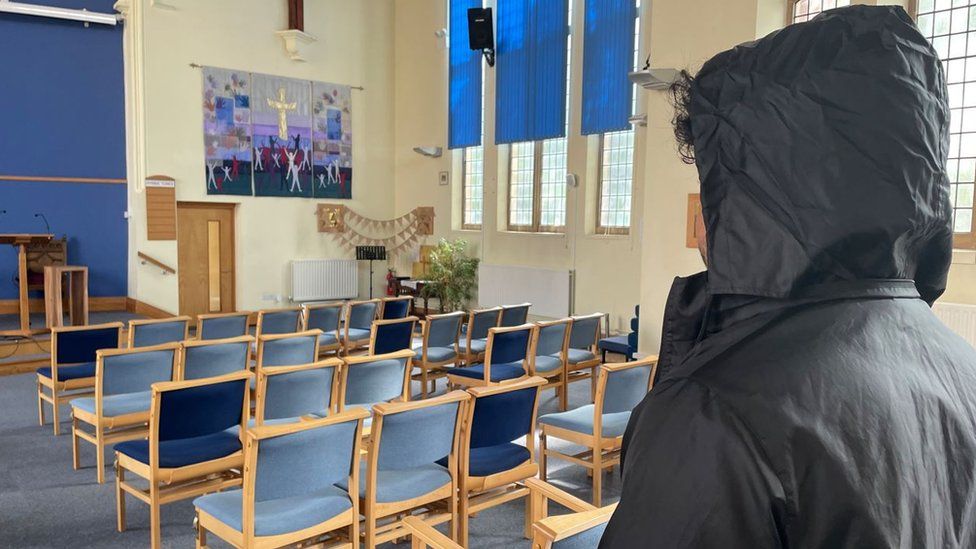
Vice chairman of EVWR, Reverend David Haslam, from Evesham Methodist Church, said the "rapid removal" of refugees was "quite shocking".
"We are absolutely appalled," he said.
"I mean this is treating people like cattle and it's so unnecessary because it's a very well-functioning hotel, we've got a mixture of families and single men, they all get on."
The individuals, some from Afghanistan and Iran, had spent between six and 18 months living in the hotel and had been attending English classes.
One asylum seeker, who said he was being relocated to Worcester, told the BBC that people were "happy" at the hotel.
Having already been moved four times, he said EVWR had helped him with college and healthcare, adding that moving to Worcester would mean he would be "too far" from where he studied.
"I don't want to move from here," he said. "They are moving us to Worcester - I think it is far from the city, it's on the motorway and you have to walk 40 minutes to the city."