It’s possible that I shall make an ass of myself. But in that case one can always get out of it with a little dialectic. I have, of course, so worded my proposition as to be right either way (K.Marx, Letter to F.Engels on the Indian Mutiny)
Wednesday, January 10, 2024
SPACE
NASA’s Webb discovers dusty ‘cat’s tail’ in Beta Pictoris System
THIS IMAGE FROM WEBB’S MIRI (MID-INFRARED INSTRUMENT) SHOWS THE STAR SYSTEM BETA PICTORIS. AN EDGE-ON DISK OF DUSTY DEBRIS GENERATED BY COLLISIONS BETWEEN PLANETESIMALS (ORANGE) DOMINATES THE VIEW AND IS LABELED “MAIN DISK PLANE.” WHILE A SECONDARY DISK (CYAN), INCLINED 5 DEGREES RELATIVE TO THE MAIN DISK, WAS ALREADY KNOWN, WEBB SHOWED ITS TRUE EXTENT AT LOWER LEFT. WEBB ALSO DETECTED A NEVER-BEFORE-SEEN FEATURE LABELED THE CAT’S TAIL. A CORONAGRAPH (BLACK CIRCLE AND TWO SMALL DISKS) HAS BEEN USED TO BLOCK THE LIGHT OF THE CENTRAL STAR. A SCALE BAR SHOWS THAT THE DISKS OF BETA PIC EXTEND FOR HUNDREDS OF ASTRONOMICAL UNITS (AU), WHERE ONE AU IS THE AVERAGE EARTH-SUN DISTANCE. (IN OUR SOLAR SYSTEM, NEPTUNE ORBITS 30 AU FROM THE SUN.) IN THIS IMAGE LIGHT AT 15.5 MICRONS IS COLORED CYAN AND 23 MICRONS IS ORANGE (FILTERS F1550C AND F2300C, RESPECTIVELY).
CREDIT: NASA, ESA, CSA, STSCI, C. STARK AND K. LAWSON (NASA GSFC), J. KAMMERER (ESO), AND M. PERRIN (STSCI).
Beta Pictoris, a young planetary system located just 63 light-years away, continues to intrigue scientists even after decades of in-depth study. It possesses the first dust disk imaged around another star — a disk of debris produced by collisions between asteroids, comets, and planetesimals. Observations from NASA’s Hubble Space Telescope revealed a second debris disk in this system, inclined with respect to the outer disk, which was seen first. Now, a team of astronomers using NASA’s James Webb Space Telescope to image the Beta Pictoris system (Beta Pic) has discovered a new, previously unseen structure.
The team, led by Isabel Rebollido of the Astrobiology Center in Spain, used Webb’s NIRCam (Near-Infrared Camera) and MIRI (Mid-Infrared Instrument) to investigate the composition of Beta Pic’s previously detected main and secondary debris disks. The results exceeded their expectations, revealing a sharply inclined branch of dust, shaped like a cat’s tail, that extends from the southwest portion of the secondary debris disk.
“Beta Pictoris is the debris disk that has it all: It has a really bright, close star that we can study very well, and a complex cirumstellar environment with a multi-component disk, exocomets, and two imaged exoplanets,” said Rebollido, lead author of the study. “While there have been previous observations from the ground in this wavelength range, they did not have the sensitivity and the spatial resolution that we now have with Webb, so they didn’t detect this feature.”
A Star’s Portrait Improved with Webb
Even with Webb or JWST, peering at Beta Pic in the right wavelength range — in this case, the mid-infrared — was crucial to detect the cat’s tail, as it only appeared in the MIRI data. Webb’s mid-infrared data also revealed differences in temperature between Beta Pic’s two disks, which likely is due to differences in composition.
“We didn’t expect Webb to reveal that there are two different types of material around Beta Pic, but MIRI clearly showed us that the material of the secondary disk and cat’s tail is hotter than the main disk,” said Christopher Stark, a co-author of the study at NASA’s Goddard Space Flight Center in Greenbelt, Maryland. “The dust that forms that disk and tail must be very dark, so we don’t easily see it at visible wavelengths — but in the mid-infrared, it’s glowing.”
To explain the hotter temperature, the team deduced that the dust may be highly porous “organic refractory material,” similar to the matter found on the surfaces of comets and asteroids in our solar system. For example, a preliminary analysis of material sampled from asteroid Bennu by NASA’s OSIRIS-REx mission found it to be very dark and carbon-rich, much like what MIRI detected at Beta Pic.
The Tail’s Puzzling Beginning Warrants Future Research
However, a major lingering question remains: What could explain the shape of the cat’s tail, a uniquely curved feature unlike what is seen in disks around other stars?
Rebollido and the team modeled various scenarios in an attempt to emulate the cat’s tail and unravel its origins. Though further research and testing is required, the team presents a strong hypothesis that the cat’s tail is the result of a dust production event that occurred a mere one hundred years ago.
“Something happens — like a collision — and a lot of dust is produced,” shared Marshall Perrin, a co-author of the study at the Space Telescope Science Institute in Baltimore, Maryland. “At first, the dust goes in the same orbital direction as its source, but then it also starts to spread out. The light from the star pushes the smallest, fluffiest dust particles away from the star faster, while the bigger grains do not move as much, creating a long tendril of dust.”
“The cat’s tail feature is highly unusual, and reproducing the curvature with a dynamical model was difficult,” explained Stark. “Our model requires dust that can be pushed out of the system extremely rapidly, which again suggests it’s made of organic refractory material.”
The team’s preferred model explains the sharp angle of the tail away from the disk as a simple optical illusion. Our perspective combined with the curved shape of the tail creates the observed angle of the tail, while in fact, the arc of material is only departing from the disk at a five-degree incline. Taking into consideration the tail’s brightness, the team estimates the amount of dust within the cat’s tail to be equivalent to a large main belt asteroid spread out across 10 billion miles.
A recent dust production event within Beta Pic’s debris disks could also explain a newly-seen asymmetric extension of the inclined inner disk, as shown in the MIRI data and seen only on the side opposite of the tail. Recent collisional dust production could also account for a feature previously spotted by the Atacama Large Millimeter/submillimeter Array in 2014: a clump of carbon monoxide (CO) located near the cat’s tail. Since the star’s radiation should break down CO within roughly one hundred years, this still-present concentration of gas could be lingering evidence of the same event.
“Our research suggests that Beta Pic may be even more active and chaotic than we had previously thought,” said Stark. “JWST continues to surprise us, even when looking at the most well-studied objects. We have a completely new window into these planetary systems.”
The observations were taken as part of Guaranteed Time Observation program 1411.
The James Webb Space Telescope is the world’s premier space science observatory. Webb is solving mysteries in our solar system, looking beyond to distant worlds around other stars, and probing the mysterious structures and origins of our universe and our place in it. Webb is an international program led by NASA with its partners, ESA (European Space Agency) and the Canadian Space Agency
‘Stellar Paternity Tests’ match orphaned stars to their Milky Way origins
Lehigh University researchers connect "hot young stars” to the clusters of their birth using Gaia Mission survey of one billion stars.
In the chaotic environment of open star clusters, strong gravitational interactions between bodies can launch individual stars far outside the cluster, even outside our galaxy, the Milky Way. Now, for the first time researchers have mapped several of those stars, which exist outside the galaxy’s disk, to the clusters of their origin using new data from the European Space Agency’s Gaia Mission.
Researchers from Lehigh University presented the findings, “Stellar Paternity Tests: Matching High-Latitude B Stars to the Open Clusters of Their Birth,” today in a press conference at the 243rd meeting of the American Astronomical Society (AAS) in New Orleans.
“Through tracing them back in time to see where they originated, we are able to match 15 of them to the star clusters where they were born,” saidM. Virginia (Ginny) McSwain, associate professor of physics, at Lehigh University. “If we can say with high confidence where some of these stars came from, we will know more about the history of the star clusters in the Milky Way.”
Most of the stars outside of the thin disk of the Milky Way, which includes the spiral arms with a thicker diameter at the center, are more than eight billion years old, forming early in the galaxy’s history. Given their very old ages, it’s not surprising they have traveled far from their birthplaces.
Since nearly all of our galaxy’s star formation occurs in the thin disk, hot B-type stars are rarely found outside this region. Yet a small number of these young stars – estimated at 10- to 100 million years old – are found at high altitudes above and below the disk, likely ejected from the clusters of their birth in the past few million years.
“Hot stars don’t often venture out of the disk, so when they do, they are noticeably out of place,” said Brandon Schweers, a Lehigh University undergraduate student who provided key research on the project. “The ‘parent’ clusters probably ejected most of these B-type stars when close, three- or four- body gravitational interactions flung out a member of the cluster, sending them running away from the plane of the Milky Way.”
One star studied was flung out with a particularly high speed, so it may have been ejected during a supernova in a close binary star system, said Schweers, a senior studying astrophysics. Stars can even be flung out, only to swing back and be sling-shotted out again.
While these “orphaned” stars have been known for two decades, none had been mapped to their place of origin before, as quality data wasn’t available to trace them to their beginnings. However, with the data from the Gaia Mission, the researchers were able to decipher the stars’ motions in greater precision than was previously available.
Using Trajectories to Trace Back Time
The Gaia Mission, launched in 2013, aims to survey more than one billion stars in the Milky Way and build a precise three-dimensional map of the galaxy. The data include unprecedented positional measurements for stars and radial velocity measurements for the brightest 150 million objects.
Based on Gaia data released in 2022, Lehigh researchers traced the kinematic trajectories of 95 high-latitude B stars and about 1,400 known galactic open clusters to identify moments in the past when they may have intersected and an ejection could have occurred.
“Using their 3-D positions and 3-D velocities through space, we were able to calculate the trajectories of each cluster and high-latitude star over the past 30 million years,” McSwain said. They used the open-source Python galpy package for galactic dynamics analysis to model the gravitational field of the galaxy at each point.
Once they identified potential matches, they compared each ejected star’s color and brightness to the Hertzsprung-Russell (H-R) diagram, a color magnitude diagram, for each open cluster. An open cluster generally has thousands of stars of the same age and composition, at the same distance.
“The shape of the H-R diagram is mostly dependent on the cluster’s age, so we can tell if the ejected star has a similar age to its potential cluster siblings,” McSwain said. Applying the H-R test narrowed down the list of potential matches further.
Finally, they analyzed the core densities of each cluster that was a possible match. Clusters with higher density have more of the strong gravitational interactions between members that give them the most potential for ejecting stars.
Paternity Tests Prove Positive
Combining these tools, the researchers confirmed positive paternity matches for 15 orphaned stars. That galactic genealogical tracing was what gave Schweers the idea for the presentation’s title.
“When I reached the stage of comparing the color and brightness for the potential matches and discarding those that showed a poor correlation in the H-R diagrams, I felt as though I was comparing the ‘DNA’ of the orphaned stars and their potential siblings,” Schweers said, reminding him of “The Maury Povich Show.” “I think everyone has heard the saying, ‘You are not the father’ that came from that show. For many of these clusters, I was essentially telling them they are not the parent of these orphaned stars, so I came up with the name ‘Stellar Paternity Tests.’”
Based on their trajectory calculations, the researchers estimate the ejections took place about 5- to 30- million years ago, “flinging abandoned stars across the Milky Way at speeds of 30-220 kilometers/second (67,000-490,000 miles/hour) to their present locations,” they wrote. “Our results provide a measure of the ejection age for each orphaned star, providing new insight into the relative importance of dynamical vs. supernovae ejection in young open clusters.”
While they were able to match a number of the far-flung stars, some couldn’t be traced back to the Milky Way’s disk very plausibly, which may provide evidence for other unusual scenarios, they added. These might include rare star formation in molecular clouds high outside the disk, or they could be relics of past dwarf galaxies that merged with the Milky Way in the past.
Undergraduate astrophysics student Christopher J. Aviles Bramer, who graduated in 2022, contributed to the research project, which was funded by Lehigh University. The AAS selected the Lehigh University findings to feature in the 2024 meeting’s press conferences.
View/download animated gif illustrating the path of 95 stars, starting from 30 million years ago until today. Credit: B. Schweers, Lehigh University
Press conferences are recorded, streamed live, and archived on theAAS Press Office YouTube channel. After the meeting, archived webcasts will be available via the AASonline archive, which links to individual briefing videos. Photos of the briefing sessions will be available after the meeting.
Nube, the almost invisible galaxy which challenges the dark matter model
Nube is an almost invisible dwarf galaxy discovered by an international research team led by the Instituto de Astrofísica de Canarias (IAC) in collaboration with the University of La Laguna (ULL) and other institutions.
The name was suggested by the 5-year-old daughter of one of the researchers in the group, and is due to the diffuse appearance of the object. Its surface brightness is so faint that it had passed unnoticed in the various previous surveys of this part of the sky, as if it were some kind of ghost. This is because its stars are so spread out in such a large volumen that “Nube” (the Spanish for “Cloud”) was almost undetectable.
This newly discovered galaxy has a set of specific properties which distinguish it from previously known objects. The research team estimate that Nube is a dwarf galaxy ten times fainter than others of its type, but also ten times more extended than other objects with a comparable number of stars. To show what this means to anyone who knows a little astronomy, this galaxy is one third of the size of the Milky Way, but has a mass similar to that of the Small Magellanic Cloud.
“With our present knowledge we do not understand how a galaxy with such extreme characteristics can exist” explains Mireia Montes, the first author of the article, a researcher at the IAC and the ULL.
For some years, Ignacio Trujillo, the second author of the article, has been analyzing, based on the SDSS images (Sloan Digital Sky Survey), a specific strip of sky, in the framework of the project Legado del IAC Stripe 82. In one of the revisions of the data, they noticed a faint patch which looked sufficiently interesting to set up a research project.
The next step was to use ultra-deep multicolour images from the Gran Telescopio Canarias (GTC), to confirm that this patch in the survey was not some type of error, but is an extremely diffuse object. Due of its faintness, it is hard to determine the exact distance of Nube. Using an observation obtained with the Green Bank Telescope (GBT), in the United States, the authors estimated the distance of Nube to be 300 million light years, although upcoming observations with the Very Large Array (VLA) radiotelescope and the optical William Herschel Telescope (WHT) at the Roque de los Muchachos Observatory, La Palma, should help them to show whether this distance is correct. “If the galaxy turns out to be nearer, it will still be a very strange object, and offer major challenges to astrophysics” comments Ignacio Trujillo.
Another challenge to the present dark matter model?
The general rule is that galaxies have a much larger density of stars in their inner regions, and that this density falls rapidly with increasing distance from the centre. However, Montes says that in Nube, “the density of stars varies very little throughout the object, which is why it is so faint, and we have not been able to observe it well until we had the ultra-deep images from the GTC”.
Nube has the astronomers puzzled. Prima facie, the team explains, there is no interaction, or other indication of its strange properties. Cosmological simulations are unable to reproduce its “extreme” characteristics, even on the basis of different scenarios. “We are left without a viable explanation within the currently accepted cosmological model, that of cold dark matter” explains Montes.
The cold dark matter model can reproduce the large-scale structures in the universe, but there are small scale scenarios, such as the case of Nube, for which it cannot give a good answer. We have shown how the different theoretical models cannot produce it, which makes it one of the most extreme cases known until now. “It is possible that with this galaxy, and similar ones which we might find, we can find additional clues which will open a new window on the understanding of the universe” comments Montes.
“One possibility which is attractive, is that the unusual properties of Nube are showing us that the particles which make up dark matter have an extremely small mass” says Ignacio Trujillo. If this was so, the unusual properties of this galaxy would be a demonstration of the properties of quantum physics, but on a galactic scale. “If this hypothesis is confirmed, it would be one of the most beautiful demonstration of nature, unifying the world of the smallest with that of the largest” he concludes.
A HUBBLE SPACE TELESCOPE IMAGE OF THE HOST GALAXY OF AN EXCEPTIONALLY POWERFUL FAST RADIO BURST, FRB 20220610A. HUBBLE’S SENSITIVITY AND SHARPNESS REVEALS A COMPACT GROUP OF MULTIPLE GALAXIES THAT MAY BE IN THE PROCESS OF MERGING. THEY EXISTED WHEN THE UNIVERSE WAS ONLY 5 BILLION YEARS OLD. FRB 20220610A WAS FIRST DETECTED ON JUNE 10, 2022, BY THE AUSTRALIAN SQUARE KILOMETER ARRAY PATHFINDER (ASKAP) RADIO TELESCOPE IN WESTERN AUSTRALIA. THE EUROPEAN SOUTHERN OBSERVATORY’S VERY LARGE TELESCOPE IN CHILE CONFIRMED THAT THE FRB CAME FROM A DISTANT PLACE.
CREDIT: NASA, ESA, STSCI, ALEXA GORDON (NORTHWESTERN)
Researchers will discuss findings during a press briefing on Jan. 9 at the American Astronomical Society meeting
Fast radio burst (FRB) is the most powerful, most distant to date
Astronomers find FRB originated not in one galaxy but a group of galaxies on the path to a possible merger
EVANSTON, Ill. — In summer 2022, astronomers detected the most powerful fast radio burst (FRB) ever observed. And coming from a location that dates halfway back to the Big Bang, it also was the farthest known FRB spotted to date.
Now, astronomers led by Northwestern University have pinpointed the extraordinary object’s birthplace — and it’s rather curious, indeed.
Using images from NASA’s Hubble Space Telescope, the researchers traced the FRB back to not one galaxy but a group of at least seven galaxies. The galaxies in the collection appear to be interacting with one another — perhaps even on the path to a potential merger. Such groups of galaxies are rare and possibly led to conditions that triggered the FRB.
The unexpected finding might challenge scientific models of how FRBs are produced and what produces them.
“Without the Hubble’s imaging, it would still remain a mystery as to whether this FRB originated from one monolithic galaxy or from some type of interacting system,” said Northwestern’s Alexa Gordon, who led the study. “It’s these types of environments — these weird ones — that drive us toward a better understanding of the mystery of FRBs.”
Flaring up and disappearing within milliseconds, FRBs are brief, powerful radio blasts that generate more energy in one quick burst than our sun emits in an entire year. And the record-breaking FRB (dubbed FRB 20220610A) was even more extreme than its predecessors.
Not only was it four times more energetic than closer FRBs, it also clocked in as the most distant FRB yet discovered. When FRB 20220610A originated, the universe was just 5 billion years old. (For comparison, the universe is now 13.8 billion years old.)
In early observations, the burst appeared to have originated near an unidentifiable, amorphous blob, which astronomers initially thought was either a single, irregular galaxy or a group of three distant galaxies. But, in a new twist, the Hubble’s sharp images now suggest the blob might be as least as many as seven galaxies in incredibly close proximity to one another. In fact, the galaxies are so close to one another that they could all fit inside our own Milky Way.
“There are some signs that the group members are ‘interacting,’” Fong said. “In other words, they could be trading materials or possibly on a path to merging. These groups of galaxies (called compact groups) are incredibly rare environments in the universe and are the densest galaxy-scale structures we know of.”
“This interaction could trigger bursts of star formation,” Gordon said. “That might indicate that the progenitor of FRB 20220610A is associated with a fairly recent population of stars which matches what we’ve learned from other FRBs.”
“Despite hundreds of FRB events discovered to date, only a fraction of those have been pinpointed to their host galaxies,” said study co-author Yuxin (Vic) Dong, an NSF Graduate Research, astronomy Ph.D. student in Fong’s lab and member of CIERA. . “Within that small fraction, only a few came from a dense galactic environment, but none have ever been seen in such a compact group. So, its birthplace is truly rare.”
Enigmatic explosions
Although astronomers have uncovered up to 1,000 FRBs since first discovering them in 2007, the sources behind the blinding flashes remain stubbornly uncertain. While astronomers have yet to reach a consensus on the possible mechanisms behind FRBs, they generally agree that FRBs must involve a compact object, such as a black hole or neutron star.
By revealing the true nature of FRBs, astronomers not only could learn about the mysterious phenomena but also about the true nature of the universe itself. When radio waves from FRBs finally meet our telescopes, they have traveled for billions of years from the distant, early universe. During this cross-universe odyssey, they interact with material along the way.
“Radio waves, in particular, are sensitive to any intervening material along the line of sight — from the FRB location to us,” Fong said. “That means the waves have to travel through any cloud of material around the FRB site, through its host galaxy, across the universe and finally through the Milky Way. From a time delay in the FRB signal itself, we can measure the sum of all of these contributions.”
To continue to probe FRBs and their origins, astronomers need to detect and study more of them. And with technology continually becoming more sensitive, Gordon says more detections — potentially even capturing incredibly faint FRBs — are right around the corner.
“With a larger sample of distant FRBs, we can begin to study the evolution of FRBs and their host properties by connecting them to more nearby ones and perhaps even start to identify more strange populations,” Dong said.
“In the near future, FRB experiments will increase their sensitivity, leading to an unprecedented rate in the number of FRBs detected at these distances,” Gordon said. “Astronomers will soon learn just how special the environment of this FRB was.”
The study, “A fast radio burst in a compact galaxy group at z ~ 1,” was supported by the National Science Foundation (award numbers AST-1909358, AST-2047919 and AST-2308182), the David and Lucile Packard Foundation, the Alfred P. Sloan Foundation, the Research Corporation for Science Advancement and NASA (award number GO-17277). Astronomers first detected FRB 20220610A with the Australian Square Kilometer Array Pathfinder radio telescope in Western Australia and then confirmed its origin with the European Southern Observatory’s Very Large Telescope in Chile.
METHOD OF RESEARCH
Observational study
SUBJECT OF RESEARCH
Not applicable
ARTICLE TITLE
A fast radio burst in a compact galaxy group at z ~ 1
Unlocking the secrets of a "hot Saturn" and its spotted star
Led by researchers from Université de Montréal's Trottier Institute for Research on Exoplanets (iREx), a team of astronomers has harnessed the power of the revolutionary James Webb Space Webb Telescope (JWST) to study the "hot Saturn" exoplanet HAT-P-18 b.
Their findings, published last month in the journal Monthly Notices of the Royal Astronomical Society, paint a complete picture of the HAT-P-18 b's atmosphere while exploring the great challenge of distinguishing its atmospheric signals from the activity of its star.
HAT-P-18 b is located over 500 light-years away with a mass similar to Saturn’s but a size closer to that the larger planet Jupiter. As a result, the exoplanet has a "puffed-up" atmosphere that is especially ideal for analysis.
Passing over a spotted star
Observations from the JWST were taken while the HAT-P-18 b was passing in front of its Sun-like star. This moment is called a transit and is crucial to detect and further characterise an exoplanet from hundreds of light-years away with surprising precision.
Astronomers don't observe light that is being emitted directly by the distant planet. Rather, they study how the central star’s light is being blocked and affected by the planet orbiting it, and so must try to disentangle signals caused by the presence of the planet from those caused by the star’s own properties.
Just like our Sun, stars do not have uniform surfaces. They can have dark star spots and bright regions, which can create signals that mimic a planet’s atmospheric attributes. A recent study of the exoplanet TRAPPIST-1 b and its star TRAPPIST-1 led by UdeM doctoral student Olivia Lim witnessed an eruption, or flare, on the surface of the star, which affected observations.
In the case of planet HAT-P-18 b, Webb caught the exoplanet right as it was passing over a dark spot on its star, HAT-P-18. This is called a spot-crossing event, and its effect was evident in the data collected for the new study. The iREx team also reported the presence of numerous other star spots on HAT-P-18’s surface which were not blocked out by the exoplanet.
To accurately determine the exoplanet’s atmospheric composition, the researchers had to simultaneously model the planet's atmosphere as well as its star’s peculiarities. In their study, they point out that such consideration will be crucial in treating future exoplanet observations via the Webb to fully harness their potential.
“We found that accounting for stellar contamination implies the existence of spots and clouds instead of haze and recovers a water vapour abundance of almost an order of magnitude lower,” said lead author Marylou Fournier-Tondreau.
“So considering the system’s host star makes a big difference," added Fournier-Tondreau, who did the work as a master's student at iREx and is now pursuing a Ph.D. at the University of Oxford.
"It’s actually the first time that we clearly disentangle the signature of hazes versus starspots, thanks to Canada's NIRISS (Near-Infrared Imager and Slitless Spectrograph) instrument, which provides wider wavelength coverage extending into the visible light domain.”
H2O, CO2, and clouds in a scorching atmosphere
After modelling the exoplanet and the star in the HAT-P-18 system, the iREx astronomers performed a meticulous dissection of HAT-P-18 b’s atmospheric composition. By inspecting the light that filters through the exoplanet’s atmosphere as it transits its host star, the researchers discerned the presence of water vapour (H2O) and carbon dioxide (CO2).
The researchers also detected the possible presence of sodium and observed strong signs of a cloud deck in HAT-P-18 b’s atmosphere, which appears to be muting the signals of many of the molecules found within it. They also concluded that the star’s surface was covered by many dark spots that can significantly influence the interpretation of the data.
An earlier analysis of the same JWST data led by a team at Johns Hopkins University had also revealed a clear detection of water and CO2, but also reported the detection of small particles at high-altitudes called hazes and found hints of methane (CH4). The iREx astronomers paint a different picture.
The CH4 detection was not confirmed, and the water abundance they determined was 10 times lower than previously found. They also found that the previous study’s detection of hazes could instead be caused by star spots on the star’s surface, highlighting the importance of considering the star in the analysis.
Could the exoplanet support life? Not likely. While molecules like water, carbon dioxide, and methane can be interpreted as biosignatures, or signs of life, in certain ratios or in combination with other molecules, HAT-P-18 b’s scorching temperatures of close to 600 degrees Celsius do not bode well for the planet’s habitability.
Future observations from another JWST instrument, the Near Infrared Spectrograph (NIRSpec), promise to help refine the team’s results, such as the CO2 detection, and shed even more light on the intricacies of this hot Saturn exoplanet.
About this study
“Near-infrared transmission spectroscopy of HAT-P-18 b with NIRISS: disentangling planetary and stellar features in the era of JWST,” by Marylou Fournier Tondreau et al, was published Dec. 9, 2023, in Monthly Notices of the Royal Astronomical Society.
The light curve shows the luminosity or brightness of the star over time. When the exoplanet passes over the star, known as a transit, part of the star’s light is blocked by the exoplanet. As a result, the star’s luminosity decreases. When a star spot is occulted on the star’s surface, or when the exoplanet passes over the dark spot, astronomers can see a signal in the light curve in the form of a small bump in the bottom of the transit light curve. See the full animation of this infographic below.
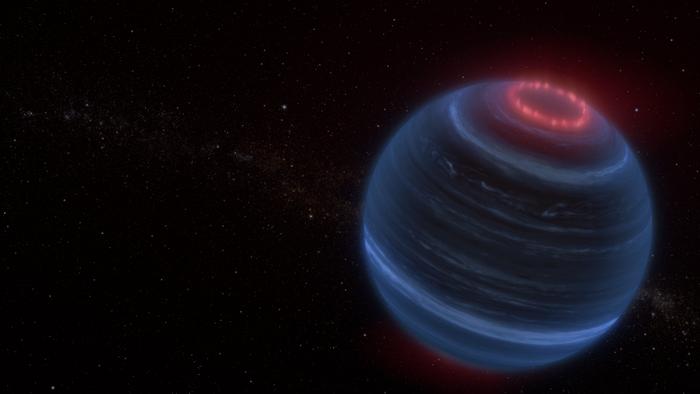
THIS ARTIST CONCEPT PORTRAYS THE BROWN DWARF W1935, WHICH IS LOCATED 47 LIGHT-YEARS FROM EARTH. ASTRONOMERS USING NASA’S JAMES WEBB SPACE TELESCOPE FOUND INFRARED EMISSION FROM METHANE COMING FROM W1935. THIS IS AN UNEXPECTED DISCOVERY BECAUSE THE BROWN DWARF IS COLD AND LACKS A HOST STAR; THEREFORE, THERE IS NO OBVIOUS SOURCE OF ENERGY TO HEAT ITS UPPER ATMOSPHERE AND MAKE THE METHANE GLOW. THE TEAM SPECULATES THAT THE METHANE EMISSION MAY BE DUE TO PROCESSES GENERATING AURORAE, SHOWN HERE IN RED.
Astronomers using NASA’s James Webb Space Telescope have found a brown dwarf (an object more massive than Jupiter but smaller than a star) with infrared emission from methane, likely due to energy in its upper atmosphere. This is an unexpected discovery because the brown dwarf, W1935, is cold and lacks a host star; therefore, there is no obvious source for the upper atmosphere energy. The team speculates that the methane emission may be due to processes generating aurorae.
These findings are being presented at the 243rd meeting of the American Astronomical Society in New Orleans.
To help explain the mystery of the infrared emission from methane, the team turned to our solar system. Methane in emission is a common feature in gas giants like Jupiter and Saturn. The upper-atmosphere heating that powers this emission is linked to aurorae.
On Earth, aurorae are created when energetic particles blown into space from the Sun are captured by Earth’s magnetic field. They cascade down into our atmosphere along magnetic field lines near Earth’s poles, colliding with gas molecules and creating eerie, dancing curtains of light. Jupiter and Saturn have similar auroral processes that involve interacting with the solar wind, but they also get auroral contributions from nearby active moons like Io (for Jupiter) and Enceladus (for Saturn).
For isolated brown dwarfs like W1935, the absence of a stellar wind to contribute to the auroral process and explain the extra energy in the upper atmosphere required for the methane emission is a mystery. The team surmises that either unaccounted internal processes like the atmospheric phenomena of Jupiter and Saturn, or external interactions with either interstellar plasma or a nearby active moon, may help account for the emission.
A Detective Story
The aurorae’s discovery played out like a detective story. A team led by Jackie Faherty, an astronomer at the American Museum of Natural History in New York, was awarded time with the Webb telescope to investigate 12 cold brown dwarfs. Among those were W1935 – an object that was discovered by citizen scientist Dan Caselden, who worked with the Backyard Worlds zooniverse project – and W2220, an object that was discovered using NASA’s Wide Field Infrared Survey Explorer. Webb revealed in exquisite detail that W1935 and W2220 appeared to be near clones of each other in composition. They also shared similar brightness, temperatures, and spectral features of water, ammonia, carbon monoxide, and carbon dioxide. The striking exception was that W1935 showed emission from methane, as opposed to the anticipated absorption feature that was observed toward W2220. This was seen at a distinct infrared wavelength to which Webb is uniquely sensitive.
“We expected to see methane because methane is all over these brown dwarfs. But instead of absorbing light, we saw just the opposite: The methane was glowing. My first thought was, what the heck? Why is methane emission coming out of this object?” said Faherty.
The team used computer models to infer what might be behind the emission. The modeling work showed that W2220 had an expected distribution of energy throughout the atmosphere, getting cooler with increasing altitude. W1935, on the other hand, had a surprising result. The best model favored a temperature inversion, where the atmosphere got warmer with increasing altitude. “This temperature inversion is really puzzling,” said Ben Burningham, a co-author from the University of Hertfordshire in England and lead modeler on the work. “We have seen this kind of phenomenon in planets with a nearby star that can heat the stratosphere, but seeing it in an object with no obvious external heat source is wild.”
Clues from our Solar System
For clues, the team looked in our own backyard, to the planets of our solar system. The gas giant planets can serve as proxies for what is seen going on more than 40 light-years away in the atmosphere of W1935.
The team realized that temperature inversions are prominent in planets like Jupiter and Saturn. There is still ongoing work to understand the causes of their stratospheric heating, but leading theories for the solar system involve external heating by aurorae and internal energy transport from deeper in the atmosphere (with the former a leading explanation).
Brown Dwarf Aurora Candidates in Context
This is not the first time an aurora has been used to explain a brown dwarf observation. Astronomers have detected radio emission coming from several warmer brown dwarfs and invoked aurorae as the most likely explanation. Searches were conducted with ground-based telescopes like the Keck Observatory for infrared signatures from these radio-emitting brown dwarfs to further characterize the phenomenon, but were inconclusive.
W1935 is the first auroral candidate outside the solar system with the signature of methane emission. It’s also the coldest auroral candidate outside our solar system, with an effective temperature of about 400 degrees Fahrenheit (200 degrees Celsius), about 600 degrees Fahrenheit warmer than Jupiter.
In our solar system the solar wind is a primary contributor to auroral processes, with active moons like Io and Enceladus playing a role for planets like Jupiter and Saturn, respectively. W1935 lacks a companion star entirely, so a stellar wind cannot contribute to the phenomenon. It is yet to be seen whether an active moon might play a role in the methane emission on W1935.
“With W1935, we now have a spectacular extension of a solar system phenomenon without any stellar irradiation to help in the explanation.” Faherty noted. “With Webb, we can really ‘open the hood’ on the chemistry and unpack how similar or different the auroral process may be beyond our solar system,” she added.
The James Webb Space Telescope is the world’s premier space science observatory. Webb is solving mysteries in our solar system, looking beyond to distant worlds around other stars, and probing the mysterious structures and origins of our universe and our place in it. Webb is an international program led by NASA with its partners, ESA (European Space Agency) and the Canadian Space Agency.
A Jupiter-sized planet has been hiding a big secret: A 350,000-mile-long tail
Scientists say the discovery presents a rare opportunity to study the physics that shape thousands of other planets
Astrophysicists have found that a large exoplanet known as WASP-69b is being trailed by a tail of gas seven times as long as the planet itself.
The comet-like tail is the result of the planet’s gas atmosphere being burned off as it passes precariously close to the hot star it orbits and stretched by stellar winds.
By studying this process in real time, scientists can better understand how thousands of other planets in our galaxy have evolved.
WASP-69b is having a hot girl summer that never ends. The huge gaseous exoplanet, roughly the size of Jupiter and approximately 160 light years from Earth, orbits its searing host star so closely that its atmosphere is boiling away at a rate of 200,000 tons per second.
In new research published in The Astrophysical Journal, a team led by UCLA astrophysicists discovered that as the planet’s atmosphere escapes into space, its host star’s stellar winds sculpt it into a comet-like tail that trails the planet for at least 350,000 miles — far longer than observed before.
“Work by previous groups showed that this planet was losing some of its atmosphere and suggested a subtle tail or perhaps none at all,” said Dakotah Tyler, a UCLA doctoral student and first author of the research. “However, we have now definitively detected this tail and shown it to be at least seven times longer than the planet itself.”
Discovered a decade ago, WASP-69b is known as a “hot Jupiter” — a gas giant planet that orbits precariously close to its star. In fact, the exoplanet is so close that it completes a full orbit in less than four Earth days; by comparison, Mercury, the closest planet to our sun, has an 88-day orbit.
The discovery that WASP-69b’s star is not only stripping away the planet’s atmosphere with high-energy radiation but also physically shepherding that escaped gas into a long, thin tail helps to reveal how stellar winds affect planets that orbit their stars so closely. Studying this type of atmospheric mass-loss directly is pivotal for understanding exactly how planets across the galaxy evolve over time with their stars, the researchers said.
“Over the last decade, we have learned that the majority of stars host a planet that orbits them closer than Mercury orbits our sun and that the erosion of their atmospheres plays a key role in explaining the types of planets we see today,” said co-author and UCLA professor of physics and astronomy Erik Petigura. “However, for most known exoplanets, we suspect that the period of atmospheric loss concluded long ago. The WASP-69b system is a gem because we have a rare opportunity to study atmospheric mass-loss in real time and understand the critical physics that shape thousands of other planets.”
Earlier observations of WASP-69b, conducted with a 3.5-meter telescope at the Calar Alto Observatory in Spain and a 5-meter telescope at the Palomar Observatory in San Diego County, showed only a hint of a tail or no tail. For the current study, the researchers used a larger, 10-meter telescope at the W. M. Keck Observatory in Hawaii, along with its high-resolution spectrograph instrument, called NIRSPEC, to make observations that were more sensitive to the detailed structure of WASP-69b’s escaping atmosphere.
The observations revealed that WASP-69b’s escaping gas, primarily hydrogen and helium, is shaped and pushed in the direction of Earth by radiation and an outflow of gas from its host star known as a stellar wind for hundreds of thousands of miles. The researchers were then able to calculate the amount of mass the planet was losing.
“These comet-like tails are really valuable because they form when the escaping atmosphere of the planet rams into the stellar wind, which causes the gas to be swept back,” Petigura said. “Observing such an extended tail allows us to study these interactions in great detail.”
Even though the hot Jupiter is dancing a dangerous tango with its star, Tyler said its atmosphere won’t completely evaporate.
“At around 90 times the mass of Earth, WASP-69b has such a large reservoir of material that even losing this enormous amount of mass won’t affect it much over the course of its life. It’s in no danger of losing its entire atmosphere within the star’s lifetime,” Tyler said.
“The resilience of this planet in such an extreme and hostile environment serves as a powerful reminder to us all,” he added. “Despite the multitude of challenges we may face, our capacity to withstand and overcome is often far greater than we realize. Our problems may seem daunting, but like WASP-69b, we have what it takes to continue on.”
Other authors of the paper include Antonija Oklopcic from the University of Amsterdam and Trevor David from the Flatiron Institute.
JOURNAL
The Astrophysical Journal
Meteorite analysis shows Earth's building blocks contained water
When our Sun was a young star, 4.56 billion years ago, what is now our solar system was just a disk of rocky dust and gas. Over tens of millions of years, tiny pebbles of dust coalesced, like a snowball rolling larger and larger, to become kilometer-sized "planetesimals"—the building blocks of Earth and the other inner planets.
Researchers have long tried to understand the ancient environments in which these planetesimals formed. For example, water is now abundant on Earth, but has it always been? In other words, did the planetesimals that accreted into our planet contain water?
Now, a new study combines meteorite data with thermodynamic modeling and determines that the earliest inner solar system planetesimals must have formed in the presence of water, challenging current astrophysical models of the early solar system.
The research was conducted in the laboratory of Paul Asimow (MS '93, PhD '97), Eleanor and John R. McMillan Professor of Geology and Geochemistry and appears in the journal Nature Astronomy on January 9.
Researchers have samples of the earliest years of the solar system in the form of iron meteorites. These meteorites are the remnants of the metallic cores of the earliest planetesimals in our solar system that avoided accretion into a forming planet and instead orbited around the solar system before ultimately falling onto our planet. The chemical compositions of meteorites such as these can reveal information about the environments in which they formed and answer questions such as whether the building blocks of Earth formed far from our Sun, where cooler temperatures allowed the existence of water ice, or if they instead formed closer to the Sun, where the heat would have evaporated any water and resulted in dry planetesimals. If the latter is correct, then Earth would have formed dry and gained its water through some other method later in its evolution.
Though the meteorites themselves do not contain any water, scientists can infer its long-lost presence by examining its impact on other chemical elements.
Water is composed of two hydrogen atoms and one oxygen atom. In the presence of other elements, water will often transfer its oxygen atom away in a process called oxidation. For example, iron metal (Fe) reacts with water (H2O) to form iron oxide (FeO). A sufficient excess of water can drive the process further, producing Fe2O3 and FeO(OH), the ingredients of rust. Mars, for example, is covered in rusty iron oxide, providing strong evidence that the Red Planet once had water.
Damanveer Grewal, a former Caltech postdoctoral scholar and first author of the new study, specializes in using chemical signatures from iron meteorites to gather information about the early solar system. Though any iron oxide from the earliest planetesimals is now long gone, the team could determine how much iron would have been oxidized by examining the metallic nickel, cobalt, and iron contents of these meteorites. These three elements should be present in roughly equal ratios relative to other primitive materials, so if any iron was "missing," this would imply that the iron had been oxidized.
"Iron meteorites have been somewhat neglected by the planet-formation community, but they constitute rich stores of information about the earliest period of solar system history, once you work out how to read the signals," says Asimow. "The difference between what we measured in the inner solar system meteorites and what we expected implies an oxygen activity about 10,000 times higher."
The researchers found that those iron meteorites thought to be derived from the inner solar system had about the same amount of missing iron metal as meteorites derived from the outer solar system. For this to be the case, the planetesimals from both groups of meteorites must have formed in a part of the solar system where water was present, implying that the building blocks of planets accreted water right from the beginning.
The signatures of water in these planetesimals challenge many of the current astrophysical models of the solar system. If planetesimals formed at Earth's current orbital position, water would have existed only if the inner solar system was much cooler than models currently predict. Alternatively, they may have formed further out, where it was cooler, and migrated in.
"If water was present in the early building blocks of our planet, other important elements like carbon and nitrogen were likely present as well," says Grewal. "The ingredients for life may have been present in the seeds of rocky planets right from the start."
"However, the method only detects water that was used up in oxidizing iron," adds Asimow. "It is not sensitive to excess water that might go on to form the ocean. So, the conclusions of this study are consistent with Earth accretion models that call for late addition of even more water-rich material."
The paper is titled "Accretion of the earliest inner solar system planetesimals beyond the water-snowline." In addition to Asimow and Grewal, co-authors are former Caltech postdoctoral scholar Nicole X. Nie, Bidong Zhang of UCLA, and Andre Izidoro of Rice University. Grewal is currently an assistant professor at Arizona State University. Funding was provided by a Barr Foundation Postdoctoral Fellowship and NASA.
Accretion of the earliest inner Solar System planetesimals beyond the water snowline
ARTICLE PUBLICATION DATE
9-Jan-2024
A chemical reaction key to various industries just got greener
A multi-institutional research team, led by Osaka University, successfully converts biomass-derived long-chain fatty acids into fatty amines, opening the door to greener catalyst processes
Osaka, Japan – From alleviating your allergy symptoms to optimizing herbicide performance, alkylamines are molecules that have many uses. Unfortunately, common methods of producing alkylamines result in harmful waste byproducts. A method of synthesizing alkylamines in a sustainable yet cost-effective way has thus been highly sought after.
Now, in a study recently published in Green Chemistry, a research team led by Osaka University has found a way. The team has developed a method of alkylamine synthesis that works under mild conditions and produces only water as a byproduct. The simple, environmentally friendly reaction conditions reported here will hopefully inspire advances in other chemical syntheses common in industry.
Sports clothing, furniture, and many other everyday products are produced, in part, by using alkylamines. So how do we produce these wonder molecules? Carboxylic acids are an ideal starting point because they can be sourced sustainably, such as from biomass. However, the synthetic procedures currently used also produce a large quantity of waste or require experimentally difficult reaction conditions, such as high pressures and temperatures. Thus, industry generally avoids carboxylic acids as a starting material for alkylamine production. Developing a new synthetic protocol that works at experimentally convenient pressures and temperatures was the goal of the research team's study.
"In our work, we unveil a novel catalyst system, a platinum – molybdenum catalyst, that can transform carboxylic acids into amines," explains Katsumasa Sakoda, lead author of the study. "This produces alkylamines, which can be used for surfactants, pharmaceuticals and more."
The researchers' synthetic protocol offers several advantages: one, the reaction conditions are mild, requiring only atmospheric hydrogen pressure and temperatures up to 160°C. Two, the turnover number, i.e., the number of moles of substrate that a mole of catalyst can convert, is high at 363. Three, the catalyst can be reused at least five times. Four, many carboxylic acid and amine starting materials are compatible with the reactions involved, such as converting fatty acids into fatty amines. Five, the reaction yields are high – up to 99%, with water being the only byproduct.
"We're excited because our research improves the environmental sustainability and simplifies the experimental setup of a common class of chemical syntheses," says Tomoo Mizugaki, senior author. "We hope that this is only the first step toward the development of greener catalyst processes.”
The team’s research is an important step forward in increasing the sustainability of a chemical reaction that is required for synthesizing many everyday products. Because the experimental synthetic procedures are safe and simple, they can be readily used for other catalytic processes.
###
The article, "Reductive amination of carboxylic acids under H2 using a heterogeneous Pt–Mo catalyst," was published in Green Chemistry at DOI: https://doi.org/10.1039/D3GC02155F
About Osaka University Osaka University was founded in 1931 as one of the seven imperial universities of Japan and is now one of Japan's leading comprehensive universities with a broad disciplinary spectrum. This strength is coupled with a singular drive for innovation that extends throughout the scientific process, from fundamental research to the creation of applied technology with positive economic impacts. Its commitment to innovation has been recognized in Japan and around the world, being named Japan's most innovative university in 2015 (Reuters 2015 Top 100) and one of the most innovative institutions in the world in 2017 (Innovative Universities and the Nature Index Innovation 2017). Now, Osaka University is leveraging its role as a Designated National University Corporation selected by the Ministry of Education, Culture, Sports, Science and Technology to contribute to innovation for human welfare, sustainable development of society, and social transformation. Website: https://resou.osaka-u.ac.jp/en
(a) The photo of Pt‒Mo/γ-Al2O3 catalyst. (b) Transmission electron microscope image of Pt‒Mo/γ-Al2O3.
Reductive amination of biomass-derived fatty acids to fatty amines
Reductive amination of carboxylic acids under H2 using a heterogeneous Pt–Mo catalyst
Exposure to air pollution associated with increase in sedentary time, study finds
Long-term exposure to current levels of UK air pollution has been found to be associated with an annual increase of up to 22 minutes of sedentary time each day, in a study published in the Journal of Public Health
Exposure to air pollution associated with increase in sedentary time, study finds
Long-term exposure to current levels of UK air pollution has been found to be associated with an annual increase of up to 22 minutes of sedentary time each day, in a study published in the Journal of Public Health.
Researchers based at the National Institute for Health and Care Research (NIHR) Leicester Biomedical Research Centre (BRC) discovered this trend in what is thought to be the first study of its kind to closely examine the relationship between the levels of background pollution people are regularly exposed to in the UK environment, and their levels of physical activity and sedentary behaviour.
Sedentary behaviour is the amount of time spent lying, reclining, sitting or standing still. Higher levels of sedentary behaviour are known to be linked to poorer health including heart disease, several types of cancer and an earlier death.
Dr Jonathan Goldney from the University of Leicester explained: “We know that air pollution is associated with cardiometabolic and respiratory diseases, and in 2019 the World Health Organization estimated that 99% of the global population breathe air containing high levels of pollutants.
“Levels of air pollution may affect people’s ability to exercise, or their enjoyment of exercise. It may also be considered a risk factor for increasing levels of sedentary behaviour by encouraging sitting time indoors and discouraging active time outdoors, further increasing the risk of chronic disease in a feedback loop.”
In this study, the team, which included Director of the NIHR Leicester BRC, Professor Melanie Davies CBE, took a close look at observations made on 644 people at risk of type 2 diabetes taking part in the ‘Walking Away from type 2 diabetes’ behavioural intervention, which aimed to increase physical activity through walking.
Dr Goldney added: “The participants in the study wore accelerometers around their waists for seven consecutive days during waking hours. This gave us their daily minutes of moderate-to-vigorous physical activity and sedentary time on three occasions over a three year period – and an incredible opportunity to look for any long term trends.”
Annual average levels of the most measured air pollutants in health research (long-term particulate matter with diameter of less than or equal to 2.5 μm (micrometres), less than or equal to 10 μm, and nitrogen dioxide) from the year the participant entered the study and the preceding two years (sourced from the Department for Environment Food and Rural Affairs’ Pollution Climate Mapping model) were then compared to the annual change in accelerometer-measured sedentary time.
After taking into account important factors like social deprivation and measures of the built environment, the associations between long-term particulate matter with diameter less than or equal to 2.5 μm (micrometres), 10 μm, and nitrogen dioxide and annual change in accelerometer measured sedentary time and physical activity were examined.
Dr Goldney said: “Although the levels of pollutants we measured were not associated with a change in moderate-to-vigorous physical activity or number of steps taken, we found that they were associated with an annual increase in sedentary time.
“An increase of 1 μgm−3 in the average concentration of atmospheric nitrogen dioxide was associated with an increase in sedentary time of 1.52 minutes per day per year in the most conservative model. And across the group, our findings suggest that high levels of exposure to nitrogen dioxide were associated with up to 22 minutes per day of increased sedentary time per year.
“We observed this association regardless of how concentrations of pollutants were measured, including as a three-year average (year of start of observation with the two preceding years), or as the average pollutant concentration during the 12-month observation period.”
“If levels of air pollution are causing this increase in sedentary time, interventions to reduce ambient air pollution concentration such as low emissions zones could have a really positive impact on individual’s levels of sedentary behaviour, and a significant effect on public health,” Dr Goldney concluded.
The NIHR Leicester BRC is part of the NIHR and hosted by the University Hospitals of Leicester NHS Trust in partnership with the University of Leicester, Loughborough University and the University Hospitals of Northamptonshire NHS Group. The Leicester Real World Evidence Unit is part of the Leicester Diabetes Centre.
Ends
JOURNAL
Journal of Public Health
METHOD OF RESEARCH
Data/statistical analysis
SUBJECT OF RESEARCH
People
ARTICLE TITLE
Long-term ambient air pollution exposure and prospective change in sedentary behaviour and physical activity in individuals at risk of type 2 diabetes in the UK
COI STATEMENT
The authors had financial support from the funders listed above for the submitted work. The authors declare that they have no competing interests.
ILLUSTRATION OF THE COMPETITION EXPLORED IN THE PAPER, BETWEEN PHAGES WITH A FIXED BRANCHING RATIO BETWEEN LYSOGENY AND LYSIS (GREEN) AND PHAGES WHO ADJUST THIS RATIO BASED ON ENVIRONMENTAL INFORMATION (PINK). THE LATTER, WHEN INFECTING BACTERIA (BLUE) RELEASE SIGNAL MOLECULES (PURPLE), WHICH THEY CAN THEN DETECT TO OBTAIN INFORMATION ABOUT THE ENVIRONMENT.
Phages, the viruses that infect bacteria, will pay a high growth-rate cost to access environmental information that can help them choose which lifecycle to pursue, according to a study. Yigal Meir and colleagues developed a model of a bacteria-phage system to investigate how much the viruses should be willing to invest to acquire information about their local environment. A temperate phage, once inside a bacterium, can choose one of two life cycles. In the lytic cycle, the phage turns the bacterium into a factory for additional phages, until the cell is full of phages and the bacterium bursts and dies. In the lysogenic cycle, the phage inserts its DNA into the bacterial genome. This lysogenic strategy is useful for situations where there are few proximate infection opportunities, either because there are few bacteria nearby or because all nearby bacteria are already infected with related phages. Once phage DNA is inserted into the bacterium, its progeny will also carry phage DNA, and can produce phages in the future when there are more uninfected targets available. Knowing the extent of infection opportunities can determine which lifecycle would lead to more descendants of the phage in the long run. Some phages do have means of sensing the abundance of bacteria nearby, as well as the abundance of phage infection events nearby—but these sensing abilities require genes that come at a cost to the phage. The authors theoretically investigate the “price,” in terms of lysogenic growth rate or number of phages released per burst, that phage should be willing to pay to gain environmental information. According to the authors, a lysogenic phage that has incurred a 50% growth rate penalty to access environmental information will still outcompete a phage that does not sense the abundance of nearby phages or bacteria.
JOURNAL
PNAS Nexus
ARTICLE TITLE
The value of information gathering in phage-bacteria warfare
MAX PLANCK INSTITUTE FOR DYNAMICS AND SELF-ORGANIZATION
Microplastic particles can be found in the most remote corners of our planet. For some places, such as Arctic glaciers and ice sheets, atmospheric transport is the only conceivable pathway. However, it is puzzling how some quite large and mostly fiber-like microplastics found their way to such places, even though atmospheric transport models predict that such large particles fall out of the atmosphere close to their sources.
The study by an interdisciplinary group of scientists from the University of Vienna, Austria and the Max Planck Institute for Dynamics and Self-Organisation in Göttingen, Germany, has approached this puzzle via an innovative combination of laboratory experiments and model simulations. The researchers first determined experimentally how fast microplastic fibers settle in the atmosphere and found that fibers settle substantially slower than spheres of the same mass.
Lack of data on microplastic fibers in air
Mohsen Bagheri of the Max Planck Institute for Dynamics and Self-Organisation, who oversaw the laboratory experiments, comments: "Surprisingly, there is almost no data in the literature on the dynamics of microplastic fibers as they settle in air. This lack of data is largely due to the challenges of conducting controlled and repeatable experiments on such small particles in air. With advances in submicron-resolution 3D printing and the development of a novel experimental setup that allows tracking of individual microplastics in air, we were able to fill this knowledge gap and improve existing models in this study".
The researchers then implemented a model describing the settling process of non-spherical particles into a global atmospheric transport model. The differences to spherical particles were dramatic: fibers with lengths of up to 1.5 mm could reach the most remote places of Earth in the model, while the model showed that spheres of the same mass settled much closer to the plastic source regions.
Daria Tatsii from the Department of Meteorology and Geophysics at the University of Vienna, the first author of the study, says: "With the novel laboratory experiments and modelling analysis, we certainly reduce uncertainties about the atmospheric transport of fibers and can finally explain via modelling why microplastics reach very remote regions of the planet. An important result of the study is that our analysis is applicable not only to microplastics, but also to any other particles such as volcanic ash, mineral dust, pollen, etc.".
Fibers might have an impact even on the stratosphere
Another finding is that, in the model, plastic fibers could reach much greater heights in the atmosphere than spheres of the same mass. Andreas Stohl of the University of Vienna who initiated the study comments: "This could have implications for cloud processes and even for stratospheric ozone, since it seems possible that microplastic fibers are abundant in the upper troposphere and might even reach the stratosphere. For instance, we cannot rule out that chlorine contained in these particles is harmful to the ozone layer. However, right now we do not even know how much plastic, and in which sizes and shapes, is emitted to the atmosphere, and we also do not know what happens to it under the extreme conditions of the upper troposphere and stratosphere. We are lacking very basic data. But given the dramatic increase in global plastic production, we have to be watchful."
Despite all uncertainties, one thing is clear from the paper: The often peculiar shapes of microplastic particles need to be considered when investigating their environmental impact.
Moisture levels in the soil can impact the effects that microplastic pollution has on soil fungi, according to new research published in Environmental Microbiology.
By studying soil samples mixed with microplastics under different conditions, investigators found that when soil is well-watered, toxic chemicals in microplastics can leach into the soil and hinder soil fungal richness. With dry soil, however, the leaching of water-extractable chemicals is less pronounced and therefore less impactful on soil fungal structure.
The researchers also noted that under dry conditions, microplastics help soil hold water for longer, which could help mitigate the effects of drought. Although this could be considered a desirable scenario, these interactions imply complex challenges for land management.
“Microplastics in soil alter soil fungal communities, which negatively affect soil ecosystem functions,” said corresponding author Yudi M. Lozano, PhD, of Freie Universität Berlin and the Berlin-Brandenburg Institute of Advanced Biodiversity Research, in Germany.
Additional Information NOTE: The information contained in this release is protected by copyright. Please include journal attribution in all coverage. For more information or to obtain a PDF of any study, please contact: Sara Henning-Stout, newsroom@wiley.com.
About the Journal Environmental Microbiology is devoted to the advancement of our understanding of microbial interactions and microbial processes in the environment, and publishes original research reporting significant advances in or relating to this subject. Environmental Microbiology is published jointly with Applied Microbiology International.
About Wiley Wiley is a knowledge company and a global leader in research, publishing, and knowledge solutions. Dedicated to the creation and application of knowledge, Wiley serves the world’s researchers, learners, innovators, and leaders, helping them achieve their goals and solve the world's most important challenges. For more than two centuries, Wiley has been delivering on its timeless mission to unlock human potential. Visit us at Wiley.com. Follow us on Facebook, Twitter, LinkedIn and Instagram.