Monday, August 25, 2025


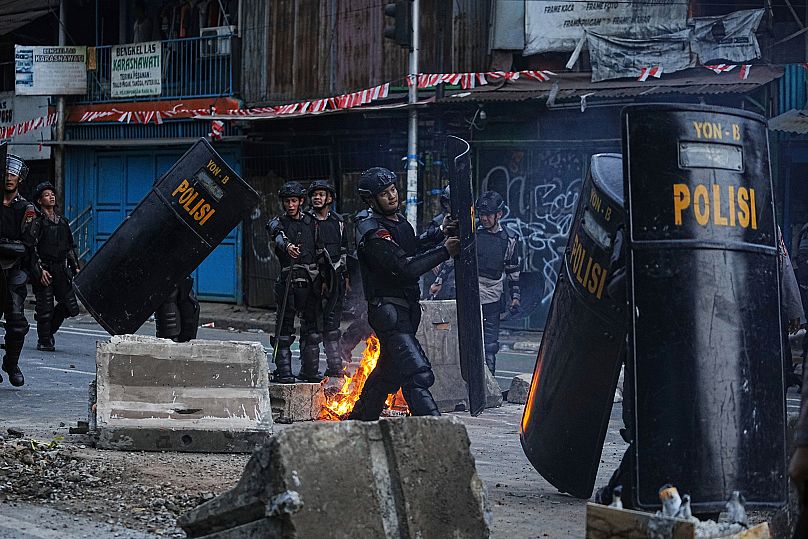
Indonesian Riot police and students clash during protest against MPs' allowances in Jakarta

Protesters throw rocks towards riot police during a protest against lavish allowances given to parliament members in Jakarta, 25 August, 2025
Copyright AP Photo

By Gavin Blackburn
Published on 

Authorities blocked streets leading to the Parliament building, including several toll roads, causing severe traffic jams in the city.

Riot police shot rounds of tear gas at thousands of students who attempted to reach Parliament in Indonesia's capital on Monday to protest against the lavish allowances of members of parliament.

The demonstrators are enraged by recent reports that 580 members of the House of Representatives had been receiving a housing allowance of 50 million rupiah (€2,637) per month since September 2024.

They view the allowances as unjust due to the economic hardship faced by most citizens in the country.

Police fired tear gas as the protesters tried to approach Parliament. Protesters fought back, hurling rocks and bottles at officers and setting fires under a flyover near the heavily guarded Parliament compound.

Authorities blocked streets leading to the Parliament building, including several toll roads, causing severe traffic jams in the city.

Riot police officers carry shields as they take position during a protest against lavish allowances given to parliament members in Jakarta, 25 August, 2025 AP Photo

More than 1,200 security personnel were deployed to secure the compound.

There were no immediate reports of injuries from Monday's unrest.

The demonstrators are demanding the abolition of what they view as lavish allowances, which come on top of lawmakers' salaries.

The housing benefit alone amounts to about 20 times the monthly minimum wage in poor areas.

House Speaker Puan Maharani told reporters on Saturday that the amount had been thoroughly considered and adjusted to current prices in Jakarta.

Corruption is seen as endemic in Indonesia and activists say police and members of Parliament are perceived as being widely corrupt in the country of more than 280 million people.

Additional sources AP

WAR IS ECOCIDE

Weakening Russia's war machine: Why Kyiv is targeting Moscow's energy sector

Copyright AP Photo


By Sasha Vakulina
Published on 25/08/2025 - 

Hungary has complained about Ukraine's strategy of targeting Russia's energy sector. But how has Kyiv intensified its attacks on the primary source of financing of Moscow’s war machine, and why is it working?

Ukraine has significantly intensified its attacks against Russia's energy sector over the past few weeks. On Sunday, Kyiv targeted a gas terminal in the Leningrad region and an oil refinery in Samara.

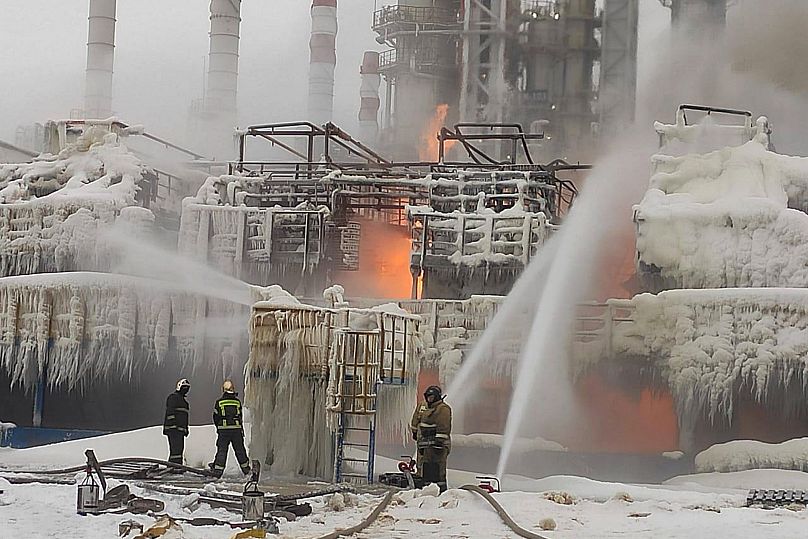
According to Russian Telegram channels, a large fire broke out at the Novatek gas terminal in the port city of Ust-Luga.

The regional governor of Leningrad, Alexander Drozdenko, claimed that 10 drones were shot down in Ust-Luga, adding that there were no casualties and fuel tanks at a port nearby had not been affected.

Ust-Luga is situated on the southern shore of the Gulf of Finland in the Leningrad region, not far from the Estonian border and around 110km west of St Petersburg.

A source in Ukraine's Security Service (SBU) confirmed to The Kyiv Independent news outlet that the SBU was behind the attack on the liquefied natural gas terminal.


Firefighters extinguish a blaze at Russia's second-largest natural gas producer Novatek in Ust-Luga, 21 January, 2024 AP Photo

"Russia trades oil and gas through this terminal with the help of a 'shadow fleet'. Drone sanctions from the SBU reduce the inflow of foreign currency that Russia needs to wage war," the source said.

The General Staff of Ukraine's Armed Forces also confirmed that Military Intelligence (HUR), the Unmanned Systems Forces and other defence agencies were behind the strike on the Syzran oil refinery in Samara, which "specialises in the production of gasoline, diesel fuel, jet fuel, and other petroleum supplied to the Russian troops."

"The Syzran refinery has a design capacity of up to 8.5 million tons of crude oil per year, accounting for around 3.08% of Russia's total oil refining volume," General Staff wrote on Telegram.

Earlier this month, Ukraine also targeted the Lukoil refinery in Volgograd, the largest in southern Russia, as well as large refineries in the Saratov and Rostov regions.

Kyiv has been focusing its drone attacks on Russia's refineries, pumping stations and fuel trains in an effort to weaken the Russian war machine.

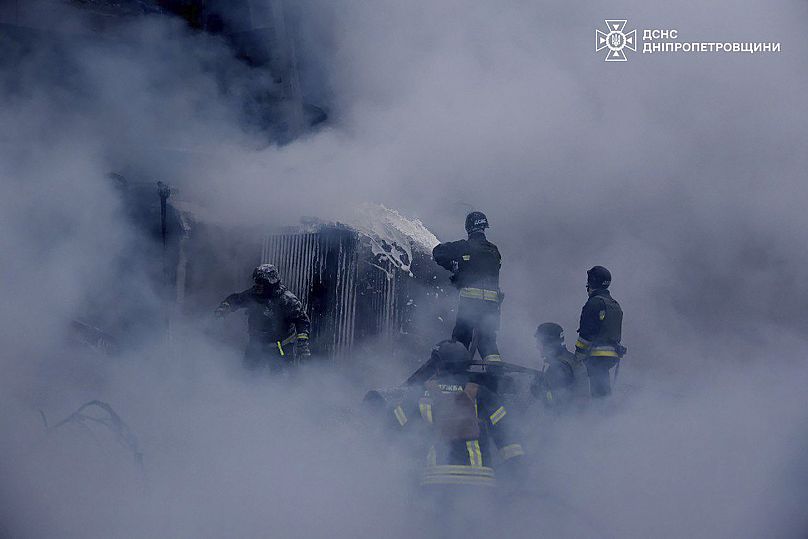
Firefighters put out a fire following a Russian missile attack on the country's energy system in Dnipropetrovsk region, 25 December, 2024 AP Photo

Ukraine's military intelligence said the Ukrainian Armed Forces are systematically implementing measures aimed at "reducing the combat potential of the Russian occupation forces, destabilising their logistical capabilities, particularly in terms of fuel and lubricant supplies, and forcing Russia to cease its armed aggression against Ukraine."

According to United24, a platform created under the initiative of Ukraine's President Volodymyr Zelenskyy, Russian oil refining capacity fell by more than 13% in August following a series of Ukrainian drone strikes on key facilities, leaving several major plants offline.

"When the enemy strikes our energy infrastructure, trying to leave us without light or heat, then its oil refineries burn. And no one can forbid us such strikes because it's justice itself that delivers them." he said.

Since the beginning of its full-scale invasion of Ukraine in early 2022, Russia has been targeting Ukraine's critical energy infrastructure, causing massive power outages across the country, specifically during the winter period, leaving millions of Ukrainians without electricity and heating.

A worker looks on a production hall after a recent Russian missile attack at DTEK's power plant in Ukraine, 28 November, 2024 AP Photo

On Monday, Zelenskyy said Moscow had already started its preparations for winter by striking Ukraine's energy infrastructure.

"This applies not only to electricity and heat generation but also our natural gas production," he explained.


Pressure on Russia's economy intensifies


Russians are likely to face higher taxes as the burden on the budget grows and the Central Bank of Russia says that "the economy needs a breather".

Russia's financial regulator published an order defining nine criteria by which banks may introduce a temporary limit on cash withdrawals from ATMs.

It is noteworthy that the central bank's order appeared against the backdrop of problems with ATMs, online services and fast payment system due to disruptions with mobile communication and internet in all regions of the country, which have been happening regularly for several months and are accompanied by problems with voice communication and navigation.

A woman stands in a currency exchange office in St. Petersburg, 25 February, 2022 AP Photo

A fuel crisis is intensifying in Russia and the regions of Ukraine that it has seized amid rising petrol prices.

According to the latest reports, at least three refineries have completely halted operations. According to various estimates, successful attacks by the AFU have reduced production by 10-15%

According to the Russian-language "Vot Tak" of the Centre for International Broadcasting TVP (Polish Public Television), problems with access to petrol have been observed in several regions in Russia.

In some areas there are huge queues at petrol stations and a system of coupons has been introduced recently. There are also reports in the Russian media that petrol is increasingly being sold only to organisations and businesses.


Libyan coastguard shot at migrant rescue ship in Mediterranean, NGO claims

A view of bullet-drilled windows aboard the MV Ocean Viking, 24 August, 2025
Copyright AP Photo   BULLET HOLES

By Rory Sullivan
Published on 

The non-profit SOS Mediterranee says the MV Ocean Viking was targeted while carrying 87 rescued migrants to safety.

A humanitarian group has claimed that the Libyan coast guard opened fire on a ship it was operating in the Mediterranean which had 87 rescued migrants onboard.

In a statement on Monday, the non-profit SOS Mediterranee called the alleged attack against the MV Ocean Viking on Sunday afternoon "an outrageous and unacceptable act."

None of the migrants or the crew were injured during the 20-minutes assault, according to SOS Mediterranee, who said the event happened in international waters 40 miles north of the Libyan coast.

"Although no one was physically wounded, everyone on board feared for their lives, and crucial rescue equipment and the ship herself suffered significant damage," the NGO said.

Rescue personnel of the Ocean Viking attend migrants rescued from a wooden boat in the Mediterranean Sea, 14 March, 2024 AP Photo

The charity reported that bullet holes were discovered in the bridge, the part of the ship where steering and navigation take place. Three fast rescue boats (RHIBS) and other equipment were also damaged, it said

The Libyan coastguard did not respond to a request for comment on the incident.

Ocean Viking, which rescued 87 migrants in the Mediterranean between Saturday evening and Sunday morning, was preparing to respond to another distress call at the time of the reported attack.

"We demand a full investigation into the events of yesterday afternoon and that those responsible for these life–threatening attacks be brought to justice," said Soazic Dupuy, SOS Mediterranee's operations director.

The NGO also called for an end to the EU's ongoing collaboration with Libya, which has been repeatedly criticised by human rights groups for the way it treats migrants attempting to reach Europe.

Libya, which rejects claims that it is guilty of human rights abuses against migrants, receives training, equipment and funding from the EU to intercept migrant boats travelling to Europe by sea.

SOS Mediterranee said that Ocean Viking was heading north on Monday to Syracuse, its home port in Sicily, to disembark the 87 migrants and to start repair work.


Argentine President Milei embroiled in corruption scandal

Argentine President Milei embroiled in corruption scandal
The latest corruption probe represents a significant threat to Milei's anti-establishment credentials and fiscal austerity agenda. / Gage Skidmore


By Mathew Cohen August 25, 2025


Argentine police raided over a dozen luxury properties on August 22, including the headquarters of the national disability benefits agency, as a corruption investigation threatens to engulf President Javier Milei's inner circle, including his sister and close advisor Karina.

This comes after it was reported that Milei and several government officials would face criminal charges relating to alleged bribery schemes in drug supply contracts through the National Disability Agency (Andis).

Federal Judge Sebastián Casanello ordered the operation targeting 15 locations in Buenos Aires following leaked audio recordings purportedly showing Diego Spagnuolo, Milei's personal lawyer and former disability agency head, describing a kickback scheme involving government health contracts.

In the recordings obtained by Reuters, Spagnuolo allegedly details how pharmaceutical companies pay bribes to Karina Milei, the president's chief of staff, to secure drug purchase contracts for disabled people. "I estimate that Karina gets 3%," the voice says, describing an apparent 8% kickback system from pharmaceutical companies.

The government dismissed Spagnuolo but blamed political opponents for exploiting the scandal ahead of crucial midterm elections. "In light of the facts that are public knowledge and the opposition's obvious political exploitation in an election year, the president has decided, as a preventive measure, to remove Diego Spagnuolo," spokesperson Manuel Adorni declared in a public statement.

During the raids, investigators seized accounting records, phones, computers, and files. The timing proves particularly damaging as Congress moves to overturn Milei's veto of increased disability spending.

The corruption scandal, which follows an earlier investigation into Milei's alleged role in promoting the $LIBRA cryptocurrency scam, is yet another significant threat to the libertarian leader's anti-establishment credentials and fiscal austerity agenda. But more crucially, it risks derailing his party’s election campaign with the October midterm vote looming.

“It’s very hard to imagine this won’t affect Milei’s approval rating,” Lucas Romero, director of political consultancy Synopsis, told Bloomberg Linea. “This episode strikes at the core of his public image, that of an outsider who came to correct the corrupt practices of politics.”

Before this scandal surfaced, it appeared that Milei’s La Libertad Avanza party was steaming into the lead, polling at 43.8% nationwide when pooled together with alliance partner PRO, while the Peronist-Kirchnerist coalition Fuerza Patria trailed by a notable 15.6 percentage points. It now appears uncertain whether the Milei-led alliance will hold its support base steady as this latest scandal rocks the nation.


US Treasury removes Syrian sanctions regulations following regime change

US Treasury removes Syrian sanctions regulations following regime change
US Treasury Department wall plaque. / CC: MohitSingh\\\\\Feedly

By bnm Gulf bureau August 25, 2025

The US Treasury's Office of Foreign Assets Control is removing the Syrian Sanctions Regulations from the Code of Federal Regulations following the termination of the national emergency and policy changes towards Syria under its new government, the Treasury announced on August 25.

According to documents reviewed by IntelliNews, US President Donald Trump issued Executive Order 14312 on June 30, 2025, revoking Syria sanctions and terminating the national emergency declared in 2004.

The president found that circumstances justifying the original sanctions, related to former president Bashar al-Assad's regime, had been transformed by developments over the six months preceding June 30, including positive actions by Syria's new government under President Ahmed al-Sharaa, whom he had previously met with earlier this year.

The original sanctions were imposed through Executive Order 13338 in May 2004, citing Syria's support for terrorism, occupation of Lebanon, weapons programmes and undermining of Iraq's stabilisation efforts.

OFAC issued the Syrian Sanctions Regulations in April 2005 to implement the executive order, with subsequent amendments expanding the sanctions regime through multiple executive orders.

Executive Order 14312 aims to remove sanctions on Syria whilst maintaining measures against the Islamic State, terrorist organisations, human rights abusers and those linked to chemical weapons or proliferation activities.

The Treasury said certain previously sanctioned persons have been redesignated under amended Executive Order 13894, which targets those contributing to Syria's situation.

OFAC intends to rename existing regulations as the Promoting Accountability for Assad and Regional Stabilisation Sanctions Regulations in a separate rulemaking.

"On June 30, the President issued an Executive Order "Providing for the Revocation of Syria Sanctions" that removes US sanctions on Syria, effective July 1, 2025, according to the mailer by OFAC seen by IntelliNews

Following the US announcement, the Syrian Ministry of Foreign Affairs said the step would contribute to facilitating commercial and financial movement, lifting restrictions on American exports to Syria.

"The Syrian Arab Republic believes that the coincidence of this decision with the visit of the second official Syrian delegation from the US Congress to Damascus carries important significance for opening a new page of bilateral relations based on mutual respect and dialogue," the ministry said in the statement.

In the government notice, it was reported that al-Sharaa received the second official delegation from the US Congress in the capital Damascus, consisting of senators and representatives from both parties, the ministry said. The delegation was accompanied by Thomas Rask, the US President's special envoy, and Deputy Assistant Secretary of State for Near Eastern Affairs.

"The delegation held meetings with President al-Sharaa in the presence of ministers of defence, interior affairs, social affairs and labour, where discussions covered ways to strengthen bilateral relations and open new horizons for cooperation between the two countries," the ministry said.


New project to improve information retrieval for lifelong learning


University of Illinois School of Information Sciences


Jessie Chin, assistant professor in the School of Information Sciences at the University of Illinois Urbana-Champaign, has received a National Science Foundation (NSF) CAREER award to support lifelong learning and foster information literacy. This prestigious award is given in support of early-career faculty who have the potential to serve as academic role models in research and education and to lead advances in the mission of their department or organization. Chin's project, "Search as a Mechanism for Learning," will be supported by a five-year, $629,451 grant from the NSF.

Her project will examine how information retrieval (IR) systems are used for lifelong learning. While users commonly turn to the internet to learn about unfamiliar topics, the internet's algorithm-mediated IR systems, including search engines and conversational agents, have limitations when it comes to adequately supporting users with complex information needs. This is especially true when it comes to learning-oriented searches, with IR models unable to fully explain and predict how and what people search to learn. For example, motivations and metacognition are often neglected in representing the search intents during learning. Hence, relying on metrics like semantic relevance or past user behavior in IR systems may inadvertently result in suboptimal information experience of learners.

"Finding information [on a search] does not necessarily lead to effective learning or deep comprehension," said Chin. "Developing IR systems for learning requires understanding how individuals monitor, assess, and regulate their learning progress, and what factors shape their judgments to persist in or disengage from learning."

This research will guide the development of personalized technologies that promote lifelong learning in various educational settings, including online adult vocational education and individualized tutoring systems for all learners. The overarching goal of the project is to empower adults across the lifespan to adapt to evolving information environments for lifelong learning.

"To facilitate the translation of research into instructional and outreach practices, the project will collaborate with the Osher Lifelong Learning Institute and the National Multiple Sclerosis Society to co-design educational games and webinars that foster information literacy and its practical applications in everyday search and learning contexts," said Chin.

Chin is a translational cognitive scientist with multidisciplinary research training in cognitive science, human factors, human-computer interaction, and health informatics. She leads the Adaptive Cognition and Interaction Design (ACTION) Lab at the University of Illinois Urbana-Champaign. Chin holds an MS in human factors and PhD in educational psychology with a focus on cognitive science in teaching and learning from the University of Illinois.


Common painkillers linked to antibiotic resistance


University of South Australia


Ibuprofen and paracetamol are common over-the-counter medications that many of us reach for when we’re sick. But new research from the University of South Australia shows that these trusted staples are quietly fuelling one of the world’s biggest health threats: antibiotic resistance.

In the first study of its kind, researchers found that ibuprofen and paracetamol are not only driving antibiotic resistance when used individually but amplifying it when used together.

Assessing the interaction of non-antibiotic medications, the broad-spectrum antibiotic ciprofloxacin, and Escherichia coli (E. coli) – a common bacteria that causes gut and urinary tract infections ­­– researchers found that ibuprofen and paracetamol significantly increased bacterial mutations, making E. coli highly resistant to the antibiotic.

It’s an important finding that has serious health implications, particularly for people in aged care homes, where multiple medications are regularly administered.

The World Health Organization reports that antimicrobial resistance is a global threat to public health, and that bacterial resistance was directly responsible for 1.27 million global deaths in 2019.

Lead researcher UniSA’s Associate Professor Rietie Venter says the findings raise important questions about the risks of polypharmacy in aged care.

“Antibiotics have long been vital in treating infectious diseases, but their widespread overuse and misuse have driven a global rise in antibiotic-resistant bacteria,” Assoc Prof Venter says.

“This is especially prevalent in residential aged care facilities, where older people are more likely to be prescribed multiple medications – not just antibiotics, but also drugs for pain, sleep, or blood pressure – making it an ideal breeding ground for gut bacteria to become resistant to antibiotics.

“In this study we looked at the effect of non-antibiotic medicines and ciprofloxacin, an antibiotic which is used to treat common skin, gut or urinary tract infections.

“When bacteria were exposed to ciprofloxacin alongside ibuprofen and paracetamol, they developed more genetic mutations than with the antibiotic alone, helping them grow faster and become highly resistant. Worryingly, the bacteria were not only resistant to the antibiotic ciprofloxacin, but increased resistance was also observed to multiple other antibiotics from different classes.

“We also uncovered the genetic mechanisms behind this resistance, with ibuprofen and paracetamol both activating the bacteria’s defences to expel antibiotics and render them less effective.”

The study assessed nine medications* commonly used in residential aged care: ibuprofen (an anti-inflammatory pain relief), diclofenac (an anti-inflammatory to treat arthritis), acetaminophen (paracetamol for pain and fever), furosemide (for high blood pressure), metformin (for high sugar levels linked to Diabetes), atorvastatin (to help lower cholesterol and fats in the blood), tramadol (a stronger pain medication post-surgery) , temazepam (used to treat sleeping problems), and pseudoephedrine (a decongestant).

Assoc Prof Venter says the study shows how antibiotic resistance is a more complex challenge than previously understood, with common non-antibiotic medications also playing a role.

“Antibiotic resistance isn’t just about antibiotics anymore,” Assoc Prof Venter says.

“This study is a clear reminder that we need to carefully consider the risks of using multiple medications – particularly in aged care where residents are often prescribed a mix of long-term treatments.

“This doesn’t mean we should stop using these medications, but we do need to be more mindful about how they interact with antibiotics – and that includes looking beyond just two-drug combinations.”

The researchers are calling for further studies into drug interactions among anyone on long-term medication treatment regimes so we can gain a greater awareness of how common medications may impact antibiotic effectiveness.

The University of South Australia and the University of Adelaide are joining forces to become Australia’s new major university – Adelaide University. Building on the strengths, legacies and resources of two leading universities, Adelaide University will deliver globally relevant research at scale, innovative, industry-informed teaching and an outstanding student experience. Adelaide University will open its doors in January 2026. Find out more on the Adelaide University website.


…………………………………………………………………………………………………………………………


Common cold may protect against COVID-19 according to National Jewish Health researchers

Peer-Reviewed Publication

National Jewish Health

DENVER (AUG 25, 2025) A new study led by researchers at National Jewish Health has found that recent infection with the common cold — often caused by rhinoviruses — may offer temporary protection against infection with SARS-CoV-2, the virus that causes COVID-19. The research provides fresh insight into why children are less likely than adults to develop symptoms and could point toward new ways to reduce the severity of respiratory illnesses.

Published in the Journal of Infectious Diseases earlier this month, the study analyzed data from the nationwide Human Epidemiology and Response to SARS-CoV-2 (HEROS) study, which tracked more than 4,100 people in 1,394 households from May 2020 to February 2021.

Researchers found that people, particularly children who had a recent rhinovirus infection, were significantly less likely to become infected with SARS-CoV-2 in the following weeks. This effect is thought to be linked to the body’s antiviral defenses. Rhinoviruses trigger a strong interferon response in the airways, which can temporarily prime the immune system to fight off other viruses.

“Our findings suggest that the immune boost from a recent cold may give the body an early advantage in fighting SARS-CoV-2 before it has a chance to take hold,” said senior author of the study Max Seibold, PhD, a researcher and Director of the Regenerative Medicine and Genome Editing Program (REGEN) at National Jewish Health. “This may help explain why children, who tend to get more colds than adults, generally experience fewer and less severe COVID cases.”

Using thousands of self-collected nasal swabs, the team tested for both SARS-CoV-2 and other common respiratory viruses, including rhinovirus, in participants of all ages. They also analyzed airway gene expression to see how recent viral infections influenced the body’s antiviral defenses. Children were found to have higher baseline expression of interferon-related genes — proteins that act as the immune system’s first line of defense against viruses — compared to adults.

While this phenomenon, known as heterologous viral interference, has been observed with other respiratory viruses, this is the first prospective study to show it may also occur with SARS-CoV-2.

“This doesn’t mean people should intentionally try to catch a cold,” said Camille Moore, PhD and lead author of the study at National Jewish Health. “But understanding how one virus can affect the body’s response to another could help us develop new prevention strategies, especially for vulnerable populations.”

The research builds on earlier findings from the HEROS study showing that children are six times less likely than adults to develop symptomatic COVID. The new data highlights the role that both age-related immune differences and recent viral exposures may play in that protection.

National Jewish Health researchers conducted the study in collaboration with partners from 12 cities across the United States.

National Jewish Health is the leading respiratory hospital in the nation. Founded in 1899 as a nonprofit hospital, National Jewish Health today is the only facility in the world dedicated exclusively to groundbreaking medical research and treatment of children and adults with respiratory, cardiac, immune and related disorders. Patients and families come to National Jewish Health from around the world to receive cutting-edge, comprehensive, coordinated care. To learn more, visit the media resources page.

###