Saturday, November 08, 2025

Why don’t Labour’s workers’ and renters’ rights reforms cut through to voters – and how should they?

When millions of workers and renters don’t know you’re doing more to improve their rights than any government in half a century, something is going very badly wrong.

“No-one who would benefit in my area knows about them,” vents one Labour MP, despite their leafleting blitz.

Recent polling bears this out. Almost half the public hadn’t heard much or anything about either reforms, including two in five Labour voters.

Deliverism is dead. Long live deliverism?

The problem isn’t Number 10 assuming policy delivery alone wins votes. Joe Biden’s defeat despite impressive achievements put paid to that, with Morgan McSweeney reportedly circulating papers on the “death of deliverism” within days of Labour’s landslide.

So why aren’t even life-changing, flagship policies cutting through, and what can Labour do?

LabourList asked a string of MPs and communication, polling and policy experts within and beyond Labour. Their analysis boiled down to three areas – messaging itself, how it’s told, and the messengers.

Stories need heroes and villains

The first messaging idea is simple: stop avoiding conflict. Be the “insurgent” government McSweeney also spoke of last July.

“The government hasn’t sought enemies on workers’ and renters’ rights, perhaps nervous about upsetting particular stakeholders,” says Steve Akehurst of Persuasion UK.

But conflict means attention. “Winter fuel and welfare were big fights. Stories that hang around have protagonists and antagonists.”

Akehurt’s recent report with the IPPR surveyed voters on a “Labour vs corporate interests” message, and found three times more support than opposition. 

Framing rental reforms as a win for tenants and landlords boosted support, but framing them as helping tenants over landlords boosted it far more:
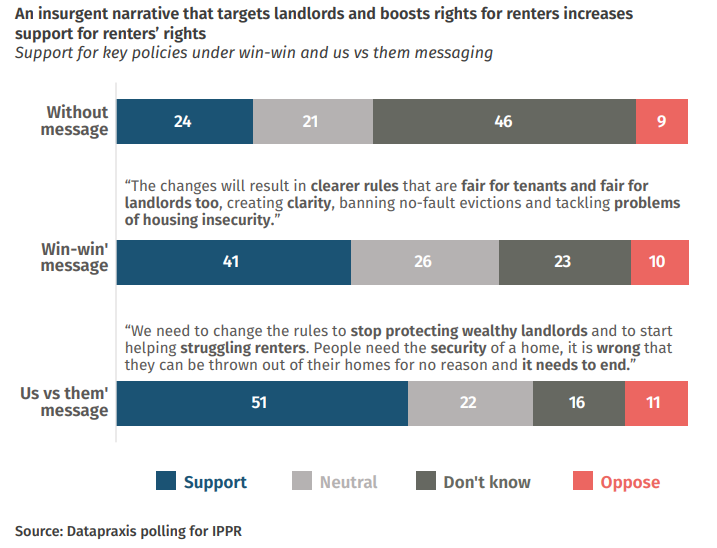
Akehurst suggests talking more openly about “transferring power” from landlords and employers would unite Reform – and Green –tempted Labour voters alike.

Defining itself more against opponents would help set the all-important “meta-narrative” about what the government is, he adds, and move debate off trickier Labour subjects like immigration.

Two MPs argue greater awareness would help prevent rival parties defining the employment debate too, and misinformation spreading. One even suggests picking a fight with Mike Ashley.

Don’t worry about losing landlords

Broadcaster, peer and ex-adviser Ayesha Hazarika is similarly sceptical of “doing good by stealth”, arguing Labour could have made more of renters’ reforms becoming law last week. “It makes you look timid – you’ve got to own good, Labour legislation you’ve delivered quickly.”

Tom Darling of the Renters’ Reform Coalition agrees government has seemed “sheepish” looking progressive.

Reticence could explain why Ipsos polling recently found voters are “less likely to have heard of the policies they like most”.

Darling was positive about more recent government messaging on renters however, and others praised one MP’s leaning into the backlash:

Several party figures note landlords probably won’t vote Labour.

Even an ex-Tony Blair aide argues: “Landlords have the homes; we have the numbers. Renters and workers are clearly part of a bigger progressive coalition.”

John McTernan adds: “So we should tell them what they get from this, and do things in line with core and brand values. Is our name the bosses’ party?”

Farage shows voters want radicalism

Moderates would argue an anti-business image has cost Labour elections before.

But McTernan argues Brexit and the past three elections reflect one story: public demand for change. 

Opinion data bears out the idea voters want “bolder changes”, according to Karin Christiansen of progressive analytics firm DataPraxis (and LabourList chair). “At European or even global level, the Overton window is the biggest in a long time, but often it’s the hard right stepping into it.”

One MP agrees. “If Nigel Farage shows one thing, it’s people want you to be radical.”

Voters only hear it when hacks tire of it

If us-versus-them is the message, how do you sell it? Through repetition, most interviewees agree, with a widespread frustration policies aren’t promoted more after their allocated day in the government’s news grid.

As former Keir Starmer adviser Peter Hyman recently warned of the case for ID cards, “people have to hear something at least five times…for it to stick”.

READ MORE: McKee on TikTok, authenticity and why Labour must catch up online

Announcements have to “breathe”, according to Hannah O’Rourke of campaign experts Campaign Lab, and fit into “patterns or rhythms”. 

It’s less about simply voicing an often-demanded “grand narrative”, but instead showing it through more, smaller stories that are “way more persuasive and important”.

One former senior insider says comms teams need to know the broader “arc of the argument over the year”, fitting announcements into it.

How to skin the cat and nail social videos

Can a repeated, positive message land, though? Harlow MP Chris Vince notes some media cover “the bad things, not the good things”. News outlets naturally shun old news. One ex-insider is unsurprised “listicle” storytelling, reeling off policies and benefits, doesn’t cut through.

Yet Hazarika argues journalist are more “open-minded” covering policy post-announcement than sometimes assumed, if policymakers bring ideas – like exclusive coverage of a housing roundtable if one had been convened last week. Others suggest platforming voters on how they’ll benefit. 

Christiansen says the centre left “have the solutions, if we’re a bit more brave and creative”. She also notes traditional media’s reach has “seriously contracted”. 

With a third of young people getting news via TikTok, McTernan asks: “What’s the TikTok strategy to tell young workers and renters their rights?”

Many interviewees argue social media video is now king, and the secret is authentic storytelling, actual engagement with voters, and explainer videos. 

Zohran Mamdani meets real people in viral videos to “bring it to life”, McTernan notes, and Hazarika acknowledges Robert Jenrick’s success “creating his own content”. 

Several praise viral explainer videos by MP Gordon McKee, and first-person TUC clips like an EV factory worker asking: “Why does Nigel Farage want me to lose my job?” 

Shoot the right messenger

Such clips highlight a third key point for video and wider cut-through – shoot the right messenger. While Hyman argues Starmer could do more “unfiltered” videos, others say varied messengers like trade union and rent campaign voices, Labour’s diverse new intake and community groups must be central, not optional. 

Voters will trust union reps and community figures like London MP Margaret Mullane “more than they’re going to trust Keir Starmer,” says political commentator Andy Twelves.

Messengers must be “close to the people we’re trying to persuade” as public trust in politicians falls, adds O’Rourke.

Labour writer Paul Richards notes the significant online cut-through of right-wing “outriders” beyond Westminster, with too few credible Labour champions.

Delivery alone can’t deliver votes

Most interviewees agree cut-through is incredibly difficult, however. Richards notes complex reforms take time and leave a “credibility gap” beforehand, worsened by current “baked-in cynicism about government ability to change things”. 

Even post-implementation, change may be noticed only when tenants encounter work or tenancy problems. “I hope people will see it, but it’s probably not a light switch moment,” says Vince. Elections abroad suggest benefiting voters don’t necessarily credit politicians, either – making relentless credit-taking vital, too.

A messaging reset clearly carries risks, from new enemies’ anger to voters cringing. 

But as one MP says of the polls: “As it stands we’ve lost the next election, so what have we got to lose?”


‘Raising taxes on the wealthy isn’t just about the money’


Labour came to power promising to reduce child poverty, as the Blair government once did; to “unleash investment” and create 650,000 jobs in future industries; and to deliver a “New Deal for Working People.” Yet, fifteen months on, those ambitions seem far from being realised. The government’s ‘austerity-light’ policies risk leaving more children in poverty by the time Labour leaves office than when it arrived.

The irony is that, with such a commanding majority, this government could take bold action to revitalise our economy and society. Instead, it has trapped itself in a cycle where high taxes on working people are stifling growth, deepening the cost-of-living crisis, allowing space for the far-right to encroach, and undermining public confidence in governments and politicians of all colours.

Extreme wealth captures and holds too much of our economic output

Whatever your preferred school of economic thought, the facts are clear – there isn’t enough money in the tax we pay to fund essential services, let alone the investment our country desperately needs. Governments can tax, they can borrow, and they can create new money. And from these options they have to deliver what people want and might reasonably expect in terms of public services now, and in terms of investment to make our country prosper in the longer term and be better for future generations.

READ MORE: ‘Britain’s wealth gap is growing – the Chancellor must address it’

The effects of the current situation are stark. One in three children grow up in poverty, condemning many to lifelong disadvantage, poor health, reduced job prospects, and shorter lives;  this not only damages individuals but weakens our economic future. The NHS is struggling, leaving us with an ailing workforce that can’t support economic renewal. Productivity is falling, but this is a symptom not a cause. Tinkering with benefits and squeezing working families harder will not fix the problem. Radical action is needed to free the economy from the stagnation that began after the global financial crash.

Of course the UK is a rich country, even though we’ve been falling down the international rankings in recent times. We’re not short of wealth and assets — but over the years too much of this has been extracted from the active economy and become concentrated and stagnated in the hands a the top 1%. It’s time to call some of this back and put it to good use in the renewal this country desperately needs.

At Patriotic Millionaires UK, we argue for a 2% annual wealth tax on assets above £10 million, which could raise around £24 billion a year without meaningful hardship for anyone. Similar reforms to capital gains and inheritance tax could raise more, providing the investment we need in people and infrastructure.

Extreme wealth creates division in society

But it’s not just about the money. It’s impossible to ignore the fact that our social fabric is fraying. Surveys show widespread distrust in politics and growing resentment at a system that always seems to have worked for the wealthy but not for ordinary people. For decades, by-elections have been dismissed as “just protest votes”, which conveniently allow us to ignore the very clear messages from voters that politics is failing them — that government policies don’t deliver the fairness or opportunity that are at the heart of British values.

Subscribe here to our daily newsletter roundup of Labour news, analysis and comment– and follow us on BlueskyWhatsAppX and Facebook.

For a party elected to “help working people” this failure is not just political but moral. It widens divisions between those who struggle and those who prosper effortlessly. The disillusionment is fuelling the rise of parties like Reform, which feed on anger and alienation.

When times are hard we know the country will pull together – we did it during COVID. But why should the poorest be told to tighten their belts while the super-rich accumulate ever more? A tax on extreme wealth isn’t just about raising money; it’s about restoring fairness and showing that the government stands with the many, not the few.

Democracy is under threat from extreme wealth

Perhaps the greatest worry is that we’ve reached a tipping point where money in politics is driving our government to act in particular ways. And this isn’t just money from the UK; it’s also from wealthy meddlers outside the country, such as Elon Musk talking about supporting Reform UK and spreading far-right propaganda on ‘X’.  Political opinion is being shaped by the super-wealthy to drive the kind of society that they want, not one that is best for working people.

Money shapes politics in increasingly sophisticated ways. Wealthy media owners — often non-domiciled — continue to steer public opinion, while social media has become a playground for paid influencers who manipulate voters for profit, whether to sell products or promote political agendas. At a more personal level, individual contributions are seen to buy influence – maybe by being invited to dinner with your politician of choice, or simply by getting your name and agenda nearer the top of their list.

Time to Do the Right Thing

The government is letting people down by continuing to let the extreme wealthly profit while working people are struggling. Voters chose Labour because they wanted genuine change. If the party fails to deliver it, it betrays not just its supporters but the country it governs. A wealth tax alone won’t solve every problem — but it can raise vital revenue, demonstrate moral leadership, and prove that this government stands for fairness and the common good.

Sometimes, governments just have to do what’s right.


Women’s Budget Groups across four nations urge UK Chancellor to fully scrap two-child limit 

NOVEMBER 4, 2025

New analysis by the UK Women’s Budget group reveals the scale of child poverty that could be ended in each nation of the UK by 2029/2030 if the two-child limit on Universal Credit were to be lifted in full. 

The findings come as Women’s Budget Groups across England, Scotland, Wales and Northern Ireland join voices to call on the Chancellor Rachel Reeves to fully abolish the two-child limit at the Autumn Budget.

New figures show the number of children in each nation that would be lifted out of economic hardship if the policy were to be fully scrapped:

  • In England, 626,022 children would be lifted out of poverty.
  • In Scotland, 51,036 children would be lifted out of poverty.
  • In Wales, 54,722 children would be lifted out of poverty.
  • Across Northern Ireland 9,791 children would be lifted out of poverty.

Current child poverty rates stand at 31% in England, 23% in Scotland, 31% in Wales, and 24% in Northern Ireland – with Scotland’s lower rate partly attributed to the Scottish Child Payment, a devolved policy that gives families direct financial support. The two-child limit is the primary driver of child poverty.

The organisations warn that partial reforms – such as lifting the policy only for working families or implementing a taper rate – would leave the most vulnerable children behind and undermine the Government’s child poverty strategy.

The societal costs of child poverty from greater unemployment, lower earnings and higher spending on public services is estimated to be £40 billion a year in 2027 for the UK. Lifting 650,000 children out of poverty could save £5.7bn in future societal costs – a higher saving than what it would cost to remove the policy.

 Dr Sara Reis, Deputy Director at the UK Women’s Budget Group, said: “No child’s future should depend on how many siblings they have. From Belfast to Cardiff, Edinburgh to London, the two-child limit is pushing families into poverty. Our analysis shows the difference one policy change could make in each nation. Ending it in full would give over half a million children a fairer start.

“Scotland’s Child Payment has helped bring poverty rates down. Giving families more money works. The Westminster government should learn from this and follow suit. The Autumn Budget is the moment to act – for every child, in all four nations.”

Hannah Griffiths, Coordinator of the Wales Women’s Budget Group, said: “The two-child limit is an unfair policy which penalises vulnerable women and children. With some of the highest rates of child poverty in the UK, the policy continues to have devastating effects in Wales where 11% of all children live in a family whose benefit payments have been restricted as a result.

“For women in Wales – who are more likely to rely on social security and to be single parents – the policy compounds existing gender inequalities, pushing them and their families into debt, poverty and hardship. For too long, women and children have borne the cost of a policy that deepens poverty and inequality. The time has come for the UK Government to abolish the two-child limit in full and provide the support that families across the UK truly need.”

 Alexandra Brennan, Coordinator of the Northern Ireland Women’s Budget Group, said: “If the Government is serious about tackling child poverty and other forms of poverty, scrapping the two-child limit in its entirety must be a top priority. 24% of children here are living in relative poverty and that’s an increase from 19% in 2021. And we know that children’s poverty is women’s poverty, as many mothers go without before their children do.

“Increasing the limit instead of scrapping it will have greater impacts here because statistically, families in Northern Ireland are larger. The answer is in the data – and the data shows that the two-child limit must be scrapped in order to lower child poverty.”

 Sara Cowan, Director at the Scottish Women’s Budget Group, said: “The Scottish Child Payment shows that putting money in families’ pockets is a critical route out of poverty. If the UK Government is serious about addressing the systemic barriers to child poverty, ending the two-child limit must be a top priority. 

“The data speaks for itself: social security is a crucial tool for lifting children out of poverty, restoring hope to families, and removing the burden of managing poverty that is often carried by women.”

The UK Women’s Budget Group is the UK’s leading feminist economics think tank, providing evidence and analysis on women’s economic position and proposing policy alternatives for a gender-equal economy. WBG acts as a link between academia, the women’s voluntary sector and progressive economic think tanks.

Image: c/o Labour Hub

A process, not an event


Ahead of a talk at Bookmarks on November 7th and the publication of his new book Revolutions: A New History later this month, Donald Sassoon considers the nature of revolutions – and how they often take revolutionaries themselves by surprise.

A revolution, in common usage, is an event which overturns the structure, the politics, or the constitution of a particular state. It is, like most complex phenomena, virtually impossible to define.

Revolutions usually start with the breakdown of the state: finance, law and order, etc. A period of crisis ensues and then, either the state is reorganized in a modified form – or a new state emerges. But was fascist Italy or Nazi Germany the result of revolutions – as some of their supporters claim?

Similarly, the fall of communism in Eastern Europe and in the Soviet Union, which did involve the breakdown of the existing states, was not called a ‘revolution’.

How about the anti-colonial revolutions? These involve the destruction of the colonial state apparatus and its replacement with a state run either by settlers (as in the revolutions in the Americas) or by the indigenous population (as in most of Africa).

As Montesquieu explained, any revolution which can be foreseen will never take place, for if foreseen it will be pre-empted by any intelligent politician.

Had not the American Revolution taken place, slavery might have been abolished sooner, since it was abolished in the British empire in 1833. So, if America had remained part of the British Empire, slavery might have been abolished some thirty years earlier than the actual abolition in 1865.

In real history matters are never clear. Even Karl Marx, who was supposed to know a thing or two about revolutions, is never precise over the use of the term. He never used the word consistently nor did he ever produce a general theory of revolutions. He seldom used the term ‘bourgeois revolution’.

In recent times we have increasingly used the term loosely: we write about the Neolithic revolution, the technological revolution, the digital revolution. We talk about the sexual revolution, the feminist revolution, the social media revolution – all processes that have changed behaviour and mentalities. But we have also used the term for ‘revolutionary’ rock bands and the rock bands themselves talked of revolution from the Rolling Stones’ Street Fighting Man (1968) to the Beatles’ more moderate Revolution (1968).

By the turn of the twenty-first century, the word revolution had become trivialized. A beautifying face cream was called the ‘Revolution Pro Miracle Cream’. Emmanuel Macron, a banal centrist politician, published in 2016 a book called Révolution where he talks about his life, his wife and the great changes he had in mind (none of which he even attempted to implement) – and plenty of other clichés. It was advertised by its British publishers as “The visionary memoir of a rising global leader.” No vision and no rise followed.

In July 2020, during the Covid-19 pandemic, Boris Johnson announced an instantly forgotten “cycling and walking revolution” while, in the same month, -on the 14th of July! – the Guardian discussed the “Nespresso coffee revolution”. By then the term had lost any meaning.

It is often said that revolutions go bad, that they betray their original high-minded principles (when they have them), and that, in what has now become a cliché, they ‘devour their children’. But, during the so-called ‘Terror’ in revolutionary France ‘only’ 2,639 people were guillotined. Many more died in the civil war in the Vendée and elsewhere.

As the leading American abolitionist and women rights’ upholder Wendell Phillips famously declared, “revolutions are not made, they come,” though he made it clear that one also needed a group of people pledged to new ideas.

What happens depends on a multiplicity of factors and not just on revolutionaries and counterrevolutionaries. Revolutions are usually initiated by a minority taking advantage of an exceptional conjuncture which they had not created. Those who stormed the Bastille could not possibly know that this would be the first step towards a republic Revolutions that would follow an unpredictable course. The women who demonstrated on 8th March 1917 in Petrograd did not know it would lead to the end of the Romanov dynasty and eventually to the Russian revolution.

Until the English ‘Glorious Revolution’ of 1688 (hardly a revolution in the modern sense), historiography seldom uses the term ‘revolution’. Montesquieu used the term révolution frequently in his De l’Esprit des Lois (1758) but he usually meant a change of regime.

The American Revolution was not called a revolution from the outset, though Thomas Paine used the term in 1777.

By 1789 it was widely used by the French revolutionaries as well as by their opponents. The word, and the event, for long caused consternation and not just in the West: in 1908 the Qing ministry of education demanded that all references to the French revolution in Chinese schools to be deleted and the word ‘revolution’ replaced with the word ‘chaos’. All to no avail: a few years later a revolution wiped away the Qing and nearly forty years of real chaos ensued.

Modern revolutions are often connected to the issue of finance and taxation. The seizure of power, as opposed to rebellions and protests, matters when the state matters, when government is for real, when the state imposes taxes. As David Hume explained, governments are “one of the finest and most subtle inventions imaginable” for, thanks to government (and the finances it raises) “bridges are built; harbours opened; ramparts raised; canals formed; fleet equipped; and armies disciplined.”

This is why the history of revolutions begins in earnest with the history of the state and the history of the national economy – what we call capitalism – and why revolutions should not be seen as sudden, short-lived events which are resolved in a few years. The purported original spark launches a process with new demands and grievances even when the original ones have been resolved. This is why the revolutions I deal with, the English Civil War, the American War of Independence and the French, Russian and Chinese revolutions are seen as long-term processes. There is no date set for the beginning of the Middle Ages, or their end, or the beginning of the Renaissance or the start of capitalism. Processes, almost by definition, do not have clear beginnings, let alone clear ends.

One should also avoid the temptation to treat the period preceding each revolution as the period which ‘prepares’ the revolution. It usually arrives unexpectedly catching the revolutionary themselves by surprise even though they spent years or even decades preparing for the great moment.

Donald Sassoon is Emeritus Professor of Comparative European History at Queen Mary, University of London. He will be spealing at Bookmarks, 1 Bloomsbury Street, London WC1B 3QE on Friday 7th November at 6.30pm about his new book Revolutions: A New History, published by Verso on November 18th.

 International Day to End Impunity for Crimes against Journalists

NOVEMBER 4, 2025

Mike Phipps reports on an important meeting highlighting a global offensive against one of our key democratic freedoms.

Sunday 2nd November was the UN-designated International Day to End Impunity for Crimes against Journalists. To mark the occasion, the National Union of Journalists London Freelance Branch partnered with King’s College London Global Digital Cultures Research Group and King’s College London Universities and Colleges Union branch to hold a symposium.

Some 1,600 journalists have been killed in the last twenty years. Ninety percent of these cases have not been ‘solved’. Mexico alone accounts for a tenth of these fatalities. Additionally journalists are ‘disappeared’, causing further anguish for their families and friends. Amnesty International is calling on the British Government to ratify the International Convention for the Protection of All Persons from Enforced Disappearances, which inexplicably it has yet to do.

The rise of right wing authoritarian regimes sees an increased threat to journalists. Ali Rocha, co-founder of Brazil Matters, highlighted the killing in the Amazonian jungle of Brazilian indigenist activist Bruno Pereira and British journalist Dom Phillips in 2022, when Bolsonaro was President. Branch Vice Chair Grace Livingstone noted the sharp increase in threats to journalists in Argentina since Milei came to power. He posted no fewer than 93 aggressive posts in a 48-hour period on Twitter/X against one particular journalist, behaviour that has led to physical attacks on members of the profession. Likewise in El Salvador, journalists have gone into exile to escape state repression.

But as Tayab Ali, of Bindman’s solicitors, pointed out, the threat to journalists comes not just from the state but from within the media itself. He noted the rise of ‘client journalism’, where editors increasingly suppress the truth to please donors and governments.

Inevitably, the situation in Gaza dominated the discussion. Between 200 and 300 journalists have been killed since October 2023, more than all the journalists killed in the major wars of the 20th century put together.

Behind this shocking figure, as broadcaster Sangita Myska pointed out, lies the Israeli assertion that journalists in Gaza are somehow ‘terrorist supporters’. More alarming is the readiness of much of the Western media to accept this unsubstantiated  propaganda. It was, she argued, a deliberate policy of discrediting journalists of colour.

Dr Moosa Qureshi of Health Workers 4 Palestine went further: “When you seal the borders and target journalists, you are not fighting terrorism: you are concealing genocide.”

John McDonnell MP, who is Secretary of the NUJ Parliamentary Group, agreed that the impunity states had in killing journalists was a threat to democracy itself. The reticence of the British Government to address these issues related to their complicity in the crimes committed by the Israeli state, through both arms sales and the continuation of normal relations, such as the warm welcome extended recently to the Israeli President. Nor has the Government taken any action against British citizens who have fought for the Israeli Defence Forces, although now Britain has recognised a Palestinian state, there is a stronger case for prosecution. The whole issue leaves the Government legally vulnerable, but also morally exposed.

Neve Gordon, Professor of International Law and Human Rights at Queen Mary University of London, set out the legal framework for the protection of journalists, which the Government claims to accept. But when the NUJ Branch wrote to the Foreign Office raising the targeted killings of their Al-Jazeera colleagues in Gaza, they received an irrelevant  – and frankly insulting – reply that Israel had a right to defend itself and there was no equivalence between it and Hamas and Hezbollah which were terrorist organisations, issues which the Branch had not raised.

Whether the so-called ceasefire in the region produces a meaningful end to Israel’s aggression or not – and there is little sign of that so far – it is unlikely that the issue of Western complicity will go away. Francesca Albanese, the United Nations special rapporteur on Palestine, presented her new reportGaza Genocide: a collective crime, to the UN General Assembly last week. It highlighted the role of 63 states in Israel’s actions in both Gaza and the West Bank and castigated the multilateral system for “decades of moral and political failure” indicative of a global system of complicity.

Meanwhile the rising threat to journalists should be a matter of concern to all. Individuals from the floor at this meeting reported the threats and harassment they had suffered in pursuit of public interest stories. It is clear that in Britian as elsewhere the targeting of freelance, independent journalists, and particularly women of colour – “low-hanging fruit”, as Branch Chair Pennie Quinton noted – is part of a wider picture of repression, which necessitates urgent solidarity.

Mike Phipps’ book Don’t Stop Thinking About Tomorrow: The Labour Party after Jeremy Corbyn (OR Books, 2022) can be ordered here.

Image: Front row, left to right: Neve Gordon, Sangita Myska, John McDonnell and Moosa Qureshi, holding up the names of some of the hundreds of journalists killed in Palestine since October. Copyright Pennie Quinton 🍉, reproduced with kind permission.


“We Are The Lions, Mr Manager!”

NOVEMBER 5, 2025

Michael Hindley reviews a piece of agitprop to celebrate the Grunwick Strike and explains why it is important to remember this important struggle.

The Grunwick strike, which lasted from August 1976 to July 1978, made a significant and lasting impact on industrial relations in Britain. In preparation for the fiftieth anniversary of the strike, Townsend Theatre are touring the country with their agitprop production of “We Are the Lions”. The title comes from a confrontation between a bullying manager at the Grunwick film processing factory in Dollis Hill, London and the spirited spokesperson for the workers, Jayeben Desai. When subjected to more bullying, Jayaben Desai snaps back:

“What you are running here is not a factory, it is a zoo. but in a zoo there are many types of animals. Some are monkeys, who dance on your fingertips, others are lions, who can bite your head off. We are the lions, Mr Manager.”

I caught up with the production at the Unity Hall, Nelson, Lancashire, a venue worth a mention of its own.

Originally opened in 1907 as a home for the Independent Labour Party (ILP) it was restored by volunteers and re-opened in 2021 and now houses a splendid exhibition of Nelson’s radical history, particularly of its local suffragettes. A suitable stage for this production, indeed.

The political background to the strike needs some explanation to a contemporary audience, who live in an era when the balance of power has swung decisively in favour of capital and further away from labour.

Determined to undermine the power of the trade unions movement, the Tory government of 1970 to 1974 of Edward Heath introduced measures, in their terms, to curb ‘wildcat’ or ‘unofficial’ strikes, that is, workplace actions for better pay and conditions, which often gathered momentum and gained ‘official’ support from unions.

In February 1974 during a strike by the National Union of Mineworkers (NUM), Heath called a General Election asking bluntly ‘Who runs the country?’ The answer was a blunt ‘not you’ and Labour came to power with paper-thin majority. The government immediately settled the miners’ strike with a huge 35% pay award.

Later that year Labour Premier Harold Wilson called an election and increased marginally Labour’s majority in the House Commons. Labour agreed a “Social Contract” with the Trade Union Congress (TUC) and passed legislation, which enhanced the shop-floor status of workers, including the right of recognition for workers, who wished to join a trade union. It was this Trade Union and Labour Relations Act (TULRA), which the strikers at Grunwick invoked when they walked-out of the factory in protest at their treatment. They were ‘recognized’ by the APEX union and the strike was made ‘official’.

Another innovation of the Wilson government was the Employment Protection Act (1975) which included the establishment of ACAS (Advisory, Conciliation and Arbitration Service) which could offer a mediation procedure in disputes between management and workers. ACAS was to play a role in the Grunwick dispute when the APEX union referred the dispute to ACAS.

In retrospect it should be recognized that the 1974-75 Labour government advanced the cause of working people more than any subsequent Labour administration, whose efforts have been insufficient by comparison.

The media pictures of the strikers caught attention for the particular reason that the strikers were women, and migrant women at that, and even more significantly, Asian women from East Africa. Their families had migrated from India to East Africa during the British Empire to provide a basis for a middle class. These migrants eventually qualified for British citizenship. After the independence of the new countries of Kenya, Uganda and Tanzania, such people, even after generations in Africa, found themselves subjected to discriminatory policies culminating in August 1972 in Uganda where the dictator, Idi Amin ordered the expulsion of Asian people. Many took advantage of their British citizenship to migrate to Britain, starting off a fresh wave of the anti-migrant racism, which remains endemic in our country.

It is noteworthy that this first stage of migration of East African Asians and their descendants, especially women, have continued to be among the highest achievers, educationally, professionally and in business, and have brought much benefit to our country. Certainly in Jayaben Desai, they have a remarkable and admirable pathfinder.

In March 1977 ACAS supported the Grunwick workers’ right to have their union membership recognized but ACAS had no power to enforce its conclusions. The limitations of the ACAS route to a solution was highlighted as the initial recommendation was challenged, defended, challenged again and finally dismissed in the unelected House of Lords.

The other feature of the Grunwick strike action was the issue of ‘secondary picketing’ and the phenomenon of ‘flying pickets’.

In the Miners’ Strike of 1972, one of the great successes for the strikers was managing to close the Saltley Gates Coal Depot in the West Midlands, which brought to national prominence, Arthur Scargill, then President of Yorkshire NUM. The mass picketing effectively ended the strike in the NUM’s favour.

There was considerable optimism on the left that similar mass picketing could turn events in favour of the Grunwick strikers as solidarity from other unions and supporters grew.

In response to more workers joining the strike and the mass picketing, from June 1977, the Grunwick management started bussing workers into the factory.

At this point a secretive and reactionary force, hostile to the cause of the Grunwick strikers, came into play in the form of the National Association for Freedom (NAFF), which became an influential factor in the outcome. This extreme right wing lobby sought to influence events and public opinion through their media and political contacts. NAFF was particularly anti-trade union and their activities were influential in committing the Tory party to a reversal of the pro-union laws of the 1970s. The Tories, under Margaret Thatcher, became the torchbearers for the hostile trade union laws from 1979 onwards.

The odds were always against the Grunwick strikers. Several in the trade union movement itself were uneasy about the violence, real and potential, of the mass picketing. The intransigence of the firm, especially Grunwick’s boss, George Ward, wore down the determination of the strikers and their supporters. The succession of legal decisions against the strikers’ cause was dispiriting, despite ACAS and Labour pro-union laws. After almost two years, the strike committee announced the end of the strike in July 1978.

The rising influence and activities of the nefarious NAFF, and similar networks, were to become a permanent feature of British politics. Their main targets were, and remain, the trade union movement, particularly the NUM – witness the defeat of the 1984-5 Miners’ strike and the left in the Labour Party.

The potential for ACAS to play a sympathetic role in workplace disputes was curtailed at birth and sadly has never been resurrected and strengthened since by subsequent Labour regimes.

Townsend Theatre Productions are to be congratulated in their dramatization of the Grunwick dispute, which showed the inspiration and limitations of union solidarity.

“We Are The Lions, Mr Manager!” is a two-actor show. Rukmini Sircar plays Jayaben Desai with eloquence and passion, while Neil Gore plays all the males, displaying energy and some remarkably swift changes of outfit – and still has breath to sing.

On their tours, Townsend recruit the support of local choirs, to add voice to the songs and presence to the crowd scenes, a most welcome innovation. In this Unity Hall production, the ubiquitous East Lancashire Clarion Choir were the supporting vocals.

Details of the itinerary of “We Are The Lions, Mr Manager” can be obtained here.

Michael Hindley is a former Member of the European Parliament and is now a freelance writer and lecturer on international politics. Follow on @hindleylancs.sky.social. This article first appeared on Substack.

Image: https://www.townsendproductions.org.uk/