World Nuclear News
Saskatchewan to evaluate large nuclear reactor technologies
_80202.jpg)
In October last year, the Government of Saskatchewan released the Saskatchewan First Energy Security Strategy and Supply Plan, setting out its vision and long-term strategy for electricity in the province. The plan sees the provincial government reiterate its commitments to nuclear power, as communicated in the provincial Growth Plan and the Interprovincial Strategic Plan on Small Modular Reactors (SMRs). Specifically, it says, the Government of Saskatchewan will continue to examine the feasibility of two SMR units near Estevan, and evaluate the feasibility of large reactors and/or advanced SMRs to meet industry demand for electricity and heat to identify if either can be economically deployed in Saskatchewan.
Crown utility SaskPower has now begun the formal process to evaluate large reactor technologies. The technology selection process will take place in parallel with SaskPower's existing SMR project.
"Our Energy Security Strategy sets out a pathway to nuclear power generation from both SMRs and large nuclear reactors, using Saskatchewan uranium," said Minister Responsible for SaskPower Jeremy Harrison. "Together with expanded intertie capacity, nuclear power will make Saskatchewan an export powerhouse and safeguard Saskatchewan's energy security far into the future."
"SaskPower will leverage partnerships with experienced nuclear operators, and will continue to engage with Indigenous Rightsholders, Saskatchewan's communities and businesses as we consider the potential deployment of large nuclear reactors," SaskPower President and CEO Rupen Pandya said. "Potentially bringing a large reactor online will take at least 15 to 20 years, which is why we need to start this process now."
SaskPower has previously selected GE Vernova Hitachi Nuclear Energy's BWRX-300 SMR for potential deployment in the province in the mid-2030s. It announced in 2024 that it had identified two potential sites for SMR deployment, both in the Estevan area in the south-east of the province. It also signed a memorandum of understanding with Cameco and Westinghouse to explore technical and commercial pathways to deploy Westinghouse's reactor technology, including the advanced AP1000 reactor and AP300 SMR for long-term electricity supply planning.
Saskatchewan is home to the largest and highest-grade uranium mines in the world, but does not currently have any nuclear power reactors. It is working alongside the provinces of Ontario, New Brunswick and Alberta on the deployment of SMRs under a joint strategic plan released in 2022.
"Significant additional regulatory, siting and engagement work are needed before any construction can begin on a new nuclear project," SaskPower noted. "SaskPower's current SMR project continues to progress and a site for the province's first SMR build near Estevan is anticipated later this year."
Strategic agreements for US cobalt-60 supply chain
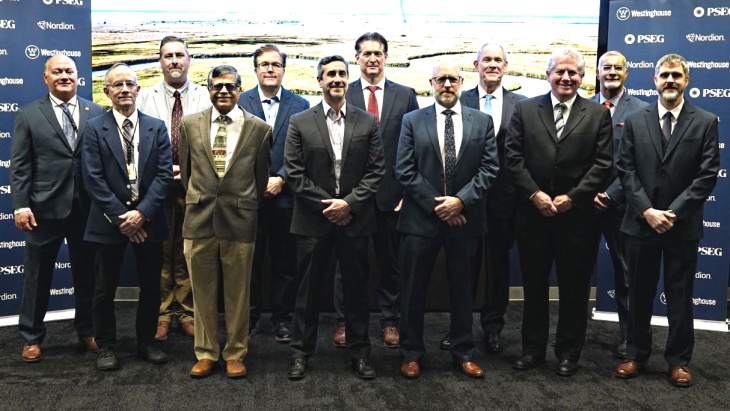
The three companies have entered into long-term agreements to implement newly developed cobalt-60 (Co-60) production technology for pressurised water reactors (PWRs) at units 1 and 2 of PSEG's Salem nuclear power plant in New Jersey, with Co-60 planned to be supplied to Nordion. They also announced that the US Nuclear Regulatory Commission (NRC) is reviewing PSEG's Licence Amendment Request. The partners are targeting implementation of the technology in 2026, subject to NRC authorisation and plant operating schedules.
"The successful implementation of this technology at Salem will lay the groundwork for broader deployment across the global PWR fleet, which makes up more than 70% of the world's commercial reactors, and will help anchor a scalable, resilient cobalt-60 supply network," Westinghouse said. "The first commercial-scale implementation of cobalt-60 production in PWRs signals a transformative step toward a secure, diversified domestic cobalt-60 supply."
Most of the world's supply of Co-60 is produced by irradiation of naturally occurring cobalt-59 in Candu reactors, mainly in Canada but also in Argentina, China and South Korea. It is also produced in RBMK reactors and the BN-800 fast neutron reactor in Russia.
Co-60 is used to sterilise around 40% of the world's single-use medical devices, including syringes, catheters, IV sets, surgical gloves and gauze used in a wide range of health care applications. It is also used in cancer treatment.
"Creating a robust domestic source of cobalt-60 builds on our longstanding ability to ensure reliability of supply for our customers," said Riaz Bandali, President of Nordion, a subsidiary of Sotera Health. "Our collaboration with Westinghouse and PSEG comes at a critical time as demand for cobalt-60 is increasing while accelerator-based irradiation technology is facing significant challenges in deployment and adoption."
"PSEG is proud to participate in a project that highlights the versatility and value of nuclear energy," said Charles McFeaters, President and Chief Nuclear Officer at PSEG Nuclear. "Producing cobalt-60 at the Salem nuclear generating station while providing safe, reliable, carbon-free electricity showcases innovative opportunities for nuclear energy and an important new role in strengthening global healthcare."
Sophie Lemaire, interim co-president of Westinghouse Nuclear Fuel, added: "Deploying cobalt-60 production technology into pressurised water reactors marks a significant milestone, extending cobalt-60 production to a new reactor platform for the first time. This advancement strengthens global supply and demonstrates how commercial nuclear energy can support critical healthcare infrastructure."
EDF and Framatome announced in November last year the launch of a feasibility study aimed at producing cobalt-60 in one of EDF's nuclear reactors. The companies plan to insert capsules containing cobalt-59 in a PWR in France. Framatome will manufacture the specialised irradiation devices at its European facilities. A first loading of demonstration capsules is scheduled for 2026, with the goal of validating technical feasibility before 2030.
In December 2021, Framatome signed a memorandum of understanding with US utility Exelon Generation to cooperate on technology development and assess the feasibility and economics of Co-60 production in PWR reactors. Earlier in 2021, Westinghouse and EDF signed an MoU on the production of Co-60 in selected PWRs owned and operated by EDF in France.
NextEra considering new nuclear capacity
_13505.jpg)
Speaking during a call with investors on Tuesday, NextEra CEO John Ketchum said its NextEra Energy Resources subsidiary "remains focused on both optimising and adding generating capacity to its nuclear fleet. We continue to advance the recommissioning of our Duane Arnold nuclear plant in Iowa, made possible by the 25-year power purchase agreement with Google we announced last year. Our nuclear fleet outside Florida is also ripe for advanced nuclear development.
"That's why we are spending time closely evaluating the capabilities of various SMR OEMs. All told, we have 6 gigawatts of SMR co-location opportunities at our nuclear sites and are working to develop new greenfield sites. Of course, any nuclear new build would have to include the right commercial terms and conditions with appropriate risk-sharing mechanisms that limit our ultimate exposure."
NextEra Energy Resources, along with its affiliate company Florida Power & Light Company, operates seven nuclear units at four sites: Turkey Point and St Lucie in Florida; Seabrook in New Hampshire; and Point Beach in Wisconsin. Additionally, it plans to restart the Duane Arnold plant in Iowa, which ceased operations in 2020. The plant is scheduled to become operational at the beginning of 2029, pending regulatory approvals.
In October last year, NextEra Energy signed two agreements with Google, including a 25-year purchase power agreement (PPA) from the Duane Arnold plant, as well as agreeing to explore the development of new nuclear generation to be deployed in the USA.
NextEra announced in December an expansion of its collaboration with Google Cloud. Together, the companies plan to jointly develop multiple new gigawatt-scale data centre campuses with accompanying generation and capacity. According to NextEra, the companies are already in the process of developing their first three campuses and are working to identify additional locations. Also in December, NextEra announced it had reached about 2.5 GW of clean energy contracts with Meta through the signing of 11 PPAs, mainly from nine solar projects.
"Our breadth and depth allow us to have a multi-year, multi-gigawatt, multi-technology discussion with hyperscalers," Ketchum said. "These data centre hub opportunities, as we call them, represent a powerful channel to originate large generation projects with expansion opportunities where we can grow alongside our hyperscaler partner rather than building on a project-by-project basis.
"As we discussed in December, our data centre hub strategy is all part of our new '15 by 35' origination channel and goal for Energy Resources to
place in service 15 gigawatts of new generation for data centre hubs by 2035."
He added: "We currently have 20 potential hubs we are discussing with the market, and we expect that number to rise to 40 by year end. While we won't convert every single hub, I'll be disappointed if we don't double our goal and deliver at least 30 gigawatts through this channel by 2035."
PEJ signs first loan agreement with US export credit agency
_53504.jpg)
The agreement was concluded as part of the US Export-Import Bank's (US EXIM's) Engineering Multiplier Program (EMP), which aims to finance preparatory and engineering works for projects carried out with the participation of US companies. The loan will increase Polskie Elektrownie Jądrowe's (PEJ's) liquidity by enabling it to refinance part of the works previously performed by the Westinghouse-Bechtel Consortium under an Engineering Development Agreement.
The Engineering Multiplier Program covers financing for key works carried out prior to the commencement of the construction phase, including feasibility analyses and selected engineering and environmental services. It is intended for projects with high potential for generating further export orders from the US and supports the preparation of projects for subsequent stages of financing.
Negotiations with US EXIM were conducted with the support of specialised law firms. The agreement complies with OECD guidelines and is secured by PEJ assets. PEJ said the agreement in its current form fully covers the needs and risks of the nuclear project. Bank Pekao SA, acting as the facility agent, is also a party to the agreement.
"We are consistently moving from letters of intent to first agreements," said Marek Woszczyk, President of the Management Board of PEJ. "The agreement we signed with US EXIM is another example demonstrating the credibility of the Polish nuclear project. The formal inclusion of the US export credit agency in the project also opens the way for us to sign further financing agreements with international institutions."
"This agreement demonstrates EXIM's commitment to unleashing US energy molecules and technologies to every corner of the globe," said US EXIM Acting First Vice President and Vice Chairman Jim Burrows. "By financing US technical expertise for Poland's nuclear development, we're supporting American jobs and proving that American innovation leads in the industries of the future."
"The conclusion of the loan agreement is the next stage in PEJ's cooperation with US EXIM, following the previously issued letter of intent for USD17.8 billion, confirming the US agency’s real commitment to the delivery of the project of Poland’s first nuclear power plant," PEJ said. "The current agreement is operational in nature and confirms US EXIM's readiness to continue supporting the project in its subsequent phases."
To date, PEJ has signed letters of intent with 11 export credit agencies from Europe, North America, and Asia, worth more than PLN100 billion (USD28 billion). The financing structure for the nuclear power plant project in the Choczewo commune assumes that debt financing will account for 70% of the investment cost, with the remainder secured with funds from the state budget.
In November 2022, the then Polish government selected Westinghouse AP1000 reactor technology for construction at the Lubiatowo-Kopalino site in the Choczewo municipality in Pomerania in northern Poland. In September 2023, Westinghouse, Bechtel and PEJ - a special-purpose vehicle 100% owned by Poland's State Treasury - signed an 18-month engineering services contract under which Westinghouse and Bechtel will finalise a site-specific design for a plant featuring three AP1000 reactors. In April last year, PEJ and the Westinghouse-Bechtel Consortium agreed the terms and conditions of an Engineering Development Agreement (EDA) after the previous agreement expired.
On 29 December, PEJ announced it had signed an amendment to the EDA with the Westinghouse-Bechtel Consortium. The amended scope of the agreement provides for the continuation of design works covering the nuclear island, turbine island, and the balance of plant, as well as further in-depth geological survey campaigns. This, it said, allows it to maintain the project schedule by advancing the power plant design and continuing field works, while simultaneously conducting negotiations and finalising the Engineering, Procurement, and Construction (EPC) contract, "which will ultimately determine our cooperation with the Westinghouse-Bechtel Consortium".
The Polish government intends to support this investment through: an equity injection of about EUR14 billion covering 30% of the project's costs; state guarantees covering 100% of debt taken by PEJ to finance the investment project; and a two-way contract for difference (CfD) providing revenue stability over the entire lifetime of the power plant of 60 years.
The aim is for Poland's first AP1000 reactor to enter commercial operation in 2033.
KHNP seeks site for new nuclear power plant
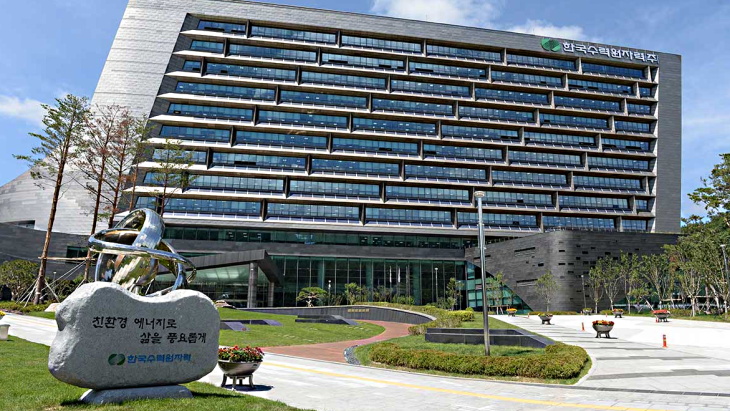
"The bid for the new nuclear power plant candidate site will be promoted through a local government-led initiative," Korea Hydro & Nuclear Power (KHNP) said.
Heads of local government have until 30 March to submit applications to host the planned reactors, which will have a combined generating capacity of 2.8 GWe.
KHNP said it has "established a site selection committee comprised of external experts to ensure fair and objective site selection". It added: "We plan to select a new nuclear power plant candidate site through a comprehensive evaluation."
Under the current plan, KHNP will select the plant site by 2027. This will be followed by a site evaluation and selection process lasting about five to six months, with the goal of obtaining a construction permit in the early 2030s and completion of the reactors in 2037 and 2038.
On 26 January, Minister of Climate, Energy and Environment Kim Sung-hwan confirmed that South Korea still plans to construct two new large nuclear power reactors by 2038, in line with its 11th Basic Plan for Electricity Supply and Demand.
The Basic Power Supply and Demand Plan contains domestic power generation facility plans for the next 15 years. It is updated by the Ministry of Trade, Industry and Energy every two years. A draft of the 11th Basic Plan - which covers 2024 to 2038 - was released in May 2024 and presented to a plenary session of the National Assembly by the Ministry of Trade, Industry and Energy on 19 February last year. It was approved by the National Assembly's Power Policy Review Committee on 21 February 2025. The plan calls for two new large nuclear power reactors with a combined capacity of 2.8 GWe and 700 MW of small modular reactor capacity to be built by 2038 - in addition to the large reactors already under construction or planned.
Since the minister's announcement, a number of cities and towns - including the southeastern cities of Busan and Ulsan - have reportedly shown interest in hosting the new nuclear reactors, Yonhap reported.
Russia and Uzbekistan MoU on radioactive waste management
Having a radioactive waste management system is part of the development in Uzbekistan of a nuclear energy sector - Russia's Rosatom is in the process of a project to build a plant featuring small modular reactors and two large units in the country.
Eduard Nikitin, Director of the Decommissioning of Nuclear and Radiation-Hazardous Facilities and Radioactive Waste Management Unit at TVEL, which is Rosatom's fuel division, said that as part of the Commonwealth of Independent States Framework Organisation, it was "actively working to foster cooperation between states on radioactive waste management. Joint seminars, training sessions, and technical tours of nuclear facilities are regularly held. This type of work helps formulate common principles for the safe management of radioactive waste and the decommissioning of radiation-hazardous facilities".
According to Rosatom the memorandum of understanding (MoU) will see them drawing on their "experience and expertise, to provide expert support in developing a national radioactive waste management system and training relevant specialists. The document also provides for the exchange of advanced technical and scientific practices in the field of radioactive waste management and nuclear power plant decommissioning".
It said the development of a radioactive waste management system "requires comprehensive preparatory work, including improving the regulatory framework in accordance with international requirements and safety standards".
A cooperation process along the same lines has also taken place in Belarus, where an organisation similar to Russia's National Operator for Radioactive Waste Management was established, and in November TVEL signed a similar MoU with the National Nuclear Centre of Kazakhstan "aimed at cooperation in the field of nuclear backend and the development of a national radioactive waste management system".
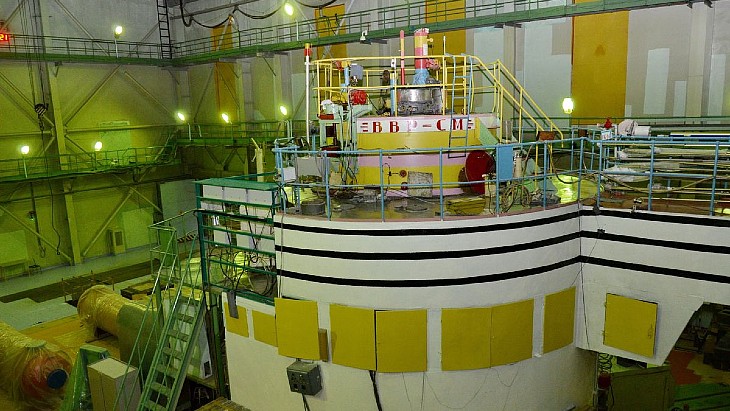
Although Uzbekistan is embarking on its first nuclear power reactors, it has considerable nuclear technology experience. It is the world's fifth-largest uranium supplier and there have also been two research reactors, a 10 MW tank type - WWR-SM - operating since 1959 at the Institute of Nuclear Physics, Uzbek Academy of Sciences near Tashkent, and a small 20 kW one operated by JSC Foton in Tashkent. According to World Nuclear Association information, decommissioning of the Foton reactor was undertaken over 2015-17. The larger WWR-SM shut down in July 2016, with decommissioning intended to begin soon after. However, in February 2017 it was decided to refurbish it, and it was restarted in July 2017.
First concrete for Uzbekistan SMR 'well before December'
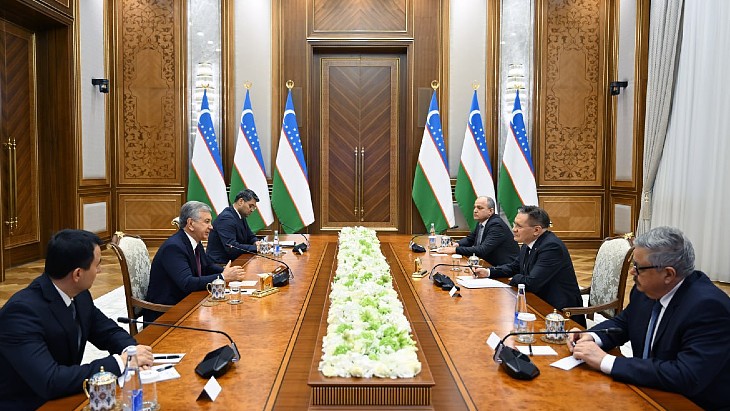
According to the president's news service the two also talked about "expanding cooperation in the peaceful use of nuclear energy", in areas such as agriculture and medicine.
First concrete for the first small modular reactor had been expected to be poured in the spring, but a draft government document published last week mentioned December 2026.
That led to the Uzatom Agency publishing a clarification on Monday saying: "We would like to emphasise that the previously announced targets remain in effect, and there is no discussion of any postponement. The date indicated in the draft reflects a conservative scenario, which envisages the completion of all numerous mandatory preparatory and licensing stages by this date."
Following the talks on Tuesday, Likhachev said: "We are moving forward at a rapid pace and fully on schedule. Work on site is proceeding actively ... this year's main goal is to begin pouring concrete for the foundation slab of the nuclear island buildings. Given the importance of meeting deadlines, we aim to begin concrete preparation work this spring."
In a subsequent interview with Russia’s Rossiya-24 television channel, as reported by the official Tass news agency, he said: "I think we will pour the first concrete … much earlier than December. Our speed will depend on the customer … this is a regulated event implying receipt of certain licences, permits, qualifications, including for local manufacturers. Nevertheless, our plans are to make it much earlier than December."
Background
A contract signed in May 2024, during a visit to the country by Russian President Vladimir Putin, was for the construction of a 330 MW capacity nuclear power plant featuring six units of the RITM-200N water-cooled small modular reactor (SMR), which is adapted from nuclear-powered icebreakers' technology, with thermal power of 190 MW or 55 MWe and with an intended service life of 60 years. The first unit was scheduled to go critical in late 2029 with units commissioned one by one.
It was the first export order for Russia's SMR. The first land-based version is currently being built in Yakut in Russia, with the launch of the first unit scheduled to take place in 2027.
An agreement signed at the end of September 2025 during World Atomic Week in Moscow multiplied the capacity of what had previously been proposed, with the plant plan switched to feature two large units - VVER-1000s with an output each of 1 GW - plus two 55 MW RITM-200N SMRs.
Excavation work began in October for the pit for the first of the SMRs at the site in the Jizzakh region. About 1.5 million cubic metres of soil will be excavated during the digging of a pit 13 metres deep for the RITM-200N, with engineering surveys and design and preparatory works also under way. Once completed, the new plant will provide for around 14% of Uzbekistan's electricity demands.
Steam generator removal begins at German plant
_87975.jpg)
The first steam generator - measuring 20 metres in height and weighing 365 tonnes - was detached from its installation position inside the reactor building on 20 January, gradually lifted, tilted and rotated several times, before finally being placed in front of the new controlled area barrier.
Planning for the project at the Grafenrheinfeld plant began as early as 2021. Several structural modifications to the plant's reactor building were necessary for the lifting and unloading of the components.
_e5dac76a.jpg)
(Image: Johannes Kiefer / PreussenElektra)
"This task demanded the utmost precision and impressive engineering," said project manager Burghard Lindner. "Thanks to months of preparation, the actual lifting operation was carried out smoothly in approximately 9 hours. Our experienced partners Framatome and Mammoet, who had already removed the four steam generators at the Unterweser nuclear power plant, also mastered this challenge at the Grafenrheinfeld plant."
The component will be moved out of the controlled area and then made ready for transport on the power plant grounds. The removal of the remaining three steam generators will follow. The plan is to move the last of the four steam generators out and place it on the site by the end of February.
In spring 2027, the four steam generators will be shipped to Cyclife in Sweden, dismantled on site, and then partially melted down. Cyclife, a subsidiary of France's EDF, specialises in the decommissioning of nuclear power plants and waste management. In 2021, the company was awarded the contract by PreussenElektra for the dismantling and disposal of a total of 12 steam generators from the Unterweser, Grafenrheinfeld, and Grohnde nuclear power plants.
.jpg_0b437a46.jpg)
(Image: Johannes Kiefer / PreussenElektra)
Steam generators are the heat exchangers in pressurised water reactors (PWRs), producing the steam that turns the turbines to generate the electrical energy in the generator. PreussenElektra said the dismantling and disposal of the steam generators is one of the key projects in the dismantling of its PWRs and will take more than a decade.
The 1275 MWe (net) PWR at Grafenrheinfeld achieved first criticality in December 1981 and was connected to the grid in the same month. It entered commercial operation in June 1982.
In August 2011, the 13th amendment of the Nuclear Power Act came into effect, which underlined the political will to phase out nuclear power in Germany. As a result, eight units were closed down immediately: EnBW’s Phillipsburg 1 and Neckarwestheim 1; EOn's Isar 1 and Unterweser; RWE's Biblis A and B and Vattenfall's Brunsbüttel and Krümmel. As part of the 13th amendment to Germany's Nuclear Power Act, Grafenrheinfeld lost its authorisation for power operation and was finally shut down on 27 June 2015.
PreussenElektra applied for the decommissioning and first dismantling permit for Grafenrheinfeld in 2014 and received it in 2018. In this first approval procedure, the company described in detail the concept for the entire dismantling of the system and the measures planned for this. PreussenElektra split the application for the individual dismantling scopes into two steps. The dismantling of the plant began in April 2018 with the granting of the decommissioning and dismantling permit. The second dismantling permit, which was granted in December 2022, for which the application was submitted in December 2019, includes the dismantling of the reactor pressure vessel and the biological shield surrounding it.
Stellaria seeks permission to build experimental reactor
_35731.jpg)
The company - a start-up spun out of the French Alternative Energies & Atomic Energy Commission and Schneider Electric - submitted its application for the creation authorisation decree (DAC) for its Basic Nuclear Installation (INB) Alpha to the French minister in charge of nuclear safety on 19 December.
The application concerns the siting and construction of its 100 kW Alvin experimental reactor, scheduled to start up in 2030, in order to launch the test programme that will definitively validate the concept.
The application comprises around 15 documents totalling more than 1,000 pages. It includes: the safety case, including a detailed description of the installation, the safety principles adopted, the analysis of incidents and accidents, including severe accidents, the management of external hazards (earthquakes, flooding, aircraft crashes), as well as radiation protection for workers, the public, and the environment; the environmental impact assessment of the installation; the conditions planned for decommissioning the installation at the end of its lifetime; a presentation of the operator's technical and financial capabilities; and all technical documents describing the installation in depth, which are essential for the review of the application.
"This new milestone represents a crucial step in the development of the French company and in the implementation of its Stellarium reactor, as it sets out the main principles of the project and officially elevates the start-up to the status of a nuclear operator," Stellaria said. "To date, Stellaria is the first company to have filed such an application with the authorities in the French fast-neutron nuclear market, and the second among the eleven French start-ups working on the development of SMRs or AMRs, after Jimmy Energy."
The Stellarium reactor proposed by Stellaria will be very compact (measuring 4 cubic metres) and will be able to use a diversified range of nuclear fuels (uranium, plutonium, mixed-oxide, minor actinides, even thorium). Stellaria says the reactor is "the world's first reactor to operate with a liquid fuel capable of destroying more waste than it produces".
Once Alvin has validated Stellaria's concept, the company plans to build a 10 MWe prototype reactor, MegAlvin.
"2025 marked a turning point for Stellaria," said Nicolas Breyton, President of Stellaria. "After a structured fundraising round, followed by the signing of a first power pre-order agreement for our reactors with Equinix, the global leader in data centres, the submission of the DAC allows us to reach a new milestone. This step is decisive for Stellaria, as it validates the work carried out so far by its teams and partners, and fully commits the company to its responsibilities as a nuclear operator. By filing this application, Stellaria moves beyond the concept stage and enters a structuring regulatory phase, in which its fundamental choices are now set."
Molten salt reactors (MSRs) use molten fluoride salts as primary coolant, at low pressure. They may operate with epithermal or fast neutron spectrums, and with a variety of fuels. Much of the interest today in reviving the MSR concept relates to using thorium (to breed fissile uranium-233), where an initial source of fissile material such as plutonium-239 needs to be provided. There are a number of different MSR design concepts, and a number of interesting challenges in the commercia
Zhangzhou 3's steam generators lifted into place
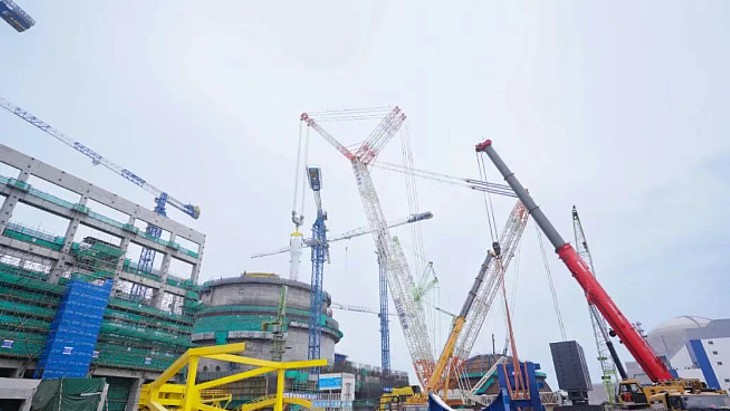
China's Ministry of Ecology and Environment issued construction licences for Zhangzhou units 1 and 2 on 9 October 2019 to CNNC-Guodian Zhangzhou Energy Company, the owner of the Zhangzhou nuclear power project, which was created by CNNC (51%) and China Guodian Corporation (49%) in 2011.
Construction of Zhangzhou 1 began in October 2019, with that of unit 2 starting in September 2020. Unit 1 entered commercial operation on 1 January 2025 while unit 2 entered commercial operation on 1 January 2026.
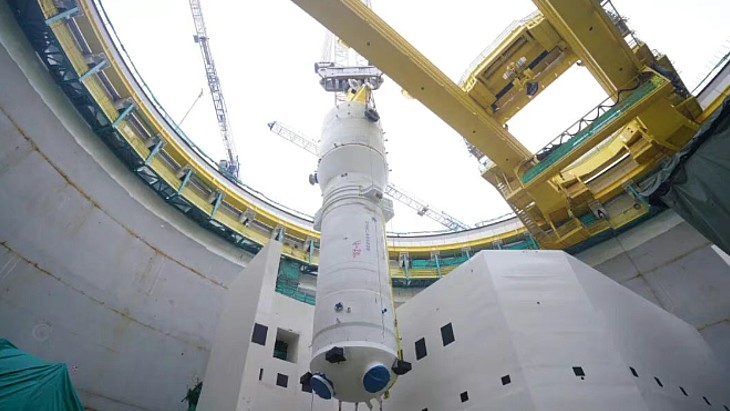
(Image: CNNC)
The installation of the steam generators, which benefited from the construction experience gained from the first phase of the project, was said to have laid "a solid foundation for the subsequent dome hoisting and main pipeline welding".
In September 2022, China's State Council approved the construction of two Hualong One units as Phase II - units 3 and 4 - of the Zhangzhou plant. Construction of unit 3 began in February 2024, with that of unit 4 starting in September.
There are proposals for two more units at the plant. Once fully completed, a six-unit Zhangzhou plant would provide more than 60 billion kilowatt-hours of clean energy annually, estimated to meet 75% of the total electricity consumption of Xiamen and Zhangzhou cities in southern Fujian.lisation of many, especially with thorium

_32451.jpg)
_15069.jpg)